

JOBS POLICIES, ANALYSIS, AND RESOURCES
Latest Jobs Posts
Suggestions for Teaching About January 6th
Brief #65 – Education
By Lynn Waldsmith
As the House committee investigating the January 6th attack on the Capitol gains momentum, teachers throughout the country are struggling more than one year later with how, or even if, to teach students about that pivotal event and its impact on our democracy.
Electric Vehicles and a Collision Course with Public Lands Management
Brief #133 – Environmental Policy
By Timothy T. Loftus
The race to electrify the transportation sector, now the largest contributor of greenhouse gas emissions in the US, will entail controversial decisions and tradeoffs involving the use and management of America’s public lands.
Ukraine: Back In The USSR?
Brief #141 – Foreign Policy
By Reilly Fitzgerald
Ukraine poses a threat in some ways to the stability of the borders around Russia as they have long sought entrance to the European Union and have also sought NATO membership. Russia sees these actions as threatening because it would bring Russia closer to the military alliances of the West that they have rejected since the days of the USSR.
Update on US-Russian Diplomatic Talks on Ukraine Crisis
Brief #140 – Foreign Policy
By Abran C
On January 10, 2022, US, its NATO allies and Russian officials began a week of talks in Vienna and other European cities in an attempt to de-escalate the rising tensions on the Ukrainian border. The meetings ended without any breakthrough and did not succeed in their key objective: removing the immediate threat of tens of thousands of Russian troops stationed at the Ukrainian border.
The Need for a Federal Statute To Combat Domestic Terrorism
Brief #180 – Civil Rights
By Rodney A. Maggay
On January 11, 2022 Assistant Attorney General Matthew G. Olsen testified before the Senate Judiciary Committee that he has decided to create a new specialized domestic terrorism unit “to augment our existing approach” and “to ensure that these cases are properly handled and effectively coordinated” across the country. Previously, the Department of Justice (DOJ) and the National Security Division (NSD) did not have a group or unit dedicated to only domestic terrorism cases.
Students Abandon Class and Demand Remote Learning During COVID Spike
Brief #64 – Education Policy
By Yelena Korshunov
“Is my child safe in school?” This is a question that millions of parents ask themselves today. Remote learning vs. in-person. In-person vs. remote. Multiple pros and cons, dipped in wordy discussions without being resolved, challenge students and their parents to solve this dilemma on their own. On Monday, January 10th, the New York City Department of Education reported 11,825 students and 2,298 staff COVID cases.
The Future of Warfare
Brief #139 – Foreign Policy
By Brandon Mooney
With the War in Afghanistan having come to an end and the neoliberal experiment of nation-building being tossed on the metaphorical scrap heap, the U.S. confronts a radically changing world in which traditional conceptions of warfare are both antiquated and ultimately disastrous.
Critical Race Theory a Critical Pedagogical and Political Issue
Brief #63 – Education Policy
By Stephen Thomas
Years ago, segregationists relied on the states to pass laws to exclude black students from their children’s schools. Today, their objective is to exclude blacks from the social studies curriculum. Either way, it is a movement centered on the debate about a crucial campaign issue that arose in the Virginia governor’s race and will rise again in the congressional mid-term elections and in state-level elections in 2022.
LGTBQ Nondiscrimination Policies Used to Mask Indecent Exposure Case
Brief #126 – Health Policy
By April Straughters
The conversation about nondiscrimination laws protecting the LGBTQ community in public spaces recently became more complicated after a transgender woman was charged with five felony counts for indecent exposure after reportedly exposing herself at a popular Korean spa in Los Angeles.


SCOTUS Refuses to Ban the Texas Abortion Law
SCOTUS Refuses to Ban the Texas Abortion Law
Health & Gender Policy Brief # 128 | By: S Bhimji | September 3, 2021
Header photo taken from: Forbes
Follow us on our social media platforms above
Browse more health & gender policy briefs here

Photo taken from: Times of Malta
Policy Summary
[SSB theme=”Official” align=”center” counter=”true” ]
The topic of abortion has always been a contentious issue in the USA. In a recent Gallup poll that asked participants about the legality of abortion, 46% described themselves are pro-choice and 49% as pro-life. So no matter what decision the state or federal government makes, a significant number of people are going to be disappointed.
Just a few days ago, the US Supreme Court voted 6-3 and refused to block a Texas law that bans most abortions. And what this has done is essentially shut down the rights of most women seeking an abortion in the Lone Star state. This law will shut down close to 90% of all abortions in the State.
The Texas law was signed in May 2021 by Governor Greg Abbot and prohibited abortions once the fetus is found to have a ‘heart-beat’- which is usually around 6 weeks – a time before most women do not even know they are pregnant.
The Texas abortion law is the strictest in the country and is part of a wider push by the Republican party. At least a dozen more states have enacted similar abortion bans but they are all facing legal challenges.
Policy Analysis
Texas has always had some of the nation’s strictest abortion laws, which have led to the closure of most abortion clinics in the state.
Even though at least a dozen other states have enacted similar ‘heart-beat’ abortion bans, they have been blocked by the courts. But the Texas case was somewhat unique- it was intentionally structured to protect government officials from enforcement, thus making future legal challenges more laborious to secure. Instead, the Texas law offers an incentive to all US citizens to file a civil suit against any healthcare provider, clinic, or anyone who assists with the procedure.
Individual American citizens have been offered cash bounties of at least $10K if they bring a successful civil lawsuit against abortion clinics, doctors, and women seeking an abortion after the 6th week of pregnancy.
Since the Supreme Court decision, the Texas abortion law went into immediate effect and has practically shut down the majority of abortion clinics in the state. Most pregnant women will not be able to access abortion care from now on.
Planned Parenthood and many abortion healthcare providers have opted to discontinue operating abortion clinics in Texas to avoid unnecessary and expensive civil litigation.

Photo taken from: Buzz.ie
Because the law provides incentives to private citizens to file civil suits against abortion clinics and providers, this has caused significant alarm in the medical community, who feel that citizen enforcement would be similar to legal vigilantism. And the fear among the pro-choice supporters and healthcare providers is that other states may also structure their abortion laws to Texas.
There is no question that the Texas abortion law has created chaos and people who really need access to abortion will be the ones to suffer.
President Biden was aghast at the Supreme Court decision and reiterated the White House’s support for Pro-Choice groups. Said President Biden, “This extreme Texas law blatantly violates the constitutional right established under Roe v Wade and upheld as a precedent for nearly half a century.”
As it stands, the Texas law will most likely affect the most vulnerable demographics in the community: the Latinos and African Americans, who also lack the financial means to seek an abortion out of state. Legal experts are now weighing their options and determining how to challenge the Texas Abortion Law.
Engagement Resources
Click or tap on image to visit resource website.

Gov. Greg Abbott signs into law one of the nation’s strictest abortion measures, banning procedure as early as six weeks into a pregnancy
https://www.texastribune.org/2021/05/18/texas-heartbeat-bill-abortions-law/

What The Texas Abortion Ban Does — And What It Means For Other States
https://www.npr.org/2021/09/01/1033202132/texas-abortion-ban-what-happens-next

Supreme Court declines to block Texas abortion law that bans procedure at six weeks
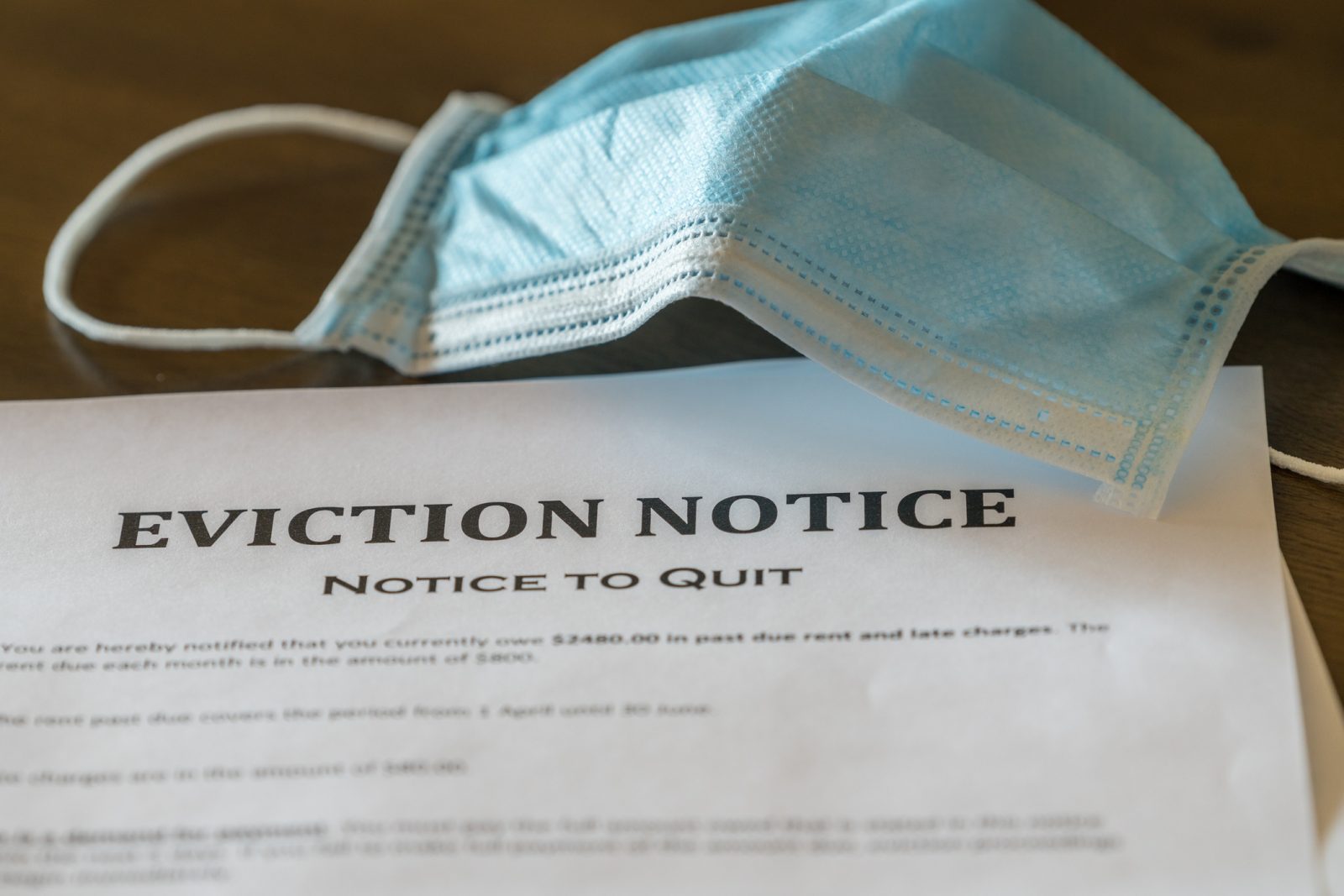
Supreme Court Overrules CDC on Issue of Eviction Moratoriums
Supreme Court Overrules CDC on Issue of Eviction Moratoriums
Health and Gender Policy Brief # 127 | By: S. Bhimji | September 1, 2021
Header photo taken from: The Progressive Pulse – NC Policy Watch
Follow us on our social media platforms above
Browse more health & gender policy briefs here

Photo taken from: WBFF
Policy Summary
[SSB theme=”Official” align=”center” counter=”true” ]
During the 2020 Covid pandemic millions of people lost their jobs and hundreds of thousands of businesses had to close; this led to a fear that if tenants did not pay their rent, mass evictions would follow. By Sept 2020, there were close to 22 million renters at risk for eviction and a separate census in July 2021 indicated that at least 7 million households had difficulty paying rent and were at risk for eviction.
The Federal Cares Act did include an eviction moratorium for all federally backed rental property but this expired in July 2020. This was followed by many states passing a broad range of temporary eviction moratoriums but as these moratoriums expired, there was again fear of mass evictions.
On Sept 4, 2020, the CDC issued a Temporary Halt in Residential Evictions to prevent the further spread of Covid 19. Then again on Aug 3, 2021, the CDC issued a new eviction moratorium in areas of high transmission of Covid 19. For most renters, it was an early Christmas gift that has already lasted for over a year.
Despite many of the residential renters also getting other state and federal assistance, a significant number did not pay rent- and the landlords suffered enormously. Over the past 12 months, there have been countless reports of landlords not being able to pay their utilities and mortgages because they had lost rental income. For much of this year, landlords have pleaded with their state governments to rescind the ban on residential evictions but met with no success.
Policy Analysis
Finally, on Aug 27, 2021, the US Supreme Court opened the floodgates for mass evictions in the US. For landlords, this news was most welcoming. Many tenants had shown no responsibility or obligation to their landlords. They were fully aware that federal law prevented them from being evicted and there was nothing a landlord could do.
Well, the renters better start packing and call the moving trucks; there will soon be a tsunami of evictions in many states.
The CDC had released a moratorium on banning evictions in counties with high levels of Covid 19 just recently but the US Supreme Court (SCOTUS) was not having any of that. By a vote of 6-3, SCOTUS struck down the U.S. Centers for Disease Control and Prevention’s (CDC) federal eviction moratorium.
What this means is that the CDC’s moratorium is ineffective, unenforceable, and not legal. It is important to note that this recent SCOTUS ruling only applies to the CDC’s federal eviction order, it does not affect any moratorium imposed by local counties or the state.
The Supreme Court did not weigh in on the policy of eviction moratorium or whether it was a good idea or a good policy for the nation. Instead, SCOTUS ruled, “that the statute on which the CDC relies does not grant it the authority it claims.” What that means in simple English is that the CDC did not have the legal power to impose the moratorium- that job belongs to Congress.

Photo taken from: Daily Mail
Without approval from Congress, the CDC cannot impose any federal moratorium as it lacks legal power. According to SCOTUS, “our system does not permit agencies to act unlawfully even in pursuit of desirable ends.”
So what does this mean for the landlords? There are at least 10-18 million tenants at risk for eviction and with this Supreme Court ruling, the landlords who have been waiting a long time are no doubt already at the lawyer’s office to initiate the evictions.
So will Congress impose its own eviction moratorium? Most likely not. With all the havoc in Afghanistan and the deadly flooding in Louisiana, the nation has many other priorities. Even if there is time and opportunity, the divided senate just can’t get anything done.
Most likely The Supreme Court will leave the decision on eviction moratorium to the individual states because the landlord-tenant relationship falls under the domain of state law.
For tenants; they have two choices, pay back what they owe the landlord ASAP or start looking for another place to stay.
Engagement Resources
Click or tap on image to visit resource website.

SCOTUS:
https://www.supremecourt.gov/opinions/20pdf/21a23_ap6c.pdf

Supreme Court Strikes Down CDC Eviction Moratorium

Protection for struggling tenants ends as the Supreme Court voids CDC eviction moratorium.

What Have We Learned from Posting Police in Schools?
What Have We Learned from Posting Police in Schools?
Health & Gender Policy Brief # 126 | By: S Bhimji | August 27, 2021
Header photo taken from: Harvard Civil Rights-Civil Liberties Law Review
Follow us on our social media platforms above
Browse more health & gender policy briefs here

Photo taken from: Getty Images
Policy Summary
[SSB theme=”Official” align=”center” counter=”true” ]
While much of the interest these days has been on the Covid-19 infections, with schools about to open, another topic also of great interest is the over-policing of schools. There are some who argue that we are over-policing the schools and that instead of having more police, we may be better off having more support staff and mental health therapists on board.
It is important to understand that policing of schools first started in response to the national epidemic of violence, crime shootings, bullying, and vandalism. Policing schools is not a new endeavor; it has been going on for more than half a century. The program is funded by federal dollars.
Fifty years ago, only 1% of schools had police officers on-site, but by 2018, approximately 58% of schools had at least one sworn law enforcement official present during the school week. All this changed with the school shootings in the 1990s; state and federal legislation stimulated the presence of more cops in schools.
Despite the increase in policing, in just the past 6 months of this year, there have been 79 shootings in US schools. The highest number of school shootings occurred in 2019 with 118 shootings. But the presence of cops in schools has not been positive; there are dozens of documented incidents over the past ten years where a security officer has pepper sprayers, tasered, or used excessive force on a student.
And in the wake of the daylight killing of George Floyd by a policeman, some school districts are wondering if there should be police officers in schools?
Policy Analysis
The few studies on whether police make schools safer show that some schools with more police tend to have higher rates of student suspension rates and arrests. But none of these studies state what the original cause of police involvement was and whether the police were the cause.
However, that is not to say the policing is completely bad for schools; two large studies did show that police make schools safer and that there are reduced rates of criminal incidents.
However, one obvious undeniable trend revealed from the studies show that policing of schools impacts African American students more than all other students. For the past 20 years, these studies show that since policing started African Americans are arrested more frequently and suspended more often from schools than other students.
Hence, some school districts have already cut their contracts with the local police department insisting that instead of police the students should be greeted with school nurses, support staff, and mental health counselors.
However, this type of thinking is not universal among all US schools. Mayors in New York City and Chicago say that law enforcement does have an important role in maintaining student safety and order. Security is still needed because the student of today is more aggressive, often carries weapons, regularly becomes violent and often fails to obey teachers.

Photo taken from: Getty Images
At the same time, surveys of schools reveal that most non-black students favor police but the same sentiments are not true among black students who are more likely to be arrested in school.
Extra policing does offer safety for the vast majority of students and staff but at the same time it also increases the risk that some students who continue to engage in harmful and disruptive behavior will formally come into contact with security staff, instead of the principal; and when this happens the outcomes sometimes are undesirable.
While the initial intention of having to police schools was considered to be a good idea, the tide has turned to the extreme. It appears that there are anti-police sentiments in some schools because of an aggressive approach towards black students.
In the end, there is no real answer to this dilemma. Some facts are undeniable. The police are not the cause of school violence and crime; most surveys indicate that they are welcome and offer safety. The other fact is that many blacks do not feel the same and their interactions with police have often been negative. One solution is to remove police from predominantly black schools.

Photo taken from: The Conversation
But the most important fact that is being missed by everyone is what is causing these students to misbehave and commit violence? The police are just playing an intermediary role and until the root causes of problematic behavior in schools are addressed, over-policing is unlikely to discontinue.
Parents need to get involved and start educating their children on appropriate behavior; if the students behave, there will not be any police involvement!!! At the same time, police should make an effort to change the negative perception that has been created and regain trust among students.
Engagement Resources
Click or tap on image to visit resource website.

BULLIES IN BLUE: THE PROBLEM WITH SCHOOL POLICING
Why There’s A Push To Get Police Out Of Schools
https://www.npr.org/2020/06/23/881608999/why-theres-a-push-to-get-police-out-of-schools

A better path forward for criminal justice: Reconsidering police in schools

Taliban Takeover: The US’s Moral Obligation to Provide Refuge
Taliban Takeover: The US’s Moral Obligation to Provide Refuge
Immigration Policy Brief # 128 | By: Kathryn Baron | August 24, 2021
Header photo taken from: WBUR
Follow us on our social media platforms above
Browse more immigration policy briefs here

Photo taken from: Taiwan News
Policy Summary
[SSB theme=”Official” align=”center” counter=”true” ]
As the Taliban rapidly took over Afghanistan amidst US withdrawal, the Biden Administration has vowed to help Afghans, targeting those who supported American military and diplomatic efforts, obtain Special Immigration Visas (SIVs). Approximately 550,000 Afghans are internally displaced and 18.4 million currently require humanitarian assistance in some capacity – women and children are among the majority of individuals immediately effected. Throughout the 20-year US involvement in Afghanistan, the US has allegedly resettled over 75,000 Afghans and their families through the SIV program and plan to continue.
Since August 14, the US has evacuated around 25,000 individuals and will likely need to assist in the evacuation of around 60,000 more. Secretary of Defense, Lloyd Austin, authorized Fort Bliss (TX) and Fort McCoy (WI) to provide temporary housing and support for up to 22,000 SIV applicants and their families. The SIV program is mainly for interpretors and individuals who directly assisted the US military, but will soon expand to those who worked for US government-funded programs, nonprofits, and media.
Immigration experts estimate nearly 100,000 individuals may be eligible for resettlement. For Afghans specifically, the existing SIV program is already backlogged up to 18,000 applicants and since applications are examined on an individual basis, the number could really be closer to 80,000 if immediate family members are factored in. Around the world, 13 countries,in additeion to the U.S., have pledged to assist Afghans in their plight: Albania, Canada, Colombia, Costa Rica, Chile, Kosovo, North Macedonia, Mexico, Poland, Qatar, Rwanda, Ukraine, and Uganda.
Policy Analysis
Under the Universal Declaration of Human Rights (1948) and the Convention relating to the Status of Refugees (1951), refugees may seek asylum in foreign territories if they have a well-founded fear of persecution. Many immigration advocates believe the US has a moral obligation to the Afghan people and have theoretically had two decades to plan for this.
Some push for the US to establish an open-door Afghan refugee policy and that the military withdrawal from Afghanistan is not the extent of the US’s role. In addition, advocates have urged the US and its NATO allies to charter flights out of Kabul to the US and NATO members states. The president of Refugees International wrote a letter to the Biden Administration suggesting the US be willing and prepare for potentially resettling up to 200,000 Afghan refugees.
Engagement Resources
Click or tap on image to visit resource website.

- National Immigration Law Center: an organization that exclusively dedicates itself to defending and furthering the rights of low income immigrants and strives to educate decision makers on the impacts and effects of their policies on this overlooked part of the population.

- Miles 4 Migrants: A charity that accepts frequent flyer mile donations to help individuals impacted by war, persecution, and/or disaster by providing flights for refugees, asylum-seekers, and their immediate family members who have legal approval for travel but cannot afford it.

- Protect Afghan Women: A project affiliated by the Georgetown Institute for Women, Peace, and Security to focus on the role women play in preventing conflict and building peace, addressing global threats, and seeking to ensure Afghan women are free from persecution.

COVID-19 Conspiracies and U.S.-China Relations
COVID-19 Conspiracies and U.S.-China Relations
Foreign Policy Brief # 126 | By: Avery Roe | August 26, 2021
Header photo taken from: The Economic Times
Follow us on our social media platforms above
Browse more foreign policy briefs here

Photo taken from: Forsal
Policy Summary
[SSB theme=”Official” align=”center” counter=”true” ]
Recently the Chinese state media has been quoting Wilson Edwards, a Swiss biologist and whistleblower, stating that the United States had been politicizing the origins of the COVID-19 virus and pressuring scientists to keep the truth quiet. This was until the Swiss Embassy tweeted that Wilson Edwards does not exist and the Chinese media began removing the references. It quickly became clear that this was the most recent in a series of state-sponsored COVID-19 conspiracy theories coming out of China.
As far as scientists can tell, COVID-19 naturally jumped from humans to animals. However, American intelligence officials are genuinely split between that theory and the theory that it came from a lab leak in Wuhan. This became clear, and higher profile, when President Biden called for additional investigation, including the exploration of the possibility that COVID-19 came from a lab. This eroded the trust between the Americans and Chinese further and led to the Chinese increasing their efforts to publish more conspiracy theories blaming the United States.
The Chinese government has come up with a wide variety of stories, most recently centering around a lab leak out of Fort Detrick. These theories are gaining traction online, with many Chinese citizens beginning to refer to COVID-19 as the “U.S. Virus,” a reference to former President Trump referring to it as the “China Virus.” As these theories and blame get traction they are significantly hardening the relationship between American and Chinese leadership, at a time when China’s new ambassador to the United States is trying to present himself as amicable and reasonable in attempts to deepen relations.
Policy Analysis
While American politicians and media have understandably been focused on conspiracy theories based in America, the repercussions of the Chinese theories and their contrast with American theories could be long-lasting. Both the Americans and the Chinese need to work towards a balance in seeking the truth, with healthy skepticism, but also trust in the scientists to determine what truly happened. Throwing accusations that have little to no basis in science is not helping anyone or anything.
Battling a pandemic would be one of the best times for two of the world’s technological superpowers to be working together to get everyone to the other side of this. Unfortunately, with all of the accusations being leveled at one another this is not the case between the United States and China.
As the relationships between leaders have corroded the likelihood that they work together has declined. If both countries were to put their best minds together, there is no telling how positive the results could be in terms of COVID-19 treatments and prevention measures.


Photo taken from: The Wall Street Journal
This brings the tension to a global scale as everyone could benefit from a U.S.-China collaboration in research. While it would be unrealistic to expect a completely amicable relationship it is imperative that tensions cool enough so that the Americans and Chinese can work together to find a way out of this pandemic, without regard to how it started.
The truth has been altered and weaponized in both countries for nationalistic purposes. Creating concern as to what will happen going forward. When the truth cannot be agreed upon, or at least investigated collaboratively, the commonalities between sides in a conflict are much more difficult to find.
Leaving this as a precedent has the potential to allow future international conflict to become much more intense, and much more difficult to find a way out of, raising the importance even higher of the United States and China figuring out how to move forward together.
Photo taken from: Foreign Policy
Engagement Resources
Click or tap on image to visit resource website.

UNICEF has published a field guide specifically focused on fighting COVID-19 vaccine misinformation.

The WHO partnered with the United Kingdom to share resources on how to stop the spread of COVID-19 misinformation online.

The Federal Trade Commission Needs an Office of Civil Rights
The Federal Trade Commission Needs an Office of Civil Rights
Civil Rights Policy Brief # 171 | By: Rodney A. Maggay | August 26, 2021
Header photo taken from: Reuters
Follow us on our social media platforms above
Browse more civil rights policy briefs here

Photo taken from: Investopedia
Policy Summary
[SSB theme=”Official” align=”center” counter=”true” ]
On July 31, 2021 David Brody and Sara Collins of the Lawyers Committee for Civil Rights Under the Law sent a letter to the United States Federal Trade Commission (FTC) on behalf of their group and twenty-three other national advocacy organizations. This collection of organizations is calling on the FTC to address online discrimination, exploitation of personal data and abusive practices. The group contends that unfair and deceptive commercial data practices cause substantial harm to communities of color and are reinforcing structural racism and systemic bias against marginalized communities. The letter asks the FTC to remedy these issues through rulemaking and by the establishment of an Office of Civil Rights (OCR) in the FTC. The letter goes on to state that the establishment of an OCR office will allow it to “assess the equities of modern digital trade” and allow OCR to “advise on actions the Commission may take” regarding unjust disparate treatment on the basis of a protected class (race, ethnicity, religion, national origin, sexual orientation, age, etc.).
Currently there are more than thirty Office of Civil Rights within federal agencies. While there are differences from office to office the core work around OCR’s is twofold. For internal matters at a federal agency an OCR helps with civil rights complaints from its employees such as Equal Employment Opportunity (EEO) complaints and reasonable workplace accommodations based on disability or religion. And for external matters an agency’s OCR monitors entities and programs that have received federal funding from an agency to ensure that non – discrimination requirements are met under various federal statutes such as Title VI of the Civil Rights Act of 1965, Title IX of the Education Amendments and other federal statutes. LEARN MORE
Policy Analysis
The request by the Lawyers Committee for Civil Rights and their partner organizations for an Office of Civil Rights to be established at the FTC would be a welcome step and would be in line with how other federal agencies have tried to ensure compliance with civil rights statutes.
An examination of how OCR’s have worked at other agencies shows that compliance with civil rights statutes are being monitored and reported. In the letter sent to the FTC a detailed list of unfair and deceptive commercial data practices illustrates how marginalized communities are often at a disadvantage. The ability of commercial firms to discriminate based on a protected class is allowed to occur unchecked whereas other federal agencies have implemented complaint processes to report these companies and firms.
If a company uses an automated – decision making system that is rooted in long standing patterns of discrimination (search engine algorithms to suppress results that are distinctly ethnic, phone apps like Uber that permit rejection of distinctly Black surnames) than having an OCR at the FTC to hear these complaints would help to put the FTC on notice that these incidents are occurring. There are also companies that are obscuring pricing and fee structures against perceived ethnic users. And consumers are increasingly losing the ability to manage privacy settings and delete unwanted accounts.

Related Article: IEEE Innovation at WorkU.S. Federal Trade Commission: Seven Ways to Help Ensure Fair AI Systems – IEEE Innovation at Work
This current inability to report to the FTC algorithm manipulation and inability to control their personally identifiable information leaves consumers with very few options. They are often simply left in the dark. Companies who use the info to exploit individual consumers and their communities are allowed to continue on as before without any incentive to change their business practices. An OCR at the FTC would allow consumers to report firms they believe are acting deceptively and pressure the FTC to adopt regulations to protect not only consumers but specifically minority consumers. What is needed are regulations that force companies and firms to be transparent and accountable about their practices with regard to racial biases and their collection of personally identifiable information. The establishment of an Office of Civil Rights, like at other federal agencies, will help the FTC understand what problems consumers are facing out there and give them an idea on how to regulate those deceptive commercial practices and abuses. LEARN MORE
This brief was compiled by Rod Maggay. If you have comments or want to add the name of your organization to this brief, please contact Rod@USResistnews.org.
Engagement Resources
Click or tap on image to visit resource website.

National Endowment for the Arts – Civil Rights Office – infopage on how the NEA accepts complaints on how a third party who received funding from the NEA may be in violation of civil rights statutes.

Environmental Protection Agency – Civil Rights Office – infopage on how the EPA handles complaints against a recipient of EPA funds.

Health and Human Services – Office of Civil Rights – how HHS handles discrimination complaints against a health care provider.

Two Bills, One Climate: Breaking Down the Climate Provisions in the “Hard” and “Soft” Infrastructure Bills
Two Bills, One Climate: Breaking Down the Climate Provisions in the “Hard” and “Soft” Infrastructure Bills
Environment Policy Brief # 125 | By: Jacob Morton | August 22, 2021
Header photo taken from: Grist
Follow us on our social media platforms above
Browse more environmental policy briefs here

Photo taken from: Yahoo News
Policy Summary
[SSB theme=”Official” align=”center” counter=”true” ]
On August 10, the Senate passed the $1 trillion bipartisan “hard infrastructure” bill, which directs a significant portion of its funding to various climate action provisions. Meanwhile, Democrats in Congress have taken it upon themselves to propose a much more aggressive $3.5 trillion budget resolution (aka the “soft infrastructure bill”) to effectively “overhaul the country’s climate, childcare, and health care laws through the budget reconciliation process.”
The “budget reconciliation process” is a special process, or tool, by which a budget resolution is proposed in the House of Representatives, and if passed, is sent to the Senate, where unlike most bills, only requires a simple majority (50 votes) to pass, cannot be stalled by a filibuster, and does not require the President’s signature. A “budget resolution” is basically a blueprint, established by Congress, to guide what the Federal government, as a whole, should set as its targets for income and spending over the next 5 to 10 years (in other words, what the Federal budget should be). A budget resolution that passes the reconciliation process, is not a law, but rather, a revision of how much money Congress can spend and where it can spend it.
Many Democrats in Congress feel the bipartisan “hard infrastructure” bill, which provides $1 trillion in funding, falls far short of what is actually needed to fund what they consider to be necessary infrastructure for the country. With this specific budget resolution, Democrats are proposing to reach beyond the 1 trillion dollars provided by the bipartisan bill, and side-step its conservative limitations, by re-writing the Federal government’s budget all-together. The process (“reconciliation”) could allow congress to spend an additional $3.5 trillion on a more robust package of infrastructure improvements and policies.
Essentially, congressional Democrats are hoping to take advantage of their majority in both chambers by using the “budget reconciliation process” to rewrite the Federal government’s budget to allow for even greater spending on issues that fall under a definition of “infrastructure” much broader than that accepted by Republicans in the bipartisan bill. The “hard infrastructure” bill, having passed its vote in the Senate now sits again in the House of Representatives where “Speaker Nancy Pelosi and a majority of the nearly 100-member Progressive Caucus have said they will not vote on it unless and until” Senate Democrats pass the $3.5 trillion budget resolution.
While we wait and see how these congressional battles play out, let’s take a look at the climate provisions included in the bipartisan “hard infrastructure bill” and those that have been included in the Democrat’s proposed budget resolution – the “soft infrastructure bill” – and what those provisions mean for Americans and our global commitment to fighting climate change.
Policy Analysis
Within the $1 trillion bipartisan bill, various climate provisions are included, and have been allocated over $300 billion in funding. The bill includes $47 billion to strengthen and increase the resilience of community infrastructure to the impacts of climate change, such as extreme weather events. This will support and expand efforts already underway or planned, as well as fund new approaches, such as “next-generation water modeling activities and flood mapping at the National Oceanic and Atmospheric Administration, which would also receive funds to predict wildfires.”
$65 billion is devoted to modernizing a “smart” and “clean” electricity grid and expanding clean energy transmission capabilities. This includes investment in “grid-balancing technologies” to ensure that “clean” electricity is also reliable electricity; and $2.5 billion given to the Department of Energy (DOE) to enter “capacity contracts” with transmission developers that will “backstop their projects if there is insufficient demand for renewable energy.”
$6 billion is allocated for advanced nuclear reactor projects and to bolster struggling nuclear reactors. Plus, over $10 billion will be invested in carbon capture and storage technologies, with over $300 million of those dollars intended specifically for power plants; $8 billion for “clean hydrogen” research and demonstration; and around $5 billion “for projects that demonstrate innovative approaches to transmission, storage, and distribution infrastructure to harden and enhance resilience and reliability.”

Photo taken from: The New York Times
“Carbon capture and storage” refers to the process of capturing carbon dioxide (CO2) emissions (usually from power plants and other heavy industry) before they are released into the atmosphere, and then transporting and storing that CO2, often in an underground geological formation. Injection of CO2 deep into the earth has been done for several decades, often as a tool for extracting even more oil from already tapped wells (aka enhanced oil recovery), but long-term storage of captured CO2 is a relatively new concept and its value as a climate change mitigation strategy is still debated.
In addition to funding, the bill gives the DOE authority to designate “national interest electric transmission corridors,” allowing the Federal Energy Regulatory Commission to overrule states on power line regulations and where they can be placed. As well, the bill directs the secretary of energy to conduct a study on job losses associated with President Biden’s decision to cancel the Keystone XL Pipeline.
The bill also includes $7.5 billion to develop electric vehicle charging stations across the country, though that is only half of the $15 billion President Biden had originally requested; and another $7.5 billion for clean buses and ferries, though experts say, “that is not nearly enough to electrify about 50,000 transit buses within five years, as Mr. Biden has vowed to do.” Other provisions found in the bipartisan infrastructure bill include:
- $39 billion to improve public transit options, plus an additional $66 billion invested in rail to fund much needed maintenance to Amtrak’s rail system and upgrades to the high-traffic Northeast Corridor from Washington to Boston. This investment is intended to improve safety, efficiency, provide more transit options, and ultimately encourage more people to utilize public transit.
- $17 billion to be spent on reducing greenhouse gas emissions from trucks at port facilities and airports.
- $21 billion to plug oil wells that are still leaking methane gas and to clean up abandoned mines.
- $15 billion for removing lead water service lines across the country; though this falls far short of the $45 billion President Biden had originally proposed and the $60 billion water sector leaders are saying is actually needed to get the job done.
- Funding for various pet projects around the country, including “$1 billion for the restoration of the Great Lakes, $24 million for the San Francisco Bay, $106 million for the Long Island Sound and $238 million for the Chesapeake Bay.”

Photo taken from: Freightwaves
Though this is a significant investment in clean energy, the bipartisan bill contains only a fraction of the money President Biden had originally requested for major environmental initiatives. Additionally, many House progressives and environmentalists argue the bill simply “extends a lifeline to natural gas and nuclear energy.” For instance, Leslie Kaufman, senior climate reporter for Bloomberg news, points out that “Many of the bill’s provisions are on the oil industry’s wish list. The proposed legislation has more than $10 billion for carbon capture, transport, and storage, along with $8 billion for hydrogen—with no stipulation that the energy used to produce it comes from clean sources.”
According to Mother Jones News, “clean hydrogen,” as written in the bipartisan infrastructure bill, likely refers to what is known as “blue” hydrogen, which “involves splitting gas into hydrogen and carbon dioxide and then capturing and storing the CO2 to ensure it doesn’t heat the planet.” The process, however, releases methane gas, “and uses a huge amount of energy to separate and then store the carbon dioxide, some of which escapes anyway.” According to a recent study published in the Energy Science & Engineering journal by researchers at Cornell and Stanford University, the production of “blue” hydrogen may actually create more greenhouse gases than burning coal or diesel.
Investing in hydrogen power as a potential alternative to traditional energy production, is not a blatant handout to fossil fuel companies in and of itself. According to Mike Fowler with the Clean Air Task Force, “[hydrogen] appears to be critical for decarbonization of ‘hard-to-electrify’ sectors such as long-haul heavy trucking, international marine shipping and some parts of heavy industry.” The problem lies, however, in the fact that a cleaner form of “green” hydrogen exists, “producing hydrogen from water with only renewable energy” instead of fossil fuels, but the bipartisan bill fails to explicitly direct its funding to that form of hydrogen power; likely to appeal to fossil fuel interests held among members of the Senate, as a compromise to secure votes for passing the bill.

Photo taken from: The Wall Street Journal
Carroll Muffett, chief executive of the Center for International Environmental Law, says, “We look at that bill and see massive giveaways to fossil fuel infrastructure that is incompatible with serious climate action.” Muffett adds, “Congress went out of its way to not specify ‘green’ hydrogen and so this funding just helps prop up the fossil fuel industry. The potential of these technologies is being routinely overstated even as the impacts are being understated.”
Climate action groups such as 350.org and Sierra Club, further criticize the bipartisan bill for giving a brand-new liquid natural gas plant in Alaska “billions in loan guarantees, while other waivers in the bill will weaken environmental reviews of new construction projects.” Natalie Mebane, Policy Director at 350.org, says of the bill, “Our Senate missed a major opportunity… While they could have led the way to a clean energy future, they chose to pour billions into the false promise of carbon capture and storage, further locking us into decades of new fossil fuel infrastructure which will ensure planetary and community devastation.” Mebane added, “Instead of facing the climate crisis, the Senate has chosen to invest billions into propping up the fossil fuel industry.”
Though skeptics warn of the nefarious compromises hidden within this bill (and the important details left out), the bipartisan work to pass it through the Senate is an accomplishment on its own. Nor is the bill entirely unpopular; a Harvard CAPS-Harris poll found that 70% of Americans support the “hard infrastructure” bill, and a poll by the Yale Program on Climate Change Communication “found 67% support among registered voters for a ‘major investment in the nation’s infrastructure.’” As Tracy Raczek, Senior Climate Advisor to the former U.N. Secretary General Ban Ki Moon, says, “When you look at greening infrastructure, greening cement, greening houses, retrofitting houses, truly transitioning our entire economy, you have an incredible job opportunity,” adding, “this is a middle-income job boom possibility.”
But while the bipartisan “hard infrastructure” bill is at least, a step forward, it certainly leaves much to be desired as far as doing what is necessary to prevent the planet from warming to an unmanageable degree. After all, the originally proposed bill was whittled down from $2.6 trillion to just $1 trillion. As Democratic Representative from New York, Jamaal Bowman says of the bill, “Though it includes important investments in hard infrastructure like our roads and bridges, it vastly underfunds public transit, [electric vehicles], and grid infrastructure,” measures vitally necessary to addressing the climate emergency.
It is precisely because of these shortcomings that Democrats in Congress have proposed the $3.5 trillion budget resolution, aka the “soft infrastructure” bill, with a particular emphasis on “social infrastructure;” an attempt to fill in the gaps left behind by the compromises made in the bipartisan bill. The proposed plan, presented to the Senate on August 9 by Majority Leader Chuck Schumer and Senator Bernie Sanders, is expected to be officially drafted by Democrat-led committees by September 15. Though the bill addresses issues ranging from creating universal pre-K and tuition-free community college, to lower prescription drug costs and immigration and border security, it also proposes significant funding for climate and energy programs across several industries. Here is a breakdown of the funding allocated to the committees tasked with drafting climate-related policies included in the $3.5 trillion budget resolution:
- Energy and Natural Resources Committee ($198 billion): To be used towards a clean electricity incentives program for utility companies; consumer rebates to weatherize and electrify homes; financing for domestic manufacturing of clean energy and auto supply chain technologies; federal procurement of energy efficient materials; climate research; research infrastructure for DOE National Labs; Hard Rock mining; and Department of Interior programs.
- Agriculture, Nutrition, and Forestry Committee ($135 billion): For agricultural conservation, drought, and forestry programs to help reduce carbon emissions and prevent wildfires; clean energy investments; agricultural climate research; and Civilian Climate Corps funding. The funds allocated to this committee, however, must also be shared with programs that advance child nutrition and debt relief.
- Commerce, Science, and Technology Committee ($83 billion): For investments in technology and transportation; National Science Foundation research and technology; and coastal resiliency and healthy oceans investments, including funding for the National Oceans and Coastal Security Fund.
- The Environment and Public Works Committee ($67 billion): For low-income solar and climate-friendly technologies; clean water affordability and access; healthy ports and climate equity; EPA climate and research programs; federal investments in energy efficient buildings and green materials; Appalachian Regional Commission; investments in clean vehicles; and a methane polluter fee to reduce carbon emissions.
- Homeland Security and Governmental Affairs Committee ($37 billion): For electrifying the federal vehicle fleet (USPS and non-USPS); electrifying federal buildings; federal investments in green materials; and resilience. The funds allocated to this committee must also be shared with border management investments and improvements to our cybersecurity infrastructure.
- Indian Affairs Committee ($20.5 billion): For Native energy programs; Native resilience and climate programs; and a Native Civilian Climate Corps. The funds allocated to this committee are also to be used towards Native health, education, and housing programs and facilities, as well as BIA programs and Native language programs.

Photo taken from: Public News Service
One component of the budget resolution that is particularly noteworthy, is the proposed clean electricity incentives program for utility companies, originally referred to as the National Clean Energy Standard. The standard would be similar to the renewable energy requirements that have already been adopted by 30 states, but instead of being a regulation, it will be structured as an incentive. The Committee on Energy and Natural Resources has been tasked with drafting the legislation (as part of the $198 billion budget the committee has been instructed to allocate), but now with a new name, the Clean Electricity Payment Program. Instead of simply requiring utility companies to use clean energy sources, the federal government will pay them to use clean energy.
Democratic Senator from Minnesota, Tina Smith, says the payment program “would encourage utilities to add cleaner electricity generation like wind and solar,” and “because [the federal government] is paying utilities to add clean power, it allows us to keep utility rates stable,” thus it won’t raise customers’ electric bills or their taxes. Adoption of the program could also mean lots of new construction jobs in the zero-carbon electricity industry.
Sam Thernstrom, chief executive officer of the bipartisan, nonprofit Energy Innovation Reform Project, however, says, “energy standard legislation would not qualify for the reconciliation plan,” because “any legislation in that package must be related to taxes, spending or debt policy.” Thernstrom adds that even if the program did qualify, “Because reconciliation limits a bill’s reach to 10 years, a clean energy standard passed through budget reconciliation could be scrapped after a decade.”
Though the intention behind the legislation may be positive, environmental groups worry that producers of fossil fuel generated electricity who simply install carbon capture systems will be considered “clean energy.” Jeff Brady, with NPR news, points out that “Both infrastructure packages include support for carbon-capture systems that likely would be installed on gas or coal power plants.” As Natalie Mebane with 350.org continues to argue, funding carbon-capture systems for fossil fuel producers is unacceptable; “It is an excuse for the fossil fuel industry to continue existing and polluting our world.”
While the true impact of this budget resolution will certainly be determined by those contentious details, Senator Bernie Sanders argues that not only will this “be the most consequential piece of legislation for working people, the elderly, the children, the sick, and the poor since FDR and the New Deal of the 1930s, … It will also put the U.S. in a global leadership position to combat climate change and make our planet healthy and habitable for future generations.” Even so, Sanders admits the $3.5 trillion resolution “doesn’t go as far as it should, but it is a major step forward in transforming our energy system away from fossil fuel to energy efficiency and sustainable energy.”

Photo taken from: Twitter
Convincing all 50 democrats in the Senate to vote for the budget reconciliation, however, may prove difficult. Senator Joe Manchin of West Virginia, for instance, represents one of the most coal-rich states in the country and is often a hard sell on any new climate or energy policy. Senator Kyrsten Sinema (D-Arizona) has stated that she opposes the level of spending in the bill, and other Democrats have expressed similar reservations. In the initial agreement reached by Senate Majority Leader Chuck Schumer and the White House, it is stated that the $3.5 trillion will be “fully offset by a combination of new tax revenues, health care savings, and long-term economic growth.”
The agreement, however, “prohibits new taxes on families making less than $400,000 per year and on small businesses and family farms.” A draft of the final bill should be presented around September 15, along with an initial vote. Meanwhile, Nancy Pelosi and progressive House Democrats say they will not pass the pending $1 trillion bipartisan infrastructure bill until the Senate passes the $3.5 trillion budget reconciliation.
Engagement Resources
Click or tap on image to visit resource website.

350 (350.org) – Standing up to the fossil fuel industry to stop all new coal, oil and gas projects and build a clean energy future for all. 350 is an international movement of ordinary people working to end the age of fossil fuels and build a world of community-led renewable energy for all.

Center for International Environmental Law (CIEL.org) – Since 1989, CIEL has used the power of law to protect the environment, promote human rights, and ensure a just and sustainable society.

Sierra Club (Tell Congress to act!) – There is a very narrow path to limiting warming to 1.5 degrees Celsius … and that path is rapidly closing.
Tell Congress to pass a bold infrastructure bill to help avoid global climate catastrophe!
References
Click or tap on image to visit resource website.

Bhatia, A., & Bui, Q. (2021, July 28). The infrastructure plan: What’s in and what’s out. The New York Times. https://www.nytimes.com/interactive/2021/07/28/upshot/infrastructure-breakdown.html?action=click&pgtype=Article&state=default&module=styln-stimulus-biden&variant=1_show®ion=MAIN_CONTENT_1&context=STYLN_TOP_LINKS_recirc.
Cochrane, E. (2021, August 10). Senate passes $1 trillion Infrastructure Bill, Handing Biden a Bipartisan win. The New York Times. https://www.nytimes.com/2021/08/10/us/politics/infrastructure-bill-passes.html.
Cochrane, E., Flavelle, C., & Rappeport, A. (2021, August 3). What’s in the $1 trillion infrastructure bill. The New York Times. https://www.nytimes.com/2021/08/02/us/politics/infrastructure-bill.html.
Brady, J. (2021, August 11). Proposed clean ENERGY standard could end power PLANT greenhouse gas emissions by 2035. NPR. https://www.npr.org/2021/08/11/1026831067/proposed-clean-energy-standard-could-end-power-plant-greenhouse-gas-emissions-by.

Korte, C. (2021, July 26). Democrats hope to pass a clean ENERGY standard that will force utilities to go green. CBS News. https://www.cbsnews.com/news/clean-energy-federal-standard-democrats/.

Memorandum to Democratic Senators, RE: FY2022 Budget Resolution Agreement Framework (reconciliation instructions). (2021, August 9). https://www.democrats.senate.gov/imo/media/doc/MEMORANDUM%20for%20Democratic%20Senators%20-%20FY2022%20Budget%20Resolution.pdf

Michelson, J. (2021, August 17). Will current infrastructure bills avert dire un climate forecast? Forbes. https://www.forbes.com/sites/joanmichelson2/2021/08/17/will-current-infrastructure-bills-avert-dire-un-climate-forecast/?sh=4b4ad46457cd.

Milman, O. (2021, August 13). Infrastructure bill includes up to $8 billion for “CLEAN” tech worse than coal. Mother Jones. https://www.motherjones.com/environment/2021/08/joe-biden-infrastructure-bill-blue-hydrogen-worse-than-coal-study-emissions-climate-change/.

Treene, A. (2021, August 9). Senate Democrats release $3.5 trillion budget resolution. Axios. https://www.axios.com/senate-democrats-budget-resolution-86d24aea-38a0-4ec2-847f-f9dbd1c7d59f.html?utm_medium=partner&utm_source=verizon&utm_content=edit&utm_campaign=subs-partner-vmg.

What the budget resolution is, and isn’t. The Government Affairs Institute at Georgetown University. (n.d.). https://gai.georgetown.edu/what-the-budget-resolution-is-and-isnt/.

Wilkins, B. (2021, August 10). Bipartisan infrastructure bill rebuked for funding false climate solutions. Common Dreams. https://www.commondreams.org/news/2021/08/10/bipartisan-infrastructure-bill-rebuked-funding-false-climate-solutions.
Johnson, J. (2021, August 9). Sanders hails $3.5 trillion resolution as Most ‘Consequential’ proposal since the New Deal. Common Dreams. https://www.commondreams.org/news/2021/08/09/sanders-hails-35-trillion-resolution-most-consequential-proposal-new-deal.

The National Vaccine Injury Compensation Program
The National Vaccine Injury Compensation Program
Health & Gender Policy Brief # 125 | By: S Bhimji | August 20, 2021
Header photo taken from: Corporate Europe Observatory
Follow us on our social media platforms above
Browse more health & gender policy briefs here

Photo taken from: WFMY News 2
Policy Summary
[SSB theme=”Official” align=”center” counter=”true” ]
Most Americans have no idea that there is a federal National Vaccine Injury Compensation Program (NVICP). This program has become very relevant recently because the government is urging all American adults to get the Covid vaccine. Rarely some people may develop an adverse reaction to a vaccine in an adult or a child and they may turn to the NVICP for monetary compensation.
The NVICP was first created in 1986 by Congress after there were several lawsuits filed against the manufacturers of vaccines. In turn, the manufacturers stated that without federal protection, they would no longer make vaccines.
Over the past 35 years, this federal trust fund has paid out billions of dollars in damages to Americans who have suffered adverse reactions to the vaccines.
How does one apply for compensation?
- If you have developed a vaccine-related adverse reaction like arm injury, nerve injury, brain infection, paralysis, or other problem that is directly attributable to the vaccine, you can get compensated.
2. The first step is to see a healthcare provider who can provide a medical statement that your injury is directly related to the vaccine.
3.The next step is to see a personal injury lawyer who will file a lawsuit in the US Court of Federal Claims in Washington, DC against the Secretary of the Department of Health & Human Resources.
4. The case will be reviewed by the attorneys from the Justice Department and physicians from the Dept of Health & Human resources.
5. In some cases the Justice Department along with the Dept of Health and Human Resources may deny the claim; in this case, the Court of Federal Claims will determine if compensation for the injured party is appropriate.
6. One does not have to be a US citizen to file a claim for vaccine injury
7. There is no age limit and anyone who got the vaccine and suffered an adverse reaction can file a claim
Before one can claim an adverse reaction or injury to the vaccine, the following criteria need to be met:
- The symptoms should have lasted more than 6 months after the administration of the vaccine or-
- The individual required hospital admission and/or surgery or-
- The individual died as a result of the vaccine
The NVICP covers the following vaccines:
- Haemophilus influenzae
- Hepatitis A and B
- Human papillomavirus
- Influenza
- Measles, Mumps, and Rubella
- Meningococcal
- Pertussis
- Pneumococcal conjugates
- Polio vaccine
- Rotavirus
- Tetanus
- Varicella (chickenpox)
Policy Analysis
The plaintiff should consult with a personal injury lawyer to determine if he or she has a vaccine case against the government. The lawyers do not charge upfront fees but do take a certain percentage of the award. In addition, the lawsuit must be filed within 36 months since the appearance of the first symptom or within 2 years, if death occurred following the vaccine administration.
In 2020, 1,191 claims were filed with the NVICP , a slight decrease from the 2,592 cases in 2003. Since 1988, more than 50% of claims have been dismissed and in about 2/3rd of cases where compensation was awarded a direct role of the vaccine and injury was not established.
The compensation will cover the legal and medical expenses, loss of future earnings, and up to $250K for pain and suffering. If the individual died, there is a death benefit of $250K. In 2020, the average payout was about $250K.

Photo taken from: Vaccine Injury Law Project
Even though many victims consult with a lawyer, this is not necessary. One can file the claim directly with the court by paying a filing fee of $250; the fee is waived for those unable to pay. To win compensation, one has to have a chronology of the events following the vaccine including all records of prior vaccinations records as well as a medical report.
It is anticipated that Congress will add the Covid vaccines to the list within the next few months. Besides Covid, other vaccines not covered include shingles, Pneumovax, anthrax, rabies, smallpox, yellow fever, tuberculosis, and typhoid fever.
Engagement Resources
Click or tap on image to visit resource website.

National Vaccine Injury Compensation Program.
https://www.hrsa.gov/vaccine-compensation/index.html

National Vaccine Injury Compensation Program
https://www.ncbi.nlm.nih.gov/books/NBK236419/

Vaccine Injury Compensation Programs
https://www.historyofvaccines.org/content/articles/vaccine-injury-compensation-programs

Apple’s New Child Sexual Abuse Material Detection System: Responsible Prevention or Dangerous Precedent?
Apple’s New Child Sexual Abuse Material Detection System: Responsible Prevention or Dangerous Precedent?
Technology Policy Brief # 62 | By: Scout Burchill | August 26, 2021
Header photo taken from: Electronic Frontier Foundation
Follow us on our social media platforms above
Browse more technology policy briefs here

Photo taken from: The Washington Post
Policy Summary
[SSB theme=”Official” align=”center” counter=”true” ]
Earlier this month, Apple announced three new features to protect children and crack down on child sexual abuse material (CSAM). While these new features, which will be rolled out on all iPhone and iPad devices in the coming months, may be well-intentioned, a number of security researchers and civil rights groups are raising the alarm about their potential to open the floodgates to increasing government and corporate surveillance.
The least controversial feature only affects Apple’s search application and Siri. The company announced that it will introduce systems to help users report CSAM, and will also provide warnings and links to mental health resources for users who search for topics related to CSAM. The remaining two initiatives, however, are far more controversial. One includes new parental control features on Apple’s iMessage application. If parents with a family account opt-in, on-device image scanning technology will be activated on their child’s device to identify and obscure any sexually explicit images shared via iMessage. If they really want to see or send such material, they will have to confirm it, and if a child 12 or under makes this choice, a warning alert will be sent to their parents.
The final and most controversial new feature will make use of similar technology, using users’ personal devices to scan their iCloud Photos pictures for CSAM. In the event that CSAM is identified, Apple will report it to their moderators, who will then review the details of the images and notify authorities if necessary. Apple claims that by disabling iCloud Photos the local scanning system on a user’s device will be completely deactivated.
The main reason a large number of security researchers and civil liberties advocates are raising red flags is that the system Apple has unveiled scans images locally on users’ iPhones or iPads. This is entirely different from normal CSAM scan systems, which run remotely, only checking files uploaded and stored on a company’s server. In effect, they argue, people’s personal phones are being equipped with the technology to surveil and monitor them, and once this technology is installed, there is no limit to what it can be used for. In short, the slow creep toward unchecked surveillance is paved with good intentions.
Policy Analysis
Before unpacking the possible downstream effects of this type of technology, let’s take a brief look at how it actually works. Apple’s CSAM scan system uses a tool called NeuralHash, which breaks each picture into a string of numbers corresponding to the visual information and characteristics of the image.
Think of it as a program that creates a numerical map of images. On its own, this “map” is incomprehensible and does not provide enough information to reconstruct the image, but it does allow the unique numerical hash, as the string or “map” of numbers is called, to be compared with a registry of hashes that include illicit CSAM content compiled by the National Center for Missing and Exploited Children (NCMEC). If a match is found, a “safety voucher” is created by the user’s personal phone and uploaded to iCloud Photos along with the image.
After a certain amount of these “safety vouchers,” the images become decrypted and sent to human moderators who then review them for CSAM. Up until the human moderators, the entire process is intended to be encrypted, meaning the data is undecipherable or secretive to ensure the security of users’ personal information and details.

Photo taken from: WSWS

Photo taken from: 9to5mac.com
So why would Apple choose to create this local image scanning system that operates directly on user’s personal devices instead of a remote one that scans users’ files stored on company servers, like Facebook, Reddit and other tech companies?
The answer to this question is currently the source of a lot of heated disagreement. On one hand, by designing their CSAM system to scan images locally, Apple can retain total control over the data. Scanning and analyzing data on cloud servers can open the door for third party players to access it. For example, iCloud is powered by Amazon Web Services and Microsoft Azure. So by building CSAM scanning systems directly into Apple devices, Apple is arguing that the entire process will be more secure.
However, accepting this argument also requires placing A LOT of trust in Apple, the company. And this is exactly what security researchers and privacy advocates are concerned about. From their perspective, these new features are a Trojan Horse. Once the local scanning system becomes built-in to Apple devices, a permanent backdoor will be wrenched open, allowing for surveillance capabilities that far surpass the system’s original intent.
According to security experts, once this scanning system is integrated into Apple’s devices, it could easily be adapted to detect any number of things governments around the world would foam at the mouth for. The slow creep from CSAM to videos of violent terrorism might be rationalized as necessary interventions, but what about the tracking and detection of LGBTQ+ people or the textual analysis of documents and protest signs? These hypotheticals are not far-fetched possibilities, particularly in a number of repressive regimes around the world. As the past two decades of the War on Terror’s securitization politics prove, compromises on civil liberties made in times of exceptional circumstances or states of emergency are extremely hard to reverse and tend to further incentivize governmental overreach. In other words, it’s a slippery slope.
Even Apple’s own reassurances that our personal data is safe in their hands is far from reassuring given Apple’s recent history. There are still many questions surrounding Apple and other tech companies’ willingness to hand over the personal data of reporters, Democratic lawmakers, and sitting White House officials to Trump Administration lackeys investigating the steady stream of leaks seeping out of the Trump White House. In China, Apple has already made many disturbing concessions to the government, even as it now urges Americans not to worry. Bending to the Chinese government’s demands, Apple now stores all its Chinese users’ data in China on state-owned servers, and the company has even abandoned the encryption technology designed to keep personal data secure, handing over the digital keys to government data centers. Furthemore, it actively aids the Chinese government in censoring the App Store.

Photo taken from: OLTNEWS
While there is no disputing the importance of protecting children from sexual abuse, Apple’s new features reflect an incredible about-face for a brand built on prioritizing and protecting user privacy. Not too long ago, in 2016, Apple was widely celebrated for refusing to help the FBI unlock the iPhone of the terrorist behind the mass shootings and attempted bombing in San Bernardino, California. In a letter to the public, Apple argued:
“…the order would set a legal precedent that would expand the powers of the government and we simply don’t know where that would lead us. Should the government be allowed to order us to create other capabilities for surveillance purposes, such as recording conversations or location tracking? This would set a very dangerous precedent.”
Now, only five years later, Apple’s newest features seem to represent a stark reversal of priorities.
Leaked internal memos reveal an air of scorn and dismissiveness toward security researchers and privacy advocates, characterizing their outspoken concerns as the “screeching voices of the minority.” But according to recent reporting, even some of Apple’s own employees are pushing back on the idea. To make matters worse, in less than a couple of hours after Apple’s NeuralHash script was published for the public to test its security themselves, a “hash collision” was discovered, meaning two entirely different images were found to produce the same hash.
Hash collisions have the potential to render entire encryption systems ineffective and unsecure. In response, Apple downplayed the significance of the development. Apple’s attempts to brush aside criticism and minimize legitimate concerns belies a real arrogance and abandonment of principles that the Apple of yesteryears at least paid lip service to. The reality is iPhones have always been insatiable collectors of personal information, but in recent months, the mask is finally starting to slip and the illusion of privacy and security is fading fast.
Plenty of people online have been expressing fear and outrage at the prospect that Apple will soon be scanning their photo library, and perhaps picking out pictures of their beloved son or daughter taking a bath or leaping through backyard sprinklers and flagging it as CSAM. This outrage is understandable, even though many would still argue it is an acceptable price to pay to target those who sexually abuse children.

Photo taken from: Forbes
However, I want to conclude instead by briefly bringing attention to a crucial node in this system, and every other content moderation system, that is always overlooked. The team of human moderators who review CSAM and other disturbing content daily.
Through their labor, societies protect themselves from the darkest corners of human existence. These workers do not receive glamorous tech salaries and yet they are subjected to unimaginable emotional and psychological trauma.
Their stories are rarely, if ever, told, shrouded in the secrecy of Non-Disclosure Agreements and the reality of a contracted and fractured workforce. While thinking about how to create more secure and ethical systems of content moderation that protects the privacy and civil liberties of users, let’s not forget about them, too.
Engagement Resources
Click or tap on image to visit resource website.

Center For Democracy and Technology

Electronic Frontier Foundation

Take control of your online privacy:
https://globalprivacycontrol.org/#about
Sources
Click or tap on image to visit resource website.

Apple’s Announcement
https://www.apple.com/child-safety/
Apple’s Letter to Public from 2016
https://www.apple.com/customer-letter/answers/

Open Letter Against Apple’s New Policies
https://appleprivacyletter.com/

Good Explainer:
The Secret Lives of Content Moderators

Apple’s Concessions in China
https://www.nytimes.com/2021/05/17/technology/apple-china-censorship-data.html
Apple Hands Over Data to Trump Administration
https://www.nytimes.com/2021/06/13/us/politics/justice-department-apple-donald-mcgahn.html

Apple Employees Resist

Problems Detected In Apple’s NeuralHash System
https://techcrunch.com/2021/08/18/apples-csam-detection-tech-is-under-fire-again/

The “Screeching Voices of the Minority” Internal Memo
https://9to5mac.com/2021/08/06/apple-internal-memo-icloud-photo-scanning-concerns/

Capitol Riot Prosecution Updates
Capitol Riot Prosecution Updates
Social Justice Policy Brief # 24 | By: Erika Shannon | August 23, 2021
Header photo taken from: The Hill
Follow us on our social media platforms above
Browse more social justice policy briefs here

Photo taken from: Jurist.org
[SSB theme=”Official” align=”center” counter=”true” ]
On January 6th of this year, several hundred people, attempting to disrupt the counting of electoral votes, breached the United States Capitol Building. The frenzy was caught on camera, Congressmen were whisked away, and some people even lost their lives. This insurrection itself was planned and executed by far-right white supremacist hate groups who could not live with the fact that former President Donald Trump lost the election to Joe Biden. The Department of Justice lists over 600 individuals who have been arrested and charged.
The Department of Justice ascertains that 165 defendants have been charges with assaulting, resisting or impeding officers or employees; six individuals have been arrested on charges that relate to assaulting members of the media; 495 have been charged with entering or remaining in a restricted federal building or grounds; 235 have been charged with corruptly obstructing, influencing, or impeding an official proceeding; 40 defendants have been charged with conspiracy.
The process of actually bringing the cases to trial is taking longer than expected. According to NPR’s database, over 40 people have pleaded guilty to one or more charges; only six people have actually been sentenced. There was the initial idea that it would be easy to prosecute those who were responsible for the insurrection. However, all of the collected information (videos, pictures, GPS locations, livestreams) has overwhelmed prosecutors, who are struggling to sift through the evidence and build cases. There is the suggestion that Department of Justice officials are having issues finding prosecutors to assign to cases, ,which is slowing down the process as well.
The Department of Justice has laid down a framework for carrying out prosecutions, which divides defendants from January 6th into three different categories.
The first category are cases described as “tourist cases,” a term derived from a quote by republican representative Andrew Clyde from Georgia. This term encompasses those who went inside the Capitol Building and walked around, but did not damage property or assault law enforcement. The second category of defendants is made up of those who broke into the Capitol, damaged property, and attempted to stop the certification of the 2020 election results.
Some of their charges may include civil disorder or assault. Prosecutors have not yet defined the third category; however, it is comprised of people who investigators believe are connected to right-wing extremist groups such as the Proud Boys, Oath Keepers, or Three Percenters. Many of their charges are more complicated than others and hinge on whether or not the assault on the Capitol was planned in advance.

Photo taken from: Emptywheel
The ongoing status of the cases are updated regularly on the Department of Justice website, as well as NPR’s database with information on the January 6th riots. There are upcoming trials for individuals such as Dona Bissey, Andrew Bennett, and Cindy Fitchett, who have pleaded guilty to parading, demonstrating, or picketing in a Capitol Building.
In addition to upcoming trials, we are still seeing people being arrested to this day over their involvement in the Capitol riots. Within the past ywo weeks two more defendants were arrested in a nine-person case involving assault on law enforcement. Steven Cappuccio of Texas and David Mehaffie of Ohio were arrested and charged with federal offenses that include assaulting, resisting or impeding certain officers, obstruction of an official proceeding and civil disorder, along with other charges.
In addition to the continuing arrests and charges being filed, the FBI is still looking for additional people involved with the Capitol riots. There is currently a $100,000 reward available for information leading to the location, arrest, and conviction of whoever is responsible for placing pipe bombs near the capitol the day before the insurrection. Even with all of the photographic and video evidence regarding the events on January 6th, there are still some key players at large and yet to be identified by authorities.
The road to prosecuting everyone involved with January 6th Capitol riots will be a long one; there’s still evidence to comb through and hundreds of people involved. The Department of Justice has many unanswered questions about the riots, such as whether or not the attack was planned in advance. FBI investigators continue to evaluate the hundreds of thousands of tips they have received since the attack in an attempt to piece together what unfolded that day and who exactly was involved.
Engagement Resources
Click or tap on image to visit resource website.

- To submit a tip to the FBI or view media related to the case, click here.

- Visit the Department of Justice website to view updates on the defendants in the Capitol Breach cases.