

JOBS POLICIES, ANALYSIS, AND RESOURCES
Latest Jobs Posts
International Sports and Performance Enhancing Drugs, Part 1
Brief #153 – Foreign Policy
By Reilly Fitzgerald
The World Anti-Doping Agency, known as WADA, is the overseer of the sporting world’s rules on banned substances for athletes. Recently, they updated their rules to continue to ban marijuana-based drugs (containing THC), and added a new drug to the list, tramadol; an opiate painkiller used often in cycling.
A New Book Points the Finger at Social Media
Brief #71 – Technology Policy
By Steve Piazza
One has to wonder how many people would sign on to become addicted to a new technology promising rabbit holes of misinformation and manipulation, alienation from family and friends, and the inability for the government to protect them from it.
The Ukraine Crisis; Situation Update #15
Brief #152 – Foreign Policy
By Abran C
At nearly eight months of war the threat of nuclear weapons continues to grow. Putin has repeatedly threatened that use of nuclear weapons was a possibility should he deem their use necessary. On October 13, 2022 EU foreign policy chief Josep Borrell warned that Russia’s army would be “annihilated” by the West’s military response if Vladimir Putin used nuclear weapons against Ukraine.
Oh, What a Splintered Web We Weave
Brief #70 – Technology Policy
By Steve Piazza
The Biden Administration recently announced that it was going to ease restrictions on internet usage in Iran following ongoing protests over the killing of Mashi Amini while she was in police custody for violating the country’s stringent dress code. The restrictions had been part of larger sanctions levied against Iran for its nuclear program and for state-supported acts of terrorism around the world.
Will Republican Policy Makers Survive Scandal Post-Roe V. Wade?
Brief #147 – Health and Gender
By Geoffrey Small
Republican policy-makers are facing a post-Roe v. Wade political landscape, where hypocrisy on anti-abortion platforms is in the national spotlight. The Herschel Walker controversy is just the latest scandal to impact the GOP. Examining mainstream abortion-related controversies can provide some insight into the potential consequences today’s Republican politicians and officials may face.
Analyzing the Impact of Reapportionment in the 2022 Mid-Term Elections
Brief #39 – Elections & Politics
By Ian Milden
Control of the U.S. House is up for grabs in the 2022 mid-term elections. Democrats currently have 220 seats and require 218 seats to retain a majority (there are three vacant seats). This brief will examine the impact of reapportionment on the U.S. House races in 2022. It will also discuss some strategies that Democrats can use to mitigate or work around the challenges created by redistricting.
California Joins the Antitrust Chorus Against Amazon
Brief #69 – Technology
By Mindy Spatt
State AGs are coming for Amazon, while major antitrust actions by the FTC and Congress loom. Efforts to rein in Amazon’s market power are ramping up in the nation’s capital and at the state level.
The Nationwide Right to Organize Act: Explained
Brief #141 – Social Justice Policy
By Emily Scanlon
What is the Nationwide Right to Unionize Act?
On September 8th, Senator Elizabeth Warren (D-MA) and Representative Brad Sherman (D-CA-30) reintroduced the Nationwide Right to Unionize Act. Labor unions are organizations formed by workers who join together and use their strength to have a voice in their workplace.
Americans Find Toxic Water at The Bottom of Their Well
Brief #149 – Environment Policy
By Todd J. Broadman
Worldwide, 1 in 10 people cannot access clean water within a 30-minute walk from their home and by 2030 this situation is projected to grow and displace up to 700 million. Closer to home, as the water treatment infrastructure in the U.S. continues to deteriorate, many Americans are facing a similar plight.


Florida’s controversial ‘Don’t Say Gay’ law explained
Florida’s Controversial ‘Don’t Say Gay’ Law Explained
Education Policy Brief #53 | By: Lynn Waldsmith | June 27, 2022
Header photo taken from: National Center for Lesbian Rights
Follow us on our social media platforms above
Browse more education policy briefs from the top dashboard

Photo taken from: USA Today
Policy Summary
[SSB theme=”Official” align=”center” counter=”true” ]
It’s not easy having curly hair in Florida. That’s the message the first openly gay class president of Pine View School in Osprey, Florida delivered last month in his commencement address, who used his curly hair as a euphemism for his sexual orientation.
Zander Moricz, 18, the youngest public plaintiff in the “Don’t Say Gay” lawsuit, had been warned by his principal that the administration would cut off his microphone if he mentioned his activism. Moricz never used the word “gay”, but his coded message nonetheless came across loud and clear.
“There are going to be so many kids with curly hair who need a community like Pine View, and they won’t have one,” Moricz said in his speech. “Instead, they’ll try to fix themselves so that they can exist in Florida’s humid climate.”
Republican Florida Gov. Ron DeSantis signed the so-called “Parental Rights in Education” bill into law in the spring, and dozens of states have introduced similar pieces of legislation.
“We will make sure that parents can send their kids to school to get an education, not an indoctrination,” DeSantis said when he signed the measure.
The “Don’t Say Gay” law bans instruction on sexual orientation and gender identity in grades K-3 and requires that it be “age-appropriate” after that. Parents can sue school districts over alleged violations. But sexual orientation and gender identity is not taught in grades K-3, and opponents worry about the impact of the law on LGBTQ students since the “age-appropriate” description is so vague that teachers and staff may be fearful to discuss or even mention issues relating to sexual orientation and gender identity, thus making LGBTQ students feel invisible. After all, even “boy” and “girl” are gender identities.
Florida’s new law takes effect July 1, but it is being legally challenged on free speech grounds.
Policy Analysis
Bills similar to Florida’s “Don’t Say Gay” law are pending in state legislatures across the country. Here is a sampling of what several states are considering:
- Alabama – a bill prohibiting early classroom instruction on sexual and gender identity.
- Arizona – a bill proposing to change the state’s sex-ed curriculum to focus on biological sex and “not gender identities.”
- Iowa – a bill requiring that parents opt in, in writing, to any instruction “relating to gender identity.”
- Louisiana – a bill limiting discussion of sexual orientation or gender identity in some grades and prohibiting it all together in others. A South Carolina bill is similar.
- Missouri – a bill banning “gender or sexual diversity training” in public schools. Indiana and Kentucky have bills that are similar.
- Oklahoma – a bill banning books from school libraries that focus on “the study of sex, sexual lifestyles, or sexual activity.”
- Ohio – a bill containing similar language used in Florida’s law.
- Tennessee – a bill banning books and instructional materials “that promote, normalize, support, or address lesbian, gay, bi-sexual, or transgender issues or lifestyle.”

Photo taken from: Mental Health America
(click or tap to enlargen)
According to Joe Saunders, political director for Equality Florida, Gov. DeSantis is relying on LGBTQ stereotypes by using the new law to imply that gay people look to sexualize children.
Critics of the “Don’t Say Gay” law say DeSantis, who is eyeing a possible presidential run in 2024, is using the law and other cultural wars for political purposes.
But the greatest criticism of the law is that it will be harmful to students. LGBTQ youth are already at greater risk of mental health issues, self-harm and suicide.
A recent report from the LGBTQ suicide prevention and crisis intervention group, The Trevor Project, found that LGBTQ youth who learned about LGBTQ+ people or issues in school were 23 percent less likely to attempt suicide in the last year.
While sexual orientation and gender identity are not taught in grades K-3 in Florida, such topics potentially may arise, as in talk of a child’s home life or family makeup. Therefore, same-sex parents say they are being erased by the “Don’t Say Gay” law.
As for older students, Sam Ames, director of advocacy and government affairs at the Trevor Project, says school is a place where LGBTQ students need to feel accepted, yet he worries that they will be far less likely to see themselves reflected in the curriculum.
“We are seeing entire chapters of textbooks being erased,” Ames told the newsletter Changing America. “Do you not talk in a civics class about Pete Buttigieg? Do you not talk in a history class about Harvey Milk or Marsha P. Johnson? These are fundamental moments, not just in LGBTQ history, but in American history, that are being written out of existence.”
Engagement Resources
Click or tap on resource URL to visit links where available

Anti-LGBTQ bills in 2022:
https://www.hrc.org/resources/state-maps/anti-lgbtq-bills-in-2021

State policies that are affirming and exclusionary of LGBTQ+ students:

The Trevor Project’s report on LGBTQ youth suicide prevention:
https://www.thetrevorproject.org/research-briefs/lgbtq-youth-suicide-prevention-in-schools/

Shinn v. Martinez Ramirez (2022): Being Innocent of a Crime is Not Enough
Shinn v. Martinez Ramirez (2022): Being Innocent of a Crime is Not Enough
Social Justice Policy Brief #36 | By: Alexandra Ellis | June 27, 2022
Header photo taken from: AZ Central
Follow us on our social media platforms above
Browse more social justice policy briefs from the top dashboard

Photo taken from: Getty Images / Brendan Smialowski
Policy Summary
[SSB theme=”Official” align=”center” counter=”true” ]
On May 25, 2022, the United States Supreme Court released the published opinion of Shinn v. Martinez. The 6-3 opinion has ramifications not only for the defendants in the case, David Martinez Ramirez and Barry Jones, but for post-conviction relief for wrongfully convicted individuals everywhere. The essence of the opinion is that being innocent of a crime is not enough.
Policy Analysis
First, let us unpack what the ramifications are of Shinn v. Martinez by putting into plain English the legal issues presented in the case. The question presented in Shinn v. Martinez is whether a federal court is permitted to hear a prisoner’s post conviction claim of ineffective assistance of counsel if they failed to preserve the issue in state court in the first habeus corpus petition.
Usually, if an individual is convicted of a state crime by a jury, and they feel as if it was unfair, they can appeal to the State’s District Court. They will then petition for their first appeal to the Court of Appeals in the state. If the court of appeals denies the petition, or affirms the District Court’s opinion, then the individual can petition the state’s Supreme Court. This process will vary from state-to-state, but the idea is that the individual must exhaust all options before filing a post-conviction relief claim.
Once all regular forms of appeal are exhausted in criminal court, the individual can sue the state in civil court for post-conviction relief, usually asserting good “cause.” Cause will be based on theories of new and compelling evidence that were not available. Plain error by the District Court (or the trial court) is another legal theory in which an individual can bring a post-conviction relief claim.
Generally, the state court will then do what’s called an evidentiary hearing, looking both to the facts that came out of the criminal case and looking to new evidence. The state’s civil court will look to see if the evidence is “clear and convincing” which is a lower standard than “beyond a reasonable doubt.” The biggest difference in this phase is that the defendant has the burden of proof instead of the state.
If the defendant’s post-conviction relief petition in state civil court is denied, then the defendant can appeal. If the appeal is denied, then the individual can file a habeus corpus petition (a claim for the person’s release) with the federal court alleging that the state errored or infringed upon certain unalienable constitutional rights.
At this phase of post-conviction relief, the federal court is generally not allowed to look beyond the state’s record unless it fits narrow exceptions like, new evidence and procedural issues like ineffective assistance of counsel. Or rather, the federal court usually not be allowed to hold a whole new trial with witnesses or allow new evidence to come in that was not available to the state court.

Photo taken from: MSNBC / Getty Images
(click or tap to enlargen)
This is because usually, they are looking to overturn convictions based on good cause or plain error. The exceptions allow new evidence to be heard by federal courts in extraordinary instances – like DNA evidence or when counsel was defective in earlier proceedings. See 28 U.S. Code § 2254(e)(2)(ii).
In Shinn v. Martinez Ramirez, the Arizona federal district court decided two cases on the theory of ineffective assistance of counsel – a constitutional claim rooted in the 6th amendment right to counsel. See Strickland v. Washington (the standard of what constitutes ineffective assistance of counsel).
The facts of these cases aren’t relevant, but what is relevant is that the federal appeals court made both cases go beyond the state’s record to determine the question of ineffectiveness of counsel because it was obvious something went wrong in the former proceedings. Justice required the appeals court to ask the federal district court to hold an evidentiary hearing on the issue- meaning new evidence could be added to the record. In Shinn v. Martinez Ramirez, Arizona petitioned en blanc (meaning the bench) the United Supreme Court to decide whether a federal court could do this. The Supreme Court decided they could not.
The Supreme Court’s decision in this case is important because it is far-reaching. The ruling basically gutted a person’s right to sue for post-conviction relief. The decision announced that individuals incarcerated at the state level have no constitutional right to present new evidence in federal court to support their claims of wrongful conviction. This means if their attorney sucked, they cannot present this new evidence.

Photo taken from: Lumen Landing
This means if there is new DNA evidence, they cannot submit this to the court as a means to prove their innocence. In this decision, the supreme court announces it is not enough to be innocent of the crime you were wrongfully convicted.
The question presented in front of the Supreme Court may not seem like a big deal at first glance. However, all the procedural hoops a wrongfully convicted individual must go through to prove their innocence is already substantial. It is expensive, complicated, and almost hopeless. For someone sitting in prison for life, or facing death row, for something they didn’t do – the Supreme Court’s decision could mean the difference between life and death.
The Supreme Court in their decision in Shinn v. Martinez Ramirez makes proving one’s innocence post-conviction even harder – if not impossible. From this decision, a federal court will not be able to open up the record to allow new evidence to come in– further punishing indigent clients for their lack of ability to secure a fair trial.
The question becomes at what point will the criminal justice system place individual lives in front of upholding a broken and often racist system? The decision in Shinn v. Martinez Ramirez embraces the idea that it does not matter if you are innocent. They tell us the Supreme Court does not care if you are innocent, it is not enough. Through this ruling that it does not matter if an individual had an unjust trial, there is no constitutional right to bring claims of new evidence of an ineffective trial to federal court for state defendants.
This is not how justice has should be served, but the addiction to procedure outweighs the need for fairness.
Engagement Resources
Click or tap on resource URL to visit links where available

To read the full opinion see: https://www.supremecourt.gov/opinions/slipopinion/21

To read a plain-English explanation of Shinn v. Martinez Ramirez and its ramifications see: https://www.thedailybeast.com/the-supreme-court-just-said-in-in-shinn-v-ramirez-that-evidence-of-innocence-is-not-enough.

To support individuals wrongfully convicted visit: https://innocenceproject.org/
THE DEPARTMENT OF JUSTICE SHOULD INDICT FORMER PRESIDENT TRUMP
THE DEPARTMENT OF JUSTICE SHOULD INDICT FORMER PRESIDENT TRUMP
U.S. RESIST NEWS OP-ED | By: Ron Israel | June 28, 2022
Header photo taken from: Business Insider
Follow us on our social media platforms above
Browse more U.S. Resist News Op Eds from the top dashboard

Photo taken from: The Daily Beast
Policy Summary
[SSB theme=”Official” align=”center” counter=”true” ]
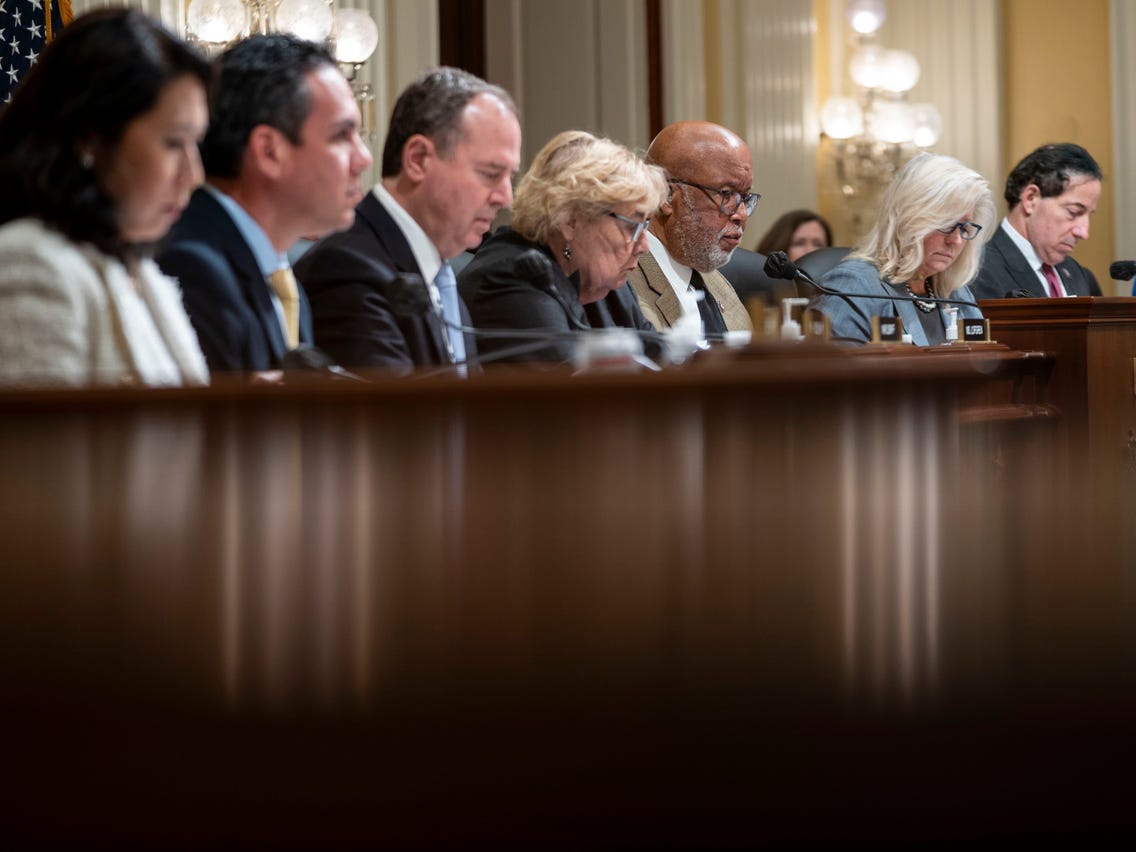
The January 6th Committee, through its publicly televised hearings has revealed that it has enough evidence to indict former President Donald Trump. The indictment would be focused on Trump’s illegal efforts to overturn the results of the 2020 Presidential elections.
The evidence would be based on Trump’s efforts to coordinate a slate of fake electors from states that President Biden legitimately won; his efforts to encourage the mob that stormed the US Capitol on January 6th hoping to prevent Vice-President Pence from certifying the election’s legitimate outcome; his publicly visible attempt to get the Secretary of State in Georgia to find him enough votes to overturn Biden’s election in that state; and his effort to get the Justice Department to declare that the 2020 election results were fraudulent.
There would be a great deal of risk involved if the Justice Department prosecuted Trump. They would need to have an iron -lad case to prove Trump’s intent to overturn the election, and they would need to convince a grand jury to unanimously agree that the evidence merited conviction. It would be a case that would drag on for some time; might further inflame existing political divisions, and might take place against the backdrop of a Republican-controlled Congress.
Policy Analysis
Some argue that rather than prosecute Trump it would be sufficient to find a way to bar him from taking public office again. There is a clause in the 14th Amendment to the Constitution that could apply. That clause, developed after the civil war, says that officeholders who “have engaged in insurrection or rebellion against the government are disqualified from future office.” However no one is sure how such a clause would be invoked today. At a minimum it probably would require the approval of both houses of Congress, a far-fetched possibility in this day and age.
So it appears that criminally prosecuting Trump for his leadership in seeking to overturn a legitimate election outcome is the best approach to dealing with the former President’s illegal actions. It is a risky approach but it is a risk worth taking. To do otherwise, to ignore and not prosecute Trump, would be setting a standard that a President is above the law Such a standard would be a slap in the face of American democracy.

Photo taken from: Washington Monthly
(click or tap to enlargen)
We know that other countries with democratic constitutions have prosecuted presidents who committed crimes and violated laws, such as France, South Africa, Colombia, Peru, and Honduras; so there is precedent from countries around the world for the United States to take such action. Failing to do so will put a stain on the character of our nation.

Quid Pro Quo Again? And Again? And Again?
Quid Pro Quo Again? And Again? And Again?
Social Justice Policy Brief #37 | By: Maureen Darby-Serson | June 27th, 2022
Header photo taken from: Fox News
Follow us on our social media platforms above
Browse more social justice policy briefs from the top dashboard

Photo taken from: Getty Images
Policy Summary
[SSB theme=”Official” align=”center” counter=”true” ]
Over the past couple of weeks, the January 6th committee has been holding public hearings that have revealed several astonishing facts regarding the attack on the US Capital and events after the 2020 Presidential election. While there have been several cringeworthily revelations, one that has gathered attention from the most recent hearings was the appointment of Jeffrey Clark as acting Attorney General of the United States, Former President Donald Trump’s third acting Attorney General at the time.
Mr. Clark was arguably given this appointment due to his willingness to investigate and prosecute false claims of election fraud and declare the 2020 election stolen from Donald Trump. Was this another case of quid pro quo by Donald Trump?
One of the first well known quid pro quo’s, in 2019, Donald Trump was accused of a quid pro quo when Ukraine asked for aid to fight off Russia and Trump offered to send aid if Ukraine investigated then presidential candidate Joe Biden. The US House of Representative considered this interfering in a presidential election and impeached Donald Trump. After the January 6th riots, they impeached him again. The Senate failed to fully impeach the Former President.
Policy Analysis
Several Department of Justice officials testified at the hearings to their disbelief that Jeffrey Clark was appointed as acting Attorney General due to his lack of background in criminal law and lack of trial experience.
They also testified to their refusal to sign a letter written by Jeffrey Clark declaring the 2020 election a fraud and one that was stolen from Donald Trump, even after finding no evidence of widespread fraud that would have changed the outcome of the election. This was the letter that made Donald Trump want Jeffrey Clark as his acting Attorney General.

Photo taken from: The New York Times
A person who was willing to write and sign a letter stating that the election was stolen was the kind of person he wanted running the Department of Justice. So, Trump did just that. Should we add this to the list of quid pro quos? With all of the other revelations, this one may take a back seat but Trump may have to answer this question if he decides to run in 2024.
Engagement Resources
Click or tap on resource URL to visit links where available

Ukraine quid pro quo timeline – https://torres.house.gov/timeline-president-trump-s-quid-pro-quo

Impeachment of Donald Trump – https://www.congress.gov/bill/117th-congress/house-resolution/24/text

January 6th Committee Hearings – https://january6th.house.gov/committee_activity

A Prescription to Improve American Healthcare
A Prescription to Improve American Healthcare
Health & Gender Policy Brief #153 | By: Inijah Quadri | June 27, 2022
Header photo taken from: Commonwealth Fund
Follow us on our social media platforms above
Browse more health & gender policy briefs from the top dashboard

Photo taken from: legacyhealthcare247
Policy Summary
[SSB theme=”Official” align=”center” counter=”true” ]
According to the Commonwealth Fund, the United States spends more on healthcare than any other country in the world. However, when it comes to healthcare outcomes, the U.S. lags behind many other industrialized countries.
There are a number of reasons for this discrepancy between spending and outcomes. For one thing, the U.S. has a relatively decentralized healthcare system, with most care delivered by private physicians and hospitals. This leads to higher costs and less efficiency than the centralized systems found in other countries. As a result, Americans are paying more for health care than ever before, yet the quality of care is not keeping up.
Additionally, the United States is one of only a few OECD countries without universal health care. Despite the Affordable Care Act, which has made coverage more available for some, the US still has a long way to go in terms of providing quality, affordable health care for all.
Policy Analysis
The Affordable Care Act, also known as Obamacare, was put into place in 2010 with the goal of making healthcare more affordable and accessible for all Americans. The law has been controversial from the start, with Republicans and other conservatives arguing that it is unconstitutional and will lead to higher premiums and taxes. Supporters of the law argue that it was needed to fix a broken healthcare system.
So far, the Affordable Care Act has had mixed results. On the one hand, it has helped millions of people gain access to health insurance. On the other hand, premiums have increased significantly for some people, and some small businesses have seen their rates go up as well. This has led to problems among low-income earners; it has led to frustration among many people who are trying to get coverage.
To fix this gap, The Affordable Care Act (ACA) of 2010 introduced a public healthcare option in the United States. This option, known as “the public option”, allows individuals to purchase healthcare coverage from the government. The public option was to be made available to all U.S. citizens and legal residents, regardless of income or health status. The public option offers lower premiums and lower out-of-pocket costs than private insurance plans, and it was to be made available to everyone regardless of pre-existing conditions. However, there has been a significant debate over the merits of the public option, and as of this writing, only three states have taken active steps to implement it.
Even with this lackluster attitude to implementing positive healthcare change, there is a broad consensus that the US healthcare system requires significant reform; there is less agreement on the specifics of what needs to be done. So, we will suggest a short prescriptive plan for improving US healthcare that focuses on prevention, cost containment, and a formula for universal healthcare.

Photo taken from: AARP
(click or tap to enlargen)
One important step is to invest in prevention. Too often, people only seek medical treatment when they are already ill. This leads to increased costs and can often be avoided through preventive measures. So, promoting health prevention needs to be a top priority.
Another key element is to ensure cost containment. This can be done by expanding Medicaid eligibility and providing subsidies for those who need help paying for health insurance. Another way to ensure equitable access is to invest in community health centers, which provide affordable care to everyone, regardless of their ability to pay.
Additionally, as the high cost of prescription drugs is a source of concern for many Americans, the government should negotiate prices with drug manufacturers and cap each product at a certain peak price. Another approach is to allow the importation of drugs from other countries, where prices are often lower.
Finally, we need to expand healthcare with a view to making it universal. There are a few steps that America can take in order to provide universal healthcare for all of its citizens. First, the government could provide more funding for Medicaid and Medicare, which would help more people afford healthcare. Second, the government could create a public health insurance program that would be available to all Americans. This program would be funded by taxes and would offer free or low-cost healthcare to its participants. If this option is chosen, taxes will directly fund healthcare and everyone will be covered—rich, poor, self-employed, employer, employee, etc.
We urge policymakers to put patients first and work together to build a health care system that works for everyone. The time for reform is now, and we must work together to make our health care system the best it can be.
Engagement Resources
Click or tap on resource URL to visit links where available

Politifact: The Poynter Institute (https://www.politifact.com/factchecks/2015/sep/01/dan-gecker/dan-gecker-says-us-only-wealth-nation-without-univ/, https://www.politifact.com/factchecks/2019/jun/21/mark-pocan/universal-health-care-diagnosis-mark/)

The Commonwealth Fund (https://www.commonwealthfund.org/publications/issue-briefs/2020/jan/us-health-care-global-perspective-2019#:~:text=In%202018%2C%20the%20U.S.%20spent,%2C%20Switzerland%2C%20spent%2012.2%20percent.)


Supreme Court Permits The Use Of State Taxpayer Funds For Religious Instruction
Supreme Court Permits The Use Of State Taxpayer Funds For Religious Instruction
Civil Rights Policy Brief #189 | By: Rodney A. Maggay | June 23, 2022
Header photo taken from: Education Week
Follow us on our social media platforms above
Browse more civil policy briefs from the top dashboard

Photo taken from: The Institute for Justice
Policy Summary
[SSB theme=”Official” align=”center” counter=”true” ]
Petitioners David and Amy Carson and Troy and Angela Nelson are two couples that reside in Maine. Both families wanted to apply for Maine’s tuition assistance program in order to send their children to two separate “sectarian” schools. Both families were denied because Maine had previously determined that using state taxpayer funds to fund tuition for students at sectarian schools was a violation of the Establishment Clause of the First Amendment.
Maine’s tuition assistance policy was crafted in response to the population sparseness of the State. Because half of Maine’s 260 school administrative units (similar to a school district) do not have enough students to establish a public secondary school in the unit, Maine devised a public program whereby parents can choose another public school in another unit for their child to attend. Maine would then allow families and the school units use of the taxpayer funds to send the child to the school in the other unit. Maine also permits parents to choose a private school that is approved by the Maine Department of Education if they are “nonsectarian.”
The only schools that cannot receive taxpayer funds are “sectarian” schools. Those schools are expressly prohibited from receiving taxpayer funds from the tuition assistance program. The reason is because Maine determined that sectarian schools are “associated with a particular faith or belief system” and “promotes the faith or belief system…and/or presents the material taught through the lens of this faith.”
Once the Carson and the Nelson families were denied tuition assistance to send their children to two sectarian schools they chose, they filed a lawsuit in the Federal District Court for the District of Maine. They claimed that their denial to receive tuition assistance for use at a sectarian school violated their rights under the First Amendment.
They lost at the trial court. An appeal was subsequently filed in the United States Court of Appeals for the First Circuit where the Court ruled against the plaintiffs again. An appeal was subsequently made to the United States Supreme Court, which ruled in a 6 – 3 decision that Maine’s denial of funds from the tuition assistance program for the Carson and Nelson families was unconstitutional because it violated the First Amendment’s Free Exercise Clause. LEARN MORE
Policy Analysis
The decision by the Supreme Court represents another low point in the Court’s recent decisions concerning the scope and limits of the First Amendment’s religion clauses. What the Court is allowing here is opening up the door for state taxpayer funds to be used for religious instruction. While the majority does not see it, or refuses to see it, the majority opinion is in clear contradiction to the Free Establishment clause’s dictates that there be a separation of church and state.
Justice Stephen Breyer’s dissenting opinion encapsulates brilliantly what the majority opinion ignores in this case. Giving a quick history lesson of the Court’s prior decisions on the Establishment Clause, Justice Breyer shows how the Court definitively stated that states cannot use “its public school system to aid any or all religious faiths” and how a state may “[not] adopt programs or practices in its public schools…which ‘aid or oppose’ any religion.”
This is explicitly clear and has been followed in subsequent Supreme Court decisions for decades – no weekly religious teachings in public schools, no prayers in public schools, no Bible readings in public schools, no religiously tailored curriculum in public schools, no prayers during public school graduations and no prayers during public school football games.

Photo taken from: Balls and Strikes / Getty
(click or tap to enlargen)
The majority opinion’s mistake is when they reasoned that this is a public benefit available to all Maine residents. The court’s reasoning relied on the Supreme Court’s 2017 decision from the case Trinity Lutheran Church of Columbia, Inc.v. Comer. That decision ruled that the church from the case could not be prohibited from state taxpayer dollars on account of their religious status because the funds were for a public benefit – the resurfacing of the church playground with recycled rubber materials.
The monies could be classified as being used for public safety and not for any type of religious instruction. But the difference from that case and the case from Maine is that state taxpayer funds would now be used for direct religious instruction. Justice Breyer notes this distinction and illustrates the “status-use” distinction that is at the heart of this case.
Justice Breyer points out that it is not the status or classification of the group that is the point but how state taxpayer funds will be used – and in this case it will now be used to directly pay for religious instruction. This isn’t about improving playgrounds or buildings anymore. The tuition monies in Maine would now be used to directly pay for religious materials and to pay the salaries of teachers who advocate for a particular religious viewpoint.
This is a clear violation of the Establishment Clause’s prohibition against religion in public schools and Justice Breyer correctly points out why the majority opinion is clearly wrong and against prior Supreme Court precedent. LEARN MORE, LEARN MORE
This brief was compiled by Rod Maggay. If you have comments or want to add the name of your organization to this brief, please contact Rod@USResistnews.org.
Engagement Resources
Click or tap on resource URL to visit links where available

Freedom From Religion Foundation – non – profit group’s statement on the Carson v. Makin case.

Americans United For Separation of Church And State – statement from non – profit group on the Carson v. Makin case.

Vive Le Tour de France … Femmes!
Vive Le Tour de France … Femmes!
Foreign Policy Brief #139 | By: Reilly Fitzgerald | June 23, 2022
Header photo taken from: RLT info
Follow us on our social media platforms above
Browse more foreign policy briefs from the top dashboard

Photo taken from: Outside Magazine
Policy Summary
[SSB theme=”Official” align=”center” counter=”true” ]
The Tour de France is the pinnacle of professional cycling. It is the highest level of competition on the biggest stage , in one of the toughest endurance sports out there. Until now, it has been strictly for men. This 21-day stage race has taken place almost every summer since 1903 – with some breaks in competition for the two world wars which devastated much of France.
Like many other major sporting competitions, the Tour de France is a 21-day period of time for France to show off its many glorious features. TV viewers and spectators alike are treated to dazzling images of the Alps and Pyrennees mountains, views over the Atlantic and Mediterranean, mass celebrations and French heroics on Bastille Day, and to end it all – a massive sprint finish down the Champs Elysees in the heart of Paris at dusk with views of the Seine, the Eiffel Tower, and the Arc de Triomphe. The pageantry of the event is similar to that of the Olympics, or the FIFA World Cup; and the global reach that the event has is certainly similar. Not only are many of the teams and athletes from many different countries; the fans and spectators come to France from all over the world to view this race from the side of the road.
The sport of cycling, and the Tour de France, have come under scrutiny for a very long time for its history of performance enhancing drug use (à la Lance Armstrong). The sport has also been a foreign policy pain in the neck for France and many European countries as there have been many multi-national law enforcement operations to curb doping. This summer, however, the Tour de France will be making headlines for a positive event rather than the negative events associated with its history. For the first time, the Tour will be welcoming a female version of the Tour de France. Historically, the women’s professional peloton has had a one-day race while the men enjoy the benefits (and struggles) of a 21-day stage race; this year, the women will race an eight-day stage race at the end of July.
Policy Analysis
The UCI (Union Cycliste Internationale), the governing body of global cycling, has staged races for the women’s peloton outside of this new Tour de France Femmes; however, these stage races have long been under criticism for not having the same three weeks of racing that the men are provided. This is not only an issue of gender equality in sports, but also an economic issue as well.
Female professional cycling teams, due to the lack of these long stage races and the lack of television coverage, are oftentimes in greater financial danger and risk than the men’s teams (which are also under a fair amount of risk, as well).
The Tour de France Femmes will be presented by NBC Sports on apps such as Peacock and CNBC, according to VeloNews. This television coverage is unusual for female cycling, especially in the United States. Many cycling races are not televised, especially in the United States, which allows sponsors that create these teams to have much exposure to the global economy which in turn means that many teams fold after a few years and riders are often left scrambling for new teams to ride on every few seasons.
NBC Sports presenting the eight-day stage race on American television should be helpful in allowing these teams to have more exposure and be able to provide a more stable outlook for their athletes.
Many current female professional cyclists, according to a survey produced by Cyclists’ Alliance, make less than $12,000 per year and many female cyclists do not even get paid or have to work a second job.

Photo taken from: Cycling News / Getty Images
(click or tap to enlargen)
These financial burdens are also on top of long training hours, travel to get to races during the season, and also the high physical risk and danger associated with professional cycling. According to Canadian Cycling Magazine, in December 2021, WorldTour male cyclists made a minimum salary of $60,000 per year. The pay disparity between the two sets of elite professional cyclists leaves much to be desired, especially for female athletes.
There have been several attempts at hosting a female Tour de France that dates back to the mid-1980s, but nothing stuck. Christian Prudhomme, the race director of the Tour de France, claims that this is because female racing is a quick way to lose money. While many female riders and team directors have blamed race organizers and other governmental bodies for not supporting, and investing in female cycling for decades.
Le Tour de France Femmes is an opportunity that is not often given to the female peloton; an eight-day stage race on global television, particularly American television, at the same time as the hype and excitement of the Tour de France.
The potential for teams and riders to showcase their talents on the world’s biggest cycling stage, and with high potential for sponsors and investors to see their achievements is entirely game changing. Let’s hope that this type of investment continues and that we start to see more coverage of women’s professional cycling.
Engagement Resources
Click or tap on resource URL to visit links where available

The Cyclists’ Alliance Rider Survey ( https://cyclistsalliance.org/2017/12/the-cyclists-alliance-rider-survey/ )

2022 Tour de France Femmes ( https://www.letourfemmes.fr/en/ )

Preview of US Senate Races in Pennsylvania and Georgia
Preview of US Senate Races in Pennsylvania and Georgia
Elections & Politics Policy Brief #38 | By: Ian Milden | June 22, 2022
Header photo taken from: The Hill
Follow us on our social media platforms above
Browse more elections & politcs policy briefs from the top dashboard

Photo taken from: Marc Levy and Seth Wenig / WHYY
Policy Summary
[SSB theme=”Official” align=”center” counter=”true” ]
Control of the U.S. Senate will be up for grabs in the 2022 mid-term elections. Competitive races in key states will determine the balance of power. In this brief, I will preview the competitive races in Pennsylvania and Georgia.
Policy Analysis
In Pennsylvania, Lieutenant Governor John Fetterman (D-PA) will face Dr. Mehmet Oz (R-PA) in the general election for the US Senate seat being vacated by retiring Senator Pat Toomey (R-PA). Fetterman has been elected statewide, initially winning his current job in the 2018 midterm elections. Fetterman hails from Braddock, Pennsylvania in the western part of the state. He has not been campaigning as he recovers from a stroke. Dr. Oz is well-known due to his television show, although he is relatively untested as a candidate for public office. Dr. Oz has faced scrutiny over his business dealings. For example, his family business was fined for hiring undocumented workers. Dr. Oz won his primary over David McCormick by less than 1000 votes.
A recent poll from USA Today and Suffolk University has Dr. Oz down by nine percentage points due to Republicans not being fully consolidated behind Oz’s candidacy after a tense primary. Dr. Oz will have some work to do over the next several months to convince Republicans to support him in November. Expect the race to get tighter in the coming months as Dr. Oz works on repairing the fractures within his own party.
In Georgia, incumbent Senator Raphael Warnock (D-GA) is running for a full term against former NFL player Herschel Walker (R-GA). Warnock won the special election to replace retiring Senator Johnny Isakson (R-GA) after ending up in a runoff with appointed Senator Kelly Loeffler (R-GA). Warnock is the pastor at the Ebenezer Baptist Church in Atlanta.

Photo taken from: NPR
(click or tap to enlargen)
During his time in the Senate, Warnock has advocated for raising the minimum wage and reinforcing voting rights through the John Lewis Voting Rights Act. His opponent, Herschel Walker. became famous for playing college football for the University of Georgia. He later played in the NFL, most notably for the Dallas Cowboys. Walker is untested as a candidate for public office.
Republicans in Georgia largely threw their support behind him after he was endorsed by Donald Trump. A lack of serious vetting of Walker has led to media scrutiny of his personal life. It was discovered that Walker fathered a child with a woman who was not his wife and whom he has largely not been present for. Walker’s campaign later admitted to two additional children that Walker fathered. Walker had previously criticized men who leave their children in a radio interview. He has also been scrutinized for false statements about his career. A recent poll from East Carolina University’s survey research center finds that the race is tied.
According to the poll’s data, Walker has less support than Governor Brian Kemp (R-GA) among non-college-educated voters and voters under the age of 65. These could be signs that Walker’s flaws as a candidate are weighing him down, but it is too early to tell. More time and additional data could provide additional insight. Even with Walker’s flaws as a candidate, Warnock will have a tough race in November due to the demographics of Georgia’s electorate, historical midterm trends, and Georgia having a runoff election if nobody gets a majority of the vote.
Engagement Resources
Click or tap on resource URL to visit links where available
Fetterman’s Campaign Website

Warnock’s Campaign Website

While Men Fight for Their Land in Ukraine, Their Families Try to Survive in a Foreign Country
While Men Fight for Their Land in Ukraine, Their Families Try to Survive in a Foreign Country
Foreign Policy Brief #138 | By: Yelena Korshunov | June 16, 2022
Header photo taken from: The New York Times
Follow us on our social media platforms above
Browse more foreign policy briefs from the top dashboard

All photos in this brief are provided by ARFA
Policy Summary
[SSB theme=”Official” align=”center” counter=”true” ]
I’m speaking with a man who was on his way to fight for his country, Ukraine, that was invaded by Russia’s troops on February 24, 2022. He packed his bag in his Brooklyn house to cross the Atlantic Ocean, back to the land where he was born. He was almost done with packing when his close relative stepped in. “You can do much more for Ukraine if you stay in America. You can help those who arrive here from Ukraine with a hope to keep their children safe and alive,” she said. “Ultimately, someone should do that here. Someone who speaks their language and has a big heart like you.” This man’s name is Yan Yufit.
I phoned him to speak about his mission. Yan is a founder of ARFA, which stands for American Revival Foundation Alliance. Since Ukrainian refugees started to arrive in the United States, he and his team are first responders to meet the needs of those – mostly women with children, and elderly people – whose lives were ruined by the war.
-When was your organization born? – I asked.
-We started four years ago in Ukraine, mostly helping Holocaust survivors and collecting information about those whose lives were taken then. We planned to open a Holocaust museum in Odessa. That time we were invited to the Babiy Yar anniversary in Kiev where we met with Ukrainian president Volodymyr Zelensky, Israeli and German presidents, and with many other activists and politicians. But when Putin’s army attacked Ukraine spreading enormous violence over this land, we switched our endeavors to help Ukrainian refugees and those who dedicated their lives to protect Ukraine. We don’t really trust big organizations because they spend a significant part of donations to pay their employees, rent facilities, etc. Nobody knows what part of this money goes to those people who are in need of them.
Conversely, we started our activity by spending our own money and attracting volunteers. Here are the names of people in my team who willingly dedicate their time and money: Irina Chmeleva, Yaroslav Litvinov, Natalie Knyazeva, Vadim Mednikov, Ilona Elias, and Tatiana Golyak. One of our friends, Svetlana Zelinskaya, who has a beauty salon, gave us a space on certain days and hours to collect and distribute supplies for refugees, e.g. clothes, kitchen appliances, toys, and many other things. Then we realized that refugees are in dramatic need of legal help, so we found a lawyer and a paralegal who joined the team to voluntarily support refugees with legal advice, filling out applications, and filing them.

We distributed food that was randomly donated, but recently we made an agreement with the Food Bank of New York, and last Saturday they delivered food that was distributed to many refugees and the other people in need. Our efforts have now started to attract politicians’ attention. Steven Simblevitz, NYS assemblyman of District 45, helped us to partner with KingsBay Y which provided us with a facility for food distribution on Saturdays.
We are located in Brooklyn, New York, and about 2,000 refugees have already applied to us for different kinds of help. ARFA helps them to get medical insurance, open a bank account, and get a driver license. We have opened free English language classes that are voluntarily led by professional educators. We even have a children psychologist who helps kids who went through the horror of war and suffer from psychological trauma. Recently, the HRA representative came to us to consult people, and we expect him to do that soon on a weekly basis.

-You don’t spend much money on advertising ARFA, so where do you find volunteers?
-It’s mostly a word of mouth. Many people with diverse backgrounds and nationalities come to us offering their hands and time. Pediatrician Boris Ripa donated twenty boxes with baby meals. There are several businesses that donated twenty multi cookers and twelve boxes with new children’s clothes. At the Ukrainian event at Times Square we met a famous Ukrainian actor Vladimir Goryanskiy who will direct the Children’s School of Arts. Eight refugees created crafts that were sold at the Ukrainian festival on Staten Island.
ARFA earned there more than $1,000 to spend for refugees’ needs. We bought and sent to the hospital in Kropyvnytskyi (a city in Ukraine) a 3D Printer that is unique for that area and will be used for making medical first aid supplies. We also sent supplies to the Ukrainian regiment in Mykolaiv, and we sent warm blankets to another regiment. We also bought free food for people in Kyiv and Kharkiv that was distributed by local volunteers.

-I’m wondering what ARFA’s challenges are, if there are any?
-The biggest problem is that we do all these things with our own limited money, and we don’t have any financing except for private donations. Another big challenge is finding a facility where we could collect, store, and distribute things for refugees, provide them with legal help, and conduct classes for children and adults.
A lot of refugees arrive in the US without having any money and basic necessities, like hygiene products. Our friend that offered us space in her beauty salon got in trouble with her landlord who couldn’t believe that we do so much work for so many people for free, without getting a profit. If we have financing, we could attract more professionals and offer more support to Ukrainians who drastically need it.

-Although refugees have multiple vital needs, which of them is a priority?
-The priority is housing and work. The biggest problem is that without work and good credit history they can’t rent a room or apartment. Some homeowners want them to pay for half a year ahead. But how can people who were forced to escape their homes under shelling have so much money? All they have is clothes on them and their terrified children.
-How long does it take to get a status that permits refugees to work in the US?
-It’s a very long process. Within four months since the war in Ukraine started and refugees ran to the US, none of these people who applied to us received a document that allows them to legally work. Our attorneys filed applications for many refugees more than three months ago, but they are still waiting and struggling to survive. They are in unbelievable poverty, many of them don’t even have money to ride a subway. They walk miles to get free food that we deliver, or to receive legal advice.
-It’s so hard even to imagine what these people are going through.
-There are so many stories that are terrifying. There is a female refugee in Brooklyn who worked as a police officer in Kyiv. Her parents live in occupied Kherson. Someone brought information about her police service to the Russian occupants’ headquarter in Kherson, and now they are treating her parents demanding that she must come back to Kherson and be prosecuted, otherwise they will be in real trouble. And there is no way for these poor people to escape occupied territory and save their lives.
There is another woman with three children (one of them is autistic) whose husband was killed the second day of the war. There are many other Ukrainian children here, in Brooklyn, whose dads fight in Ukraine against its occupants or have already lost their lives in the war.
Policy Analysis
Recently, after the war started, NYS governor Kathy Hochul stated “On behalf of 20 million New Yorkers, I am here to say with resolve in my heart, that we stand against this tyranny, and condemn Putin’s unjust and inhumane violation of the sovereignty of Ukraine. And we will stand with Ukraine and its people now, and forever more. New York is with you. We will always be with you. The United States of America will be with you.”
But beyond these pathetic words, there are thousands of Ukrainian refugees that don’t have a place to live in, and don’t have basic needs, like food and medical help. They can’t even obtain permission to work to be able to buy food for their kids.
There is a website with some resources created for “Ukrainian people” by New York State, offering translation in eleven languages, including Russian, but paradoxically none of these languages is Ukrainian. And in fact, sadly, after reaching out to these resources, refugees run into a wall of bureaucracy.
As a result of this nonsense, we have many hardworking people who are not allowed by our slow bureaucratic machine to earn money for rent and for even simplest human living, while people like Yan Yufit and his ARFA team members who work hard on full-time jobs spend money from their own pockets, time after work, and endeavor to help these people.
Patriotic speeches don’t protect, feed or cure hungry, frightened kids, whereas giving their caregivers permission to work would make a big difference in their lives.
Engagement Resources
Click or tap on resource URL to visit links where available

Uniting for Ukraine. https://www.uscis.gov/ukraine

Help Center ARFA: American Revival Foundation Alliance.
https://www.facebook.com/ARFAhelps/

Governor’s Website with Resources for Ukrainian People. https://www.governor.ny.gov/news/governor-hochul-launches-website-resources-ukrainian-people-and-their-allies-new-york
NYS Stands with Ukraine: Resources for Ukrainians and how New Yorkers can help. https://www.ny.gov/new-york-state-stands-ukraine-resources-ukrainians-and-how-new-yorkers-can-help

New Charges Filed Against Proud Boys
New Charges Filed Against Proud Boys
Elections & Politics Policy Brief #37 | By: Stephen Thomas | June 13, 2022
Header photo taken from: ABC
Follow us on our social media platforms above
Browse more elections & poltics policy briefs from the top dashboard

Photo taken from: Click Orlando
Policy Summary
[SSB theme=”Official” align=”center” counter=”true” ]
As of this writing, none of the five members of the Proud Boys who received two additional Capitol riot charges June 6 have pleaded guilty. The group faces nine charges in all in connection with the breach of the U.S. Capitol on Jan. 6, 2021. The case is before the U.S. District Court for the District of Columbia.
The riot interrupted the congressional counting of the electoral votes in the 2020 presidential election, which President Joseph R. Biden Jr. and Vice President Kamala D. Harris won—despite Republican lies to the contrary.
The defendants include Henry “Enrique” Tarrio, 38, of Miami, Fla., the former national chairman of the Proud Boys; Ethan Nordean, 31, of Auburn, Wash.; Joseph Biggs, 38, of Ormond Beach, Fla.; Zachary Rehl, 37, of Philadelphia; and Dominic Pezzola, 44, of Rochester, N.Y. All are detained.
The two additional charges include one count of seditious conspiracy and one count of conspiracy to prevent an officer from discharging any duties, according to the Justice Department.
The other seven charges against this fivesome include conspiracy to obstruct official proceedings; obstruction of an official proceeding and aiding and abetting; obstruction of law enforcement during civil disorder and aiding and abetting; destruction of government property and aiding and abetting; and two counts of assaulting, resisting, or impeding certain officers. This list of charges comes directly from the grand jury superseding indictment dated June 6.
A sixth defendant in this group of defendants, Charles Donohoe, 34, of Kernersville, N.C., pleaded guilty April 8 to conspiracy to obstruct an official proceeding and assaulting, resisting or impeding officers, according to a Justice Department news release.
That same news release reads that the Proud Boys describe themselves as a “pro-Western fraternal organization for men who refuse to apologize for creating the modern world, aka Western Chauvinists.”
Policy Analysis
The practical definitions of the two added charges come from a plain reading of the United States Code, which is a compilation of federal statutes passed by Congress and signed by the president. These are statutes, not “regulations,” the latter of which are written by government agencies and do not pass through the legislative process.
This is the unedited federal statute that defines seditious conspiracy (Title 18 U.S. Code Section 2384):
“If two or more persons in any State or Territory, or in any place subject to the jurisdiction of the United States, conspire to overthrow, put down, or to destroy by force the Government of the United States, or to levy war against them, or to oppose by force the authority thereof, or by force to prevent, hinder, or delay the execution of any law of the United States, or by force to seize, take, or possess any property of the United States contrary to the authority thereof, they shall each be fined under this title or imprisoned not more than twenty years, or both.”
The following is the unedited federal statute that defines conspiracy to prevent an officer from discharging any duties. (This is Title 18 U.S. Code Section 372. The title of the offense differs between the indictment and the statute; nevertheless, this is indeed the code number that the indictment identifies.):
“If two or more persons in any State, Territory, Possession, or District conspire to prevent, by force, intimidation, or threat, any person from accepting or holding any office, trust, or place of confidence under the United States, or from discharging any duties thereof, or to induce by like means any officer of the United States to leave the place, where his duties as an officer are required to be performed, or to injure him in his person or property on account of his lawful discharge of the duties of his office, or while engaged in the lawful discharge thereof, or to injure his property so as to molest, interrupt, hinder, or impede him in the discharge of his official duties, each of such persons shall be fined under this title or imprisoned not more than six years, or both.”

Photo taken from: KNWA
(click or tap to enlargen)
The indictment contains allegations, which federal prosecutors must prove in any cases that go to trial. Prosecutors have a lot of ammunition to work with. If the government can prove some of the facts contained in the indictment, then it has a solid case against these five defendants.
For instance, on the seditious conspiracy charge alone, according to the indictment, prosecutors believe they can show that the defendants conspired to “oppose the lawful transfer of presidential power.” The indictment alleges the fivesome did the following—and this is the tip of the iceberg:
- Used “programmable handheld radios,” encrypted applications, and other means of communication in the “attack,”
- Mobilized and led the crowd into the Capitol,
- Dismantled and “stormed past” metal barricades (bypassing and even assaulting law enforcement officers), and
- Destroyed property, including fencing and a window.
Then, there is the charge of preventing an officer from discharging any duties. On this additional count, the government must show that the defendants conspired to forcibly “induce” members of Congress and law enforcement personnel “to leave the place where their duties as officers were required to be performed.”
Here, it is obvious that Congress evacuated to safety, in so doing delaying the electoral vote count. Additionally, injury and death were inflicted on law enforcement in the attack. Proving that the defendants were a part of a conspiracy is one thing, but it is a given that the attack resulted in those repercussions.
Keep in mind that the government has a wealth of video footage and witnesses to help make the charges stick, should any of these defendants go to trial. No wonder a sixth defendant who was charged with this group struck a plea deal.
Engagement Resources
Click or tap on resource URL to visit links where available

Superseding Indictment
https://www.justice.gov/usao-dc/press-release/file/1510791/download
Justice Department News Release

Seditious Conspiracy
Title 18 U.S. Code Section 2384
https://www.law.cornell.edu/uscode/text/18/2384
Conspiracy to Prevent an Officer from Discharging Any Duties
This charge is also known as “Conspiracy to impede or injure officer”
Title 18 U.S. Code Section 372