

JOBS POLICIES, ANALYSIS, AND RESOURCES
Latest Jobs Posts
It’s Time to Declare Independence from America’s Two Political Parties
U.S. Resist News Op Ed
John Halpin
The parties insist everyone must toe the line and hold the same ideological views. If the parties won’t change, then voters in the middle should just reject them.
Congressional Effort to Regulate Internet Algorithms May Impact Efforts that Support Reproductive Rights
Brief #61 – Technology Policy
By Mindy Spatt
According to a US Surgeon General’s advisory, online misinformation is dangerous to our health. Abortion advocates agree. So does my pregnant daughter whose Tik Tok and Instagram are filled with horror stories of premature births and preeclampsia that just exacerbate the normal anxieties that come with being pregnant. According to a recent LA Times article she is not alone.
Changes in Google Cookie Policy Could Help Improve Consumer Privacy
Brief #60 – Technology
By Christopher Quinn
In 2023 Google Chrome is phasing out third party cookies. What this means is the entire global browser market will no longer track users’ every move across the web. Safari, Firefox and Brave already block third-party cookies by default to protect users’ privacy. Google Chrome currently holds 64.9 percent of the global browsing market.
Analyzing the Implications of the Dissolution of the Israeli Knesset
Brief #140 – Foreign Policy
By Ian Milden
On June 22nd, Prime Minister Naftali Bennett announced plans to dissolve the Knesset, Israel’s parliament. This means that a snap election will be held this fall. This will be the fifth election in Israel in under four years.
The Supreme Court Weakens The Separation of Church and State With High School Football Coach Decision
Brief #190 – Civil Rights
By Rodney A. Maggay
Joseph Kennedy was a football high school coach at a public high school in Bremerton, Washington. During his time as a coach in the Bremerton School District Mr. Kennedy had started a routine where he would pray at the fifty – yard line of the football field at the conclusion of the game.
For a ‘Young’ Country, the U.S. Has an Old and Outdated Constitution
U.S. RESIST NEWS OP-ED
By Alexander Clarkson
The belief that the United States is a uniquely youthful society in contrast to an aging and decadent Europe has become so entrenched that it is rarely questioned. Whether out of politeness or genuine belief, Europeans encountering this recurring trope often turn to their own.
New Tech Regulation Bill Being Considered by Congress American Innovation and Choice Online Act
Brief #59 – Technology
By Christopher Quinn
A major piece of legislation that could re-shape the tech industry is just a few steps away from becoming law.
The American Innovation and Choice Online Act, S.2992 (117) led by Senators Amy Klobuchar (D-Minn) and Chuck Grassley (R- Iowa) would prohibit dominant tech platforms from what its sponsors believe amounts to unfairly ranking their services above those of its rivals. The new law would help small businesses and entrepreneurs by barring Amazon, for instance, from giving preference to its own products.
Preview of US Senate Races in Nevada and North Carolina
Brief #39 – Elections & Politics
By Ian Milden
Control of the U.S. Senate will be up for grabs in the 2022 mid-term elections. Competitive races in key states will determine the balance of power. In this brief, I will preview the US Senate races in Nevada and North Carolina.
Florida’s controversial ‘Don’t Say Gay’ law explained
Brief #53 – Education
By Lynn Waldsmith
It’s not easy having curly hair in Florida. That’s the message the first openly gay class president of Pine View School in Osprey, Florida delivered last month in his commencement address, who used his curly hair as a euphemism for his sexual orientation.


Eye on the Fed
Eye on the Fed
Economic Policy Brief #TBA | By: Greg Ziegler | January 31, 2022
Header photo taken from: ABC News
Follow us on our social media platforms above
Browse more economic policy briefs from the top dashboard

Photo taken from: News Text Area (.com)
Policy Summary
[SSB theme=”Official” align=”center” counter=”true” ]
The Federal Open Market Committee (FOMC) concluded the first of its eight scheduled meetings for 2022 on Wednesday, January 26th. The Committee is comprised of twelve members and is responsible for overseeing the nation’s monetary policy to promote the nation’s economic goals. At the conclusion of its meeting the Committee issued a press release summarizing the key points the Committee considered in its deliberations stating that, “indicators of economic activity and employment have continued to strengthen,” and that, “job gains have been solid in recent months, and the unemployment rate has declined substantially.” Further, the Committee communicated the actions it would take, stating that it, “seeks to achieve maximum employment and inflation at the rate of 2 percent over the longer run. In support of these goals, the Committee decided to keep the target range for the federal funds rate at 0 to 1/4 percent.” The Committee conceded that, “with inflation well above 2 percent and a strong labor market, the Committee expects it will soon be appropriate to raise the target range for the federal funds rate.”
Policy Analysis
The Federal Reserve rate is the interest rate at which depository institutions lend balances at the Federal Reserve to other depository institutions overnight. This rate serves as a key tool that the Fed uses to impact economic policy. By lowering this rate, the Federal Reserve makes it easier to borrow, which increases consumer borrowing, which in turn increases consumer spending, which may contribute to the economy growing too quickly, which can increase inflation. Doing the reverse, raising the Federal Reserve rate, makes it more expensive to borrow, which should lead to less consumer borrowing and spending, while the reduction in spending should slow the growth of the economy and lead to an inflation reduction.
Currently, the Inflation rate is 7% which is the highest it’s been in the last 40 years (10.3% in 1981), making the FOMC’s decision to leave the rate unchanged mildly surprising as it takes time for rate changes to achieve their desired effect. The Committee did hedge its bets and say that it is likely that they will raise the interest rate at their next meeting in March (March 15th and 16th).

The two ingredients of a healthy economy.
Photo taken from:
The Federal Reserve Bank of San Francisco
(click or tap to enlargen)
The stock market showed some volatility leading up to the Fed’s decision on the Federal Reserve rate. The Dow was down 920 points intraday on Monday the 24th, and down over 640 points intraday both Tuesday and Wednesday, closing down over 350 points on Wednesday, before rallying to finish up 590 points on Friday. For the week the Dow Jones Industrial Average closed up 1.92%. Similarly, the S&P 500 Index closed down 58 points on Wednesday and 54 points on Thursday before rallying to close up 95 points on Friday. For the week the S&P Index closed up 1.73%.
Engagement Resources
Click or tap on resource URL to visit links where available

Federal Open Market Committee Meeting Press Release
https://www.federalreserve.gov/monetarypolicy/fomc.htm

Current Inflation Rates

U.S. Historical Inflation Rates
https://www.usinflationcalculator.com/inflation/historical-inflation-rates/

S&P 500 Index Historical Prices
https://finance.yahoo.com/quote/%5EGSPC/history?p=%5EGSPC
Dow Jones Index Historical Prices

Long COVID and the Economy
Long COVID and the Economy
Health & Gender Policy Brief #146 | By: Rosalind Gottfried | January 26, 2022
Header photo taken from: iStock
Follow us on our social media platforms above
Browse more health & gender policy briefs from the top dashboard

Photo taken from: New Jersey Business Magazine
Policy Summary
[SSB theme=”Official” align=”center” counter=”true” ]
Long Covid may affect well over a million people who contracted the virus. The syndrome manifests in pulmonary, cardiovascular, and nervous system symptoms which can persist for months after initial illness and may even occur in those who never were sick initially. Ailments can include shortness of breath; erratic heartbeats and blood pressure; fatigue; pain, and an inability to concentrate and a general “fuzziness.” Those suffering from these conditions can also succumb to depression and anxiety, whether that is a primary symptom or a consequence of the fall out form the syndrome. In a study of over 250,000 Covid patients, over half expressed some declines six months after the initial infection. These include physical and psychological impairments. Twenty percent reported a decline in mobility; 25% felt a decline in concentration; 20% experienced hair loss and/or rashes; and many people reported cardiovascular and gastrointestinal effects.
The fallout can be severe. The inability to work can result in loss of jobs and benefits such as health insurance. Many who must quit, or get fired, and suffer multiple illnesses are unable to pay for care and are losing homes, cars, and potentially family who cannot cope with the stressors. Some people who have long term health insurance have reported that their insurers are denying claims as is the government disability offices of the Social Security Administration. The National Institute of Health has committed 1.15 billion dollars to study long term Covid.
The impact of deaths from Covid goes beyond the number of people who have passed away. If we consider a deathrate of 1 million people, and calculate Years of Life Lost (YLL), the average is nine years because many covid patients are older. But other people have succumbed from Covid and they had potentially longer lives. Estimates suggest that the total years of life lost will exceed ten million from deaths. The recent reporting of long Covid suggests that the loss to the economy, in terms of loss of producers (work) and consumers will have a far-reaching impact than just those due to death.
Policy Analysis
With estimates of those who have had Covid reaching 50 million, it is difficult to estimate how many will ultimately succumb to long Covid though it is surely clear that the cost to the economy will be severe. There are at least two aspects to this situation; the first is paying for the care and treatment of the syndrome and the support of the those afflicted. The government safety net must be addressed as individual needs may far surpass current provisions. The second issue is to compensate for the lack of labor force participation and the reduced consumption of those who cannot return to the paths they were on previous to the pandemic.
The medical professionals need to be able to define the syndrome so that people can qualify for aid. Currently, it is vaguely described as persistent symptoms which cannot be explained by another condition.

The implications of COVID-19 for mental health and substance abuse.
Photo taken from: Kaiser Family Foundation
(click or tap to enlargen)
The government should develop a policy to subsidize those who cannot work, or who can only work part time, so that they don’t fall into worse situations from which they will be unable to extract themselves. Some fear that the depression from the loss of previous work and quality of life could result in a swelling of suicide and opioid use.
Private employers would be wise to allow people who suffer from Covid related syndromes to work part time; to work from home; and to keep benefits such as health insurance. The prevalence of long term Covid deserve the attention, concern, and resources we can muster as a nation.
Engagement Resources
Click or tap on resource URL to visit links where available

https://www.forbes.com/sites/patrickwwatson/2021/06/14/the-long-covid-economy/

https://www.washingtonpost.com/business/2021/12/09/long-covid-work-unemployed/

https://fortune.com/2021/11/16/long-covid-pandemic-physical-economic-effects-vaccination-treatment/

The U.S. House Select Committee Investigation of the January 6 Attack on the Capitol: Part 7
The U.S. House Select Committee Investigation of the January 6 Attack on the Capitol: Part 7
Social Justice Policy Brief #31 | By: Erika Shannon | January 27, 2022
Header photo taken from: ABC News – Walt Disney
Follow us on our social media platforms above
Browse more social justice policy briefs from the top dashboard

Photo taken from: Michigan News
[SSB theme=”Official” align=”center” counter=”true” ]
The one-year anniversary of the attack on our nation’s Capitol may have passed, but one thing is clear: the House Select Committee is no longer playing games with their investigation. Their quest for answers has been long, full of obstacles, yet they continue to try and delve through all the information they can possibly get their hands on. They have faced people trying to stonewall the investigation, as well as a severe lack of cooperation from the former President himself.
Most recently, the House Select Committee issued subpoenas to four more Trump allies who publicly promoted unsupported claims about the election and participated in attempts to disrupt/delay the certification of the election results. This includes Jenna Ellis, Sidney Powell, Boris Epshtein, and Rudy Giuliani. Giuliani himself actively promoted election fraud claims and tried to convince state legislators to take steps to overturn the 2020 election results.
The day after issuing those four subpoenas, the House Select Committee issued subpoenas to Nicholas J. Fuentes and Patrick Casey. These two are leaders of the “America First” or “Groyper” movement and were present on the Capitol grounds on January 6, 2021. They also participated in events prior to that day, where unsupported claims about election fraud were promoted. The two are also being investigated for the tens of thousands of dollars worth of Bitcoin they were wired from a French computer programmer. The FBI is trying to assess whether these funds were linked to the Capitol attack or otherwise used to fund illegal activity.
While he was not formally subpoenaed, talk show host Sean Hannity was sent a letter by the House Select Committee; in the letter, they are asking for his cooperation to voluntarily answer questions about matters including communications between himself, the former President, Mark Meadows, and others in question regarding the events of January 6. The committee already has communications between Hannity and those listed, and at this point they are looking for clarification from him.
The daughter of the former President has also been issued a request for information from the panel, though not a subpoena. The House Select Committee sent her a letter similar to Sean Hannity’s, where they are asking her to voluntarily come forth and give information relevant to January 6’s events. There is evidence that Ivanka Trump was in direct contact with Donald Trump at key moments on January 6, 2021 which means she likely has key information that would help the panel figure out how the day’s events truly unfolded, and who is to blame.
Individuals are not the only ones facing subpoenas and scrutiny from the House Select Committee. The committee has received inadequate responses to prior requests for information from several social media companies. In response, the panel issued four subpoenas to social media companies as apart of its investigation — Alphabet, Meta, Reddit, and Twitter. There are suspicions that the platforms were used to not only spread misinformation and hate, but to plan domestic violent extremism and harbor efforts to overturn the 2020 election. The House Select Committee wants to ensure that events such as the ones that unfolded on January 6th at the nation’s Capitol cannot be planned so easily on social media, and they are requiring the cooperation of these four companies to make that happen.
Several of Trump’s former allies have already come forth and provided testimony, likely against the former President’s wishes. There is hope that those trying to hold out for as long as they can will end up coming in to give depositions; until then, several key players from Trump’s inner circle have already come forth. This includes William Barr, Keith Kellogg, Jeffrey Rosen, Kayleigh McEnany, Ali Alexander, and Kash Patel.

Photo taken from: The Mercury News
(click or tap to enlargen)
It is obvious that the House Select Committee has a plethora of information to wade through at this point, even though there are some who are not cooperating. What does the committee do with the information they receive, though? As it turns out, the committee has put together five teams made up of their staff members to help sort through information. The “Inside the Fence” team is dedicated to understanding the preparation and response to the event by federal and local law enforcement. The “follow the money” team examines the funding for demonstrations against the election results. A third team investigates online information and extremist activity. A fourth team is looking at the pressure campaigns in Washington DC and in state capitols to overturn election results or delay certification of electors. The fifth team keeps their focus on organizers of the demonstrations on the National Mall at the Capitol.
Moving forward, the panel is focusing much of its energy on the task of recording and listening to a slate of public hearings to be able to tell the story of January 6 from start to finish, along with one or more written reports. The reports will detail the events of that day and also make recommendations on how to prevent similar situations from occurring again.
This Brief is part of an ongoing series in the Select Committee’s investigation; further updates will be provided as the investigation continues.
Engagement Resources
Click or tap on resource URL to visit links where available

To read the House Select Committee’s letters to those mentioned above, or for daily updates, visit the Committee website.

The Healthcare System in US Prisons is in Drastic Need of Improvement
The Healthcare System in US Prisons is in Drastic Need of Improvement
Health Policy Brief #145 | By: Inijah Quadri | January 25, 2022
Header photo taken from: Modern Healthcare
Follow us on our social media platforms above
Browse more health and gender policy briefs from the top dashboard

Photo taken from: NICIC.gov
Policy Summary
[SSB theme=”Official” align=”center” counter=”true” ]
Getting ill in prison is a bad idea. Because of years of underfunding and privatization, the medical treatment provided to those who are jailed is deplorable.
Almost four times as many convicts over the age of 55 are in prison now as there were at the beginning of this century. Because of this, the prevalence of diabetes and heart disease – to name just a few – has skyrocketed. Given their high rates of addiction, young offenders in prison aren’t exactly the healthiest of all groups. Hepatitis C infection rates are 35 percent higher in prisons than in the general population, despite the fact that inmates make up just 1% of the population. As research explains, “They are the most costly and the illest people in the population.”
In the last decade or two, most states have outsourced jail health care to private organizations. That creates a motivation for cost-saving measures. As such, there are several tales of people dying in vain as it might take weeks for an inmate to visit a doctor after complaining about the same symptoms many times. True, convicts have tried to escape during medical transports to hospitals, but that is not enough reason for guards and other personnel to typically assume that detainees are lying about being unwell.
Chronic health issues, mental illness, and drug addiction are more prevalent among inmates and detainees in immigration facilities. Even before, as well as during and after jail or detention, people often get subpar medical care. This only serves to exacerbate their predicament.
Policy Analysis
Health needs of prisoners can be addressed through policies like expanding access to substance use disorder treatment, family planning, and mental health services, all of which are supported by the American Academy of Family Physicians (AAFP). As incarceration and detention are both harmful to health, the AAFP advocates for sentencing nonviolent criminals and drug possession offenders to shorter terms of imprisonment and abolishing detention for people seeking refuge in the United States on lawful grounds.
The American Academy of Family Physicians (AAFP) supports efforts to improve the current bail system and reduce the negative health outcomes of those awaiting trial in prisons and jails. Providing better health care in prisons and detention centers and enhancing the coordination of services after release are two possible interventions that might enhance the health of those who are jailed.

Photo taken from: The Pew Charitable Trust
(click or tap to enlargen)
Volunteers in correctional or detention facilities can help family physicians improve the health of those behind bars, as can supporting collaborations between those institutions and community health services, integrated care models, and more connections to resources for housing, employment, and mental health.
Prison health, according to some, would be improved if it were integrated into the local health care system. Whether it’s opioid addiction or an infectious disease outbreak, communities aren’t immune to what occurs inside their jails.
However, the majority of non-prisoners don’t recognize how health issues in prisons influence their own lives. For individuals who society deems to be deserving of punishment, therapy may never be a high priority.
Engagement Resources
Click or tap on resource URL to visit links where available

American College of Correctional Physicians (https://accpmed.org/)

National Correctional Health Care Commission (http://www.ncchc.org/)

The Center for Prisoner Health and Human Rights (www.prisonerhealth.org/)

Outdoor Sports and Exercise Can Help Fight Pandemic Depression
Outdoor Sports and Exercise Can Help Fight Pandemic Depression
Health & Gender Policy Brief #127 | By: Yelena Korshunov | January 25, 2022
Header photo taken from: Medical News Today
Follow us on our social media platforms above
Browse more health and gender policy briefs from the top dashboard

Policy Summary
[SSB theme=”Official” align=”center” counter=”true” ]
“Depression on my left. Loneliness on my right. They don’t need to show me their badges. I know these guys very well,” wrote Elizabeth Gilbert in her New York Times bestseller, Eat Pray Love. Can you imagine that one in three of your neighbors suffers from pandemic depression? Or maybe you are the one who knows what depression feels like?
According to a Boston University School of Public Health study, depression among adults in the US tripled in the early 2020 months of the coronavirus pandemic. It jumped from 8.5 percent before the pandemic to a shocking 27.8 percent. The Boston University study revealed that the rate of depression has worsened in 2021, climbing to 32.8 percent and affecting 1 in every 3 American adults.
When pandemic fogged the world, people’s accustomed lifestyle drastically changed. Many lost their work and stable income, and had to forego lifetime habits. Sport clubs, theaters, and cinemas had to shut their doors for a long period. Others, like the author of this Brief, were passionate travelers, but this habit was cut by the status quo. Some people are lucky to have a chameleon talent to adapt to the current reality, some are lucky to not face staggered changes, but one in three people all over the country started experiencing anxiety and depression. Since then, many world famous scientific medical institutions have been working toward finding a solution on how to support mental health during the pandemic.
We are used to thinking that jogging, walking, and playing outdoor sports helps us have a healthy body , but a number of recent studies found that being active and spending time outdoors during the pandemic is also extremely important for our mental health. Research at the Max Planck Institute for Human Development showed that less time outdoors leads to brain atrophy, over time and with age, thus spending active time outdoors is vitally important for our mental health.
In Spring and Summer 2020 the healthcare company Kaiser Permanente conducted a study, which involved 20,000 people from Hawaii, Colorado, Georgia, the mid-Atlantic states, and Southern and Northern California. Kaiser Permanente studied the longitudinal associations of physical activity, time spent outdoors in nature and symptoms of depression and anxiety during COVID-19 quarantine and social distancing in the United States. Results were consistent across all demographic subgroups, including white, Hispanic, Black, and Asian respondents. The study found that those who had exercised or spent more time outdoors had lower anxiety and depression scores. These participants also reported fewer symptoms of anxiety and depression over time. Those who did not report doing any physical activity during lockdown had the highest depression and anxiety scores.
Policy Analysis
A growing body of research suggests that people of all demographics should be encouraged to participate in outdoor physical activities routinely, and especially during public health emergencies. Outdoor opportunities for physical activity, including parks and other nature venues, should remain open for use and be accessible during the pandemics.
On April 30, 2021, in “A Proclamation on National Physical Fitness and Sports Month, 2021” president Joe Biden shared with the nation that “physical activity is one of the best tools we have to help combat chronic diseases experienced by over half of all Americans. Even a single session of moderate-to-vigorous physical activity can boost your mood, sharpen your focus, reduce your stress, and improve your sleep. More regular physical activity — over months or years — can contribute to a reduced risk of depression, heart disease, several types of cancer, dementia, type 2 diabetes, and obesity.”
“No matter our age or ability,” Biden said, “the more that we can make regular physical activity and participation in sports a part of our lives, the better off both we and our Nation will be.”

Pickleball game.
Photo taken from: The AARP
(click or tap to enlargen)
Paul Reed, Deputy Assistant Secretary for Health and Director in the US Office of Disease Prevention and Health Promotion also emphasized that “physical activity has many well-established mental health benefits. These are published in the government’s Physical Activity Guidelines for Americans and include improved brain health and cognitive function, a reduced risk of anxiety and depression, and improved sleep and overall quality of life.”
The author of this Brief solved the problem by switching from traveling abroad to exploring local outdoor activities, e.g. hiking.
My husband and I were amazed at how many beautiful places and challenging hiking trails we found not far from our home in New York City. The Appalachian trails, Minnewaska, Irvington Woods, and Croton Aqueduct in Hudson Valley became a physical challenge for the body and an admiration for eyes. I discovered pickleball and minigolf appeared to be very close by.
For 6 years residing in my neighborhood and traveling overseas I didn’t know about this outdoor luxury that abundantly sat right under my nose and cost little to nothing. Another priceless benefit was meeting a local pickleball community – new people who shared the same passion and became such a great support to fight the pandemic frustration.

Engagement Resources
Click or tap on resource URL to visit links where available

Best Trails in United States of America https://www.alltrails.com/us
Fun and Free Family Outdoor Activities in Your State

Get Outside! https://www.nps.gov/planyourvisit/recreation.htm
Learn More Resources
Click or tap on resource URL to visit links where available

Outdoor exercise lessened anxiety and depression

A Proclamation on National Physical Fitness And Sports Month, 2021

Physical Activity Is Good for the Mind and the Body
https://health.gov/news/202112/physical-activity-good-mind-and-body

Depression Rates in US Tripled When the Pandemic First Hit—Now, They’re Even Worse
https://www.bu.edu/articles/2021/depression-rates-tripled-when-pandemic-first-hit/

Suggestions for Teaching About January 6th
Suggestions for Teaching About January 6th
Education Policy Brief #TBA | By: Lynn Waldsmith | January 24, 2022
Header photo taken from: TBA
Follow us on our social media platforms above
Browse more education policy briefs from the top dashboard

Photo taken from: Yahoo News
Policy Summary
[SSB theme=”Official” align=”center” counter=”true” ]
As the House committee investigating the January 6th attack on the Capitol gains momentum, teachers throughout the country are struggling more than one year later with how, or even if, to teach students about that pivotal event and its impact on our democracy.
For example, a Pennsylvania school district warned teachers earlier this month not to “wade into” discussions about the one-year anniversary of the Jan. 6 incident with students. A school administrator of the Pennridge School District, located outside Philadelphia, instructed teachers in an email to “simply state that the investigation is ongoing and as historians we must wait until there is some distance from the event for us to accurately interpret it.”
Pennridge Superintendent David Bolton defended the contents of the email, telling local news outlet WHYY that “multiple teachers” had asked for guidance from the district on how they should address the anniversary.
In a similar incident, middle school teacher Liz Wagner teaches in a Des Moines suburb. She and her colleagues got an email from an administrator last year, warning them to be careful in how they framed any discussion about Jan. 6.
“Last year I was on the front line of the COVID war, trying to dodge COVID, and now I’m on the front line of the culture war, and I don’t want to be there,” Wagner told the Associated Press.
Policy Analysis
While some teachers feel strongly about teaching students about the Jan. 6th insurrection and the current congressional fact-finding mission to uncover the truths that led to it, others are wary to wander into what they see as yet another political hot potato, particularly in so-called red states with Republican majorities. And still other teachers prefer to avoid discussing the event altogether, particularly if administrators are cautioning them to do so.
The reluctance is understandable, since it illustrates how divided the country remains as the “big lie” that Donald Trump won the 2020 presidential election continues to reverberate through the Republican party and its supporters.
A little more than a year since pro-Trump protestors stormed the U.S. Capitol, attacked police, threatened lawmakers, and disrupted the certification of the 2020 presidential election, an NPR/PBS NewsHour/Marist National Poll finds that roughly half of U.S. adults say an insurrection took place that threatened democracy, and about as many say Trump is to blame. In addition, more than six in ten Americans (62 percent) think the investigation into Jan. 6 is appropriate and not a witch hunt (compared to 35 percent who believe the opposite).
Yet many Americans have accepted a different narrative, with 80 percent of Republicans saying the events of Jan. 6 were a legitimate act of dissent or should be put aside as something that occurred in the past.
Despite the deep partisan divides, anxious teachers are being encouraged by many educators and parents not to avoid teaching students about the events of Jan. 6 and their aftermath. Teaching that history, civics or current events have real world applications is crucial in helping students to become engaged in democracy. So, the more important question becomes, how to teach young people about that infamous day. Fortunately, there are numerous resources available (see below), but most experts agree on some basic fundamentals.

Photo taken from: America’s New Hub Triangle
(click or tap to enlargen)
First, adults shouldn’t assume that students know what happened on Jan. 6. Many don’t. It’s a good idea for any class discussions to begin by focusing on what students know and what questions they have. Teachers should remain as impartial as possible by simply stating the facts surrounding the day and the current investigation. This also underscores the importance of not only teaching students to check their facts but to help them develop news literacy by helping them learn the difference between a reputable source and propaganda.
Teachers must create a safe space for debate and encourage students to share and criticize opinions, not attack each other. On the other hand, teachers must be careful not to create a false equivalence between “two sides” of a debate. For example, a teacher should never divide the class in half and pose a question as to whether voter fraud helped Joe Biden win the presidency because the evidence is clear and overwhelming that such claims of voter fraud perpetuated by the “big lie” are completely false.
Drawing connections between what happened on Jan. 6 and past examples of sedition and pubic protest is also encouraged, so students can learn how various historical examples are similar to and different from what happened on Jan. 6. The textbook company McGraw Hill recently said in a statement that it will include events from Jan. 6 in new editions of their books.
“As our content and curriculum are updated for new editions of our social studies programs, events such as Jan. 6 (as well as many other recent events of historical importance such as the 2020 election, the Trump presidency, the COVID-19 pandemic and more) would certainly be covered in age- and grade-appropriate ways – and aligned to state standards and local school district needs.”
Experts say focusing on language should also be a key point of any lessons about putting Jan. 6 into historical context. For example, the murder of hundreds of innocent African Americans in Tulsa, Okla. by a white mob was known for decades as the Tulsa Race Riot. Only recently have historians begun to refer to the tragedy as a massacre. Students can explore how news outlets like PBS have changed references to Jan. 6 over time from ‘Protest’ To ‘Riot’ To ‘Insurrection’. Or they can discuss why many Black Lives Matter protestors were referred to as “thugs” or “looters”, when some people continue to refer to Jan. 6 participants as “patriots”.
Engagement Resources
Click or tap on resource URL to visit links where available

NPR/PBS NewsHour/Marist National Poll: One Year Since the Unrest at the U.S. Capitol, January 2022

Univ. of Michigan — Resources for Studying and Teaching the January 6, 2021 U.S. Capitol Insurrection
https://guides.umd.umich.edu/c.php?g=1113081
Univ. of Michigan — Resources for Studying and Teaching the January 6, 2021 U.S. Capitol Insurrection
https://guides.umd.umich.edu/c.php?g=1113081

Education Week — 6 Ways to Help Students Make Sense of the Capitol Siege

New York Times — Teaching Resources to Help Students Make Sense of the Rampage at the Capitol

Learning for Justice –Teaching the Historical Context of January 6
https://www.learningforjustice.org/magazine/teaching-the-historical-context-of-january-6

PBS — Classroom resource: Three ways to teach the insurrection at the U.S. Capitol
https://www.pbs.org/newshour/extra/daily-videos/classroom-resource-insurrection-at-the-u-s-capitol/

Electric Vehicles and a Collision Course with Public Lands Management
Electric Vehicles and a Collision Course with Public Lands Management
Environmental Policy Brief #133 | By: Timothy T. Loftus, Ph.D. | January 23, 2022
Header photo taken from: Visalia Times Delta
Follow us on our social media platforms above
Browse more environmental policy briefs from the top dashboard

Photo taken from: National Park Service
Policy Summary
[SSB theme=”Official” align=”center” counter=”true” ]
The race to electrify the transportation sector, now the largest contributor of greenhouse gas emissions in the US, will entail controversial decisions and tradeoffs involving the use and management of America’s public lands. The reason is simple: electric vehicles (EVs) are powered by sophisticated batteries that are increasing demand for metals such as lithium that are already in great demand for use in smartphones, computers, and myriad other high-tech devices.
Mining companies, both US- and foreign-based, are increasingly eyeing federal land for the metals they contain. Seeking approval for leases is now often justified in terms of how their mining operations will enable the Biden Administration’s quest to combat climate change. While there may be merit for the US to be less reliant on foreign sources of lithium and other critical metals necessary to sustain our 21st Century lifestyle, new mines will be destructive to land and habitat much as they always have been. New mines will also often operate against the wishes of local Indigenous people and lead to more cases of environmental injustice.
Public land under the purview of both the U.S. Dept. of Agriculture’s Forest Service (USFS) and the U.S. Dept. of Interior’s Bureau of Land Management (BLM) is managed under a multiple-use mandate. For example, these federal lands, belonging to all Americans, are managed to conserve vital habitat to protect biodiversity and provide high-quality drinking water along with enabling an ever-growing number of recreationists. Forest Service and BLM land is also managed to yield producer and consumer resources such as timber and grazing land and acreage that can be leased for oil, gas, and metal/mineral extraction much as they have been throughout our nation’s history.
Today, the private sector seeks new leases for the mining of metals that are necessary for EVs, cell phones, computers, and more. High-tech devices that most Americans take for granted and are acquiring at increasing levels, require metals including lithium, cobalt, copper, nickel, gold, platinum, and antimony, among others. Such metals are necessary for the circuit boards, wires, conductors, and other components that either instruct or enable an ever-growing list of products and appliances in everyday use. They are necessary for the new generation of lithium-ion batteries that are the heart of EVs and are also essential for storing energy made available by wind and solar power.
While manufacturers rely heavily on importing these metals or products, demand and national security call for metals to be mined here in the United States if economically viable deposits can be found. One such deposit of antimony is found on USFS land in Idaho. As reported by the New York Times last month, Perpetua Resources, an Idaho-based company, is seeking approval from the Biden Administration to develop a new open-pit gold mine on the Tonto National Forest. The mine will also be one of the more significant sources of antimony in the US. The mine is opposed by the Nez Perce Tribe for its impact on rivers and salmon.
A comparable situation is occurring in northern Nevada where a large open-pit lithium mine is contested by local ranchers, environmentalists, and the Fort McDermitt Paiute and Shoshone Tribes. Lithium Americas’ Thacker Pass mine was approved in the waning days of the Trump Administration and is situated on BLM land. While expected to be the most significant source of lithium in the US, it will use a considerable amount of groundwater in an otherwise dry high-desert area – 5,200 acre-feet or 1.7 billion gallons per year – and generate large volumes of highly-toxic waste. The mine will also have a severe impact on pronghorn antelope and sage grouse habitat. The mine received approval in federal court last July to begin excavation as reported by Reuters.
More examples of new mining proposals on federal land are playing out in other states: the Rosemont open-pit copper mine located within the Santa Rita Mountains and Coronado National Forest south of Tucson, Arizona. This proposed mine is operated by Hudbay Minerals, a Canadian firm, and poses a threat to habitat deemed critical for endangered jaguars.
Another open-pit lithium mine is proposed by Australian company, Hawkstone Mining, on BLM land in west-central Arizona. As reported by High Country News last summer, exploration wells are being drilled along the border of land granted to the Hualapai Tribe. In all the mining projects mentioned here, Indigenous people are impacted, the local environment and habitat are degraded, and federal approval is required given the public lands involved. That said, the mines promise the metals that Americans and others crave and jobs that are in short supply in remote areas.
Policy Analysis
One axiom of economics is that demand creates supply. And the unquenchable thirst for high-tech or smart devices and growing demand for lithium-ion batteries that store energy are major drivers of new proposals to mine precious and other metals on public land. Beyond American reliance on smartphones and other metals-intensive devices, the current push to replace internal-combustion engines with EVs has turbocharged demand and raised the stakes for the acquisition of metals.
To be sure, the US is reliant on imports of most metals used in smart devices and lithium-ion batteries for EVs. For example, Australia leads the world in lithium production with Chile the second largest producer. China and Argentina are the third and fourth largest producers of lithium respectively. According to the U.S. Geological Survey, the two most significant sources of imported lithium for the US are Argentina and Chile. Lithium production in the US is currently limited to one brine operation in Nevada.
Three-quarters of the world’s antimony is mined and produced in China. Similarly, the Democratic Republic of Congo is the world’s largest producer of cobalt, accounting for about 60 percent of global production. Cobalt production is very minor in the US compared to other nations and US cobalt reserves represent less than one percent of the world-total reserves.
The US is the fifth largest producer of copper in the world with Chile and Peru being the top two producers (and China third.) The situation is similar for platinum-group metals such as platinum and palladium. Lastly, the US ranks number four in world production of gold and third in reserves.
A variety of precious and other metals are necessary for life as we have become accustomed to it. They are also essential in our quest to reduce greenhouse gas emissions enabling the transportation sector is to evolve in the era of climate change and remain as prevalent in society as it is currently. As consumers of the end-products, however, we cannot afford to be divorced from the damage done to land, habitat, and water that is irrevocable and unquestionably part of the purchase and more than likely than not, an example of “out-of-sight, out-of-mind.”

India’s aluminum, China’s lithium, and Israel’s new battery tech are amongst the global frontline of e-vehicle production.
Photo taken from: The Print
(click or tap to enlargen)
Electric vehicles are considered a more sustainable mode of transport compared to fossil fuel powered vehicles. The social and environmental costs stemming from the mining of metals, however, would not be included in a life-cycle analysis of carbon dioxide equivalent emissions per mile driven. And that begs the question: at what cost to our natural heritage should EVs and our appetite for smart devices entail? Are they so essential as to come at any cost? Consumer demand suggests “yes” to that last question.
Without doubt, climate change poses an existential threat to humans, societies worldwide, and many other species that we share Earth with. Greenhouse gas emissions must be reduced or eliminated where possible. Can we significantly reduce emissions without sacrificing more of our already diminishing stock of natural capital? Is it still possible to organize ourselves and the way we live to be less dependent on vehicles? Are millions of cars and trucks the problem with millions more to come, rather than how they are powered?
Addressing inadequate public transportation options in many places will be helpful, but such options alone won’t solve the problem. Perhaps the focus of electrification in this sector ought to be on the biggest emitters – buses and heavy-duty trucks – while making common cars more fuel efficient and driving more expensive (e.g., a carbon fee built into the price of a gallon of gasoline.)
To be sure, we are dealing with a vexing social problem with considerable environmental consequences no matter the path forward.
As consumers, there is a need to be clear-eyed about the hidden costs incurred by the production of smart devices and the new push to electrify all vehicles on the road. An overreliance on metals-hungry, technology-based products alone may not be the panacea that marketeers would have us believe. Yet time and ongoing advancements might well lessen some of these concerns.
Engagement Resources
Click or tap on resource URL to visit links where available

Intergovernmental Science-Policy Platform on Biodiversity and Ecosystem Service (IPBES)

U.S. Department of the Interior, Bureau of Land Management. About Mining and Minerals.


Ukraine: Back In The USSR?
Ukraine: Back In The USSR?
Foreign Policy Brief #141 | By: Reilly Fitzgerald | January 23, 2022
Header photo taken from: Russia Beyond
Follow us on our social media platforms above
Browse more foreign policy briefs from the top dashboard

Photo taken from: The Indian Express
Policy Summary
[SSB theme=”Official” align=”center” counter=”true” ]
Ukraine is one of the major foreign policy concerns of the Biden Administration with tensions reaching a high point over the last month with multiple phone conversations between Russian President Vladimir Putin and President Joe Biden and in-person negotiations between US and Russian diplomates in Europe during the past 2 weeks; the major concern of the Biden Administration is another invasion of Ukraine, like the world saw in 2014 with the invasion of the Crimean Peninsula.
Ukraine has long been a focus of Russian politics and culture. Ukraine’s relationship with Russia is a long and complicated one dating back to the origins of the Russian people in Kievan Rus in the 9th Century. Ukraine was part of the centuries old Russian Empire ruled by the Czars, and then became part of the Soviet Union under communist rule.
Fast-forward to the 1900s and the introduction of the Soviet Union to the world stage, and we can start to see some clear examples of Russian (then Soviet) and other sorts of foreign interference in Ukraine; when Ukraine was used mostly for its agricultural advantages. The early stages of the Soviet Union were famous for their strategies of ‘collectivization’ under Joseph Stalin which directly led to widespread famine in Ukraine known as ‘Holodomor’; during this famine over 3 million people died. Once World War II began, Ukraine was occupied by the Nazis until 1944. About 5 million Ukrainians were killed during the conflict and another 1 million Jewish Ukrainians were killed as victims of the Holocaust. After the war Stalin famously deported 200,000 Crimean Tatars for their alleged aid to Nazi Germany; though this reasoning is now a little more suspicious.
In 1954, the Soviet Union under Nikita Kruschev gifted the Crimean Peninsula to the Ukrainian Soviet Socialist Republic as a gift to mark the 300th anniversary of the Russian Empire (which was so large it ranged from modern day Finland through Mongolia and to the Pacific Ocean). The merger of the two countries in 1654 was done under the auspices of the Russian Czar after Ukraine and Russia fought a war against the Polish.
When the Soviet Union fell in the early 1990s, Ukraine gained its full independence from the Soviets; this allowed for many policy changes such as allowing the Tatars to return after their deportation, and creating a new Ukrainian Constitution. However, since the end of the Soviet Union, there have been many instances of pro-Russian candidates running for positions in government and other Russian interference with Ukraine including cyberattacks on Ukrainian elections in 2014.
President Putin has seemingly been trying to interfere,as many of his predecessors have done, in the politics and governments of the former Soviet states – especially Ukraine. The 2014 invasion of Crimea followed the ousting of a pro-Russian Ukrainian president, Yanukovych, during the Ukrainian Revolution. The invasion and conflicts since 2014 have had approximately 7,000 casualties, according to a report from the fall of 2021 from the United Nations Office of the High Commissioner for Human Rights. It should come as no shocker to the international community that President Putin has, in recent months, been building up his military presence along the border with Ukraine, potentially signaling a Russian invasion of sorts.
Policy Analysis
Ukraine has long sought entrance to the European Union and membership in NATO. Russia sees these actions as threatening because it would bring the borders of Russia closer to the military and political alliances of the West .
Ukraine is an ally of the United States, which has been made clear by President Biden throughout recent calls with President Putin. President Bident spoke with President Putin recently, and said the following afterward: “We made it clear to President Putin that if he makes any more moves and goes into Ukraine, we will have severe sanctions. We will increase our presence in Europe with our NATO allies, and it will be a heavy price to pay for it,”, as reported by NBC News. Biden also has said that there will not be a military intervention into Ukraine if Russian forces do invade the country.The strategy at that point would be to fund and arm an insurgency inside of Ukraine to repel the Russian military. This would be done with NATO aid in terms of money, munitions, training, technology, intelligence and information,; but without NATO countries putting their own troops on the line. The United States already gives Ukraine around $2.5 billion in defensive military aid – and that could be expanded to a larger sum and including more offensive weaponry.
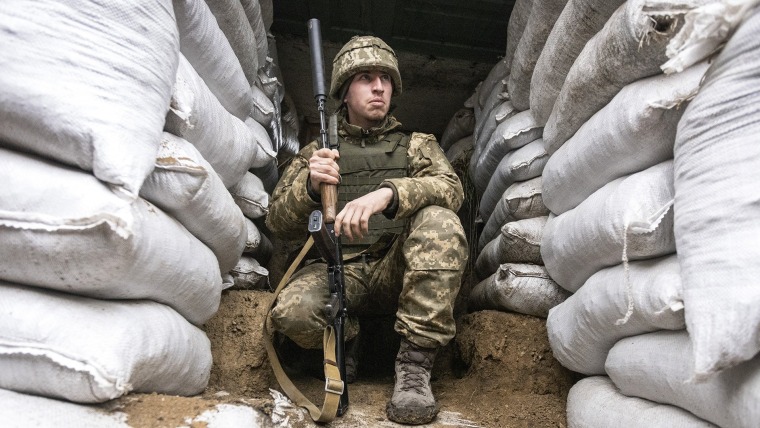
US sends military aid to Ukraine amid Russian invasion tensions
Photo taken from: NBC News
(click or tap to enlargen)
Ukraine is very concerned about the reality of a Russian invasion. According to the BBC, the Ukrainian Defense Minister Reznikov believes the invasion could be as imminent as the early months of 2022. CIA Director William Burns agrees and thinks Russia “could act in a sweeping way”. Russia has accused the United States of providing masses of weapons to Ukraine fueling the conflict. President Putin’s major demands are stopping NATO from expanding into Ukraine, the removal of Western military presence in Eastern Europe, and a wish to return to pre-1997 political borders which would remove counties like Latvia, Lithuania, Estonia, Romania, Bulgaria, and Macedonia from NATO.
This would re-create the Cold War Era “Buffer Zone” around Russia to protect their sphere of influence from Western ideas and values.
It is unclear whether or not sanctions against Russia will be a strong enough deterrent to keep Russia from carrying out an invasion. Ukraine will be a big test for the Biden Administration. Many of the values and ideals that President Biden and the United States will be put to the test by the less than democratic Russian President. The talks between the two leaders and their diplomats in recent weeks have not achieved anything as of yet with both sides claiming that no progress has really been made – and tensions rising. However they have agreed to keep negotiating. The next few weeks should shed light on what Russia will do.
Engagement Resources
Click or tap on resource URL to visit links where available

NATO Relations with Ukraine ( https://www.nato.int/cps/en/natolive/topics_37750.htm )

US Department of State – Ukraine ( https://www.state.gov/countries-areas/ukraine/ )

Update on US-Russian Diplomatic Talks on Ukraine Crisis
Update on US-Russian Diplomatic Talks on Ukraine Crisis
Foreign Policy Brief #140 | By: Abran C | January 20, 2022
Header photo taken from: The New York Times
Follow us on our social media platforms above
Browse more foreign policy briefs from the top dashboard

Jen Psaki said Russia could invade Ukraine within the next month or so.
Photo taken from: The Associated Press
Policy Summary
[SSB theme=”Official” align=”center” counter=”true” ]
On January 10, 2022, US, its NATO allies and Russian officials began a week of talks in Vienna and other European cities in an attempt to de-escalate the rising tensions on the Ukrainian border. The meetings ended without any breakthrough and did not succeed in their key objective: removing the immediate threat of tens of thousands of Russian troops stationed at the Ukrainian border.
Russian officials were angered at NATO’s refusal to guarantee their key demands, that Ukraine never is granted membership to NATO, and that the alliance withdraws its forces from Eastern Europe. Russian Deputy Foreign Minister Sergey Ryabkov suggested the talks had reached a dead-end and stated he didn’t see a reason for the two sides to continue talks. US Secretary of State Anthony Blinken stated that the US would do what was necessary to reinforce Ukraine defensively and economically, “we are planning and putting together things that we have not done in the past”. US officials have also warned of the talks being a false-flag operation to give Russia the pretext for an invasion.
Policy Analysis
As a former Soviet republic, Ukraine is used to having decisions made on its behalf in foreign capitals. Russia’s demands seek to have Ukraine remain in its sphere of influence. Moscow has stated it is threatened by NATO’s expansion eastward towards its borders, having taken in 14 new members from Eastern Europe since the Cold War ended. Ukraine has become Russia’s redline. The US and our NATO allies are attempting diplomacy to engage with Russia and stop an escalation of violence.
US officials have warned that these talks may have been a false-flag operation to allow Russia to assert it had no options left to defend itself if diplomacy fell through. Russia’s list of demands was made to signal to the US and NATO that they should comply or else. We refused, and now we have entered the “or else” timeframe, waiting to see what Russia’s response will be.
For the moment there is still time to avoid an invasion into Ukraine if any sort of comprise or effective deterrent can be reached soon. It had been suggested previously that the build-up of troops along the Ukrainian border may have been a show of force for Russia, to let the West know it meant business but might not actually lead to conflict if its bluff worked.

Photo taken from: The Sun
(click or tap to enlargen)
Whether that action was a show of force, a way to distract the Russian public under the guise of nationalism, reaction to the fear of a democratic Ukraine that might inspire the Russian public, or an attempt to recreate the former Soviet Sphere of influence, with the stagnation of talks, the threat remains high.
The next steps now will depend on if Russian President Vladimir Putin wants to take the gamble of an invasion of Ukraine..
Engagement Resources
Click or tap on resource URL to visit links where available
NATO– NATO is committed to the peaceful resolution of disputes. If diplomatic efforts fail, it has the military power to undertake crisis-management operations.

U.S. Department of State– The U.S. Department of State leads America’s foreign policy through diplomacy, advocacy, and assistance by advancing the interests of the American people, their safety and economic prosperity.

The Need for a Federal Statute To Combat Domestic Terrorism
The Need for a Federal Statute To Combat Domestic Terrorism
Civil Rights Policy Brief #180 | By: Rod Maggay | January 20, 2022
Header photo taken from: Los Angeles Times
Follow us on our social media platforms above
Browse more civil rights policy briefs from the top dashboard

Photo taken from: WSAV-TV
Policy Summary
[SSB theme=”Official” align=”center” counter=”true” ]
On January 11, 2022 Assistant Attorney General Matthew G. Olsen testified before the Senate Judiciary Committee that he has decided to create a new specialized domestic terrorism unit “to augment our existing approach” and “to ensure that these cases are properly handled and effectively coordinated” across the country. Previously, the Department of Justice (DOJ) and the National Security Division (NSD) did not have a group or unit dedicated to only domestic terrorism cases.
The National Security Division of the Department of Justice is comprised of seven sections and offices. The Division has the Counterterrorism Section, Counterintelligence and Export Control Section, Foreign Investment Review Section and the Office of Intelligence. Additionally, it has the Office of Justice for Victims of Overseas Terrorism, Law and Policy Office and an Executive Office. Previously, attorneys in the Counterterrorism Section handled both international and domestic terrorism cases with a majority of the cases being international terrorism cases. LEARN MORE, LEARN MORE
Policy Analysis
In June 2021, the Biden Administration released a national strategy paper titled National Strategy For Countering Domestic Terrorism. The paper proposed four pillars that contained strategy goals to combat the rise of domestic terrorism incidents in the United States. The pillars were [1] understanding and sharing domestic terror related information, [2] preventing domestic terrorism recruitment and mobilization, [3] disrupting and deterring domestic terror activity and [4] confronting long term contributors to domestic terrorism. The national strategy was well – received as a broad all – encompassing plan to combat domestic terror in the United States but the plan lacked some details on how domestic terror investigations and prosecutions would work.
Assistant Attorney General Matthew G. Olsen’s testimony before the Senate Judiciary Committee helped to fill in some of the details. In his testimony, he recounted how his division’s domestic terrorism investigative caseload had doubled since 2020, which were followed by violent and deadly attacks in El Paso, Texas, Pittsburgh, Pennsylvania and Charleston, South Carolina in recent years. Because attorneys from the Counterterrorism Section were handling both international and domestic terror prosecutions the Section simply became overwhelmed when domestic terror incidents began to rise. The creation of this new unit to specialize in domestic terror incidents is intended to help lighten the load of current attorneys to focus on international terror incidents and allow the new unit to focus specifically on homegrown threats within the United States.

Photo taken from: Michael Ciaglo / Getty Images
(click or tap to enlargen)
However, there is one missing piece to the puzzle that stands in the way of allowing domestic terror prosecutions to go forward. Federal law does not have a specific statute that addresses domestic terrorism incidents. There are only laws against international terrorism incidents which would not be applicable in cases against domestic defendants.
The FBI Agents Association has even come out in support of a separate domestic terrorism statute to be enacted. Previously, a “terrorism enhancement” charge was one way prosecutors were able to attach increased penalties to underlying crimes if it was connected to a domestic terror incident. This allowed prosecutors to seek more severe penalties instead of simply charging a domestic terror defendant with a simple trespass or assault. As an illustration, many charges levied against many of the defendants in the January 6th riot are not being charged with a “terrorism enhancement” charge. This will likely result in minor punishments based on only trespass and assault despite extreme politically based violent actions by many of the defendants.
Greater punishments could be had against more of the defendants if only there was a federal domestic terrorism statute. While the unit created by Assistant Attorney General Olsen is exactly what is needed to counter the increase in domestic terror incidents, a federal statute is the one thing that would help the new unit effectively and efficiently address these homegrown dangers. LEARN MORE, LEARN MORE, LEARN MORE
This brief was compiled by Rod Maggay. If you have comments or want to add the name of your organization to this brief, please contact Rod@USResistnews.org.
Engagement Resources
Click or tap on resource URL to visit links where available
White House – Fact Sheet – info sheet on President Biden’s National Strategy for Countering Domestic Terrorism.

Department of Homeland Security – Fact Sheet – infopage on DHS actions to combat domestic violent extremism.