Many Ukrainians closely followed President Volodymyr Zelensky’s visit to Washington, where Ukraine and the United States planned to sign an agreement on rare earth metals. According to the American side, this deal was intended to pave the way for a ceasefire in Ukraine. However, a verbal spat between President Donald Trump, Vice President James Vance, and President Zelensky turned everything upside down.
Foreign Policy
Argentinian Resistance: Austerity’s Failures
The Argentinian people have had enough. On 12 March 2025, the people of Buenos Aires took to the street to protests President Javier Milei’s policy of extreme austerity. The protesters showed anger at the weakness of their pension system exposed by these policies. In reaction, the government sent out police; senior citizens and soccer fans were then blasted with firehoses, teargassed, and shot with rubber bullets Ghastly images and videos have emerged of badly wounded protesters voicing their desperation to the riot police.
The Week That Was: Global News in Review
The United States in early March was added to the CIVICUS Monitor Human Rights Watchlist. CIVICUS is a global research organization that studies and publishes the status of freedoms and threats to civil liberties in various countries around the world each year. CIVICUS has pointed to Trump’s erratic use of executive orders, mass firings of federal workers, dismantling of foreign aid programs, antagonism of journalists and efforts to tamp down pro-Palestinian protests as just some of the reasons for the change in the United States status.
A World Without USAID: Deadly Impact
40% of the U.S. population line our coasts. That equates to approximately 130 million people residing in coastal counties. In addition to those who retire seaside, entire economies are integrated into the coastal industries of fishing, tourism, energy, shipbuilding, and recreation. Even a cursory glance using google maps shows how tightly clustered the built space is, all on only 10% of the total U.S. land mass. Shoreline communities have five times the population density as compared to the U.S. average.
Over a month of Trump: An explanation of new US Foreign Policy
It has been over a month now of the reelected Trump administration, in only a short time Donald Trump has managed to completely rewrite US foreign policy. Old allies are now possible enemies, old enemies are allies. There’s the possibility of the United States annexing and taking land by force, trade wars are on the rise and US soft power and global aid are now a thing of the past.
Navigating Global Governance in a Multipolar World: U.S. Strategy Amid Changing Power Dynamics
40% of the U.S. population line our coasts. That equates to approximately 130 million people residing in coastal counties. In addition to those who retire seaside, entire economies are integrated into the coastal industries of fishing, tourism, energy, shipbuilding, and recreation. Even a cursory glance using google maps shows how tightly clustered the built space is, all on only 10% of the total U.S. land mass. Shoreline communities have five times the population density as compared to the U.S. average.
UCI World Championships in Rwanda
The International Cycling Union (UCI) is the governing-body of cycling throughout the world. This year’s World Championships, held every four years, will take place in and around Kigali, Rwanda. The previous edition of the World Championships was held in the cycling-rich region of Flanders in Belgium. According to Velo, the planned route in Kigali is set to be the hardest course ever for a UCI World Championships. The men’s course is set to be a 268 kilometer slog through the Rwandan mountains (with more climbing than previous World Championships set in the European Alps) and the women’s race will be a similar slog through the mountains but a bit shorter at only 165 kilometers.
Trump Leaves the WHO: A Dangerous Era for Our Health
No one in this world deserves to get sick. It is a condition that ranges from a day-long tedium to the unfortunate conclusion of one’s life. From both extremes and everything in between, illness is a state of being humanity could live without, or at least with a reduced frequency.
Week That Was: Global News in Review
US-Russia Talks in Saudi Arabia, Civil War in Sudan Nears Two Year Anniversary, China Restricts Certain Ethnic Groups from Leaving the Country, and Argetina’s Crypto Scandal
Gazans Face a Precarious and Uncertain Future
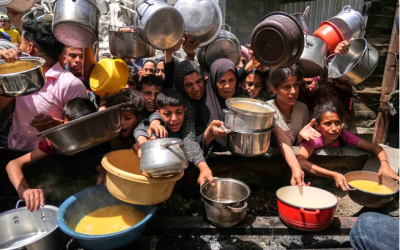
Israel’s assault on Gaza has decimated its people and infrastructure. Rebuilding will take decades, and in the meantime, the population remains dependent on international aid. Not only has Israel put drastic new restrictions on United Nations aid, but Donald Trump is pulling US funding for UN aid programs, suggesting that Palestinians should be forced out, the US take over and “build a Middle East Riviera there.
Trump on USAID: The End of American Soft Power
In the three weeks of Donald Trump’s second term as President of the United States, he has singlehandedly stunted America’s ability to project soft power. Taking actions like ending most foreign aid and withdrawing from treaties like the Paris Climate Agreement, Trump’s America First isolationist policies will be devastating to the United States’ credibility and strength, and to the rest of the human race’s ability to remain safe, healthy, educated, and alive.
Ownership in Emerging Frontiers: Outer Space and Cyberspace
The ownership of outer space and cyberspace has become a critical issue as humanity expands its activities into these domains. Outer space, once the realm of government-led exploration, is now increasingly commercialized with private companies launching satellites, planning lunar missions, and pursuing asteroid mining