

JOBS POLICIES, ANALYSIS, AND RESOURCES
Latest Jobs Posts
The Race to ’24: Trump and his detractors, how the Republican field is shaping up
Brief #79 – Elections & Politics Policy
by Abigail Hunt
The 2024 Presidential election is pivotal – will we be able to continue the democratic policies of the past four years?… It is too early to say which of the candidates will cement the nomination, though DeSantis’s fundraising capabilities and name recognition give him an early advantage.
For Republicans, “Parent Choice” is About Power, not Freedom
Brief #83 – Education Policy
by Rudolph Lurz
During a debate in the 2021 Virginia gubernatorial campaign, Terry McAuliffe… stated, “I don’t think parents should be telling schools what they should teach.”
An Update on Foreign Military Support for Ukraine
Brief #77 – Foreign Policy
by Yelena Korshunov
European leaders agreed on the transfer of new large packages of military aid to Kyiv… will the new round of arms deliveries to Ukraine make the country ready for a counteroffensive?
Important Tech Accountability Measures in California May Get Picked Up by Congress
Brief #88 – Technology Policy
by Mindy Spratt
Two measures being considered by the California State Legislature would rein in egregious practices by tech companies that critics have long complained about.
The End of Title 42 and a New Beginning for Immigration Policy
Brief #133 – Immigration Policy
by Arvind Salem
On May 11th at 11:59 PM EDT, a pandemic-era immigration policy deriving from a law known as Title 42 expired after being in effect for over 3 years.
An Early Look at the 2024 Race for the Republican Presidential Nomination
Brief #77 – Elections & Politics Policy
by Ian Milden
The race for the 2024 Republican presidential nomination has started to develop.
The Week That Was: Global News in Review
Brief #76 – Foreign Policy
by Abran C
This is our 7th in a series designed to help our readers catch up on international events of the past week.
Help Wanted: Seeking Support for Unaccompanied Children
Brief #147 – Social Justice Policy
by Steve Piazza
This is the second part of a report on how child labor laws are failing to protect minors from work related abuses and the implications that has for their education.
Two Judges Have Opposing Rulings, and Backgrounds, on Abortion Rights
Brief #161 – Health & Gender Policy
by Geoffrey Small
Last month two federal judges issued contradictory rulings on the abortion medication mifepristone, the most commonly used procedure in the United States.


China’s “Zero-COVID”: Was it worth it?
China’s “Zero-COVID”: Was it Worth it?
Health and Gender Policy Brief #154 | By: Geoffrey Small | January 30, 2023
Header photo taken from: Kevin Frayer / Getty Images
Follow us on our social media platforms above
Browse more health and gender policy briefs from the top dashboard

Photo taken from: Reuters
Policy Summary
[SSB theme=”Official” align=”center” counter=”true” ]
During December, 2022, citizens of China took to the streets and sparked a mass protest against the government’s “zero-COVID” policies that had been in place for over two years. According to Human Rights Watch, prolonged lockdowns, administered unpredictably, by the CCP (Chinese Communist Party) have hampered accessibility to necessities like food and proper healthcare. This is especially true for more vulnerable populations like senior citizens.
Videos online show COVID-19 control workers and police dragging and beating people who resisted the lockdowns. Journalists have also been targeted for reporting on COVID-related information and the authoritarian methods that the government used to control outbreaks. It is well known that China has the largest population in the world, with a cultural emphasis on supporting a collective society. However, was a draconian-style lockdown worth it? Comparing metrics between China’s policies and the United States may offer some insight.
Policy Analysis
Rate of Infection
It is well known that the CCP philosophy on transparency runs in contrast to basic principles of a free market democracy like the United States. The reported data on the rate of China’s infection, hospitalization, and deaths have not been entirely accurate or consistent. However, as the pandemic draws to a close, more accurate reports are coming out of China, as they recently abandoned their “zero-COVID” policy.
According to Reuters, Wu Zunyou, chief epidemiologist at the China Center for Disease Control and Prevention, reported that 80% of the population in China has been infected. From December 8th to January 12th, Reuters also reported that 59,938 Chinese patients died in hospitals, which is a significant increase from previously reported figures during the “zero-COVID” policy era.
Chart taken from: The Pew Research Center
(click or tap to enlargen)

The United States’ recent medical reports indicate about half of the population has reported infections with COVID-19. The CDC also reported that 17,158 people have died from infection between December 10th and June 14th. When factoring in China’s significantly larger population, the rate of deaths between the two countries during that timeframe are relatively similar.
Vaccine Effectiveness
Chinese officials have stated that their overall vaccination rate is about 90%. However, 30% of the elderly 60 and up have not been vaccinated. 60% of citizens 80 and older also remain unvaccinated. According to the CDC, The United States two-dose vaccination rate is closer to 69% with 94% of citizens 65 or older vaccinated.
When it comes to vaccine development, there is plenty of misleading information stating that Chinese-developed vaccines CoronaVac and Sinopharm are far less superior to Moderna and Pfizer. Despite this misinformation, China could have benefited from a non-isolationist approach to vaccine development. According to NPR, studies conducted on these vaccines indicate they all offer a high rate of protection. Pfizer’s efficacy rating was 95% to 97%, compared to CoronoVac’s 89% to 94%. However, CoronaVac tests showed that the first two doses provided significantly less protection for older adults when compared to Pfizer.
China’s “zero-COVID” policies will always be subjected to criticism when it comes to the draconian, isolationist, and authoritarian methods they used to keep the virus under control. Its important to donate to organizations like Human Rights Watch in order for the public to understand that authoritarian methods of controlling a pandemic are not more effective than a democratic society’s.
Engagement Resources
Click or tap on resource URL to visit links where available

https://donate.hrw.org/page/107245/donate/1?ea.tracking.id=EP2022EVpgdonate&promo_id=1000

The Impact of Social Media on Politics and Society
The Impact of Social Media on Politics and Society
Technology Policy Brief #52 | By: Inijah Quadri | January 22, 2023
Header photo taken from: kyspp.nus.edu
Follow us on our social media platforms above
Browse more technology policy briefs from the top dashboard

Photo taken from: Chris Hale / CQ Roll Call
Policy Summary
[SSB theme=”Official” align=”center” counter=”true” ]
Social media has revolutionized the way we communicate, access information, and engage with politics and society. Platforms such as Facebook, Twitter, and TikTok have become an integral part of our daily lives, connecting us with friends and family, news, and entertainment. However, the influence of social media on politics and society is a complex and multifaceted issue, with both positive and negative consequences.
This brief aims to explore the ways in which social media is shaping the political and social landscape, focusing on the messaging, approach, and audience of different platforms.
Messaging on Social Media
One of the most significant ways in which social media is impacting politics and society is through the messaging that is shared on these platforms. Social media allows individuals and organizations to disseminate information and ideas to a large audience in a relatively short amount of time. This has led to an increase in the amount of information available to the public, but it has also created a space for misinformation, disinformation, and the spread of conspiracy theories.
For example, during the 2020 US Presidential Election, there were numerous instances of misinformation and disinformation being spread on social media platforms. Misinformation about voter fraud and the integrity of the election was widespread, and it was amplified by politicians and influencers with large social media followings.

Photo taken from: Shutterstock
(click or tap to enlargen)
This led to confusion and mistrust among the public, and it played a role in the events that occurred on January 6th, 2021 when a mob of Trump supporters stormed the US Capitol.
Approach of Social Media Platforms
The approach of social media platforms is also playing a significant role in shaping the political and social landscape. Platforms like Facebook and Twitter have been criticized for not doing enough to combat misinformation and hate speech. These platforms have relied on user-generated reports to flag content that violates their policies, but this approach has been criticized for being slow and ineffective.
Audience of Social Media Platforms
The audience of different social media platforms also plays a role in shaping the political and social landscape. Platforms like Facebook and Twitter have a broad and diverse audience, while newer platforms like TikTok and Parlor tend to have a more niche audience. This can lead to a self-reinforcing echo chamber, where individuals are only exposed to information and ideas that align with their existing beliefs.
In addition, a study by the Pew Research Center found that individuals who primarily get their news from social media are more likely to have politically polarized views and to be less informed about current events. This is because social media algorithms tend to prioritize content that is likely to generate engagement, such as content that is controversial or that aligns with the user’s existing beliefs. This can lead to a situation where individuals are exposed to a narrow range of information and ideas, which can reinforce their existing beliefs and biases.


Charts taken from:
The Pew Research Center
(click or tap to enlargen)
Right-Wing Platforms
There are also social media platforms specifically catering to right-wing audiences, such as Truth Social and Parlor. These platforms have been criticized for promoting conspiracy theories and hate speech, and for not taking enough action to combat misinformation.
Additionally, some of the users of these platforms have been linked to far-right and extremist groups, raising concerns about the promotion of hateful and dangerous ideologies.
Impact on Democracy
The impact of social media on democracy is a contentious issue. On the one hand, social media allows for a more engaged and informed citizenry, as individuals can easily access information and engage in political discussions. Additionally, social media has been credited with helping to mobilize political movements, such as the Arab Spring and the Black Lives Matter movement.
On the other hand, social media can also have negative effects on democracy. The spread of misinformation and disinformation can lead to confusion and mistrust among the public, which can erode the foundations of democracy. Additionally, social media can be used to amplify the voices of extremist and fringe groups, which can skew the political discourse and undermine the democratic process.

Photo taken from: Justin Tallis / AFP
The Role of Governments and Regulators
The impact of social media on politics and society has led to calls for increased regulation of these platforms. Governments and regulators have been criticized for not doing enough to combat misinformation and hate speech, and for not holding these platforms accountable for their actions.
For example, the European Union has proposed a new regulation called the Digital Services Act, which would require social media platforms to take more responsibility for the content that is shared on their platforms. Additionally, the US Congress has held multiple hearings on the role of social media in the spread of misinformation and disinformation, and there have been calls for increased regulation of these platforms.
Conclusion
In conclusion, the impact of social media on politics and society is a complex and multifaceted issue. While social media has provided individuals and organizations with new and powerful ways to communicate and engage with politics and society, it has also created a space for misinformation, disinformation, and the spread of conspiracy theories.
It’s important for social media platforms to take a more proactive approach in combating misinformation and promoting verified content, and for governments and regulators to hold these platforms accountable for their actions. Additionally, individuals need to be more critical of the information they encounter on social media and seek out diverse sources of information to form a well-rounded understanding of current events and issues.
Engagement Resources
Click or tap on resource URL to visit links where available

Center for Digital Society: (https://cfds.fisipol.ugm.ac.id/2021/12/09/the-age-of-fake-news-how-fake-news-marred-the-2020-u-s-presidential-election/)

Chron (https://smallbusiness.chron.com/facebook-avatar-rules-27201.html)

European Commission (https://digital-strategy.ec.europa.eu/en/policies/digital-services-act-package)


Pew Research Center (https://www.pewresearch.org/journalism/2014/10/21/political-polarization-media-habits/)

The SoapBox (https://newrepublic.com/article/168214/west-parler-truth-social-failing)

Twitter (https://help.twitter.com/en/safety-and-security/sensitive-media)

January 10th Revealed the Need to Update Our Aviation Safety Technology
January 10th Revealed the Need to Update Our Aviation Safety Technology
Technology Policy Brief #51 | By: Steve Piazza | January 21, 2023
Header photo taken from: Jeenah Moon / The New York Times
Follow us on our social media platforms above
Browse more technology policy briefs from the top dashboard

Photo taken from: Charles Rex Arbogast / The Associated Press
Policy Summary
[SSB theme=”Official” align=”center” counter=”true” ]
The Federal Aviation Administration (FAA) requires that all pilots receive NOTAMs (Notice To Airmen, or Notice to Air Missions in the United States) prior to takeoff. The purpose of these notifications is to provide pilots with information regarding obstacles they may encounter along the way.
Currently, pilots receive NOTAMs through the Federal NOTAM System (FNS), which gathers information from the source of the problem and disseminates it via text so it is available during pre-flight preparations.
Due to a recent technical issue that eventually resulted in the grounding of all commercial and private aircraft in the U.S., attention has been thrust upon aging industry technology in a communication system which has grown exponentially since it was first deployed.
Policy Analysis
On the evening of January 10, while performing regularly scheduled maintenance, an engineer mistakenly replaced a crucial file with one that was corrupt, preventing the NOTAMs from loading and disseminating.
After hours of unsuccessfully rebooting the system, all domestic flights were grounded. It wasn’t until 9:00 AM the next morning that the situation had been remedied and the flight ban lifted. According to Flightaware.com, the entire episode caused the delay of more than 11,000 flights and cancellation of another 1300.
Canada also experienced a similar technical issue which may or may not be related. But, because their system is more advanced and they have less air traffic, they did not experience such a disruption.
The FAA was quick to say that terrorism had been ruled out and called it a technical problem. But without a proper backup system that is nothing more than analog phone equipment rather than current, more reliable technology, whatever they call it should be an indication that the industry is in a crisis.
In plain terms, the present but outdated air transportation infrastructure places travelers and the general public at serious risk.
To begin with, the NOTAM system is almost 30 years old. The practice itself actually started in 1947, which was based on a Notice to Mariners developed by the US Navy way back in 1869.

Photo taken from: Seth Wening, The Associated Press
Ever since the existing system’s deployment in 1993, air traffic controllers, pilots, and other airline personnel receive NOTAMs via text messages traveling along aged teletype networks. This format, which includes the required use of presenting information in all caps, makes messages very difficult to read for pilots already faced with overwhelming, but crucial pre-flight protocols.
An example of their cumbersome nature is this text from a 235 word NOTAM message regarding airspace around San Angelo, Texas: …
SPECIAL SECURITY INSTRUCTIONS, ALL ACFT FLT OPS ARE PROHIBITED: WI AN AREA DEFINED AS 5NM RADIUS OF 311647N1002234W (SJT135007.0) 3500FT MSL-FL180 EFFECTIVE 2301152100 UTC (1500 LOCAL 01/15/23)….

Photo taken from: The Federal Aviation Association
The extreme volume of messages also presents difficulties. The number of messages have tripled in the last 10 years and will soon surpass 1 million per year. Sometimes obstacles are easily overlooked because of the amount of information transmitted. Some users have even said they have at times ignored them because they’re too unwieldy.
Minor steps to make information easier to access and read have been taken. NOTAM communications are now available in digital format, so if flight personnel feel the need to research information on flying conditions, they can use web based applications like FNS NOTAM Search. NOTAM Search is a typical webpage database function where the end user enters a query such as date and location information to get access to the notices.
Other resources that provide additional data, community support, or tools for developers include the FNS NOTAM Distribution Service (FNS NDS) and the NOTAM Application Programming Interface (API) .
Unfortunately, out of synch steps like these are not enough, and solutions for the needed overhaul of the NOTAM system have been proposed. These include automated notifications written in clear sentences and updated graphical interfaces that even show airport diagrams and taxi lanes. Yet, at last discussion, such improvements could take up to six years to implement.
Transportation is not the only area of the government that has been in need of technology upgrades. The Technology Modernization Fund established in 2017 has helped 15 federal agencies with over $400 million in IT upgrades.
But other agencies, such as the Social Security administration and the Small Business Administration, like Transportation are still in dire need.
The recent events of January 10-11 may speed things along for NOTAMs in particular. But as long as there are partisan Congressional stalemates, such as the delayed vote on President Biden’s pick as FAA Director, such upgrades may just have to remain on the ground.
Engagement Resources
Click or tap on resource URL to visit links where available

If you’re interested in real time flight data, click here:

The FAA provides a glimpse into how they’ve modernized NOTAMs to date:
https://www.faa.gov/about/initiatives/notam

Flyer’s Rights is a consumer advocacy group that is highly dedicated to making change at the federal level: https://flyersrights.org/

The International Civil Aviation Organization is an agency of the United Nations that advocates for civil aviation system safety around the world. Amongst other things, a search also provides access to NOTAMs: https://www.icao.int/Pages/default.aspx

Russia Continues to Kill Ukrainians. Children are Targeted.
Russia Continues to Kill Ukrainians. Children are Targeted.
Foreign Policy Brief #166 | By: Yelena Korshunov | January 23, 2023
Rubbles of a recently attacked residential building in Dnipro, Ukraine.
Header photo taken from: facenews.ua
Follow us on our social media platforms above
Browse more foreign policy briefs from the top dashboard

Photo taken from: unian.ua
[SSB theme=”Official” align=”center” counter=”true” ]
Russia’s missile killed 46 people in Dnipro on January 14th, among them 5 children
On January 14th a Russian missile hit a residential high-rise building in Dnipro – a big industrial Ukrainian city. According to the head of the Ukrainian regional military administration, Valentin Reznichenko, on January 17th the removal of rubble had been going on for more than 60 hours. At that moment, 90% of the wreckage of the destroyed nine-story building had been dismantled.

Photo taken from: dw.com
Reznichenko reported that 39 people were rescued, 46 died, 79 were injured, including 16 children. There are now 28 injured in hospitals, 10 are in serious condition. 25 residents of the house are still being searched.
These five beautiful kids in the photo below are among those whose lives were taken by a Russian missile that day. They are among about 1,000 children who were killed or injured during Russia’s war in Ukraine.
Image taken from: euromaidanpress.com
(click or tap on image to enlargen)

27-year-old Kateryna Zelenska was rescued from under the rubble after more than 20 hours. Her body temperature was 31°C (87.8°F). Her husband and one-year-old son died under the rubble. Kateryna was deaf from birth and unlike other victims couldn’t call for help during “minutes of silence,” when rescuers were listening from where under the rubble people were calling for help.


Photos taken from (clockwise from top left):
Katerina’s Instagram; Euromaidan Press; Facebook of Denys Monastyrskyi, Minister of Internal Affairs
Refugees from Donetsk and Luhansk were affected by blast wave in the dormitory that stands near the attacked building
Ukrainian portal Tehnopolis(tehnopolis.com.ua) told their audience about what happened in the dormitory of the Dnipro Academy of Physical Culture and Sports that stands a few meters from the house that was hit by a Russian rocket on January 14. The windows are broken, the building is cut with debris – this is how the house, where about a hundred displaced persons from the Donetsk and Luhansk regions had found shelter, looks like today. During the missile attack the blast wave blew out the windows of the building.
Currently, there is no electricity, water and gas in the dormitory. The woman whose name is Olga moved to Dnipro from Eastern Ukraine in April. She says she was asleep during the explosion. “I was in such a shock. I didn’t understand anything. The windows flew out, the panes were flying at us. My husband said: “Come on, crawl into the corridor, it’s safer there, because the rocket hit somewhere”. We heard people’s screams, moaning. Smoke was pouring out. Firefighters arrived fast,” she recalls. Olga was also injured – her fingers were cut by glass.
Meantime in Russia
Some residents of Moscow brought flowers, candles and toys to the monument of Ukrainian poetess Lesya Ukrainka after a Russian missile hit the building in Dnipro, injuring and taking the lives of many people. On the night of January 18, the spontaneous memorial was removed by officials.
A police paddy wagon has been on duty at the site. It’s known that the police detained four people. One of them is charged with petty hooliganism, he was left at the police station until the morning. What happened to the rest of the detainees is unknown.

Location Data Still Putting Abortion Seekers At Risk
Location Data Still Putting Abortion Seekers At Risk
Health & Gender Policy Brief #153 | By: Mindy Spatt | January 20, 2023
Header photo taken from: CNN
Follow us on our social media platforms above
Browse more health and gender policy briefs from the top dashboard

Photo taken from: Electronic Frontier Foundation
Policy Summary
[SSB theme=”Official” align=”center” counter=”true” ]
After the Supreme Court’s decision in Dobbs and resultant abortion bans, online access to abortion information became increasingly important, and advocates for choice began expressing concern about the vulnerability of location data. With criminal penalties possible in some states, the data could potentially be used by prosecutors to track visits to abortion clinics or to their websites.
Google vowed to fix the problem (See Technology Policy Brief # 68), but recent tests by advocates and researchers show that location data related to abortion is still being collected and sold to brokers, and a new broker, Fog Reveal, is specifically marketing location and other personal data to law enforcement.
Policy Analysis
After Google publicly committed to deleting user location history related to abortion clinics and their websites, a research team at the University of Pennsylvania’s School of Medicine and Carnegie Mellon’s Cy Lab ran tests to find out whether location data from abortion clinic webpages was still being collected and whether it was available through data brokers.
Their findings were extremely disturbing; 99% of the webpages of the abortion clinics surveyed had third-party trackers embedded in their sites. Not just one, an average of nine per clinic.
The researchers then looked at where those trackers were sending the data to, and found that that 97.3% of the web pages reported the data to Alphabet (Google), 38.1% reported to Meta (Facebook), 32.7% to Adobe Systems, and 25.1% to Microsoft. There are few limits on the selling and reselling of tracked information from healthcare websites, which doesn’t enjoy the same privacy protections as other medical information.
The nonprofit advocacy group Accountable Tech also tested Google’s new policies by visiting abortion clinics with Android phones and then checking to see whether data related to those visits was being stored by Google. They found that “Google is still retaining location search queries by default, and location history for users who have it turned on – including for reproductive care facilities…”
The data is easily available to law enforcement thanks to a recent entry into the data broker business, Fog Reveal, a platform that gives law enforcement easy access to location data and a trove of other potentially identifying information.
According to the Electronic Frontier Foundation, “Virginia-based Fog Data Science sells a service that it bills as allowing police to see where a person was at any point in time over the past several years. This surveillance not only includes possible crime scenes, but also homes, churches, workplaces, health clinics, or anywhere else.”

Photo taken from: Tom Williams / Associated Press
(click or tap to enlargen)
The University of Pennsylvania researchers also recommend that healthcare organizations eliminate or take steps to minimize their use of apps and other third party features that require or enable tracking.
EFF found that Fog Data currently has at least 18 contracts with law enforcement agencies and its marketing materials claim it has “billions” of data points about “over 250 million” devices, and that its data can be used to learn where targets work, live, and associate.
All of the advocates are urging passage of privacy legislation including the American Data Protection and Privacy Act as well as further action by Google.
Accountable tech concluded that Google can and should stop collecting and retaining user location data – and enact the changes it previously announced. As long as Google retains the data, it could be forced to hand it over to law enforcement. The FCC could also tighten its rules on cell phone location tracking.
EFF’s research on Fog Reveal caught the attention of Representative Ana Eschoo (D- CA) who has urged the Federal Trade Commission to investigate the company. In a letter to the agency she said:
“…tools like Fog Reveal may present new threats as states across the country pass increasingly draconian bills restricting people’s access to abortion services and targeting people seeking reproductive healthcare.
The use of Fog Reveal is also seemingly incompatible with protections against unlawful search and seizure guaranteed by the Fourth Amendment. Consumers do not realize that they are potentially nullifying their Fourth Amendment rights when they download and use free apps on their phones.”
Engagement Resources
Click or tap on resource URL to visit links where available

Post-Roe, Google’s Data Collection and Policies Could Endanger Those Seeking Abortions, November 29, 2022, https://accountabletech.org/research/googles-data-collection-and-policies-could-endanger-those-seeking-abortions/

Prevalence of Third-Party Tracking on Abortion Clinic Web Pages, Ari B. Friedman, Lujo Bauer ; Rachel Gonzales, Matthew S. McCoy, JAMA Intern Med. September 8, 2022

Important Elections in the First Half of 2023
Important Elections in the First Half of 2023
Elections & Politics Policy Brief #50 | By: Ian Milden | January 17, 2023
Header photo taken from: RFCP (.org)
Follow us on our social media platforms above
Browse more elections and politics policy briefs from the top dashboard
Policy Summary
[SSB theme=”Official” align=”center” counter=”true” ]
While the start of the presidential race tends to get most of the election coverage around this time of year, there are a couple of important elections in the early months of 2023. This brief will discuss two of these races and why they matter.
Policy Analysis

Photo taken from: NBC12 (.com)
Virginia’s 4th Congressional District
After Congressman Donald McEachin (D-VA) passed away on November 29th, a special election was ordered to fill the vacancy in Virginia’s 4th congressional district. The special election will be held on February 21st. Democrats nominated state senator Jennifer McClellan. The Republicans nominated Leon Benjamin. Benjamin was the Republican nominee who lost to McEachin in 2020 and 2022. Early voting has already started and will go on until February 18th.
Virginia’s 4th Congressional district is based around Richmond. McEachin won over 60% of the vote in 2022, so this is a district that Democrats should be heavily favored to win. Special elections tend to feature low voter turnout rates, so margins can vary wildly based on who shows up to vote. The margins in special elections can provide indications of what voters might do in upcoming elections. For example, Democrats started to overperform expectations in special elections in 2022 after the Supreme Court overturned Roe vs Wade, which foreshadowed Democrats performing relatively well in the 2022 mid-term elections.
If Democrats retain the seat in Virginia’s 4th district, it won’t give them the House majority, but it will provide Democrats with a little more leverage in negotiations by giving Republicans a smaller margin for error on party-line votes. Having this seat filled by a Democratic incumbent will also be one less seat for the Democratic Congressional Campaign Committee to worry about in 2024. Democrats should hold this seat, but sometimes crazy things happen in special elections.

Photo taken from: PBS Wisconsin
Wisconsin Supreme Court
Wisconsin voters will also get to vote on February 21st. Instead of voting for members of Congress, they will get to vote for state judicial officials. This includes filling an open seat on the state supreme court.
Justice Patience Roggensack has decided to retire after serving two ten-year terms. Roggensack was part of a four-member conservative majority on the court. Since the court has seven seats, the newly elected Justice will determine the ideological balance of the court. The term of Justice Roggensack expires at the end of July.
Four candidates are running for state Supreme Court Justice. The top two finishers in the non-partisan election on February 21st will advance to the general election on April 4th. The four candidates are former state Supreme Court Justice Dan Kelly, Waukesha County Judge Jennifer Dorow, Milwaukee County Judge Janet Protasiewicz, and Dane County Judge Everett Mitchell. Kelly and Dorow are campaigning as conservatives. Judge Protasiewicz and Judge Mitchell are expected to join the progressive justices on the court if they are elected.
The state Supreme Court would have the ability to rule on legal disputes related to the elections in Wisconsin. This includes Gerrymandering cases, which have a significant impact on the partisan distribution of seats in the U.S. House and the state legislature. The state Supreme Court also can rule on state policy decisions that are challenged in court. This authority can lead to major changes in public policy. Areas of public policy they can rule on include (but are not limited to) abortion, labor, and public health.
The state Supreme Court has the power to resolve disputes between the Governor and the state legislature. Given the conservative majority on the court, most of these disputes have been resolved in favor of the Republican-controlled state legislature rather than the Democratic Governor.
For example, the conservative majority on the Wisconsin Supreme Court ruled against Governor Tony Evers’ emergency orders related to the Covid-19 pandemic. This significantly limited the governor’s authority to make public health rules to combat the pandemic. If Judge Protasiewicz or Judge Mitchell is elected, the state Supreme Court would likely reach a different verdict in similar cases in the future.
Unlike the special election in Virginia, I don’t have an indication of who is likely to win. It will be a low-turnout election due to the timing of the election and the offices on the ballot. While the race is technically non-partisan, political party organizations in the state get involved in turning out voters for their preferred candidates. This race is worth keeping an eye on because it would have implications for any legal disputes about upcoming elections in the state.
Engagement Resources
Click or tap on resource URL to visit links where available

Wisconsin Democratic Party

Jennifer McClellan for Congress
https://jennifermcclellan.com/

Judge Protasiewicz’s Campaign Website
https://www.janetforjustice.com/

Judge Mitchell’s Campaign Website

The Week That Was #2
The Week That Was #2
Foreign Policy Brief #165 | By: Abran C | January 18, 2023
Header photo taken from: Ina Fassbener / AFP
Follow us on our social media platforms above
Browse more foreign policy briefs from the top dashboard
A new series to catch you up on the top stories that occurred around the world last week.

Photo taken from: Evaristo Sa / Getty Images
[SSB theme=”Official” align=”center” counter=”true” ]
Invasion of the Brazilian Congress
On January 8, 2022 thousands of far right insurrectionists stormed the Brazilian congress and supreme court in an event reminiscent of the January 6, 2021 capitol attack in the United States.
In addition to the similar time of year, the reason behind the insurrection in Brazil is eerily similar to the attack on the US capital in that supporters of the outgoing president claim the election was stolen. Rioters attempted to remove left-wing President Lula Da Silva from office. The insurrectionist made it into the inner sanctum of what should have been one of Brazil’s most secure locations, leaving a trail of destruction in their wake. Many have sinced questioned how such a politically sensitive building could have been left so exposed.
Like in the US, the warning signs were apparent for some time, with election deniers mobilizing on social media ahead of the attack and former President Bolsonaro claiming foul play. Celso Amorim, Brazil’s former defense minister, said he was struggling to fathom how security forces and intelligence agencies had failed to detect or stop the threat.
The mob ultimately failed to reach the offices of President Lula. Brazil’s former Minister of Justice and Public Security under Bolsonaro, Anderson Torres, was in charge of security in Brasilia during the invasion, and has been arrested on suspicion of “omission” and “connivance”. Former President Bolsonaro himself has been on vacation in Florida and has yet to return to Brazil or comment on the recent attack by his supporters.
Serbia and Kosovo tension
Last week NATO denied Serbia’s request for NATO troops to be deployed in the Balkans for the first time since the end of the Bosnian war in 1999. Serbia requested to deploy troops in Kosovo in response to clashes between Kosovo authorities and Serbs in Kosovo’s northern region.
Last month the Serbian army was put on high alert as tensions continued to increase between Serbs and Albanians. Serbia does not recognise Kosovo as an independent state, nor do the ethnic Serbs who live there. Tensions have become particularly high over the past few months, with ethnic Serbs withdrawing all co-operation with Kosovo authorities and blocking crossing points between Serbia and Kosovo.
Tensions between Belgrade and Pristina have ebbed and flowed since Kosovo’s declaration of independence from Serbia in 2008. Kosovo, which has an overwhelmingly ethnic Albanian majority, broke away from Serbia after a war in 1998-99.

Photo taken from: Armend Nimani / AFP via Getty Images
(click or tap to enlargen)
After the most recent tensions that arose due to alleged reports of ethnic Serbs coming under attack NATO peacekeepers have faced calls from Belgrade to protect Serbs, as well as demands from Pristina to dismantle the barricades between the two countries. NATO has rejected these calls from either side thus far.
Climate Standoff at Lützerath, Germany

Photo taken from: Life Gate
Germany suffering from an energy crisis as a result of the war in Ukraine has had to make consessions opposing its climate goals for 2030. The small town of Lützerath was mostly abandoned after 1000 police were involved in an eviction operation. The town has become a battle ground between activists and the government and a symbol in the fight against climate change. For the past two years activists have attempted to protect the village from being bulldozed to make way for the opencast lignite mine.
German police in riot gear have begun removing protestors from the village and property belonging to RWE, the company which owns the village’s land and houses.The company has the backing of the provincial government. RWE has said it’s necessary to mine the large lignite reserves under the town, to help address Germany and Europe’s sky-rocketing energy prices amid Russia’s war on Ukraine. Still several hundred climate activists moved into the town of Luetzerath weeks ago to resist further mining and it is expected that thousands more will join the protests.

The Ukraine Crisis: Situation Update: #18
The Ukraine Crisis: Situation Update: #18
Foreign Policy Brief #164 | By: Abran C | January 13, 2023
Header photo taken from: The Associated Press
Follow us on our social media platforms above
Browse more foreign policy briefs from the top dashboard
This is the 18th in a special U.S. RESIST NEWS series that updates our readers on the latest developments in Russia’s invasion of Ukraine.

Photo taken from: EPA-EFE / MYKOLA TYMCHENKO
Battle for Soledar
[SSB theme=”Official” align=”center” counter=”true” ]
As we approach the one year anniversary of the invasion of Ukraine on February 24, 2022, Ukranian troops are currently entrenched in heavy fighting in the small salt mining town of Soledar. The town lies at the center of the Donbas region, the vast eastern part Ukraine of which Russia has annexed as its own territory late last year. The two sides involved in the fighting for this town, however, are not both official military forces, rather, on the Russian side it is the infamous Wagner mercenary group fighting to capture the town.
The military significance of Soledar itself is minimal, but it is only a few miles northeast of the larger city of Bakhmut, which Moscow has struggled to capture for months, and has become perhaps the most contested city in the on the eastern front. Capturing Soledar would provide an eastern entry into Bakhmut. and would be a symbolic PR win for the private military Wagner group and its owner- Russian oligarch Yevgeny Prigozhin- who has criticized the defense ministry’s management of the war in Ukraine and is likely attempting to position himself for a larger role in the war
Due to the intense fighting and non-state actors involved, getting clear and definitive information has been difficult. Yevgeny Prigozhin of the Wagner group on Tuesday said that Wagner mercenaries were in total control of the town, yet the Kremlin had not claimed victory itself. Meanwhile Serhii Cherevatyi, spokesman for the Eastern group of the Ukrainian Armed Forces, said that Ukrainian forces were supplying troops with ammunition and food, describing the situation as “under control”. Conflicting claims from either side has been common throughout this conflict and with the addition of private military contractors it is likely information will become more obscure.
The Russian armed forces have had nothing to claim as victory since the beginning of July. In recent months, they have had to retreat in both Kharkiv to the north and Kherson in south. The capture of Soledar, despite its lack of importance strategically, and a path to the city of Bakhmut would therefore be something to uphold as a positive development in the Russian war effort that has until now been a near complete failure. Conversely, for Ukrainians, the ability to continue to hold out and repel Russian attacks in this small town claimed by the Kremlin as part of Russian territory as we near the one-year anniversary will represent a major victory.
New Year New War tactics
Western powers have promised to begin sending more advanced weaponry to Ukraine. France, Germany, and the US announced on Wednesday that they would be sending light armored fighting vehicles to the battlefield. These weapons are a sign of increasing armaments being sent to Ukraine, and though beneficial to the Ukranian effort, they are not likely to beat back the invading army and retake the Eastern territories lost in the Russian annexation.
Ukrainian officials have been pushing for more heavy weaponry but Western powers have been hesitant in sending them.There are debates among officials about the extent to which Ukraine should be armed by the US, with some feeling more advanced weaponry may help bring about a swifter end to the now protracted war, and others believing arming Ukraine will only prolong fighting.
There is of course also the danger that arming Ukraine with advanced weaponry would be seen as a provocation by Russia and cause an even further increase in hostilities.

Map taken from: Institute for the Study of War
(click or tap to enlargen)
Russia in its latest military shake up has appointed Valery Gerasimov as overall commander of the war. Gerasimov played key role in Russia’s seizure of Crimea in 2014 and in Russia’s military support for President Bashar al-Assad in the Syrian Civil War. The Kremlin had recently appointed a new commander in October but in light of a host of defeats by the Russian army the previous commander was demoted.
Gerasimov’s appointment is a sign the Kremlin seeks to intensify the war and reverse the course of its string of defeats. Whatever course of actions are taken in the coming weeks and months, 2023 thus far seems to be a year that will see continued conflict in Ukraine.

Who Will Be the Gatekeepers in 2023?
Who Will Be the Gatekeepers in 2023?
Technology Policy Brief #78 | By: Mindy Spatt | January 11, 2023
Header photo taken from: Sitra
Follow us on our social media platforms above
Browse more technology policy briefs from the top dashboard
Supreme Court Will Consider Whether Social Media Companies Should Be Liable for Damage Caused Through Their Platforms and More Closely Regulated. Would the Government Be a Better Gatekeeper Than Elon Musk?

Photo taken from: Dado Ruvic | Reuters, BuzzMachine
[SSB theme=”Official” align=”center” counter=”true” ]
If anything is clear from Elon Musk’s takeover of Twitter, it is that he is ill equipped to be the arbiter of who or what should be banned from the platform. He appears to be the last person on earth anyone would choose for the job. Former CEO Jack Dorsey had no particular qualifications to do so, but his decisions didn’t garner the publicity or public dismay Musk’s have. And if not Musk, or Mark Zuckerberg, who was notoriously late to the Trump/Russia party on Facebook, then who?
Social media companies currently operate with no responsibility for the content being distributed on their platforms. A federal law, Section 230 of the Communications Decency Act of 1996, shields them from liability for third party content.
It also allows them to take “any good faith action to restrict access to or availability of material that the provider or user considers to be obscene, lewd, lascivious, filthy, excessively violent, harassing, or otherwise objectionable.” So whatever efforts Zuckerberg, Musk and other social media giants have made to keep hate speech or other harmful content off of their platforms have been purely voluntary. And not enough, judging by recent lawsuits by the Social Media Victims Law Center, which describes itself as “a legal resource for parents of children harmed by social media addiction and abuse.”
The Center is suing Tik Tok for wrongful death on behalf of the families of 8-year-old Lalani Erika Walton of Temple, Texas, and 9-year-old Arriani Jaileen Arroyo of Milwaukee, Wisconsin who both died after participating in TikTok’s “Blackout Challenge” which encourages users to choke themselves to the point of unconsciousness.
The group has also filed a suit against Snap, Inc. on behalf of the families of eight teenagers and young adults across six states, all of whom died after taking fentanyl-laced pills purchased from drug dealers they connected with on Snapchat. The suit alleges that Snapchat’s unique disappearing message features, “encourage, enable, and facilitate illegal and deadly drug sales of counterfeit pills containing lethal doses of fentanyl to minors and young adults.”
Although the Center notes on its website that Section 230 needs to be changed, their lawsuits are based on a products liability theory, alleging that the algorithms or other elements of the platforms’ delivery systems are dangerous and defective.
Nothing talks like money, so if these actions are successful they are sure to spark major changes in the industry. And two cases currently before the Supreme Court may signal an end to the broad protections of Section 230.

Photo taken from: Bloomberg
Both cases blame social media for ISIS’s ability to recruit and enable terrorists. In Gonzalez v. Google, the family of an ISIS terrorism victim alleges that YouTube’s algorithms make it easy for ISIS find new recruits, and that You Tube should be held liable for the result of its algorithms regardless of Section 230’s protections. Lower courts have issued conflicting opinions on these questions.
In Twitter, Inc. v. Taamneh, the court will consider whether “a defendant that provides generic, widely available services to all its numerous users and “regularly” works to detect and prevent terrorists from using those services knowingly provided substantial assistance” under anti-terrorism laws by not taking action to prevent such use.
The court could resolve these cases by deciding to treat social media companies as common carriers. Lower courts and Justice Thomas have indicated support for this approach, treating the companies similarly to public utilities providing communications services.
In that case, the FCC, more experienced in stopping obscenity than viral suicide videos, would be providing guidance. And likely not go as far as some advocates would like. The nonprofit media advocacy group Media Justice has a set of recommended guidelines for social media companies to follow to “stop amplifying the worst content on their platforms” on their website https://www.changetheterms.org.
Engagement Resources
Click or tap on resource URL to visit links where available

Robert Reich, Do we want social media companies to decide whether Kanye West gets a platform? The Guardian, Oct. 12, 2022.
https://www.theguardian.com/commentisfree/2022/oct/12/kanaye-west-twitter-instagram-robert-reich

John Villasenor , Social Media Companies and Common Carrier Status, A Primer, Thursday, October 27, 2022, Brookings.edu.
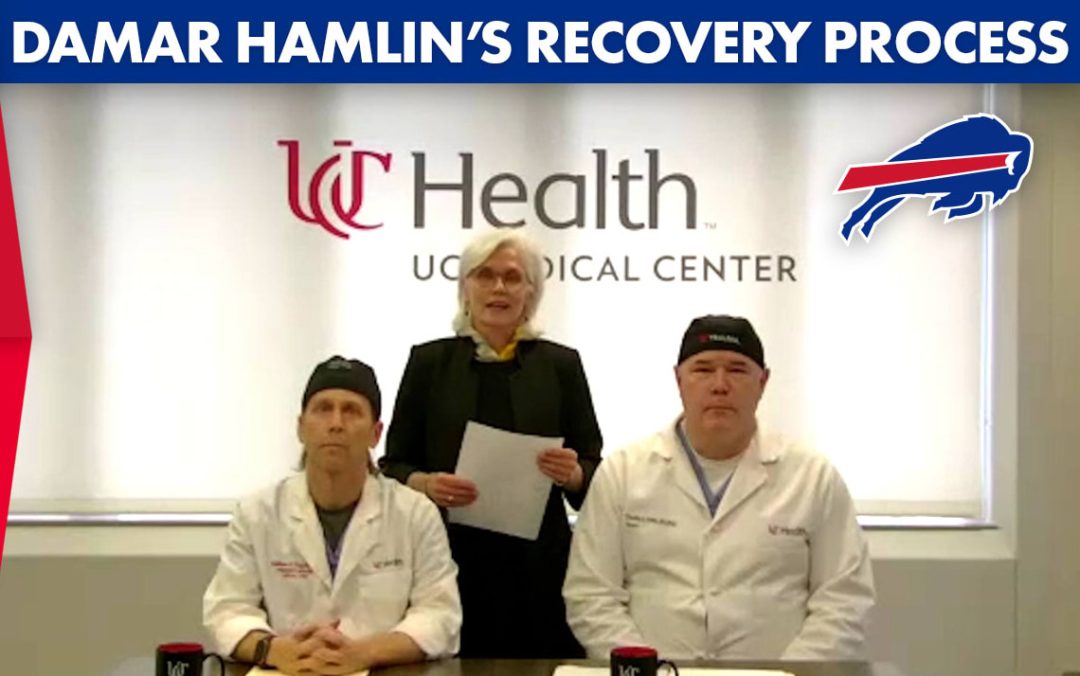
Damar Hamlin’s Recovery: What a U.S. Worker Deserves
Damar Hamlin’s Recovery: What a U.S. Worker Deserves
Health and Gender Policy Brief #152 | By: Geoffrey Small | January 8, 2023
Header photo taken from: the Buffalo Bills Press Conference
Follow us on our social media platforms above
Browse more health & gender policy briefs from the top dashboard

Photo taken from: Penn State Health
Policy Summary
[SSB theme=”Official” align=”center” counter=”true” ]
On January 2nd, 2023 NFL Buffalo Bills safety Damar Hamlin suffered from cardiac arrest after a tackle to the chest during a Monday-night football game with the Cincinnati Bengals. As he laid motionless on the field for approximately ten minutes, first responders applied CPR, an AED (automated external defibrillation), oxygen, and an intravenous solution in order to prevent brain damage that can occur after cardiac arrest. Medical experts have speculated that Hamlin suffered from Commotio cordis, which can happen when trauma to the chest disrupts the electrical charge to the heart.
The first responders managed to restore his heartbeat on the field. Approximately a half hour after his cardiac arrest, Hamlin was transported to the University of Cincinnati Medical Center by ambulance. He was reported in critical condition after his arrival and was intubated. Hamlin later regained consciousness on January 5th and had the breathing tube removed the following day. His medical team eventually reported that Hamlin had full control over his bodily functions and feeling in all of his extremities.
Without a quick response from highly trained medical staff in the NFL and the University of Cincinnati Medical Center, this event may have resulted in severe brain damage or death. Hamlin is a professional athlete employed in the NFL, where highly trained medical staff and technology are required to be on standby during games, practices, and facility-based training. If medical experts concur that Hamlin suffered from Commotio cordis, it may also be concluded that this event was a freak accident, which happened to a highly trained professional athlete at the pinnacle of his health.
Comparatively, most U.S. workplaces do not have the same level of medical response that teams in the NFL provide. However, cardiac arrest is far more common with the average U.S. worker. Exploring the data related to cardiac arrest, and the federal regulations when responding to an event in the work place, may offer some insight into how our system can change to give U.S. workers similar support that was provided to Hamlin.
Policy Analysis
According to the National Institute of Neurological Disorders and Stroke, brain cells begin to die after five minutes of oxygen deprivation, also known as cerebral hypoxia. That is why medical experts agree that a trained CPR and first-aid responder may be the difference between life or death during cardiac arrest. The American Heart Association states that OSHA (Occupational Safety and Health Administration) reports 10,000 cardiac arrests in U.S. workplaces annually.
Only 45.7% of people who experience Out of Hospital Cardiac Arrest receive the immediate help they need before professional medical help arrives. Approximately 51% of U.S. workers can’t locate an AED, a device that was instrumental in restoring Hamlin’s heartbeat. That number rises to 66% in the hospitality industry. 55% of U.S. workers don’t receive first-aid, CPR, and AED training from their employer.
OSHA does not require employers to provide first-aid or CPR training. OSHA does not have regulations that require U.S workplaces to have AEDs. This is in spite of the fact that 9 out of 10 victims of cardiac arrest who receive a shock within the first five minutes from an AED live.

Infographic taken from: AHA Mediagenic
(click or tap to enlargen)

Infographic taken from: AHA Journals
(click or tap to enlargen)
Hamlin’s cardiac arrest has highlighted the benefits of having employees trained in first-aid, CPR, and AED administration. It’s the difference between life or death.
Having trained CPR employees and an AED on-site is beneficial, despite the lack of federal regulations requiring employers to have them. Also, 65% of employees surveyed by the American Heart Association would view their employers more positively if they provided CPR training.
Donating to the American Heart Association can help spread awareness that government regulations need to improve. Also, please donate to Damar Hamlin’s toy drive.
Engagement Resources
Click or tap on resource URL to visit links where available

https://cpr.heart.org/en/resources/contact-cpr-and-first-aid?form=FUNELYZXFBW
