

JOBS POLICIES, ANALYSIS, AND RESOURCES
Latest Jobs Posts
X Marks the Spot as Elon Musk Makes More Enemies
Brief #94 – Technology Policy Brief
by Mindy Spatt
In a letter threatening suit on June 20, X cited this report in accusing the CCDH of “making inflammatory, outrageous, and false…
Path for Democrats to Regain the House Runs Through New York
Brief #88 – Elections & Politics Policy Brief
by Ian Milden
Democrats lost their majority in the House of Representatives in the 2022 mid-term elections. However…
The Week That Was: Global News In Review
Brief #86 – Foreign Policy Brief
by Abran C
Last week the United States Department of Justice called for the removal of a floating border barrier that has raised territorial and humanitarian concerns.
Russian Bombing Can’t Break the Spirit of the Citizens of Odessa
Brief #85 – Foreign Policy Brief
by Yelena Korshunov
On the night of July 18th Raisa woke up from a terrible roar and heart-rending children’s screams.
Carbon Taxes: Balancing Climate Change Mitigation with Sustainable Economic Growth
Brief #157 – Environmental Policy Brief
by Inijah Quadri
Carbon tax implementation has emerged as a pivotal tool for promoting a transition towards a greener economy.
Navigating the Information Jungle: Social Media, Disinformation, and Political Polarization
Brief #93 – Technology Policy Brief
by Inijah Quadri
Disinformation is an orchestrated campaign designed to propagate lies, distortions, and half-truths…
Why The Religious Liberty Argument Threatens Civil Rights And Anti – Discrimination Statutes
Brief #209 – Civil Rights Policy Brief
by Rodney A. Maggay
Legal scholars are wondering if this refusal to serve another person could be extended to matters outside LGBQT+ issues.
FDA Legalizes Nonprescription Birth Control, but Legal Challenges Await
Brief #81 – Health & Gender Policy Brief
by Geoffrey Small
According to the FDA, “Almost half of the 6.1 million pregnancies in the U.S. each year are unintended.
The Ukraine Crisis Situation Update #25
Brief #84 – Foreign Policy Brief
by Abran C
The world’s most vulnerable among the hungry will suffer the worst consequences.


U.S. RESIST NEWS PRINCIPLES OF DEMOCRACY
U.S. RESIST NEWS PRINCIPLES OF DEMOCRACY
U.S. Resist News Op Ed. | By: U.S. Resist News | April 2023
Header photo taken from: theguardian.com
Democracy in the United States is under attack. Donald Trump demonstrated that you could be President and yet disregard the political and legal norms and values that made the US a symbol of what it means to be a democratic country. He politicized the justice system, showed disregard for the rule of law, and refused to accept the results of a free and fair Presidential election. Trump unleashed a wave of democracy disrespect by his followers that climaxed in the January 6th insurrection attack on our nation’s capital.
And now, although Trump is out of office and faces criminal indictments, the threat to our democracy remains. A significant but so far minority group of our citizens lacks the understanding of democracy’s importance. In the face of this threat there is a concerted effort to reaffirm and strengthen our democratic system by those of us who believe it is still the best from of governance. U.S. RESIST NEWS supports this effort, and believes it should be guided by the following list of principles.
- We live in a culturally diverse, multi-ethnic and racial society where everyone has the same political and legal rights.
- Everyone in our country is subject to the Rule of Law, even movie stars, and porn stars, and billionaires, and Presidents.
- Our system runs on free and fair elections that periodically and routinely take place providing accountability for existing leaders and opportunities for those who want to serve in leadership roles.
- We vote for policies that support our rights and opportunities and for the integrity, intelligence and compassion of those who want to lead us.
- Those who run for political office respect their opponent’s points of view and honor the peaceful transfer of power regardless of whether they win or lose.
- We place a cap on the use of money in politics so as to limit the influence of money on political campaigns and outcomes.
- We value the separation of powers between the executive, legislative and judicial branches of government; with each branch having a distinct role that enables them to co-exist and exercise checks and balances with each other
- We respect the roles played by the media and civil society as organizations that help hold our politicians accountable, inform us about the issues, and serve as a voice of advocacy for our citizens
- Our democracy can’t exist and flourish with large income inequalities between members of society.
- We need to have an educated and informed citizenry for a healthy democracy.
This list of democratic principles is most likely incomplete, and we welcome suggestions from our readers and subscriber for additions to this list (Please send suggestions to our Managing Editor: roncisrael@gmail.com.
It is important to never lose sight of the principles of our democracy. They are the basis for the freedoms we enjoy and the debates and conversations needed to draft and support our public policies.

An Early Look at the 2023 Kentucky Governor’s Race
An Early Look at the 2023 Kentucky Governor’s Race
Elections & Politics Policy Brief #74 | By: Ian Milden | April 24, 2023
Header photo taken from: courier-journal.com/Matt Stone
Policy Summary
[SSB theme=”Official” align=”center” counter=”true” ]
Kentucky is one of three states to elect Governors in the year before the Presidential Election. Incumbent Governor Andy Beshear (D-KY) is running for re-election with strong approval ratings, but the strong Republican partisan lean of Kentucky makes it challenging for any Democrat to win there. This brief will take a look at the race a few weeks before Republicans choose a nominee.
Policy Analysis
In 2019, then-Attorney General Andy Beshear defeated Republican Governor Matt Bevin to become the Governor of Kentucky. During his time in office, Beshear has dealt with the Covid-19 pandemic and multiple natural disasters. Beshear has provided updates frequently to Kentucky residents to inform them of the latest developments and what his administration was doing to help. Beshear’s presence, crisis-management skills, and focus on issues that matter to Kentucky voters have given him one of the strongest approval ratings among governors in the United States.
While Beshear’s excellent job performance has positioned him well for re-election, Kentucky is an increasingly difficult state for Democrats to win in. Republicans have taken over most of the remaining statewide offices, and they hold supermajorities in both houses of the state legislature. Democrats also haven’t been competitive in major federal races in the state except for the third Congressional district, which contains Louisville. Republicans also finally passed Democrats in statewide voter registration numbers.
Republicans are currently in the middle of a competitive primary race. The major candidates for the Republican nomination for Governor are Attorney General Daniel Cameron, State Auditor Mike Harmon, State Agriculture Commissioner Ryan Quarles, and Former Ambassador Kelly Craft. Cameron succeeded Beshear as the Attorney General and has the endorsement of Donald Trump. Cameron also has close ties with Senate Minority Leader Mitch McConnell. Mike Harmon became the auditor in 2015 when he defeated incumbent Auditor Adam Edelen (D-KY). Quarles was elected as the agriculture commissioner in 2015, and he has strong relationships within the Kentucky state Republican Party. Kelly Craft served as the Ambassador to Canada and the Ambassador to the United Nations during the Trump Administration. Her family has donated a lot of money to Republicans in Kentucky. Craft’s campaign was the first to air ads on television, which was a necessity since many Kentuckians did not know who she was when she launched her campaign. Attacks between the Craft campaign and the Cameron campaign have gotten uglier in recent weeks. The primary is on May 16th.
Regardless of whomever the Republicans nominate, they won’t have the baggage of unpopular former Governor Matt Bevin (R-KY). Bevin alienated voters by attempting to roll back the popular expansion of Medicaid services, which occurred under former Governor Steve Beshear (D-KY). Bevin also attempted to reduce pensions for Kentucky teachers, which also prompted significant protests. Bevin also had poor relationships with members of his own party, which resulted in some of his vetoes being overridden by the Republican-controlled state legislature.
Bevin’s unpopularity cost him significant amounts of votes in the 2019 election. In addition to losing Louisville and Lexington by historically large margins, he lost some counties in rural areas of Eastern Kentucky and suburban counties in Northern Kentucky that most Republicans have won comfortably in recent years. Bevin also lost Warren County and Davies County, which hold the third and fourth largest cities in Kentucky. Bevin also underperformed typical Republican margins in many rural counties, which is why he could not make up for losses in other areas.
If Andy Beshear is going to win reelection in November, his performance will need to be similar to his 2019 election win. The Louisville and Lexington areas are Beshear’s base of support, so he needs to win there by large margins and get high voter turnout rates in those areas. Beshear will also need to win Warren and Davies Counties and perform well in the northern Kentucky suburbs. Beshear will also need to contain Republican vote margins in the rural areas that compose the rest of the state. Most of these counties will vote for the Republican nominee, but the Republican nominee will have to perform better than Matt Bevin in order to win the Governor’s office this year.
[SSB theme=”Official” align=”center” counter=”true” ]
Engagement Resources
Follow us for the latest U.S. RESIST News!

Meta’s Oversight Board Invites Comments on Martyrs
Meta’s Oversight Board Invites Comments on Martyrs
Technology Policy Brief #83 | By: Mindy Spatt | April 20, 2023
Header photo taken from: reuters.com
Policy Summary
[SSB theme=”Official” align=”center” counter=”true” ]
Meta’s Oversight Board has taken public comments on the way its platforms treat the Arabic word “Shaheed”, often deleting it from posts by posters Meta has deemed dangerous. Currently the most removed word on all of Meta’s platforms, critics claim the company’s standards for dangerous content are biased and unfair. The Oversight Board will issue and advisory opinion on the issue, which is attracting international attention.

Photo taken from: thehill.com
Policy Analysis
Meta requested the Board review itself. It treats the word as “an “honorific” with “multiple meanings” that is often “used to describe someone dying unexpectedly or prematurely, at times referring to an honorable death….” The word does not have an equivalent in English, so Meta translates it to mean martyr in all contexts.
The board that will decide the issue is an international panel of former political leaders, journalists and human rights activists based in London. You may remember that it played a role in Trump getting kicked off of Facebook in 2018, affirming leadership’s decision to remove him for violating company policies against inciting violence.
That decision generated outsize interest for an Oversight Board decision, receiving 9,666 public comments mostly from the United States and Canada. By comparison, the Board’s investigation into Meta’s decision to remove a video from Instagram showing the aftermath of a terrorist attack in Nigeria received just 9 comments. The original comment period for Shaheed was extended and ended on April 17.
This decision is framed by Meta’s equally controversial policies governing who Meta considers to fit into its Dangerous Individuals and Organizations categories. Takedowns of the word Shaheed are largely applied to individuals appearing on that Dangerous Individuals and Organizations list, many of whom are Arabic, and hence in the top tier of that multi-tiered list.
The list itself was secret until The Intercept published it in October 2021, and confirmed long held suspicions of anti- Muslim and anti-Arabic bias. Included in the top tier of the most terrifying terrorists are not only known the likes of Al Queda but also an innocuous sounding British aid organization, the Palestinian Relief and Development Fund. Intercept’s report contained comments from legal experts including Faiza Patel of the Brennan Center for Justice, who said “The lists seem to create two disparate systems, with the harshest penalties applied to heavily Muslim regions and communities.” In contrast, Patel pointed out, “Hate groups designated as Anti-Muslim hate groups by the Southern Poverty Law Center are overwhelmingly absent from Facebook’s lists.”

Photo taken from: aljazeera.com
According to Meta, it interprets “Shaheed” as martyr, and hence praiseful. Praise of Dangerous Individuals is prohibited by Meta’s policies. These policies have been harshly criticized by Palestinian journalists, whose posts are often deleted.
The Palestinian social media monitoring Centre Sada Social reported that 600 Palestinian accounts or pro-Palestinian Facebook posts were restricted or deleted in 2021, a record. It noted the targeting of the word Shaheed which Palestinians frequently use to describe people killed by Israeli forces, regardless of whether they participated in attacks or were innocent civilian victims. The punishment doesn’t end there; Meta keeps tracks of how many removals users amass, and if they accumulate too many their accounts may be disabled altogether.
Meta acknowledges that changes are needed, and has requested the Board’s approval for allowing expanded use of Shaheed. It proposes to remove content that uses “Shaheed” to refer to an individual designated as dangerous under Meta’s Dangerous Individuals and Organizations policy “only where there is additional praise, representation or support, or where there is a signal of violence.” The board, appointed by Meta, may be amenable to that change but will surely have other perspectives to consider.
Follow us for the latest U.S. RESIST News!
Engagement Resources
Click or tap on resource URL to visit links where available

Register of Charities – The Charity Commission of England and Wales, PALESTINIANS RELIEF AND DEVELOPMENT FUND

Southern Poverty Law Center Hate Map

Meta’s Oversight Board is considering discarding one of its most important language analysis tools in fighting terrorism on social media, by Tal-Or Cohen Montemayor, Jerusalem Post, APRIL 4, 2023

Revealed: Facebook’s Secret Blacklist of “Dangerous Individuals and Organizations”, by Sam Biddle, The Intercept, Oct. 12, 2021.

Child Labor Laws are Not Meant to Be Broken
Child Labor Laws are Not Meant to Be Broken
Social Justice Policy Brief #146 | By: Steve Piazza | April 20, 2023
Header photo taken from: khon2.com/Getty Images
Policy Summary
[SSB theme=”Official” align=”center” counter=”true” ]
Child labor laws have been in place in the U.S. since the signing of the Fair Labor Standards Act of 1938 (FLSA). Protections against abuses such as excessive hours worked and hazardous jobs are governed both by federal and state regulations.
These laws also have educational implications. Laws at the federal level mandate that students aged 14 and 15 can only work three hours on a school day and no more than 18 hours per week that school is in session. This must be done during the hours of 7:00 AM to 7:00 PM, though there are exceptions during periods of no school.
At the state level, most follow federal statutes, though with some exceptions. For example, according to the Department of Labor, Idaho students under 16 are allowed to work until 9:00 PM and up to 54 hours a week. Meanwhile, those under 16 in Maine may work up to 50 hours a week when school is in session, and three of those days may be on school days.
Recent easing of restrictions in some state laws have child advocates concerned that diminished protections might not only lead to an increase in child labor abuses, but will have a negative impact on children’s education as well.

Photo taken from: hrw.org
Policy Analysis
Recent evidence shows a rise in job abuses of those under 18 years of age. The Labor Department reports that child safety violations have grown significantly over the past 7 years, from 1012 to 3876, while the number of occurrences of minors working on hazardous job sites almost doubled.
A lot of reasons for this exist, but one of the major reasons is that ignored or loosened laws and under sourced government agencies have enabled many companies to hire staffing firms that reportedly have been less than forthright about applicant age. This is exacerbated when sponsors of migrant children are sending them off to work rather than school, or simply that children are victims of traffickers who operate in every state.
The Economic Policy Institute raises concern in a report that any changes in child welfare protections can negatively impact the well-being of children, including reversing a trend showing a ten year increase of teens finishing school. Such concerns have not stopped a number of states from making changes anyway.
In Arkansas, for example, Governor Huckabee Sanders signed into law the Youth Hiring Act of 2023 which states that 16-year-olds no longer need a work permit nor must they verify their age. Related measures are moving forward in Minnesota (workers 16 and 17 years old would be allowed on construction sites) and Iowa (minors would be allowed to work longer hours).

Photo taken from: theguardian.com/Patrick T Fallon/AFP/Getty Images
It’s true that under the right conditions minors can benefit from a wide range of experiences holding a job. Part time work can provide lifelong skills, self-confidence, and even economic advantages for teens and their families. Yet, it’s also true that allowing a 17-year-old to work 47 hours in one week can have serious effects on young workers.
Numerous studies have shown students who work at least 15 hours during the school week are less likely to participate in school activities, have less time to study, exhibit problem behaviors, are often too tired to be attentive during the school day, and often drop out.
Data on actual dropout numbers is very difficult to get a handle on because of the many different ways it gets calculated. Graduation rates, however, are easier to obtain. According to an Education Week special report in August, 2022, the graduation rate was almost cut in half in 31 states the previous year. Certainly, the pandemic played into this, as some students just didn’t return after being away. But the promise of an immediate income does create a disincentive to return to school.
Consider this. Young children in the cobalt rich Republic of Congo find themselves out of school and knee-deep in toxic materials earning pennies a day mining for materials used in the manufacturing of American made cars, watches, computers, just about everything that we use. Currently there are calls for extraction of more natural resources in the U.S., and if profit drives things and knows no geopolitical boundaries, what’s to stop the further exploitation of children here even if existing laws cannot protect them?
The United States may be thousands of miles from the Republic of Congo, and many argue that children have been working all throughout history. But that should be no excuse to reduce protections that have improved their lives since the Industrial Revolution, and which can continue to provide some hope to children here, and all over the world.
Follow us for the latest U.S. RESIST News!
Engagement Resources
Click or tap on resource URL to visit links where available

This site goes into greater detail about the FLSA.
For a better understanding of how children are exploited around the world and what’s being/been done to prevent it, this site breaks it down by region and country and even indicates specific industries.

Stop Child Labor is an advocacy group highlighting the issues and solutions to the problem.

Governor Whitmer Repeals Michigan’s 1931 Law Banning Abortion
Governor Whitmer Repeals Michigan’s 1931 Law Banning Abortion
Health & Gender Policy Brief #160 | By: Arvind Salem | April 18, 2023
Header photo taken from: wgvunews.org/Al Goldis/Associated Press
Policy Summary
[SSB theme=”Official” align=”center” counter=”true” ]
On April 5, Governor Whitmer overturned Michigan’s 1931 law banning abortion. While the law was not in effect, its repeal represents a massive victory for abortion supporters across the state.
Although the law is referred to as the “1931 law”, it was actually passed in 1846 and revised in 1931. The law made it a four-year felony to assist in an abortion except to save the mother’s life. Notably, the law was passed before women and people of color were granted the right to vote and before the ratification of Michigan’s constitution in 1963. These facts and the social changes after the law’s passage have made the law subject to heavy criticism today and have supplied fodder for challenges to the law.
When the Supreme Court overruled Roe v. Wade last summer, Governor Whitmer and Planned Parenthood both filed for injunctions to prevent the 1931 law from taking effect. Both efforts were successful, based on the aforementioned legal grounds, and eventually led to a permanent injunction, meaning the law could not be legally enforced and would not govern abortions in Michigan in the absence of Roe v. Wade. Furthermore, in the 2022 elections, voters in Michigan overwhelmingly passed Proposition 3: a ballot initiative that added abortion protections to the state constitution.
The repeal of this law adds a new protection to abortion rights in Michigan. There was concern that anti-abortion activists could bide their time and introduce a proposition of their own that overturns proposition 3. If that were to occur, 1931 would once again be binding. The repeal of the 1931 law eliminates that possibility and forces anti-abortion activists to not only overturn Proposition 3 but also pass a law of their own if they wish to criminalize abortion.

Photo taken from: bridgemi.com/Dale Young/Bridge Michigan
Policy Analysis
This is a resounding victory for Democrats, who proved that they can pass legislation when given their first trifecta in nearly 40 years. This is an especially important achievement for Governor Whitmer, as she largely ran on protecting abortion rights, and has passed legislation fulfilling this promise within her first 100 days of office, and recently passed a package to deal with gun violence and school shootings, specifically concerning background checks and safe storage requirements, after Michigan experienced two tragic school shootings at Oxford High School and Michigan State University. The implications for the governor’s next election cycle remain to be seen. By passing this repeal she has delivered on an important campaign promise but has partially lost the ability to run on the issue of protecting abortion now that it is protected in the state constitution and the 1931 law has been repealed.
This news comes amid a larger conflict on abortion in the wake of a Texas district judge’s ruling that suspended FDA approval for mifepristone, an abortion pill, and the decision upon appeal to the fifth circuit that fell short of suspending FDA approval for the pill, but upheld restrictions that would prevent it from being sent through the mail. The news in Michigan is a bright spot for abortion activists who hope to harness that energy and messaging to solidify abortion rights in more traditionally red states.
Follow us for the latest U.S. RESIST News!
Engagement Resources
Click or tap on resource URL to visit links where available

NARAL Pro-Choice America is an advocacy organization that works to elect lawmakers that support reproductive freedom and lobby lawmakers to support pro-choice bills by organizing and mobilizing a large network of pro-choice supporters. Readers interested in supporting the pro-choice movement may be interested in donating or volunteering with this organization.

Planned Parenthood of Michigan is a branch of the national Planned Parenthood organization that seeks to encourage bodily autonomy and informed reproductive decisions, and helps facilitate abortions as part of this mission. Readers interested in supporting the pro-choice movement may be interested in donating to this organization.

Right to Life of Michigan is an organization that works to preserve and educate others on the sanctity of life across the issue areas of abortion, infanticide, euthanasia, and assisted suicide by working for the passage of the Human Life Amendment by mobilizing pro-life supporters and elected pro-life candidates. Readers interested in supporting the pro-life movement may want to donate or involve themselves with this organization.

Emily’s List is a national organization that works to elect pro-choice, democratic women by recruiting and mobilizing support for their candidacies and campaigns. Readers who would like to see electoral change in favor of the pro-choice movement in states besides Michigan would be interested in contributing to this organization.

The Ukraine Crisis: Situation Update: #22
The Ukraine Crisis: Situation Update: #22
Foreign Policy Brief #179 | By: Abran C | April 14, 2023
Header photo taken from: news.sky.com
Leaked Pentagon Documents
The online leaks of highly classified documents on a number of sensitive military information, including info on the Ukraine war, has sent top Pentagon officials scrambling this week. The documents contain classified briefings detailing the US military efforts in the Ukraine war, data on military activities like US drone spy planes in the region, and the state of Ukrainian forces. and intelligence involving allied nations. The Pentagon has been careful not to authenticate the information contained in any specific document, yet there have been reports that some documents may have been doctored. For example documents showing estimates of Russian troops deaths in the Ukraine war that are significantly lower than numbers publicly stated by U.S. officials. The documents also show a different view of what the US military perceives about the war, a document from early February expresses misgivings about Ukraine’s chances of success in its spring counteroffensive. A 21 year old man who was a member of the intelligence wing of the Air National Guard is said to have been the source of the leaks, and was arrested on April, 12, 2023.
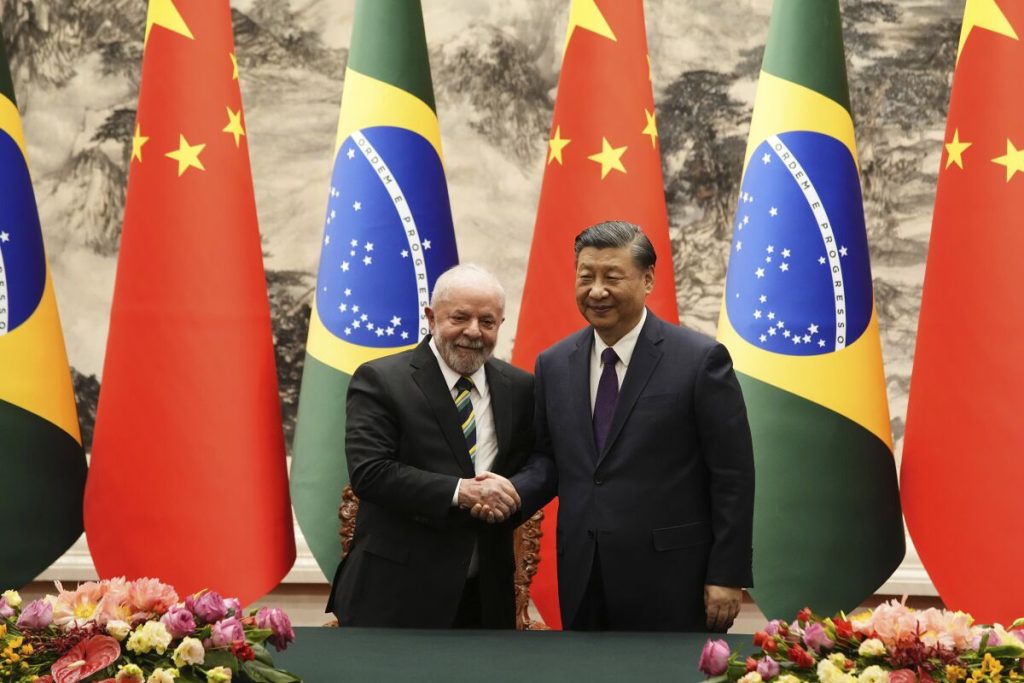
Photo taken from: sandiegouniontribune.com/Ken Ishii/Pool Photo via AP
More Backers for China’s Peace Plan
This week Brazilian President Lula da Silva flew to Beijing for a diplomatic visit where he aims to convince President Xi Jinping to form a group of nations to mediate an end to the war in Ukraine. Lula has suggested a proposal for China to lead peace talks between Russia and Ukraine, something that Western leaders haven’t shown willingness to engage in, besides French President Emmanuel Macron. Last week Macron went to Beijing accompanied by EU President Ersula Von Delien in order to attempt to persuade China to do more to end the war in Ukraine. It is a sign of shifting global politics that China is being turned to in order to help make peace, and signals a decline in faith in the US’ ability to do so.

Photo taken from: themoscowtimes.com/Alexander Avilov/Moskva News Agency
Russian Military Reforms
Russia’s parliament, the Duma, has approved a bill that would raise the age limit for military personnel serving in active duty from 40 to 65. Throughout the duration of the war Russia has met fierce resistance from Ukrainian forces, it is unlikely Moscow intended for the fighting to last as long as it has. As Russian troops have suffered thousands of casualties as the war got bogged down, the Kremlin is in need of further expanding its range of recruitment of troops and is turning to older citizens to fill those gaps. Additionally, Russia will begin sending electronic military draft papers and crack down on draft dodgers. One year of military service is compulsory in Russia for all men aged 18 to 27. Under the current system, men targeted by military recruiters are hand-delivered paper summons at their registered addresses. They must personally sign a document to confirm their receipt, but as was seen during the last mobilization, many will attempt to avoid conscription by any means necessary and may escape receiving their summons. Under the new plan, Russian men will receive draft papers by registered post and via a personal account on the site “Gosuslugi” an online public services portal in Russia. Once the electronic summons are served under the new legislation men who fail to show up at the military enlistment office by the required date will be automatically banned from traveling abroad. This is an effort by the Kremlin to keep its fighting aged men from fleeing the country. However, it is more likely these new rules being put into place will lead to even more Russians fleeing, anger the population, and lead to more dissent.
Follow us for the latest U.S. RESIST News!

Why The Republicans Got It Wrong Expelling Democratic State Legislators In Tennessee
Why The Republicans Got It Wrong Expelling Democratic State Legislators In Tennessee
Civil Rights Policy Brief #72 | By: Rodney A. Maggay | April 12, 2023
Header photo taken from: cnn.com/Cheney Orr/Reuters
Policy Summary
[SSB theme=”Official” align=”center” counter=”true” ]
On March 27, 2023 a shooter entered The Convent School in Nashville, Tennessee and killed six people. Three of the victims were nine – year old students with the other three victims adults who were employees of the school. On March 29, protesters staged a peaceful protest at the Tennessee Capitol building demanding a solution to gun violence.
On March 30, three Democratic members of the Tennessee House disrupted the proceedings of the chamber to illustrate that the House chamber was not listening or being responsive to calls for gun reform. The Democratic members were State Reps. Justin Jones and Justin Pearson, both black, and State Rep. Gloria Johnson, a white woman. On April 6, 2023 the House chamber took votes to determine whether to expel any of the three members. The House voted 72 – 25 to expel Justin Jones. The House’s vote was 69 to 25 to expel Justin Pearson. And, when the House voted whether to expel Gloria Johnson the vote was 69 to 26 in favor, which was one vote shy required to kick her out of the House chamber. Rep. Johnson was permitted to keep her seat while the seats occupied by Rep. Jones and Pearson is now vacant.
Under the Tennessee Constitution, any vacancy in the seat of a state legislative member will be filled on a temporary basis by the legislative body of the county where the seat is vacant. This means that the Metropolitan Council of Nashville and Davidson County and the Shelby County Board of Commissioners will appoint a successor until a special election will be held to determine who will hold the seat. Initial reports have indicated that the county legislative bodies will reappoint Justin Jones and Justin Pearson to the state House seats.
- Learn more about protesters demanding change at the state capitol.
- Learn more about Tennessee lawmaker, Justin Pearson, who is expecting to be reappointed after unprecedented expulsion.

Photo taken from: pressdemocrat.com/AP Photo/George Walker IV
Policy Analysis
Why was the expulsion of two state legislative members in Tennessee significant?
While many legislative chambers have rules on seating and disciplining members of their chamber, the expulsion of two Democratic and nearly another Democratic member was no ordinary action. The action was taken as retaliation for the political position of the three members and actions the two expelled members took to express a message that was the focus of a protest that was occurring just outside the Tennessee Capitol building. It was an exceedingly rare move that has not been seen in state United States statehouses for more than one hundred fifty years.
At this time, Republican lawmakers in Tennessee have a supermajority in both chambers of the state Legislature. What this means is that their majority is not simply more than half but high enough to overcome any opposition from the opposing party. It is even large enough to overturn a veto from Republican Governor Bill Lee should he decide to veto a bill (not likely). Currently, the Tennessee House membership is comprised of 75 Republicans and 24 Democrats prior to the expulsion of Reps. Jones and Pearson. The Tennessee Senate is made up 27 Republicans and 6 Democrats.
The reason why the expulsion was an extraordinary move is because the move was taken to silence legislators who were trying to say something that the Republican leadership simply did not want to hear. But this diminishes the legislative process because it subverts the will of the voters who decided that these are the two people who will be their representative and who will bring their message to the state capitol. Yet the Republican majority decided that they did not want to hear the message of gun reform and instead voted to kick them out and deny them access to the chamber for the rest of the term. In effect, they told the two legislators that their political position is not good enough for them to serve as a state legislator.
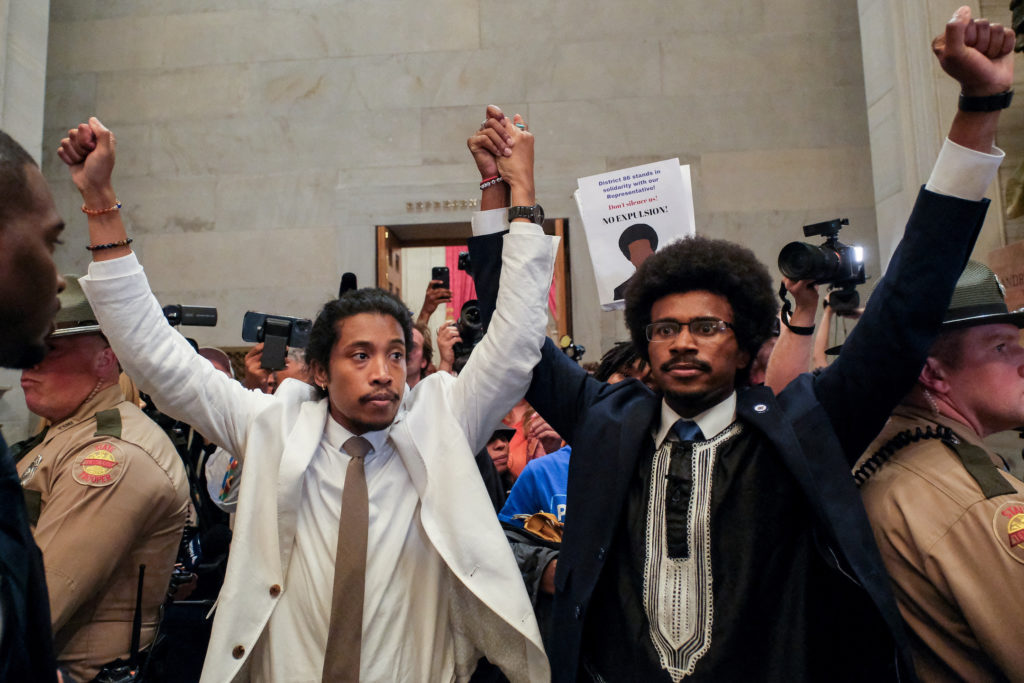
Photo taken from: pbs.org
However, the Tennessee Constitution provides that legislators have a “liberty to dissent from and protest against, any act or resolve which he may think injurious to the public or to any individual, and to have the reasons for his dissent entered on the journals.” Legislative chambers are a place of competing ideas and, hopefully, compromise and so different ideas and positions are encouraged in order to find the best solution possible. However, here the Republicans completely ignored that and took measures to expel members because they just so happened to have a position that the Republicans did not approve. They could have censured the lawmakers or even delivered a statement that the Republicans simply disagreed and left it at that. Expulsion was unnecessary especially when Republicans had a supermajority in the chamber. What the Republicans did here was try to suppress a message. This is a dangerous road to go down because it could seem to set a precedent that only the Republican message is the “right” message for a legislator to have. Informed and civil dissent is no longer to be tolerated is what the Tennessee House seems to be saying to the rest of the country.
However, it seems likely that the two expelled House Representatives will have the last laugh. Even though they were expelled, the Tennessee Constitution permits the county legislative councils to appoint an interim successor. And it looks likely that both Reps. Pearson and Jones will be re-appointed by their respective county councils.
In late breaking news, the Nashville Metropolitan Council voted unanimously (36 members) on Monday April 10 to reinstate Rep. Justin Jones to the Tennessee Legislature. Within an hour of the vote, Rep. Jones was sworn in and immediately marched back into the House chamber to applause. As for Rep. Pearson, the Shelby County Board of Commissioners will hold a vote on Wednesday April 12 whether to reappoint Rep. Pearson. While his reappointment seems likely, it probably will not be unanimous, as a commissioner has indicated that she may not support a reappointment at this time.
Learn more about Ousted Tennessee legislator Justin Jones reinstated after Nashville council vote.
Learn more about Tennessee House GOP expelling 2 Democrats in retaliation over gun control protest.
Learn more about Tequila Johnson’s opinion on Democracy in Tennessee.
Follow us for the latest U.S. RESIST News!
Engagement Resources
Click or tap on resource URL to visit links where available

MSNBC Report – report from news site detailing how Reps. Jones and Pearson were targeted for removal by the Tennessee GOP for months prior to vote on expulsion.

National Public Radio (NPR) – analysis of whether other state houses will follow and vote to expel members for their political positions.

It’s Past Time to Overhaul the Federal Election Commission
It’s Past Time to Overhaul the Federal Election Commission
Elections & Politics Policy Brief #73 | By: Ian Milden | April 12, 2023
Header photo taken from: brennancenter.org
Policy Summary
[SSB theme=”Official” align=”center” counter=”true” ]
The Federal Election Commission (FEC) is supposed to be the primary regulator for federal campaigns. However, the structure of the organization has made it dysfunctional for years. This brief will discuss the consequences of the FEC’s dysfunction and propose some potential reforms.

Photo taken from: govexec.com/Mark Van Scyoc/shutterstock.com
Policy Analysis
The Federal Election Commission was founded in 1975 to enforce campaign finance rules described in the Federal Election Campaign Act of 1971 for Presidential and Congressional campaigns. It is an independent agency led by six commissioners. These commissioners are appointed by the President and confirmed by the Senate. Commissioners serve for six years in staggered terms. No more than three commissioners are allowed to be of the same party. The commission was designed this way to promote bipartisan decision-making.
The Federal Election Commission is required to have paperwork registering every new campaign organization and political action committee. These organizations are required to report their fundraising and spending activities every quarter to the FEC. The FEC examines filings for potential violations and makes rules on what campaign funds can be spent on. Serious violations of campaign finance laws are referred to the Justice Department for criminal investigation.
Candidates for federal offices are also required to file a personal financial disclosure form once they raise or spend $5000 dollars. The deadlines for the filing are May in the year before the primary or within 30 days of meeting the $5000 fundraising threshold. There is a fine for failing to file the personal financial disclosure form, but this is rarely enforced. Several current members of Congress failed to file a personal financial disclosure form on time during their most recent campaign.
Unfortunately, the current structure of the commission has resulted in gridlock. Many non-criminal campaign finance violations, such as sloppy record keeping, go unpunished due to a 3-3 vote by the commissioners or the campaigns get off with very light fines. The gridlock on revising the rules is also problematic for regulating the digital activities of campaigns as online fundraising and advertising tools have evolved fast enough to render many existing rules moot. At times in recent years, the FEC has not had enough commissioners on unexpired terms, which has left the FEC without the ability to make decisions or enforce penalties.
The FEC also maintains a system for public financing of campaigns, but the rules for spending campaign funds are so severely restrictive that most campaigns since 2008 have not used it except for long-shot candidates who make desperate attempts to keep their campaigns alive. The FEC may need new legislation from Congress to overhaul or abolish this outdated and dysfunctional system, which costs taxpayers money when hopeless candidates decide to use it.
The FEC has also done a poor job of regulating campaign organizations that remain in operation after a particular campaign has ended. There are several campaign organizations that continue to spend funds on consultants, restaurants, transportation expenses, and more items long after the candidates they are supposed to be promoting have left public office or, in some cases, when a candidate has died. The media has called these campaigns “zombie campaigns”. The Tampa Bay Times published an extensive investigation into zombie campaigns in 2018. Many other unsuccessful campaign organizations still exist because they are unable to pay their debts. For example, Newt Gingrich’s 2012 Presidential Campaign still exists because it has been unable to pay off the millions of dollars in debt that Gingirch acquired during the campaign. Gingrich’s 2022 year-end report lists $4.6 million in remaining debt.

Photo taken from: brennancenter.org/BCJ/Getty/Phil Roeder
Potential Reforms
Senator Michael Bennet (D-CO) introduced the ZOMBIE Act in 2021, which would require campaign organizations to close their accounts within six months of the end of a campaign unless a candidate filed for re-election. It did not pass and GovTrack indicates that the bill never received a floor vote.
In addition to Senator Bennet’s Zombie Act, new legislation is needed to address specific circumstances that the current FEC has failed to effectively deal with. Specific punishments for non-criminal violations like sloppy financial records may deter campaigns from trying to cut corners or violate rules. These punishments should be adjusted by law every campaign cycle relative to inflation, cost of living, and other changes in campaign finance rules that affect how much campaigns can raise and spend.
If the FEC is to become a respected enforcer of campaign finance rules, major changes to the structure of the organization are necessary. The structure of the six-member commission is no longer viable in a highly partisan environment. The number of commissioners should be changed to an odd number of commissioners in order to eliminate the 3-3 votes. While the law preventing a majority of commissioners being from the same party is a good idea, it would be better to make a majority of the commissioners non-partisan. Specific regulations on who can be appointed should be included to uphold the non-partisan ideal. Examples of potential appointees for future commissioners could include long-time civil servants, academics, retiring judges, or other judicial officials who lack significant ties with any party or campaign.
Follow us for the latest U.S. RESIST News!

Beyond the Headlines: A Closer Look at the Charges Facing Donald Trump
Beyond the Headlines: A Closer Look at the Charges Facing Donald Trump
Elections & Politics Policy Brief #72 | By: Arvind Salem | April 11, 2023
Header photo taken from: 9news.com
Policy Summary
[SSB theme=”Official” align=”center” counter=”true” ]
On March 30, 2023, after months of deliberation, a Manhattan grand jury indicted former President Donald Trump, making him the first president to be indicted, sending shockwaves throughout the United States. Given the politically charged and historical significance of this trial, discourse on the trial has understandably tended to focus more on its political implications and its larger ramifications on American democracy rather than on the many complex legal issues the trial features, the nature of the charges, and the events that ultimately led to this historical moment in American history.
The events that have led to this trial stretch all the way back to Trump’s 2016 presidential campaign. In the days leading up to the election, porn star Stormy Daniels wanted to go public with her story of an affair she had with Donald Trump. Stormy Daniels contacted the National Enquirer to sell the rights of the story. Instead of publishing the story, The National Enquirer brokered a deal between Michael Cohen, Trump’s lawyer at the time, and Stormy Daniels’s lawyers, resulting in Cohen paying $130,000 to silence Stormy Daniels. After Trump had won the election and became president, he reimbursed Michael Cohen, and when doing so, he allegedly improperly categorized his payments as a legal expense pursuant to a fictional retainer.
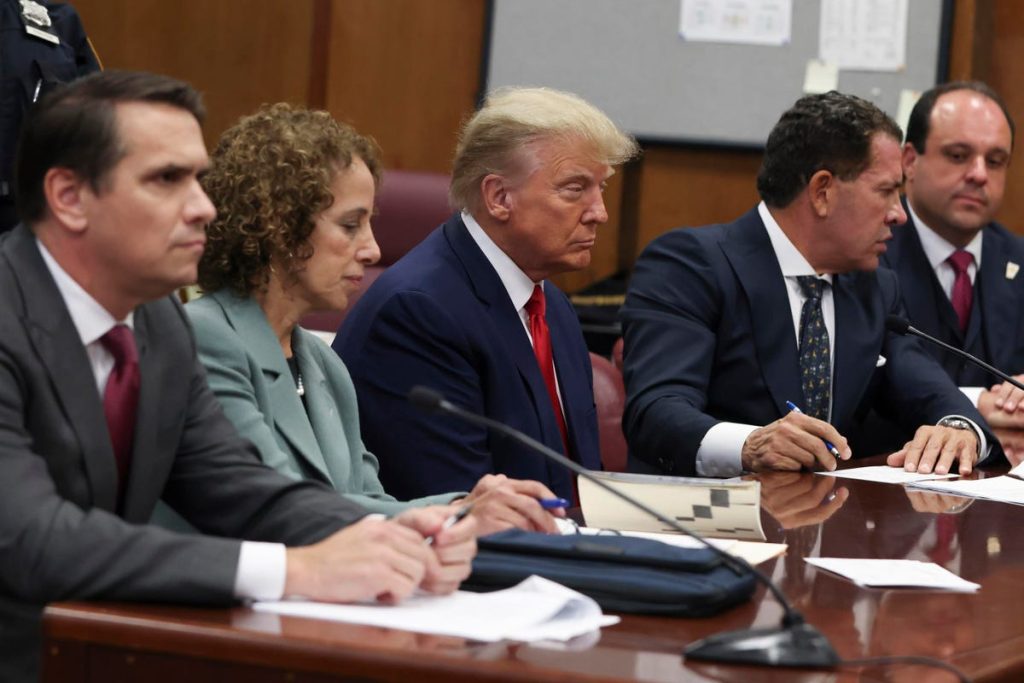
Photo taken from: forbes.com/Andrew Kelly/Pool Photo via AP
Policy Analysis
The Manhattan District Attorney charged President Trump with 34 counts, or instances, of falsifying business records. Trump has pleaded not guilty on all counts. Falsifying business records is normally a misdemeanor charge, yet Manhattan District Attorney Alvin Bragg has upgraded the charges to felony, which can only be done if he can prove that Trump falsified business records in order to conceal another crime. The District Attorney did not state the other crime in the indictment, but when asked he noted several possible underlying crimes including illegally promoting a candidate, making false statements to tax authorities, and violating federal election contribution limits. However, citing federal election contribution regulations as a possibility for an underlying crime raises the question if a violation of a federal law can justify elevating a state misdemeanor to a state felony. The answer to this question is largely unknown, as it has not been resolved by any appellate court in New York.
Another legal issue is the statute of limitations. The falsifying business records felony has a statute of limitations of 5 years, meaning that prosecutors have 5 years from the crime to initiate legal proceedings. Since Trump’s final payment to Cohen was in December 2017 the statute of limitations has expired. However, the statute of limitations can be paused when the defendant is “continuously outside the state.” Prosecutors will likely argue that Trump’s time as president from 2017-2021 represents a period when he was continuously outside the state, thus allowing them to pause the statute of limitations and prosecute Trump.

Photo taken from: theconversation.com/Joe Raedle/Getty Images
An issue for Trump’s defense is that the trial is taking place in Manhattan: a liberal area, where Trump is quite unpopular. Trump has repeatedly stated that any trial in Manhattan would be unfair, and has suggested that the trial be moved to the far more conservative area of Staten Island.
Regarding the actual outcome of the trial, it is the general consensus that Trump is extremely unlikely to spend any time in prison. Trump technically faces a maximum sentence of 136 years in prison, each count of the falsifying business records felony carries a maximum sentence of 4 years in prison, and the misdemeanor version carries 1 year per count, however, there is no mandatory minimum sentence, meaning that many other factors will play a role in sentencing. Many attorneys have said that a similarly situated defendant in their 70s, with no previous criminal history would not see the inside of a jail cell for a nonviolent Class E felony with no specific victims. However, others have argued that Cohen’s 13-month jail sentence for campaign finance violations in relation to the Stormy Daniels payment, tax fraud, and false bank statements, mean that prison time is not off of the table for the former president.
Follow us for the latest U.S. RESIST News!
Engagement Resources
Click or tap on resource URL to visit links where available

Act for America is an organization that seeks to educate and mobilize Americans against foreign and domestic threats, and advocates for bills to achieve these aims. Those who feel that this indictment constitutes a breakdown of justice may wish to support this organization.

ActBlue allows people to donate to a host of Democratic organizations, candidates, and causes. Readers are likely to find organizations that are supporting the Trump indictment on this site and may wish to donate money to further that cause.

The Brennan Center for Justice at NYU Law School is an organization that promotes reforms to American democracy and argues against many practices today such as gerrymandering and mass incarceration. Readers who are concerned about the health of democracy in light of this indictment may wish to support the Brennan Center and help it advance its proposed reforms.

Winred allows people to donate money to Republican candidates to support their campaign. Readers interested in supporting President Trump or other members of the Republican party may find that this is a useful way to convey their support and help the Republican cause.

Don’t Say Gay Reprise: A Look Ahead
Don’t Say Gay Reprise: A Look Ahead
Education Policy Brief #82 | By: Rudolph Lurz | April 7, 2023
Header photo taken from: ulink.miami.edu
Policy Summary
[SSB theme=”Official” align=”center” counter=”true” ]
March 28th, 2023 marked the first anniversary of the signing of Florida’s controversial Parental Rights in Education Act. Critics have commonly labeled it as the “Don’t Say Gay” law. The law effectively prohibits the instruction of sexual orientation and gender identity in grades K-3 in Florida classrooms, and gives parents the opportunity to sue school districts if the policy is violated. Governor DeSantis and his allies argue that the law is necessary to prevent “grooming” of minors. Governor DeSantis, in a heated exchange with a reporter, repeated those arguments and noted additionally that it was inappropriate for kindergartners to discuss sexual topics in their classrooms. At the time of the bill’s debate and passage into law, DeSantis frequently criticized the term “Don’t Say Gay” as a misrepresentation by the media. The age of children in question is a frequent defense by DeSantis and his allies in the Florida Legislature and beyond.
Multiple other states are copying Florida’s law, demonstrating that there are strong currents in the GOP pulling for these cultural measures in the classroom. A bill in the U.S. House of Representatives aims to expand the law’s language to prohibit instruction at any building or agency that receives federal funding, which would potentially include some libraries and after school programs. Despite DeSantis’s early insistence that the law’s aim was to protect young children in grades K-3, Florida’s Department of Education is attempting to expand the provisions of the law into grades 4-12. The vague language of the law has a chilling effect on classroom discussions on any subject matter that approaches these topics, as educators fear losing their employment or subjecting their district to a lawsuit.

Photo taken from: mynews13.com
Project Analysis
I began my teaching career at a rural Title I school in central Florida. I conducted my dissertation research on education policy formation in Florida. I am familiar with Governor DeSantis’s past and his political acumen.
On the surface, the Governor’s policies, which are part of a broader culture war, do not seem to make much sense. His anti-LGBTQ+ stance and other social policies have alienated younger voters. The “Don’t Say Gay” debate sparked a huge fight with Disney, one of the largest employers in the state. Generally speaking, conservatives tend to be pro-business and strong supporters of the free market economy. Wielding the power of the state to meddle with a large corporation’s policies, especially a behemoth like Disney, seems like a real head scratcher.
Unlike former President Trump, Governor DeSantis does not shoot from the hip and improvise his political attack angles. He is a shrewd, Harvard-educated politician who trounced his gubernatorial opponent by twenty points in what was once a swing state. If he takes a strong stance on a position, it is because he sees a quantitative advantage.

Photo taken from: wcjb.com
If one looks past the noise, Governor DeSantis’s tactics are straight out of the traditional GOP playbook to put Democrats on the wrong side of 60/40 cultural issues. In 2004, that cultural issue was marriage equality. Ohio’s Marriage Protection Amendment was widely viewed as a ballot initiative to drive up conservative turnout. At the time, same-sex marriage was opposed by 60% of Americans. By 2012, that figure swung to over 50% opposition in swing states to banning same sex marriage at the federal level.
Today, marriage equality is both settled law and politically popular. Culture warriors like Governor DeSantis needed a new 60/40 issue to galvanize support and paint opponents as extremists. They simply moved from left to right on the LGBTQ+ acronym to attack the TQ+ portion of it. A recent poll by YouGov showed that just 32% of Americans would be “very supportive” if their child came out as transgender, and just 14% of Republicans.
Governor DeSantis recognizes that this is a political winner for him, so it’s no surprise he will continue promoting legislation that puts the issue front and center in the public sphere. With a budget surplus in excess of twenty billion dollars, the Governor can afford to antagonize Disney. They are unlikely to pack up and leave the state, considering they have multiple theme parks and resorts located in central Florida. With a margin of victory approaching twenty percentage points, he can afford to antagonize younger voters with his social policies. With Florida’s large (and growing) senior population, the polling figures will likely continue to land in his favor.
DeSantis’s crusade might be a solution in search of a problem, but as long as he’s on the correct side of state and national polling, he’ll keep advancing it.
Follow us for the latest U.S. RESIST News!
Engagement Resources
Click or tap on resource URL to visit links where available

For further engagement on this topic, consult the homepage of Florida’s largest teacher’s union, along with Florida’s Department of Education