

JOBS POLICIES, ANALYSIS, AND RESOURCES
Latest Jobs Posts
The Ukraine Crisis: Situation Update: #22
Brief #179 – Foreign Policy
by Abran C
The online leaks of highly classified documents on a number of sensitive military information, including info on the Ukraine war, has sent top Pentagon officials scrambling this week.
Why The Republicans Got It Wrong Expelling Democratic State Legislators In Tennessee
Brief #203 – Civil Rights Policy
by Rodney A. Maggay
On March 27, 2023 a shooter entered The Convent School in Nashville, Tennessee and killed six people. Three of the victims were nine – year old students with the other three victims adults who were employees of the school.
It’s Past Time to Overhaul the Federal Election Commission
Brief #73 – Elections & Politics Policy
by Ian Milden
The Federal Election Commission (FEC) is supposed to be the primary regulator for federal campaigns. However, the structure of the organization has made it dysfunctional for years.
Beyond the Headlines: A Closer Look at the Charges Facing Donald Trump
Brief #72 – Elections & Politics Policy
by Arvind Salem
On March 30, 2023, after months of deliberation, a Manhattan grand jury indicted former President Donald Trump, making him the first president to be indicted, sending shockwaves throughout the United States.
Don’t Say Gay Reprise: A Look Ahead
Brief #62 – Education Policy
by Rudolph Lurz
March 28th, 2023 marked the first anniversary of the signing of Florida’s controversial Parental Rights in Education Act. Critics have commonly labeled it as the “Don’t Say Gay” law.
Insulin Prices: Are They Low Enough?
Brief #159 – Health & Gender Policy
by Geoffrey Small
As the U.S. healthcare system continues to fall short, when compared to other peer countries, the battle for insulin prices highlights just one of the major issues the country is facing.
The Current Status of Congressional Efforts to Pass Gun Control Legislation
Brief #145 – Social Justice Policy
by Inijah Quadri
Gun control legislation has been a contentious issue in the United States for decades. As the debate surrounding the Second Amendment and its implications for American society continues, we will provide a thorough, fact-based analysis of the current status of congressional efforts to pass gun control legislation.
A New Standard For Homelessness Prevention Programs
Brief #144 – Social Justice Policy
by Caroline Howard
Like many places in the United States, King County, Washington has had a persistent and increasing Homelessness problem for years. As of 2020, 11,751 people were experiencing homelessness in the county, and the number has only continued to grow due to the COVID-19 pandemic.
Strengths and Weaknesses of ICC Warrant for Putin’s Arrest
Brief #178 – Foreign Policy
by Yelena Korshunov
The International Criminal Court has issued arrest warrants for the Russian president, Valdimir Putin, and Russia’s commissioner for children’s rights, Maria Lvova-Belova. The warrants were issued in relation to the forced unlawful deportation of Ukrainian children to Russia.


Court of Appeals For The Eleventh Circuit Takes Down Judge Cannon’s Mar – a – Lago Rulings
Court of Appeals For The Eleventh Circuit Takes Down Judge Cannon’s Mar – a – Lago Rulings
Civil Rights Policy Brief #198 | By: Rodney A. Maggay | December 10, 2022
Header photo taken from: U.S. Department of Justice / Handout via Reuters
Follow us on our social media platforms above
Browse more civil rights policy briefs from the top dashboard

Photo taken from: Alon Sky / AFP via Getty Images
Policy Summary
[SSB theme=”Official” align=”center” counter=”true” ]
On December 1, 2022 the United States Court of Appeal for the Eleventh Circuit issued its ruling in the case Trump v. United States of America. The case was an appeal from the United States District Court for the Southern District of Florida and is popularly known as the Mar – a – Lago documents case.
The case stemmed out of the efforts of the National Archives and Records Administration’s (NARA) efforts to retrieve sensitive classified information from President Donald Trump after his presidential term came to an end in 2021. It was believed that these documents were at President Trump’s personal residence in Mar – a – Lago, Florida. After months of negotiations and requests for extensions for return of the documents by President Trump, the FBI executed a search warrant at Trump’s home in August 2022. The search resulted in the recovery of 22,000+ documents including over one hundred documents labeled confidential, secret or top secret.
Subsequently, Trump brought a lawsuit in the United States District Court for the Southern District of Florida asking for judicial oversight of the search as well as for additional relief including the appointment of a special master to review the documents seized. In a series of questionable rulings, the district court allowed the appointment of a Special Master to review the documents seized and prohibited the government from reviewing the documents. The government appealed those orders, which temporarily stayed the orders from going into effect. Finally, the appeals court ruled on the merits of the appeal and ruled unanimously 3 – 0 that the district court could not block the U.S. from using lawfully seized records in a criminal investigation. LEARN MORE
Policy Analysis
While the government search at Mar – a – Lago generated alot of sensational news – search of a former President’s residence, classified documents containing nuclear information and a special master appointed to review the seized materials – the appeals court issued a rather ordinary, but still important ruling. The appeals court did not need to thoroughly address the most newsworthy aspects of the case but instead issued a ruling on a procedural element of the case. The case came down to whether the federal district court had jurisdiction to hear the case.
The appeals court applied the four factors of a test from the case Richey v. Smith. That case only allows a district court to hear a suit concerning the seizure of personal property if 1] the government had a “callous disregard” for a plaintiff’s constitutional rights, 2] whether the plaintiff has an individual interest and need for the return of his personal property, 3] whether the plaintiff would suffer an irreparable injury if he is denied the return of his property, and 4] whether there is an adequate remedy at law for the plaintiff.
The court ruled against the President in all four of the factors in its examination of the facts of the case. The appeals court ruled that the government did not have a “callous disregard” for President Trump’s constitutional rights because it followed appropriate procedures when issuing subpoenas and the search warrant. And it continued that President Trump did not have an interest in government records and that the President could not suffer a personal harm because the records are government records.
Any injury suffered by their exposure would be an injury to the U.S. and not Trump personally. Finally, the court said that the fourth factor under Richey of the availability of an adequate legal remedy was under federal criminal court rules.
This would then have barred his case in the civil proceeding. Trump could not force his case to be heard in a civil court because he was challenging the seizure of the docs under a criminal search warrant. His legal remedy was in a criminal proceeding. (President Trump even cited Federal Rules of Criminal Procedure 41(g) in one of his court filings.)

Photo taken from: Evan Vucci / AP Photo
(click or tap to enlargen)
In reality, there has been no constitutional violation (there was a properly issued search warrant) so there is no need to complain there is no adequate remedy available to Trump. In sum, the appeals court ruled the federal district court presided by Judge Aileen Cannon had no jurisdiction or legal authority to hear Trump’s case as a civil proceeding.
The court’s ruling raises the question as to why Judge Aileen Cannon made such head scratching rulings. The appointment of a Special Master to review the documents was unprecedented as were certain conclusions reached by Judge Cannon.
It appeared that the Judge went out of her way to make rulings unsupported by law to favor the former President. She was an appointee of President Trump, which raised questions as to whether Judge Cannon could be unbiased when hearing the case. The appeals court even at times hinted that Judge Cannon was introducing and adopting legal positions that the President or his lawyers were not making or introducing in court. It is uncertain if Judge Cannon was intentionally trying to help Trump out in the case but the appeals court here saved the day with their precise and well – supported legal analysis.
The appeals court saw through Judge Cannon’s flimsy reasoning and helped bring an end to the likely delay tactics that Trump was using and which Judge Cannon may have been encouraging. With President Trump’s decision to not appeal the appeals court ruling, the government can now continue with its review of the seized classified documents and determine on the merits and under the law whether Trump should be held accountable for how he handled sensitive classified documents. LEARN MORE, LEARN MORE, LEARN MORE.
This brief was compiled by Rod Maggay. If you have comments or want to add the name of your organization to this brief, please contact rodwood@email.com.
Engagement Resources
Click or tap on resource URL to visit links where available

LawFare – article discussing whether charges should be brought in Mar – a – Lago documents case.

Morocco and the World Cup
Morocco and the World Cup
Foreign Policy Brief #158 | By: Reilly Fitzgerald | December 12, 2022
Header photo taken from: soccer.ru
Follow us on our social media platforms above
Browse more foreign policy briefs from the top dashboard

Photo taken from: Showkat Shafi / Al Jazeera
Policy Summary
[SSB theme=”Official” align=”center” counter=”true” ]
At this point in the FIFA World Cup there are four teams remaining, as we enter the semi-final stage: France, Morocco, Croatia, and Argentina. This World Cup, as previously documented by U.S. Resist News, has been fraught with controversies ranging from alcohol consumption at stadiums to major international relations issues, such as the usage of slave labor and corrupt money to build the infrastructure to host the tournament, and more.
The tournament is set for an intriguing and compelling final few matches. The last time a South American nation won the World Cup was Brazil in 2002; and the last time Argentina has won a World Cup was 1986. Argentinian superstar Lionel Messi will lead his team into their semi-final match tomorrow against Croatia, a team that has never won the World Cup, but finished in second place in the last World Cup hosted in Moscow in 2018.
France and Morocco are set to square off on Wednesday in what is sure to be as emotional and as political as Iran v. United States match. Morocco gained their independence from France in 1956 after many, many years, of colonial rule which has shaped that country ever since. Morocco is the first African nation to ever reach the semi-finals of the World Cup. This match-up is more representative of colonial history and the role of France in global affairs than it is about football, in many ways.
Policy Analysis
Colonialism plagued the world for centuries, and many would argue that the United States carries on this political strategy still; however, there is no country more famous for its colonial possessions than France. The French government possessed wide swaths of land in North America, Africa, and some smaller pieces of land in Asia.
This history of colonialism has led to much social commentary surrounding France and the role that immigration, from their former colonial regions, has led to their success as a footballing nation.
The economic and political conditions that have plagued many parts of Africa since the mid-1900s have been the direct result of colonialist policies enacted by European countries and the United States of America. A vast majority of the ten worst economies in the world are found in Africa, and many of those are former French colonies. In 1956, Morocco gained its independence from France along with Tunisia; Algeria, later, gained its independence in 1962 after a military campaign that relied on terroristic efforts from both sides.
France has long struggled with its identity, and what makes a French person French. Immigration has, as it has in many countries, complicated the French national identity. Immigration statistics show that almost 25% of immigrants to France are from North Africa especially from Algeria, Morocco, and Tunisia; according to the Institut National D’Études Demographiques.

Photo taken from: TBA
(click or tap to enlargen)
Many famous French football players are of North African descent, with the most famous being Zinedine Zidane whose parents hailed from Algeria.
Even more recent players such as global sensation Kylian Mbappé’s parents are from Africa – his father was born in Cameroon and his mother was born in Algeria; and, although he is missing from the World Cup, this year’s Ballon D’Or winner (award given to best player of the year globally) Karim Benzema’s parents are Algerian and he is a practicing Muslim, as well. It is estimated that there are over a million Moroccans living in France as part of the Moroccan diaspora.
Culturally, Morocco and France are heavily related due to the presence of the French language in Moroccan society. Although Arabic is the most dominant language in Morocco, French is still regularly taught in Moroccan schools and still understood and used by many citizens.
The Arab world was heavily criticized and rejected by many prominent, and particularly European, critics as not being a “footballing” region and therefore should not be hosting the World Cup. Countries such as Qatar, Iran, and Saudi Arabia, which were included in this year’s tournament, went home fairly early and have left Morocco as the sole Islamic, and Arab, nation.
Morocco stunned the world and Cristiano Ronaldo’s star-studded Portuguese team to advance to this late round – not too shabby for a ‘non-footballing’ nation. The hopes of an African nation to finally be liberated from what started as a European sport rest on the shoulders of the Moroccan “Atlas Lions”.
Engagement Resources
Click or tap on resource URL to visit links where available

Human Rights Watch – 10 Questions Journalists Should Ask FIFA and Qatari Officials About Rights Abuses ( https://www.hrw.org/news/2022/03/29/10-questions-journalists-should-ask-fifa-and-qatari-authorities-about-rights-abuses#Nine )

2022 FIFA World Cup ( https://www.fifa.com/tournaments/mens/worldcup/qatar2022 )

Legislative Priorities for the New Congress
Legislative Priorities for the New Congress, Part I: Elections & Voting, the Environment, Immigration, Gun Control
U.S. Resist News Op Ed | By: U.S. Resist News | December 12, 2022
Header photo taken from: Erin Scott-Pool / Getty Images
Read Part 2 Here

Photo taken from: Barrons (.com)
The US Mid-Term Elections resulted in a near political stalemate. Democrats will continue their control of the Senate. Republicans will have a slim majority in the House. Many observers think it will be next to impossible to get anything done in this environment. On the other hand, there seem to be a sprinkling of Congresspersons on both sides willing to cross over on specific issues. Therefore we are hopeful that the next session of Congress, as well as the current lame-duck session, will result in some meaningful legislation
We believe that the following issues are low-hanging fruit for the new Congress (or the states), to pass new legislation. These issues either already have some support from both parties, or have the political urgency needed to encourage legislators to cross political lanes and work on bills that address them. The following OP Ed, posted in 2 parts over the next few days, identifies these issues and describes the kinds of laws that legislators need to focus on and get passed.
Elections and Voting

Photo taken from: Getty Images
While there is widespread need to reform our election system (e.g. do away with the electoral college) lack of bipartisan support for most reforms dims their chances of passage. However it seems likely that there is enough bipartisan support for congress to pass the Electoral Count Act (ECA). The Act is being put in place to avoid what happened in 2020 when right wing political operatives organized slates of false electors to challenge the election results in different states.
The ECA defines the process when Congress meets every four years in the first week in January to count the electoral votes for president and vice president. This meeting is mandated by the Constitution, which requires that all electoral votes be sent to Congress and counted in front of the House and Senate. This count is normally a formality, but the ECA includes a caveat with potentially enormous consequences. Congress can reject an electoral vote, the law says, if a majority of both the House and Senate finds that an elector’s appointment was not “lawfully certified” or that the elector’s vote was not “regularly given.”
The Environment

Photo taken from: Getty / Spencer Platt
The major challenge with regards to environmental policy has to do with implementation of the climate legislation portion of the Inflation Reduction Act that Congress passed and President Biden signed over last Summer. The Inflation Reduction Act puts about $370 billion into combating climate change and bolsters U.S. energy production, using incentives for private companies to produce more renewable energy and for households to transform their energy use and consumption.
On paper the act is an extremely important step forward in the US effort to combat climate change and honor its commitment to the Paris Agreement. However, it will be up to the administration as well as Congressional oversight to ensure that the new climate bill is fully implemented.
Other important environmental issues that Congress needs to address are the continued drought in Western states, ongoing threats to endangered species, and the continued efforts to drill for oil, gas and precious metals in different parts of the country.
Immigration

Photo taken from: Luis Sinco / Los Angeles Times
Both Democrats and Republicans have expressed in interest in different aspects of immigration reform, and it looks like a bill might get passed in the current lame duck session. Its focus is a path to citizenship for dreamers (favored by many Dems) and provisions for tighter border security (favored by many Republicans).
The Biden administration also has issued a proposed bill called the U.S. Citizenship Act. The Act calls for providing pathways to citizenship and strengthening labor protections for immigrants; prioritizing smart border controls; and addressing the root causes of migration, such as instability in Mexico and other Central American neighbors. The bill is not perfect and could be strengthened. Perhaps the new Congress, which so far has ignored it, could summon the political will to pass it.
Gun Control

Photo taken from: Nicholas Kamm / AFP via Getty Images
Last Summer Congress approved the Gun Safety Act that includes
incentives for states to pass so-called red flag laws that allow groups to petition courts to remove weapons from people deemed a threat to themselves or others. The bill also expands an existing law that prevents people convicted of domestic abuse from owning a gun to include dating partners rather than just spouses and former spouses; and expands background checks on people between the ages of 18 and 21 seeking to buy a gun.
Yet the Gun Safety Act is just a baby step forward in putting in place the legislation needed to curb America’s gun violence epidemic. Given the continued prevalence of mass shootings it seems there should be at least a few Republican Senators and Representatives willing to take the next steps in gun control legislation, such as banning AK 15s and other weapons of mass destruction, and outlawing the production of so-called ghost guns.
Democrats May be Making a Mistake with the Iowa Caucuses
Democrats May be Making a Mistake with the Iowa Caucuses
Elections & Politics Policy Brief #47 | By: Ian Milden | December 8, 2022
Header photo taken from: Associated Press
Follow us on our social media platforms above
Browse more elections and politics policy briefs from the top dashboard

Photo taken from: Mary Green / WIS
Policy Summary
[SSB theme=”Official” align=”center” counter=”true” ]
The DNC recently voted to approve a plan to shake up the schedule for the 2024 Democratic presidential primaries. While parts of the proposal would require the cooperation of several state governments (some of which are controlled by Republicans), the biggest change that will likely come from this plan is the removal of the Iowa Caucuses from its first-in-the-nation status. This Brief will examine the reasons why the Democratic Party approved this plan and the potential hazards this plan may pose for Democrats down the road.
Policy Analysis
The DNC approved a plan proposed by President Joe Biden that would significantly revise the schedule for the 2024 primaries. It would give the first primary to South Carolina. New Hampshire and Nevada would then vote next on the same day. Georgia and Michigan would be permitted to hold primaries before Super Tuesday. Iowa would be gone from the early state lineup entirely.
Biden requested the change to insulate himself from any potential primary challenge if he moves forward with his plan to run for re-election. Iowa and New Hampshire were his weakest states, so they made sense as targets. Iowa’s caucuses are run and paid for by the state’s Democratic Party, unlike New Hampshire’s primary, which is run and paid for by the state government.
Other Democrats had argued before Biden’s proposal was unveiled that Iowa’s caucuses should not go first because Democrats have struggled in recent Iowa elections, Iowa is not very diverse, and Iowa’s 2020 Caucuses were a disaster. The Iowa State Democratic Party has proposed a vote by mail caucus to prevent a repeat of the issues from 2020.
While Iowa’s caucuses are likely to lose their spot, there is one unsettled legal issue. Iowa state law requires the political parties to hold a presidential nominating caucus at least eight days before any other state holds a similar contest. The law also says that the caucuses should be held by the fourth Monday in February. It is unclear what power the state has to enforce this or what the consequences would be if Democrats did not hold their Iowa caucuses in a manner consistent with Iowa state law. New Hampshire has a similar state law, and the DNC’s request to have it changed is not sitting well with local elected officials.
While it is unlikely that Democrats are going to change their mind about the fate of Iowa’s caucuses, there are four arguments that I think are worth considering for future Democratic primary cycles.
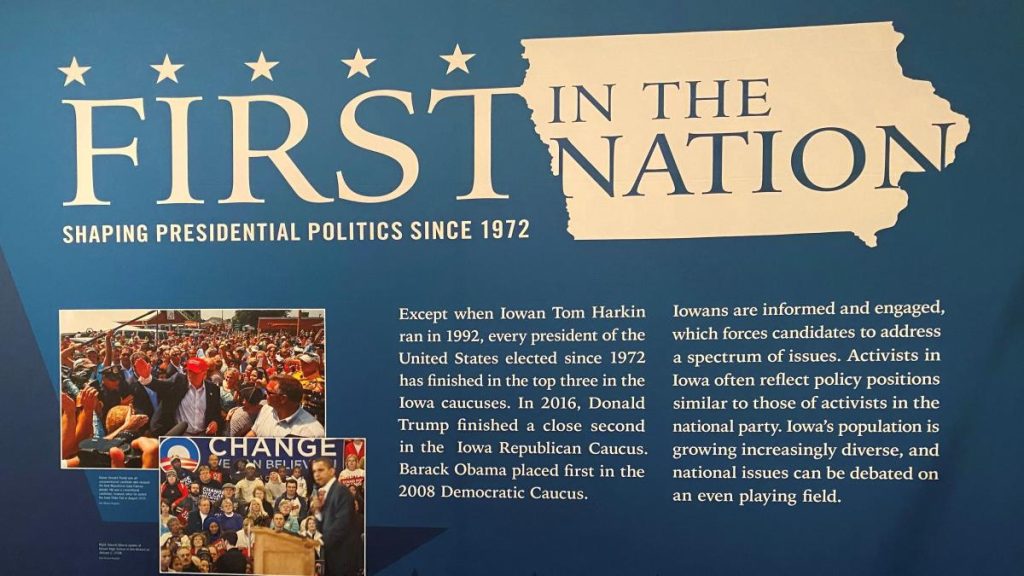
Photo taken from: Yahoo
(click or tap to enlargen)

First, I think moving the caucuses due to poor performance by Democrats in state and federal elections in Iowa is a problematic argument to make when South Carolina has an early voting date on the primary calendar. Democrats have a better chance of competing in Iowa elections than in South Carolina elections. Democrats have been losing elections in Iowa due to poor campaign strategy, occasional issues in candidate selection, and dwindling investment of resources from outside of the state. These issues are fixable if Democrats are willing to put in the effort and try new ideas.
Second, Iowa isn’t an early state for diversity. Iowa has maintained an ability to be appealing for an early state because of its small size. It is cheaper to do most campaign activities in Iowa than in other places, which lowers the financial threshold required for a campaign to compete. This gives candidates who are not as well-known or well-funded the ability to compete if they have a good strategy and a compelling vision for voters. Nevada and South Carolina were added as early states by Democrats in 2004 to bring geographic and racial diversity to the primary process while keeping the financial threshold to compete relatively low.
Third, Iowa generally doesn’t pick the nominee for President. As the first state in the process, its main job is to eliminate campaigns that are not viable financially or strategically. The states that have the most influence on the process go third and fourth, which are currently Nevada and South Carolina. Nevada and South Carolina have a better track record of picking nominees because they go after Iowa and New Hampshire eliminate a lot of candidates. Since there are rarely more than four viable campaigns after the first two contests, the winners of subsequent contests require a broader coalition to win primaries, rather than the 20% to 33% of the vote needed to win in Iowa or New Hampshire.

Photo taken from: Chip Somodevilla / Getty Images
(click or tap to enlargen)
Fourth, while Iowa’s small towns and rural counties may not look like the diverse constituencies of the Democratic Party’s base, they do look like the small towns and rural areas of Minnesota, Wisconsin, Michigan, and Pennsylvania. Those four states have featured increasingly close races for their electoral college votes, which have been influential in determining the outcome of recent presidential elections. Democrats have been losing small towns and rural counties in these states by increasingly larger margins.
Allowing Iowa to maintain its first-in-the-nation caucus would require candidates to figure out how to better compete in these small towns and rural counties since Iowa does not have a large city where a Democratic candidate can expect to run up a large margin that makes up for poor performance elsewhere.
If Democratic candidates develop new strategies to compete in these small towns and rural counties, they can deploy them in the general election in Minnesota, Wisconsin, Michigan, and Pennsylvania. While Democrats are likely to still lose small towns and rural areas with new strategies, losing them by a smaller margin may affect the winner of a state’s electoral votes.
I don’t expect Joe Biden to face a serious primary challenge in 2024. I also don’t expect the DNC to suddenly give up on the plan they recently approved for 2024, though I am not sure to what extent they will succeed in implementing it. I hope that these arguments are considered when the Democrats revisit the rules for the 2028 presidential primaries.

The Reckless Growth of BlackRock and Other Asset Management Companies
The Reckless Growth of BlackRock and Other Asset Management Companies
Social Justice
Policy Brief #142 | By: Abigail Hunt | December 7, 2022
Header photo taken from: Carlo Allegri / Reuters
Follow us on our social media platforms above
Browse more social justice policy briefs from the top dashboard

Photo taken from: Daniel Leal-Olivas / AFP / Getty Images
Policy Summary
[SSB theme=”Official” align=”center” counter=”true” ]
As of December 2021, BlackRock, an asset management company – and one of the “Big Three” global money managers along with Vanguard and State Street – had more than $10 trillion in assets under management. The company controls so much capital if it were a country its GDP would rival that of the wealthiest nations in the world. BlackRock describes itself as “a global investment manager and fiduciary” and a leading provider of financial technology.
Founded in 1999, over the past quarter century, the company has grown to 70 offices in 30 countries. On the BlackRock website, solicitation for their tax-loss harvesting service advises clients to try to save money on their tax bills. In fine print, it reads that as of June, 2022 was the third worst year for stocks and the worst year for bonds in almost a century (since 1926) and warns of risk factors associated with investment. The BlackRock website states 2022 is the second-worst year in history for 60/40 portfolios (60 percent investment in stocks, 40 percent in bonds).
In 2020, CNN Business reported the Big Three are the largest stakeholders in 88 percent of the S&P 500 companies per a study done by the American Economic Liberties Project (AELP). Fox News reports that in October 2022 when a British parliamentary committee asked the company to stop investing in big oil, BlackRock refused – stating that “engineering a specific climate outcome was not in their best interest” – e.g. they lose money if oil and gas loses money. Climate activists with banners, pitchforks, and rocks set up a protest in BlackRock’s New York office, resulting in 10 arrests and no change in BlackRock’s stance on climate issues or their daily operations.
Policy Analysis
BlackRock is a bloated money machine with too much influence. In addition to their disregard of the global climate crisis, Fox Business reports the company is inextricably intertwined with the Chinese Communist government; BlackRock funneled billions in American dollars to China, ignoring the fact that their capital investments prop up an entity responsible for widespread devastation in the form of oppression, abuse, and widespread human rights violations.
When a single individual or entity has control over a service or industry or when their wealth is so immense it is abhorrent, they cannot be controlled, and we are treading in dangerous waters.
Photo taken from: Proxy Insight, YourStake (.org)
(click or tap to enlargen)

Engagement Resources
Click or tap on resource URL to visit links where available

BlackRock website. https://www.blackrock.com/us/financial-professionals

Carla Mozée. US stocks slump as Fed officials see more rate hikes in the pipeline to tame inflation. November 17, 2022. https://markets.businessinsider.com/news/stocks/stock-market-news-fed-bullard-george-rate-hikes-pivot-dow-2022-11

Daniel Urie. Carvana, Zulily and Peloton among companies with large layoffs in Pa. in 2022. July 6, 2022. https://www.pennlive.com/news/2022/07/carvana-zulily-and-peloton-among-companies-with-large-layoffs-in-pa-in-the-first-half-of-2022.html

Theron Mohamed. Wharton professor Jeremy Siegel says the US economy is faltering – and the Fed may cut interest rates to 2% next year. November 22, 2022. https://markets.businessinsider.com/news/stocks/wharton-jeremy-siegel-economy-inflation-recession-fed-interest-rates-housing-2022-11

BlackRock tells UK ‘no’ to halting investment in coal, oil and gas. October 18, 2022.
https://www.foxbusiness.com/energy/blackrock-tells-uk-no-to-halting-investment-in-coal-oil-and-gas
Aislinn Murphy. BlackRock headquarters stormed by protesters, some carrying pitchforks. October 26, 2022. https://www.foxbusiness.com/politics/blackrock-headquarters-stormed-protesters-some-carrying-pitchforks
Audrey Conklin. BlackRock investments in China: Consumers’ Research warning consumers, governments, Consumers’ Research sent a letter to the governors of 10 states. December 2, 2021. https://www.foxbusiness.com/politics/blackrock-china-consumers-research-warning

Nicole Goodkind. Consumers are keeping the economy afloat… for now. November 30, 2022. https://www.cnn.com/2022/11/30/investing/premarket-stocks-trading/index.html
Matt Egan. BlackRock and the $15 trillion fund industry should be broken up, antimonopoly group says.
https://www.cnn.com/2020/11/24/business/blackrock-vanguard-state-street-biden/index.html

Graham Steele. The New Money Trust: How Large Money Managers Control Our Economy and What We Can Do About It. https://www.economicliberties.us/our-work/new-money-trust/

Are Tech Billionaires the Worst Polluters on Earth?
Are Tech Billionaires the Worst Polluters on Earth?
Technology Policy Brief #75 | By: Mindy Spatt | December 8, 2022
Header photo taken from: Jason Goad / The Guardian
Follow us on our social media platforms above
Browse more technology policy briefs from the top dashboard

Photo taken from: ESG Clarity
[SSB theme=”Official” align=”center” counter=”true” ]
Tech Billionaires Leave an Outsize Carbon Footprint, Despite Their Carbon Neutral Claims. Advocates claim allowing polluters to purchase carbon offsets is a “scam” and hurting, rather than helping the planet.
Among the many false claims that rained out of the mouth of billionaire BS artist Sam Bankman-Fried was the claim that his crypto exchange FTX was a “carbon neutral company”, a claim parroted by his celebrity spokesperson Gisele Bündchen and gushed over in Forbes magazine.
How could a crypto company be carbon neutral? According to a recent report by the White House, the crypto industry is poisoning the air at an alarming rate, with more emissions than many countries including Argentina and Australia, and “the rapid growth of crypto-assets could potentially hinder broader efforts to achieve U.S. climate commitments to reach net-zero carbon pollution.”
FTX was likely no different. Bankman-Fried’s boast was based on his own calculations of the company’s purchase of carbon offsets in relation to FTX’s direct emissions only, not those associated with the crypto products being traded there. Or the broader implications for the environment. Neither calculation stands up under scrutiny.
The White House report found that the crypto industry’s environmental impact goes far beyond the operations of a single trading platform. “Besides purchased grid electricity, crypto-asset mining operations can also cause local noise and water impacts, electronic waste, air and other pollution from any direct usage of fossil-fired electricity, and additional air, water, and waste impacts associated with all grid electricity usage.”
But the bigger problem with Bankman-Fried’s boast is that it drastically overestimates the value of offsets and their impact, which critics allege are minimal. Despite that offsets have become the flavor of the month for billionaires looking to make excuses for the huge streams of emissions they and their companies spew. Advocates are fighting back with data that says offsets are at best meaningless and at worst harmful.

Chart taken from: The Conversation
Offsets are primarily the planting of trees or other measures that protect forests. These offsets, however, don’t have any direct impact on reducing the planet-heating gases building up in our atmosphere. While trees may absorb some carbon, it is difficult to measure, and many credits go toward preserving existing forests, which creates no new benefits.
An analysis on offsets in California by carbonplan.org found that a large number of the credits in the program do not reflect real climate benefits. Their research shows that the “scale of the problem is enormous: 29% of the offsets we analyzed are over-credited, totaling 30 million tons of CO₂e worth approximately $410 million.”
Carbonplan’s criticism seems mild in comparison with Greenpeace’s call for an end to carbon offsets altogether, According to Greenpeace, carbon offsetting “is truly a scammer’s dream scheme.” In Greenpeace’s view, the purchase of offsets far away from the places they are actually polluting allows companies to avoid making meaningful reductions in their emissions or repairing the communities that are directly impacted.
Bankman-Fried is hardly alone in trying to justify his outrageous lifestyle and fossil -fuel driven businesses with the purchase of offsets. Billionaires like Bill Gates and Jeff Bezos have routinely shrugged off criticisms of their companies’ outsize carbon footprint and their own lavish, fuel-burning lifestyles with claims that offsets take care of the problem.
But no matter how many trees they plant, according to Oxfam, billionaires are the worst polluters in the world, not just because of their businesses, private jets, yachts and rocket ships.. ‘The world’s richest people emit huge and unsustainable amounts of carbon and, unlike ordinary people, 50% to 70% of their emissions result from their investments. “ Oxfam’s analysis shows that the top 125 billionaires in the world are emitting, on average, “3 million tonnes a year, more than a million times the average for someone in the bottom 90% of humanity.”
Bankman-Fried was also lauded for his future commitments to climate change and other worthy causes, as Bezos has been, donations that are unlikely to make a meaningful dent in all the poison these individuals and their companies have left behind.
And that may never materialize. With his company in bankruptcy and its celebrity backers being sued right and left, Bankman-Fried’s big promises are looking pretty empty. The foundations funded by FTX are likely to go under and grantees are worried that under bankruptcy law they could even be required to return recently received funding.
Engagement Resources
Click or tap on resource URL to visit links where available

Climate and Energy Implications of Crypto-Assets in the US, Sept. 2022. https://www.whitehouse.gov/wp-content/uploads/2022/09/09-2022-Crypto-Assets-and-Climate-Report.pdf

Carbon Offsets are a Scam, by Chris Greenberg, November 10, 2021, https://www.greenpeace.org/international/story/50689/carbon-offsets-net-zero-greenwashing-scam/

Carbon Billionaires: The investment emissions of the world’s richest people , 07/11/2022 , https://policypractice.oxfam.org/resources/carbon-billionaires-the-investment-emissions-of-the-worlds-richest-people-621446/

January 6th Committee Will Send Criminal Referrals to Department of Justice
January 6th Committee Will Send Criminal Referrals to Department of Justice
Elections & Politics Policy Brief #46 | By: Maureen Darby-Serson | December 9, 2022
Header photo taken from: NBC 9 News
Follow us on our social media platforms above
Browse more elections and politics policy briefs from the top dashboard

Photo taken from: Getty Images
Policy Summary
[SSB theme=”Official” align=”center” counter=”true” ]
On December 8th, 2022, sources revealed that the January 6th Committee were considering referring 5 individuals, including former President Donald Trump, for criminal charges to the US Department of Justice. Mark Meadows, John Eastman, Jeffrey Clark, and Rudy Giuliani are the other four alleged targets of these referrals. What do these referrals means and what will come of them?
Policy Analysis
When a committee refers an individual to the US Justice Department for criminal referrals, they do not have to accept the committee’s referral and file charges. They will likely look at the evidence that the committee has and decide from there whether or not to bring charges against the individual.
In this situation, it is unclear if the Justice Department will follow through with charges. The Committee has not released their final report on the January 6th investigation, so it is not clear what kind of evidence they have against these individuals. These referrals may well be symbolic.
Either way, this is unprecedented. A committee has never referred a president to the Justice Department for criminal charges after an investigation. What this means for the 2024 Presidential election will remain to be seen.

Photo taken from: The Associated Press / The Washington Times / John Minchillo
Engagement Resources
Click or tap on resource URL to visit links where available
https://www.cnn.com/2022/12/08/politics/january-6-committee-criminal-referrals/index.html

The Need to Reframe Education Reform
The Need to Reframe Education Reform
Education Policy Brief #58 | By: Steve Piazza | December 2, 2022
Header photo taken from: Ann Hermes / The Christian Science Monitor / Getty Images
Follow us on our social media platforms above
Browse more education policy briefs from the top dashboard

Chart taken from: World Education News + Reviews
Policy Summary
[SSB theme=”Official” align=”center” counter=”true” ]
In the United States, no single, comprehensive K-12 academic curriculum exists at the Federal level. The states maintain the authority to design and mandate systemic curricula, but even then there is no real consistency.
Once statewide curricula reach the district level, there may or may not be some room for deviation. Exactly how teachers go about adhering to the curriculum is often prescribed, though at times it may be left up to their discretion providing that it fulfills all of the requirements as mandated by state standards.
All this is to say that what is to be taught is determined by state authority, but it also means that there is no real agreement on teaching methodology, let alone on how students learn best.
Policy Analysis
Most legal decisions on student learning seem to avoid what it actually means to learn and instead reflect everything but. Once all students were mandated into schools by 1918, the history of education has been marked by labor law disputes, social issue standoffs, school management conflicts, common core debates, assessment anxieties, and funding blitzes.
Many laws related to education improvement have been passed in most states. Yet, even though 29 states may have passed laws policies relating to evidence-based reading solutions, a closer look reveals that the majority of education related laws are mostly about budgets, security, and board and administrative protocol.
Standards, social issues, measurement, laws, etc., are only part of the story. They too often simply overshadow what really matters in education by not directly addressing what it means for a student to learn.
The phenomena involved in learning are rooted in tenets of educational psychology but unfortunately become quickly obscured by seemingly not diminishing philosophical and political divides. Discredited one-size-fits all approaches are repeatedly seen as the way to accountability, while calls for a concentration on basic skills versus more creative and critical thinking are still being answered.
This doesn’t mean that some progress in the teaching of reading or providing STEM opportunities hasn’t been made, or that objective discussion about improvement cannot take place. But even though there’s plenty of talk about innovation or meeting individual student needs, the widespread delivery of it still appears insufficient.
For example, Georgia allows for more flexibility by allowing entire systems to have charter status, but 42% of the charter schools have closed and thus have critics wondering if schools free from typical rules and regulations go far enough in helping students in need. Or, Colorado has sanctioned “innovation” schools designed to encourage increased school autonomy, but recent operational changes have threatened to reverse some gains.

Photo taken from: Andrew Caballero-Reynolds / AFP / Getty Images
(click or tap to enlargen)
Once things have leveled out, maybe the profession can be allowed to get back to considering and securing best practices.
All this has been exacerbated by school closures during the pandemic and any discussions about teaching and learning are now minimized by strategies attempting to make up for time lost. Funding from The Department of Education has mostly concentrated on out of school activities and increasing assessment. But out of school support, though always vital, is only part of the overall solution, and assessment should never, ever be confused with teaching and learning.
It cannot happen too soon because sometimes it seems we’re still stuck in the 20th Century. States like Idaho, Iowa, Oklahoma, and Tennessee, have prioritized social issues over the learning process by spending time and resources legislating bans against teaching certain concepts on race or sex. In other states, hotlines for reporting teachers in exchange for bounties exist.
One has to look extremely hard to find where the discussion of inquiry or problem based learning, gamification, or experiential learning is touted enough to permeate the day to day vocabulary of the mainstream public. For that matter, where is there legislation that precisely spells out protections for teachers’ judgment regarding long proven approaches to design “constructivist” and “formative” learning activities (as opposed to mere training and conditioning) that allow students to flourish as individuals?
We certainly have to be wary of laws that mandate one methodology over another, or that require standardized lesson scripts. But laws ought to exist that protect an educator’s judgment in providing learning opportunities in manners that meet the learning style of each individual student. If words teachers are prohibited from using can make their way into the law, protecting words that are vital to learning surely can.
Protections that encourage best practices for learning outcomes go a lot farther in a democracy than mandates that are a poor substitute for them.
Engagement Resources
Click or tap on resource URL to visit links where available

Click this link For an overview of classroom teaching methods:
https://teach.com/what/teachers-know/teaching-methods/

Here is another way to learn more about legislation regarding education: https://www.ncsl.org/research/education/education-bill-tracking-database.aspx

Teachers are encouraged to become agents of change, and this Louisiana special education teacher provides some paths to increased involvement and leadership (worth a read by non teachers as well): https://blog.ed.gov/2022/09/teachers-as-advocates-and-leaders-of-the-profession/

FCC Stumbles As It Tries to Increase Access to Broadband
FCC Stumbles As It Tries to Increase Access to Broadband
Technology Policy Brief #74 | By: Mindy Spatt | November 30, 2022
Header photo taken from: Associated Press
Follow us on our social media platforms above
Browse more technology policy briefs from the top dashboard

Image taken from: FCC / AEI (.org)
[SSB theme=”Official” align=”center” counter=”true” ]
Will $65 billion in Infrastructure funds finally bridge the digital divide and connect the 19 million Americans who still lack access to high-speed internet? The FCC’s First Step Appears to be a Misstep.
The Federal Communications Commission’s long-awaited broadband availability map was released on Nov. 18 and was immediately met with a storm of criticism. The map will be used to determine where $42 billion from the Infrastructure investment and Jobs Act will be spent. Hence states , municipalities, territories and Internet Service Providers (ISPs) have a huge stake in the map’s accuracy, which was in question even before it was released.
Key areas of contention include the numbers of unserved areas and which areas will be the most expensive to serve. The FCC map will also impact who will receive grant funding through the Broadband Equity, Access, and Deployment (BEAD) Act, but for that program states may also submit their own maps and data.
According to the nonprofit advocacy organization Free Press, “State broadband offices, local communities, and community based organizations have noted a number of inaccuracies in the new broadband maps.”
Criticisms have centered on missing locations, inadequate data about actual vs. advertised speed and about affordability. Advocates also claim the locations of homes and businesses should be more granular. Also problematic is the very short timeline for challenging the map, which ends Jan. 13. The process of amassing this data is complicated and difficult, and sates that lack expertise could find themselves left behind.
According to Free Press, states, municipalities and territories “are well positioned to know what broadband serviceable locations exist in their communities, and where broadband is and isn’t available, because they are members of those communities, with an overarching view of what occurs there. Although eager to challenge those inaccuracies, many expressed confusion over the process. In an ex parte filing Free Press “urges the Commission to offer clarifying guidance.”
The federal government has already spent about $85 billion on closing the digital divide, yet the goal of universal access remains elusive. The FCC’s map focuses on availability, which doesn’t always translate into access.
Just because high speed internet is available in an area doesn’t mean the residents of that area can afford it or have the equipment necessary to access it. While about 95% of Americans live in areas where high speed internet is available, less than 87% of households have access. An estimated half of those households report that the reason is affordability.
To address that problem, some BEAD funding will go to the FCC’s Emergency Broadband Benefit (EBB) program, which subsidizes broadband service for eligible households—defined as those that suffered income loss during the pandemic or meet other need-based criteria, such as eligibility for school lunch programs. This program is being renamed the Low-Income Broadband Benefit and the subsidy will be provided at a lower rate, down to $30 from an original $50 per month.
Of course, $30 a month is still out of reach for many low income households. In order to quality for BEAD funding, states must submit a Five-Year Action Plan that contains a state Digital Equity Plan, which in turn must in turn include a middle-class affordability plan and a low-cost broadband service option.

Infographic taken from: Broadband Now (.com) – visit website for more data findings on broadband coverage in the U.S.
(click or tap to enlargen)
The Act does not define exactly what each of these should look like, but. the state must consult with the Dept. of Commerce’s National Telecommunications and Information Administration before submitting a final draft.
Universal access is achievable. The US currently ranks 26th in the world for broadband access, behind Kuwait, New Zealand and Aruba among others. And we’ve done little to regulate Internet Service Providers or require robust low-income programs. It remains to be seen whether throwing money at the problem- or, possibly, at the wrong places- will actually conquer the digital divide.
Engagement Resources
Click or tap on resource URL to visit links where available

FCC Broadband Map: https://broadbandmap.fcc.gov/home

New Broadband Map Brings Challenges for Local Government, Carl Smith, Governining.com, Nov. 23, 2022. https://www.governing.com/now/fccs-new-broadband-map-brings-challenges-for-local-government

What Is the FCC’s New Broadband Map and Why Does it Matter? Jake Varn and Lily Gong,: The Pew Charitable Trusts 11/25/22. https://www.pewtrusts.org/en/research-and-analysis/articles/2022/11/18/what-is-the-fccs-new-broadband-map-and-why-does-it-matter

Should There Be Term Limits For Members of Congress?
Should There Be Term – Limits For Members of Congress?
Civil Rights Policy Brief #197 | By: Rodney A. Maggay | November 17, 2022
Header photo taken from: J. Scott Applewhite, The Associated Press
Follow us on our social media platforms above
Browse more civil rights policy briefs from the top dashboard

Infographic taken from: Scholastic
Policy Summary
[SSB theme=”Official” align=”center” counter=”true” ]
The United States Constitution describes the qualifications a person must have in order to be eligible to be a Representative in Article One, Section Two, Clause Two. And for Senators, the qualifications are described in Article One, Section Three, Clause Two. Minimum age limits and minimum years of citizenship, among other qualifications, are listed. But the last few decades have seen an interest in adding an interesting limitation – term limits for Members of Congress.
While Members of the House of Representatives and Senators can serve for multiple terms that sometimes go on for decades, the concept of term limits for federal officials is not new to the U.S. Constitution. The Twenty – Second Amendment to the Constitution provides in Section One that “No person shall be elected to the office of the President more than twice[.]” And around the U.S. at the state level, term limits is considered the norm.
As of 2022, thirty – seven (37) states have imposed some form of term – limits on the office of Governor while sixteen states have some term limits on their state legislative officials. And among city and local officials, research by the non – profit group U.S. Term Limits has shown that 9 of the 10 largest U.S. cities has a form of term limits for their city council and mayoral officials.
So, should there be some form of term limits for Members of Congress?

Image taken from: Pew Research Center
Policy Analysis
In order to make sense of where the issue of term limits stands today, it is important to understand how we got to this point. Since the adoption of the Constitution in the 1700’s, the document has been silent on term limits. Through the years, it simply became accepted that a person could be re-elected as often as their constituents would allow. After the unprecedented four terms of President Franklin D. Roosevelt, Americans decided that no one should be elected President for more than two terms and the Twenty – Second Amendment to the Constitution was added.
The issue shifted to Congress and whether term limits should be imposed on its members. A number of states began exploring the issue and soon, the issue made its way to referendums and ballot initiatives for citizens to vote and decide the issue. Many of the measures passed, imposing term limits on officials for state office and federal legislators representing the state.
However, the Supreme Court stepped in and halted the trend as it applied to federal legislative officials. In the 1995 case U.S. Term Limits, Inc. v. Thornton, the Court ruled that states could not add additional qualifications on their federal legislative representatives. States could add restrictions to their state officials but had to go through the constitutional amendment process if they wanted to add term limits for their Representatives and Senators. Surprisingly, right leaning Justice Clarence Thomas and more moderate Justice Sandra Day O’Connor agreed in a dissent that states should have the right to impose term limits on their federal legislators.
The issue eventually became a cause that many Republicans championed. It even became part of their messaging in the 1994 mid – term elections. A bill proposing a constitutional term limits amendment was eventually introduced in 1995 and garnered 227 votes (227 – 204), which was short of the required 290 to continue the amendment process.
In the aftermath of the 2022 midterm elections, should there be term limits for Members of Congress? The results of the midterms showed that there are many people in Congress who have served for the past number of decades.
Rep. Nancy Pelosi has been a Congresswoman since 1987. Sen. Patrick Leahy has been the Senator from Vermont since 1975. And even though he was not on the ballot in 2022, Sen. Mitch McConnell was first elected in 1984. While these members and others from both sides of the aisle have contributed a number of accomplishments, their long tenures has contributed to the political gridlock that currently plagues Washington, D.C. It has become difficult to propose and encourage new ideas and have Congress see things from a different point of view.

Chart taken from: Pew Research Center
(click or tap to enlargen)
And in the current political climate, no one seeks to find middle ground on issues or try to reach for compromises. No politician wants to give in or lose on an issue and sometimes they simply decide it would be better to do nothing at all to preserve their seat.
With the Senate looking it may be headed to another 50 – 50 split, maybe term limits could have helped break that tie by forcing entrenched candidates out and allowing new candidates in who could better appeal to voters. And, by knowing that they would serve for a definite period of time, term limits could make new candidates more beholden to their local constituents instead of trying to conform to a political party’s national message.
Term limits is not a dead issue. Just this month, North Dakota passed an amendment imposing term limits on state officials. And in Congress, a new bill was just introduced by Rep. Mayra Flores from Texas for a constitutional amendment imposing term limits. (Sen. Ted Cruz introduced the Senate version of the bill). This could be the issue that might help break the political gridlock in Washington. Another interesting twist that could be considered is changing the length of a term for Representatives and Senators.
Some proposals consider changing a Representative’s two year term to four or maybe even staggering seats as is done in the Senate. Proposals for Senators have suggested one eight year term and others that suggest a term less than the current six. While these are bold proposals, a longer or shorter term might not mean much unless some form of term limits are implemented. Any change in the length of a term has to be accompanied with term limits.
With the increasing number of term limit laws at the state level and bipartisan support in Congress, now is the time to give this issue another look as it applies to Congressional Representatives and Senators. LEARN MORE
This brief was compiled by Rod Maggay. If you have comments or want to add the name of your organization to this brief, please contact rodwood@email.com.
Engagement Resources
Click or tap on resource URL to visit links where available

U.S. Term Limits – non – profit group advocating for term limits for Members of Congress.

Heritage Foundation – older 1994 article laying out the rationale for Congressional term limits.