

JOBS POLICIES, ANALYSIS, AND RESOURCES
Latest Jobs Posts
The Ethical Dilemma of A.I. and Mental Health
Brief #158 – Health and Gender
By Geoffrey Small
The United States continues to fall short in providing basic healthcare necessities that other high-income nations provide globally. The proportionally low quality healthcare system in the U.S is compounded by a growing mental health crisis in a post-pandemic society, where demand for psychological help is higher than ever.
A Third of the Population Continue to Cook our Planet
Brief #153 – Environment Policy
By Todd J. Broadman
The methods that many humans apply to cooking their food are proving to have a substantial effect on our environment and health. About 2.4 billion people cook food using a “dirty” biomass method of cooking which uses wood, animal dung, and charcoal fire pits or kerosene stoves.
Facing the Dubious Paradigm of School Shooting Responses
Brief #61 – Education
By Steve Piazza
In response to a spate of shooting incidents in schools over the last several decades, state and local governments have attempted a number of ways to keep students safe.
Four Ways to Improve the United Nations
Brief #174 – Foreign Policy
By Inijah Quadri
The United Nations (UN) was established in 1945 with the aim of promoting international cooperation, peace, and security. Over the years the organization has evolved, taking on new roles and addressing new challenges.
However, the UN is not without its shortcomings, and there have been calls for reform and improvement. In this article, we will explore some of the ways in which the UN could be improved.
Will Regulation Stifle Crypto, And Do We Care?
Brief #80 – Technology Policy
By Mindy Splatt
Fans of crypto have enthusiastically told me it enables lower income people to invest and earn money. They think it is more democratic and less corrupt than the stock market. And they eschew consumer protections, believeing that in order for it to accomplish these wonders it must not be hampered by a governmental bureaucracy.
Will the Republicans Nominate Trump again? Examining Potential Indicators
Brief #64 – Elections & Politics
By Ian Milden
Donald Trump launched his third campaign for the Presidency in November. For several months, he had the field to himself. With Republican rivals launching campaigns to oppose him, this Brief will examine potential indicators that will come up over the next several months to help us determine Trump’s chances of winning the Republican nomination again.
State Bill To Test Limits of Election Fraud Claims In California
Brief #201 – Civil Rights
By Rodney A. Maggay
Last month in California Assemblymember Bill Essayli, a Republican from Riverside County, introduced AB 13 that seeks to make changes to existing California state election law.
Is The Premier League Getting Out of Control?
Brief #173 – Foreign Policy
By Reilly Fitzgerald
The UK government has been debating the idea of having more oversight in regards to the finances of Premier League clubs. Over the past few years, the world has seen unprecedented amounts of money on individual player transfers, team acquisitions by actors within foreign governments like the Saudi Arabian Public Investment Fund (PIF) among others, talks of teams entering into new leagues across Europe at the exclusion of other teams, and so much more.
Everyday Life in Ukraine in the Midst of a War
Brief #172 – Foreign Policy
By Yelena Korshunov
February 24th 2022 is now the day in world history when Russia started a bloody violent war against Ukraine. For another year Ukrainians have been suffering from Russian missiles, cruelty, and terrorist attacks on energy infrastructure. People are used now to constant power outages.


Amazon is a Hazardous Place to Work, But Don’t Dare Tell the Company to Change
Amazon is a Hazardous Place to Work, But Don’t Dare Tell the Company to Change
Technology Policy Brief #72 | By: Mindy Spatt | November 8, 2022
Header photo taken from: Chris J Ratcliffe | AFP | Getty Images
Follow us on our social media platforms above
Browse more technology policy briefs from the top dashboard

Photo taken from: Claudine Hellmuth / E&E News
[SSB theme=”Official” align=”center” counter=”true” ]Workers, regulators even its own investors want Amazon to improve its abysmal worker safety record. But the company has fought tooth and nail to quash those efforts.
Working conditions at Amazon’s warehouses are among the worst in the US. High quotas and constant surveillance likely contribute to injury rates for Amazon workers that are substantially higher than for comparable businesses; Amazon’s injury rate for warehouse workers was more than twice as high as Walmart’s in 2020, and its serious injury rate for warehouse workers was about 80% higher than for the industry overall.
These alarming statistics drove the company’s own investors, including Digital investment platform Tulipshare, to propose resolutions at Amazon’s 2022 annual meeting calling for the company to report on worker health and safety and the treatment of its warehouse workers.
The company’s board opposed the resolution which predictably failed, along with 14 others on worker safety. “Whilst we are disappointed that our proposal did not pass today, this vote was just the beginning in the fight for workers’ rights,” said Antoine Argouges, CEO and founder of Tulipshare, adding that Amazon had not yet disclosed by what percentage the proposal was rejected.
Argouges also said he believed there was widespread support for the resolution among investors, and indicated his intention to continue “the fight for better working conditions at Amazon.”
In its home state, Amazon is battling with the Washington Department of Labor & Industries over hazardous conditions at a warehouse in Kent, Washington.The Department found that workers were under pressure to lift, carry, and twist at a rapid pace, which the Board said was likely to lead to injury. The Department fined Amazon a paltry $60,000 and ordered the company to change these practices and decrease the potential harm to workers.
Amazon Would Rather Fight Than Change
Rather than comply Amazon appealed the order, claiming the citation requiring the company to reduce to the alleged safety hazards before any appeal could be heard, would require expensive changes to its warehouse design and retraining warehouse employees.
In its appeal Amazon complained that the process required by the board would be extremely disruptive to its operation and cost millions.
And Amazon brazenly asserted its corporate personhood, claiming the order by the Department of Labor and Industries order violated its right to equal protection under the 14th Amendment to the US Constitution.
The federal Occupational Safety and Health Administration, in collaboration with the U.S. Attorney’s Office for the Southern District of New York. is also investigating potential workplace safety hazards at Amazon warehouses nationwide, CNBC recently reported.
OSHA inspectors are looking at many of the same practices mentioned above, including Amazon’s ergonomics program and Power Industrial Truck (known as PIT) operations. Employees working in this sector are required to drive forklifts to reach high shelves, move heavy items, and operate other potentially dangerous equipment.
OSHA may also be looking into extreme heat in Amazon facilities. Heat-related hazards are a new emphasis for the agency, and were one of the complaints that spurred a walkout in August by 160 employees at the Amazon’s San Bernardino International Airport facility

Photo taken from: Amazon, Wired
(click or tap to enlargen)

Photo taken from: kadmy / iStockphoto
(click or tap to enlargen)
Amazon’s Solution
Amazon has zeroed in on robots as the solution. “The movement of heavy packages, as well as the reduction of twisting and turning motions by employees, are areas we continually look to automate to help reduce risk of injury,” Amazon said.
But critics allege that not only do the robots not make workers safer, they may be making things worse. They claim injuries are on the increase in warehouses with workers, because they cause managers to “raise performance quotes.” So far, it looks like workers can’t win.
Engagement Resources
Click or tap on resource URL to visit links where available

The Strategic Organizing Center (SOC) is a democratic coalition of four labor unions: Service Employees International Union (SEIU), International Brotherhood of Teamsters (IBT), Communications Workers of America (CWA) and United Farmworkers of America (UFW). Together, SOC-affiliated unions represent more than 4 million workers.
https://thesoc.org/news/amazons-safe-new-robot-wont-fix-its-worker-injury-problem/

Amazon warehouses face expanded probes into safety hazards as investigators visit three more sites by Annie Palmer, Aug. 2, 2022
https://www.cnbc.com/2022/08/02/three-more-amazon-warehouses-part-of-osha-safety-investigation.html

Inland Empire Amazon Workers United https://www.facebook.com/ieamazonworkers

Checking in on US Senate Races Before Election Day, Part 2
Checking in on US Senate Races Before Election Day, Part 2
Elections & Politics Policy Brief #42 | By: Ian Milden | November 2, 2022
Header photo taken from: Scott Olson—Getty Images
Follow us on our social media platforms above
Browse more elections and politics policy briefs from the top dashboard

Photo taken from: Rachel Woolf / The New York Times
[SSB theme=”Official” align=”center” counter=”true” ]
Election Day is November 8th. This Brief will take a look at some of the Senate Races I previewed over the summer and early fall and provide some short updates on the state of those races.
Colorado – For a Republican to win in Colorado, they would have to win not only conservative voters, but also a significant share of unaffiliated voters. Republican Nominee Joe O’Dea tried doing this in the primary and won over an underfunded conspiracy theorist.
Shortly after the primary, O’Dea got into a war of words with Trump, which may cost him votes from Trump’s supporters. Republicans didn’t make a significant investment in the state due to the unexpected expense in Ohio. Senator Michael Bennet (D-CO) should win reelection, though the margin might be closer than Democrats would prefer.
New Hampshire – Republicans held their primary in September and nominated Don Bolduc, a retired general known for appearances on Fox News. The types of statements that got Bolduc on Fox News don’t sit well with many of New Hampshire’s moderate voters.
He’s been trying to backtrack on some of his more controversial statements on topics like the 2020 election and abortion in hopes that some voters have short memories. With the polls getting slightly tighter, a Super PAC with ties to the Heritage Foundation is spending money to help Bolduc. This is a closer race than Democrats hoped to have, but Bolduc is a flawed candidate. Senator Maggie Hassan (D-NH) should still be favored to win reelection.

Photo taken from: WSAV-TV
Arizona – Blake Masters (R-AZ) was trailing significantly in most polls at the start of the General Election. As a result, the Senate Leadership Fund, the primary Super PAC supporting Republican candidates for the U.S. Senate, canceled its plans to run ads in the state. The NRSC has reinvested some money into the race, but it hasn’t made up for the cuts made by the Super PAC or Masters’ fundraising difficulties. The national environmental trends and polling trends within Arizona for all statewide races have moved towards the Republicans in recent weeks.

Photo taken from: The Associated Press
(click or tap to enlargen)
Senator Mark Kelly (D-AZ) still leads narrowly in most polls (and often within the margin of error), and Masters still has a poor image among Arizona voters. I think Senator Kelly will still win as long as Democrats mail their ballots back, but I wouldn’t completely rule out Arizonans supporting Republicans in many state races this year.
Wisconsin – Mandela Barnes’ (D-WI) polling lead didn’t last long. Senator Ron Johnson (R-WI) is now leading after spending on TV ads criticizing Barnes on crime.
Democrats have not been able to invest enough to prevent the ads from having an effect. The general election campaign has not only harmed Barnes’ image, but according to the Marquette University Law School Poll, Johnson’s image has improved. If Democrats don’t defeat Senator Johnson this year, then that will likely prompt some difficult conversations within the party about strategic directions.
Florida – I didn’t give Democrats a very good chance of winning the Florida Senate Race when I previously wrote about this race. National and statewide Democrats haven’t invested a significant amount of money in Florida for this year’s statewide elections. Florida probably shouldn’t be considered a swing state until Democrats develop a better strategy to compete in statewide elections.
Utah – There are not many polls for this race. The Dan Jones and Associates poll has gathered new data about every other month. The most recent one I could find was from early October. It still shows Senator Mike Lee (R-UT) in the lead, but unaffiliated candidate Evan McMullin has been slowly gaining support.
A more recent poll from Emerson College shows Lee with a wider lead. Voter perceptions of McMullin appear to be worse in the Emerson College poll when compared to earlier polls, which suggests that his chances of pulling off an upset are still slim.
Engagement Resources
Click or tap on resource URL to visit links where available

DSCC – Official Campaign Arm of Senate Democrats

Abbott Running Scared: Texas Incumbent Limited Voter Access to Polls Ahead of Midterms
Abbott Running Scared: Texas Incumbent Limited Voter Access to Polls Ahead of Midterms
Elections & Politics Policy Brief #43 | By: Abigail Hunt | November 2, 2022
Header photo taken from: Shelby Tauber / The Texas Tribune
Follow us on our social media platforms above
Browse more elections & politics policy briefs from the top dashboard

Photo taken from: Brandon Bell / Getty Images
[SSB theme=”Official” align=”center” counter=”true” ]
For the disillusioned and jaded non-conservatives of the Lone Star state, seeing Beto O’Rourke within spitting distance of Greg Abbott in a dead heat for governor thrills our withered-but-still-beating Grinchy little hearts. From 1847 to 1979, with the exception of a few years here and there, Texas was Democratic. The most-beloved governors in our history are Democrats – Sam Houston, Ann Richards. I suspect there may be a greater number of Texans watching these election results with interest – we could make history this year.
There are many events that can influence any election outcome, and this one is no exception. Reports are already rolling in of ballot tampering, voter intimidation, closed polling locations, and denied mail-in ballots. For the first time, I had to vote on an electronic machine that then printed a ballot sheet, on which my votes were printed. I then had to insert that page into a separate machine, a scanner, in order for my vote to be counted. It added a couple of extra steps to the process. This is just my anecdotal experience, but it is disconcerting.
Adding steps that could further complicate things for those with language barriers, impairments, and disabilities who already have to deal with barriers to access. Another barrier to access for a majority youth voter population is the lack of voting options for college students. In an article from Alex Nguyen, the Texas Tribune reports limited access to voting locations for thousands of students at smaller universities across the state, stating that for some campuses the nearest polling site is several miles away. Student IDs are not considered acceptable forms of identification. Despite these barriers, voter turnout from 2014 to 2018 more than tripled for voters under 30, from 8 to 26 percent.
Alex Nguyen. College voters held back by Texas election law, lack of on-campus polling sites. October 28, 2022.
https://www.texastribune.org/2022/10/28/texas-young-voter-turnout-access/
So who is our governor? Greg Abbott made a windfall from a devastating back injury that crippled him for life. After he achieved a political position of power, he supported legislation that made it harder for someone to get a settlement similar to his own. He made choices that furthered his own political interests but were detrimental to others. He has passed laws that outlaw abortion and prevents the teaching Critical Race Theory (CRT) in schools; Abbott is out for #1 – himself. Greg Abbott did nothing after children were massacred in Uvalde, just like the Texas police there stood by and did nothing, and every one of those individuals needs to, at minimum, lose their jobs.
Abbott does not care about the danger to the average Texan – man, woman, or child. He let Texans freeze when the power went out, because he had power. His child attends private school. He has no familiarity to a relationship with pregnancy. If it does not personally affect him, he doesn’t care who it hurts or kills.
There are “dark money” groups influencing politics in the state – a Texas Tribune
An article by Patrick Svitek discusses two of these groups, No It Couldn’t LLC and Coulda Been Worse LLC. However, the monies contributed by these groups are in the tens of thousands, compared to the millions spent by the gubernatorial candidates themselves.
More than the money, the creative productions by these groups are making an impact. The ad campaigns produced by the aforementioned groups, as well as those made by the PAC Mothers Against Greg Abbott, have elicited powerful responses across social media.
Mothers Against Greg Abbott. Greg Abbott Chose This – https://youtu.be/AmmgN-Nkn1Q
Mothers Against Greg Abbott. “Whose Choice?” https://youtu.be/faTNMTVsgAA
Patrick Svitek. Uvalde shooter footage in ad criticizing Abbott’s gun policies. October 27, 2022. https://www.texastribune.org/2022/10/27/dark-money-ad-greg-abbott-uvalde/
Beto O’Rourke is the people’s champion. People want Robin Hood more than the Sheriff of Nottingham, and Beto is definitely closer to Robin, enough to alienate many conservatives.
Anti-O’Rourke ads produced by Abbott’s campaign talk about Beto’s criminal record. A bit hypocritical since one of Texas’s most-successful former governors who went on to become President was a Republican with a criminal record – George W. Bush. Because the fact is that one-third of adult citizens have a criminal record in the U.S. People have an inflated sense of superiority for not having a criminal record.

Photo taken from: Todd Wiseman / The Texas Tribune
Most of us have broken at least one minor law; much of the difference between someone with a criminal record and someone without is that only one of the two was caught and prosecuted. Our criminal justice system disproportionately affects the poor and people of color. Some of us have loved ones with a criminal record and//or have a criminal record ourselves – is it not representative of the people to have someone like themselves, including criminal history, in power?
Robin Hood is the protagonist despite the fact that he robs people, because it is understood in the telling of the story that the rich people are lazy, indulgent, spoiled, and cruel, and that the workers who exert the effort and keep the country running are oppressed, abused, and deprived of even minor comforts. Robin Hood is balancing the scale we can all see is unevenly tipped.
Abbott did not bring Texas to greatness, and neither did Rick Perry before him – the economic machine of Texas developed from dirt-poor settlements inhabited by industrious Mexicans and Southerners on whose backs an empire was built, many years before either of those men existed.
National Conference of State Legislatures Barriers to Work: People with Criminal Records: Improved Access to Licensed Occupations for Individuals With Criminal Records. July 17, 2018. https://www.ncsl.org/research/labor-and-employment/barriers-to-work-individuals-with-criminal-records.aspx

Screenshot taken via: Twitter
In anticipation of the real threat of Texas flipping blue and cementing itself as a swing state, Greg Abbott is advertising for governor as he has never had to do before. A 2016 Twitter post wherein Abbott describes Clarissa Phalen, a police officer in Texas, as his “wife’s niece” is now infamous for the reference. The post celebrates Phalen becoming a law enforcement officer. Recently, Greg Abbott’s “wife’s niece” made a commercial at his behest to attempt to reconnect with the people – it is as cringe-y as it sounds. The Tío Greg commercial, paid for by the Abbott campaign, can be viewed here:
Greg Abbott Youtube. Tío Greg. https://m.youtube.com/watch?v=803XV392sTk&feature=youtu.be
In the lead up to Election Day, the polls are flip-flopping way more than usual. For those of us hoping to make history and return to our roots with Beto, there is the slightest glimpse of light at the end of a tunnel. Here is to hoping that light is the return of the sun on the other side of a dark tunnel rather than impending end.

Education Takes a Back Seat in the 2022 Midterms
Education Takes a Back Seat in the 2022 Midterms
Education Policy Brief #57 | By: Steve Piazza | October 31, 2022
Header photo taken from: The Associated Press Photo / Jeff Amy
Follow us on our social media platforms above
Browse more eduation policy briefs from the top dashboard

Photo taken from: Reuters / Evelyn Hockstein
Policy Summary
[SSB theme=”Official” align=”center” counter=”true” ]
Most polls show that 2022 midterm election voters seem to have prioritized the economy over all other issues. Not surprisingly, since it often holds voter interest more than crime, foreign affairs, health, and the environment.
Education finds itself at the bottom of most recent surveys, if it’s visible at all. When it is, specific hotbed issues like student debt relief or parental rights are more likely to be reflected as a concern for voters than curricular overhauls, improving school performance, and sadly, preventing school shootings.
Subsequently, political candidate discussions on children learning and safety seem to be conspicuously absent in mainstream congressional contests.
It’s not totally omitted, though. Across the country there are seven state superintendent races, and 51 pertaining to state boards of education. Yet, these races, especially in Arizona, Florida, and South Carolina, are more about cultural ideologies than policy on learning and safety.
The same is true where amendments and referenda are on the ballot. Voters are deciding on issues ranging from funding initiatives to legislative oversight of the state’s board of education. But infrastructure and protocol matters, though important, have taken precedence and become a substitute for progress in student achievement.
Policy Analysis
Education is something that directly affects all American citizens, not just parents and children. Whether somebody is a product of a public, private, or home school, everybody has a stake because a democratic society depends on an educated populace.
So why is it that debate over teaching and learning in public schools seems neglected during campaigns, and especially congressional races?
To be sure, it’s a risky undertaking for politicians to take on educational issues. Just think of what happened to Democrat Terry McAuliffe’s gubernatorial campaign in Virginia after his remarks that alienated parents.
Waning public sentiment about education can also be a factor. An October 2, 2022 Morning Consult poll shows voters declaring education as “very important” only 50% of the time. The economy (80%) and crime (61%) were the top two choices while education was fifth. In a similar poll by Monmouth University, education barely makes it into the top 10, and that has to do with student loan debt specifically. Even then it rated “extremely or very important” only 31% of the time.
All this despite the concerns of time missed during Covid and recent results of the National Assessment of Educational Progress (NAEP), or the nation’s report card. The first since the pandemic started, it shows that eighth grade students showed a proficiency in math of 26%, down 8% from 2019. Fourth grade scores were down 5%. Scores for reading were also down, though that’s part of a trend prior to 2020.
Some say that too many people just don’t understand educational issues, let alone the political process. Many schools and organizations have already introduced civics initiatives to better educate future voters, but it takes time to increase substantive viewpoints and involvement beyond voting.
Others say politicians and parents have no place in the discussions, that practitioners should decide curricular matters. That debate has been around for decades and is one that needs to be resolved with all stakeholders in mind.
Yet one more reason education doesn’t take center stage could be a result of long term-political strategies.

Photo taken from: The Hill / Julia Nikhinson
(click or tap to enlargen)
For over sixty years, the Democrats have seen themselves as the party of education. They do have a decorated history of passing significant public school education initiatives at the federal level.
But while Democrats have been persistently touting their support for education for some time, some believe many conservatives never got over the 1954 United States Supreme Court decision requiring desegregation, and the Republican Party and its wealthy benefactors have been quietly waging a cultural war against schools ever since.
By 1988, the Republicans had had enough and the quiet frustration manifested itself into a clamorous push for vouchers and school choice. More recently, dubious Critical Race Theory (CRT) fears and inflated parental rights measures have contributed to the noise. In fact, data from Pew Research shows more than twice as many Republicans believe public schools are having a negative impact on the country.
It’s not a stretch to say that too many voters in general elections are in the habit of voting for parties rather than issues and assume that the party leaders will then make the right decisions. But decisions based on populist notions do not teach children how to read or do math.
Both parties may feel they will win the strategy battle outside the classroom, but what actually happens inside still needs to be seriously addressed.
Engagement Resources
Click or tap on resource URL to visit links where available
To find out more about who and what’s on the ballot this year, visit these sites:


If you’re interested, in learning more about curricula by state, you can use a tool designed by Education World to perform a search:

https://www.educationworld.com/standards/
These are links to resources on educating students about the election process:

https://www.edutopia.org/article/using-election-teaching-tool


Medicare Drug Prices: Listen to the Organizations that Matter
Medicare Drug Prices: Listen to the Organizations that Matter
Health and Gender Policy Brief #148 | By: Geoffrey Small | November 1, 2022
Header photo taken from: Phelan M. Ebenhack / The Associated Press
Follow us on our social media platforms above
Browse more Health and Gender policy briefs from the top dashboard

Chart taken from: The Kaiser Family Foundation 2022 Report “An Overview of the Part D Prescription Drug Benefit”
Policy Summary
[SSB theme=”Official” align=”center” counter=”true” ]
President Biden traveled to Irvine, California and Portland, Oregon during the month of October to promote the Inflation Reduction Act. As open enrollment for Medicare begins, the Biden administration is highlighting how seniors can benefit from health insurance savings made possible by the new policy. The Inflation Reduction Act aims to reduce senior health care premiums by an average of $800 annually.
To mark the beginning of his trip, Biden signed an executive order requiring the Department of Health and Human Services to submit a report detailing ways seniors can save on drug costs and have access to innovative drug therapies. However, the California GOP released a response, claiming that the Inflation Reduction Act “will not reduce inflation” as elections draw closer.
The Chairman of the California GOP, Jessica Millan Patterson, stated “Californians are suffering under the reckless policies of Joe Biden and the California Democrats who enable his failed agenda.” When dealing with contradictory claims related to this new policy, established medical and social organizations can provide better insight into how beneficial the Inflation Reduction Act truly is for seniors.
Policy Analysis
The American Medical Association
On August 17th, 2022, the AMA issued a press release on their assessment of the Inflation Reduction Act. The AMA stated that the bill includes strategies that the organization has been advocating. Not only do they support the extended Affordable Care Act tax credits and the bill’s commitment to fight climate change, which the AMA declared as a public health crisis in June, but the organization also supports the ability for Medicare to negotiate drug prices. The AMA’s only critique of the bill was that it didn’t go far enough in stopping the Medicare payment cuts for physicians, which is scheduled to take place on January 1st.
The American Association of Retired Persons
The AARP has been one of the major advocates in lowering drug prices for seniors since the Inflation Reduction Act was advancing through Congress. AARP CEO, Jo Ann Jenkins, went to Capitol Hill to personally advocate for prescription savings. They also sent a petition with 4 million American signatures and helped AARP members send thousands of emails, as well as phone calls, urging Congressional members to pass the bill. Jenkins wrote a letter to AARP members in September stating “Drug companies have for decades raked in record profits by charging Americans three times what people in other countries pay for the same medications. Now that will begin to change.” She stated that the Inflation Reduction Act is a “historic victory for consumers.”
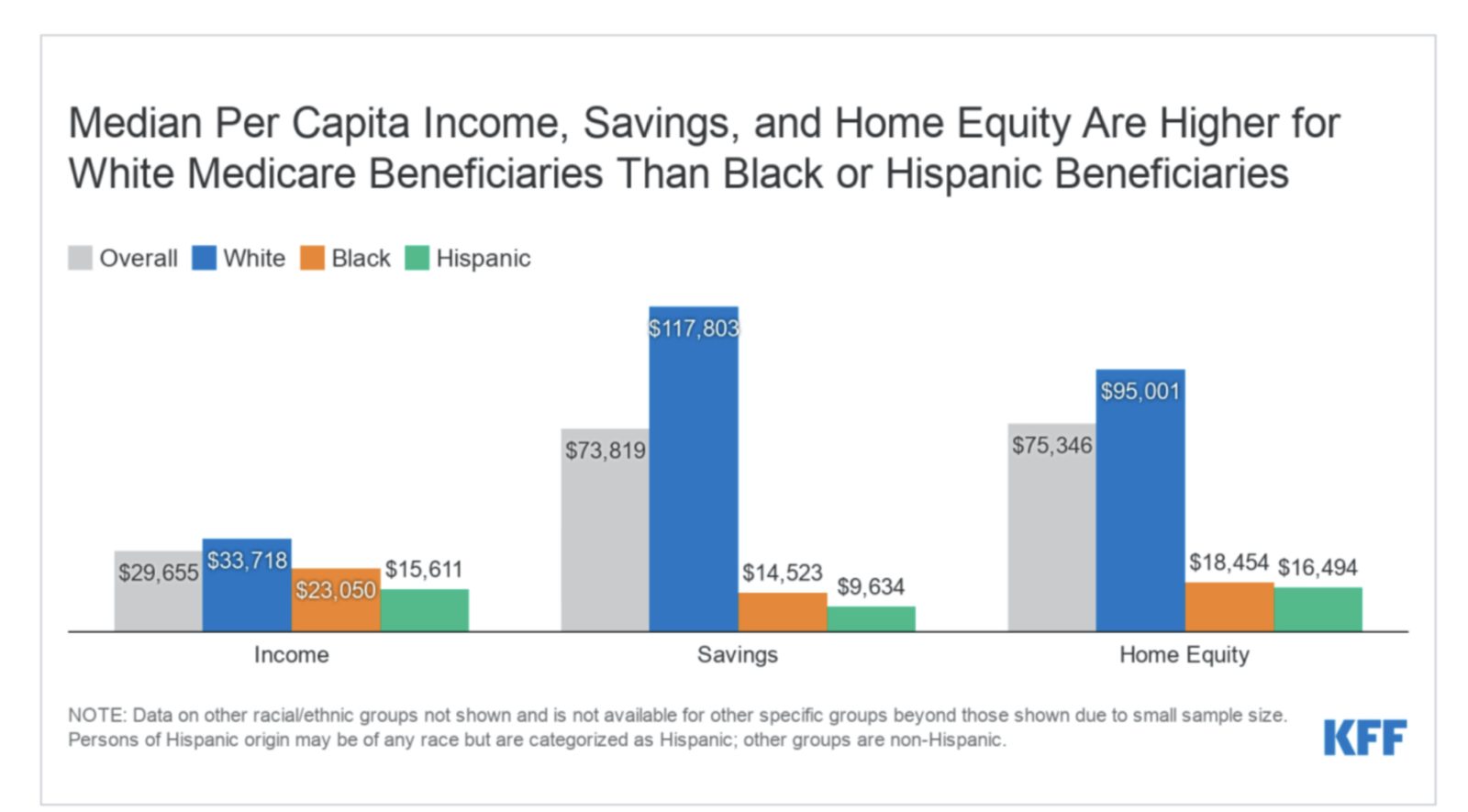
Chart taken from: The Kaiser Family Health Foundation 2021 Report “Racial and Ethnic Health Inequities and Medicare”
(click or tap to enlargen)
The National Association for the Advancement of Colored People (NAACP)
The NAACP issued a press release on Biden’s executive order the same day it was signed. The release stated “With one in four middle-class Americans struggling to afford the cost of their prescriptions, all efforts to reduce these costs are essential.” Keisha Deonarine, the Director of the NAACP’s Center for Opportunity, Race and Justice Center of Innovation, also stated “For Black Americans, thirty percent are not taking medications as prescribed due to cost. This results in under-usage of necessary medications resulting in poor health outcomes.”
Understanding these organizations’ assessments on the benefits of reducing drug prices and inflation is necessary during a time when election seasons lead to misleading political rhetoric. Donating to the AARP foundation and the NAACP can help keep Americans informed and balanced when making decisions about the future of health care and senior benefits in the United States.
Engagement Resources
Please donate:

https://www.aarp.org/aarp-foundation/


Checking in on US Senate Races Before Election Day
Checking in on US Senate Races Before Election Day
Elections & Politics Policy Brief #40 | By: Ian Milden | October 31, 2022
Header photo taken from: Demetrius Freeman / The Washington Post
Follow us on our social media platforms above
Browse more elections & politics policy briefs from the top dashboard

Photo taken from: Sean Simmers / The Associated Press
Policy Summary
[SSB theme=”Official” align=”center” counter=”true” ]
Election Day is November 8th. This brief will take a look at some of the Senate Races I previewed over the summer and provide some short updates on the state of those races.
Policy Analysis
Georgia – The headlines have not improved for Herschel Walker (R-GA) since I last wrote about this race. He’s been accused of paying for his mistress’ abortion and criticized by his son for his behavior. He’s still in the race because he still has the support of the Republican Party and most Republicans in Georgia. Senator Raphael Warnock (D-GA) appears to be in a good position, though this race could still head to a runoff if nobody gets a majority of the vote.
Republicans might appreciate a runoff because that might help their chances of winning the seat. Republicans might dread a runoff because they would have to campaign with Herschel Walker for two more months.
Pennsylvania – The margin in the polls has become tighter as I thought it would. Lt. Governor John Fetterman (D-PA) still leads Dr. Mehmet Oz (R-PA).
Dr. Oz has struggled to improve his image among the electorate as most polls, including ones with more favorable results for Republicans, indicate a high percentage of voters still hold negative opinions of Dr. Oz. His tasteless attacks on Fetterman’s health likely did not help. This race remains Democrats’ best hope of picking up a Republican-held Senate race.


Photo taken from: John Lochner / Associated Press
Nevada – The polls have moved a few points in the direction of Republican Adam Laxalt, which isn’t a great sign for Senator Catherine Cortez-Masto (D-NV).
The polls still show a margin of error race and Nevada has a reputation for being a difficult state to get an accurate poll from, so Democrats still have a shot to keep the seat. However, the movement in the polls and the internal squabbles within the Democratic Party make this race the most concerning one for Democrats where they have an incumbent to defend.
North Carolina – This race hasn’t gained the national attention that some other U.S. Senate races have received. Most polls show margin of error races with several polls showing both candidates having support in the mid-40s.
That’s a sign that voters don’t know the candidates very well, which I indicated might be an issue for both candidates several months ago. This race will be decided based on who turns out to vote. Over the past decade, that has worked out better for the Republicans in North Carolina.
Photo taken from: Charles Rex Arbogast / Associated Pres
Ohio – Republican Super PACs are spending about $3 million in TV ads a week in Ohio, which they didn’t plan on doing. Republicans had to invest that much money to prop up J.D. Vance (R-OH) because it is hard for Republicans to win back control of the U.S. Senate if they lose in Ohio. Congressman Tim Ryan (D-OH) has kept this a margin of error race despite little investment from national Democratic groups. It doesn’t seem likely that Congressman Ryan will win, but the race is close enough where a Democratic win isn’t impossible.
Iowa – I wrote back in July that Democrats were not going to win in Iowa unless something substantially changes the race by late October. I have not seen anything that substantially changes from that assessment. Republicans have been running more ads on TV than Democrats, not just in the race for the U.S. Senate seat, but also in races for U.S. House seats and several statewide offices. Election night is likely to bring more disappointment for Democrats in Iowa.
Engagement Resources
Click or tap on resource URL to visit links where available
DSCC – Official Campaign Arm of Senate Democrats

Why Are China / US Sanctions Such a Big Issue? (Part I – General Sanctions)
Why Are China / US Sanctions Such a Big Issue? (Part I – General Sanctions)
Foreign Policy Brief #153 | By: Inijah Quadri | October 22, 2022
Header photo taken from: Shutterstock.com
Follow us on our social media platforms above
Browse more foreign policy briefs from the top dashboard

Photo taken from: Mark Wilson / Getty Images
Policy Summary
[SSB theme=”Official” align=”center” counter=”true” ]
Trade sanctions on the US imposed by China, in the last several years, are a reflection of Beijing’s desire to respond to similar sanctions imposed by America. In particular Chinese sanctions are a reaction to the effects of the trade war that the United States exacerbated during Trump’s presidency. It is essential for businesses in the US and China to have a solid understanding of the China / US sanctions conflict and the compliance repercussions associated with it, given the growing influence that these restrictions have on the global financial landscape.
What Exactly Is the Sanctions Regime Against China?
In recent years, Washington’s sanctions against China have been focused on several industries, including telecommunications, semiconductors, data security, financial services, amongst others. There has been a flurry of new US limitations on Chinese exports, imports, FDI (foreign direct investment), and financial securities, which are radically altering the economic relationship between the United States and China. Due to increasing caution and mistrust on both sides of the Pacific, cross-border business travel between the United States and China is at a standstill.
Congress has supported this US offensive by appropriating more funds to sectors seen as crucial to sustaining U.S. competitive advantages in technology, manufacturing, and defense. For example, the U.S. Senate passed the U.S. Innovation and Competition Act that increases funding for semiconductor manufacturing, hastens the rollout of 5G telecommunications capabilities, and restructures the National Science Foundation with the goal of making the US more competitive in science.
Congressional support for American industries that compete with China is expected to persist beyond 2022, with far-reaching consequences for a wide range of industries. A recent example are American sanctions on the Chinese company Huawei. The US suspected that Huawei was using its operations to spy on American technology.
The government banned Huawei products in the US asked its allies to stop using Huawei equipment in their 5G mobile networks. The American government also used export prohibitions to deprive Huawei of essential American goods and technologies.
Recently the US also has blocked deals that would have put the dating app Grindr under Chinese control and US chipmaker Qualcomm under Singaporean control (for fear of Chinese influence); it’s pressured multiple Chinese companies to leave the New York Stock Exchange; and the Trump administration attempted to ban the Chinese owned WeChat and TikTok, the latter of which is still under investigation by an interagency national security panel.


Photos taken from: Str / Nikkei montage / Getty Images
What Has China’s Response Been?
The Chinese Ministry of Commerce (MOFCOM) said in 2019 that it would initiate its own foreign sanctions program. This started in 2021 with the Anti-Foreign Sanctions Law. Article 6 of this law makes provision for the Chinese government to seize and freeze movable property, real estate, and other types of property of listed individuals.
It also creates provisions to enable the government to forbid or restrict organizations or individuals in China from conducting transactions and engaging in any cooperation with listed foreign organizations or individuals. Finally, it also grants powers to remove listed persons from Chinese soil and prevent them from ever returning.
Other designations to counter foreign sanctions against China have been put in place including posting US organizations an Unreliable Entity List, as well as a new Data Security Law. These laws buttress the Anti-Foreign Sanctions Law.
Are the US/China Sanctions Working?
According to studies, sanctions can be viewed as a technique that alert parties to a problem without actually addressing it. Still, both Chinese and American governments use sanctions to show that they don’t like the policies of the other. However, many people think it’s a safe result because no one gets hurt or dies. So, what is the effect of these sanctions?
Even as the two countries have imposed sanctions on each other, they have nevertheless found alternative ways to produce their affected products. But there has been a cost: prices have increased. This is according to the International Monetary Fund. Sanctions have only served to sow seeds of distrust, and going down this line, the end result will most likely be devastating for both parties.
Engagement Resources
Click or tap on resource URL to visit links where available

IMF Blog (https://www.imf.org/en/Blogs/Articles/2019/05/23/blog-the-impact-of-us-china-trade-tensions)

International Trade Administration: (https://www.trade.gov/country-commercial-guides/china-import-tariffs)

Mercator Institute for China Studies (MERICS): (https://www.merics.org/de/kurzanalyse/chinas-anti-foreign-sanctions-law-warning-world)

The United States Innovation and Competition Act of 2021 (S.1260): (https://www.congress.gov/bill/117th-congress/senate-bill/1260)

A Candidate Code of Ethics
A Candidate Code of Ethics
U.S. RESIST NEWS OP ED | By: Ron Israel Abigail Hunt, Rod Maggay, Geoffrey Small,and Steve Piazza | October 28, 2022
Header photo taken from: Matt Dorfman

Photo taken from: The Washington Post
The US election system, at the core of our democracy is under attack. Many politicians still refuse to accept the results of the 2020 Presidential election; others refuse to go on record saying they will accept the result of mid-term races where they are candidates. Debates are at a minimum, and campaigns are rife with lies, false statements, and dark money.
In the face of this assault U.S. RESIST NEWS puts forward the following Candidate Code of Ethics intended to restore integrity and respect for the election process. We ask all candidates in the upcoming midterm elections and beyond to agree to adhere to the following Code.
Candidate Code of Ethics
1. Abide by the Results of the Election:
I pledge to honor the results of this election contest, even if I am the losing candidate.
2. Be Transparent Regarding Sources of (and Limits to) Campaign Finance:
I will make my donors and my donation sources a matter of public record; and will abide by any agreed upon campaign spending limits among myself and other candidate.
3. Disclose and Recuse Oneself from Involvement with All Actual and Potential Conflicts of Interest, including Investments:
I will disclose any existing and potential conflicts of interest that might unnecessarily bias my positions on campaign issues, and recuse myself from taking positions on issues where I might have a conflict of interest.
4. Refrain from Making False Claims About Your Background:
I will not lie about my past record or background.
5. Display Respect for Your Opponent:
I will not slander my opponent or make false statements about his or her actions or words.
6. Agree to a Moratorium on Speeches 5 Days Prior to the Election:
I agree to refrain from making campaign speeches 5 days prior to Election Day.

Photo taken from: Stand By Your Ad
7. Commit to Advertising that Supports the Issues in My Platform:
My campaign advertising will focus only on the issues I am supporting.
8. Participate in at Least 2 Debates:
I agree to participate in at least 2 debates with my opponent(s).
I agree to have a bi-partisan panel monitor the use of this Code by candidates for office and highlight any violations.

Increasing Reports of Voter Intimidation Incidents As Election Day Nears
Increasing Reports of Voter Intimidation Incidents As Election Day Nears
Civil Rights Policy Brief #196 | By: Rodney A. Maggay | October 23, 2022
Header photo taken from: Ben Torres / The Texas Tribune
Follow us on our social media platforms above
Browse more civil rights policy briefs from the top dashboard

Photo taken from: Alexia Faith
Policy Summary
[SSB theme=”Official” align=”center” counter=”true” ]
On October 17, 2022 in Mesa, Arizona a couple approached an outdoor voting drop box to deposit their ballots for the upcoming 2022 midterm elections. The couple was legally permitted to drop off their ballots early as Arizona’s early voting period had begun on October 12th. As the couple neared the outdoor drop box they were met by a group of people who were simply hanging around the ballot drop box. The group began to film and photograph the couple as they dropped their ballots into the box. The situation became hostile as the group accused the voter of being a “mule.”
The term “mule” is a reference to the 2022 film “2000 Mules” which claims that groups associated with the Democratic Party are paying people to illegally collect and submit voting ballots. The couple then retreated to their car. Members of the group followed the couple, took photographs of the couple’s license plate and continued to follow the couple in a separate car as the couple drove away. The couple subsequently filed a complaint with the Arizona Secretary of State’s Office. That complaint was referred to the United States Department of Justice and the Arizona Attorney General’s Office for investigation.
Under 18 U.S.C. § 594 it is “illegal to intimidate, threaten, coerce” or “attempt to intimidate, threaten or coerce, any other person for the purpose of interfering with the right of such other person to vote or to vote as he may choose.” Under 52 U.S.C. § 20511(1) it is a crime to “intimidate, threaten or coerce any person” for “registering to vote, or voting.” In addition to these federal statutes, nearly every state has a state statute prohibiting the intimidation of voters in order to prevent the voter from casting a ballot. LEARN MORE
Policy Analysis
With mere weeks before Election Day for the 2022 midterm elections, it is not just the integrity and security of elections that has become the focus nationwide but the safety of voters themselves.
The incident in Mesa, Arizona is not a random incident where a voter has been approached by groups of people questioning the couple’s right to vote. Also in Arizona in Maricopa and Yavapai counties there have been incidents reported where unauthorized groups have suddenly appeared to monitor ballot drop boxes in those counties. While it would be easy to simply label these incidents as unique to Arizona that has not been the case.
State election officials in Colorado, North Carolina and Nevada have also reported incidents of voter intimidation. And in California in Shasta County, voters have reported receiving suspicious phone calls where the caller has questioned the voter about their voter registration status. The callers did not identify as an election official from the county elections office.
While the incident in Arizona is disturbing because of the close physical proximity that the group had with the voting couple, intimidation and harassment is not limited to only approaching voters at ballot drop boxes or at voting booths. According to the ACLU, intimidation of voters can occur by spreading false information about voter and language requirements and displaying false and misleading signs in order to confuse a voter. This could falsely sow doubt in a voter’s mind that could deter them from voting or registering to vote at all. Other methods or techniques are brandishing weapons and wearing military style uniforms in order to create a hostile atmosphere.

Sheet taken from: Georgetown Law – Georgetown University
(click or tap to enlargen)
Being armed or portraying a military demeanor can be a huge deterrent to a voter especially when that is combined with an aggressive questioning of a voter about their qualifications to vote or their preferred language. The incident in California where voters have received phone calls at their homes demonstrates that this intimidation of voters is not restricted to areas surrounding a polling booth or a ballot drop box. Certain groups are now calling voters at their homes which is just as illegal as physically approaching a voter out on the street.
So with days to go, what recourse do voters have if they feel they are being approached or questioned inappropriately while trying to cast their ballot? First, the Institute for Constitutional Advocacy and Protection at Georgetown Law School has compiled a useful list of laws by states that ban armed militias and groups from state polling places.

Image taken from: Protect Democracy
The guide lists every state and compiles the laws that prohibit armed groups from approaching polling sites and how to recognize these groups based on their words, actions and dress. Local phone numbers are also listed so a voter who feels threated can call a local number and request help immediately. Additionally, the American Civil Liberties Union (ACLU) has issued a fact sheet with how to calmly respond if a voter is challenged on their qualifications and how to request a provisional ballot if there is a mixup with a voter’s registration.
With right wing elements believing the “Big Lie” that the 2020 election was stolen from Donald Trump, it appears that more groups are determined to be out in force to monitor polling places for perceived fraud. But this is also a situation that could easily turn into harassment and intimidation of voters. What voters can do is make themselves aware of these harassment tactics and work with the options made available by the ACLU and other groups to report what is happening out there as Election Day nears. Any voter who is qualified to vote should not have any obstacles to cast a ballot. LEARN MORE, LEARN MORE
This brief was compiled by Rod Maggay. If you have comments or want to add the name of your organization to this brief, please contact rodwood@email.com.
Engagement Resources
Click or tap on resource URL to visit links where available

FairVote – a comprehensive report from non – profit group chronicling historical incidents of violence and intimidation used to deter voters from casting a ballot.

American Civil Liberties Union (ACLU) – info sheet with listing of a voter’s voting rights as well as info on what to do when confronted with inappropriate interference when trying to vote.

Campaign Legal Center (CLC) – info page on protecting voters from voter intimidation.

The Trump Subpoena
The Trump Subpoena
Elections & Politics Policy Brief #41 | By: Maureen Darby-Serson | October 26, 2022
Header photo taken from: Rebecca Noble / The New York Times
Follow us on our social media platforms above
Browse more elections and politics policy briefs from the top dashboard

Photo taken from: The New York Times
Policy Summary
[SSB theme=”Official” align=”center” counter=”true” ]
Last week, the January 6th Committee issued a subpoena to former President Donald Trump in one of its most brazen moves to uncover Trump’s involvement in the insurrection that happened early in 2021. This will likely start a long and arduous court fight over whether Trump will actually appear before the committee.
The biggest reason the Committee issued this subpoena is to investigate Trump’s involvement in finding fake electors to say that he won the 2020 presidential election.
Policy Analysis
What does this mean for the committee hearings and Trump? The short answer is not much. The long answer is that it is complicated. The short answer stems from the reality that Trump will likely not testify or will do so in a very limited manner, potentially by invoking his fifth amendment right to self-incrimination.
The complicated answer comes after Steve Bannon received a 4-month prison sentence for defying the January 6th Committee’s subpoenas. If Donald Trump refuses to testify and does not do so, he may face a similar fate, depending on if the Department of Justice decides to pursue charges.
Trump’s lawyers have indicated that he will comply with the subpoena but only time will tell.

Photo taken from: Kevin Dietsch / Getty Images
Engagement Resources
Click or tap on resource URL to visit links where available

https://www.nytimes.com/2022/10/21/us/politics/trump-subpoena-jan-6.html
https://www.nytimes.com/2022/10/21/us/politics/steve-bannon-sentence-contempt-congress.html