

JOBS POLICIES, ANALYSIS, AND RESOURCES
Latest Jobs Posts
The Ukraine War: One Year on
Brief #171 – Foreign Policy
By Abran C
We have arrived at the one year mark of the invasion of Ukraine, a war that has caused widespread destruction, displacement, and death as Ukraine still continues to fight back against Russia’s invading army with no end in sight. One year ago Russian forces at the command of Vladimir Putin launched the largest war on the European continent since World War II.
Montana Debates Letting Doctors Refuse Care to LGBTQ Citizens
Brief #157 – Health and Gender Policy
By Caroline Howard
The Montana House of Representatives recently debated and then passed a bill which is being referred to as a medical right of conscience law. This act, as the Montana Free Press put it, would allow “medical institutions, providers and other health care employees to deny services based on their ‘ethical, moral, or religious beliefs or principles’”.
Congress Needs to Act on Bills Regulating Data Brokers
Brief #79 – Technology Policy
By Steve Piazza
Ever since Congress enacted the Electronic Communications Privacy Act of 1986 it has been unable to secure legislation to increase privacy protection that better reflects the technologies of today.
An Early Look at the 2023 Mississippi Governor’s Race
Brief #63 – Elections & Politics
By Ian Milden
Three states hold elections for governor in years before the Presidential Election. This brief will look at the governor’s race in Mississippi, the only race this year where it is currently clear who the nominees will be. This brief will also discuss some current issues in Mississippi politics that could become important issues in the campaign.
Judicial Credibility At Issue In North Carolina Supreme Court Case
Brief #200 – TBA
By Rodney A. Maggay
In 2018, North Carolina voters approved a constitutional amendment that would require a voter to present a valid photo ID in order to vote in – person. In response, North Carolina’s Republican majority state legislature enacted S.B. 824, which would implement the amendment even though Governor Roy Cooper vetoed the bill.
The Week That Was #4
Brief #170 – Foreign Policy
By Abran C
A new series to catch you up on the top stories that occurred around the world last week.
Facebook’s Advertising Practices Run Afoul of Privacy Protection Rules in Europe
Brief #53 – Technology Policy
By Mindy Spatt
A groundbreaking decision by European regulators is pushing Meta, parent company of Facebook and Instagram, to make changes to its advertising policies. The ruling goes further than any US authority has gone in limiting Facebooks’ ability to collect users’ data. Meta is expected to appeal.
IMPROVING THE EFFECTIVENESS OF CONGRESS
U.S. RESIST NEWS OP ED
U.S. Resist News
The current ineffectiveness of Congress is one of the biggest threats to our democracy. Increasingly Americans are losing faith in the ability of Congress to pass meaningful legislation and respond to their needs. In this Op ED U.S. RESIST NEWS Reporters offer practical suggestions that will enable Congress to act as the legislative body the founders intended it to be.
The Ukraine Crisis: Situation Update: #19
Brief #169 – Foreign Policy
By Abran C
We are now a week out from the one year anniversary of the Russian invasion of Ukraine. The war has led to huge loss of life, damaged economies, created food shortages worldwide, caused political divisions within alliances like the EU and NATO, and continues to threaten the security of all of Eastern Europe. This weekend Ukraine’s top military commander said the country’s forces are holding their ground along the front line in the eastern region of Donetsk, including the besieged town of Bakhmut, where some of the fiercest battles of the war are currently taking place.


International Sports and Performance Enhancing Drugs, Part 1
International Sports and Performance Enhancing Drugs, Part 1
Foreign Policy
Policy Brief #153 | By: Reilly Fitzgerald | October 24, 2022
Header photo taken from: Marijuana Moment
Follow us on our social media platforms above
Browse more foreign policy briefs from the top dashboard

Photo taken from: The Creative Commons
Policy Summary
[SSB theme=”Official” align=”center” counter=”true” ]
The World Anti-Doping Agency, known as WADA, is the overseer of the sporting world’s rules on banned substances for athletes. Recently, they updated their rules to continue to ban marijuana-based drugs (containing THC), and added a new drug to the list, tramadol; an opiate painkiller used often in cycling.
The use of drugs in sports for performance benefits goes back many, many years. The early riders of the Tour de France used alcohol, cocaine, and other drugs to fuel their endurance feats and then there is the use of anabolic steroids across the sport of baseball, or the use of blood transfusions and other methods that ruined the career of American cycling legend Lance Armstrong.
Both of the substances at the center of this article have had consequences on athletics this year, and years prior. Right before the Tokyo Olympics in 2021, American sprinter Sha’Carri Richardson tested positive for having THC in her system during the Olympic Trials – and received a 30-day ban from competition, all but excluding her from the Games.
Policy Analysis
The requirements for WADA to ban a substance, or to have one removed, is to prove three things: the first, that the substance is harmful to the health of an athlete; the second, that the substance can enhance the performance of an athlete; and the final, that it is against the spirit of sport. Marijuana has been a bit of a contentious member of this list, as many countries (and states) have legalized its use for recreation users, and there has been debate regarding its ability to enhance one’s performance athletically.
In fact, there have been studies that suggest marijuana could be an effective treatment tool for concussion related illnesses, and that there is no evidence to support the idea that it provides a performance benefit outside of chronic pain management. One does not need to look further than the American National Institute of Health’s website to find such studies.
Sha’Carri Richardson’s 30-day ban from competing in the Olympics for the United States raised a major question over the use of marijuana in sports. She tested positive for the substance at the Olympic Trials. She explained this by stating that she learned of the death of her biological mother by a reporter, and was distraught and sought the relief of marijuana to cope with her feelings of grief.
It is important to note that marijuana use is acceptable, amongst athletes, as long as it is used outside of a competition – so it is acceptable to use it during the months of training leading up to a major event, but not at/during the event.

Photo taken from: REUTERS / George Frey
(click or tap to enlargen)
WADA also states that the test for marijuana at competitions has a high threshold, which in their eyes is trying to account for the amount of THC that may be in one’s system as a recreational user, who used the substance prior to competing.
The more serious and pressing concern in the WADA list of banned substances is the inclusion of tramadol, an opiate painkiller. Though, this will officially take effect in January of 2024. WADA is hoping that by waiting to put the substance on the list immediately, that athletes and medical professionals can work together to educate each other and work to get rid of its use in sport.
WADA’s Monitoring Program found that between the years of 2012 and 2015 that 71-82% of tramadol use was in professional cycling. The most notable moment of the year, regarding this substance, was the disqualification of Nairo Quintana from the results at the end of the Tour de France, as the race had already banned that substance (he had placed 6th in the three week Grand Tour).
His disqualification from the race is being fought in the Court of Arbitration For Sport. WADA states that this drug is dangerous due to its risk for addiction among athletes, and also the UCI (Union Cycliste Internationale) suggests that it is a major risk for the riders in the peloton due to the drug’s side effects. WADA also said that tramadol is “against the spirit of sport”, along with it being clearly harmful to athletes and providing a clear, though dangerous, performance benefit.
Engagement Resources
Click or tap on resource URL to visit links where available

Cannabis and the Health and Performance of the Elite Athlete ( https://www.ncbi.nlm.nih.gov/pmc/articles/PMC6116792/ )

WADA Prohibited List 2022 ( https://www.wada-ama.org/sites/default/files/resources/files/2022list_final_en.pdf )

A New Book Points the Finger at Social Media
A New Book Points the Finger at Social Media
Technology Policy Brief #71 | By: Steve Piazza | October 23, 2022
Header photo taken from: Max Fisher via Twitter
Follow us on our social media platforms above
Browse more technology policy briefs from the top dashboard

Photo taken from: Possessed Photography / Unsplash
[SSB theme=”Official” align=”center” counter=”true” ]
One has to wonder how many people would sign on to become addicted to a new technology promising rabbit holes of misinformation and manipulation, alienation from family and friends, and the inability for the government to protect them from it.
Max Fisher argues in his new book, The Chaos Machine, that social media companies like Facebook, Twitter, and YouTube knew that number would be miniscule. So they engineered clandestine artificial intelligence (AI) programs that would make decisions for users worldwide in order to keep them interminably engaged. Millions and millions never stood a chance to think for themselves and avoid damage to their emotional and mental health, let alone the political landscape, and perhaps even the future of democracy.
Fisher, a writer for the New York Times who, along with a team of reporters, nearly won a Pulitzer prize in 2019 reporting on the effects of social media, continues here with extremely thorough reporting.
Though most of the examples Fisher pulls from have been highly publicized and may seem all too familiar, the book’s strength comes from Fisher’s sound, journalistic abilities seeking out and securing primary sources.
He scours the world like a war correspondent, putting himself in touch with people on the front lines of the Rohingya genocide in Myanmar or the Zika outbreak in Brazil. At times we find him in executive meeting rooms at Facebook, while at others he’s seamlessly citing scholars and industry professionals as needed. He even spends time with leading psychologists where he speaks with them about user syndromes like status threat, deindividuation, and others. Without question, this is extremely solid reporting.

Max Fisher: when you open up a social media platform, what you think you’re seeing are posts, thoughts and sentiment from people in your community, from your friends, and you think when you interact with them, when you post something and get a response, what you’re seeing is the feedback from your community and what they like and don’t like. And that is not the case.
Photo taken from: ABC
(click or tap to enlargen)
At the center of it all is the indictment of a Silicon Valley built upon the drive to disrupt and break the status quo without concern for reprimand. This revolutionary attitude towards authority dates back to the 1990’s, when the industry informed world governments they were governing themselves and stood behind a manifesto that free speech of any kind, was thereafter non negotiable.
This explains why hate speech and conspiracy theories have been allowed to proliferate.
Despite occasional outcry and non-aggressive government attempts to intervene, nothing prevented the companies from developing algorithms that increased user engagement while maximizing profits.
As the potential for subscribers and ad revenues became unlimited, so was the power for the companies to ignore criticism and deny responsibility for any harm done. Fisher writes that the “social media overlords” defended themselves by believing “…any bad behavior was users’ fault, no matter how crucial a role the platform played in enabling, encouraging, and profiting from those transgressions.”
Fisher often reminds us that controversy sells, citing instances where Facebook deliberately ignored calls for help from countries with snowballing subscriber lists that misinformation from social media posts had gotten out of control resulting in violence and death.
Sri Lankan Government Minister, Sudarshana Gunawardana said in 2018 after hate riots driven by viral rumors, “We’re a society, we’re not just a market.”
It’s pretty clear who the villains are here. Yet, it’s one thing to spotlight the negligence of corporations and their stockholders, the incriminating statements made by Mark Zuckerberg and other CEOs and administrators, and the lack of urgency and fortitude by the government; it’s another to get things to change.
And, recalling the murderous actions by the computer HAL in Stanley Kubrick’s 2001: A Space Odyssey which prioritizes mission over humans, Fisher also is explicit who the victims are and that something, whatever that might be, must be done to protect them the moment a threat is evident.
This book may not have the impact of forcing a CEO to resign or topple a corporation, but at least it can add to any momentum towards a tipping point of systemic change.
We just have to hope that the AI does not get their first.

The Ukraine Crisis; Situation Update #15
The Ukraine Crisis; Situation Update #15
Foreign Policy Brief #152 | By: Abran C | October 17, 2022
Header photo taken from: Finbarr O’Reilly / The New York Times
Follow us on our social media platforms above
Browse more foreign policy briefs from the top dashboard

Photo taken from: AP / Olivier Matthys
Here is the latest update regarding U.S. RESIST NEWS coverage of Russia’s war with Ukraine.
Nuclear threats
[SSB theme=”Official” align=”center” counter=”true” ]
At nearly eight months of war the threat of nuclear weapons continues to grow. Putin has repeatedly threatened that use of nuclear weapons was a possibility should he deem their use necessary. On October 13, 2022 EU foreign policy chief Josep Borrell warned that Russia’s army would be “annihilated” by the West’s military response if Vladimir Putin used nuclear weapons against Ukraine. NATO has also issued warning to the Kremlin about possible nuclear strikes with NATO’s Secretary General Jens Stoltenberg stating that a “very important line would be crossed” if it uses nuclear weapons in Ukraine.
Any nuclear use in Ukraine would be likely to involve non-strategic weapons that have shorter-range delivery systems, and which are usually less powerful than strategic arms. However on average these weapons are many times more powerful that the Hiroshima or Nagasaki bombs and would still cause untold damage. Still, it is far from certain that Putin would be prepared to be the first leader to use nuclear weapons in wartime since 1945.
If his primary goal is to stay in power, a nuclear strike would be exactly the wrong way of going about it. The Russian president is reported to be facing dissent from his inner circle after the debacle that has been their invasion of Ukraine. Taking the step to use nuclear arms could bring his authority to its breaking point.
Missile strikes and rival alliances
Areas of Ukraine such as the capital Kyiv and Zaporizhzhia have once again been hit by missiles. It is likely that Russia’s attacks on the capital came as a response to gains made by Ukraine in territory captured by Russia and the blowing up of a Russian made bridge connection with Crimea.
On the same day as the strikes, Russia’s President Vladimir Putin met with Turkish President Recep Tayyip Erdogan for talks in Kazakhstan. Putin had previously offered to continue to send gas to Europe via the Nord Stream 2 but was rejected by European governments which have worked to remove their reliance on Russian energy over the past year.
During the meeting, Putin suggested Turkey could be used as a hub to deliver Russian gas to Europe. Meanwhile, Zelensky has urged President Biden and leaders of the other G7 industrialized countries for further support for Ukraine. If Western support for Ukraine remains in place there is a possibility to continue to make gains against Russian forces.
The UN General Assembly on October, 12, 2022 overwhelmingly voted to condemn Russia’s annexation of parts of Ukraine. Only 35 nations abstained from the vote including China, India, Pakistan and South Africa.

Photo taken from: North Atlantic Treaty Organization
(click or tap to enlargen)
Additionally, the defense ministers of 14 NATO countries, including recently joined Finland, signed a letter of intent to create a European air and missile defense system. The new air defense system further outlines the failure of Putin’s gamble to weaken the region’s unity and reduce NATO’s influence.

Oh, What a Splintered Web We Weave
Oh, What a Splintered Web We Weave
Technology Policy Brief #70 | By: Steve Piazza | October 17, 2022
Header photo taken from: Radio Free Europe
Follow us on our social media platforms above
Browse more technology policy briefs from the top dashboard

Photo taken from: AP Photo / Michael Sohn
Policy Summary
[SSB theme=”Official” align=”center” counter=”true” ]
The Biden Administration recently announced that it was going to ease restrictions on internet usage in Iran following ongoing protests over the killing of Mashi Amini while she was in police custody for violating the country’s stringent dress code. The restrictions had been part of larger sanctions levied against Iran for its nuclear program and for state-supported acts of terrorism around the world.
U.S. Treasury GENERAL LICENSE D-2, which allows for the reopening of the internet in Iran, is not unlike its issuance of GENERAL LICENSE 25 of April 4, 2022 in response to Russia’s invasion of Ukraine. D-2 also allows for communication exchanges involving such tools as instant messaging, social networking, video conferencing authorization servers, and basic internet cloud based servers. And just like the earlier agreement, the more recent license makes it clear that anything other than communications that are prohibited in earlier regulations are still not allowed.
This reversal is now consistent with past U.S. and international attempts to promote rules designed to prevent global citizens from being unable to access networks open to the rest of the world. It’s long been agreed that a spliternet, or an internet that is separate and centrally controlled, does not promote democratic values and must be discouraged.
Policy Analysis
Early internet pioneers envisioned a networked system that promoted democratic principles, and thus designed its infrastructure to achieve that. The open internet has grown to consist of over 12.2 billion connected computers around the world, each with its own unique hardware name and IP address (location).
It would seem that the idea of controlling so many devices would be difficult, but in reality that’s not the case. It only takes an authoritative will to force local internet providers to surrender the necessary machine information in order to control what users see, and don’t. Knowing which IP addresses to filter, a disreputable government can break its own citizens off from each other, and the rest of the world.
The concept of a fragmented internet is not a new one. The term splinternet was first coined back in 2001 to describe sovereign states’ decisions to break up the global network into different, somewhat separate systems via the implementation of filters.
Justification for the filters, applied from within a country or without, may convey that they are designed to protect privacy or block culturally undesirable or threatening sites. However, the filters are too often implemented for censorship or propaganda purposes.
Despite agreements between many countries to prevent splintering, such as the 2017 International Strategy of Cooperation on Cyberspace, splintering has not been thwarted. China, Russia, Iran and North Korea have long been considered the worst offenders in splintering the internet, even though China has paid plenty of lip service in support of the accord. Its latest move to censor social media posts showing protest banners hanging off of Beijing’s Sitong bridge shows how much their internet Great Firewall is still very much in play.
In Iran’s case, the splintering had taken place incrementally over time by an outside state or states, particularly the United States. A country-wide internet shutdown was embedded within overarching sanctions attempting to influence changes in behavior and perhaps even a regime change.
Effects on the Iranian government and officials aside, the lack of access mostly ended up creating a closed, controlled environment that runs counter to the web’s original design promoting democracy and free speech. Instead, this isolationism tragically resulted in great economic, physical, and emotional suffering to Iranian civilians.

Photo taken from: TBA
(click or tap to enlargen)
Since 2016, when the US severed its contractual relationship with The Internet Corporation for Assigned Names and Numbers (ICANN), its global leadership towards an unencumbered world wide web has waned. Thus, it now has the flexibility to develop its own splinternet-like tactics in the name of policies that serve its own interests, all the while endorsing the idea of openness as a central value.
It’s a tricky walk, though. Using sanctions in Iran for a regime change, for example, becomes a human rights issue, according to Assla Rad, Research Director at the National Iranian American Council. “If broad-based sanctions are indeed to be understood as a tool of accountability in international relations, then they should not themselves violate international law by carrying out collective punishment against a civilian population.”
But yet, bereft of cooperative agreements with a global commitment, the U.S. seems determined to turn the internet on and off as needed. Certainly the recent moves show that they believe they are able to do so in order to achieve favorable results.
In the future, it would be important for all governments to prioritize the inclusion of civilians and industry to be a part of the conversation as sanctions are being considered. Especially before implementation, so those in government can be reminded that specific bad players can be identified, even sanctioned, without having to bring the whole system down and causing harm in the first place. Collateral damage is not a strategy.
An open internet that allows for the free flow of substantiated news and verified information is what stands between us and totalitarianism. Taking the internet away and restoring it only after people suffer, and even die, is nothing short of barbarism.
Engagement Resources
Click or tap on resource URL to visit links where available

To read the actual text of the U.S. Department of the Treasury GENERAL LICENSE D-2, click this link: https://home.treasury.gov/system/files/126/iran_gld2.pdf

Organizations like the Global Network Initiative (GNI) are actively working to keep the internet private and safe while at the same to protecting freedom of expression: https://globalnetworkinitiative.org/about-gni/

This letter from the human digital rights advocacy group Access Now is a good example of what strength through collaboration can look like: https://www.accessnow.org/letter-us-government-internet-access-russia-belarus-ukraine/

NetBlocks monitors internet outages and disruptions around the world and reports on digital rights as part of its mission: https://netblocks.org/

Will Republican Policy Makers Survive Scandal Post-Roe V. Wade?
Will Republican Policy Makers Survive Scandal Post-Roe V. Wade?
Health and Gender Policy Brief #147 | By: Geoffrey Small | October 16, 2022
Header photo taken from: David Frum
Follow us on our social media platforms above
Browse more health and gender policy briefs from the top dashboard

Photo taken from: Naral Pro-Choice America
Policy Summary
[SSB theme=”Official” align=”center” counter=”true” ]
Republican policy-makers are facing a post-Roe v. Wade political landscape, where hypocrisy on anti-abortion platforms is in the national spotlight. The Herschel Walker controversy is just the latest scandal to impact the GOP.
Examining mainstream abortion-related controversies can provide some insight into the potential consequences today’s Republican politicians and officials may face.
Policy Analysis
Herschel Walker and The Georgia 2022 Senate race are the latest examples of these controversies. An Emerson College Poll indicated that Democratic incumbent Raphael Warnock is pulling ahead of Walker, the Republican challenger. The recent polling data may be related to the bombshell report by the Daily Beast. Walker’s stance on abortion has been well documented.
He stated that the procedure is equivalent to murder and there’s “no exception” related to the life of the mother, incest, or rape. However, a woman who asked to remain anonymous has told the Daily Beast that she became pregnant during a relationship with Walker in 2009.
After informing the Republican candidate, he requested that she undergo an abortion. The woman provided a copy of a receipt from the abortion clinic, a Bank of America receipt showing a $700 check written by Walker to cover the cost, and a signed “get well” card he sent to the woman.

Photo taken from: Daily Herald
(click or tap to enlargen)

Photo taken from: The Associated Press
(click or tap to enlargen)
Scott DesJarlais , the U.S Representative for Tennessee’s 4th Congressional District, was embroiled in a similar campaign controversy in 2012. The Huffington Post reported transcripts of a phone conversation, which he recorded in 2000, pressuring a woman he was having an affair with into getting an abortion.
DesJarlais was a practicing physician at the time, and the woman was also his patient. Information about his affair and abortion was already heavily circulated when he rose to power on the Tea Party platform in 2011. It was also reported that Washington D.C watchdog group, The Citizens for Responsibility in Ethics, helped initiate a Tennessee Board of Health investigation into claims that he was having multiple affairs with patients.
As a result, he was officially reprimanded and fined a total of $1500 for his conduct. Despite the reported controversies, DesJarlais is still a Republican representative for Tennessee with a pro-life stance. Democratic candidate Wayne Steele is currently challenging his seat for the 2022 election in November.

Photo taken from: Politico
(click or tap to enlargen)
Scott Lloyd’s abolitionist stance on abortion is similar to Walker’s. Lloyd was selected as the Director of the Office of Refugee Resettlement under the Trump Administration in 2017. During his college years, Lloyd wrote a class assignment about assisting a woman he had gotten pregnant with getting an abortion, despite his own reluctance. The controversy escalated when it was reported that he personally intervened in preventing pregnant refugees from receiving an abortion during his time as Director.
These interventions caused major lawsuits claiming that he was violating the constitutional rights of young refugee women. After less than a year-and-a-half mishandling refugee family separations, he was removed from his position in July 2018. He recently resigned from a town council position in Fort Royal, Virginia, due to a conflict of interest.
Republicans certainly faced less severe consequences before the recent Supreme Court Roe V. Wade decision, but that may come to an end. The majority of the U.S. public are in favor of a women’s right to choose and Republican policy-makers may not be as insulated as Scott DesJarlais was in 2012.
It is important for pro-choice advocates to donate to the campaigns for Democratic Senator Raphael Warnock of Georgia and Tennessee Democratic challenger Wayne Steele. This will send a message to anyone in the GOP that a hypocritical stance on abortion will no longer be tolerated.
Engagement Resources
Click or tap on resource URL to visit links where available


Analyzing the Impact of Reapportionment in the 2022 Mid-Term Elections
Analyzing the Impact of Reapportionment in the 2022 Mid-Term Elections
Elections & Politics Policy Brief #39 | By: Ian Milden | October 12, 2022
Header photo taken from: Kim Hairston/Baltimore Sun/Tribune News Service via Getty Images
Follow us on our social media platforms above
Browse more election & politics policy briefs from the top dashboard

Photo taken from: Ally Finn / National Conference of State Legislatures, All About Redistricting
Policy Summary
[SSB theme=”Official” align=”center” counter=”true” ]
Control of the U.S. House is up for grabs in the 2022 mid-term elections. Democrats currently have 220 seats and require 218 seats to retain a majority (there are three vacant seats). This brief will examine the impact of reapportionment on the U.S. House races in 2022. It will also discuss some strategies that Democrats can use to mitigate or work around the challenges created by redistricting.
Policy Analysis
Every ten years, U.S. House seats are reapportioned based on the latest census data. States are required to draw new district lines based on the number of seats they have been allocated and population changes within the state. Most new district lines are drawn by state legislatures, which have limited incentives to draw them impartially.
The 2020 census reapportionment gave additional seats to Texas, North Carolina, Florida, Montana, Colorado, and Oregon. Texas gained two seats in reapportionment, while the other states gained one seat. Republicans controlled the redistricting process in Texas, Florida, Montana, and North Carolina. North Carolina does not give the governor a role in the redistricting process. Colorado has an independent redistricting commission.
Those seats that came from California, New York, Illinois, Pennsylvania, Michigan, Ohio, and West Virginia. California and Michigan have an Independent Redistricting Commission, so Democrats did not control the process in those states. New York’s redistricting was done at the direction of the state judicial system due to lawsuits over the initial maps. Illinois’ redistricting led to a pair of Democratic incumbents facing each other as well as a pair of Republican incumbents.
Ohio’s redistricting process was controlled by Republicans and they dismembered the district represented by Tim Ryan (D-OH), who is now running for the U.S. Senate.

Photo taken from: Julie Carr Smyth / Associated Press
(click or tap to enlargen)
The Ohio state Supreme Court ruled that the maps have been illegally gerrymandered to provide partisan benefit to Republicans, but those maps will be used in 2022 because the primaries have already occurred.
The reapportionment is helpful to Republicans because Republicans have control of the redistricting process in key states. The reapportionment might be enough to give Republicans the majority in the House. This does not account for incumbents of both parties who could face a difficult re-election campaign because they are in swing districts. Many of these swing districts are held by Democrats who won difficult races in 2018 and managed to hold on in 2020.
Strategies for Democrats
There are several strategies that Democrats have used successfully to win House seats and several new strategies that they could employ to win seats. Filing lawsuits to force states with gerrymandered maps to redraw them has been a successful strategy for Democrats. Democrats have been more successful when those lawsuits are filed in state courts. Democrats managed to gain some seats in Virginia, North Carolina, and Florida during the middle of the previous decade due to successful lawsuits overturning the original congressional district maps.
Expanding the party’s coalition is what helped Democrats pick up enough House seats in 2018 to win control of the House. The voters who left the Republican Party to vote for Democrats that year tended to be well-educated suburban residents who did not like the direction that Donald Trump was taking the Republican Party in. Using campaign strategies that made these voters comfortable with voting for Democrats was the key to winning these voters and keeping them in the Democratic coalition.
Democrats can also target Republican districts if they run candidates who fit the districts and change their communications strategies to appeal to those constituencies. For example, Democrats have been losing support from Latino voters, which has cost them seats in Florida and Texas. Democrats have also struggled in recent years with rural voters and blue-collar voters, which has cost them seats in states like Iowa.
There are Democrats currently in Congress, such as Senator Jon Tester (D-MT), who won races in rural states. Studying their campaigns can provide Democrats with strategies to win in districts where they have struggled in recent years. There are also a few signs from the special elections that rural voter turnout may be down. If this proves to be the case in the 2022 general elections, then Democrats should develop and test some ideas in the 2024 election cycle to try to win support from these voters.
Finally, Democrats should consider the viability of passing new federal laws governing the redistricting process. States can be required to have an independent redistricting commission if federal law requires it. State legislators and governors may oppose this proposal because it would force them to give up some power and possibly create an unfunded mandate. If there isn’t a path to mandate the creation of Independent Redistricting Commissions at the state level, Democrats should consider other policy alternatives to improve the redistricting process.
Engagement Resources
Click or tap on resource URL to visit links where available

DCCC – Official Campaign Arm of House Democrats

National Democratic Redistricting Commission

California Joins the Antitrust Chorus Against Amazon
California Joins the Antitrust Chorus Against Amazon
Technology Policy Brief #69 | By: Mindy Spatt | October 13, 2022
Header photo taken from: Roger Kisby for The New York Times
Follow us on our social media platforms above
Browse more technology policy briefs from the top dashboard

Photo taken from: AP Photo / Eric Risberg
[SSB theme=”Official” align=”center” counter=”true” ]
State AGs are coming for Amazon, while major antitrust actions by the FTC and Congress loom.
Efforts to rein in Amazon’s market power are ramping up in the nation’s capital and at the state level. Amazon was accused of anticompetitive practices by California’s Attorney General, Rob Bonta, who filed suit against the online giant in September. Bonta claims Amazon is violating California’s Unfair Competition Law and Cartwright Act in order to avoid price competition from other e-commerce sites.
The suit alleges that “Amazon requires merchants to enter into agreements that severely penalize them if their products are offered for a lower price off-Amazon.” Those agreements “thwart the ability of other online retailers to compete, contributing to Amazon’s dominance in the online retail marketplace…”
Amazon’s market dominance make it a must-have distributor for merchants, a growing number of whom sign on every day despite the high cost of doing business on the site. In a press release, Bonta said “Amazon coerces merchants into agreements that keep prices artificially high, knowing full well that they can’t afford to say no.”
According to the lawsuit, the policy was previously known as the “Pricing Parity Provision” and included in Amazon’s agreements with Amazon Marketplace sellers. In 2019 Congress began asking questions about the policy and Amazon got rid of the language. But, Bonta’s suit claims, the policy remained, in the form of high penalties on sellers that offer their products for lower prices elsewhere.
California’s lawsuit comes in the wake of the a successful effort by Washington Attorney General Bob Ferguson to hold Amazon accountable for its anticompetitive practices. His work ended in Amazon being forced to shut down its “Sold by Amazon” program nationwide.
The “Sold by Amazon” program allowed the company to negotiate prices with third-party sellers, rather than compete with them. Ferguson filed suit on antitrust grounds, claiming the practice restrained competition in order to protect profits. In a consent decree Amazon agreed to end the program and paid $2.5 million to fund antitrust enforcement by the AG.
In the Senate, the American Innovation and Choice Online Act, introduced by Sens. John Kennedy (R-La.), Amy Klobuchar (D-Minn.) and Chuck Grassley (R-Iowa) looms. “Big Tech has a track record of unfairly limiting consumer choices and thwarting free-market competition,” Kennedy said.
“The American Innovation and Choice Online Act would help offer consumers more options at competitive prices from businesses online, which is what the American economy is supposed to do best.”
And the Federal Trade Commission, now helmed by Lina Kahn, is widely expected to be cooking something up. Biden’s appointment of Kahn to lead the agency leaves no doubt as to where he stands on Amazon’s anti-competitive activities.

Screenshot taken from: Twitter, Bloomberg
(click or tap to enlargen)
Kahn’s groundbreaking 2017 paper in the Yale Law Journal, Amazon’s Antitrust Paradox, suggested that turn-of-the-century antitrust laws and rules needed to be updated for the modern digital age. With classic, railroad style monopolies the fear was that they would use their market dominance to jack up prices. Kahn argued that undercutting the competition can also be monopolistic. Amazon’s lower prices give it so much market power it can easily dominate its competitors.
Amazon and Facebook objected vociferously when President Biden appointed Kahn to the FTC and it’s easy to see why. She wrote her seminal paper as a student. Now, as an agency head who won bipartisan support in her confirmation hearings, she’s in a position to put her ideas into action.
Engagement Resources
Click or tap on resource URL to visit links where available

Why Amazon Is Wrong About the American Innovation and Online Choice Act
by Bill Baer, June 14, 2022

Amazon sued by California on Allegations it Blocks Price Competition
https://www.retaildive.com/news/amazon-sued-california-price-competition-allegations/631910/
by Ben Unglesbee, Sept. 15, 2022

Amazon Acts to End EU Antitrust Investigations, Avoid Fine
By Foo Yun Chee, July 14, 2022

The Nationwide Right to Organize Act: Explained
The Nationwide Right to Organize Act: Explained
Social Justice Policy Brief #141 | By: Emily Scanlon | October 10, 2022
Header photo taken from: Getty Images
Follow us on our social media platforms above
Browse more social justice policy briefs from the top dashboard

Photo taken from: Samuel Corum / Getty Images
[SSB theme=”Official” align=”center” counter=”true” ]
What is the Nationwide Right to Unionize Act?
On September 8th, Senator Elizabeth Warren (D-MA) and Representative Brad Sherman (D-CA-30) reintroduced the Nationwide Right to Unionize Act. Labor unions are organizations formed by workers who join together and use their strength to have a voice in their workplace. The bill would support the right to unionize in the workplace by overturning so-called “right-to-work” laws. As labor unions grow in size and popularity, this bill would increase the strength of labor unions and give power back to the American worker.
What problems would the Nationwide Right to Unionize Act solve?
In the aftermath of a major wave of strikes in 1945 and 1946, Congress enacted the Taft-Hartley Act of 1947. President Harry Truman attempted to veto the bill, but many Democrats crossed party lines to override the veto. The Taft-Hartley Act limited the strength of unions by banning several union practices. One of these practices was what’s known as “union shops,” which are places of employment which require all employees to be part of the union. Because union shops were made illegal, states were given the authority to enact “right-to-work” laws. Right-to-work laws allow a person to get or keep a job regardless of if they join or pay the union.
Because of the Taft-Hartley Act, federal law already prevents discrimination based on union status. The difference between this and right-to-work laws is that these laws go one step further by requiring unions to represent non-union employees, regardless of how much money or time it costs the union. Essentially, they allow employees to enjoy the benefits of being in a labor union without paying their share of the cost of the union.
Today, 26 states have right-to-work laws. Employees in right-to-work states have yearly salaries that are, on average, $11,059 lower than states without these laws. This is a 17.1% decrease, even when adjusted for factors such as education level, job opportunities across the state, and the age of workers. These states also see a decrease in unionization rates by 5%.
Finally, workers in states without right-to-work laws are more likely to receive health insurance and pensions than states with these laws—3.8 million and 2 million, respectively. These discrepancies in compensation are the reason why “right-to-work” laws have been known more informally as “right-to-work for less” laws. By passing the Nationwide Right to Unionize Act, people living in right-to-work states would see an increase in their wages, benefits, and quality of life over time.

Photo taken from: Ringo H.W. Chiu / AP
What would the proposal do?
The Nationwide Right to Unionize Act has one goal: end so-called “right-to-work” laws across all states. It would repeal Section 14(b) of the Taft Hartley Act and allow for private companies to make their own decisions on unionization. This would lead to less restrictions on unions, giving employees the power to bargain with employers on a more even playing field. It would tip the power scale between employers and employees. The interests of workers in the US and workers’ rights would be prioritized, resulting in better outcomes for all.
What are proponents and opponents saying?
While the Nationwide Right to Unionize Act itself is not gaining much attention, a previous bill proposed by Senator Warren, the Protecting the Right to Organize Act, has been discussed at length. Additionally, the debate of “right-to-work” laws has been around for decades. Here is where proponents and opponents of each stand:
Opponents of right-to-work laws:
- Balance power scales between employees and employers.
- Prioritize the interests of workers.
- Strengthen unions.
- Raise wages and benefits.
- Protect the First Amendment right to assemble.
Proponents of right-to-work laws:
- Ironically, protect the First Amendment right to free speech.
- Keep business costs down because of lower labor costs.
- Grow employment rates.
- It is important to note that this is an untrue assumption. Of 27 states that have adopted right-to-work laws, 23 states have failed to increase employment rates. In fact, states who have recently adopted these laws are actually seeing a reversal of previous expanding trends in employment. This means that right-to-work laws are not only unhelpful, in many states they are actively harmful to employment rates.
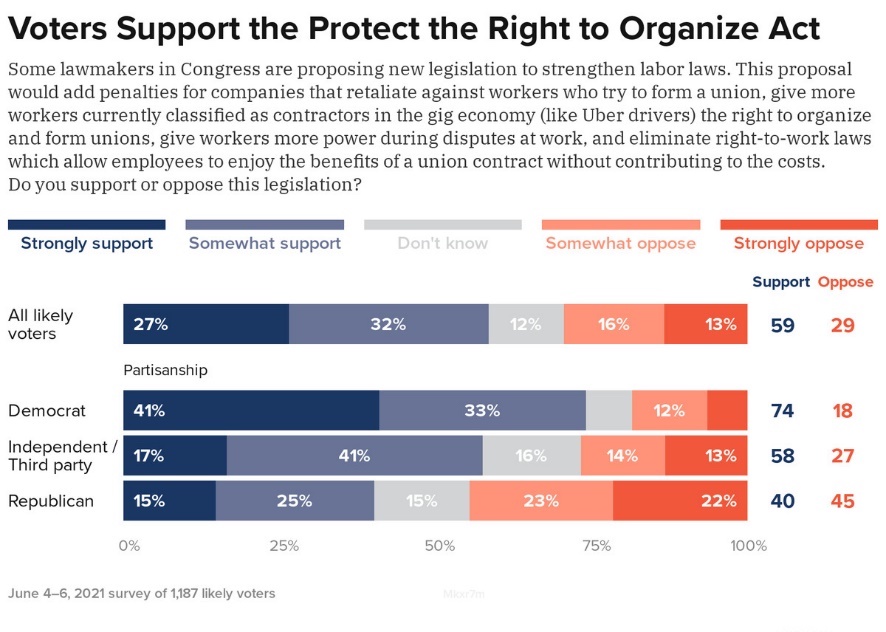
Chart taken from: Vox / Data for Progress
As for the popularity of the Protecting the Right to Organize Act, support among American voters is much higher and more bipartisan than expected. The chart above, retrieved from Vox, shows that 40% of Republicans, 74% of Democrats, and 58% of Independents support the act. While these results still show the strongest support among Democrats, the trend among Republican voters is much more favorable than Republican legislators. Given the similarities between the Protecting the Right to Organize Act and the Nationwide Right to Unionize Act, we would except similar trends of popularity.
What is the bill’s future?
Senator Warren has introduced this bill before as the Protecting the Right to Organize Act in 2017, and again in 2020. Representative Sherman has introduced similar bills in the House every session since 2008. None have gone far in any of these attempts.
However, in March of 2021, the Protecting the Right to Organize did pass in the House but failed in the Republican-controlled Senate. Today, the Nationwide Right to Unionize Act has 26 cosponsors in the House and 18 cosponsors in the Senate. In both chambers, it has been introduced in committee but has not made it out. For it to become law it must go through this process:
- Pass in the House Committee on Education and Labor.
- Pass in the House of Representatives with a simple majority of 218 votes.
- Pass in the Senate Committee on Health, Education, Labor, and Pensions.
- Pass in the Senate with a simple majority of 51 votes.
- Be signed by President Biden.
With that being said, the bill as of now does not have a strong likelihood of passing. GovTrack, an independent website that tracks the status of legislation, estimates its likelihood of passing is around 30%. Despite its low chances of passing, this bill is continuing an important conversation about workers’ rights and unionization in the US today.
Engagement Resources
Click or tap on resource URL to visit links where available

American Federation of Labor and Congress of Industrial Organizations (AFL-CIO)

Service Employees International Union (SEIU)

American Federation of State, County & Municipal Employees (AFSCME)

Americans Find Toxic Water at The Bottom of Their Well
Americans Find Toxic Water at The Bottom of Their Well
Environment Policy Brief #149 | By: Todd J. Broadman | October 10, 2022
Header photo taken from: Justin Metz / Consumer Reports
Follow us on our social media platforms above
Browse more environmental policy briefs from the top dashboard

Photo taken from: Michael M. Santiago / News 21
Policy Summary
[SSB theme=”Official” align=”center” counter=”true” ]
Worldwide, 1 in 10 people cannot access clean water within a 30-minute walk from their home and by 2030 this situation is projected to grow and displace up to 700 million. Closer to home, as the water treatment infrastructure in the U.S. continues to deteriorate, many Americans are facing a similar plight.
In terms of that plight, Jackson, Mississippi serves as one stark example among thousands, of a water infrastructure given way to neglect. Jackson is a city of 160,000 residents who no longer have clean drinking water. The city’s water treatment plant shut down last August due to a major pump failure. Since then, a massive effort led by the National Guard to distribute bottled water has been in place.
Nationwide, the American Society of Civil Engineers has issued a grade of C-minus to the drinking water infrastructure. Virtually all funding for water treatment and associated infrastructure rests with states and local taxing authorities. The federal government contribute less than 4%. In low-income districts. This means that the necessary tax revenue for water maintenance and improvements falls far short of requirements, what is termed “systemic disinvestment.”
The average U.S. water-network pipe is 45 years old, with some cast-iron pipes more than a century old. “Absent an emergency, cash-strapped water utility managers will continue to deal with aging water systems by economizing on routine maintenance and deferring upgrades for as long as possible,” is Berkeley Professor David Sedlak’s grim prognosis.
The result of being highly localized means there are approximately 50,000 separately managed water systems operating in the U.S. — compared to only 3,300 electric utilities. A relatively small number of the water systems are privately run, about 12%, the vast majority operated by municipal governments. Local governments are faced with the difficult balance between investing in necessary and costly upgrades, and increasing water rates to pay for those upgrades.
The estimated cost to fix Jackson’s water plant is over a billion dollars. New York City has already spent $6 billion to complete one third of the new water tunnel necessary to repair two older tunnels constructed a century ago. About one third of its water leaks out through the two aging pipes.
The exorbitant infrastructure costs are paid not only through water consumption taxes, but also through the issuance of bonds. And here also we find great disparity between higher and lower income water districts. Private investors purchase bonds based upon their rating and return.
For example, in the case of Jackson, Mississippi, Moody’s Investor Service downgraded their bond rating to junk status, declaring, “The downgrade reflects the city’s support of and exposure to the stressed City of Jackson Water and Sewer Enterprise” and the “low wealth and income indicators of residents.” This means that bondholders had to be paid more interest for the increased risk of default. Jackson would have to pay up to an additional $4 million annually in interest alone.
As water customers are faced with unclean drinking water, they invariably take officials to court. The crisis in Flint, Michigan resulted in former Michigan governor Rick Snyder being charged with willful neglect of duty for redirecting Flint’s water supply to the Flint River without proper treatment — the catalyst for that city’s crisis. Four residents in Jackson have filed a lawsuit against the city for failing to protect the water supply from extreme weather events, in their case a flood.
There are also “environmental justice” concerns as expressed by EPA head Michael S. Regan, in areas like Jackson that are low income and majority Black. These are areas of “long-standing concerns in historically marginalized communities.” In the Chicago area, levels of lead in the water were found to be highest in Black and Hispanic neighborhoods. Native American households face a similar predicament. The city of Baltimore recently detected E. coli in its public water system.
Policy Analysis
The huge scale of infrastructure upgrades and new capital projects, in not just water, but in roads, bridges, dams, and other services, have not been given the attention they need. This is because the projects are long-term and they do not coincide well with shorter term election cycles.
They also reveal the fragmentation and disparity between economic classes and racial groups. For water infrastructure alone, over the next decade, upgrade estimates across the country tally to over a trillion dollars!
At a paltry $55 billion, the amount of funding allocated from President Biden’s Infrastructure Investment and Jobs Act for safe drinking water, the federal contribution to fix this looming crisis barely makes a dent. “This is becoming a chronic problem, and we’re not going to grant our way out of it; the federal government is not going to be able to allocate the needed capital to fix these problems,” said Robert Powelson, president of the National Association of Water Companies, a trade group representing investor-owned utilities.
The deeper issue, according to The Washington Post, is rooted in racism – which translates into environmental injustice. For example, when federal courts forced Jackson schools to desegregate back in 1970, white families left in big numbers (estimated at 40,000) and with them went the tax base for infrastructure. The sense of contributing to the collective social good also followed them out of the city.

Chart taken from: The EPA
(click or tap to enlargen)
Jackson’s recent effort to raise Mississippi’s state sales tax failed as did their effort to authorize a bond sale. They face a Republican, white, dominated state legislature, and one that is now tabling the move to privatize the water system.
The bulk of the water infrastructure funding under the recent legislation is being distributed through the EPA’s drinking water and clean water revolving loan programs.
The drinking water program has $30.7 billion (including $15 billion for replacing lead pipes) and the clean water program — mainly wastewater treatment and managing stormwater — has $12.7 billion. The remaining billions are distributed through programs that target specific problems or communities. A formula determines each state’s designated share. There is also a required state match of between 10% and 20%.
Engagement Resources
Click or tap on resource URL to visit links where available

https://www.thelancet.com/journals/lanam/home both a destination for publication and a platform to advance the global impact of research.

https://www.pbs.org/ the nation’s largest stage for the arts and a trusted window to the world.

https://www.americanprogress.org/ an independent, nonpartisan policy institute that is dedicated to improving the lives of all Americans through bold, progressive ideas, as well as strong leadership and concerted action.

The Ukraine Crisis: Situation Update #14
The Ukraine Crisis: Situation Update #14
Foreign Policy Brief #151 | By: Abran C | October 3, 2022
Header photo taken from: Associated Press
Follow us on our social media platforms above
Browse more foreign policy briefs from the top dashboard

Photo taken from: Creative Commons
Annexation
[SSB theme=”Official” align=”center” counter=”true” ]
Russia’s President Vladimir Putin on September 30, 2022 signed accession treaties formalizing the annexation of four occupied regions that make up 15% (at least 40,000 square miles ) of Ukraine’s territory. The annexation, which is the largest land grab in Europe since World War II, comes on the heels of what the UN and Western powers described as sham referendums held in Eastern Ukraine to authenticate Putin’s goals.
Referendums on joining the Russian federation were held in Donetsk, Luhansk, Kherson and Zaporizhzhia with each region seemingly voting to break away from Ukraine. News agencies run by the pro-Kremlin administrations in Donetsk and Luhansk reported up to 99.23% of people voted in favor of joining Russia, a wildly high and unrealistic percentage for almost any free and fair election.
Ukrainian President Zelensky accused Russia of brutally violating the UN statute and international law by trying to annex territories seized by force. At a session of the United Nations Security Council, Russia alone vetoed a resolution condemning the annexation, with other global powers such as China, India and Brazil abstaining from the vote.
The US in response to the annexation imposed a new round of sanctions on hundreds of Russian individuals and companies. Additionally President Joe Biden, stated: “Make no mistake, these actions have no legitimacy. The United States will always honor Ukraine’s internationally recognised borders” signaling his intent to remain firm in not recognizing Putin’s illegal action.
Putin’s decision to annex the territories is seen as a response to Russia’s growing difficulties on the battlefield. Even as the territories are now being claimed as a part of the Russian federation, not all areas are controlled by Russia. In recent weeks Ukraine has made gains in retaking captured territories and driven back Russian forces. With the annexation Putin appears to be attempting to make his actions seem worthwhile to a Russian public that has suffered heavy losses and faced economic hardship.
The annexation now makes the prospect for diplomacy much harder, Ukraine is seemingly unable to use the succession of certain territories as a bargaining chip now that Russia formally recognizes the territories as its own. Zelensky has also said his administration would no longer negotiate with Russia as long as President Vladimir Putin remains in power.
The annexation further escalates the already deadly war in an even more desperate manner. Putin has stated that any attack on the now “Russian territories” would be regarded as an attack on Russian soil, meaning that any attempt to retake the territory by Ukraine or assistance from allies in the region could now be met with the full force of Russia’s military, including nuclear weapons.
Ukrainian President Zelensky on the same day announced that Ukraine would be submitting an accelerated application to join NATO. It is unclear and unlikely that the application would be accepted considering fighting already taking place in Ukraine would necessitate an immediate response from other NATO members and engulf the alliance and Russia into a World war.
Civilians Suffer
On September 30, 2022 the same day as Putin claimed to have liberated Eastern Ukraine, at least 30 civilians were killed in a Russian strike on a convoy of civilian cars in southern Ukraine.
The convoy had been assembling at a market in the city of Zaporizhzhia, preparing to leave Ukrainian controlled territory to visit relatives and deliver supplies in an area occupied by Russia.
The Office of the UN High Commissioner for Human Rights has verified a total of about 6,000 civilians that have been killed in fighting with many more likely unaccounted for.

Photo taken from: Reuters
(click or tap to enlargen)

Photo taken from: REUTERS / Maxim Shemetov
Russian Conscription
In Russia a mobilization targeted 300,000 draftees to join the war likely to replace the large quantities of killed and wounded soldiers.
Many draftees are from Russia’s ethnic minority groups who often rank lower on the social hierarchy than Russia’s slavic majority in its Western region. In Moscow, hundreds gathered to protest after Putin’s mobilization announcement. Police officers reportedly began giving draft notices to those they detained at the protest. Subsequently, neighboring states such as Georgia and Finland all saw huge queues forming at their border crossings as people tried to flee conscription.
With the huge numbers of recent border crossings Finland joined Poland, Estonia, Latvia, and Lithuania and closed its borders to Russians seeking to enter the country without a visa. Additionally earlier this month, the EU also decided to make it more expensive and difficult for Russian citizens to get visas by suspending a visa deal between the EU and Russia.
Nord Stream Gas Pipeline Ruptures

Photo taken from: CNBC
(click or tap to enlargen)
Major leaks erupted this week in the Nord Stream gas pipelines that carry fuel from Russia to Europe under the Baltic Sea. There is a consensus among all parties that the pipeline was sabotaged, but it remains unclear as to who is responsible. Russia has blamed the West with President Vladimir Putin stating that the United States and its allies blew up the Nord Stream pipeline, “The sanctions were not enough for the Anglo-Saxons: they moved on to sabotage” he said.
The EU stated that they believe the damage was caused by sabotage but have stopped short of naming anyone. Ukraine has frequently called for Europe to halt all purchases of Russian fuel – stating that purchasing Russian energy helps fund the war.
A damaged Nord Stream pipeline brings its call for a full Russian fuel embargo closer to reality.The damage means Russia loses its energy leverage over Europe, now it cannot threaten to cut off gas supplies as it has no capability to deliver it.
The ruptures of the gas pipeline has also led to what has been called the biggest single release of climate damaging methane ever recorded, according to the United Nations Environment Programme. “This is really bad, it is most likely the largest emission event ever detected,” said Manfredi Caltagirone, head of the International Methane Emissions Observatory.