Uber has buried statistics on assaults and accidents on its platform for years. Journalists and advocates have dug hard and are revealing disturbing levels of both. As more customers are suing the company for its inadequate safety measures, Uber is responding with a ballot initiative in California that would limit its liability for accidents, and consumer attorneys are supporting measures that would increase Uber’s liability and accountability.

Search Results
Will the Meta Verdicts Spur Change? (Technology Policy Brief #166)
Do social media companies try to hook children on their products? Do they fail to adequately protect those children from harmful content, predators, and exploitation? Millions of parents would probably agree with the juries in California and Texas that recently answered those questions with a resounding yes. As a result, one young plaintiff was awarded $6 million from YouTube and Meta in one case, and Meta was ordered to pay $374 million in civil penalties in the other. Meta and YouTube have, of course, vowed to appeal. Despite a growing awareness of the risks to children and teens online, new legislation on children’s online safety remains stalled in Congress, and a robust regulatory system is nowhere in sight.
Tech Billionaires Making a Killing on AI War Machines (Technology Policy Brief #165)
The Pentagon is enriching the pockets of the tech billionaire owners of AI companies. While the Department of Defense/War has broken its contract with the company Anthropic, other AI companies are signing large contracts, such as Open AI and Palantir.
How Will Tech Money Influence the California’s Governor’s Race (Technology Policy Brief #163)
Tech billionaires are spending at historic levels to influence politics in California. Google and Facebook, and their CEO’s, are donating heavily to key races in November 2026, as are venture capitalists, cryptocurrency entrepreneurs, and Palantir’s co-founders. Whether or not the candidates they are backing win, they will have an impact.
A Proposed Billionaire Tax Divides Democrats in California (Health & Gender Policy Brief #185)
A proposed billionaire tax authored by a powerful healthcare workers union could go to the voters in California if the sponsors can collect the requisite number of signatures to qualify for the ballot. Even before it has, powerful politicians and tech billionaires are divided, some supporting it, others organizing against it and willing to spend millions to do so.
Asylum Cooperative Agreements Draw Questions from Judges As More Applicants are Removed
The Trump administration has revived a policy of entering into Asylum Cooperative Agreements with secretive terms that violate the right of a person physically present in the US to seek asylum. The policy isn’t a new one; Trump did it in his first term, but it’s being used much more extensively now, alarming judges and advocates and frightening asylum seekers.
Misogyny and Abuse Are Thriving Online (Technology Policy Brief #162)
Two new reports document the alarming rise of online violence against women and girls. Sex trafficking, sexualized images, and stalking and exploitation online are nothing new. But Artificial Intelligence has exacerbated the problem. Deepfakes almost exclusively target women; in fact, some of the technology used to create them, developed by mostly male teams, only works on female forms.
Rideshare Drivers Organize As Earnings Decline (Technology Policy Brief #160)
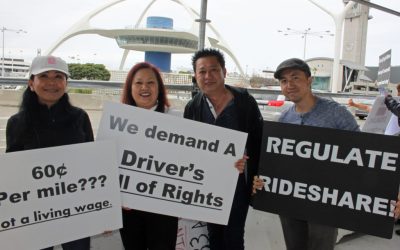
When Uber and Lyft came on the scene, taxi drivers protested vociferously. Now it’s the rideshare drivers protesting, as their earnings go down and the threat of autonomous vehicles looms. Organizing by rideshare drivers has had some success, but how effective hard-won changes will be remains to be seen. Workers scored an apparent victory in securing collective bargaining rights in California. But a similar law in Massachusetts has yet to yield results and the California law was a compromise that included enormous giveaways to the companies.
Antisemitism Is the Weapon, Teachers are the Target (Education Policy Brief #213)
Educators who are critical of the Israeli government or the occupation, or who voice support for Palestinian statehood, are increasingly at risk of disciplinary action or even job loss. Extremist pro-Israel groups are advocating for and winning statutory and regulatory limits on educational content critical of Israel, all under the guise of fighting rampant Antisemitism. Even the use of pro-Palestinian slogans like “From the River to the Sea, Palestine will be Free” on social media has led to teachers being placed on leave. Educators and free speech advocates are organizing to fight back, and a recently approved law in California, ostensibly to curb antisemitism, is being challenged in federal court by the ADC.
California’s Landmark AI Regulations Don’t Go Far Enough (Technology Policy Brief #158)
California styles itself as a leader in AI regulation. Two landmark bills were signed by Governor Newsom this year over the usual industry objections. But the bills don’t go as far as safety advocates wanted, and don’t offer sufficient protections to young, vulnerable users.