The Trump administration has revived a policy of entering into Asylum Cooperative Agreements with secretive terms that violate the right of a person physically present in the US to seek asylum. The policy isn’t a new one; Trump did it in his first term, but it’s being used much more extensively now, alarming judges and advocates and frightening asylum seekers.

Search Results
Misogyny and Abuse Are Thriving Online (Technology Policy Brief #162)
Two new reports document the alarming rise of online violence against women and girls. Sex trafficking, sexualized images, and stalking and exploitation online are nothing new. But Artificial Intelligence has exacerbated the problem. Deepfakes almost exclusively target women; in fact, some of the technology used to create them, developed by mostly male teams, only works on female forms.
Rideshare Drivers Organize As Earnings Decline (Technology Policy Brief #160)
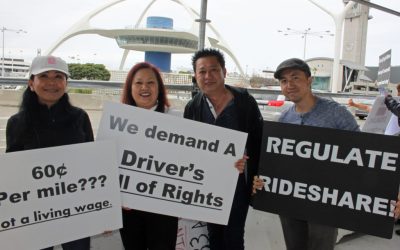
When Uber and Lyft came on the scene, taxi drivers protested vociferously. Now it’s the rideshare drivers protesting, as their earnings go down and the threat of autonomous vehicles looms. Organizing by rideshare drivers has had some success, but how effective hard-won changes will be remains to be seen. Workers scored an apparent victory in securing collective bargaining rights in California. But a similar law in Massachusetts has yet to yield results and the California law was a compromise that included enormous giveaways to the companies.
Antisemitism Is the Weapon, Teachers are the Target (Education Policy Brief #213)
Educators who are critical of the Israeli government or the occupation, or who voice support for Palestinian statehood, are increasingly at risk of disciplinary action or even job loss. Extremist pro-Israel groups are advocating for and winning statutory and regulatory limits on educational content critical of Israel, all under the guise of fighting rampant Antisemitism. Even the use of pro-Palestinian slogans like “From the River to the Sea, Palestine will be Free” on social media has led to teachers being placed on leave. Educators and free speech advocates are organizing to fight back, and a recently approved law in California, ostensibly to curb antisemitism, is being challenged in federal court by the ADC.
California’s Landmark AI Regulations Don’t Go Far Enough (Technology Policy Brief #158)
California styles itself as a leader in AI regulation. Two landmark bills were signed by Governor Newsom this year over the usual industry objections. But the bills don’t go as far as safety advocates wanted, and don’t offer sufficient protections to young, vulnerable users.
Zuckerberg Keeps Coming For Your Children (Technology Policy Brief #157)
Complaints about META’s failure to protect children from the ills of social media continue to plague the company. Most recently, unauthorized images of children were used in ads for Meta’s Threads app, and a significant study of the company’s improvements in response to previous concerns criticized its efforts as largely ineffective.
Instead of a Break Up, Google Gets a Slap on the Wrist (Technology Policy Brief #156)
Google’s critics and competitors celebrated a court decision last year that found Google in violation of antitrust laws due to its monopolies over search services and online advertising. Smaller companies, increasingly dependent on search rankings and online ads, simply can’t compete
AI Dirties the Air and Drives Demands for Environmental Justice (Technology Policy Brief #155)
Artificial Intelligence is more ubiquitous in our daily lives than you may realize. It drives the constant stream of personalized ads, instant navigation directions when driving, voice assistants such as Siri and Alexa, shows up first in our Google searches, and much more. The massive data centers powering all that instant intelligence are less visible to those of us who use it the most. But they have become ubiquitous in lower-income communities of color, communities with the least access to high-speed home internet and some of the worst air pollution in the country.
Trump FTC Deletes Click to Cancel Rule (Technology Policy Brief #154)
Few people are likely to miss the click-to-cancel rule. Consumers won’t, since they never had a chance to enjoy it, and businesses won’t because they hated it. The rule, which would have required all sorts of online businesses to make it easy for consumers to cancel unwanted subscriptions and memberships, was blocked by a federal appeals court just days before it was set to go into effect, a ruling that is unlikely to be appealed. Trump opposes consumer protections and is reshaping the FTC to carry forward his pro-business agenda.
Profits and Protests at Palantir (Technology Policy Brief #152)
Palantir Technologies’ data tracking software and Artificial Intelligence tools are playing a huge role in the ICE sweeps plaguing communities throughout the US, sparking a national day of protests and concerns over a revolving door between the company and key government agencies.