

JOBS POLICIES, ANALYSIS, AND RESOURCES
Latest Jobs Posts
Colorado (2026 Democratic Primary Preview Series Brief #6)
There are ten congressional seats up for the 2026 election in Colorado. All of the state’s eight U.S. House of Representatives seats and one U.S. Senate seat. The Democratic Party currently holds four of the eight House seats and both U.S. Senate seats in a state that has trended Democratic of late.
Montana Youth Return to Court to Block Laws Weakening Climate Protections (Environment Policy Brief #186)
A group of young activists from the landmark Held v. Montana case filed a new challenge against recent state laws. The filed petition challenges several statutes passed by Republicans that threaten the activist group’s victory in the Montana Supreme Court in 2024. According to the group, the new changes are violations of the state’s guarantee of a “clean and healthful environment.” The youth plaintiffs are preparing for a renewed legal fight and highlighting that climate harms are a constitutional issue.
The Week That Was: Global News in Review (Foreign Policy Brief #224)
Latin America’s shift towards the political right has continued following the recent elections in both Chile and Honduras. In Chile the election of the far-right Jose Antonio Kast marked the country’s most significant shift rightward since the former Chilean dictator, Agusto Pinochet. The election of Kast now makes three neighboring South American states formerly at odds, Argentina, Bolivia and Chile, firmly in control by the rightwing and all seeking closer relations with the United States. In Honduras the Trump backed candidate, Nasry Asfura has been declared the winner after a more than two week long vote count left those in the small Central American country in suspense. Following the election results, the opposing Liberal Party candidate, Salvador Nasralla refused to concede and alleged interference in the election process by the United States after President Trump conditioned continued aid to the country on whether the right-wing candidate won. Trump also pardoned the former Honduran President found guilty of trafficking drugs to the United States.
U.S. Deports Russian Dissidents who Face Prison or Draft in Russia (Foreign Policy Brief #223)
In October 2025, U.S. Department of Homeland Security reported on its official website that more than 2 million undocumented immigrants had already left the United States — including 1.6 million who voluntarily self-deported and more than 527,000 who were forcefully deported. “This is just the beginning,” Assistant Secretary Tricia McLaughlin proudly stated.
Arizona (2026 Democratic Primary Preview Series Brief #3)
There are ten federal seats up for election in Arizona in 2026. All nine of Arizona’s U.S. House of Representatives seats and one of two Senate seats. Arizona’s Federal congressional delegation reflects its status as a pivotal battleground state. Multiple House districts and a Senate seat are held by Democrats in a state that has historically leaned Republican.
The Final Bill: The Economics, Ethics, and Ecology of American Death Care
Death in the United States has evolved from a community-centered rite into a sprawling, multi-billion-dollar commercial sector often dubbed the funeral industrial complex. With approximately three million Americans dying annually, a figure projected to rise as the baby boomer generation ages, the logistics of disposition have become a pressing socioeconomic challenge. For decades, the default American way of death involved embalming, heavy metal caskets, and concrete vaults, a practice that is historically an anomaly and environmentally taxing. However, economic pressures and shifting cultural attitudes have catalyzed a massive transition toward cremation. In 2024, the cremation rate surpassed 61 percent, with projections suggesting it will exceed 80 percent by 2045.
Trump’s AI Executive Order and the Federal–State Power Struggle (Technology Policy Brief #161)
The Federal-State battle over AI regulation has heated up after President Trump signed an executive order on Dec. 11 that blocks states from enforcing their own regulations on artificial intelligence. The order seeks to create a “single national framework” for AI. However state lawmakers, tech experts, and civil rights organizations are worried about what this means for the country. Many believe that federal regulations could slow down America’s competitiveness in the global AI race and will have serious implications for national security.
Breaking the Chains: Niger’s Pivot from Neocolonialism to Sovereignty (Foreign Policy Brief #224)
The July 2023 military takeover in Niger, led by General Abdourahamane Tchiani and the National Council for the Safeguard of the Homeland (CNSP), marked a significant setback for democratic governance in the Sahel. However, the removal of President Mohamed Bazoum must be viewed not merely as an isolated authoritarian power grab, but as a catalyst for a profound geopolitical realignment. In the two years since the coup, the CNSP has systematically dismantled long-standing security frameworks, resulting in the expulsion of French forces in late 2023 and the complete withdrawal of United States military personnel and the closure of key drone bases by September 2024.
The Week That Was: Global News in Review (Foreign Policy Brief #223)
Ukraine’s government has agreed to the core parts of a peace deal brokered by the Trump administration to end the now nearly four year long war. US officials have been meeting with both the Russians and Ukrainians in order to secure an end to the war. The plan was presented as a 28 point peace plan but upon revision by the Ukrainian side has been revised to a 19 point peace plan that no longer includes items such as amnesty regarding acts committed during the war. Ukraine as part of the deal has agreed not to increase the size of its military and will not join NATO under the updated plan.


Should Transgender Athletes be Allowed to Compete? (Foreign Policy Brief #225)
Foreign Policy Brief #225 | Reilly Fitzgerald | December 3, 2025
Policy Summary
Recently the International Olympic Committee (IOC) has been considering the idea of altering their policies on inclusion of transgendered athletes in the Olympic Games. Currently, and since 2004, the IOC’s rules have allowed for each nation’s federation to determine inclusivity of transgendered athletes (or not to include them). In the history of the Olympic Games, there has only ever been one transgender athlete compete and it was New Zealand’s Laurel Hubbard (Olympic weightlifting); and a transgender athlete has NEVER won a medal in the Olympic Games.
The proposal is seeking a uniform policy that the IOC would apply across all Olympic competitions, taking power from each federation’s ability to determine who is, or is not, included in an Olympic delegation. The IOC has yet to decide on whether or not to move this policy forward; however, it is heavily reported across all media platforms that this policy will become real. It should be noted that this policy only seems to be applicable to women’s sports as it aims to target transgender athletes and potentially test athletes to confirm their gender as females.
This Brief describes the background and history of the challenging issue of testing for transgender athletes.
Background
Gender identity and sports has become a household topic both in the United States and abroad. In the United States local, state, and federal policymakers, including the President, have weighed in on the issues; some states have even passed legislation either targeting or promoting inclusion in sports. Based on reporting from The Hill, in December 2024, the NCAA President Charlie Baker told the US Senate that there were ‘ less than 10 transgender student-athletes in the NCAA (out of over 500,000 student-athletes)..
The International Olympic Committee’s (IOC) Dr. Jane Thornton has spoken about some early research findings that are pointing toward a physical and competitive advantage for transgender athletes who transitioned after experiencing male puberty, even after suppressing testosterone in their bodies, according to The Ministry of Sport. This is furthering the desires of the IOC’s president, Kirsty Coventry, who is calling for a more uniform and blanket policy for the inclusion, or rejection, of transgender athletes in the Olympics. Currently, each nation’s sporting federations get to decide whether or not to include transgender athletes in their nation’s delegations. The IOC’s potential shift in policy would make it so that each federation would have to follow one policy and not have the freedom to include these athletes.
The policy shift is one that would encourage further testing and scrutiny of transgender athletes to confirm their gender. Some sporting federations are already conducting tests to confirm gender. The International Ski and Snowboard Federation (FIS) has been utilizing cheek swabs and blood testing to verify gender in their ski and snowboard competitions. The International Boxing Association (IBA) is also conducting testing of their own; however, there has been controversy regarding their practices. The IBA is a Russian-led association, and they were at the forefront of the Imane Khelif case. Khelif was disqualified from the 2023 World Championships after tests supposedly revealed XY chromosomes and higher levels of testosterone; however, the IOC cleared her to compete in the 2024 Paris Olympics, and these results were never officially revealed. The IBA did not reveal their testing methods. The timing of the disqualification came just a few days after Imane Khelif defeated Russian boxer Azelia Amineva, who had been undefeated before their fight. This is just one example of the use of gender confirming testing, or supposed testing, being used against athletes in unethical ways.
World Athletics, which oversees track and field events globally, instituted new rulings this summer ahead of the World Athletics Championships in Tokyo in September. The rulings required all female athletes to be subjected to genetic testing to confirm the presence of XY chromosomes, suggesting that it would detect whether an athlete was male or female genetically. It appears to be a ‘once-in-a-lifetime’ test; however, according to the BBC some countries have outlawed genetic testing for non-medical reasons. This type of law and ban in countries like France and Norway have meant that athletes from these countries must conduct these genetic tests abroad, and not within the borders of their own countries. This decision was sparked by champion athlete Caster Semenya’s gender being questioned due to her successes. She was determined to be an athlete who was born with “differences in sex development” (or DSD). Semenya always competes as a female due to externally having female reproductive organs, but also has internal testes.
This has been called into question in the past too, in 2016’s Olympics in Rio, all three podium finishers in the women’s 800m were athletes with DSD (Disorders of Sexual Development)conditions (and Semenya won gold at that race), according to the BBC.
History
The idea of gender confirmation testing in athletics is not a new concept. Women’s sports was brought into the Olympic Games in 1924. By the 1950s and 1960s, concerns regarding doping and gender fraud became more prevalent (oftentimes, these rumors were based on visual stereotypes). The 1936 Olympics in Berlin had several issues related to gender. In the 100 meters, Helen Stephen defeated Stella Walsh (Stanisława Walasiewicz). Helen defeated Walsh in the 100 meter dash. A Polish publication accused Helen Stephens of being a man due to her impressive performance. Olympic officials carried out a physical examination to confirm Helen’s gender as a female, and it was confirmed, and she was awarded her medal. However, Stella Walsh was killed in the 1980s in a shooting in Ohio; and the autopsy revealed that she had a genetic condition with “ambiguous genitalia” known as mosaicism. Mosaicism is a condition that is created when a single egg is fertilized and creates an error when cells begin to divide. It should be stated that Walsh’s gender identity, that she lived with her entire life, was female.
After the 1936 Olympics, gender testing continued to evolve. In the 1960s and 1970s, physical exams were commonplace across all international sports; ironically, one competitor was disqualified, at the 1967 Pan-American Games in Winnipeg, for not having large enough breasts to be considered feminine. Physical exams were as invasive, at times, as they sound; they ranged from a hands-off examination, to a physically manipulative exam, and other methods all of which were humiliating and degrading. Chromosomal testing became quite popular after being introduced at the 1968 Winter Olympics in Grenoble, however, a false positive was not an uncommon occurrence. In a 2010 study Vanessa Huggie wrote “this test for chromosomal sex does not necessarily map on to physiological or phenotypic sex, which are the only kinds of sexual identity that confer a sporting advantage (and there are many confounding conditions, as people can be born with just one or three or more sex chromosomes …”
The organization that led the charge in the 1940s for more gender testing was the International Amateur Athletics Federation (IAAF). The IAAF was insistent on conducting more tests to sort out cases of accused gender fraud. By the 1980s, the IAAF dropped its usage of chromosomal testing and genetic tests for physical examinations. All testing was dropped by 1992 due to new urine tests for doping control, and the idea that minimal clothing in sports would help reveal one’s gender. By 1999, the IOC ended the requirement for any blanket testing policies, and the 2000 Olympics in Sidney were the first to be done since 1936 without gender confirmation testing.
The goal for the IOC now is to create a blanket gender testing policy for the 2028 Olympics in Los Angeles. President Trump has been one of the most ardent supporters of policies limiting or erasing the participation, of transgender athletes in sports at all levels; and has even called for more testing by the IOC ahead of the 2028 Games. President Trump has also made mention of Title IX , a federal law that prohibits sex-based discrimination, as his means of ‘protecting women in women’s sports’ while excluding and perhaps discriminating against transgender athletes.
Meanwhile, Democratic lawmakers around the country have fought to create more inclusionary policies. California, currently, allows transgender athletes to participate in sports through the high school level; and their policy is based on gender identity rather than genetics. The Olympics in LA in 2028 are going to be a contentious one to watch on this issue as the stage is being set for inclusive California to be hosting the Olympics which, under the IOC, may very well end the inclusionary practices that have been in place since 2000.
Conclusion
The American people also seem to have moved closer toward President Trump’s positioning on this issue with a recent Pew Research Center poll showing that 66% of Americans believe that transgender athletes ought to participate on sports teams, or in sporting divisions, that match the sex that was assigned to them at birth. This positioning though seems to lack nuance that historical perspective may provide such as stories like Stella Walsh whose own gender was a bit more complicated than just “male” or “female.”
Though a decision has yet to be made, it does seem that the IOC is interested in repeating history by bringing back these gender confirmation tests – even though there are decades worth of false positives, mixed results, and conflicting bodies of evidence in the research literature. It seems unfair and hypocritical that this policy is only regarding women’s sports and does not appear to be an expectation on the men’s side of the Olympics. There is a lot that is going to be decided in 2026 as we move closer to Los Angeles 2028; but the IOC would be wise to review some of their own history and decisions.
Engagement Resources
- Testing sex and gender in sports; reinventing, reimagining and reconstructing histories (Heggie, 2010) –https://pmc.ncbi.nlm.nih.gov/articles/PMC3007680/#:~:text=For%20men%20there%20is%20no,the%20phrase%20’sex%20testing‘
- Pew Research Polls – https://www.pewresearch.org/short-reads/2025/02/26/americans-have-grown-more-supportive-of-restrictions-for-trans-people-in-recent-years/
- Decision to Abolish Gender Testing at Sydney Olympics Supported By Yale Physician (Yale School of Medicine, 2000) – https://medicine.yale.edu/news-article/decision-to-abolish-gender-testing-at-sydney-olympics-supported-by-yale-physician/

Is Trump trying to dig up the ocean? And what does the rest of the world think? “Seabed Mining” (Environment Policy Brief #185)
Environment Policy Brief #185 | Charlie Sweeney | December 12, 2025
In keeping with the administration’s bull-in-a-China-shop approach to the environment, foreign policy, tariffs, and just about every other domestic and international issue, the Trump team now wants to dig up the bottom of the sea.
Though it might sound more like a dystopian science fiction film premise— enormous machines crawling across the seafloor, scooping up mineral-rich rocks, sending clouds of sediment drifting for miles, smothering deep-sea life, changing water chemistry, leaving deep trench-like scars on the seabed that remain visible decades— this could be reality with the Trump administration’s new seabed mining initiative.
In late April 2025, the president signed a directive telling federal agencies to “unleash” America’s offshore mineral resources. The bold language calls for the relevant US government apparatus to take an active lead in deep-sea exploration and encourage private companies to get into the game.
Trump’s seabed mining EO tells NOAA to get permits moving faster, pushes the Interior Department to map offshore areas where valuable metals might be found, an extreme break with the current international agreements governing exploitation of the sea bed in international waters.
The idea is familiar, and in keeping with Trump‘s single-minded pursuit of the building blocks of our modern technological economy— minerals needed for batteries, electronics, and the defense industry, which are often processed in China.
Trump’s seabed mining EO defies established convention, acting unilaterally despite long-standing international agreements protecting the seabed from commercial exploitation until fully fleshed-out guidelines can be agreed upon by the international community.
From the administration’s point of view, waiting for years of international negotiation is too slow, so the United States should act first. That includes the possibility of approving mining in waters outside the US’s EEZ (exclusive economic zone).
Not surprisingly, alarms went off around the world.
Foreign governments, scientists, and ocean advocates reacted immediately. China warned that no nation should treat the deep seabed as its own property. The International Seabed Authority — the body that oversees activity in international waters — said American permits issued outside its system could undermine decades of work.
Environmental groups went further. Many see the policy as a reckless push to open a barely understood ecosystem to industrial extraction. They point to research showing how long damage can last.
One of the sharpest criticisms came from Earthjustice, which called the policy “a life raft for an untested, opaque industry that science is telling us poses enormous threats to ocean ecosystems for little gain.”
Private mining companies have taken notice. A Canadian firm, The Metals Company, has already begun discussions with U.S. officials about exploiting a swath of the Pacific, a move that drew intensive protests from island nations, environmental groups, and deep-sea ocean life researchers.
What are the rules in place, and how does Trump’s EO circumvent those protections?
The current international system for decades has held that the deep seabed beyond national borders be treated as a shared trust — the “common heritage of mankind.”
International rules were created through the U.N. Convention on the Law of the Sea, which established the International Seabed Authority.
That body has issued exploration licenses, but it has never approved commercial mining. Final rules for full-scale operations are still being negotiated.
Today, dozens of countries and many corporations support a moratorium or pause until more science is done. They argue the risks are too great, and recovery is too slow.
Deep-sea animals are slow-growing, fragile, and often found nowhere else on Earth. If we scrape them away, the wounds may outlast us.
Engagement Resources
- Earthjustice quote and press release: https://earthjustice.org/press/2025/earthjustice-statement-on-trump-administrations-deep-seabed-mining-executive-order
- Reuters: China reaction https://www.reuters.com/markets/commodities/china-urges-us-follow-international-law-reported-deep-sea-metals-stockpile-plan-2025-04-14/
- International Seabed Authority statement https://isa.org.jm/news/statement-on-the-us-executive-order-unleashing-americas-offshore-critical-minerals-and-resources/
- CSIS analysis of mining politics https://www.csis.org/analysis/trumps-deep-sea-mining-executive-order-race-critical-minerals-enters-uncharted-waters

How low will he go? President Trump’s penchant for debasing himself undermines U.S. Credibility (Elections & Politics Brief #201)
Elections & Politics Brief #201 | Nicholas Gordon | December 15, 2025
Summary
If you were new to President Trump’s Oval Office press conferences with world leaders, you might have found his meeting with Saudi Arabia’s Crown Prince Mohammed bin Salman (MBS) on Tuesday, November 18, to be an astonishingly low moment for a U.S President. As though determined to debase himself and weaken U.S. credibility, Trump dismissed U.S. intelligence findings linking the crown prince to the murder of journalist Jamal Khashoggi, while savagely attacking the reporter who asked about it. And, per usual, Trump went out of his way to denigrate past presidents and brag about himself ad nauseum.
The moment was grim, and all too familiar. Time and again, Trump subjects his Oval Office guests to degrading behavior—from ambushing Ukrainian President Volodymyr Zelensky to presenting false claims of “white genocide” to the South African President Cyril Ramaphosa. The pattern makes a mockery of the office and undermines the American people. It’s beyond time for Republican leaders to show respect for the citizens they serve by taking a stand against Trump’s Oval Office depravity.
Analysis
Last February, President Trump hosted Ukrainian President Volodymyr Zelenskyy in an Oval Office meeting which quickly soured, setting the tone for the egregious encounters that followed. Zelenskyy, visiting with the aim of forging a minerals deal that would help ensure further U.S. support as he defends his country against the ongoing Russian war, instead found himself ambushed by Trump and Vice President JD Vance. In their attack on the leader of a U.S. ally, Trump and Vance accused Zelenskyy of failing to show proper gratitude for U.S. aid. The American leaders then took turns berating and humiliating Zelenskyy, calling him disrespectful and pointing out that Ukraine was losing soldiers on the battlefield. This dismal exchange came on the heels of Trump wrongly accusing Ukraine of starting the war, when in fact Russia invaded Ukraine more than three years ago. After being tossed from the Oval Office and having his subsequent events in Washington canceled, Zelenskyy showed grace and diplomacy, thanking both the administration and the American people.
In May, Trump ambushed President Ramaphosa with false claims of “white genocide” and “land seizures” during another disastrous meeting that rivaled the indignity of Trump’s ambush of Zelenskyy. Deeply misinformed by debunked race-based conspiracy theories, Trump played a video showing rows of white crosses lining a rural road, and claimed, “These are burial sites right here. Burial sites. Over a thousand of white farmers.” But Trump was dead wrong. The crosses do not mark graves. The clip depicted a protest against the murder of a white farming couple in 2020.
“Have they told you where that is Mr. President?” Ramaphosa asked calmly. “I’d like to know where that is, because this I’ve never seen.” Trump responded, wrongly, “These people are officials, and they’re saying ‘kill the white farmer and take his land.’”—and brandished a copy of a random blog post he asserted was about “white farmers being burned.” The image on the blog post was in fact from the Democratic Republic of Congo, not South Africa.
Ramaphosa was praised for his composure and diplomatic skill in handling Trump’s bullying and false allegations, while Trump was widely denounced for his bigotry and ignorance. “There is criminal activity in our country,” Ramaphosa explained, expertly modulating his tone and content to meet the comprehension level of his deluded interlocutor. “People who do get killed unfortunately through criminal activity, are not only white people. The majority of them are black people,” Ramaphosa said, in a statement backed by facts.
Following the meeting, Rep. Yvette Clarke wrote on social media, “The president’s ignorance of history and reality is an embarrassment to our nation. South Africa’s Black population was subjugated, segregated, and murdered for decades. Trump and Musk can lie and cry all day, but their hoax has no comparison to the brutality of Apartheid.”
And yet, it gets worse
Sitting with the crown prince—a man with a growing list of human rights abuses—Trump sunk to new lows. When ABC News reporter Mary Bruce asked MBS about his alleged involvementin the murder of Khashoggi in 2018, Trump savagely attacked Bruce. “You’re a terrible person and a terrible reporter,” Trump said. “Your crappy company, your news is so fake we should look at that. The way you ask a question with the anger and meanness is terrible. You ought to go back and learn how to be a reporter.” Accusing Bruce of “insubordination,” Trump stated that the crown prince knew nothing about Khashoggi’s murder. “A lot of people didn’t like that gentleman you’re talking about. Whether you like him or didn’t like him, things happen,” said Trump, who has a history of trashing U.S. intelligence conclusions in favor of tyrants.
If undermining the U.S. intelligence community and the free press, two pillars of democracy, were not enough, Trump then took his customary potshots at his presidential predecessors and boasted about his voting numbers, all of which comments were utterly out of context. After claiming that “Obama treated Saudi very badly,” and “Biden didn’t have any idea where the hell the country was,” Trump turned to his guest and asked, “Does Trump blow them all away?” Smiling sheepishly, the crown prince replied, “We’ve worked with all presidents.” Later, apropos of nothing, Trump stated, “I won Indiana by record numbers. I won many states by record numbers.” While the crown prince’s smile oozed embarrassment throughout the meeting, it’s unclear whether he was smiling because he got away with murder or because of Trump’s vulgarity. Perhaps both.
Conclusion
Americans want their president to do well. We want Trump to honor the democratic principles that the world looks to United States to uphold. But by constantly attacking our allies, reporters, intelligence agencies, and past U.S. presidents—often while siding with dictators and serial human rights’ abusers—Trump undermines and disrespects the very people he was elected to serve and protect. Ironically, for a president obsessed with trying to project strength and emulate a strongman, Trump personifies weakness and insecurity in his Oval Office behavior. Republican leaders who have been complicit in Trump’s act for a decade by kowtowing to his demonstrable falsehoods and abject racism need to hold him accountable to a higher standard of leadership if we hope to restore U.S. credibility.
Engagement Resources:
- org
- A nonprofitthat “aims to reduce the level of deception and confusion in U.S. politics by providing original research on misinformation and hoaxes.”
- The Hoover Institute
- A public policy think tank that “seeks to improve the human condition by advancing ideas that promote economic opportunity and prosperity, while securing and safeguarding peace for America and all mankind”
- The National Endowment for Democracy (NED)
- An independent, nonprofit foundation “dedicated to the growth and strengthening of democratic institutions around the world.”

The Need for a US Technology Policy
USRESIST NEWS GROUP OP ED
It is a technological age, but America lacks the semblance of a policy to regulate our use of technology. We have so far failed to develop policies to help assure us that our economic and social well-being is not being picked apart by our use of unregulated technological platforms.
The US has enacted regulations that more or less effectively guide our use of mass media communications; why not technology? Is it in part because of the enormous power that technology companies hold in our economy; because of their lobbying efforts? because our politicians are frightened of losing funding support from technology billionaires? Because of fears that regulating technology also would be a violation of free speech?
Whatever the reasons, we at USRESIST NEWS believe our country needs to take greater action. The abuses that technology causes have begun to outweigh their benefits. We propose that Congress and the administration take immediate action and enact policies to regulate our use of technology. Such policires would cover the following issues.
1.Regulating cell phone use by children
The major focus for regulating the use of technology by children , mainly cell phones, has been at the school and classroom level. While major federal legislation has yet to be enacted, a great many US states have put in place legislation banning cell phone use. As of late 2025, a majority of U.S. states—at least 37—have enacted laws or policies that ban or restrict student cellphone use in schools to improve academic focus and mental health.
The push for these laws is largely bipartisan, driven by a growing consensus that cell phones are a major source of academic distraction and contribute to youth mental health problems. Research suggests that bans can lead to improved test scores and increased social interaction among students. For example, a proposed Danish law would give victims, who are primarily girls and women, removal and compensation rights.
At the Federal level some, including the Department of Education, believe that cell phone use is a matter of local control, and does not come under the Federal Government’s jurisdiction. However, there recently has been an encouraging initiative at the federal level. The Focus on Learning Act is bipartisan legislation introduced by Senators Tom Cotton and Tim Kaine The Act aims to: (a)require the U.S. Department of Education to study the effects of cell phones on academic performance, mental health, and other student outcomes; and (b) create a pilot program to award grants to school districts that implement cellphone-free policies. The Focus on Learning Act has yet to be passed and is currently being reviewed by a Senate Committee. However policy like this would go a long way to helping our country identify what best practice is in relation to the disruptive use of cell phones in schools.
- Banning the promotion of hate speech and violence
Technology is used to promote hate speech and violence through platforms like social media, which can amplify aggressive language and ideologies that lead to offline harm. This includes online harassment, which can escalate to physical violence, and the creation of deepfakes or other manipulated content that spreads disinformation. The ease of online communication allows hateful ideologies to find and connect like-minded people, creating a sense of normalcy around prejudice and potentially leading to radicalization.
So far the Federal government has done little to regulate the use of online hate speech. There have been no effective efforts to establish digital governance that include principles of transparency and algorithmic accountability to prevent violence. Many politicians take refuge in the belief that efforts to curb online hate speech are a violation of first amendment (freedom of speech rights). However, it is useful to recognize that the use of 21st century online communications is much different than face to face proclamations. A message posted on the Internet can indiscriminately reach large numbers of people across the world some of whom may be motivated to react violently or in self-destructive ways
.The European Union provides an example we could learn from. It has implemented significant legislative initiatives, most notably the Digital Services Act (DSA), which impose a duty of care and due diligence obligations on large online platforms to mitigate systemic risks like the dissemination of illegal content, including hate speech. The EU also established a Code of Conduct on countering illegal hate speech online in partnership with tech companies, which led to commitments to review and remove illegal content quickly.
- Protecting the right to privacy
In the US the lone existing federal technology privacy law is outdated. The Electronic Communications Privacy Act (ECPA) of 1986 was an early attempt to protect digital communications but is now considered outdated given modern technology. Lawmakers and civil liberties advocates are pushing for a federal privacy law specific to emerging technologies like facial recognition, or broader legislation that addresses general data collection practices.
A new “Facial Recognition and Biometric Technology Moratorium Act” has been introduced in (but not yet passed by) the U.S. Congress. It seeks to ban federal law enforcement from using such technologies and withholding funds from state and local agencies that do. There are also ongoing discussions about a federal “Delete Act” to allow consumers a one-step mechanism to have data brokers delete their information.
The European Union’s General Data Protection Regulation (GDPR) is worth looking at. It is considered one of the world’s toughest privacy laws. It broadly prohibits data collection and use by default unless it falls under specific legal exceptions. The EU has also introduced the AI Act, which places restrictions on certain high-risk AI and biometric technologies.
The need for a new regulatory agency
We also believe there is a need for a Federal Technology Commission — a new agency that can carry out Congressional mandates in the three areas targeted above and help ensure the safe, effective and equitable use of information and education technologies. Given the common use of algorithms and other technology tools, there is wisdom in having a single agency oversee efforts in all three areas. Existing agencies, such as the Federal Trade Commission and the Federal Communication Commission, already have extensive agendas that would limit their abilities to serve in this new capacity.

A Congressional Bill to Improve the Nation’s Water Infrastructure (Environment Policy Brief #185)
Environment Policy Brief #185 | Haley Gabrielle Lloyd | December 4, 2025
Policy
The official Environmental Protection Agency (EPA) report states that about 240,000 water main breaks occur each year in the United States. This highlights the urgent state of the nation’s water infrastructure. Rep. Salud Carbajal, D-Calif., introduced the Water Infrastructure Resilience and Sustainability Act (H.R. 5566) on Sept. 26, 2025. Rep. Carbajal, introduced the bill to modernize the aging water systems across the nation.The bill seeks to amend the Federal Water Pollution Control Act and the Safe Drinking Water Act.
The bill would reauthorize and expand programs to strengthen water infrastructure. Oversight would come from the House Energy and Commerce Committee and the Transportation and Infrastructure Committee. The bill’s goal is to help communities improve drinking water, wastewater, and stormwater systems. The legislation aims to protect water systems from the impacts of climate change, natural disasters, and other risks. Federal funding would help local governments maintain safe, reliable water systems.
The risks of not passing this legislation are growing. U.S. water infrastructure is aging and not built for current climate challenges. More frequent droughts, flooding, and contamination threaten both cities and rural areas. Without urgent federal funding, widespread service failures, unsafe drinking water, and soaring emergency expenses are inevitable.
The Trump administration reduced federal involvement in environmental protection, increasing water system risks. EPA cuts weakened oversight by reducing staff and limiting enforcement of clean-water standards. Rollbacks to water protections have restricted the tools available to states and local governments. Environmental studies show that climate change poses substantial risks to these systems. As federal support declines, communities face growing climate pressures with fewer resources.
Passing H.R. 5566 is needed to maintain national water protection standards as climate risks escalate and federal support decreases. Surprisingly enough, the bill has 6 sponsors, 5 of which are Republicans and a single Democrat. This bill has gained support with national water and environmental organizations. With Republicans holding the House majority, H.R. 5566 faces a shocking path to victory if more GOP members join. Many water and environmental groups note that bipartisan water-infrastructure bills do well when they are framed as natural disaster prevention, clean water initiatives and ways to protect rural communities.
Analysis
Opponents of H.R. 5566 argue that federal involvement in water should not replace state and local control, and some resist expanding the EPA’s role. These arguments reflect limited-government views despite rising climate risks.
Supporters say state and local governments cannot meet these challenges without reliable federal help. Most have limited budgets and need support to upgrade systems to safe standards. In the Mississippi Delta, small towns depend on federal funds to repair outdated water systems they cannot afford to repair on their own. For example, in Holly Springs, Mississippi, the city used federal funds to repair broken lines and damaged pumps after several interruptions left residents with boil-water notices and low pressure. Nearby in Clarksdale, Miss., the Delta Regional Authority used federal funds to upgrade systems, improve water treatment, and reduce contamination risks. Without federal assistance, officials said, these improvements would not be possible. Groups including the American Public Works Association, American Rivers, the American Water Works Association, and the U.S. Water Alliance has supported H.R. 5566 for these reasons. Examples like these show that both rural and urban areas have interest in this bill. This gives this bill a better chance of being bipartisan and broader with support.
Without strong federal support, many water systems will not keep up with the impacts of climate change. Drought reduces supplies, storms cause flooding, and sewage overflows raise contamination risks. These can cause public-health issues and strain hospitals and emergency services. The CDC estimates that 1 million to 7 million waterborne disease cases occur each year. Improved systems could help prevent health emergencies. Vulnerable communities face greater risks, especially low-income and rural areas that need federal funding for upgrades.Due to the fact that historically Republican-leaning rural areas will be impacted negatively failing at the worst outcome of (H.R. 5566) not passing, there is a chance we may get a vote on this. On Dec. 1, 2025 the bill was referred to the Subcommittee on Water Resources and Environment.
Conclusion
The future of water systems depends on whether Congress chooses to maintain a federal role in water infrastructure or continue rolling back environmental protections and oversight. H.R. 5566 would not reverse broad rollbacks but would provide state and local governments with support to manage water systems amid a climate crisis. It would help reduce inequities and better prepare communities for water challenges and public-health threats.
Resources
- https://dra.gov/delta-regional-authority-invests-over-1-5-million-to-address-infrastructure-needs-in-13-communities Delta Regional Authority announcement on more than $1.5 million invested in rural water infrastructure projects across 13 Communities.
- https://www.govern1.com/US/Holly-Springs/117674288828820/City-of-Holly-Springs-Utility-Department Information from the City of Holly Springs Utility Department documenting local water-system needs and upgrades.
- https://www.congress.gov/bill/119th-congress/house-bill/5566 Official Congress.gov page for H.R. 5566
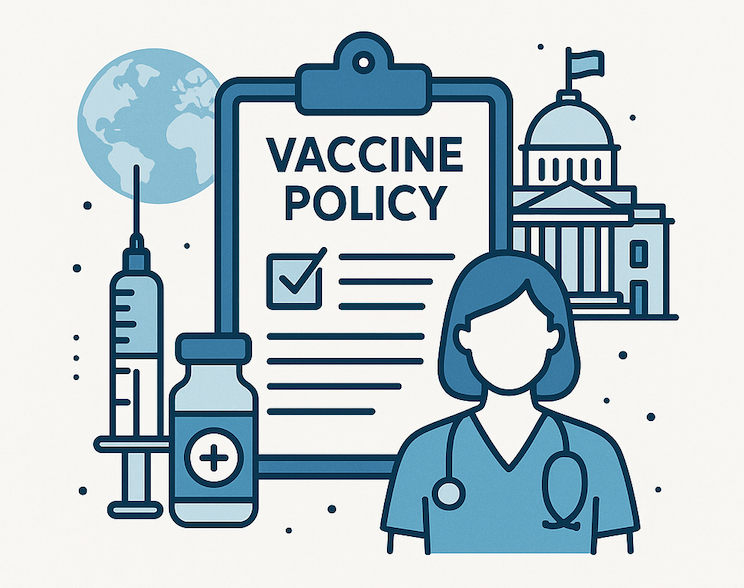
The Challenges to Federal Vaccination Policy (Health & Gender Policy Brief #182)
Health & Gender Policy Brief #182 | Haley Gabrielle Lloyd | December 9, 2025
Summary
The Protecting Free Vaccines Act (H.R. 5448) aims to preserve stable vaccine coverage by freezing ACIP recommendations as of 2024 and requiring all major insurance programs to continue covering those vaccines without cost-sharing until 2030. H.R. 5448 was introduced on Sept. 18, 2025, by Rep. Frank Pallone D-NJ-6. Since this is a Democrat-sponsored bill in a Republican-controlled House, its chances of passing are currently low unless bipartisan support grows.
Background
For years, the United States followed a clear rule: If the Advisory Committee on Immunization Practices (ACIP), the Centers for Disease Control and Prevention (CDC) vaccine advisory group, recommended a vaccine, insurance had to cover it without out-of-pocket costs. This became the national standard for private insurance, employer plans, Medicare, Medicaid, and the Children’s Health Insurance Program (CHIP). Routine immunizations became free. Coverage was reliable and accessible across all states. This was federally implemented through the Affordable Care Act (ACA). It required that the majority of private Medicaid insurance plans cover ACIP-recommended vaccines. This also included no cost-sharing under Section 2713. Eventually individual states started to have similar requirements for Medicaid and CHIP.
Under the Trump administration, vaccine coverage and policy are becoming unstable. Government-promoted “vaccine hesitancy,” the dismissal of scientific advisers, and budget cuts to the CDC have weakened national vaccine recommendations. Additionally, the reduced emphasis on the central roles of scientific groups, such as ACIP, is weakening their influence on public health policy.
If federal standards weaken, insurers can reintroduce cost-sharing, and states may reduce Medicaid and CHIP vaccine coverage. Lower coverage would increase the risk of preventable outbreaks and place additional strain on health care systems. These changes would affect not only individuals but entire communities.
Analysis
Opponents of the Protecting Free Vaccines Act believe freezing ACIP’s 2024 recommendations limits future officials’ ability to revise vaccine policy. Some lawmakers view the bill as federal overreach, objecting to requirements on private insurers and limits on state authority over Medicaid. They emphasize local control and medical freedom, highlighting a divide among lawmakers and differing views on the federal role in health policy.
Supporters argue that these objections overlook the current health policy environment. Without a stable federal standard, insurers can quickly change coverage, and states facing budget pressures may reduce preventive care. Employer plans could reintroduce costs for vaccines that were previously free, and families on Medicaid would risk losing access. This would deepen health inequities, especially for low-income children and older adults.
Without strong federal standards, long-term risks to public health preparedness will grow. Vaccines depend on public trust, clear guidance, and stable access. When vaccine policy becomes politicized, uptake declines and vaccination rates fall. This increases the risk of disease outbreaks and public health crises. The 2019 measles outbreak showed how quickly vaccination gaps can widen. Diseases like measles, influenza, and COVID-19 could resurge, straining health care systems, raising costs for families, and weakening preparedness for future threats.
Conclusion
H.R. 5448 would maintain no-cost coverage of all vaccines recommended in 2024 through 2030, preventing insurers and states from increasing or reducing costs for these vaccines, even if federal policy changes. While the bill does not address broader political polarization, it establishes a clear federal safeguard for vaccine access during a period of rapid change.
The future of vaccine access will depend on how the Trump administration changes health agency policies and interacts with scientific groups. Cuts to the CDC, weakened federal guidance, and reduced roles for advisory groups like ACIP indicate that vaccine policy is becoming more politicized. Without federal protections, vaccine coverage will remain vulnerable to further cuts. The Protecting Free Vaccines Act would not reverse the administration’s broader health policy direction, but it would provide a safety net for the next four years. Maintaining a stable foundation now helps ensure that future administrations are not left to rebuild a weakened public health system.
Engagement Rersources
- Official Congress.gov page for H.R. 5448 with full bill text, sponsors and legislative history. https://www.congress.gov/bill/119th-congress/house-bill/5448
- CDC surveillance report on adult vaccination coverage in the United States. https://www.cdc.gov/mmwr/volumes/65/ss/ss6501a1.htm
- Peer-reviewed BMC Public Health study examining how politics and misinformation affected COVID-19 vaccination patterns. https://bmcpublichealth.biomedcentral.com/articles/10.1186/s12889-021-12432-x
- CDC report on the 2019 measles outbreaks across the United States. https://www.cdc.gov/mmwr/volumes/68/wr/pdfs/mm6840e2-H.pdf
Rideshare Drivers Organize As Earnings Decline (Technology Policy Brief #160)
Technology Policy Brief #160 | Mindy Spatt | December 9, 2025
Summary
When Uber and Lyft came on the scene, taxi drivers protested vociferously. Now it’s the rideshare drivers protesting, as their earnings go down and the threat of autonomous vehicles looms. Organizing by rideshare drivers has had some success, but how effective hard-won changes will be remains to be seen. Workers scored an apparent victory in securing collective bargaining rights in California. But a similar law in Massachusetts has yet to yield results and the California law was a compromise that included enormous giveaways to the companies.
Analysis
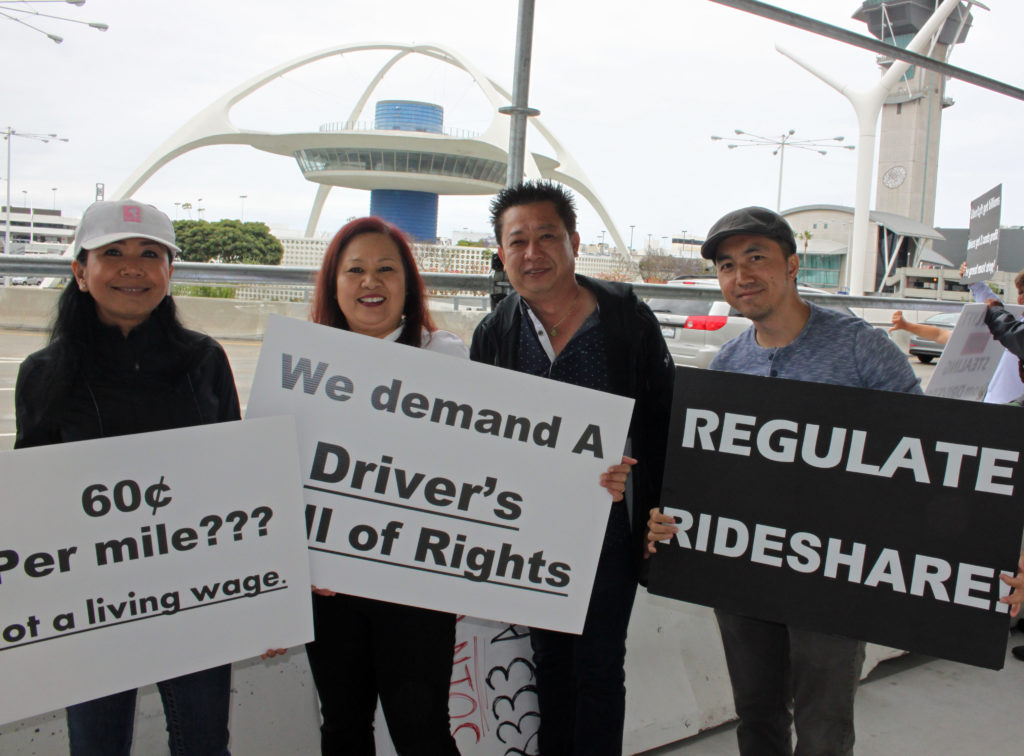
The news is mostly bad for Uber and Lyft drivers, who have staged a series of protests across the country as they see their already minimal earnings decrease and work without any employment protections. Here in San Francisco, automated Waymos are everywhere. The pricing is similar to Lyft and Uber, but costs to consumers may be lower since no tip is necessary. Analysts say Waymo’s earnings are already cutting into Uber’s
There is worse to come for drivers. Uber and Lyft have made no secret of their intention to move toward automated vehicles as well. Rollouts will begin in 2026 and eventually will replace drivers altogether. Some drivers have already gotten side gigs training the AI vehicles that will supplant them.
Still, the companies have been able to crush efforts by drivers to obtain meaningful employment protections. Organizing drives have had some success, but it may be too little too late.
In New York, the Taxi Workers Alliance sponsored a protest that attracted hundreds of Uber and Lyft drivers. They claimed the companies were locking them out of the apps for hours or days at a time in a deliberate attempt to avoid the city’s minimum pay regulations by keeping them off the road for extended periods. Their protests were heard as the Taxi Commission eventually voted to restrict such lockouts, requiring advance notice to affected drivers and forbidding lockouts for at least 16 hours after a first trip, but failing to stop the practice entirely.
In Nashville, protesters were less successful. Five drivers from the Tennessee Drivers Union were banned from Nashville International Airport after leading a protest for better pay and working conditions there. That means those drivers, who get most of their business from Airport rides, have lost most of their income.
Shrinking earnings led Uber and Lyft drivers at Milwaukee Mitchell International Airport to stage a strike of sorts against the two rideshare companies by gathering at the staging lot for the apps and shutting off their apps. The drivers hope that action will spark an organizing campaign.
Massachusetts drivers won that right through Question 3, a ballot measure that passed in November 2024. But the law does not reclassify drivers as employees, which would allow them to benefit from the rights afforded by the National Labor Relations Law; it only allows collective bargaining. A campaign is underway to certify a bargaining unit. Critics say that as long as drivers are classified as independent contractors, they cannot have fair employment rights and point out that Uber and Lyft didn’t bother to oppose Question 3.
The same is true for a recently passed law enabling rideshare workers to organize in California, where the companies spent a record-breaking $200 million to pass a ballot measure preventing drivers from being classified as employees. Not only did they not oppose AB 1340, a law allowing collective bargaining for rideshare drivers, but they actually signed off on the bill. In exchange, they were gifted a reduction in insurance coverage, lowering their costs while severely limiting recovery for individual Californians harmed by uninsured or underinsured drivers.
The California law was lauded as a huge expansion of collective bargaining rights and a historic step in empowering over 800,000 rideshare drivers working for companies like Uber and Lyft. But Rideshare Drivers United, a Los Angeles-based advocacy group of 20,000 drivers, said in a blog post that they were not at the table for the final version of the bill, which represented a compromise between the companies and the Service Employees International Union (SEIU), which is vying to represent California drivers.
According to Drivers United, “The bill …will force drivers to negotiate from a pay floor far below minimum wage, lacks substantial protections for drivers who engage in taking action such as striking, and has no adequate measures to hold companies accountable if they ignore or violate the established rules.
Still, they say, “Whether the law is too weak or strong enough is up to us as drivers! In Massachusetts, SEIU passed a similar law in 2024, but has yet to deliver a union or contract. But if California drivers build real power through public action, and fight together for a strong first contract, we can change our future forever under this law.”
Engagement Resources
- Question 3 Still a Question: Massachusetts’ Experiment in Sectoral Bargaining for Gig Workers
- Question 3 Still a Question, Ted Parker, April 8, 2025, On Labor https://onlabor.org/question-3-still-a-question-massachusetts-experiment-in-sectoral-bargaining-for-gig-workers/
- AB 1340 Overview, Rideshare Drivers United, https://www.drivers-united.org/ab-1340

Arkansas (2026 Democratic Primary Preview Series)
2026 Democratic Primary Preview Series | Nate Iglehart | 12/5/2025
Announced Arkansas Democrat Senate Candidates: Ethan Dunbar and Hallie Shoffner
Announced Arkansas Democrat House Candidates: Terri Green, Zack Huffman, Chris Jones, Robb Ryerse, Steven O’Donnell, and James Russell
Arkansas is approaching an election season where five of its six congressional representatives are up for election. The current delegation consists of Republican Senators John Boozman and Tom Cotton, and Republican House Representatives Rick Crawford, French Hill, Steve Womack, and Bruce Westerman for districts 1-4 respectively. The only one not up for election is Boozman.
For the last 15 years, Arkansas has been represented in Congress exclusively by Republicans, and that is a grip that has tightened over the last decade. In the presidential elections, the state hasn’t voted for a Democrat since 1996. But there is still support for Democrats in Arkansas; after all, Bill Clinton was once the governor of the The Natural State. Places like Little Rock and a handful of eastern counties voted blue in the most recent election, and Trump’s MAGA agenda may be starting to lose its appeal to rural voters after his embrace of Big Tech and tariffs that hurt American farmers.
Arkansas is a state dominated by white Americans and Christians, both of which are demographics that make up some 70% and 80% respectively of the population. But there is trouble brewing in the 3,045,637 person-strong state. Arkansas ranked 48th in a nationwide assessment of health care access, affordability, equity and outcomes, and while its population is still growing, the rate of its growth has slowed to around 1% as of 2022. Now, the economic outlook of the state has been rapidly improving over the past few years, and its ranking on this front has jumped between 5 and 13 places depending on which index is used. Agriculture dominates the economy, creating around $16 billion (or 8.5% of the state’s GDP) annually. The question now is how much longer this growth can continue, and how much goodwill this growth buys for the Republicans in power. The primary elections will take place on March 3, 2026, and in races where no candidate receives over 50%, runoff elections will take place on March 31, 2026.
Announced Senate Candidates
Ethan Dunbar, 61, is the current Lewisville mayor and a retired Command Sergeant Major, the highest enlisted rank in the Army. Raised in the small rural town of Lewisville, he served in the military for 33 years before being elected in 2018 and re-elected in 2022 as the mayor of his hometown. His focuses as mayor were on infrastructure, housing opportunities, restoring civic pride, and leading with ethical Christian faith. Ethics and civility both are major themes of his Senate campaign, and in fact, he earned his PhD in Interdisciplinary Leadership from the University of Central Arkansas with a dissertation on the ethical leadership of elected officials. He is also very involved in community service organisations, such as the Democratic Party of Lafayette County, the Lafayette County Leadership Council, and the Lions Club International. With his military and religious background, and a history of public service focused on community, it is likely that his story will play well to voters, but his opponent is well-liked amongst the Republican party and especially the MAGA voter base.
Platform Priorities
- Respect, Civility, and Ethics: Holding leaders accountable and returning the political process to one focused on respect and cooperation
- Jobs and Rural Growth: Protecting Arkansas’ lithium and advanced manufacturing sectors, as well as providing support for small farms.
- Education and Healthcare: Protecting rural hospitals, preventing healthcare costs from rising, and growing support for schools and skilled trades.
Voter & Donor Support
No official donor support data is yet available, but he is a well connected Democrat in Arkansas. This will help in the primary, but Arkansas is a strong red state, and while he has the background that many Arkansas voters will like (retired soldier, religious, and an Arkansas native), his opponent is popular and checks many of the same boxes.
Why He Might Win
- His heavy emphasis on religion and Christianity may play well in a core state of the Bible Belt.
- As Trump’s popularity continues to decline, voters might be turned off by Tom Cotton and his embrace of MAGA issues such as CRT in schools.
- Ethics is an increasingly important value when it comes to leaders, and as corruption scandals and disrespectful politics expands in government, Dunbar’s focus on ethics may be a welcome stance for Arkansas voters.
Why He Might Lose
- Arkansas is a Republican stronghold, and while he has qualities that many might find admirable, there is still a team mentality in Arkansas politics (vote red, no matter who).
- His platform is heavy on rhetoric but light on more explicit policy moves
Key Election Variables
- How much a religious electorate wants a religious Senator
- With ACA subsidies expiring soon, healthcare might become a massive boon for candidates like Dunbar who are running lowering healthcare costs.
General Election Odds: Low
Primary Odds: Medium
Hallie Shoffner, 38, is a fellow Arkansas native who is focusing heavily on farmers and supporting local farms across the state. As a 6th generation farmer, she ran her family’s farm until it was forced to shut down in February due to high input costs and inadequate federal assistance. She is also the founder and CEO of Delta Harvest, which builds local food infrastructure and supports farmers with marketing and producing specialty goods like rice. Now she is turning her eyes towards Washington, wanting to fight the rigged system that she sees Republican incumbent Tom Cotton having bolstered over his 10-year tenure. With a focus on the trials and tribulations of rural farmers in Arkansas, and a promise to restore medicaid in a state suffering a crumbling healthcare system, she is looking to capitalize on the populism that seems to be spreading across American politics.
Platform Priorities
- Agricultural Support: Citing Cotton’s nay votes against the 2018 Farm Bill, she says that she will push for more federal support for farmers and try to lower costs across the board.
- Restoring Medicaid: Restoring Medicaid and saving social security are both major focuses of Shoffner, citing them often as an issue that hits rural citizens more than rich, urban citizens.
- Affordability: Between healthcare, food costs, and housing, Shoffner is focusing on lowering costs for Arkansas voters.
- Lowering the deficit: Once a constant Republican talking point, Shoffner has blasted Cotton’s “blowing up of the deficit” while normal people still suffer.
Voter & Donor Support
With her history of helping farmers, a massive Arkansas industry that has been feeling pain of late, it is likely that this will help her garner support across the state. She also has raised $663,452 as of September 30, a relatively small amount likely buoyed by individual donations.
Why She Might Win
- Despite having a small platform, it is focused on an industry that Arkansas prides and that she has actively worked to support. Recent elections like Mamdani’s NY win show that experience only matters so much, and having popular policies and great interpersonal skills matter a lot more.
- This also has likely led to far more exposure to far more people in Arkansas, which could lead to a huge bump in support.
- Populism is in vogue, and her background as a farmer pushing back against Cotton’s establishment stance may win over people disillusioned with how things are currently going.
Why She Might Lose
- Her Clinton-like background as a Democratic farmer from Arkansas is a bit risky, as Clinton’s popularity in the state is a bit of a mixed bag.
- Lack of experience still will matter to some, and her experience is far more concentrated on farms than in Senates.
- Her farm-focused platform may run into a hitch with Trump’s recent $12 billion aid package for American farmers, meaning voters may be more willing to vote for the status quo than they were a few months ago.
- Her platform has some explicit policy stances, but it still lacks a diversity that is important for attracting a broad coalition of voters.
Key Election Variables
- How much hurt farmers are feeling as November approaches.
- Whether or not ACA subsidies expire and how much healthcare in Arkansas deteriorates.
General Election Odds: Low
Primary Odds: Medium to High
Recent Interviews:
Hallie Shoffner talks farmers and challenging Sen. Tom Cotton | THV11+ Interview
———————————————————————
Announced House Candidates
District 1 – Terri Green
Terri Green, a retired pathologist in her 60s, has thrown her hat into the ring against incumbent Rick Crawford. With a progressive platform based on lifting up the poor and middle class, inclusion and tolerance for all, and fighting authoritarianism and facism, she is angling to be a minor test case for the progressive wing of Democrats. Having studied history and law at Baylor before going to medical school, her intelligence and work ethic can’t be questioned. She specialized in pathology before becoming a clinical laboratory director. Now, she wants to give voters in Arkansas a real choice between the status quo of Crawford and a new future under Green.
Platform Priorities
- Economic equality: She is leaning into the cost-of-living crisis as one that has only gotten worse under the Republican leadership of Arkansas, and wants to bring up the poor and middle classes.
- Human Rights: Green has seen the treatment of immigrants and the LGBTQ+ community by this administration as morally abhorrent, and she aims to return Arkansas’s 1st district seat to one filled with someone who protects human rights.
- Corruption and Oligarchy: She sees the values of transparency, equity, and inclusion and tolerance for all pillars of Democracy, and in taking no PAC money, Green wants to lead the charge against the tightening grip of politics that oligarchs and fascists have.
Voter & Donor Support
A relatively unknown name, and no PAC support both mean she is starting her campaign heavily on the back foot.
Why She Might Win
- She is a political outsider in Arkansas and the only competition to Crawford, meaning that anyone who has lost interest in Crawford will either not vote or turn to Green.
- Her policy policies will resonate with independents who see an increasingly authoritarian and corrupt administration in Washington.
- The potential size of the coming blue wave in 2026 could very well buoy her to a victory, as long as a few other dominos fall in her favor.
Why She Might Lose
- Practically no media presence yet, with a campaign page with grammatical errors show a lack of attention to detail that many voters are likely to notice.
- No government focus, and her medical background is not conducive for government work or endearing herself to rural Arkansas voters.
- Her opponent, Rick Crawford, is incredibly popular since his election in 2010 and even ran unopposed in 2020. This district is also the most red in the state, further cutting her chances of winning
- Lack of clear policy stances besides very general statements on affordability and morals in politics.
Key Election Variables
- How disillusioned voters could become with Crawford and Republicans.
General Election Odds: Extremely low
Primary Odds: Uncontested
District 2 – Zack Huffman and Chris Jones
Zack Huffman, 34, is a former elementary math teacher and a current Director of Development for Teach for America since 2018 who is coming from the Democratic stronghold city of Little Rock. Having studied public policy and leadership at the Clinton School of Public Service and the University of Mississippi, his focus is heavily on the little guy. Arkansas’ 2nd District is the least Republican in the state, and while it contains the capital of Little Rock, his background is one that comes from rural living and the challenges that come with that hard lifestyle. Much of his platform is focused on the main issues of the time: affordability, healthcare, and housing. But his opponent is one who is the definition of the status quo, and as time goes on, it seems increasingly possible that this district will flip blue.
Platform Priorities
- Education: As a teacher, his focus on equipping Arkansas schools and teachers with the best support to raise the next generation is a primary focus of his.
- Housing: Huffman believes that every person in Arkansas deserves a home and that everyone should have at least a pathway to homeownership.
- Food: His experience in elementary schools exposed him to the extent of child hunger in Arkansas, where some estimates say 1 in 4 children go to sleep hungry. He believes that hunger can be ended in Arkansas in a way that doesn’t break the budget.
- Healthcare: Rural hospitals and communities remain a primary political issue in Arkansas, and his emphasis on the “Grannies and Papaws” of those communities is grounded in ensuring that zip code doesn’t determine health outcomes.
Voter & Donor Support
As of September 30, Huffman has raised $6,301, a very meager sum. However, he will likely find a lot of support in Little Rock and the surrounding towns, despite the county still leaning red for the past few election cycles.
Why He Might Win
- In the least Republican Arkansas county, the best chance the state has in electing a Democrat lies here, and a potential blue wave in 2026 could push him past the post.
- His opponent, French Hill, has been hit with some controversy after misleading campaign ads.
Why He Might Lose
- Education isn’t a hot-button issue, so his background as a teacher may not carry him super far.
- His policy areas are relevant to Arkansas, but the depth of his policy plan leaves a lot to be desired.
- French Hill, while increasingly unpopular, is still a Republican incumbent in a safe Republican state who is now running for his 7th straight election win.
Key Election Variables
- His success relies heavily on riding a blue wave across Arkansas, and if Hill continues to slowly lose support.
- If education becomes a primary issue, then he will be in a prime position to capitalize. If not, his background will only do so much to bolster his electoral position.
General Election Odds: Low to medium
Primary Odds: Low to medium
Chris Jones, 45, is a pastor and scientist who ran a bold but unsuccessful campaign for governor in 2022 against Sarah Huckabee Sanders. He garnered a respectable 35% of the vote, but since then has co-chaired the national Dirt Road Democrats political action committee and continued his work as a banker. His message is one that has four main elements: economic equality, reinforcing citizens’ power over special interests, continuing sustainable development across Arkansas, and empowering entrepreneurs. The last point is especially important to Jones, as in addition to being a banker and pastor he was the executive director of the Arkansas Regional Innovation Hub, which gave support to entrepreneurs. He also holds five degrees, ranging from math and physics bachelor’s degrees to an M.S. in technology and policy from MIT, and a Ph.D. in urban studies and planning from MIT. This election represents a new test for Jones, and his more narrow focus from the gubernatorial race to a House seat may give him just enough of an advantage to take the race.
Platform Priorities
- Economic Equality: He wants to foster an economy that allows people to prosper, and this is much in line with his policy of supporting entrepreneurship.
- Democracy: Jones wants to be the representative for a state that increasingly feels poorly represented, as shown by its elected officials’ down votes for continuing Medicare and food system support. He also wants to ensure electoral maps are fair, and that rules are both just and followed.
- Sustainable Development: Jones wants to invest in keeping hospitals open, improving resources for teachers, and backing apprenticeships for the next generation.
- Entrepreneurship: His background is strong in allowing new business to grow, and Jones wants to continue this work in “unleashing innovation, empowering small business, and turning ideas into jobs.”
Voter & Donor Support
He has great name recognition, especially amongst Democrats, and also has a lot of wealthy connections through his network of Democratic donors and his experience as a banker. So far, he has raised $198,101, the most outside of Hill’s $2.4 million.
Why He Might Win
- Name recognition is king, and he is well connected across the state. His intelligence and education is no secret, and while his platform shies a bit away from farmers, it hits policies that help everyone
- He has experience running a race and winning a primary, and while the general election is another story, experience also is important
- Although he didn’t perform super well in the gubernatorial race, he narrowed his electorate from a strong red state to instead its least red district, giving him as good a chance as he could ask.
Why He Might Lose
- However, he still lost his gubernatorial race by a decent margin, and he is still without much government experience outside of an aid position of Sanders’ father.
- Hill is still polling decently well, and has raised far more money as of September.
- His policies are more focused on urban issues like business, which will play well in Little Rock but less well outside of the city.
Key Election Variables
- The magnitude of a potential blue wave.
- Jones’ ability to endear himself to voters outside of Little Rock.
General Election Odds: Medium
Primary Odds: High
Recent Interviews:
Chris Jones – Talk Business and Politics with Roby Brock
District 3 – Robb Ryerse
Robb Ryerse, 50, is a pastor and nonprofit leader who is no stranger to running for this district’s seat. In 2018, Ryerse challenged incumbent Steve Womack but lost in a landslide. This time around, he is eyeing a rematch and has since switched parties to the Democrats in light of Trump’s takeover of the party and affordability issues. Those affordability issues are one of the three main themes of his campaign, along with empowering a progressive vision of faith and protecting freedom in a way that includes LGBTQ+ rights, abortion, and gender affirming care. Outside of politics, he and his wife have started nonprofits that combat extremism, he’s worked with Vote Common Good and co-founded with Dr. Chris Jones Vortex PAC, along with starting a church called Vintage Fellowship. His background as a pastor and his work in the nonprofit sector are likely to endear him to many in the very religious state, and his previous campaign experience will no doubt be useful in his fight to win this time around.
Platform Priorities
- Affordability: One of the key reasons he’s running as a Democrat, affordability is paramount to Ryerse. He plans to build more affordable housing, invest in preventing homelessness, and treat housing as a human right on top of lowering healthcare costs and cutting taxes for low and middle income families.
- Faith and Governance: He wants to use faith to inject morality into politics through campaign finance reform, ending gerrymandering, expanding access to voting, and leading with transparency.
- Freedom on all fronts: Ryerse’s vision of freedom extends past religious and gun freedom to issues like bodily autonomy and LGBTQ+ rights, and includes freedom from things like systemic racism and going broke over a medical emergency.
Voter & Donor Support
He has already raised $37,462, which is on pace to pass the $50,303 he raised over the course of his 2018 run. In terms of voter support, Arkansas’ third district is the second least Republican dominated, meaning his progressive messaging may play better here.
Why He Might Win
- He has the most in depth policy website out of any on this list, which is always comforting for voters.
- He checks both demographic majority boxes as a white Christian pastor, and can still swing independents with his slightly more progressive take on most issues. As a result, he may be able to win voters from all over the political spectrum
- His focus on affordability has been shown in other states to be a genuinely salient sticking point towards incumbents, and Trump’s inability to address it so far is not going unnoticed.
Why He Might Lose
- His district is still a +10 Republican district, which is a tall order even with a 2026 blue wave.
- His opponent, Steve Womack, is a very popular Republican who has lots of local connections and appearances on top of holding the longest consecutive voting streak in the House, a testament to his work ethic and reliability.
- Progressive values, even with a Christian tinge, are still generally a risk in American politics and especially in a conservative state like Arkansas.
Key Election Variables
- How much religion and affordability becomes main issues as we near November 2026.
- Ryerse’s ability to fundraise and convince a generally more rural electorate of his progressive vision for the district.
General Election Odds: Medium
Primary Odds: Uncontested
District 4 – Steven O’Donnell and James Russell
Steven O’Donnell, 58, is an experienced business owner and former U.S. Navy sailor who now wants to stand up for the little guy. He’s worked in feed mills, the construction industry, and manufacturing before starting his own business as a licensed general contractor in home construction and remodeling. Across these many years of work and service, he has seen how the average American is slowly losing ground to elites, and his focus is on how to make the average American’s life easier. While he lacks a clear policy platform, his focus is on being a trustworthy middleman and representative of what his constituents want, not what he wants. So far, that seems to be transparency, fighting oligarchy, and protecting lower-income Americans.
Platform Priorities
- Budget Transparency: One of the few concrete promises O’Donnell makes it that he wants the U.S. House of Representatives to become the vigilant watchdog of our national interest and ensure funding decisions are scrutinized with clear receipts.
- Fighting Billionaires: Much of O’Donnell’s messaging is focused on standing up for the hardworking Americans he spent much of his career around. How he plans on doing this, however, is unclear.
Voter & Donor Support
No donor support data is available yet, but it will likely be a financial uphill battle both in the primary and general elections. On the voter front, he seems to be the definition of the everyman that many voters love to root for, but it remains to be seen how much that will translate to actual votes.
Why He Might Win
- Being a political outsider comes with no baggage and some benefits like no poor track record and being able to represent himself as a true counter to the status quo.
- His military and managerial experience will both play well in Arkansas, as well as potentially making up for a lack of government experience.
Why He Might Lose
- Practically no media presence or name recognition.
- O’Donnell also has practically no concrete policy ideas other than representing hardworking Americans and fighting corruption.
- Incumbent Bruce Westerman is very popular, currently in his fifth term in office with no sign of lost support.
Key Election Variables
- Whether or not he can come up with concrete policy standpoints.
- The extent to which he can wield his everyman image to make up for his lack of experience.
General Election Odds: Low
Primary Odds: Low
James Russell, 53, is the owner of an outpatient mental health business in Little Rock since 2014 and a veteran. He describes himself as “unapologetically progressive while also being a fiscal realist,” and he is no stranger to Arkansas politics. He ran for Governor in 2022, and despite losing, he still overperformed with an exceptionally high vote-per-dollar-spent ratio. He also initially was set to run for Tom Cotton’s seat, but switched races in late October. He has also spent time in public service roles ranging from healthcare credentialing, to disaster preparedness, and now is setting his sights higher. His platform is
Platform Priorities
- Economic Fairness: Russell supports upping the minimum wage and supporting fair pay laws, alongside improving access to education so everyone has a higher leveled playing field. He also backs a tax on the top 0.1%, and wants to close tax loopholes and campaign finance dominance by PACs.
- Healthcare: Russell aims to expand Medicare and begin moving toward healthcare for everyone.
- Housing: He sees the housing crisis as one caused by big companies, and aims to prevent companies from buying up homes and raising rent too high. He also wants to count rent payments when people apply for a mortgage, increasing the ability of citizens to own a home.
Voter & Donor Support
No donor support data is available yet, but it will likely be a financial uphill battle both in the primary and general elections. He has lived and worked throughout the 4th District, however, which means voters know who he is and while the district is fairly Republican-leaning, incumbents are increasingly unpopular as the cost-of-living fails to fall.
Why He Might Win
- He has lived and worked throughout the 4th District, meaning he is well-connected to his constituents. He also is very involved with local organizations like Renters United, further improving his track record and relatability.
- His military background and name recognition will resonate with voters.
- His policies are concrete and generally popular, despite his progressive label.
- He has experience running campaigns and has a solid media presence.
- His experience living in both rural and urban environments may lend him the ability to communicate effectively to both worlds and understand issues at their core.
Why He Might Lose
- Incumbent Bruce Westerman is very popular, currently in his fifth term in office with no sign of lost support.
- His lack of focus on farmers could hurt his chances, but much of the farmland in Arkansas is not in this district.
- Progressive values are still generally a risk in American politics and especially in a conservative state like Arkansas.
Key Election Variables
- Westerman’s ability to garner his own support while sitting on a variety of committees and subcommittees as well as being a member of multiple congressional caucuses.
- Russell’s ability to gain ground after starting the race late.
- Whether or not progressive policies like taxing the top 0.1% and Medicare for all continue to be risky, given Mamdani’s NYC mayoral win.
General Election Odds: Low to medium
Primary Odds: High
Recent Interviews:
Arkansas senate candidate James “Rus” Russell talks On The Record
Overall, Arkansas is likely to remain a Republican bastion. But that bastion may be poised to have its walls chipped every so slightly come 2026, with a handful of well-positioned Democratic candidates. In addition, those candidates’ different messages will be interesting to watch, and seeing how far progressive candidates get versus more moderate or more explicitly religious candidates will be informative for the 2028 elections. The pendulum in Arkansas has swung decidedly in favor of Republicans over the past few cycles, but that pendulum will always have a chance of swinging back, and with 2026 having issues like affordability and transparency being extra important, this might be the time.
Engagement Resources:
Ballotpedia – serves as an initial go to for candidates and races at all levels:
United States House elections in Arkansas, 2026 (March 3 Democratic primaries) – Ballotpedia
United States Congress elections, 2026 – Ballotpedia
270ToWin has an aggregate of polls and insight into how every race is shaping up towards the 2026 Midterms:

Alaska (2026 Democratic Primary Preview Series Brief #2)
2026 Democratic Primary Preview Series Brief #2 | Nate Iglehart | 11/29/2025
- Announced Alaska Democrat Senate Candidates: Ann Diener and Mary Peltola
- Announced Alaska Dem. House Candidates: Matt Schultz, and (potentially) Mary Peltola.
Announced Alaska House Candidates
There are two seats up for grabs this coming election season in Alaska: the first is Alaska’s single, at-large House of Representatives seat, and the second is the Senate seat of Republican Dan Sullivan. The current delegation consists of Republican Representative Nick Begich III, Republican Senator Dan Sullivan, and Republican Senator Lisa Murkowski.
Alaska has long been a Republican stronghold at the federal level, and while that still remains the case, the grip that the Republican party has on the state has begun to wane over the past few election cycles. In 2000, Democrats only received 27.7% of the vote, but that number has risen to 43% and 41% in the 2020 and 2024 elections respectively. Anchorage’s legislature and mayor have both slowly shifted to the center, and with affordability being one of the key issues this election season, Democrats may have a rare opportunity to gain some ground. The potential expiration of ACA subsidies at the end of this year is also a main sticking point, and some polls suggest that Senator Dan Sullivan’s seat may be less secure than previously thought.
Alaska is an exceedingly rural state outside of Anchorage, and takes the title of least densely populated state. However, its population of roughly 733,391 people with a median age of 35.6 years makes it one of the youngest states in the nation. This dichotomy of rural life and a young population will be a test of the Democratic platform, which has often focused more on the latter than the former. It will also make the issues of affordability more prevalent, while the ACA subsidy issue may carry less weight. The primary will be held on August 18th, with the general election following on November 3.
Announced Senate Candidates
Anna Diener
Ann Diener, 52, seems to be the main candidate for Democrats in Alaska. She is a journalist, having worked for the newspaper sales executive at the Fairbanks Daily News-Miner, and only arrived in Alaska in 2021. Without experience in governance, she relies on her background in media and her time working with Les Gara’s campaign for Governor in 2022, which ultimately lost. Diener’s platform prioritizes workers’ rights, infrastructure, housing, natural gas expansion, and foreign policy. While Alaska’s Senate races rarely draw many eyes, Democrats may see this seat as one with potential to flip, as polls show that Sen. Dan Sullivan is not particularly popular. Diener may not have name recognition or an extensive resume in government, but she may have just enough relatability, bipartisan policies, and political tailwind to take the general election as the sole Democratic candidate at the moment.
Platform Priorities
- Infrastructure: Building adequate roads, with a focus on improving the Dalton Highway and a full extension of the Alaska Railroad to Alberta, Canada.
- Housing: Focus on building and refurbishing housing, making use of the new proposed infrastructure projects.
- Agriculture and Tourism: Expanding the Alaska Grown program, which establishes farms and agriculture across the state. Also promoting tourism to the state.
- Energy: Expanding the use of LNG (natural gas) along with its pipelines and other sustainable mining operations. The focus here is on lowering energy costs for Alaska’s citizens, as well as an “all-in” approach on energy that seeks to make LNG, clean coal, and other mining pursuits as sustainable and affordable as possible.
Voter & Donor Support
- No data yet on available donor support, nor on Diener’s voter appeal in comparison to Sullivan.
Why She Might Win
- Sullivan isn’t a very popular opponent
- Trump’s endorsement of SUllivan could backfire if Trump’s popularity continues to fall
- New figures in politics often capitalize in chaotic times
- Energy policy that caters to Alaska’s strengths will be perceived as common sense
Why She Might Lose
- Alaska is still decently Republican-leaning, and while Sullivan isn’t particularly popular, incumbency carries with it some advantages in voters’ minds.
- Lack of true government experience could make Diener seem unqualified.
- Media presence is minimal, with mainly a campaign website, Facebook, and a handful of other social media accounts. Also has not done an interview yet.
Key Election Variables
- Sullivan’s sliding popularity and the nationwide perception of Republicans
- Energy and housing costs
- Extent to which dissuaded voters vote for a Democrat instead of Green or independent party candidates.
General Election Odds: Medium-low due to district partisanship, but opponent is not popular.
Primary Odds: Currently uncontested
Mary Peltola
Mary Peltola, 52, would be the other Democratic candidate for the seat, but she has yet to file to run as she navigates a lawsuit involving the death of her husband. She also may yet turn her eyes to the race for Alaska’s House of Representatives seat. Pelotla was the Alaskan Representative in the House from 2022 to 2025, after defeating Republican former Governor Sarah Palin and Republican Alaska Policy Forum board member Nick Begich III. Her win was one of many firsts, including first Alaska Native member of Congress, first woman to represent Alaska in the House of Representatives, and the first Democrat to serve as Alaska’s representative in the House since Nick Begich Sr. in 1972. If she were to run again, it’s likely that her platform would be similar to the one that she won her 2022 election with: infrastructure improvements, advocacy for Alaskan fisheries, and cooperation with the Alaska Native Communities. But without any indication that she will file for a run for the seat, it is unclear how much longer she can wait to decide if she runs for the Senate seat or for the House seat.
Platform Priorities
- Fishery Advocacy: She worked to ban predatory foreign trawlers to protect salmon and worked to revise the Magnuson–Stevens Fishery Conservation and Management Act.
- Infrastructure Improvements: Her first term was marked by a $2 billion boon she helped secure from the Bipartisan Infrastructure Law and the Inflation Reduction Act for Alaskan projects
- Aid to Native Communities: She addressed long-standing promises to Alaska Native communities, and sponsored the Native American Millennium Challenge Demonstration Act to assist remote communities with economic development.
Voter & Donor Support
- Voters and donors who are embedded in Alaska’s Democratic campaigns would know her name and know her ability to get things done.
- Her bipartisan streak may gain some independent votes, but her 2024 loss showed that Republicans and Independents disillusioned by Trump and MAGA would rather vote for a third party, and could under Alaska’s Ranked Choice Voting system.
Why She Might Win
- Name recognition and a history of service for Alaska already.
- A growing demographic shift towards the center may lend her additional support.
- Dan Sullivan is not particularly popular.
- Bipartisan stances could be a welcome sight in an election that will be extremely divisive.
Why She Might Lose
- Her refusal to start her campaign so far is costing her valuable money and time
- Voters already showed that they preferred Dan Sullivan over her in 2024.
- Alaska still remains a relatively red state.
Key Election Variables
- How popular Dan Sullivan is approaching election day.
- How late Peltola starts her campaign.
- Voter fatigue for Trump-style politics and Trump-endorsed politicians.
- The seriousness of the cost-of-living crisis, and who is blamed for it.
General Election Odds: Medium-low due to district partisanship, but opponent is not popular.
Primary Odds: High if she did run, but the later she declares, the lower her odds get.
Announced Alaska House Candidates
Matt Schultz
Matt Schultz, 53, is a progressive pastor with a decently strong online following, and he is taking his first stab at governance with this race to represent Alaska’s at-large district. As the pastor of Anchorage’s First Presbyterian Church, he has an extensive history of support for progressive policies and ideals, having spoken at Anchorage’s No Kings day rally while focusing on homelessness in Anchorage, food insecurity, and raising the minimum wage. The New York-born pastor moved to Alaska in 1997, and his work as a pastor has garnered him respect amongst Anchorage’s populace. While he has often denounced Trump, he wants to run a campaign that focuses on issues rather than people, with his key policy areas being the cost-of-living, protecting health care and medicaid, protecting LGBTQ+ rights, and growing the diversity of Alaska’s energy sector. With his name recognition alongside his progressive Christian identity, he stands out as a candidate who can reach parts of both parties while also having lived in Alaska for decades now. Both of these aspects may help him gain momentum, but that same progressive Christian identity could also backfire and make many Alaskans see him as a Democrat first.
Platform Priorities
- Healthcare: Safeguarding access to health care and clinics, cutting travel and wait times, and making medicine more affordable are all key elements of Schultz’s platform. He is also in favor of continued funding for providers like Planned Parenthood.
- Infrastructure and Energy: Schultz supports investment in infrastructure, including addressing issues at the Port of Alaska in Anchorage and exploring options for rail development. He also believes in a diversified energy sector in order to lower energy prices.
- Social Justice: His speeches at the No Kings protests go hand-in-hand with his historical support for the BLM movement and LGBTQ rights. He also has previously advocated for an ordinance banning conversion therapy for minors, and wants to fight the rise of Christian nationalism across the nation.
- Cost-Of-Living: On top of housing, Schultz says that one of the key reasons he began his campaign is the high cost of groceries, fuel, housing, and child care. He also opposes federal tax cuts for the wealthy and the cutting of social programs.
Voter & Donor Support
- There aren’t any figures regarding his fundraising yet, but his identity could draw attention from Democratic donors and voters who may see a chance to flip Alaska blue or support a more progressive brand of Christianity. He also has a good media presence, both in interviews and in speeches he’s given. Importantly, her has connections through his uncle, Tom Begich, who is running for governor as a Democrat and his other uncle, Mark Begich, is a Democratic former U.S. senator. But his lack of experience could also hinder support from all sides, and his opponent has already raised a decent war chest.
Why He Might Win
- Community service experience could go a long way in a rural state.
- Savvy media presence and his relative youth may shine, becoming an alternative to the status quo that is guided by a set of religious moral values.
- A growing demographic shift towards the center may lend him additional support.
- Dan Sullivan is not particularly popular.
Why He Might Lose
- Alaska is not a particularly religious state, so his pastor background might not carry enough weight.
- Lack of experience and proven track record could hinder voters’ opinions of his potential.
- Progressive social justice stance could alienate many voters more concerned with pocketbook issues, something that rang true in the 2024 elections.
- It is unclear how good Schultz is at fundraising, and his opponent has a headstart.
- Alaska still remains a relatively red state.
Key Election Variables
- How popular Dan Sullivan is approaching election day.
- Whether or not Peltola enters the race.
- Voter fatigue for Trump-style politics and Trump-endorsed politicians
- The seriousness of the cost-of-living crisis, and who is blamed for it.
General Election Odds: Medium-low due to district partisanship, but opponent is not popular.
Primary Odds: Medium-high, his identity is intriguing and his decorum could stand well against his opponents.
Recent Interviews:
15 minutes with Matt Schultz, new Democratic candidate for U.S. House
Mary Petola
Overall, Alaska may not be the most exciting race going up to the election, but Democratic campaign planners are actively eying developments as we inch towards the election. Shifting demographics, a rising cost-of-living, and some interesting candidates could mean Alaska regains Democratic representation. While the state won’t carry much weight in the electoral college, a Democratic win here would spell out the writing on the wall for the current Republican stronghold, and perhaps be a part of a larger blue wave in 2026.
Engagement Resources:
Ballotpedia – serves as an initial go to for candidates and races at all levels:
Alaska elections, 2026 – Ballotpedia

Alabama (2026 Democratic Primary Preview Series Brief #1)
Brief #1 | 2026 Democratic Primary Preview Series | Alabama | Morgan Davidson | 11/28/2025
- Announced Alabama Dem. Senate Candidates: Dakarai Larriett, Lamont Lavender, Kyle Sweetser
- Announced Dem. House Candidates: Clyde Jone, Shomari Figures, Lee McInnis. Amanda Pusczek, Shane Weaver, Jeremy Devito, Candice Devieilh, Greg Howard, Andrew Sneed, Keith Pilkington, Terri Sewell
The Yellowhammer State will have all seven of its U.S. House seats on the ballot in 2026, along with one of its U.S. Senate seats. Alabama’s current House delegation includes: District 1: Barry Moore (R); District 2: Shomari Figures (D); District 3: Mike Rogers (R); District 4: Tyler Aderholt (R); District 5: Dale Strong (R); District 6: Gary Palmer (R); and District 7: Terri Sewell (D).
Sen. Tommy Tuberville (R) would normally be up for re-election, but he’s forgoing a second Senate term to run for governor. His decision leaves one of Alabama’s Senate seats open for the first time in years, setting up what could become one of the state’s most consequential races of the cycle.
Alabama’s seven House districts reveal a stark divide between the state’s fast-growing urban centers and its aging rural regions, shaping very different political realities heading into 2026. The Black Belt anchored Districts 2 and 7 remain the most demographically diverse, with younger urban populations surrounded by older rural communities, creating the only reliably Democratic footholds in the state. In contrast, deeply rural districts like the 3rd and 4th continue to trend older and overwhelmingly conservative, while the Huntsville-centered 5th stands out as a rare pocket of youth, education, and rapid population growth driven by the defense and tech sectors. Suburban strongholds around Birmingham and Mobile add yet another layer, blending upper-income commuters with exurban sprawl. Together, these demographic contrasts set the stage for how competitive each district may be in 2026, defining where either party can realistically expand its influence. The primaries will take place on May 19th of 2026 followed by the General election on November 3rd.
Senate Candidates
Dakarai Larriett, 43, is a gay Black businessman and first-time candidate whose run for the U.S. Senate began after what he describes as a wrongful arrest that pushed him toward public service. A former Whirlpool employee who later launched his own pet-care company, Larriett frames his campaign around the everyday struggles he has seen in Alabama’s working communities. He emphasizes criminal-justice reform, better access to healthcare, stronger public education, and a jobs agenda centered on small business and economic mobility. His profile is likely to resonate with younger voters, LGBTQ+ Alabamians, and Black communities who respond to the lived experience he brings to the race. But with no prior political experience, minimal name recognition, and an uncertain donor base, Larriett starts as an underdog. His success will depend on whether his justice-reform message breaks through and whether he can build a statewide operation quickly. His chances of winning the primary remain low to moderate, and he has not yet given any major interviews.
Military veteran and community advocate Lamont Lavender entered the Democratic primary with a message focused on service, security, and economic fairness. While his age and full biography aren’t yet publicly documented, Lavender describes himself as a proud U.S. veteran and a champion for the “everyday Alabamian.” His stated priorities include lowering crime rates, securing livable wages, expanding veterans’ support systems, and pushing for affordable housing and healthcare. He also stresses transparency and government accountability as core values. Lavender’s background gives him natural appeal among veterans and working-class Democrats, especially in rural counties. However, his campaign infrastructure remains almost nonexistent: he has no public website, limited digital footprint, and no visible fundraising network. Without rapid organization and visibility, he risks being overshadowed by candidates with clearer profiles. His chances of winning the primary are currently low, and he has no publicly available interviews to date.
Kyle Sweetser, a 36-year-old construction business owner, enters the race with perhaps the most politically compelling story among the Democratic contenders. A former Republican who once spoke at the Democratic National Convention to denounce Donald Trump, Sweetser says the modern GOP “cares more about culture wars than people.” His political shift forms the backbone of his campaign- a pitch to Alabamians who feel politically homeless in a polarized climate. Sweetser emphasizes infrastructure as his core issue, arguing that roads, broadband, water systems, and rural connectivity are essential to lifting Alabama’s economy. He highlights his work-site experience and frequent conversations with working-class residents as proof that he understands the state’s day-to-day challenges. His crossover appeal could attract moderate Democrats, independents, and even disaffected Republicans, giving him a broader coalition than his rivals. The challenge is whether he can fundraise and organize quickly enough to convert that appeal into votes, but at this early stage, Sweetser stands out as the most viable Democrat in the field. His chances of winning the primary are moderate to high. No recent interviews are publicly available, though his past DNC remarks are archived.
Thirty-two-year-old chemist and emergency-response specialist Mark Wheeler presents himself as an “everyday family guy” bringing practical, science-based leadership to politics. With no prior elected experience, Wheeler leans heavily on his professional background, emphasizing environmental responsibility, clean water access, disaster preparedness, and healthcare affordability. His message focuses on pragmatic governance rather than ideological fights, positioning him as a calm, solutions-oriented alternative to political gridlock. Younger voters, STEM professionals, and environmentally focused Democrats may find his profile appealing, though Wheeler currently lacks the name recognition and organizational strength needed for a statewide campaign. His biggest hurdle is differentiating himself in a field already defined by stronger narratives; Larriett’s justice story and Sweetser’s party-switching momentum. Despite that, Wheeler could gain ground with a disciplined message and active outreach. His chances of winning the primary are low to moderate, and no recent interviews are available.
There is no polling yet on the Democratic side of this primary, but my pick is Sweetsner. His background is more appealing to key voters needed to win a deep red state like Alabama; & the disaffected Trump voter will likely resonate with voters in a midterm election where the President has historically low polling numbers. Sweetsner’s appearance at the DNC will also help him with donations & name recognition. Dakari Larriett also has a strong personal story that went viral which makes him a viable 2nd choice in the primary but either candidate will have an uphill battle against whichever Republican emerges in the wake of Tubberville running for governor. A note of interest here is Paul Finebaum. Finebaum has floated the idea of running as a Republican in this race but the current ESPN/SEC host may gather a unique coalition & govern differently than other Republicans in the race.
House Candidates
District 1 – Clyde Jones
Rev. Clyde W. Jones Jr. is a retired U.S. Army First Sergeant with 21 years of service as a Signal Communications soldier, including deployments in Desert Storm and Operation Iraqi Freedom II, where he earned a Bronze Star. After relocating to South Alabama for work in 2013, he spent more than a decade in industrial safety roles before retiring from FMC Agriculture Solutions in 2024. Jones holds a B.S. in Liberal Arts with a focus on Administration and Management from Excelsior University. He currently serves as an Associate Minister in Daphne and holds leadership roles in Alabama Arise, the Baldwin County NAACP, SEEDS (a local education foundation), and the Episcopal Diocese’s racial-justice commission. He positions himself as a veteran-driven, community-grounded public servant.
Platform Priorities
- Veterans’ support: Expand access to VA care, mental-health services, and transition programs.
- Education investment: Strengthen public schools, support local foundations, improve funding for rural and suburban districts.
- Worker safety & economic mobility: Draws on his industry background to push for safe workplaces, fair wages, and job opportunities in coastal Alabama.
- Racial justice & equity: Advocates for equal access to opportunity, fair policing, and community-based justice initiatives.
- Healthcare access: Supports lowering costs and expanding rural and suburban provider access.
Voter & Donor Support
Jones’s natural base includes veterans, Black voters, faith-based communities, and civic-engagement organizations connected to Alabama Arise and the NAACP. His network in Baldwin County’s nonprofit and church communities gives him early grassroots potential, but major-dollar donor support remains unclear.
Why He Might Win
- Strong leadership credentials from military and community service.
- Deep involvement in local civic and racial-justice organizations.
- Could consolidate Democratic voters in Mobile and Baldwin County who want a community advocate rather than a traditional politician.
Why He Might Lose
- AL-01 is a heavily Republican and structurally difficult district for Democrats.
- Low name recognition outside political and advocacy circles.
- Fundraising capacity and campaign infrastructure are still unknown.
Key Election Variables
- Whether Democratic turnout in Mobile County improves.
- Ability to attract moderate or independent voters in Baldwin County.
- National environment and how energized Democratic voters are in a red-state cycle.
- Strength of the Republican nominee (likely strong).
General: Low due to district partisanship, not candidate quality.
Primary: Uncontested
District 2 – Shomari Figures
Shomari Figures, 40, is the incumbent representative for Alabama’s 2nd Congressional District and one of the most prominent rising Democrats in the state. He comes from a well-known civil-rights and political family: his father filed the landmark lawsuit that bankrupted the Ku Klux Klan, and later served in the Alabama Senate until his passing. His mother succeeded him and continues to hold the seat today, giving Figures deep roots in both legal advocacy and state-level policymaking. First elected under the new court-ordered map that reshaped AL-02 into a majority-Black district, Figures now represents a constituency that aligns strongly with Democratic priorities and demographics.
Platform Priorities
- Civil rights & justice reform: Continues his family’s legacy advocating for equal protection, voting rights, and community safety.
- Economic development: Focus on job creation, small-business support, and federal investment in Montgomery and the Black Belt.
- Healthcare access: Supports lowering costs and protecting coverage, especially in rural counties where hospital closures hit hardest.
- Education: Pushes for stronger public-school investment and college/job-training opportunities.
- Good governance & public integrity: Emphasizes transparency and ethical leadership.
Voter & Donor Support
- Figures benefits from a built-in majority-Democratic district, strong support among Black voters, Montgomery urban voters, and younger progressives. His family’s name carries influence in civil-rights, church, community activism, and legal circles. Donor support is expected to remain steady, with national Democratic groups likely to protect the seat.
Why He Might Win
- Incumbency advantage and strong district alignment.
- Deep family legacy in justice advocacy and Democratic politics.
- Represents a newly drawn district designed to empower minority voters.
- National midterm trends in 2026 could disadvantage Republicans down-ballot.
Why He Might Lose
- Realistically, he’s unlikely to face a serious threat.
- Only vulnerabilities would come from intra-party disputes, low-turnout anomalies, or unexpected scandals; none currently present.
Key Election Variables
- Turnout in Montgomery and the Black Belt.
- Whether Republicans invest resources despite long odds.
- Strength of Figures’s community presence and constituent services (currently strong).
Chances of Winning the General Election
Very High: one of the safest Democratic seats in Alabama.
District 3 – Lee McInnis
Lee McInnis, an older Alabama native and Auburn University graduate, is a U.S. Army veteran with an extensive background in defense intelligence. After completing a master’s degree in Communications and International Relations at Auburn, he worked in Washington in military intelligence and later deployed to Iraq and Afghanistan as a civilian analyst. His service earned him multiple honors, including two NATO medals, the Joint Staff Civil Commendation Medal, the Global War on Terrorism Civilian Service Medal, and the Defense Intelligence Agency Director’s Intelligence Award. McInnis has no prior political experience but has taught government at a local college.
Platform Priorities
- Healthcare: Repeal sections of the Trump-era budget he argues cut $1 trillion from federal health-care support.
- Education: Expand access and funding for public schools and higher education.
- Middle-class stability: Advocates for policies that strengthen wages, affordability, and economic opportunity.
Voter & Donor Support
Likely to draw interest from veterans, Auburn-area moderates, and Democratic voters seeking a national-security–experienced candidate. Donor support is expected to be modest given the district’s strong Republican tilt.
Why He Might Win
- Uncontested Democratic primary.
- Strong national-security credentials and academic background.
- Appeals to voters who value military and intelligence experience.
Why He Might Lose
- AL-03 is a solid Republican district.
- Limited name recognition and no prior elected service.
- Fundraising obstacles typical for Democrats in deep-red regions.
Key Election Variables
- Turnout in Auburn and surrounding counties.
- Ability to raise funds and connect with younger voters.
- Strength of incumbent Mike Rogers- currently strong last ran unopposed & 10+ years in Congress
Chances of Winning the General Election: Low- district is safely Republican despite a credible résumé.
District 4 – Amanda Pusczek & Shane Weaver
Amanda Pusczek, 35, is a nurse and progressive Democrat focused on strengthening public institutions and expanding opportunities for working families. A political newcomer, she centers her campaign on improving conditions for federal workers, supporting small businesses, and building a fair and humane immigration system. She also emphasizes the need for fully funded public schools and modernized learning environments.
Platform Priorities
Federal workers & small businesses: Policies that improve workplace protections and encourage small-business growth.
Immigration: A fair, humane, opportunity-focused system reflecting America’s immigrant heritage.
Education: Fully funded public schools and support for innovative, equitable education models.
Voter & Donor Support
Appeal strongest among progressive Democrats, younger voters, and healthcare workers. Donor support is expected to be limited in this heavily Republican district.
Why She Might Win
- Clear, values-driven progressive agenda.
- Authentic working-class background as a nurse.
Why She Might Lose
AL-04 is one of the most Republican districts in the state.
Very limited name recognition and fundraising power.
Progressive platform may struggle with conservative rural voters.
Key Election Variables
Turnout among progressive and younger Democrats.
Ability to run a shoestring grassroots campaign.
Strength of the Republican incumbent — 28 years in office, deeply entrenched.
District 4 – Shane Weaver
Shane Weaver, 52, is a lifelong Alabamian from a family of coal miners and farmers, bringing a deeply working-class perspective to the race. Raised in Nauvoo and a graduate of Carbon Hill High School, Weaver experienced firsthand the challenges of low-wage jobs before putting himself through the University of Alabama, where he earned a degree in Management Information Systems. He has since worked as a project manager across multiple industries. Weaver frames his life experience with poverty, long hours, and job insecurity as the foundation of his political philosophy: government should serve working people, not corporations and the wealthy.
Platform Priorities
- Worker rights: Fair wages, stronger unions, and shifting economic power away from corporations.
- Child safety: Safer schools, better protections, and ensuring children have consistent access to food and support.
- Financial security: Policies to address rising prices, housing costs, and basic economic instability for working families.
Voter & Donor Support
- Likely to appeal to working-class Democrats, union households, and voters drawn to economic-populist messaging. Donor support expected to be modest due to district partisanship.
Why He Might Win
- Authentic working-class story with lived experience.
- Populist workers-first platform could resonate with some Democratic voters.
Why He Might Lose
- District is overwhelmingly Republican and historically noncompetitive.
- Low name recognition and limited financial resources.
- Economic-populist message faces an uphill climb against entrenched conservative voting patterns.
Key Election Variables
- Ability to mobilize economically stressed voters.
- Grassroots enthusiasm vs. limited funding.
- Republican incumbent’s dominance — 28 years in office, deeply secure.
District 5 – Jeremy Devito, Candice Devieilh, Greg Howard, Andrew Sneed
Alabama’s 5th Congressional District, centered on the rapidly growing city of Huntsville, has attracted an unusually crowded Democratic primary field for 2026, with four declared candidates: Jeremy Devito, Candice Duvieilh, Greg Howard Jr., and Andrew Sneed. While the district remains a Republican stronghold, demographic shifts and first-term GOP incumbent Dale Strong’s relatively low profile have prompted Democrats to test the waters, hoping that national midterm trends and Huntsville’s urban growth might create a narrow opening.
- Jeremy Devito, a mid-30s Army veteran and local activist, is running as an unapologetic progressive. He emphasizes democracy protection, civil rights, and climate action, and has been outspoken in his criticism of Trump-aligned politics. His platform energizes left-wing voters but his aggressive rhetoric, including a viral anti-ICE rant, may alienate moderates in a conservative-leaning district.
- Candice Duvieilh, a public policy expert and former educator, brings a technocratic, issue-focused approach. With degrees in education and nonprofit management, she emphasizes school funding, healthcare access, and federal accountability. Duvieilh has earned praise for her credibility and professionalism, but her campaign remains low-profile and underfunded, limiting reach beyond policy circles.
- Greg Howard Jr., a Huntsville-based author and LGBTQ media entrepreneur, brings a bold, progressive vision. A former drag performer and podcast host, Howard’s platform includes LGBTQ rights, marijuana legalization, police reform, and abolishing ICE. He is a strong communicator with appeal to younger and activist voters, but lacks political experience or major fundraising capacity.
- Andrew Sneed, a 45-year-old small business owner and master plumber, is the early frontrunner. A Huntsville native who built his company from scratch, Sneed presents as a center-left, electable alternative. His messaging centers on protecting Social Security, government reform, and job security in the face of automation. With over $230K raised, far more than his rivals, and a focus on pragmatic solutions, Sneed is seen as the Democrat best positioned to compete in a general election.
Primary Outlook:
Sneed leads in fundraising and viability, but Devito and Howard may split progressive votes, while Duvieilh appeals to moderates seeking experience. The field reflects a growing ambition among Democrats to field credible candidates even in red districts, and to build name recognition for the long haul.
Flip Potential:
Realistically, AL-05 remains a steep climb. The GOP has held the seat for decades, and Dale Strong won with over 65% in 2022. However, Huntsville’s rapid growth, a shifting workforce, and potential Republican midterm fatigue may allow Democrats to tighten the margin. If any seat outside AL-02 is flippable, this is it, but it would take near-perfect conditions and a strong nominee to pull it off.
District 6 – Keith Pilkington
Pilkington, a middle-aged Army veteran and registered nurse, is the only declared Democratic candidate in Alabama’s 6th Congressional District for 2026. He has framed his campaign around economic fairness, declaring “war on high costs”and calling for a future “we all can afford.” Beyond that messaging, however, little public information exists. There is no official campaign website, public policy platform, or visible organizing presence.
Platform Priorities
- Cost of living: Reduce financial strain on working families and improve economic access.
- Veterans & healthcare: Background suggests likely concern for veterans’ issues and medical care, though specifics are unknown.
- General economic reform: Broad messaging about affordability and economic fairness.
Voter & Donor Support
Minimal public footprint; no evidence of donor network, endorsements, or active grassroots support. Unclear whether the campaign is ongoing or dormant.
Why He Might Win
- Military and healthcare background could appeal to select voters if effectively communicated.
- Uncontested in the Democratic primary as of now.
Why He Will Likely Lose
- No online presence, press coverage, or concrete campaign activity.
- Lacks clear messaging, infrastructure, or visibility.
- District 6 is a deep Republican stronghold.
District 7- Terri Sewell
Terri Sewell, 60, is a multi-term Democratic incumbent and the clear favorite to retain her seat in Alabama’s 7th Congressional District. A Selma native and proud African American leader, Sewell has long represented the state’s only majority-Black district. She boasts deep personal and historical ties to the area: her mother was a librarian, her father a beloved local coach, and she was the first Black valedictorian of Selma High School. Sewell later graduated with honors from Princeton, earned a master’s at Oxford, and completed her law degree at Harvard. She began her legal career in New York before returning to Alabama, becoming the first Black woman partner at a Birmingham law firm.
Platform Priorities
- Job creation & economic development: Focused on workforce expansion and support for small businesses.
- Healthcare: Supports expanding access and affordability, particularly in underserved areas.
- Veterans: Advocates for stronger VA support and transitional services.
- Education: Invests in public school funding and college access.
- Infrastructure & preservation: Prioritizes rebuilding roads and broadband while defending civil rights landmarks and history in the district.
Voter & Donor Support
Sewell has longstanding, deep support from Black voters, community leaders, and national Democratic donors. She is consistently one of Alabama’s strongest fundraisers and has national visibility through her work on voting rights and historic preservation.
Why She Might Win
- Highly popular and well-established.
- Represents a safe Democratic stronghold.
- Deep roots and unmatched resume in the district.
Why She Might Lose
- No realistic path to defeat based on current electoral dynamics.
Key Election Variables
- Turnout in the Black Belt and urban centers like Birmingham and Tuscaloosa.
- No serious Democratic primary challengers or Republican threats expected.
Overall, Alabama is poised for significant turnover in its congressional delegation, though none of the seats are currently expected to flip from red to blue. Still, if Trump’s unpopularity drags on down-ballot Republicans, there’s a narrow path forward for a few of the more credible Democratic challengers, especially in rapidly shifting districts like AL-05.
Engagement Resources:
- Ballotpedia- serves as an initial go to for candidates & races at all level: https://ballotpedia.org/Alabama_elections,_2026
- Dakarai Larriett Arrest Footage- https://www.usatoday.com/videos/news/2024/10/30/bodycam-video-sober-man-gets-arrested-for-alleged-drunken-driving/75946312007/
- Kyle Sweetsner- https://www.youtube.com/watch?v=C3QVmx5vdbM
- Andrew Sneed Interview- https://www.youtube.com/watch?v=uNRmBtT5LZw
- Terri Sewell Interview- https://www.youtube.com/watch?v=6XyvK7yXlds
- Lee McInnis TownHall- https://www.youtube.com/watch?v=XOZlOyXKfuo