

JOBS POLICIES, ANALYSIS, AND RESOURCES
Latest Jobs Posts
The Wisdom in Bipartisanship
U.S. RESIST NEWS EDITORIAL
By Ron Israel
Many political observers question President Biden’s emphasis on bipartisanship. Why they ask should Biden put so much emphasis on bipartisanship when the other side of the aisle doesn’t seem interested.
Should the Supreme Court Have Term Limits?
U.S. RESIST OP-ED
Paul M. Collins and Artemis Ward
Pressure on Supreme Court Justice Stephen Breyer to step down will likely grow now that the court’s session has ended. Breyer, 82, joined the court in 1994. His retirement would allow President Joe Biden to nominate his successor and give Democrats another liberal justice, if confirmed.
Prospects for the Biden Agenda (Part 1)
Brief #24 – Elections and Politics
By William Bourque
After President Biden’s hard-fought victory in November, it became clear that who can vote and how they can vote would become a national talking point in his first months in office. Indeed, President Biden has focused on voting rights but has yet to push a voting rights bill through the heavily divided Congress.
Many Legal Challenges to Georgia’s Restrictive Voting Law: Can They Succeed?
Brief #23 – Elections and Politics
By Zack Huffman
Attorney General Merrick Garland announced, on June 25, that the Department of Justice was suing the State of Georgia in federal court to overturn Georgia’s recently-passed voter restriction law.
The new Georgia law, which was passed by Republicans along partisan lines, creates new hurdles for voter registration and for absentee voting, while making it easier for voters to be removed from the rolls.
College Athletes Can Now Earn Money
Brief # 57 – Education Policy
By Lynn Waldsmith
For the first time, college athletes can profit from their name, image and likeness (known as “N.I.L.), now that the NCAA decided to allow the historic change in a surrender to growing pressure from states and the Supreme Court. While student athletes still cannot be directly paid by the schools they represent, the sweeping change to the NCAA’s longstanding policy that student athletes not receive any form of payment, other than scholarships that cover tuition, room and board, opens the door to that possibility in the future.
Georgia’s U.S. Senators Introduce Voting Bill To Limit Politicization of Elections
Brief # 168 – Civil Rights
By Rodney A. Maggay
On June 21, 2021, Georgia Democratic Senators Raphael Warnock and Jon Ossoff along with three other Senators introduced the Preventing Election Subversion Act of 2021. Senator Ossoff stated, “This legislation will ensure nonpartisan election officials can carry out free and fair elections without partisan interference and help safeguard the sacred right to vote.”
Crime is on the Rise in U.S. Cities: Is there a Plan?
Brief # 19 – Social Justice
By Erika Shannon
The year 2021 has, fortunately, brought people many things to look forward to. With the pandemic beginning to get under control, people are excited to resume their normal lives. Unfortunately, this year has also brought over 250 mass shootings in the United States, along with a rise in other violent crimes.
Who Has Not Been Vaccinated?
Brief # 115 – Health and Gender Policy
By S. Bhianji
As of June 15, 2021, the Centers for Disease Control and Prevention stated that nearly 182 million Americans have received at least one dose of a Covid-19 vaccine. Of these 156 million have been fully vaccinated by the two-dose series made by Moderna & Pfizer or the single dose Johnson & Johnson vaccines.
U.S., U.K. Warn of Ongoing Russian Hacking Efforts
Brief # 53 – Technology Policy
By Henry Lenard
U.S. and British government agencies released details on July 1 of an ongoing cybersecurity threat linked to Russia’s military intelligence agency GRU against hundreds of government agencies, energy companies and other organizations worldwide.


The CDC Under Trump and Biden: What A Difference!
Brief # 98 Health and Gender Policy
The CDC Under Trump and Biden: What A Difference!
By Erin McNemar
March 29, 2021
Policy
Since the beginning of his administration, former President Donald Trump gave the impression that he was skeptical of the scientific community. This information came to a head when Trump was faced with how to deal with the COVID-19 pandemic. Over the course of his final year in office, Trump chose to spread misinformation regarding the virus rather than relying on the information from the Centers for Disease Control and Prevention (CDC). With Trump leaving office and President Joe Biden stepping in, the American people are seeing a change in how the CDC is utilized.
Analysis
Much of Biden’s platform when he was running for President was based around the idea that science would be at the top of his agenda. Before making decisions regarding climate change, coronavirus etc. he would consult with a team of experts. The concept of listening to experts and following recommendations was a dramatic shift from what we saw in the Trump administration. With that in mind, it was not surprising to discover the muzzle placed on the CDC during the Trump presidency.
Once Biden took office, newly appointed CDC Director Dr. Rochelle Walensky came out and said that the Trump administration attempted to silence the agency in order to downplay how severe the pandemic actually was. “They [CDC] have been diminished. I think they’ve been muzzled. That science hasn’t been heard…This top-tier agency, world renowned, hasn’t really been appreciated over the last four years and really markedly over the last year, so I have to fix that,” Walensky said.
Accusations of the administration’s dismissive nature for science were also echoed by Chief Medical Advisor Dr. Anthony Fauci. Throughout his pandemic response, Trump continuously undermined the CDC with misleading comments regarding treatment and by appointing officials to carry out his messaging. Essentially, Trump decided to sideline the agency’s expertise and knowledge and tried to take matters into his own hands according to Walensky. Trump wanted to be the one controlling the narrative, not the virus.
Moving forward into the Biden Presidency, Walensky has said the CDC is planning to revamp the agency’s communications. This will include regular briefings run by Walensky and engaging the public on social media. “Science is now conveyed through Twitter. Science is conveyed on social media, on podcasts and in many different ways, and I think that’s critical,” Walensky said. “We have to have a social media plan for the agency.”
Walensky said that interacting on social media will be an important tool in combating misinformation leftover from the Trump administration. The largest difference in the CDC between the two administrations is the willingness of the President to work with the agency and accept its advice. While the Trump administration wanted to silence the CDC and control their own narrative, the Biden administration turns to the agency for guidance on how to conduct policy. Rather than looking at the agency as a treat, the Biden administration views the CDC as an ally and an asset.
Engagement Resources
- Read about the Biden-Harris COVID-19 response plan.
- Learn about COVID-19 through the CDC.
- Read about the vaccine.
- Check your state’s government website to find out when you can get the vaccine.
- Reach out to your senators and representatives to take action!
- To keep up to date on the latest health & gender policy news, SUBSCRIBE HERE!
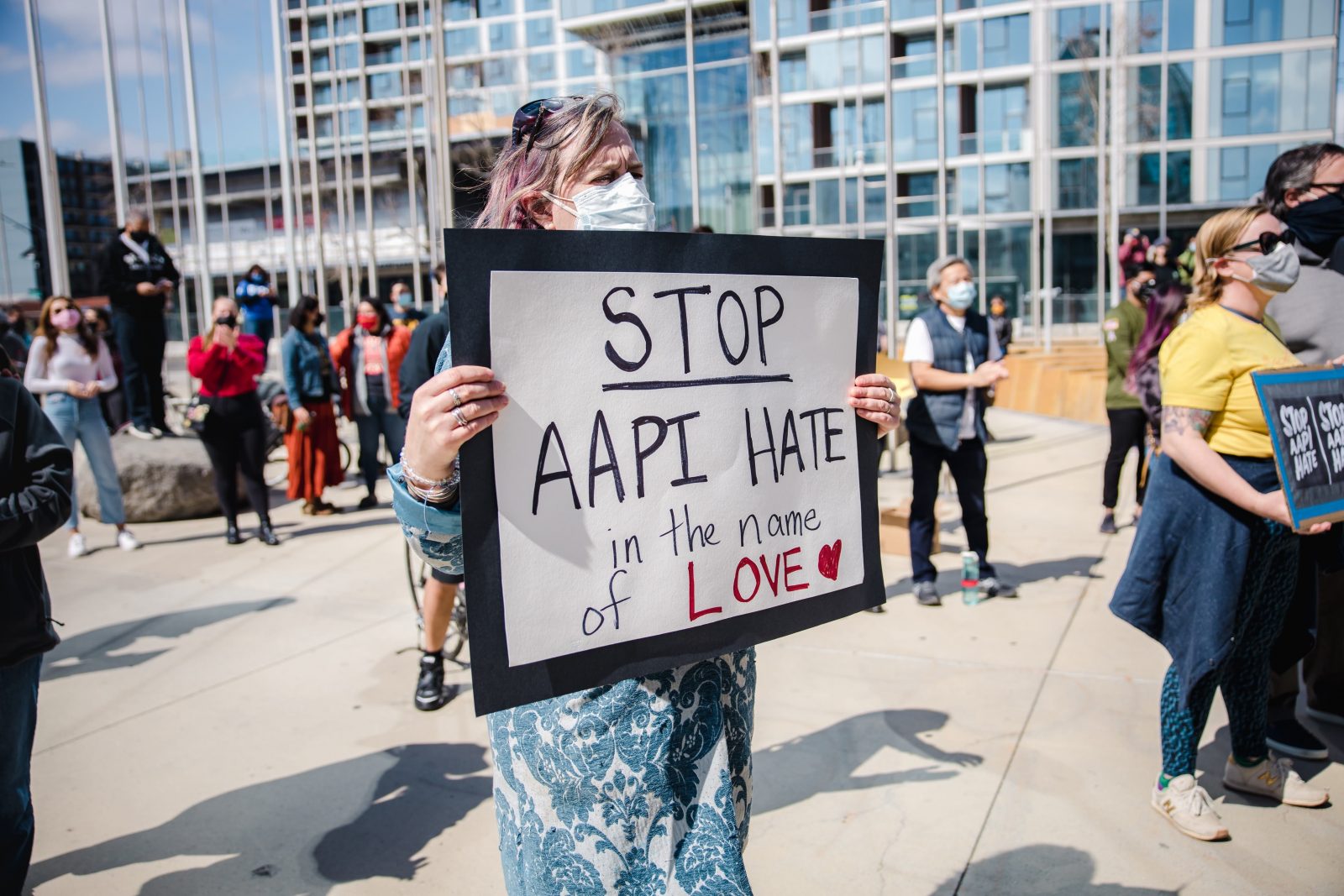
Political Comments About Coronavirus Help Spark Rise in Asian-American Hate Crimes
Brief # 10 Social Justice
Political Comments About Coronavirus Help Spark Rise in Asian-American Hate Crimes
By Erika Shannon
March 29,2021
Over the course of the past year, there has been a rise in the number of hate crimes against Asian Americans. This is being credited to COVID-19 originating in Asia, along with the rhetoric of former president Donald Trump. Trump often referred to COVID-19 as the “Chinese virus” on Twitter, and continued to defend his use of the term at a later press conference. While he finally agreed to not use the term, it had already done damage; it sparked a Twitter movement of anti-Asian sentiment and gave some people the fuel they needed to take that hate off the web and into the real world. According to The Center for the Study of Hate and Extremism, anti-Asian hate crimes spiked from 49 crimes resulting in charges in 2019 to 122 crimes in 2020. The findings are particularly disturbing because overall hate crimes actually dropped by 7% in 2020 due to the ongoing pandemic and associated business and school closures. In 2021, the racism towards Asian Americans seems to unfortunately not be slowing down.
This year, we have already seen Asian Americans being targeted, and sometimes murdered, due to prejudices that can be partially associated to the ongoing COVID-19 pandemic and its origins. In recent news, a 37-year-old Asian American woman was on her way to a rally against anti-Asian violence when she was attacked. The man approached her and asked for her sign, proceeding to rip it up and throw it in the trash. When the woman asked him to stop, he punched her twice in the face. Since the incident, 27-year-old Erick Deoliveira has been charged with a hate crime.
Prior to this incident, a 38-year-old man by the name of Elias Guerrero was arrested for punching a 66-year-old Asian man in the face and striking a 54-year-old Asian woman with a metal pipe. He was charged with assault as a hate crime, harassment, criminal possession of a weapon, resisting arrest, and criminal possession of a controlled substance. A few weeks ago, an 83-year-old Asian American woman was punched in the face and spit at in New York. While the attack was unprovoked and there is no clear evidence that it was motivated by hate, it is troubling nonetheless due to the disturbing uptick in attacks against those of Asian descent. In New York City alone, there have been 29 incidents of hate reported against Asian Americans just this year, according to the NYPD.
The crimes we are seeing committed against Asian Americans do not always end with people’s lives being spared. On March 20, a 27-year-old Asian American woman was gunned down in Compton, California. With the rise in prejudice, her family wants the murder to be investigated as a possible hate crime. This is not an outrageous request with all things considered, and while the investigation is ongoing, hopefully some light can eventually be shed on her needless murder.
On March 16, there was a mass shooting in the Atlanta area that took place in three different massage parlors. Eight victims succumbed to their wounds, and six of those victims were of Asian descent. While again, there has not yet been an official link announced between Asian American prejudice due to the pandemic and the mass shooting, the facts are still disturbing and have left many reeling in its wake. With tensions and hate already on the rise, crimes like these are senseless and may serve to foster fear in the Asian American community.
While there has been a large rise in hate crimes towards Asian Americans, we have also seen a movement emerge to combat these crimes. Large companies, such as Amazon, are using their platforms and influence to spread messages of positivity towards Asian and Pacific Island communities here in America. Many organizations have also surfaced to put forth information and put racist stereotypes about Asians to rest. California State University has formed a Center for the Study of Hate and Extremism and put efforts into combatting anti-Asian sentiment. The organization “Stop AAPI Hate” has also become a resource for those who would like to get involved, donate, or report incidents of hate. From March 19, 2020 to February 28, 2021, the Stop AAPI Hate reporting center received 3,795 incident reports of discrimination and harassment against Asian Americans. The types of discrimination they report include verbal harassment, physical assault, civil rights violations, and online harassment. The only way to combat hate is to educate and spread correct information, which we finally see being done on a larger scale. March 26, 2021 was deemed the #StopAsianHate Virtual Day of Action and Healing, and there is hope that raising awareness can stop these heinous and uncalled for attacks against our fellow Americans of Asian descent.
RENEWAL RESOURCES
- Center for the Study of Hate and Extremism
- To report a hate incident against an Asian American, visit the Stop AAPI Hate website.
- Asian Americans Advancing Justice

Fishing Boat Dispatch
Changing Tides: A new blog post on the marine environment written by U.S. RESIST NEWS Reporter Katherine Cart
Fishing Boat Dispatch # 2
March 1, 2021
I came to Amaknak Island by plane. The mountains the plane passes between were, in June, very green. The visual sense that the Aleutian Chain gives is of a treeless Hawaii – its geology is similar; the landscape is very young, and active volcanoes grow the islands sporadically. Extending like a hooked arm, the Aleutians delineate the southern edge of the Bering Sea. Amaknak rises from the North Pacific, 800 miles south of Anchorage. Around the smidge of land that is the Aleutian Chain, there is very little but sea.
Amaknak’s Iliuliuk Bay, where 300 foot vessels dock, offload fish, and fuel, drops dramatically to twenty fathoms. The basalt and andesite flows and pyroclastic rocks that form the cliffs of Mounts Ballyhoo and Split Top, and through which obdurate roads have been blasted, rise nearly two thousand feet from the bay edge. Thin soil, reddish, capped by tall grasses and shrub like a fur, holds tremulous purchase on the volcanic substrate. There is a wildness and fragility to Amaknak. With nearly three thousand residents, Amaknak is the most populous of Aleutian islands, and where Dutch Harbor provides anchorage to the North Pacific fishing and shipping fleets. Billions of dollars pass through each year.
The litoral margins of islands Amaknak and Unalaska house factories, supply stores, dynamite-blasted roads, and small mountains of CONEX containers that grow and shift and diminish as they are offloaded, filled with frozen fish product, and locked onto the decks of six-hundred foot carrier vessels. Semis move containers from factory to dock. Upon completing a two week trip, the lines of factory fishing vessels are caught by longshoremen, and crews of thirty or a hundred begin offloading into warehouse and waiting CONEX hundreds of thousands of pounds flash-frozen pollock, flatfish, rockfish, cod – reduced from individual entities to fillet, surimi, a gutted, buyable product. Everyday, at any hour, this churn twists. There is no night in Dutch Harbor.
I have walked across the island in winter, when the sun has set hours before and only rises perfunctorily. Darkness on the road is a brief punctuation between fluorescent, dazzling lights. Trucks drive back and forth and back again, from Westward Plant on Unalaska Island, to City Dock in Iliuliuk Bay, from Kloosterboer to town. Across the roads we have cut into the land, the dirt bleeds, sod hangs like skin, basalt is boney, black. There is the sense everywhere of wounds not quite healed. And very tired people scurry, moving fish.
Once, during the second world war, Dutch Harbor was a military base. Its ordnance formed Alaska’s Iron Ring and suffered in June of 1942 a Japanese air strike. You can see the remains of the fortification everywhere, and especially well from Mount Ballyhoo. Artillery digs make oddly geometric lines across the hump of Bunker Hill. Cement bunkers sit atop many hills, and beneath, into the rock, are bored caves like wormholes for storage and infantry movement. On Ulakta Head sits the highest battery in North America, at 897 feet. Below, anti-submarine nets once crossed the mouth of Iliuliuk Bay. On Hog Island, in spring, flowers nearly cover the gun shields of Fort Learnard. When the war ended, the U.S. navy leaked away, leaving the cement husks of conflict in the landscape.
Before the war, and before commercial fishing, and before Russian fur-trappers arrived in the eighteenth century and erected the green-steepled Church of the Holy Ascension on the slopes of Unalaska, indigenous Unangan people lived on the islands for thousands of years – though you’d be hard pressed to find their any obvious trace. The last several centuries of human development have been like the sudden, fitful seep of a volcano, radically amending landscape.
Beneath the water, we dig holes too. Trawlers whose nets scrape the benthos pull black mud, coral, old plastic, unsellable sculpin, sand lances and dollars, crab (last summer, a codend dumped five metric ton crab to deck – a slowly crawling mountain, up which deck hands ran, laughing), all to target this fish or that fish, at the whim of buyers. The seafloor we gouge with codends like bombs dropped from the sea roof is delicate spawning ground, quiet habitat in which competition has evolved for millenia. The act of trawl fishing seems to me much like spraying a machine gun through a forest, hoping to kill a deer. I don’t know how long it takes the mud to settle. Perhaps not so long as the ratifying of litigation that would eliminate wasteful fishing, but long enough.
Two noticeable heat “blobs” have bloomed off the west coast of North America over the last decade. In aerial heat maps of water temperature anomalies, the Bering Sea, during these events, registers a deep, brickish red. The color denotes an average temperature increase of 3ºC. Pacific cod, a fatty fish whose eggs are susceptible to heat flux took – and are taking – a beating. The alarmingly low cod stock, when I was collecting data aboard a pollock dragger last winter, limited catch size across fisheries and threatened to close areas to trawl fishing.
In 2019, another heat-bubble bloomed, moving from the South Pacific north, changing ecosystems, coastal climate, weather patterns. I saw, and became quite used to, many tons of northern sea nettle falling like giant raindrops from net to trawl alley. Jellyfish are impossibly durable invertebrates: they can survive in low-oxygen water when other species might seek cleaner currents. Warming trends boost plankton growth, diminishing oxygen. On a different boat, a factory vessel, there were, for a few days, as many jellyfish as pollock in my samples.
A broad sheet of sea ice seen on a clear winter dawn is a tremendous thing. It is soft and pinkish until the horizon, and behind you, the Bering Sea is black, gold, pink, translucent and green at wave tip – it is a field of rippling mirror. Sea ice, each winter, shrinks. Its southern edge moves north. Fish whose habitat is frontier ice move north. Do we follow?
Things are moving. We are moving. Of course, migration is a constant. Living matter seeks new ledges on which to root. Monarchs cross the Atlantic. Humans walk land bridges and steel bridges. Last week, the Perseverance Rover landed on Mars. Cold flamingos come down from the mountains, and the mountains rise up from the sea. The Earth grows callus in ridges, absorbing stampede, monsoon, quake and rot.
Looking at Dutch Harbor from Ballyhoo, I was reminded of a child’s playthings, spilt across a carpet. Blue-roofed houses, factories billowing fishmeal steam, roads that, from so high above, appear benign, even quaint. It’s impossible not to wonder what will happen to that place when, inevitably, we move onwards, perhaps northwards, and settle our boxes and buildings and giant semi trucks elsewhere. How long does it take an island to grow up, grow over, reclaim? And can the seafloor recover?
Learn More:
“New Marine Heatwave Emerges off West Coast, Resembles ‘the Blob’” NOAA (5 September, 2019), retrieved 27 February from: https://www.fisheries.noaa.gov/feature-story/new-marine-heatwave-emerges-west-coast-resembles-blob

Fishing Boat Dispatch
Changing Tides : A new blog post on the marine environment written by U.S. RESIST NEWS Reporter Katherine Cart
# 3 Fishing Boat Dispatch
March 26, 2021
Walk to Maine’s midcoast and look southwest. Unless you’ve gotten yourself in a spruce thicket, you will see Atlantic water filling the hole that is the Gulf of Maine. Likely, you will hear the sea, smell it, be standing in its sandy refuse. It will very possibly feel colder – or at least damper – here than a mile inland. Chilled oceanic air is sucked landwards, dumping sludgy precipitation, heaping fog, painting rime on roof, pine, window pane, dune hollow. A weathered-in gulf can be, to the casual observer, somewhat benign, rather like watching on a TV screen an avalanche shift some unpopulated mountain. Storms are spectacular to witness from the beaches, nasty to endure offshore. Inland Maine is a stronghold well protected from tidal degradation by granitic coastline, carved out over several millennia by the heaving of the Laurentide ice sheet over Appalachian stone. If you are standing at the coast and look down, between your feet you will see the long lateral scratches the Laurentide left, sloughing southwest into the sea. One cannot help but to think of fingernails, and a general determination to cling on.
I am a deckhand on a Maine lobster boat. We fish out of Bailey Island, in Casco bay, where the Atlantic can roll storms that break the shore rocks. The coastline, though mightily old, is still changing. Islands degrade by bits. The wind in the Gulf of Maine whips from the planar globe storm swells that feel sentient in their hostility. Like an obnoxious housecat, the wind comes and goes, hisses at you for no good reason. It will outlast us.
Yesterday, fishing offshore, the shaft of our old 40 foot Novi cracked. In the hour that we waited for a good samaritan to finish hauling his own strings and snag us for a tow to land, we were pushed by the wind against an outgoing tide nearly one mile towards Small Point, and began taking on a little water. Not too much. Enough to notice. Over the radio another captain warned: “supposed to breeze up.” We were lucky – yesterday was the first true day of warmth offshore. The wind, though sustained, was mild compared to the winter blows we’ve sat out or – miserably – fished through. It was a glorious day. A good day to be on the water. A good day to ride the bow, toss lines, catch a ride, if we must.
Twenty-eight miles northeast of us, eighty lobster boats congregated at Monhegan Island. In single file, they traced the path of the proposed underwater cable that would link a future 12 megawatt wind turbine to South Boothbay, linking offshore wind energy to the main power grid. This seabed path, since the beginning of March, has been under survey by research vessels. Lobstermen out of Friendship, Monhegan, Bristol, Boothbay and other port towns have experienced disruptions in set strings of traps, feel that the proposed wind turbine is a threat to current and future livelihood. I’ve experienced snarled and cut strings – detangling hundreds of pounds of lobster trap and line is hellacious, time-consuming, dangerous and costly. Another boat’s gear can be caught up, a string set over another by accident. Frustration is standard fare in lobstering. And while such frustrations are an expected, though unwelcome, part of the job, one does not relish the idea of an outside source – say, research vessels with no traps or profit to lose – causing further gear-loss. Tangled gear costs money. Time costs. Such aggravation is sapping in an already tiring day.
The intended wind turbine does not immediately impact the waters that I fish in. Talk in Mackerel Cove, where I dock, hasn’t yet focused on wind energy, though the issue has gained central focus in the Maine Lobsterman’s Association Newspaper, which my captain brings to the boat and does not read. As a sternwoman, however, I feel the shuddering brace of the Maine lobstering community. Pulling wildlife from the ocean is a volatile vocation. This year, nearly every boat I knew of turned to pig hide for baiting: sandfleas, which prosper in warming waters, were cleaning traps of the standard baitfish before lobsters could wander their dim demersal way through trap kitchen to parlor. The Gulf of Maine is warming faster than 99% of all global waters. American lobster are susceptible to infinitesimal changes in water temperature; in the larval stage, they can expire en masse, and as adults, shell disease, which appears like rot on the carapace, proliferates in warmer waters. Day after day last fall, we hauled empty traps. When I was given my 1099 last month, my captain looked at my total revenue: “should have been twice that.”
I have only lobstered since August and have no real dog in this fight. I have no payments to make on a boat, no family to support, no children who expect to apprentice under me, gain a captain’s license, buy their own vessel. The patterns of the day (up at 3:00 am, on the water by 5:00 am, hauling, hauling, reeking of ripe fish, ludicrously worn-out, docked by evening), however, are appealingly forthright. That women and men fish lobster their entire lives does not surprise me. These are hard, honest days.
In college, I interned with Aqua Ventus’s VolturnUS 1:8, the pilot wind project deployed by the University of Maine in 2013 near Castine, ME. (I spent, on average, an hour a day for a year and a half clicking through stilled images of the bobbing, yellow VolturnUS 1:8 turbine, watching for bird strikes and any evidence of detriment to marine life – I saw none.) During that time, former Maine Governor Paul LePage discouraged Statoil’s proposed $120 million Maine offshore wind project by reopening state waters to potential wind investors. Statoil has since relocated its investment to Scottish waters, and in 2017 began successfully producing energy. In May of 2014, Aqua Ventus was awarded just $3 million of the $47 million the project was hoping for in federal support. Four years later, as offshore wind energy in Maine again began gaining momentum, LePage ordered a moratorium on the development, citing potential risk to Maine’s tourism economy. It has not been an easy ride for wind power investors with sights on the gulf. Incidentally, LePage was the sole Atlantic Coast governor to support the former president Trump’s 2018 proposed “Outer Continental Shelf Draft Proposed Oil and Gas Leasing Program,” which would have opened Maine waters to oil drilling. Now, Maine Governor Janet Mills supports Gulf of Maine wind power. She has opened conversations with the Maine lobstering community and issued a ten-year moratorium on wind projects within three miles of the mainland and inhabited Maine Islands, excluding the Monhegan Island project. Today, that project is using the technology of the floating VolturnUS 1:8 scale pilot turbine. There is no doubt of the potential benefit for Maine energy consumers and job seekers.
These two perspectives have split for me an uncanny rift. The coastal strip that is the lobstering community is a Maine symbol. That it might face its end within my lifetime is wrenching. Fishing communities are so entrenched that peninsula-dwellers speak with unique accents; of the man who towed us ashore yesterday, my captain said: “well, it’s not strong, but he’s sure got the Small Point accent.” Small Point is seven miles as the crow flies from Mackerel Cove. Fishing is, perhaps, the most deeply generational tradition we have in our country. These are lifestyles passed hand over hand like line to kin. There is a romance to lobstering; even the casual observer, those who watch us fish through blows from the safety of shore, cannot deny that.
If you are reading this, there is a good chance you support renewable energy. I do. I have. I will. In my logical brain, I support wind energy in the Gulf of Maine, whatever it may mean for the lobstering community. And to be clear: nobody seems particularly certain what impact wind energy might have on the lobstering community. It is the unknown, yet visible (climate change, unfortunately, is less acutely so), that has piqued fear. Logic aside, in my gut I, too, fear for those few whose children are fed, clothed, housed, by what is pulled from wind power’s path. I worry for my captain, and his son who is one of the fastest sternmen in the cove. To lobster is to both slow time’s twist towards frenzy and to put your eye to the speeding time-keeper that is the warming, shifting Atlantic. I mourn the ending of things as they are.
Changing oceanic ecosystems will bring the end of Maine lobstering before wind power ever does. Of that I am certain. But for those fishing families who feel the acute pinch of wind development already – what comfort does the broader strokes of future history bring?

The Impact of Biden’s American Rescue Plan on Education
Brief # 57 Education Policy
The Impact of Biden’s American Rescue Plan on Education
By Emily Carty
March 23, 2021
Summary
President Biden’s American Rescue Plan, signed into law on March 11, 2021, has a wide range of implications regarding the school system and, more generally, education and development of our youth population. Under the Act’s Title II (Committee on health, education, labor, and pensions), Subtitle A (Education Matters), Biden’s plan for our education system is laid out. Throughout the entirety of the act however, there are various sections that impact children or education, particularly notable is an increased child tax credit that will be extended to benefit lower-income families.
The American Rescue Plan allocates just over $122 billion ($122,774,800,000 to be precise) to carry out the laws pertaining to the section on education. The funds will be available through 2023. The law outlines how funds will be distributed and what they can be used for. Block grants for public schools will go to states to be distributed to Local Education Agencies in the manner outlined by the Elementary and Secondary Education Act of 1965.
There are some guidelines as to how the general block grant money needs to be spent, since its primary focus is to remedy the havoc wreaked by Covid. At least 90 percent of money distributed to states must go directly to Local Education Agencies, the public education boards within states which administer federal and state education laws and funding. At a minimum, 20 percent of funds are for addressing learning loss throughout the pandemic. Educators define learning loss as a deviation from the “normal” level of learning students demonstrate based on grade, age group, or subject year after year.
The remaining 70 to 80 percent of funds from block grants could be spent on: updating technology and educational facilities to mitigate effects of the virus, developing mental health resources for youth, designing emergency preparedness and school closure plans, professional development for educators, or supporting learners with unique needs. There are other guidelines and recommendations, but it is ultimately up to Local Education Agencies how the money will be spent. The Act’s word choice and statements denote an equity-centered approach coming from the Biden Administration — something that states can take cues from.
In addition to public school support, the Act sets aside funds for other specific purposes. One of the first provisions listed is the allocation of 800 million dollars to support the identification of and development of support programs for youth experiencing homelessness. Additionally, Emergency Assistance to Non-Public schools which “enroll a significant percentage of low-income students” will be eligible for up to 2.75 billion dollars. Non-public schools are private or independent schools which do not receive money from the government.
Higher education institutions will receive a little over 39.5 billion dollars. The money can be used for a variety of things but is aimed particularly at making higher education institutions safe to reopen as well as providing mental health support through this crisis. The act primarily aims to distribute money to public high education institutions and particularly the ones which service low-income communities and students.
Additionally, the act requires states to maintain or increase funding for schools and Local Education Agencies in order to receive funds — this is under what is called “Maintenance of Equity.” The idea is that these funds are to support the recuperation of schools and students in the wake of coronavirus, they are not replacing the money already set aside to support education.
Analysis
The American Rescue Plan is a bold plan to address the effects of Covid and learning-loss on our schools and students. It also addresses long-held concerns surrounding funding for building upgrades, staffing, professional development, and support services, all with a focus on equity. The plan directly aims to reduce child poverty through the provisions related to schools as well as through child tax credits. With the new law raising the child tax credit from $2000 to $3600 per child, and extending it to more lower-income families, the Washington Post suggests it will work as “essentially a guaranteed income.”
All put together, the act provides a significant amount of money directly to states and Local Education Agencies to begin the work of reopening schools safely, implementing new learning plans to remedy a year of virtual-school, and repairing our school infrastructure. The maintenance of equity provisions are major wins for education advocates across the nation — the federal government is explicitly preventing states from cutting funding to schools because of general economic losses due to the pandemic. By providing direct money to families the Biden Administration is acknowledging the fact that educational outcomes are largely related to poverty, which has only been exacerbated throughout the pandemic. If we really care about students’ educational outcomes, we must address poverty and this is a good first step.
The federal government is not able to oversee the administration of all of these funds, especially since many will come in the form of block grants. While there are rules and recommendations, funding considerations will be largely left up to states and local educational agencies, for better or for worse. The “highest poverty” and “highest need” districts have extra protection from local budget cuts and staff cuts, however many districts are exempt from these rules — including the over 6000 districts with fewer than 1000 students. Either way, having these recommendations included in the first place will set the stage and provide guidance for all districts that wish to prioritize equity.
Critics of the education portion of the act suggest it may leave districts less flexible with their hiring practices or if an unexpected event occurs. While there certainly will be added complexities to state and district practices and teacher contract bargains, the emphasis on equitable and sustainable spending on students is greatly needed. The key here will be deliberate and intentional spending that will improve learning outcomes and focus on equity.
The American Rescue Plan Act addresses the effects of school shutdowns and increased poverty rates by putting low-income and high-need students and families first. The act leaves a lot of room for states to make major spending decisions, but it also provides guidelines and rules on what one cannot do with the money. While there is not a huge emphasis placed on what the educational outcome and goals for students are, it allows states and local education activists to call for and implement concrete, state- and local-specific plans to address equity and learning-loss in a way that makes the most sense for their community.
Renewal Resources
Children’s Defense Fund – This organization is dedicated to advancing justice for all children. They have a range of resources and programs designed to educate the nation and our government about children’s needs, and they have policy solutions and evidence-based ideas they lobby for. Check out their action page to easily text or reach out to your representatives about relevant child welfare policy issues.
The Education Trust – This group is federal and has regional chapters, it performs policy research and advocacy in all things education. Check out their advocacy pages to get informed, get resources, and find a way to reach out to your representatives.
The National Youth Law Center – A non-profit law firm specializing in low-income youth justice, NYLC represents youth interests by holding government and administrative systems accountable through legal action. Check out their detailed policy recommendations or wins around education (and other topics) and download templates to show support and send to your representatives.
Sources
District Administration – American Rescue Plan
US Department of Education – American Rescue Plan Announces State Funding
Washington Post – Biden’s American Rescue Plan is actually a huge new school reform …
Ed Week – Aid Package Protects Funding for Students in Poverty, But Could Challenge Schools
National Education Association – What American Rescue Plan Means for Educators and Students
Center for American Progress – ARP Could Help Prevent State Public Higher Education Cuts

The Federal Deficit and Uncollected Taxes
Brief #112
The Federal Deficit and Uncollected Taxes
Rosalind Gottfried
Federal Deficit, Tax Cuts, IRS
March 23, 2021
Policy
Biden’s 1.9 trillion dollar American Rescue Plan is viewed as adding to the already ballooning federal deficit. Certainly the pandemic has added to that burden but the structural issues go much deeper than the necessary expenditures to address the desperate economic situation which befell many Americans. The deficit is expected to reach 35 trillion dollars by the end of the 2021 fiscal year; it stood at 28 trillion prior to the latest stimulus. In the first five months of the fiscal year the deficit was 68% greater than for the same time in the previous year.
One source of the growing federal deficit can be found in the effectiveness of the Internal Revenue Service (IRS). The IRS estimates that there will be 600 billion dollars in uncollected taxes this year and 7.5 trillion over the next ten years. That is more than one half of the projected deficit. Ninety five percent of taxes from wage earners are estimated to be collected due, in large part, to the way the system tracks wages which makes it hard for these to go unreported. This is not so with business profit and income from such things as royalties and rent. There are no mechanisms, at present, to provide third party verification for these sources of income.
A second cause for the anticipated 1.4 trillion dollars of uncollected taxes has its roots in the 2017 tax cuts passed in the Trump administration. These cuts were touted to help middle income Americans and to boost business investment. Neither of these things actually occurred. The insignificant decrease in taxes went unnoticed by most Americans while the greatest gains went to the top 20% of earners. Corporate tax was reduced to 21% from 35%, a decrease of 31% increasing the budget deficit by more than 50%. The tax cut’s selling point promised the corporate world would utilize the saving to boost the economy and create jobs. Though there were some short term gains the rate of economic growth was identical the rate in 2015, showing no permanent gains from the cuts.
Analysis
The IRS sustained budget cuts of more than 20% between 2010 and 2019. With the loss of personnel, and outdated computer systems, only one quarter of calls for tax help were answered and much tax revenue was lost due to the inability of workers to audit wealthy households. Improvements in the IRS would cost 100 billion dollars over the next ten years but would yield six times that in tax revenue collected. Suggestions for better computer system sand more personnel also need to be paired with new systems of tracking in/outflow of funds from businesses. This could be achieved with systems of verified reporting utilizing banks.
Most Americans, 75%, supported the latest stimulus and many would like to see increased government spending to create jobs and build back the infrastructure. To do so would take funds and it is clear that the weight of generating these has not been equitably distributed.
Learn More References

The War On Government
Forty Januaries ago, Ronald Reagan, upon assuming the most powerful governmental office in the history of civilization, declared in his inaugural address that “in this present crisis, government is not the solution to our problem; government is the problem.” To show he meant it, Reagan soon proposed a budget that gutted social programs and cut taxes. The idea was that, down the road, it would be harder to restore such programs and still profess yourself dedicated to fiscal responsibility.
Some years later, an incisive observer of American politics reflected on that pivotal moment in 1981: “The Reagan tax cuts have ended growth of the social agenda; it’s all come to a screeching halt.” The observer was a young senator named Joe Biden. He had voted for the Reagan budget. Now, like many of his Democratic colleagues, he would have to live in the political and moral — and narrative — universe it created.
In a remarkable swerve of history, forty years later, Biden, now president of the United States, has a chance, should he choose to embrace it, to break us all out of that universe. The war on government bankrupted itself spiritually and materially a long time ago. What dances on the horizon is the prospect of a war for government.
First came the American Rescue Plan, which was far from everything progressives wanted and far from everything the country needed, and yet, with that longer 40-year view in mind, a departure from the hegemony of the government-is-the-problem caucus. Now comes word of Biden’s plans for the second phase of his policy rollout, dealing with more chronic ailments, having already targeted the most acute crises.
According to a new report in The New York Times, President Biden’s economic advisers are preparing to recommend spending as much as $3 trillion on a sweeping set of efforts aimed at boosting the economy, reducing carbon emissions and narrowing economic inequality, beginning with a giant infrastructure plan that may be financed in part through tax increases on corporations and the rich.
Included in the package, which advisers told The Times might be broken into pieces, are “the construction of roads, bridges, rail lines, ports, electric vehicle charging stations and improvements to the electric grid,” plus “free community college, universal pre-K education, a national paid leave program and efforts to reduce child care costs,” plus plans to “make permanent two temporary provisions of Mr. Biden’s recent relief bill: expanded subsidies for low- and middle-income Americans to buy health insurance and tax credits aimed at cutting poverty, particularly for children.”
Now, I have my own preferred policy rollout list, and I’m sure you have yours, and many of my priorities, including, say, Medicare for All or all public college being free, aren’t anywhere on this list. But while we can, and should, get into the particular policies, there seems to be something more elemental and fundamental to say about this moment. With this proposed $3 trillion in spending, over and above the $1.9 trillion of the rescue plan, and with the philosophy animating the spending more importantly, Biden has become an unlikely deserter of the war on government.
More than former Presidents Bill Clinton and Barack Obama, who, unlike Biden, were not fixtures of Washington in the Reagan years and didn’t vote for any of his agenda. We don’t yet know if Biden has the stomach to make as strident a case for government-as-solution as Reagan made against the state. But it would be foolish not to observe that, thanks in part to the agitations of those who have shown the war on government to be an epic disaster (and who have fought Biden oftentimes), something new is happening. The proof that it is happening is that a moderate like Biden is on board.
In the coming weeks, there will be the familiar haggling and begging and bully pulpiting and Manchining as these proposals run through the congressional grinder. But it would be a mistake to treat this as a purely legislative challenge. Think back to Reagan. First there was the argument against government; then there was the dismantling of it. In the coming months, I long to hear an equal and opposite case for government, one unlike any I’ve heard in my gray, elder-millennial lifetime.
I heard the faintest hint of it some days ago when, in celebrating the passage of the American Rescue Plan, President Biden said these words: “We need to remember, the government isn’t some foreign force in a distant capital. No, it’s us, all of us, we the people.” In the United States of America, this is a more radical statement than it ought to be. I threw out all my bingo cards in 2020, but I will say that I didn’t have Joe Biden making the case that the government is us.
I don’t think Biden had a religious awakening. I think the five intersecting crises of the past year made it impossible for anyone in his position to attempt to be anything but transformational and go down in history as a serious person. There was Covid, of course, and the more chronically unhealthy country it found. There was the economic crisis it unleashed, and, again, the more chronically precarious and hard-up econony that crisis exacerbated. There was the racial crisis put front and center by Black Lives Matter and, more generally, a growing recognition of the need to reckon with things long overdue and make the society safe and healthy and dignified for people of all marginalized backgrounds. There was the democratic crisis revealed by the fact that, for a while there, we weren’t sure about a peaceful transfer of power. And there was climate, the question that refuses to go away, even in plagues, with coronatime perhaps serving as a test drive for what it looks like for the world to rally together.
There are no personal solutions to problems like these. There are no corporate solutions to them. There are no nonprofit solutions to them. As Carol Hanisch once taught us, there are only political solutions to shared political problems like these. The strange gift President Biden inherited was a network of problems so deep-rooted, so far-reaching, so long-in-the-making, so gnarled in their intersections, that they provide the best cover and ammunition in years to advocate for government.
Again, by this I don’t just mean introduce governmental solutions and spend money, which Biden is already doing. I mean adding to that a militant case for government that is every bit as emotive and powerful as the forty-year case against, which was so compelling that it persuaded millions of people to vote for their own subjugation.
I’m talking about truly educating Americans about what the government does — not just the famous parts of it that we hear about on the news and argue about without end. But the uncelebrated and obscure and dull parts of it that keep our food safe and roads clean and Social Security checks printing and markets open and schools teaching and medical research coming, that give us things like the internet.
Some of this advovacy is the work of people in government itself. But we in the media have a role to play. Mark Zuckerberg didn’t make himself an entrepreneur-hero-king (before he became a fallen emperor). We made him that. We put him on magazine covers. We covered his thoughts as if they reflected thinking. We built him up into something more than yet another guy running an ad-based business without scruples.
Well, it’s going to take many of us in media, in Hollywood, in music, in the culture more generally to reflect on how we have been captured by Reagan’s story, however we may think we despise it. Captured by the basic narrative that what we do alone matters more than what we do together, that denigrates or just overlooks the commons. And we ought to find ways to tell other stories. Stories of solidarity and collective adventure and shared purpose and systemic answers. Stories of unsung heroes. Stories of kind and decent structures rather than just kind and decent individuals.
I don’t know if those who can, will choose to take advantage of this moment in this way. But I believe they have a window of opportunity to end a whole damned age.

The Five Things that Should Be On The Biden Tech Agenda
Brief #41 – Technology
By Charles A. Rubin
March 22, 2021
Summary
As the Biden Administration fills out its policy teams, we at U.S. Resist News would like to suggest an urgent technology agenda for consideration. The geometric improvements in computer processor speeds and the dramatic breakthroughs in new technologies have made the need for leadership and open discussion imperative. We call on the Biden Administration to get out in front of these issues to make these technologies available to all Americans and ensure that these technologies work in the service of all Americans.
Analysis
1. Cybersecurity – State actors are increasingly involved in attacks on elections, on critical infrastructure and business systems. In recent weeks attacks against Microsoft Exchange based email systems have been uncovered affecting government agencies and businesses large and small. These intrusions have primarily been detected by private sector security firms but the onus should be on our Federal government in cooperation with open societies throughout the world to coordinate intelligence and devise mechanisms to thwart these attacks.
2. Free Speech – The Biden Administration should lead the debate on what constitutes journalism and free speech in the internet age. We need to have a frank and open discussion on how to combat misinformation and the responsibilities of social media platforms in moderating their content. This is, again, a problem that open societies need to confront together to devise common definitions and solutions.
3. Worker Displacement – The pandemic has accelerated a trend to automate repetitive tasks and employ artificial intelligence (AI) to augment or replace workers. By one estimate, 45 million American workers will be displaced by technology over the next 15 years. While the technology often promises better services and lower prices, we can not let it create poverty in the process. We need opportunities for workers to retrain and a solid understanding of what the workforce of the future will look like.
4. Artificial Intelligence – We are increasingly relying on sophisticated algorithms to make complex decisions. There are indeed exciting opportunities for better medical diagnoses, more efficient and safer transportation systems and technologies that will remove the human factor from dangerous work. There is, however, a dark side. Facial recognition technologies have been shown to be inaccurate when attempting to identify women and people of color leading to false arrests and further distrust of our police. Fully autonomous weapons systems presage a frightening battlefield where humans are targeted by machines. The Biden Administration must be clear as to their goals and stake out a leadership position on the world stage.
5. Technology Accessibility – The COVID19 pandemic has also brought into sharp relief the widening digital divide in the United States. Our nation’s school children in particular suffered disproportionately as classes moved on-line and, in many places, continue on-line. In many parts of the country, where broadband was spotty or unavailable, this meant little or no learning at all. The US must embark on a program similar to the Rural Electrification Act of 1936 to close these gaps and provide reliable internet service to all Americans.
While this list is not exhaustive, we believe that it provides a good starting point for the Administration to set a tone and make real progress.
Renewal Resources
- The Federation of American Scientists provides science-based analysis of and solutions to protect against catastrophic threats to national and international security.
- The Information Technology and Innovation Foundation is a think tank whose Its mission is to formulate, evaluate, and promote policy solutions that accelerate innovation and boost productivity to spur growth, opportunity, and progress.
- Electronic Frontier Foundation Founded in 1990, EFF champions user privacy, free expression, and innovation.
- The Technology Policy Institute focuses on the economics of innovation, technological change in the United States and around the world

Biden and the American Relationship with Europe
Brief # 104 Foreign Policy
Biden and the American Relationship with Europe
By Will Solomon
March 22, 2021
Policy Summary:
The Biden campaign was extremely vocal about its intention to restore a “traditional” American role in foreign affairs, an essential component of this being a restitution of America’s typical postwar role with respect to its European allies. In theory, this would reverse Trump’s erratic position towards these traditionally central alliances, which involved the imposition of tariffs on European goods, mixed rhetoric on NATO (unusual for a postwar American president), and his rhetorical hostility to the European Union, among other phenomena.
While it is tempting to read America’s shifting relationship to Europe and NATO as solely a product of the Trump administration, the reality is that it is indicative of a more complex geopolitical shift. Individual European nations and the European Union collectively are both highly attuned to the reality of waning American power and domestic American instability. Other phenomena, like the rise of China, and Europe’s reliance (potential or otherwise) on Russian fossil fuels, exist independently of the Trump administration’s geopolitical choices.
Thus, Biden’s approach to reconstructing European alliances and (attempting to) reassert a traditional American role in world affairs must be seen as connected to, but not wholly defined by, the Trump administration’s approach.
Analysis:
There is clearly a widespread sense in Europe that the era of American hegemony is waning, and that its protective attitude over Europe cannot be counted on in perpetuity. While most European allies were evidently pleased by a break from Trump, they simultaneously recognized that, for many reasons, the world is changing.
Myriad specific issues come up. One is the European relationship with Russia, embodied in the nearly-completed Nord Stream 2 pipeline, which will transport natural gas from Russia to Germany. Both the Trump and Biden administrations have vocally opposed the pipeline, for fear it will give Russia increased leverage over Europe. At this point, it remains unclear how severely the Biden administration will work to undermine the project, but this challenge is likely indicative of further stress in coming years.
A similar point of tension has been the years-long negotiation of an EU-China trade deal. This occurs in the context of rising geopolitical tension between the United States and China, and growing assertiveness on both sides. But from the US perspective, it is increasingly clear that the Trump administration’s bellicose rhetoric and posture towards China was not a one-off approach—the Biden administration’s tone towards China has also been consistently antagonistic, and has been matched by actions like sending warships through the Taiwan Strait, and engaging in aggressive “vaccine diplomacy” in Asia. There is clear concern in Europe about being caught in the middle of this dispute, a possibility that will likely continue to grow in probability over the next several years.
A specific detail of this potential conflict was raised in a recent New York Times article: secondary sanctions. As the article describes, there is growing concern about the effect secondary sanctions—which could target European businesses involved with China—might have on Europe in future US/China trade disputes. The problem has already come up with respect to countries like Iran and Russia, as secondary sanctions have targeted European firms that do business with these countries (including on the aforementioned Nord Stream 2 pipeline).
Iran in particular is worth noting, because the Biden administration could (in theory) resolve this issue by removing Trump-era sanctions on Iran and recommitting to an Obama-era posture, as a meaningfully good faith attempt to restart negotiations around the JCPOA. But Biden has expressed unwillingness to do this, which may well ultimately doom the entire nuclear deal—as well as drive a bigger wedge between the US and Europe.
Ironically, if the Biden administration were seriously committed to engaging more diplomatically with Europe, its best bet would be to do so elsewhere around the world—this sort of multilateralism would avoid the American-European relationship being caught in the global crossfire. But in its burgeoning aggressiveness—behaving confrontationally towards China and Russia, and potentially neglecting to re-join the JCPOA (the Joint Comprehensive Plan of Action, aka the Iran Nuclear Deal) —the Biden administration is ultimately undermining its own position with respect to Europe. Thus to meaningfully re-engage with European allies, the Biden administration must reconsider how it is engaging with the rest of the world.
Engagement Resources:
https://quincyinst.org — “The Quincy Institute is an action-oriented think tank that will lay the foundation for a new foreign policy centered on diplomatic engagement and military restraint. The current moment presents a once-in-a-generation opportunity to bring together like-minded progressives and conservatives and set U.S. foreign policy on a sensible and humane footing.”
https://www.democracynow.org — “Democracy Now! produces a daily, global, independent news hour hosted by award-winning journalists Amy Goodman and Juan González. Our reporting includes breaking daily news headlines and in-depth interviews with people on the front lines of the world’s most pressing issues.”
https://ecfr.eu — “The European Council on Foreign Relations (ECFR) is an award-winning international think-tank that aims to conduct cutting-edge independent research on European foreign and security policy and to provide a safe meeting space for decision-makers, activists and influencers to share ideas. We build coalitions for change at the European level and promote informed debate about Europe’s role in the world.”

A Surge of Unaccompanied Children at the US Southern Border
Brief #117– Immigration
By Kathryn Baron
A Surge of Unaccompanied Children at the US Southern Border
March 22, 2021
Policy Summary
The US is seeing a record-breaking influx of children held in government facilities after crossing the southern border. The amount of unaccompanied children crossing the border has increased 63% so far in 2021 and border facilities are over capacity due to COVID-19 social distance restrictions in addition to the sheer number of children needing accommodations. The US Customs and Border Patrol (CBP) is currently holding more than 13,000 unaccompanied children in custody. The children’s ages range from toddlers (usually with an older sibling) to teens. Those under 18 are being allowed to enter the US while their claims are processed.
An overwhelming majority are from Guatemala and other Central American countries. The Federal Emergency Management Agency – a government organization that normally handles major crises such as natural disasters – is responding to the situation.
Analysis
Immigration laws prevent unaccompanied children from being immediately sent away as quickly as adults and/or families. Due to the fact that they are fleeing abuse and/or other harms, they must be given the opportunity to file for asylum upon entering the US. Government agencies are scrambling to find facilities to accommodate the influx of children and place them in humane settings. The Biden Administration also is turning away adults – predominantly adult males – who try to enter at legal points of entry.
Engagement Resources
- The National Immigration Law Center: an organization that exclusively dedicates itself to defending and furthering the rights of low income immigrants and strives to educate decision makers on the impacts and effects of their policies on this overlooked part of the population.
- The ACLU: a non-profit with a longstanding commitment to preserving and protecting the individual rights and liberties the Constitution and US laws guarantee all its citizens. You can also donate monthly to counter Trump’s attacks on people’s rights. Recently, the ACLU has filed a lawsuit challenging the separation of families at the border.
- Center for Disease Control: the CDC provides updated information surrounding COVID-19 and the US responses
- Deferred Action for Childhood Arrivals (DACA): Through the Department of Homeland Security’s website, this link provides additional information regarding the Obama era program.