

JOBS POLICIES, ANALYSIS, AND RESOURCES
Latest Jobs Posts
Wyoming (2026 Democratic Primary Preview Series #27)
Wyoming is the most Republican state in the country at the presidential level, having gone for Donald Trump by more than 45 points in 2024, and Democrats have not won a statewide race since 2006 or a U.S. Senate seat in the state since 1970.
Understanding China: Part II China’s Geography and Demographics (Foreign Policy #226)
China serves as the definitive geographic and demographic anchor of the East, a vast landmass of approximately 3.7 million square miles that shares borders with fourteen nations. This physical reality dictates much of its internal policy and external posture. From the high-altitude Tibetan Plateau to the fertile floodplains of the Yangtze and Yellow Rivers, the country is divided by the Heihe-Tengchong Line, an imaginary boundary that reveals a stark reality: roughly 94% of the population lives on the eastern side of the line, occupying only 43% of the land. This concentration of humanity has fueled the most rapid urbanization in human history, shifting hundreds of millions of people from agrarian lifestyles to industrial and technological hubs.
Data Center Debates Pit Communities Against Billionaires (Technology Policy Brief #168)
According to a Gallup poll, the majority of people don’t want data centers built near their homes. Communities are taking their objections to the ballot box, and legislators are taking notice. State and local governments are enacting regulations and ending tax breaks. The data center industry is fighting back, spending millions to influence elections and promote tech friendly policies and candidates.
Unmasking the Realities of Climate-Driven Migration (Environment Policy Brief #165)
Climate change has fundamentally reshaped global human mobility, acting as a dominant and accelerating force behind mass displacement. Unpredictable weather patterns, rising sea levels, and catastrophic extreme heat are rendering vast swaths of the planet uninhabitable. A nearly 2026 report from the United Nations High Commissioner for Refugees reveals that almost 120 million people are displaced globally, with a staggering 75 percent residing in countries facing high-to-extreme exposure to climate-related hazards.
North Carolina (2026 Democratic Primary Preview Series Brief #26)
North Carolina, the Tar Heel state, enters the 2026 election cycle as one of the nation’s most closely watched battleground states. While Republicans have enjoyed success in many statewide federal races over the last decade, Democrats remain highly competitive thanks to continued growth in urban centers such as Charlotte, Raleigh, Durham, & Greensboro. At the same time, Republicans continue to dominate much of rural eastern & western North Carolina, creating a state that is often decided on the margins. That said, North Carolina may represent Democrats’ best Senate pickup opportunity in 2026.
New Mexico (2026 Democratic Primary Preview Series Brief #25)
New Mexico, or the Land of Enchantment, has a Senate seat up for grabs, along with 3 House races. All 5 of New Mexico’s current congressional seats are held by Democrats & all 4 offices on the ballot are being defended by Democratic incumbents. Incumbent Ben Ray Luján will face the Republican candidate, Larry Marker, who ran as a write-in candidate & need to surpass a vote total to be on the ballot in November.
Week That Was: Global News in Review (Foreign Policy Brief #225)
An explosion lights up the sky over the city during a Russian missile and drone strike, amid Russia’s attack on Ukraine, in Kyiv, Ukraine June 2, 2026
Tech Bros Fail to Advance in California Elections (Elections & Politics Policy Brief #205)
Wealthy tech executives have been ratcheting up their political activism in California, sponsoring ballot measures and backing candidates up and down the ticket, often with great success. In the recent primaries, several of them tried for office themselves. Despite spending millions more than their opponents, they failed to win votes.
Protect Communities, Not Criminals (Social Justice Brief #191)
On May 15, Texas Governor Greg Abbott announced a new initiative titled “Protect Communities, Not Criminals,” which includes a proposal to create a statewide prosecutor with the authority to override local district attorneys in certain cases. This proposed role would allow a state-appointed prosecutor to step in when a local prosecutor has not secured an indictment within 90 days, effectively creating a “backstop” to ensure cases move forward. Supporters of the proposal frame it as a necessary response to what they describe as “rogue prosecutors” local district attorneys who decline to pursue certain categories of crimes based on policy or resource limitations. The initiative is presented to ensure consistency in enforcement across Texas counties and to prioritize victims’ rights.


Understanding China: Part II China’s Geography and Demographics (Foreign Policy #226)
Foreign Policy #226 | Inijah Quadri | June 17, 2026
Policy Issue Summary
China serves as the definitive geographic and demographic anchor of the East, a vast landmass of approximately 3.7 million square miles that shares borders with fourteen nations. This physical reality dictates much of its internal policy and external posture. From the high-altitude Tibetan Plateau to the fertile floodplains of the Yangtze and Yellow Rivers, the country is divided by the Heihe-Tengchong Line, an imaginary boundary that reveals a stark reality: roughly 94% of the population lives on the eastern side of the line, occupying only 43% of the land. This concentration of humanity has fueled the most rapid urbanization in human history, shifting hundreds of millions of people from agrarian lifestyles to industrial and technological hubs.
The demographic landscape is currently undergoing a historic transformation. After decades of hyper-growth, China is facing a population decline for the fourth consecutive year, with 2025 year-end data released in 2026 showing a total population of approximately 1.4 billion. This shift is accompanied by a rapidly aging workforce and a shrinking birth rate, which fell to record lows despite the transition from the One-Child Policy to a Three-Child Policy. The government is now grappling with the material reality of a silver economy, where the social contract must adapt to support a burgeoning elderly population while maintaining the industrial productivity that lifted over 800 million people out of extreme poverty in recent decades. Understanding these spatial and human constraints is essential for any analysis of China’s role in the global struggle for sustainable development and its resistance to Western-led unipolarity.
Historical context is also essential. Imperial China evolved through a recurring dynastic cycle in which ruling houses claimed the Mandate of Heaven, consolidated territory and bureaucracy, flourished through agricultural expansion, trade, and cultural production, and then weakened under fiscal strain, elite corruption, rebellion, ecological pressure, or foreign invasion. Key predecessors to the Qing included the Shang, Zhou, Qin, Han, Sui, Tang, Song, Yuan, and Ming dynasties, each of which helped define China’s administrative traditions, cultural identity, and territorial imagination.
The Qing must therefore be read as the last chapter of a much longer imperial pattern rather than as an isolated episode. Its immediate predecessor, the Ming, arose after the collapse of Mongol Yuan rule, rebuilt a Han-led agrarian state, strengthened bureaucracy and trade, and sponsored major cultural and maritime projects before being weakened by fiscal crisis, factional conflict, peasant rebellion, and Manchu military pressure. The Manchu Qing seized Beijing in 1644, expanded China’s frontiers, and presided over high imperial prosperity, but nineteenth-century rebellions, unequal treaties, and failed reforms eroded its legitimacy. The 1911 Xinhai Revolution ended the dynasty and created the Republic of China; only after warlord fragmentation, Japanese invasion, and civil war did the Communist victory of 1949 establish the People’s Republic of China.
Analysis
The relationship between China’s geography and its political economy is defined by the struggle to manage uneven development. While the coastal provinces have become the factory of the world, the vast western interior remains a focal point for state-led investment aimed at reducing regional inequality. This geographic disparity is not merely a logistical hurdle but a central concern for the Common Prosperity initiative, which seeks to redistribute wealth and resources away from billionaire-led tech sectors toward rural revitalization. The massive infrastructure projects seen in Xinjiang and Tibet, while often viewed through a lens of Western security concerns, are internally framed as essential integration efforts to connect the periphery to the central economy, ensuring that the benefits of development are not hoarded by the urban elite.
This uneven development also has an ethnic dimension. China officially recognizes 56 ethnic groups: the Han majority and 55 minority nationalities. Among the largest minority groups are the Zhuang, Uyghur, Hui, Miao, Manchu, Yi, Tujia, Tibetan, and Mongol communities, many of whom are concentrated in frontier or autonomous regions that are central to China’s territorial, security, and development strategy. Their voices enter the policy process mainly through state-recognized channels: regional ethnic autonomy, local people’s congresses, the National People’s Congress, and the Chinese People’s Political Consultative Conference. However, this representation operates within a Party-led system, meaning minority interests are formally included but do not function as independent veto points against national policy priorities set by the Communist Party.
This historical arc matters because China’s current geography and demographics are not timeless facts; they are the accumulated result of frontier expansion, agrarian settlement, river-basin statecraft, imperial integration, and revolutionary state-building. The Communist state inherited both the Qing territorial frame and the Republican-era problem of rebuilding sovereignty after imperial collapse, then reorganized population, industry, and infrastructure through socialist planning, land reform, and later market-era development.
Chairman Xi Jinping is therefore central to how these geographic and demographic pressures become policy. Xi holds China’s three most important leadership posts: General Secretary of the Communist Party, President of the People’s Republic of China, and Chairman of the Central Military Commission. His influence is not simply personal; it is institutional. The Party Constitution identifies Xi Jinping Thought as a guiding ideology and calls for the Party to uphold the centralized, unified leadership of the Central Committee with Xi at its core. In practice, this gives Xi dominant agenda-setting power over major national priorities—such as common prosperity, rural revitalization, technological self-reliance, national security, and ethnic unity—while ministries, provincial governments, and consultative bodies operate within the broad policy direction established by the Party center.
Demographically, China is entering a period of post-growth that challenges the capitalist assumption of infinite expansion. The shrinking labor force is driving a shift toward high-tech automation and green development as the state seeks to maintain its standard of living without the population dividend of the 20th century. From a perspective that values labor rights and social welfare, this demographic crunch places immense pressure on the Chinese state to strengthen its social safety nets. The Hukou system—the household registration policy that historically limited migrant workers’ access to social services—is undergoing significant reformto allow the internal migrant proletariat to fully participate in the urban social contract. This is a critical move toward justice for the floating population that built China’s modern cities under precarious conditions.
Furthermore, China’s geography informs its environmental policy, which is perhaps the most critical global issue of our era. As a nation highly vulnerable to climate change, with its most populous cities located on sinking coastal plains and its water security tied to melting Himalayan glaciers, China has pivoted toward becoming a renewable energy superpower. It currently leads the world in solar and wind capacity. This transition is not just a matter of ecology but of sovereignty; by reducing dependence on imported fossil fuels, China mitigates the geographic vulnerability of the Malacca Strait, a maritime chokepoint through which much of its energy flows. To manage the increasing threat of urban flooding, the government has pioneered the Sponge City concept, integrating permeable surfaces and green infrastructure to harmonize urban density with the natural water cycle.
Finally, the demographic shift toward an older population necessitates a move away from the grueling work culture that dominated the previous decade. There is a growing class consciousness among Chinese youth, evidenced by social movements like lying flat and involution, which reject the hyper-competitive pressures of the market. The government’s response to these demographic and social pressures—balancing the need for economic stability with the demands of a new generation for a better quality of life—will determine the stability of the Chinese model. This internal evolution is far more significant to the average Chinese citizen than the geopolitical posturing often highlighted in American media, as it touches on the fundamental right to dignified labor and social security in a changing world.
Having established this physical and human foundation, we can better understand how these forces are channeled through the specific political structures and historical legacies we will explore next month.
Take Action
- Tricontinental: Institute for Social Research: A movement-driven institution that produces high-quality research on the Global South, offering deep dives into China’s poverty alleviation and its role in a multipolar world from a non-Western, anti-imperialist perspective.
- Qiao Collective: A diaspora-led media collective that challenges the New Cold War rhetoric. They provide resources and toolkits for understanding Chinese policy through the lens of anti-imperialism and Global South solidarity.
- Asia for Educators (Columbia University): A historically grounded teaching resource for tracing China’s major dynasties, the Ming-Qing transition, the Republic, and the rise of the Communist state.

Data Center Debates Pit Communities Against Billionaires (Technology Policy Brief #168)
Technology Policy Brief #168 | Mindy Spatt | June 26, 2026
According to a Gallup poll, the majority of people don’t want data centers built near their homes. Communities are taking their objections to the ballot box, and legislators are taking notice. State and local governments are enacting regulations and ending tax breaks. The data center industry is fighting back, spending millions to influence elections and promote tech friendly policies and candidates.
Analysis
Data centers are enormous facilities housing tens of thousands of servers, routers, and cooling equipment needed to power artificial intelligence. All of that equipment requires massive amounts of electricity- some can use as much as a small city. That all generates heat, so data centers also need massive amounts of water to cool down, straining resources. So it is no surprise that a recent Gallup poll found that 7 in 10 people in the United States don’t want data centers constructed near them.
According to Gallup, “Barely a quarter favor these projects, with 7% strongly in favor.” Those sentiments were confirmed in a June election in Monterey Park, California, when the city became the first in the U.S. to enact a permanent ban on data centers. The vote wasn’t close; 86% of voters favored the ban in order to protect local air quality and resources, and prevent overuse of electricity.
The city was reacting to a proposal by an Australian firm to build a data center in Monterey Park, although the company had withdrawn its application after the City Council opposed the project and announced the ballot measure.
Across the country, people are organizing to oppose proposed data centers, concerned with the outsized impacts they have on local communities as they suck up water and energy, blight the landscape and deteriorate the quality of life
In Oregon, the city of La Pine rejected a proposed 20-megawatt data center, and the major tech hub of Hillsboro halted new tax break applications while considering an outright moratorium. Both cities cited local concerns over heavy energy demands, groundwater risks, and strained community infrastructure. In La Pine, officials unanimously rejected a proposed land sale for a data center, and residents are now demanding stricter noise and lighting standards as well as transparent reporting of resource consumption for future data centers.
And in Salem, Oregon, the state legislature passed laws requiring data centers to pay their fair share of energy infrastructure and enacted a moratorium on new data center tax breaks. They are not alone. In New York State, legislators recently passed a bill that imposes a one-year moratorium on mammoth data centers used to power generative A.I.
After Illinois lawmakers failed to pass any regulations during their regular session, despite widespread concerns from local communities about data centers, Governor JB Pritzker used his executive authority to pause tax breaks for data centers and spoke approvingly about the POWER Act, a bill discussed in legislative committee meetings but never brought to a vote.
Tech companies sell Data Centers with the promise of jobs and increased economic activity. While there may be an increase in jobs during data center construction, once built, they employ just a few people. But the promise of economic improvement can be attractive to local governments in cash-strapped low-income communities of color, which have borne the brunt of data centers (see Technology Policy Brief #155) and could continue to do so as wealthier communities enact bans.
With AI driving record profits, tech companies appear to have an insatiable need for data centers, and are not ignoring the growing threat. They have millions to spend pushing public policies that benefit them, promoting sympathetic candidates, and opposing bans and moratoriums.
A leading lobbying organization is the Data Center Coalition (DCC) a member association self-described as the voice of the data center industry. Its members are the corporations owned by the wealthiest tech billionaires, Amazon, Google, Microsoft, and Meta, as well as companies that operate data centers, including Coreweave and Oracle. The Center is located in Leesburg, Virginia. Leesburg is in Loudoun County, already home to hundreds of data centers. In fact, it claims to be home to one of the largest concentrations of data centers in the world.
The Coalition lobbies for tax incentives and energy infrastructure improvements. A guest column by DCC President Josh Levi in an Ohio newspaper waxed eloquent about the potential economic benefits the state could see from data center construction. At a Board of County Commissioners meeting in Calvert, Maryland, Levi described the potential increase in local tax revenue that building data centers could create. Open AI and Palantir are behind a Super PAC called Leading the Future that has “raised” $75.5 million and backed Republican candidates in state contests in Texas, North Carolina, and elsewhere. The website https://poweredbywho.com/money lists 9 Super PACs dedicated to lighter AI regulation with a current total of $275 million to spend.
Take Action
- 10 Reasons Data Centers Must Be Stopped, Food and Water Watch, https://www.foodandwaterwatch.org/2026/03/04/the-top-10-reasons-data-centers-must-be-stopped/
- Community Benefits Agreement Template, Stop Dirty Data Centers Campaign, NAACP. https://naacp.org/sites/default/files/documents/NAACP%20CBA%20Template%202026.pdf
- Data center-related ballot measures, 2026, Ballotpedia, https://ballotpedia.org/Data_center-related_ballot_measures,_2026

Unmasking the Realities of Climate-Driven Migration (Environment Policy Brief #165)
Environment Policy Brief #165 | Inijah Quadri | June 23, 2026
Policy Issue Summary
Climate change has fundamentally reshaped global human mobility, acting as a dominant and accelerating force behind mass displacement. Unpredictable weather patterns, rising sea levels, and catastrophic extreme heat are rendering vast swaths of the planet uninhabitable. A nearly 2026 report from the United Nations High Commissioner for Refugees reveals that almost 120 million people are displaced globally, with a staggering 75 percent residing in countries facing high-to-extreme exposure to climate-related hazards.
This crisis is not a naturally occurring inevitability, but a systemic failure driven by a global economic model that prioritizes endless extraction over ecological preservation. The burden of climate displacement falls disproportionately on communities in the Global South, Indigenous populations, and the global working class. For example, in Central America’s “Dry Corridor,” consecutive years of severe drought and crop failures have undermined subsistence farming and pushed many rural workers and families from Guatemala and Honduras toward Mexico and the United States. Likewise, in Bangladesh, rising sea levels and intensifying cyclones have caused severe saltwater intrusion in coastal regions like Satkhira, ruining agricultural land and contributing to migration from rural coastal communities toward urban centers such as Dhaka.
In the Pacific, the existential threat of rising oceans has already begun displacing communities in low-lying island nations such as Tuvalu and Kiribati; one widely cited example is Ioane Teitiota, a man from Kiribati who migrated to New Zealand and argued that sea-level rise, saltwater contamination, and shrinking habitable land made life in Kiribati increasingly unsafe. These communities, which have historically contributed the least to the greenhouse gas emissions driving the crisis, are forced to abandon their homes and livelihoods due to floods, droughts, and resource scarcity fueled by the heavily industrialized nations of the Global North. The dynamic exposes a stark systemic inequality: affluent nations continue to drive environmental collapse, while the most marginalized populations bear the devastating human cost.
Analysis
When vulnerable populations are forced to flee climate-ravaged regions, they are routinely met with hostile, militarized borders rather than humanitarian refuge. International legal frameworks, such as the 1951 Refugee Convention, still do not officially recognize the legal concept of a “climate refugee.” This glaring omission leaves millions of displaced individuals in a perilous legal void, completely devoid of the protections necessary for their survival and resettlement.
The United States, despite standing as one of the largest historical emitters of carbon pollution, has largely responded to this displacement crisis through aggressive border militarization and the criminalization of migrants. Instead of expanding legal pathways for migration, offering climate reparations, or addressing root ecological causes, federal investments are overwhelmingly channeled into surveillance technologies, armed border patrols, and physical barriers.
A 2025 field report by the International Refugee Assistance Project at the US-Mexico border demonstrates that these restrictive immigration policies actively compound the climate crisis for migrants. By deliberately sealing off safe and accessible points of entry, the government funnels displaced families into treacherous, unregulated routes across the desert. In these remote areas, migrants face life-threatening exposure to the exact same environmental extremes, such as severe heatwaves and sudden floods, that originally drove them from their homes.
This punitive approach treats human movement as a national security threat to be repelled by force, rather than the predictable consequence of ecological collapse. Furthermore, the sprawling, resource-intensive infrastructure of border enforcement and military operations are themselves massive polluters, generating carbon emissions that only accelerate the warming driving the displacement in the first place.
Addressing climate migration requires a radical departure from this cycle of exclusion and violence. Genuine climate justice necessitates recognizing the right to move as a fundamental human right, dismantling the violent architecture of border deterrence, and holding the primary institutional and national drivers of climate change accountable for the mass displacement they have engineered.
Take Action
- National Partnership for New Americans – Climate Justice Collaborative (https://partnershipfornewamericans.org/climate-justice-collaborative/): An initiative building the capacity of the immigrant rights movement to join the fight for climate justice, fighting to ensure the US prepares for and welcomes migrants displaced by environmental crises.
- International Refugee Assistance Project (https://refugeerights.org/): A legal advocacy organization that extensively researches the intersection of climate harms and border policies, actively pushing back on restrictive immigration laws and advocating for legal pathways for climate-displaced people.
- Southern Border Communities Coalition (https://www.southernborder.org/): A coalition advocating for human rights and pushing back against the militarization of the US-Mexico border, highlighting how increased enforcement uniquely endangers vulnerable migrants fleeing systemic disasters.

North Carolina (2026 Democratic Primary Preview Series Brief #26)
2026 Democratic Primary Preview Series | Morgan Davidson | 6/15/2026
North Carolina, the Tar Heel state, enters the 2026 election cycle as one of the nation’s most closely watched battleground states. While Republicans have enjoyed success in many statewide federal races over the last decade, Democrats remain highly competitive thanks to continued growth in urban centers such as Charlotte, Raleigh, Durham, & Greensboro. At the same time, Republicans continue to dominate much of rural eastern & western North Carolina, creating a state that is often decided on the margins. That said, North Carolina may represent Democrats’ best Senate pickup opportunity in 2026.
Unlike states such as New Mexico or Missouri, where one party enters the cycle with a clear advantage, North Carolina remains highly contested. Rapid population growth, changing suburban voting patterns, & competitive statewide elections have made the Tar Heel State a major target for both parties. As a result, candidates can expect significant national attention, outside spending, & voter outreach efforts throughout the campaign.
North Carolinians cast their primary ballots on March 3 & will be returning to the polls for the general election on November 3rd.
Senate
Democrat Roy Cooper (male, 69) will face Republican Michael Whatley in November after incumbent Senator Thom Tillis (R-N.C.) announced his retirement amid growing criticism from portions of the Republican base and disagreements with the Trump administration. Tillis’ departure transforms what could have been a difficult Democratic challenge into one of the party’s best pickup opportunities in 2026.
Cooper enters the race as one of the strongest Democratic candidates Republicans could have faced. A former governor and attorney general, Cooper has won statewide office multiple times in a state that has often favored Republicans in federal elections. His record of electoral success, statewide name recognition, & established fundraising network give Democrats reason for optimism heading into the general election. While Michael Whatley enters the race with strong ties to the national Republican Party, early indicators suggest Cooper begins the campaign as the favorite in what is expected to be one of the most closely watched Senate races in the country.
House
Over in the House, Democrats face a much tougher environment than they do in the Senate race. While national conditions may favor the party in 2026, North Carolina’s congressional map remains tilted toward Republicans. As a result, Democrats are likely to spend more time defending their existing seats than pursuing major gains.
NC-01: Incumbent Don Davis (Democrat, male, 54) faces the most difficult re-election campaign of any Democratic incumbent in the state. Following redistricting, the historically Black district has become significantly more competitive and is viewed as a prime Republican pickup opportunity.
NC-02: Incumbent Deborah Ross (Democrat, female, 63) should have little trouble retaining her seat. The Raleigh-area district remains one of the safer Democratic seats in North Carolina.
NC-03: Raymond Smith Jr. (Democrat, male, 64) will challenge incumbent Republican Gregory Murphy. Despite Smith’s experience in public service, the district remains strongly Republican and is expected to stay in GOP hands.
NC-04: Incumbent Valerie Foushee (Democrat, female, 70) is expected to comfortably win re-election. The district’s Democratic lean and her incumbency make her one of the safest Democrats on the ballot.
NC-05: Chuck Hubbard (Democrat, male, approximately 60) will face incumbent Republican Virginia Foxx. While Hubbard has local ties and experience, the district remains heavily Republican and favors Foxx.
NC-06: Cyril Jefferson (Democrat, male, 34) will challenge incumbent Republican Addison McDowell. Jefferson is one of the younger Democratic candidates on the ballot and could emerge as a figure to watch in future cycles, though he faces long odds in 2026.
NC-07: Kimberly Hardy (Democrat, female, 49) is expected to fall short against incumbent Republican David Rouzer. However, Hardy’s involvement within the Democratic Party has helped establish her as a recognizable figure among party activists.
NC-08: Colby Watson (Democrat, male, 37) will face incumbent Republican Mark Harris. The district leans Republican and Watson enters the race as a clear underdog.
NC-09: Richard Ojeda (Democrat, male, 55) is among the more interesting Democratic challengers in the state. A former West Virginia State Senator, military veteran, and one-time presidential candidate, Ojeda brings significant name recognition and a unique political background. Despite that profile, he remains a long shot against incumbent Republican Richard Hudson.
NC-10: Ashley Bell (Democrat, female, in her 40s) will challenge incumbent Republican Pat Harrigan. While Bell has worked to build support throughout the district, Harrigan enters the race with a significant advantage.
NC-11: Jamie Ager (Democrat, male, 47) may be Democrats’ most intriguing challenger outside of NC-01. A farmer and the grandson of former Congressman Jamie Clarke, Ager has deep roots in western North Carolina and could attract attention in a district that has occasionally produced competitive races. He still faces an uphill battle against incumbent Republican Chuck Edwards.
NC-12: Incumbent Alma Adams (Democrat, female, 80) is expected to win another term representing the Charlotte-based district. Adams remains one of the most secure Democratic incumbents in the state.
NC-13: Paul Barringer (Democrat, male, 58) will challenge incumbent Republican Brad Knott. The district favors Republicans, making Barringer a significant underdog.
NC-14: Lakesha Womack (Democrat, female, 48) will seek to hold the district for Democrats. Given the district’s partisan makeup, Democrats enter the race in a favorable position and should remain competitive heading into November.
Democrats’ Best Chance to Flip
Democrats’ best pickup opportunity in North Carolina is the U.S. Senate race. Following Thom Tillis’ retirement, former Governor Roy Cooper enters the race against Republican Michael Whatley with a strong statewide profile, significant name recognition, & a history of winning competitive elections. What was once expected to be one of the nation’s premier toss-up races has shifted in Democrats’ favor, making the Senate seat their clearest path to a gain in North Carolina.
In the House, Democrats face a much more difficult map. While national conditions may favor the party in 2026, mid-decade redistricting has made many congressional districts significantly harder to contest. As a result, Democrats may find themselves in the unusual position of being favored in a marquee statewide race while struggling to translate that success into gains down ballot.
Among House races, Democrats’ best opportunity appears to be NC-11. While the district still leans Republican, Democratic nominee Jamie Ager has emerged as a strong challenger with deep roots in western North Carolina, significant fundraising success, & a profile that aligns well with the district’s rural character. National Democrats have increasingly focused on the seat, viewing it as one of the few Republican-held districts in the state where favorable national conditions could create a path to victory. Ager remains an underdog against incumbent Chuck Edwards, but among Democratic challengers in North Carolina, he appears to have the clearest path to an upset should a Democratic wave materialize in 2026.
At the same time, Democrats must play defense in NC-01, where incumbent Don Davis faces a much tougher district following redistricting. What was once a relatively secure Democratic seat has become one of the GOP’s top targets, highlighting the challenges Democrats face under the current congressional map.
North Carolina serves as a reminder that candidate quality, fundraising, & voter enthusiasm are only part of the equation. District lines matter, & Republicans have benefited from a map that helped shift the state’s congressional delegation from a 7-7 split earlier in the decade to a 10-4 Republican advantage. While Democrats cannot control the maps, they can continue to organize, recruit candidates, & build relationships with voters across the state. Those investments help build the infrastructure & candidate bench needed to compete in future elections.
If Democrats leave 2026 with a Senate pickup while maintaining most of their House seats, it would represent a strong result given the challenges posed by the current map. More importantly, it would position the party to remain competitive in one of the nation’s most important battleground states for years to come.
Recent Interviews
- Senate: Roy Cooper- https://www.youtube.com/shorts/iRtormxHGUQ
- NC-01: Don Davis- https://www.youtube.com/watch?v=riR26BBNYWY
- NC-02: Deborah Ross- https://www.youtube.com/watch?v=_GDTkGcFUls
- NC-03: Raymond Smith Jr.- https://www.youtube.com/watch?v=s1dn_K8vNjs
- NC-04: Valerie Foushee- https://www.youtube.com/watch?v=fi7kFpo4ehI
- NC-05: Chuck Hubbard- https://www.facebook.com/ChuckHubbardNC/videos/i-want-to-take-a-moment-to-introduce-myself-to-all-of-the-new-followers-im-happy/1647855966267113/
- NC-06: Cyril Jefferson- https://www.youtube.com/watch?v=4bmIlm18doM
- NC-07: Kimberly Hardy- https://www.facebook.com/reel/1247581780779299
- NC-08: Colby Watson- https://www.youtube.com/watch?v=PtcvVOtvD2s
- NC-09: Richard Ojeda- https://www.facebook.com/RichardOjeda2020/videos/why-im-a-democrat/2019571348634996/
- NC-10: Ashley Bell- https://www.youtube.com/watch?v=_mBDwDZJp_k
- NC-11: Jamie Ager- https://www.youtube.com/watch?v=DU3qYqVW83o
- NC-12: Alma Adams- https://www.instagram.com/reel/DYqQkEJmJSu/
- NC-13: Paul Barringer- https://www.instagram.com/reel/DVZcOq3jlrj/
- NC-14: Lakesha Womack- https://www.youtube.com/watch?v=LyFszdvNecM
Take Action
- Ballotpedia- serves as an initial go-to for candidates and races at all levels: https://ballotpedia.org
- Cook Political Report- CPR evaluates races by competitiveness: https://www.cookpolitical.com
- Carolina Public Press is a nonprofit outlet known for tracking political happenings in the Tar Heel State. https://carolinapublicpress.org/

New Mexico (2026 Democratic Primary Preview Series Brief #25)
2026 Democratic Primary Preview Series | Morgan Davidson | 6/3/2026
New Mexico, or the Land of Enchantment, has a Senate seat up for grabs, along with 3 House races. All 5 of New Mexico’s current congressional seats are held by Democrats & all 4 offices on the ballot are being defended by Democratic incumbents. Incumbent Ben Ray Luján will face the Republican candidate, Larry Marker, who ran as a write-in candidate & need to surpass a vote total to be on the ballot in November.
Voters made their voices heard in the primary on June 2nd & will return to the polls for the general election on November 3rd.
Senate
Ben Ray Luján first entered the Senate in 2020 & looks poised to continue his tenure in 2026. Luján will face Republican write-in candidate Larry E. Marker, who qualified for the ballot after receiving 4,770 votes, well above the 2,531 required. Despite securing a challenger, Republicans enter the race at a significant disadvantage given Luján’s incumbency, name recognition, & New Mexico’s recent voting trends.
Before joining the Senate, Luján represented New Mexico’s 3rd Congressional District in the House of Representatives & served as House Assistant Speaker. A native of Nambé, a small community north of Santa Fe, Luján has built his political career around healthcare access, economic development, environmental conservation, & support for New Mexico’s rural communities. During his time in Congress, he has championed efforts to protect patients with pre-existing conditions, expand clean energy investment, strengthen New Mexico’s economy, support victims of natural disasters, & advocate for Native American communities. With nearly two decades in federal office & a well-established statewide profile, Luján enters 2026 as a heavy favorite to retain his seat.
House
Over in the House, Democrats won handily in 2024, with their narrowest margin of victory coming in at just over 4 points, in a year when the party underperformed nationally. Given the current political environment, where Republicans face headwinds nationally, Trump remains unpopular, the war with Iran continues, & prices continue to rise across the board, Democrats appear well-positioned for another sweep in New Mexico. That outlook is strengthened by Republicans’ struggles to field a top-of-the-ticket candidate.
NM-01
New Mexico’s 1st Congressional District is a Democratic safe haven that includes most of the Albuquerque metro area, the state’s largest population center. Incumbent Melanie Stansbury (female, 47) ran unopposed in the Democratic primary & should have little trouble continuing to represent NM-01 in Washington.
Before joining Congress, Stansbury served in the New Mexico House of Representatives & built a reputation around water policy, environmental issues, economic development, & public lands management. Since winning a special election in 2021, she has consistently carried the district by comfortable margins. Given the district’s strong Democratic lean, her incumbency advantage, name recognition, campaign infrastructure, & the lack of a serious Republican challenge, NM-01 is expected to remain securely in Democratic hands in 2026.
NM-02
New Mexico’s 2nd Congressional District is likely to be the most competitive district in the state, though that is not saying much in 2026. The district stretches from Texas to Arizona & includes much of southern New Mexico. Areas in the southeast are heavily tied to the oil & gas industry and politically resemble neighboring West Texas, while population centers such as Las Cruces help offset those conservative votes. The result is a district that is more competitive than the rest of the state, but one that still leans Democratic in the current political environment.
Incumbent Gabriel Vasquez (male, 41) ran unopposed in the Democratic primary & should continue to represent NM-02. Vasquez was born & raised in Las Cruces and has built much of his political profile around issues important to southern New Mexico, including economic development, public lands, water policy, and border communities. While Republicans would likely target this district first if they hoped to make gains in New Mexico, the combination of incumbency, demographic trends, & the current political climate leaves Vasquez in a strong position heading into November.
NM-03
Finally, New Mexico’s 3rd Congressional District is currently represented by incumbent Teresa Leger Fernandez (female, 66). She ran unopposed in the Democratic primary & will face Republican Martin Reuben Zamora in the general election. The district includes northern New Mexico, the state capital of Santa Fe, & large portions of the state’s eastern region. Born in Las Vegas, New Mexico, Leger Fernandez earned her undergraduate degree from Yale before building a career as an attorney, advocate, & public servant focused on issues affecting New Mexico communities.
Leger Fernandez enters the race with several advantages. She is a well-established incumbent with deep roots in the district, strong name recognition, & a proven record of winning elections. Combined with the district’s Democratic lean & her longstanding ties to northern New Mexico, those factors should place her in a strong position heading into November. Barring a major shift in the political environment, NM-03 is expected to remain comfortably in Democratic hands.
Recent Interviews
Senator Ben Luján Question RFK (PBS)- https://www.youtube.com/watch?v=DPtM2DTfTj0
Inside the Epstein Files with Melanie Stansbury- https://www.youtube.com/watch?v=LLzED3JOmMA
Gabriel Vasquez- https://www.youtube.com/watch?v=yt8FVkmL62M
Teresa Leger Fernandez on Iran- https://www.pbs.org/video/leger-fernandez-on-iran-cesar-chavez-reckoning-7wast6/
Take Action
- Ballotpedia- serves as an initial go-to for candidates and races at all levels: https://ballotpedia.org/New_Mexico_elections,_2026
- Cook Political Report- CPR evaluates races by competitiveness: https://www.cookpolitical.com/
- Source New Mexico is a nonprofit outlet known for tracking political happenings in the Land of Enchantment.- https://sourcenm.com/

Week That Was: Global News in Review (Foreign Policy Brief #225)
Foreign Policy Brief #225 | ABRAN CASTRO | June 8, 2026
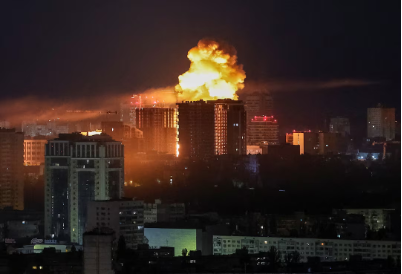
Russian Strikes on Ukraine
An explosion lights up the sky over the city during a Russian missile and drone strike, amid Russia’s attack on Ukraine, in Kyiv, Ukraine June 2, 2026
In recent days, following Ukrainian drone attacks on Moscow and Russian oil facilities, Russian drones and missiles have pounded Ukrainian cities such as Kyiv and Dnipro killing dozens of people and wounding hundreds more. Throughout the four year war Russia has targeted Ukraine’s power supply and civilian infrastructure, but the recent strikes on Kyiv have been stronger than anything the capital city has witnessed before. European Commission President Ursula von der Leyen has stated that the European Union would be sending more weapons to help Ukraine reinforce its air defense systems.
A Russian drone hit a block of flats in Romania, causing large fires and injuring two people. The event in Romania, a NATO member, raised alarm at the possibility of the war escalating. NATO secretary general, Mark Rutte, said the alliance “stands ready to defend every inch of allied territory”. Talks to end Russia’s war on Ukraine have stalled, and key meditator, the United States has been preoccupied with its own war on Iran. More recently on June 3rd, in a high profile attack, Ukrainian drones hit infrastructure in St Petersburg, Russia. The attack came only hours before Vladimir Putin’s glitzy annual economic forum in the city, designed to attract foreign investment. The attack signaled both that Russia and its major cities are not insulated from the war and that at least for now, more escalation will follow in the coming weeks and months.

Israel’s invasion of Lebanon
A woman searches through rubble after an Israeli strike in Beirut. Photo: Anwar Amro/AFP via Getty
As the United States and Iran continue negotiations that might put an end to the war, the Israeli-Lebanese front remains as active as ever. Israel has increased strikes and incursions deeper into Lebanon. Israeli forces have reached the outskirts of the southern Lebanese cities despite a ceasefire agreement in place since April, as analysts warn that Israel is laying the groundwork for long-term control and annexation of Lebanese territory. The incursion into the country marks Israel’s deepest push into Lebanon in more than a quarter of a century. Israeli forces now occupy about 770 square miles of Lebanese territory, or nearly one-fifth of the entire country and the death toll is at over 3,000 people.
Meanwhile, ceasefire talks between Washington and Tehran have become increasingly tied to developments in Lebanon. Iranian officials warn that an Israeli withdrawal from Lebanon is a prerequisite for any meaningful progress in negotiations between the two countries to end the US-Israel war on Iran and achieve aims like the reopening of the strait of Hormuz. More recently Iran for the first time since the ceasefire, launched missiles at Israel, in what Tehran said was retaliation for Israeli strikes and invasion into Lebanon’s capital, Beirut. Israel in turn bombed sites in Iran, while President Trump, at least publicly, urged Israel against resuming the war on Iran and continues to claim a peace deal with Iran is within reach.
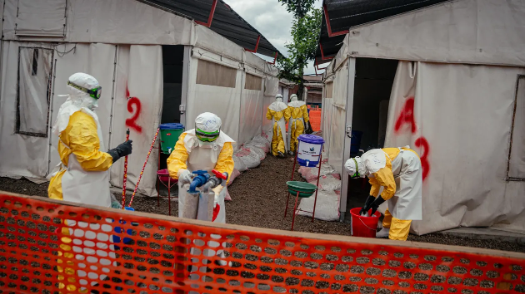
Ebola outbreak in the DRC
Doctors Without Borders health workers wearing personal protective equipment move through the isolated red zone to monitor patients, provide medical care and ensure sanitation at the Ebola Treatment Center in Munigi in Congo on June 2, 2026.Jospin Mwisha | AFP | Getty Images
An outbreak of the Bundibugyo strain of Ebola, a rare form of the virus for which there are currently no vaccines or targeted treatments, is spreading rapidly across eastern DRC. The World Health Organization (WHO) has declared the outbreak a “Public Health Emergency of International Concern” which is an extraordinary designation reserved for events that require a strong and immediate international response. In the country it is estimated that 3.9 million people live in immediate emergency conditions, while 73% of the population live in extreme poverty with millions facing hunger. The DRC is facing a multitude of critical issues all at once, collapsing health services, record hunger, armed fighting and drastic aid cuts, all pushing millions of people toward the brink, making them more susceptible to the ebola virus.
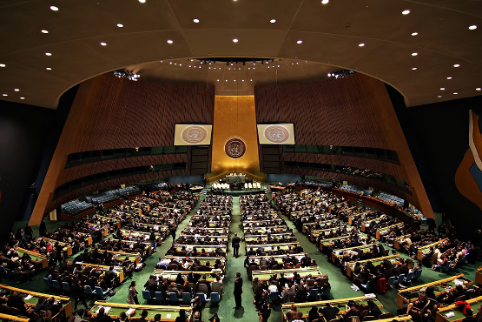
UN votes to enforce action on climate change
Image source: Wikimedia Commons, United Nations General Assembly Hall (3).jpg, by Basil D Soufi, licensed under Creative Commons Attribution-Share Alike 3.0 Unported
The U.N. General Assembly recently voted overwhelmingly to support strong action to combat climate change despite recent diplomatic efforts by the United States to have the measure withdrawn. The 193 member General Assembly approved a nonbinding resolution endorsing the landmark advisory opinion by the U.N. ‘s top court, the International Court of Justice, in 2025, called failure by countries to protect the planet from climate change a violation of international law. The vote was 141-8 with 28 abstentions. Countries such as the U.S., Russia, Belarus, Israel, Iran and Saudi Arabia opposed the measure. Part of the court’s decision stated that states may be legally required to stop the wrongful conduct and make full reparations for climate damages. A major signal that the global stance on climate change is moving forward and promoting action and accountability.

Protests in Albania over Trump-Kushner land privatization
Protestors take part in a demonstration in front of the prime minister’s office in Tirana, Albania, on June 3. AFP via Getty Images
Thousands of Albanians have taken to the streets of Tirana in recent days protesting against the selling of their country’s coastline and islands to a company linked with Trump’s son-in-law Jared Kushner and daughter Ivanka Trump. The $1.6 billion luxury resort is being built by Kushner’s investment firm, Affinity Partners on land that is on an environmentally sensitive part of the country’s coast. The Trump-Kushner project sites include Sazan island, which is just off the coast of Albania and a stretch of coastline near the Vjosa-Narta protected wetland home to flamingos, seals and sea turtle nesting sites. Albania’s Prime Minister Edi Rama, who has faced massive criticism and protest over the deal, has insisted the investment from the project would bring benefits to Albania, promising both jobs and improved infrastructure. Albania’s state anti-corruption agency has confirmed it opened an investigation related to the project but has not yet disclosed details.

Tech Bros Fail to Advance in California Elections (Elections & Politics Policy Brief #205)
Elections & Politics Policy Brief #205 | Mindy Spatt | June 7, 2026
Summary
Wealthy tech executives have been ratcheting up their political activism in California, sponsoring ballot measures and backing candidates up and down the ticket, often with great success. In the recent primaries, several of them tried for office themselves. Despite spending millions more than their opponents, they failed to win votes.
Analysis
Tech billionaire-turned-environmentalist Tom Steyer was one of several former tech executives self-funding campaigns for office in the California primary or running as proxies for the industry’s most affluent. Steyer somehow used his wealth as a calling card to woo progressives, promoting himself as the only candidate not beholden to special interests and bragging about how much fossil fuel companies and the reviled California utility company PG&E were spending to campaign against him. Irene Kao, the executive director of the progressive group Courage California, commented that the group’s endorsement of Steyer “came as a surprise to us. But a lot of our work has to do with holding corporations and the wealthy accountable.”
Steyer’s many homes around the country, previous investments in private prisons, and lack of detailed proposals to fix the states’ ills were things a swath of voters were willing to forget about, netting him 20% of primary voters. Voters were less forgiving of Katie Porter, who started the race as the more natural choice for progressives, but was permanently shunned as mean and nasty after she was caught yelling at a staffer in an unflattering video.
Steyer also picked up a high-profile endorsement from Jane Fonda, touted in his TV ads, which were ubiquitous during the campaign. Steyer’s spending, all out of his own pocket, broke all sorts of records. The total spent on the Governor’s race, $315.8 million, broke the record for the most expensive race for a state’s top office in American history. And this was only a primary. Most of that money, $201 million, was spent by Steyer.
The campaign of another former tech executive, San Jose Mayor Matt Mahan, was a last-minute attempt by tech billionaires to grab the Governor’s office when the race looked like it could be theirs for the taking. But Mahan failed to distinguish himself in debates, and the $35 million his backers spent did little to boost his name recognition outside the Bay Area. Netflix CEO Reed Hastings reportedly asked for his $1 million donation back when Mahan’s PAC and other campaign offices started shutting down. Other donations may also have been refunded. According to the NY Times, Mahan’s $35 million war chest was amassed with promises that the money would be returned if Mahan lost.
The crowded Democratic field had sparked worries that the two Republicans in the race could end up on the ballot. In the end, the Democrats coalesced behind former Attorney General and US Secretary of Health and Human Services Xavier Becerra, who is favored to win in his November race against republican Steve Hilton.
Two Congressional races also attracted the interests- and dollars- of wealthy former tech executives. Ethan Agarwal, a startup founder, challenged popular progressive incumbent Congressman Ro Khanna for supporting the proposed billionaire tax in California’s 17th Congressional district. Agarwal’s campaign was funded by Silicon Valley billionaires, including venture capitalist Ron Conway and the CEO of Y Combinator, Garry Tan. Agarwal did poorly, and Khanna will face republican Ritesh Tandon in the general election, a race Khanna is sure to win.
A high-profile congressional race in San Francisco for the seat held by Nancy Pelosi for 39 years saw record spending by another former tech executive, Saikat Chakrabarti. In this case, the tech money was behind State Senator Scott Weiner, widely seen as the frontrunner. Chakrabarti, relatively unknown in San Francisco, entered the race when Weiner was facing vociferous opposition from progressives for his support of military aid to Israel. But Weiner unexpectedly issued a statement accusing Israel of genocide in Gaza and withdrew from the Jewish Legislative Caucus, which has come under criticism for its blindly pro-Israel agenda.
That left Chakrabarti to go after Connie Chan, a member of the San Francisco Board of Supervisors who wasn’t as well-known as Weiner or as well-funded. Chakrabarti hired paid canvassers, and paid those who spoke Chinese, and could work in Chan’s Chinatown home base, extra. But in addition to being unconnected locally, Chakrabarti’s key story about having cut his chops as AOC’s Chief of Staff backfired when she refused to endorse him or respond to press queries about him. In this case, it turned out that all the paid advertising, paid supporters, and paid consultants you can buy with $10 million couldn’t beat Chan’s bona fides. She was backed by important labor organizations, the Harvey Milk LGBTQ Democratic Club, and a slew of well-known democrats ranging from progressives to moderates. Nancy Pelosi’s late endorsement clinched the deal for Chan, who spent $690,000 to Chakrabarti’s millions, and Scott Weiner’s $3.9 million, an impressive win that means a real contest for Weiner in the general election in November.
Those were candidates from the tech industry itself. Candidates backed by tech money did well in local races, including two in San Francisco, and tech money managed to defeat a San Francisco proposal for an “Overpaid Executive Tax”, prompting journalist Tim Redmond to comment in his 48Hills.org online newspaper that the election’s “real winners are the handful of billionaire tech plutocrats who have been trying for years to take control of this city.”
- Take Action
The Corporate and Billionaire Opponents of San Francisco’s Overpaid Executive Tax, Sarah Anderson, Campaign Legal Center, April 29, 2026
https://ips-dc.org/the-corporate-and-billionaire-opponents-of-san-franciscos-overpaid-executive-tax/ - Arab Resource and Organizing Committee: AROC Joint Endorsement: Connie Chan and Saikat Chakrabarti https://arocaction.org/endorsements/
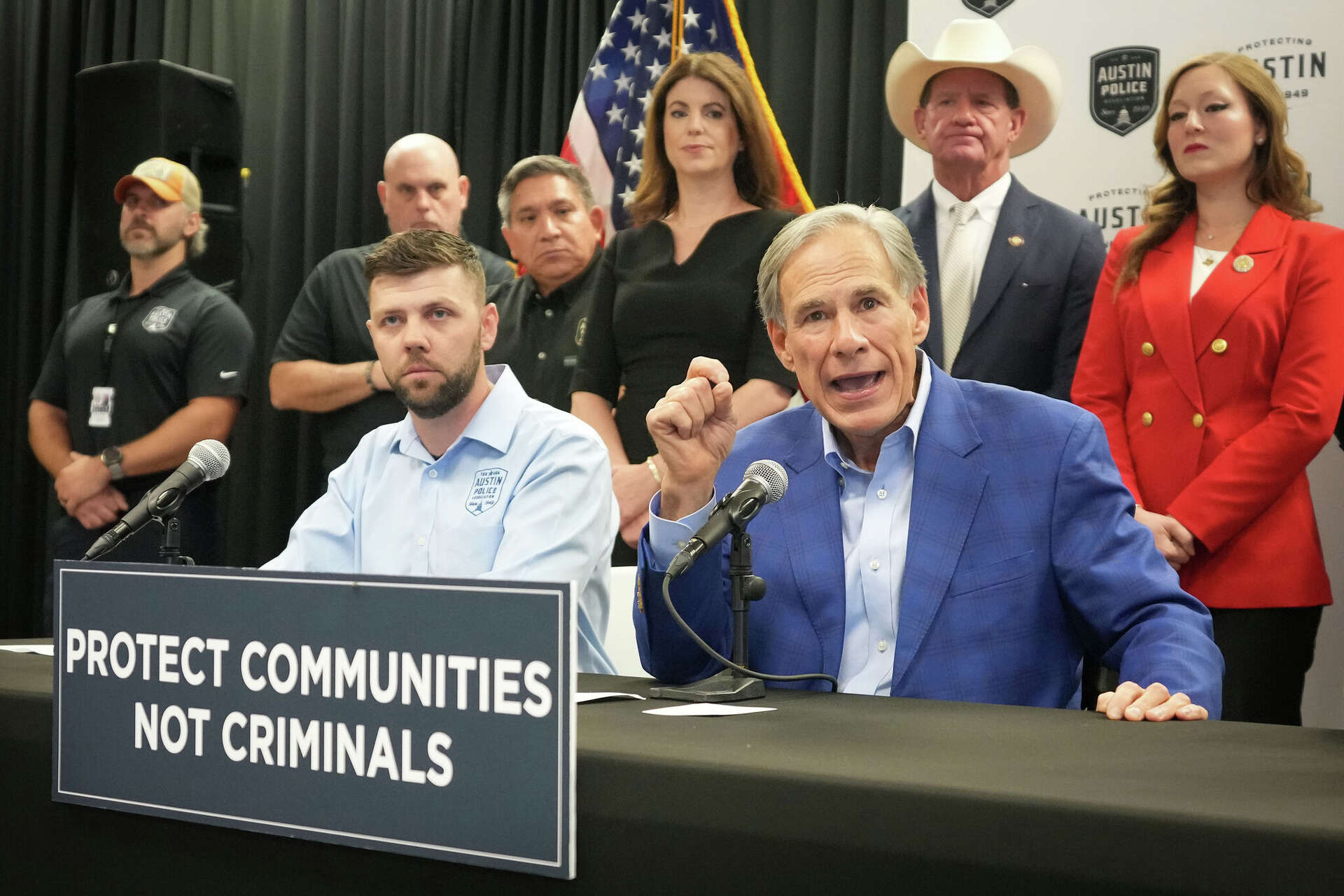
Protect Communities, Not Criminals (Social Justice Brief #191)
Social Justice Brief #191 | Valerie Henderson | June 1, 2026
Summary
On May 15, Texas Governor Greg Abbott announced a new initiative titled “Protect Communities, Not Criminals,” which includes a proposal to create a statewide prosecutor with the authority to override local district attorneys in certain cases. This proposed role would allow a state-appointed prosecutor to step in when a local prosecutor has not secured an indictment within 90 days, effectively creating a “backstop” to ensure cases move forward. Supporters of the proposal frame it as a necessary response to what they describe as “rogue prosecutors” local district attorneys who decline to pursue certain categories of crimes based on policy or resource limitations. The initiative is presented to ensure consistency in enforcement across Texas counties and to prioritize victims’ rights.
However, critics argue that the proposal represents a significant shift in power, moving authority away from locally elected officials and into the hands of a centralized, state-controlled prosecutor. This raises concerns about government overreach, political interference in the justice system, and the erosion of local democracy.
Beyond structural concerns, the proposal also has potential implications for communities that are already disproportionately impacted by the criminal justice system particularly Black and Brown communities across Texas. With expanded prosecutorial power and fewer local checks, the policy could deepen existing disparities in policing, charging decisions, and incarceration rates.
Analysis
At its core, the proposal to create a statewide prosecutor is not just about efficiency it is about who holds power in the criminal justice system. Historically, district attorneys in Texas are locally elected, meaning they are accountable to the communities they serve. They make decisions based on local priorities, resource realities, and, ideally, the needs of their constituents. This proposal disrupts that structure by introducing a top-down authority that can override those locally elected officials. Under the plan, if a district attorney does not act within 90 days, a statewide prosecutor, appointed and confirmed at the state level, can take control of the case. While this is framed as a safeguard for public safety, it also sets a precedent where state leadership can intervene in local decision-making, potentially influenced by political agendas rather than community context.
The justification for this change rests heavily on the narrative of “rogue prosecutors.” However, that framing is highly subjective. In many urban counties, prosecutors have adopted policies that focus on reducing incarceration for low-level offenses, addressing systemic inequities, and reallocating resources toward more serious crimes. These decisions are often rooted in data, and public mandates are not neglected. Labeling them as “rogue” creates a political justification for removing local control. From a racial justice perspective, this shift raises serious concerns. Research and long-standing data show that Black and Brown communities are already disproportionately impacted at every stage of the criminal justice system from arrest to sentencing. Expanding prosecutorial power without strong accountability measures risks amplifying those disparities.
As a Black woman and a mother of both sons and daughters, this is where the policy becomes deeply personal. Policies like this do not operate in a vacuum, they shape how young people are policed, charged, and sentenced. When prosecutorial power expands, it often does not expand evenly it is applied more aggressively in communities that are already over-surveilled and under-protected. Additionally, removing local discretion can erase the progress some communities have made toward reform. Local prosecutors who are attempting to implement alternatives to incarceration or address systemic bias could be overridden by a state-level authority that does not share those priorities. This creates a chilling effect on reform and reinforces a one-size-fits-all approach to justice, something Texas’s diverse population cannot afford.
The statewide prosecutor position is currently a proposed law, not an enacted law. lawmakers are not scheduled to consider the measure until the next legislative session. While the new statewide prosecutor is just a proposal, Texas lawmakers did pass a law in 2023 (Texas House Bill 17) that allows for the removal and impeachment of local district attorneys who refuse to prosecute certain crimes. T e likelihood of a statewide prosecutor law passing is moderately high, but it faces steep constitutional and procedural hurdles. creating a centralized “Chief State Prosecutor” with the power to override locally elected officials may require an amendment to the Texas Constitution.
My Opinion
This proposal raises a fundamental question: Is this truly about public safety, or is it about control? As a Black woman raising both sons and daughters, I understand firsthand how policies like this can have unequal consequences. The idea of expanding prosecutorial power without equally expanding accountability is concerning because history has shown us exactly where that imbalance tends to land. It lands hardest on communities that already experience disproportionate policing and harsher outcomes within the justice system. Local prosecutors are not perfect, but they are elected by the people they serve. That matters. It means communities have a direct voice in how justice is carried out in their neighborhoods. When that power is shifted to a centralized authority, it dilutes that voice and distances decision-making from the people most impacted by it. There is a difference between ensuring accountability and removing autonomy. And when policies begin to blur that line, especially in a state with a long history of inequitable outcomes for minority communities, it is worth asking who ultimately benefits and who bears the cost.
If the goal is truly to protect communities, then solutions should invest in those communities, not override them.
Take Action
- Texas Civil Rights Project (TCRP)
- ACLU of Texas
- Texas Appleseed
Keywords
Texas statewide prosecutor; Greg Abbott policy; criminal justice reform Texas; prosecutorial power; local vs state control; racial disparities justice system; Black communities policing; systemic inequality Texas; mass incarceration; criminal justice accountability; government overreach; Texas law enforcement policy.

Ukrainian Drones Have Changed the Rules of War (Foreign Policy Brief #225)
Foreign Policy Brief #225 | Yelena Korsunov | June 7, 2026
The geography of the war has changed. Once, the war in Ukraine was measured in miles of trenches, destroyed towns, and incremental advances across the Donbas steppe. Over the past two years, however, the conflict has expanded both vertically and territorially, carried not only by missiles and aircraft but also by relatively inexpensive drones assembled in workshops across Ukraine. The battlefield no longer ends at the front line. It now stretches hundreds—and sometimes thousands—of kilometers into Russian territory, reaching oil depots, military plants, logistics hubs, and even Moscow itself.
What Ukraine has built is more than a drone industry. It is what Reuters has described as an adaptive wartime ecosystem. Despite constant bombardment, power shortages, and labor disruptions, the country has developed one of the most rapidly evolving unmanned warfare programs in modern military history. Reuters describes Ukraine’s strategy as a campaign of mid-range and long-range strikes aimed at degrading Russia’s military logistics and energy infrastructure while compensating for Kyiv’s shortage of conventional firepower.
The scale of this transformation is difficult to overstate. Before Russia’s full-scale invasion in 2022, Ukraine’s domestic drone sector was modest and heavily dependent on imported components and volunteer initiatives. Today, Ukrainian officials openly discuss mass production. Drone units operate with a software-startup mentality: rapid iteration, constant redesign, and immediate battlefield feedback. A vulnerability discovered at the front—such as signal jamming—can lead to modifications within days rather than procurement cycles lasting years.
This acceleration has altered the strategic depth of the war. Ukrainian drones now routinely strike targets deep inside Russia, including areas once considered beyond Kyiv’s reach. Reuters reported in April that Ukraine struck an oil pumping station near the Ural Mountains, approximately 1,500 kilometers (932 miles) from the Ukrainian border. The symbolic significance was as important as the physical damage. For decades, the Urals were viewed as distant, industrial, and largely insulated from war. Ukrainian drones challenged that assumption.
Other strikes have reinforced the message. Ukrainian forces have targeted facilities in Cheboksary, also roughly 1,500 kilometers (932 miles) from Ukraine, including defense infrastructure linked to Russian military production. Oil refineries in Samara, Ryazan, Perm, Tuapse, and Krasnodar regions have repeatedly been hit in campaigns designed not only to damage infrastructure but also to reduce Russia’s wartime energy revenues. Reuters estimates that Ukrainian strikes disrupted approximately 700,000 barrels per day of Russian refining capacity between January and May 2026 alone.
Moscow, long considered politically untouchable territory, has also become a regular target. Russian authorities have reported frequent drone attacks on the capital, including a large-scale assault in March involving hundreds of drones. The military impact of these attacks varies, but their psychological effect is undeniable. Airports suspend flights. Air defenses fire over residential neighborhoods. Moscow residents, long removed from the daily realities of war, increasingly experience moments of uncertainty familiar to Ukrainians since February 2022.
Ukraine’s drone campaign reflects a broader shift in military power away from expensive centralized systems toward locally developed, low-cost technologies. A long-range drone may cost only a small part of a cruise missile while forcing a defender to deploy far more expensive air-defense assets. Russia can manufacture missiles at scale, but defending thousands of miles of infrastructure against persistent drone attacks presents a different challenge.
Experience has become Ukraine’s greatest strategic asset. No NATO military has accumulated comparable real-time knowledge of large-scale drone warfare under continuous combat conditions. Ukrainian operators combine reconnaissance drones, FPV systems (the First-Person View system that transmits a live video feed from a drone’s camera), maritime drones, electronic warfare tools, and long-range strike platforms into integrated operational networks. The result is not merely tactical innovation but the development of a new model of warfare.
Western defense analysts increasingly study Ukraine not only as a recipient of military aid but also as a laboratory of future conflict. The war has demonstrated how technological adaptation can partially offset disparities in population, industrial capacity, and ammunition reserves. It has also shown how quickly civilian expertise can be transformed into military capability. Many Ukrainian drone engineers once designed consumer electronics, software systems, or racing drones. Wartime necessity redirected their skills.
The deeper significance, however, lies elsewhere. The drone war has blurred the distinction between rear and front. A refinery in the Urals, a command facility hundreds of miles from Ukraine’s border, or a district of Moscow can no longer be considered entirely beyond reach. Distance, once central to strategic security, has become increasingly conditional.
The war is no longer confined to where soldiers meet. It now unfolds across networks, infrastructure, algorithms, and industrial geography. Ukraine’s drones have not defeated Russia. But they have changed the shape of the conflict and Russia’s military expectations, extending Ukraine’s reach far beyond what conventional military balances once suggested possible.
Take Action
- US Global Leadership Coalition. The Importance of U.S. Assistance to Ukraine, https://www.usglc.org/the-importance-of-u-s-assistance-to-ukraine/
- Syracuse University. Ukraine Crisis: Resources and Support, https://ivmf.syracuse.edu/ukraine-crisis-resources-and-support/#1-ways-to-give
- The Ukraine Oversite. The United States and its international partners provide a variety of training to the Ukrainian Armed Forces (UAF), including basic, collective, leadership, and platform-specific training, https://www.ukraineoversight.gov/Funding/Training-Advising/
- GMF (German Marshall Fund). In response to Russia’s brutal war against Ukraine, the German Marshall Fund of the United States (GMF) established a comprehensive emergency program to support Ukrainian citizens, civic activists and civil society organizations (CSOs), and journalists and independent media, https://www.gmfus.org/democracy/ukraine-relief-resilience-recovery

With his Iran war, Trump Creates Confusion and Squanders Credibility (Foreign Policy Brief #226)
Foreign Policy Brief #226 | Nicholas Gordon | June 8, 2026
Now three months into his Iran war, President Trump continues to spew so much contradictory nonsense on the conflict that anyone attempting to take the president at his word would be lost in the morass. One moment Trump is threatening to annihilate Iran’s civilization, hurling churlish curses at the country’s leadership for not doing what he wants, the next he’s saying a deal is nearly complete. One minute he’s claiming the goal of regime change, the next he’s abandoning it in favor or “winding down” the war. One hour he’s saying “you don’t do a ceasefire when you’re literally obliterating the other side,” the next he’s gladly accepting a ceasefire.
The president’s utterly incoherent approach to the war evinces disrespect for American citizens looking for honest answers and assessments, which is exactly why we need to hold him accountable for his words. While we can’t get the truth from Trump or his administration, and while his sycophantic Republican colleagues refuse to hold him accountable, the record shows a president oozing confusion and desperate for an off-ramp to the war he started.
It’s either gaslighting or he’s ‘disconnected from reality’ himself
In late February, Trump tried to justify starting the war by claiming that Iran was mere weeks away from obtaining a nuclear weapon, an assessment disputed by nuclear experts and intelligence reports. The statement also made a mockery of Trump’s earlier claim that Operation Midnight Hammer conducted in June had “completely and totally obliterated” Iran’s nuclear program.
As the U.S. and Israel began bombing the Iranian regime, Trump casually told the people of Iran to “take back your country.” Given the regime’s well-documented brutality against its own citizens and the lack of a strong, organized opposition force, Trump’s advice was both deadly and outlandish. As noted, Trump would later claim regime change, but U.S. intelligence shows the regime is still intact.
Soon after starting the war, Trump declared, “there will be no deal with Iran except UNCONDITIONAL SURRENDER,” employing his trademark juvenile-bully caps. If we take Trump at his word here, then there will be no deal, because Iran has not only made it clear that they will not surrender, but also that they have the capacity to outmaneuver Trump, mainly by leveraging control of and thereby weaponizing the Strait of Hormuz to disrupt global energy markets.
When this Iranian strategic advantage emerged, Trump went further off the rails, most notoriously with his deranged Easter Weekend Truth Social post in which he pathetically cried, “Tuesday will be Power Plant Day, and Bridge Day, all wrapped up in one, in Iran. There will be nothing like it!!! Open the Fuckin’ Strait, you crazy bastards, or you’ll be living in Hell – JUST WATCH! Praise be to Allah. President DONALD J. TRUMP.” The post, widely condemned by sounder political operatives, was vintage bluster and bombast from Trump. Most embarrassingly for the president, the post effectively conveyed Trump’s failure to foresee Iran’s strategic advantage and his frustrated inability to solve it.
While Trump continued to issue countless falsehoods about the war—saying that the U.S. had “already met and exceeded all military objectives,” and achieved “Total and complete victory.100%. No question about it.”—the reality of Iran controlling the Strait of Hormuz posed a grave, geopolitical challenge that prompted Trump to impose a U.S. naval blockade on Iranian ports and shipping in the strait. The blockade, which sought to force Iran to free up passage of all global marine traffic, required 10,000 U.S. military personnel, more than a dozen warships, and over 100 fighter and surveillance aircraft.
By April, regarding Trump’s mishandling of the war, German Chancellor Friedrich Merz stated plainly that the U.S. is being “humiliated” by Iran. Rather than address the criticism, Trump responded with his typically petty social media posts attacking Merz and making false claims about him wanting Iran to have a nuclear weapon—the same baseless and preposterous accusation Trump made about Pope Leo. Merz’s comments, however, echoed the assessments of diplomats and global political analysts who lament how Trump got Iran wrong.Moreover, by failing to build a coalition of support before heading into the war, Trump has resorted to attacking European allies for not joining in his war of choice after the fact.
Conclusion
In their attempt to justify Trump’s starting of the war and evade holding him accountable for his words or actions, Republicans have collectively decided to hide behind a truism which no one anywhere has ever argued against, that Iran cannot have a nuclear weapon. Ironic, their claim, given that in 2018 Trump backed out of the Joint Comprehensive Plan of Action (JCPOA), the Obama-negotiated deal co-signed by China, France, Russia, the United Kingdom that had significantly curtailed Iran’s nuclear program.
Today, however, Trump has had to relent on his de-nuking demands, seeking instead a deal wherein Iran will simply reopen the Strait of Hormuz—that is, return the strait to the state it was in before Trump started his war and empowered Iran with control of the strait.
While the U.S. and Iran continue to trade strikes, Trump continues to give conflicting comments on the state of the ongoing negotiations, debasing himself, depriving American citizens of honest assessments, and lending credibility to the enemy’s assertion that the American president is “disconnected from reality.”
But Trump’s confused stew of words on the war do make it painfully clear that his lack of strategy, leadership, and coherent messaging have emboldened the Iranians and revealed how hard it will be to end his festering conflict.
Take Action
- Institute for the Study of War
- aims to provide ‘real-time intelligence to help leaders make informed decisions in conflict zones around the world and educate the next generation of national security leaders’
- The Center for Strategic and International Studies (CSIS)
- a bipartisan, nonprofit research organization ‘dedicated to advancing practical ideas to address the world’s greatest challenges’
- The Council on Foreign Relations (CFR)
- an independent, nonpartisan U.S. think tank ‘dedicated to helping policymakers, business leaders, and the general public better understand international affairs and U.S. foreign policy’