

JOBS POLICIES, ANALYSIS, AND RESOURCES
Latest Jobs Posts
Situation Update: The Ukraine Crisis
Brief #90 – Foreign Policy Brief
by Abran C
Drone attacks on Russian territory have become an almost daily occurrence…
Is Trump Barred From The 2024 Ballot By The Constitution’s Disqualification Clause?
Policy Brief #211 – Civil Rights
by Rodney A. Maggay
Could Donald Trump be barred based on the U.S. Constitution’s 14th Amendment “Disqualification Clause?”
Medicare Negotiations on Drugs Save Money and Lives
Policy Brief #163 – Health and Gender
by Geoffrey Small
The Inflation Reduction Act, which was enacted last year, gives Medicare the authority to negotiate drug prices with pharmaceutical companies….
Google Cloud’s AI Conference Draws Protestors
Brief #97 – Technology Policy Brief
by Mindy Spatt
The emergent capabilities of AI systems have blurred the boundaries between machine autonomy and human control…
Examining Competitive US House Races in California
Brief #93 – Elections & Politics Policy Brief
by Ian Milden
The small size of the Republican majority leaves Democrats with a path to re-take the House majority.
Donald Trump and Accountability
Brief #92 – Elections & Politics Policy Brief
by Abigail Hunt
Donald Trump is currently the leading candidate for the Republican party Presidential nomination – this man who openly bragged, on tape, about sexually assaulting strangers…
The Increased Clout of Youth Climate Activists: The Case of Montana
Brief #159 – Environmental Policy Brief
by Inijah Quadri
In a world demanding urgent action on climate change, youth activists are going beyond marching…Are we on the cusp of a new era of environmental litigation?
Is Donald Trump a Mob Boss? How Georgia is Using an Organized Crime Law to Prosecute Him
Brief #91 – Elections & Politics Policy Brief
by Arvind Salem
President Trump has been indicted once again for his efforts to overturn the 2020 election: this time in Georgia, which means…
Navigating Digital Ethics: Autonomy, Consent, and Algorithmic Justice in the Modern Age
Brief #96 – Technology Policy Brief
by Inijah Quadri
The emergent capabilities of AI systems have blurred the boundaries between machine autonomy and human control…


The Increasing Use of Drugs to Enhance Performance in International Triathlons
The Increasing Use of Drugs to Enhance Performance in International Triathlons
Foreign Policy Brief #78 | By: Reilly Fitzgerald | May 30, 2023
Photo taken from: education.triathlon.org
__________________________________
Summary
Endurance sports have long been the target of allegations and investigations into doping. No one needs an introduction to the name Lance Armstrong, for example, cycling’s worst offender and villain in terms of doping and ruining the lives of the people that accused him of cheating. Triathlon, an endurance sport that involves swimming, cycling, and running consecutively, is also no stranger to doping and cheating.
Analysis
Triathlon has a fairly short, when compared with the likes of cycling and running, history of doping. The sport really was not founded until late in the 1970s. Triathlete Magazine recently posted online a brief history of doping in the sport which included many elite triathletes. Some of these dopers have had pretty severe repercussions due to their doping, and due to some of these athletes there are more protections in place to attempt to curtail doping in the sport.
A few weeks ago, professional triathlete Collin Chartier’s doping was discovered and he has been handed a 3-year ban from the sport. Chartier is yet another perpetrator of dishonesty, and cheating, in endurance sports.. He is just one triathlete in a much larger group of endurance athletes that have perpetuated a long history of cheating.
Nina Kraft was one of the earliest dopers in triathlon, who tested positive for Erythropoietin (EPO). She was a German triathlete who, prior to the positive test, had won the famed and world-renowned Ironman World Championships in Kona, Hawaii; and, she won Ironman Germany, as well in 2004. She admitted to doping, and was given a one-year ban from the sport. After her ban, she had a successful comeback in both triathlon and running. The largest consequence of the events of her doping was that the German Triathlon Federation created the Elitepass for triathletes, which allowed only athletes with the Elitepass to be eligible for prize money at races with the major condition that they be subjected to unannounced drug testing.
Bridget McMahon, a Swiss triathlete, tested positive for EPO after winning the gold medal in triathlon at the 2000 Sydney Olympics. She admitted to taking “small doses”, otherwise known as microdosing, of EPO. She never gave up the name of her supplier, however; and was given a two-year ban and never raced again as a professional athlete. However, she then entered as an “Age Grouper” (Non-professional triathlete race division) and won every race that she enetered.. It should be noted, however, that Age-Group athletes are not nearly as strenuously tested (if they even get tested) as the professional triathlon field. Another Age-Group athlete that tested positive was Eduardo Solis, a Costa Rican non-professional triathlete; he tested positive for the use of EPO and various steroids.
EPO has long been the drug of choice for endurance athlete dopers. It is the main substance that Lance Armstrong, and many other cyclists, used through the 1990s and into the early 200s. It is a drug that is prescribed for patients, in a medical setting, that need to produce more red blood cells. Athletically speaking, the boost of red blood cells in your body allows your blood to carry more oxygen to your muscles when exercising, which allows your muscles to produce more work. For a triathlete, or other endurance athletes, it means that they are able to go longer in distance, and go faster too. Access to this drug is very easy to gain, Collin Chartier bought it online in November and began using it soon afterward.
It has long been the stance of dopers, especially cyclists, that all of “the top athletes” worldwide are under the microscope in terms of testing. It also has been well documented by athletes in almost every sport that unannounced testing occurs and is an inconvenience to their lives, but, testing has also made it more difficult for athletes to use performance enhancing drugs.
It remains to be seen what more can be done in terms of anti-doping measures globally. We have seen the creation of various agencies, and organizations, that are supposedly testing athletes in and out of competition. We have brand new tests to detect new substances, and can retroactively test blood samples from previous events. We have seen varying lengths of bans given out to athletes, Lance Armstrong was handed a life-long ban from competing in the sport of cycling for example.
Ironman athlete Lionel Sanders, a professional triathlete from Canada and known associate of Collin Chartier’s, has a proposal which may help triathlon recover its image from the dopers. His suggestion was that 20% of all prize purses on the professional circuit (the Professional Triathletes Organization races) go towards drug testing athletes out of the competition. This would roughly equate to $120,000 per race – as each race offers a winner’s purse of $600,000. This is a creative suggestion that puts the athletes at the center of the solution rather than having outside agencies involved, or in the case of Russia at the Olympics – having governments involved.
Engagement Resources:

The Implications of the George Santos’ Indictment
The Implications of the George Santos’ Indictment
Elections & Politics Policy Brief #78 | By: Ian Milden | May 25, 2023
Photo taken from: csmonitor.com
__________________________________
Summary
On May 10th, Congressman George Santos (R-NY) was indicted by federal prosecutors on charges of money laundering, wire fraud, theft of public funds, and making false statements to the government. Santos has pleaded not guilty. This Brief will discuss the charges against him and examine the political implications of his indictment.
Analysis
Congressman George Santos had gained a reputation for admitting that he made false statements about his biography during his campaign for Congress. An investigation from the Department of Justice alleges that his dishonesty went further than his campaign falsehoods.
The indictment against Santos outlines two separate schemes that resulted in thirteen charges against him. The first part of the indictment accuses Santos of taking contributions from his campaign account and using them for his personal benefit. Prosecutors say that he used these funds on personal debts and designer clothes. Prosecutors have Santos’ bank records to support their claims.
Using campaign funds for personal expenses is illegal, and other members of Congress have gotten in trouble for it. A recent example is Congressman Duncan Hunter (R-CA) who pleaded guilty to federal charges after using campaign funds on things ranging from toys for his children to vacations.
The second part of the indictment against Santos alleges that he applied for unemployment assistance in 2020 when he still had employment. Prosecutors say that Santos gained $24,000 from unemployment assistance that he was not eligible for. Santos was likely aware that fraudulently applying for unemployment benefits was a crime since he co-sponsored a bill to combat unemployment assistance fraud that was due to receive a floor vote the same week he was indicted for it.
The indictment also says that Santos made false statements to the House of Representatives in his required financial disclosure statement. Prosecutors say he falsely stated that he earned a salary from a company he owned as well as the value of his savings and checking accounts.
When a member of Congress is indicted, they are usually required to step back from their committee assignments. This is formally required by the House Republican Conference Rules. Congressman Santos already stepped back from his committee assignments back in January, so the indictment doesn’t change any committee activities.
Santos was already facing calls to resign from disgusted colleagues and those have increased, particularly from the New York delegation. Santos has said that he will not resign. If Santos refuses to resign, Congress would have the ability to expel him. Expulsion requires the support of two-thirds of the members of the House of Representatives. Expulsion is rarely used, and most cases were for treason during the start of the civil war. More recent cases of expulsion from Congress have included members who were convicted of corruption charges and accused of sexual misconduct. House Democrats attempted to force a vote to expel George Santos from the House, but it did not get the support of Republican leadership. House Speaker Kevin McCarthy expressed a desire to refer Santos’ indictment situation to the House Ethics Committee, which usually defers to the Justice Department in cases involving criminal conduct. House Republicans voted to refer Santos to the House Ethics Committee on May 18th.
Given the speed at which the Justice Department investigation has moved and the nature of the charges and evidence against Santos, it seems unlikely that Santos will avoid a conviction and remain in Congress. To be clear, Santos would be eligible to remain in Congress if he is convicted, but House rules would prevent him from voting and his colleagues would likely move to expel him. Santos could also resign as part of a plea agreement. A special election would be called to fill the seat when Santos leaves office.

The Race to ’24: Trump and his detractors, how the Republican field is shaping up
The Race to ’24: Trump and his detractors, how the Republican field is shaping up
Elections & Politics Policy Brief #79 | By: Abigail Hunt | May 26, 2023
Photo taken from: telegraph.co.uk
__________________________________
The 2024 Presidential election is pivotal – will we be able to continue the democratic policies of the past four years? Will a win for the Republicans mean the next administration spends time dismantling the work of the previous officeholder?
The way candidate choices are lining up ahead of the 2024 presidential election could be Deja Vú as President Joe Biden and former President Donald J. Trump, 45th president of the United States plan to duke it out for the Presidency one more time.
Trump is in the running even though he was indicted in spring 2023 in New York on 34 counts of falsifying business records in the first degree, a class E felony. Per the New York Courts website, a Class E felony is punishable by a possible sentence of less than a year up to four years in prison.
Trump also has recently been convicted of the sexual assault of E. Jean Carroll, and faces possible federal criminal charges for the mishandling of top secret government documents and for leading the January 6th insurrection of the US capitol. At the state level he faces potential criminal charges for attempting to falsify the outcome of the Presidential election in Georgia.
Despite all this, the irascible yet indomitable Trump persists in the political arena. Once again, Biden faces the prospect of a head-to-head with Trump. Trump’s campaign, titled Agenda 47, details how he will wage war on Biden’s policies, claiming he will advocate for veterans, improve the quality of life for all Americans, and protect American workers (though he offers few details on how he will achieve these goals.
In addition to Trump other Republicans are seeking to enter the race and Trump is no longer a shoo-in… In February, Nikki Haley, a Republican and former Governor of South Carolina, and Vivek Ramaswamy, a biotech and health care entrepreneur, announced their candidacies. Asa Hutchinson, former Arkansas governor and congressman, and conservative talk radio host Larry Elder joined the pack in April. The month of May brought South Carolina Governor Tim Scott and Florida Governor Ron DeSantis into the ring.
On May 24, DeSantis announced his 2024 bid in an unconventional way – via a livestream event with Elon Musk, the platform’s owner and a strong DeSantis supporter. In 2022, DeSantis raised more than any other gubernatorial candidate in U.S. history, and most of it was funded through a state-level political action committee (PAC), Friends of Ron DeSantis. DeSantis officially parted ways with the PAC, but now the $173.2 million fund is in the hands of DeSantis’s supporter, friend, and colleague, Florida Republican State Senator Blaise Ingoglia, who sponsored several conservative pieces of legislation which DeSantis signed into law, including allowing a jury to sentence someone to death from a unanimous jury decision to a 2/3rds majority.
Scott, a junior senator, espouses traditional Republican viewpoints – he stands with Israel, criticizes the federal government, supports the police. There is a subliminal sense of pulling oneself up from the bootstraps in Scott’s life story, the child of a single mother who struggled to make ends meet. With a bachelor’s in political science, Scott has very little real-world working experience, having previously worked as an insurance and real estate agent.
It is too early to say which of the candidates will cement the nomination, though DeSantis’s fundraising capabilities and name recognition give him an early advantage. Regardless of who takes the nomination, the candidate pool indicates that the conservative Deep South was deeply unsatisfied with Trump as their President. Whoever becomes the Republican nominee will face off against an incumbent president – historically not a fight often won.
Engagement Resources:
- “Pro-Ron DeSantis super PAC to inherit state-level PAC war chest to support presidential run” Open Secrets is a nonpartisan, independent and nonprofit research group tracking the influence of money, how its allocated, and its influence in U.S. politics and legislation.
- Tim Scott, the Facts. Vote Smart states its mission is to help inform the public about the elected officials that represent them, educate the public about major election issues, and outline the components of the Voter’s Self-Defense System. They offer a free Voter’s Self-Defense Manual.

For Republicans, “Parent Choice” is About Power, not Freedom
For Republicans, “Parent Choice” is About Power, not Freedom
Education Policy Brief #83 | By: Rudolph Lurz | May 23, 2023
Former Virginia Gov. Terry McAuliffe (left) debates Republican gubernatorial candidate Glenn Youngkin, hosted by the Northern Virginia Chamber of Commerce on September 28, 2021, in Alexandria, Virginia. Photo taken from: cnn.com
__________________________________
During a debate in the 2021 Virginia gubernatorial campaign, Terry McAuliffe made a serious blunder. He stated, “I don’t think parents should be telling schools what they should teach.”
His opponent, Glenn Youngkin, seized on that mistake. Youngkin made “parent choice” in education the centerpiece of his campaign, especially concepts such as CRT (Critical Race Theory) and LGBTQ+ issues. Youngkin framed McAuliffe’s stance as anti-parent and elitist, and rode that messaging all the way to a surprise victory in a state that has trended blue in recent years.
The exact target of parent anger in districts nationwide is difficult to pinpoint, but can best be explained with the near-ubiquitous term of “anti-woke”. Parents and policy makers who prescribe to this philosophy claim that public school districts are indoctrinating students with so-called “woke” ideology. This includes things like the acceptance of non-binary and transgender students, health classes which include discussion of LGBTQ+ issues, and the role of racism in American history.
“Parent Choice” has become the mantra of those who stand in opposition to curriculum issues such as these. School board meetings have become raucous and even violent. School board members have received violent and obscene threats, drawing the attention of the Attorney General and Department of Justice. Attendees at these meetings sometimes do not even have children in the districts involved. Attempts to bar non-district attendees from these meetings have been denigrated as authoritarianism. The DOJ’s efforts to protect school board members have been framed as portraying parents as terrorists. Ted Cruz, in a letter co-signed by other Senate Republicans, stated, “Parents and other citizens who get impassioned at school-board meetings are not domestic terrorists. You may believe that, but too many people involved in this issue seem to think harsh words can be criminalized. Getting the FBI’s Counterterrorism Division involved in the matter only makes this worse—dramatically worse.”
To Republicans like Senator Cruz, whether or not the protestors have children in the school district is not relevant. Advocacy coalitions such as Moms for Liberty get the word out, and meetings that were once sparsely attended have become loud battlefields of partisan vitriol.
Analysis
As I noted in a previous brief, the current criticism of public education is not a traditional GOP attack angle. The standard refrain was that public districts were failing, and parents should receive a voucher to use the per pupil funding of their child toward the tuition of the private school of their choice. Vouchers are a popular form of school choice, which advocates for the idea that the money should follow the student. “Butts in seats” is shorthand for a common funding formula used by school districts. A district map determines which areas are zoned for elementary, middle, and high schools. Students attend their districted school, and the number of students who are counted as “present” in the first few weeks of the year determines the funding levels for the next academic year. The per pupil figure in that formula is determined by many factors, including property tax revenues and state funding.
Every district is different. School choice advocates vary from those who would like to take their kid’s entire per pupil amount and get a voucher from a Catholic school (which raises church/state concerns), to those who want the option to attend a different public school in the same district. That argument is more logically sound, as funds allocated for that student remain in the district instead of leaving for private schools. However, it still is problematic. If one district school is performing poorly, how many families are allowed to leave for greener pastures? Would the district then be obligated to provide transportation to schools on the other side of the county?
These are questions I am used to discussing as an education policy analyst. This latest trend under the guise of “parent choice” is both bizarre and alarming. Advocacy groups like Moms for Liberty are not seeking opt-out clauses or pushing for vouchers. They want to control the education options for the entire district. Vicki Baggett, an English teacher in Florida, has personally filed over 150 forms seeking the removal of books from district libraries across the state.
“Parent Choice” is a solid rallying cry for firing up suburban moms to vote Republican. It uses warm terminology with the positive connotation of having a voice in the education of their children. What parent wouldn’t want that?
The issue with this modern movement is that it’s anything but warm and fuzzy parents cheering for their own kids. It is centered on activist partisans who seek power at the state and federal levels. If groups are advocating for the removal of entire sections of books from school libraries and chilling any classroom discussions on topics they do not like, that is not “parent choice”.
That is dominion.
Parents should absolutely have a voice in their kids’ education. They have public forums at school board meetings to make their voices heard. There are appropriate avenues available for parent input and dissent.
Parent voices become alarming when they demand dominance over the education options for every student in the district. Those voices become frightening when they show up at districts where their kids don’t live and demand dominance there, too. Those voices require DOJ intervention when they begin threatening school board members with violence if they don’t get their way.
For the civic health of this nation, and the decentralized local control that traditional Republicans used to advocate for, it’s vital that school board meetings become boring again.
If you are threatening other parents and educators and screaming at the top of your lungs in a county 200 miles away, you’re doing it wrong.
Engagement Resources
An Update on Foreign Military Support for Ukraine
An Update on Foreign Military Support for Ukraine
Foreign Policy Brief #77 | By: Yelena Korshunov | May 23, 2023
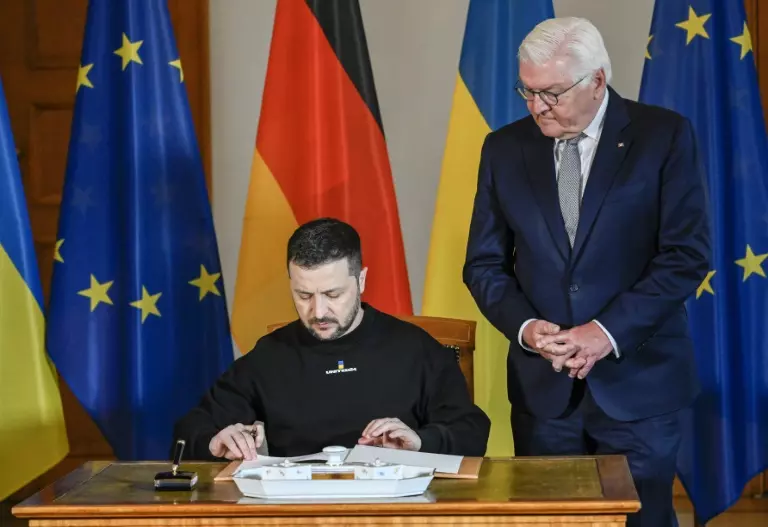
Volodymyr Zelensky signs the guestbook at the Bellevue Palace before heading into talk with Germany’s President Frank Walter Steinmeyer. Header photo taken from: inkl.com
__________________________________
This month Ukraine’s President visited Italy, Germany, France and Great Britain. As a result of the meetings, the European leaders agreed on the transfer of new large packages of military aid to Kyiv and announced the creation of a coalition for the supply of Western fighter jets and the training of Ukrainian pilots. But will the new round of arms deliveries to Ukraine make the country ready for a counteroffensive?
One of Zelensky’s achievements during this trip is the creation of the fighter jet coalition: the British will train F-16 pilots and, together with other members of the coalition, transfer fighters to Ukraine. At the same time, the British have been hinting they have the opportunity to train the Ukrainian Air Force pilots on any aircraft. In Great Britain where there are pilot training centers, including for flights at low altitudes.
The announcement of the creation of a coalition can really be a kind of trigger for other countries in the direction of fighter jet deliveries. However, it is not clear whether F-16s will be supplied to Ukraine as part of the coalition. Various options are being discussed.
Great Britain announced that it would send to Ukraine drones and missiles for anti-aircraft missile systems. They are invaluable for Ukraine because they counter Russian missile and drone attacks. France also has promised to deliver several dozen armored vehicles and light tanks, including the AMX-10 RC, in the coming weeks, according to a joint statement issued after President Emmanuel Macron’s talks with Ukraine’s president. Some of them arrived in Ukraine earlier and already have been mastered by Ukrainian crews.
In addition to that, a 2.7 billion euro aid package was announced by Germany. It includes Marder BMP, Leopard tanks, 200 drones, and 100 armored vehicles. Germany is one of the centers of production of weapons in Europe, including Leopard tanks. The other day, the German weapons manufacturer Rheinmetall and the Ukrainian company Ukroboronprom concluded a major agreement on the creation of a joint arms manufacturing venture. This act is not just about the current purchase of some weapons, but also about long-term cooperation.
Quite recently, on May 9th, another American aid package was announced. New in this package was equipment for the integration of Western air defense systems into the air defense system of Ukraine; however, these deliveries will take several months. The Ukrainians themselves have been calling for the integration of foreign weapons into the unified information system of the air defense of Ukraine since the very beginning of the supply of foreign equipment at the start of the war.
Reflecting the latest news, Alexander Lukashenko, self-proclaimed President of Belarus and an ally of Putin, has said that all the statements about the Ukrainian counteroffensive are “disinformation”. Lukashenko has traditionally stated that Ukraine and Russia should sit down at the negotiating table without any preliminary demands from Kyiv.

Ukraine’s President Volodymir Zelensky is welcomed by France’s President Emmanuel Macron upon his arrival at the Elysee presidential palace in Paris on May 14, 2023. Photo taken from france24.com
Analysis
In fact, the French, German and British packages saturate the armed forces of Ukraine with the equipment that it already received earlier. The only exception was the mention in the Franco-Ukrainian declaration that France would provide an anti-aircraft SAMP-T-Mamba air defense system known for its exceptional quality. Previously it was said that they will be installed in the Spring.
There was no dramatic news during Zelensky’s visit except for the discussion of the fighter coalition. After the war ends, Ukraine will certainly adopt an ambitious program of re-construction of its armed forces, and those who are now supplying Ukraine with their armored vehicles understand that this equipment will remain in Ukraine’s service. It will need to be serviced, modernized, and updated with new systems, as part of post-war plans.

Important Tech Accountability Measures in California May Get Picked Up by Congress
Important Tech Accountability Measures in California May Get Picked Up by Congress
Technology Policy Brief #88 | By: Mindy Spratt | May 19, 2023
Header photo taken from: calmatters.org
Summary
Two measures being considered by the California State Legislature would rein in egregious practices by tech companies that critics have long complained about. They are of course opposed by industry that may well see them as the tip of an iceberg, as they mirror efforts in other states and at the federal level. But some nonprofit advocacy organizations are also opposed.
Analysis
Senator. Susan Talamantes Eggman’s (D-San Joaquin) Right to Repair Act (CA Senate Bill 244) would require companies to eliminate roadblocks that now prevent consumers from fixing electronic products like cell phones and appliances, forcing them to buy new ones whenever something goes wrong. The bill would provide additional benefits to the state by reducing the amount of electronic waste.
According to Californians Against Waste, a co-sponsor of the bill, easier access to repairs would also bring much-needed economic relief in the midst of rising prices. A recent report found that Californian families could save $330 per year by repairing electronics themselves or using independent repair shops, adding up to a total savings of $4.3 billion across the state.
New York state already has a Right to Repair law on the books, although it doesn’t encompass as many products as the California proposal. “The passage of the New York law demonstrates that there is nationwide economic and environmental urgency to extend digital rights to consumers and clear landfills from electronics and appliances waste” said Clara Vazeix, a Policy Analyst for Californians Against Waste.
New York and California are not alone. According to Stateline.org, 17 other states are considering similar bills, and facing “furious” opposition from the tech industry. And federal action may be coming. President Biden issued an executive order on the subject in 2021, requesting that the Federal Trade Commission draft new rules to prevent manufacturers from limiting the right to repair, and Rep. Joseph Morelle, (D-NY-25) introduced a federal Right to Repair Bill in 2021.
Also on the agenda in Sacramento this legislative session is the California Journalism Preservation Act (CA Assembly Bill 886). The bill, introduced by Assemblymember Buffy Wicks (D- Oakland) would require tech platforms such as Facebook and Google to pay fees to newspaper publishers when they reprint local content. According to Wicks, “Currently, creators of quality journalism are not adequately compensated for the use of their content that takes a tremendous investment to produce, and therefore, cannot reinvest enough in journalists and newsrooms.” The fees from the new charges would primarily go to fund local journalism jobs.
Who could be against that, other than Google and Facebook? The media advocacy group Free Press for one, who said, in a letter to California Assembly Members, that the Act “is the wrong solution to the state’s local-news crisis. This bill is nothing more than a huge handout to the same companies — including conglomerates like Gannett and hedge funds like Alden Global Capital — that have systematically destroyed local news.”
The Executive Vice President & General Counsel of the News/Media Alliance, Danielle Coffey, disagrees. According to Coffey, “The dominant tech platforms reap the vast majority of the online revenue at news publishers’ expense”, decimating newsroom budgets and creating more opportunities for misinformation. Her organization, whose website says it represents “nearly 2,000 diverse publishers in the United States—from the largest groups and international outlets to hyperlocal sources…” supports the California bill and is advocating for similar legislation on the federal level.
The federal Journalism Competition & Preservation Act (JCPA), which came close to passing in Congress last year, was recently reintroduced by Senate Antitrust Chairwoman Amy Klobuchar (D-MN) and Senator John N. Kennedy (R- LA.)
Like the California Act, the federal one has been criticized by advocacy organizations as being too little too late. According to the Electronic Frontier Foundation the JCPA would “limit the organizations that could get compensation under this scheme to publications with 1,500 employees or fewer. But that won’t preserve competition, because the loss of local and independent news has already happened.”
Engagement Resources
- Gadget Industry Tosses a Wrench Into ‘Right to Repair’ Efforts Elaine S. Povich – Feb. 2, 2023
- The Journalism Competition and Preservation Act Will Produce Neither Competition Nor Preservation, Katharine Trendacosta and Mitch Stoltz June 29, 2022
- New York Right-to-Repair Law Promises Easier, Cheaper Electronics Repairs, Nicholas De Leon, Consumer Reports, January 6, 2023

The End of Title 42 and a New Beginning for Immigration Policy
The End of Title 42 and a New Beginning for Immigration Policy
Immigration Policy Brief #133 | By: Arvind Salem | May 19, 2023
Header photo taken from: npr.org
Summary
On May 11th at 11:59 PM EDT, a pandemic-era immigration policy deriving from a law known as Title 42 expired after being in effect for over 3 years. Title 42, part of a larger law known as the Public Health Service Act of 1944, was designed to help the President take emergency actions to control the spread of contagious diseases into the country: in this instance to control the spread of COVID-19. However, the period of national emergency ended, and Title 42 along with it.
Before the enactment of Title 42, migrants could cross illegally and request asylum, allowing them to remain in the United States after they were screened and released until their immigration case was reviewed. Under Title 42, many migrants were prevented from seeking asylum and returned across the border. Notably, there were no legal consequences for someone attempting to illegally cross the border under Title 42, encouraging many repeat attempts. Title 42 was also not a blanket ban on asylum as there were certain exceptions, including unaccompanied children, Ukrainian refugees and migrants deemed to be vulnerable. The surge in migrants that qualify for an exception from Title 42 means that its use has been waning even before it has officially ended. Overall, Title 42 resulted in migrants being denied asylum over 2.8 million times.
With the end of Title 42, United States migration policy will become governed by Title 8 of the United States Code. Title 8 carries more severe consequences for migrants attempting to enter the United States illegally. Title 8 and other border policies will remove migrants found ineligible for asylum through a quick deportation process known as expedited removal, which would also ban them from the United States for 5 years.
Analysis
The end of Title 42 has huge political consequences and enormous consequences for the policy area of immigration as a whole. Politically, it creates a fracture in the Democratic party. Several moderate Democrats criticized Biden’s action to lift Title 42 and attempted to extend it. Meanwhile, this is a uniting moment for Republicans that allows them to energize their base around the issue of border security as the President has to navigate a post Title 42 world. Biden has already struggled with public approval on immigration, with a recent Reuters/Ipsos poll finding that 60 percent of Americans disapprove of President Biden’s handling of immigration compared to just 26 percent that approve. The expected migrant surge post Title 42’s expiration is likely to exacerbate this problem and allow Republicans to attack Biden for his handling of immigration and border security.
The end of Title 42 represents a crossroads for President Biden and the country on how they want to move forward on immigration policy. Reforms in the area of immigration policy have largely stalled, with the last big immigration package coming under President Reagan in 1986 with another smaller package coming under President Bush in 1990. With Congress seemingly unable to take action, President Biden is doing most of his work through Executive orders, including efforts to address overcrowding, stricter asylum rules, and attempting to speed up the process, all in an attempt to disincentivize illegal crossings and to stop people from paying smugglers to help them enter the United States.
Engagement Resources
- FAIR, the Federation for American Immigration Reform, is a nonpartisan, public-interest organization that seeks to evaluate policies and develop solutions to reduce the impact of excessive immigration on all facets of the nation including security, the economy, and healthcare. Readers who want to help further immigration reforms through a nonpartisan organization may be interested in contributing to this organization.
- The American Immigration Council works to ensure due process for all immigrants by increasing access to legal counsel for immigrants and using the legal system to ensure fair treatment for immigrants. The American Immigration Council also aims to educate the public and use communications strategies to spread awareness about the importance of immigrants to the United States. Readers who want to help more immigrants receive access to legal counsel may be interested in contributing to this organization.
- The ACLU, the Americans Civil Liberties Union, is an organization that works to protect the freedoms of Americans across a wide range of issues, including voting rights, free speech, and racial justice. One of the issues they address is immigration, helping ensure that immigrants receive the legal protections that they are entitled to. Readers who want to help ensure that immigrants receive fundamental constitutional protections that they are entitled to may be interested in contributing to this organization.

An Early Look at the 2024 Race for the Republican Presidential Nomination
An Early Look at the 2024 Race for the Republican Presidential Nomination
Elections & Politics Policy Brief #77 | By: Ian Milden | May 16, 2023
Header photo taken from: cnn.com
Summary
The race for the 2024 Republican presidential nomination has started to develop. This brief will examine where the race stands at this point by looking for insights from early polling data. The brief will also discuss some of the limitations of our knowledge and uses of early polling data.
Analysis
The race for the Republican Presidential nomination has started to develop. Former President Donald Trump filed to run in November of last year. Former UN Ambassador Nikki Haley, former Arkansas Governor Asa Hutchinson, radio host Larry Elder, and biotech executive Vivek Ramaswamy have all launched campaigns for the Republican presidential nomination. Senator Tim Scott of South Carolina has formed an exploratory committee, and he appears likely to go forward with a campaign.
Several other Republicans have expressed interest in running, and they could join the race in the coming weeks and months. These Republicans include former Vice President Mike Pence, Florida Governor Ron DeSantis, former New Jersey Governor Chris Christie, and New Hampshire Governor Chris Sununu. These potential candidates have to make a final decision soon to build effective campaign organizations that can compete in the early primaries.
Some Notes on Polls
There are a handful of polls that can provide some insight on the current state of the race, though there are some caveats that I should mention before looking at the data.
First, polls are not predictive. They are meant to capture the thoughts and opinions of a target audience (in this case, likely Republican primary voters) at a specific point in time. Those thoughts and opinions can change over time, so examining trends over time tends to provide the most insight. Examining trends over time is difficult to do early in a campaign.
Second, if you have read my previous work incorporating polling data (which I often did for this website when looking at Senate races in the 2022 mid-terms), you would know that I do not value the topline (or horse race) numbers very much. Instead, I am more concerned with the underlying demographic trends that are used to come up with the topline numbers. The underlying demographic trends in polling data tend to be more consistent from pollster to pollster even as the topline numbers shift since different pollsters will have different methods and formulas for figuring out what they think election day turnout will look like.
Third, most polls at this point are national polls, which is not how the primary is decided. Individual states vote on different days. Some candidates may post better numbers in specific states, such as a candidate’s home state. This won’t be reflected in a national poll, but some of the underlying data from the national poll may indicate where a candidate has the best chance of competing since most of the underlying trends repeat themselves at the state level. For example, candidates who struggle with college-educated voters are likely to perform worse in states with a greater percentage of college educated voters.
Fourth, since candidates are still able to launch campaigns, some polls may not incorporate candidates who have not launched a campaign. Other polls will incorporate candidates who have decided not to run for President in this election cycle. The entrances and exits of candidates from the race can change the minds of respondents, and updated polling data would be needed to reflect those changes.
What the Data Tells Us
The early data from every poll I have been able to find paints one clear picture: The race for the 2024 Republican nomination is currently Trump’s race to lose. He consistently leads in the polls by sizable margins, and he does so with substantial support from most of the underlying demographic trends. If you are interested in looking at some of those trends for yourself, this spreadsheet has some of the underlying demographic trends from the ABC News and Washington Post poll conducted at the end of April and beginning of May.
There are a few notable areas of weakness for Trump. For example, he gets substantially less support from college graduates, women, and voters in more urbanized areas when compared with voters who did not graduate from college, men, and rural voters. Trump also performs better among voters who identify as more conservative rather than moderates or independents. These trends are not going to be problematic for Trump in a Republican Primary because the Republican party’s base voters are increasingly from rural areas, lack college degrees, and are self-identified conservatives.
Florida Governor Ron DeSantis has been the closest competitor to Trump in most polls, but his support has been declining in recent surveys. His support skews towards college-educated voters, women, and voters in more urbanized areas. DeSantis likely got support from these voters due to his prominence in conservative media as a Trump alternative. These voters may now be looking for an alternative to DeSantis due to his abrasive personality and his political fights with entities like Disney. Many of these voters are not seeking someone with a personality and temperament that is similar to Trump’s. I would not be surprised if his support continues to decline among these voters if he launches a campaign and does not make substantial changes to appeal to these voters.
If someone is going to beat Trump in the primary, they are going to have to figure out how to chip away at the solid support he has right now. The recent indictment in New York State does not appear to have damaged Trump’s standing within the Republican party, at least according to Reuters’ polling data from last month. Trump’s support seems to be durable, as his support is coming from the same demographics who supported his two previous campaigns. The other candidates for the Republican nomination need to adjust their campaign and communication strategy to adapt to this reality since hoping that Trump will be forced out of the race is an exercise in wishful thinking.

The Week That Was: Global News in Review
The Week That Was: Global News in Review
Foreign Policy Policy Brief #76 | By: Abran C | May 16, 2023
Header photo taken from: english.elpais.com
This is our 7th in a series designed to help our readers catch up on international events of the past week.
End of US policy Title 42
Last week the policy known as Title 42 expired, ending one of the country’s most controversial border restrictions in recent memory. Title 42 is a Trump-era policy that had allowed US authorities to rapidly turn away most migrants and refugees who arrive at the country’s southern border, without giving them an opportunity to apply for protection. US officials are now expecting to see a surge in the number of migrants and refugees attempting to enter the country’s Southern border. The large number of people now expected to pass through is a result of the policy that kept thousands of people from making asylum claims in the first place. In another controversial move, the Biden administration deployed military troops to the border. These actions have drawn major concern from rights groups that accuse Washington of cracking down on asylum, which is a right recognised under both US and international law.
Turkish Elections
Turks last week began voting in the country’s first elections since a number of traumatic events, such as the COVID-19 pandemic, the deadly earthquakes back in February, and the invasion of Ukraine. Turkish President Recep Tayyip Erdogan, who has ruled the country for the past 20 years is facing his toughest challenge to the presidency. His public support has waned against the backdrop of a severe economic crisis, lingering effects of the earthquake, rising costs of housing, and the large number of refugees in the country. Kemal Kilicdaroglu, who is Erdogan’s main rival, represents a bloc composed of six political parties and has also secured the backing of many other opposition groups. Additionally, million’s of first-time young voters who make up almost 8% of the Turkish electorate support Erdogan’s opposition and want a change after 20 years under his rule. The election outcome will have major consequences for the region and would affect a wide range of international events, from migration to Europe, to the wars in Syria and Ukraine, to the addition of further members into NATO and more.
Chile’s Conservatives will rewrite the country’s constitution
In 2020 Chileans voted to draft a new constitution to replace their current one which was drafted under former dictator Agusto Pinochet. The largely independent and left-wing constituents drafted the first rewrite, which focused mainly on social benefits, environmental rights, gender parity and Indigenous rights. The failure of this constitutional draft was seen as a blow by many who saw it as a chance to uphold environmental and indigenous rights for the region and the globe. This draft ultimately failed to pass because of a struggling economy and rising crime that many attributed to the new left-wing government. After the Chilean public voted on a new round of right-wing constitutional drafters last week, conservative parties, many of whom objected to a constitutional rewrite, will now be able to implement their version of a redraft and put it to a vote in the coming year.
Arrest of former Pakistani Prime Minister
Late last week Pakistan’s former Imran Khan was granted bail by the country’s High Court. His release comes just days after his dramatic arrest over corruption charges set off an outpouring of anger against the country’s military. The dramatic arrest triggered clashes with police and paramilitary forces across the country that resulted in the killing of a dozen people, and nearly 2,000 protestors arrested.The former PM is accused of corruption for illegally acquiring land and unlawfully selling gifts sent to him by foreign leaders while in office. Pakistan has a tumultuous history with arresting its Prime ministers, often with the army taking control of the country in the interim. Political turmoil in the country is currently being exacerbated by the record high inflation, unemployment, and natural disasters that have struck the country.

Help Wanted: Seeking Support for Unaccompanied Children
Help Wanted: Seeking Support for Unaccompanied Children
Social Justice Policy Brief #146 | By: Steve Piazza | May 15, 2023
Header photo taken from: nytimes.com
Please note: This is the second part of a report on how child labor laws are failing to protect minors from work related abuses (see U.S. RESIST NEWS Social Justice Policy Brief # 146) and the implications that has for their education. This time the focus is mainly on unaccompanied migrant children.
Policy Summary
Federal government educational support for qualified migrant children comes from the Migrant Education Program (MEP), which is administered by the U.S. Department of Education’s Office of Migrant Education (OME). The program provides grant funding under Title 1, Part C to all states, which in turn decide how the money will be used. Typically, state MEPs will offer academic, counseling, and other services to support all migrant children PreK-12 regardless of status.
OME programs also include incentives for State Educational Agencies (SEAs) to collaborate with MEPs in other states since migrant families tend to move to where the work is.
An immigrant child has legal status if he or she is accompanied by a parent or guardian who was granted official entry of some sort (even or if the child himself/herself were granted some sort of official entry. Otherwise they are considered undocumented.
Although undocumented migrant children in the United States are allowed access to PreK-12 education, unlike other migrant children they lack basic protections of federal and state social programs safeguarding their overall well being, not to mention assurances that they end up in school at all. Undocumented children are either children who are unaccompanied by a parent or a guardian or have a parent/guardian who themselves are either undocumented or whose environment is not deemed appropriate for children.
Policy Analysis
Unaccompanied minors are detained and processed by the U.S. Department of Health and Human Services (HHS). HHS oversees the Office of Refugee Resettlement (ORR), which has the responsibility to secure the release of children to sponsors it has verified, whether family members or not.
According to HHS, the number of children ORR serves has grown from 8,000 prior to 2012 to 128,904 in 2022. The Labor Department puts that last number at 146,925, while already having processed 46,825 this year.
Yet, too many unaccompanied youths are released to individuals who have not been adequately verified, and many of them end up being forced to work jobs involving long hours and hazardous conditions. School for them is not an option. Even if unaccompanied children are in good homes, economic situations there might require them to help out financially. That’s not quite trafficking, but it can have the same effect on a child’s education.
Government attempts to address the issue have fallen short. Recently, a report by Hannah Dreier of the New York Times on migrant child labor abuses of unaccompanied youth has called out the Biden Administration for failing to properly heed warnings that abuses have been taking place.
According to Dreier, the Biden Administration has since committed itself to the issue, but only after the administration refused to comment on why they ignored notifications and blame volleyed back and forth between agencies. Dreier went on to tell PBS, “no single agency is really responsible for these children after they’re released to sponsors.”
ORR Director Robin Dunn Marcos told NPR they lack the personnel and resources to monitor what happens to the migrant children once they’re released. It’s been proposed that HHS be provided with $7.3 billion to strengthen the migrant support infrastructure in 2024, but that’s a long time away.
Existing programs, like The Education for Homeless Children and Youth program, just don’t go far enough. Authorized under Title VII-B of the McKinney-Vento Homeless Assistance Act, that program may provide relief to some unaccompanied children as long as they’re identified and not lost in the trafficking landscape.
Directly addressing the school issue itself is also an enormous task. By law, all children regardless of status must be allowed to attend school. Education Week reports that migrant services are available for 302,000 eligible students, including 28,000 out-of-school youths.
Even for those in school, the staggering academic results show that progress is not where it should be. The Migrant State Agency Program’s 2016 performance report for migrant students grades 3 to 8 showed less than 30% proficiency standards in reading and language arts. It was even lower for math. Some of this has to do with the transitory behavior of migrant families, ongoing language barriers, and agricultural labor exceptions in existing laws, but it is an indication that much improvement is needed.
Test scores are only part of the indication that they are being underserved. Long term effects are worth considering since about 55% of migrant workers claim to have received no more than a ninth grade education. More than half of those never even made it to the seventh grade.
Meanwhile, child labor abuses remain a reality. That’s not surprising in an economy where opportunists coveting gainful bottom lines are incentivized on the backs of children. Such practices run counter to the systemic change necessary for societal norms to reflect what’s best for them.
Prioritizing unaccompanied migrant children’s welfare over production costs related to auto parts factories, meat packing plants, restaurants, and construction sites may seem herculean. But devoting protective resources now is a powerful step towards eliminating abuses not only for them, but for all children. It also teaches them the humanity they’ll need to influence how the economy, not to mention migrant programs, ought to run in the future.
Engagement Resources
- Kids in Need of Defense (KIND) is an immigration advocacy organization committed to maintaining protections for children. Here is a link to an information sheet about providing support to unaccompanied minors: https://supportkind.org/wp-content/uploads/2022/03/UIC-Schools-Convening-Fact-Sheet-June-2021_updated.pdf
- The Young Center for Immigration Children’s Rights has been directly serving unaccompanied minors for almost 20 years. To learn more visit: https://www.theyoungcenter.org/about-the-young-center