

JOBS POLICIES, ANALYSIS, AND RESOURCES
Latest Jobs Posts
The Ukraine Crisis: Situation Update: #22
Brief #179 – Foreign Policy
by Abran C
The online leaks of highly classified documents on a number of sensitive military information, including info on the Ukraine war, has sent top Pentagon officials scrambling this week.
Why The Republicans Got It Wrong Expelling Democratic State Legislators In Tennessee
Brief #203 – Civil Rights Policy
by Rodney A. Maggay
On March 27, 2023 a shooter entered The Convent School in Nashville, Tennessee and killed six people. Three of the victims were nine – year old students with the other three victims adults who were employees of the school.
It’s Past Time to Overhaul the Federal Election Commission
Brief #73 – Elections & Politics Policy
by Ian Milden
The Federal Election Commission (FEC) is supposed to be the primary regulator for federal campaigns. However, the structure of the organization has made it dysfunctional for years.
Beyond the Headlines: A Closer Look at the Charges Facing Donald Trump
Brief #72 – Elections & Politics Policy
by Arvind Salem
On March 30, 2023, after months of deliberation, a Manhattan grand jury indicted former President Donald Trump, making him the first president to be indicted, sending shockwaves throughout the United States.
Don’t Say Gay Reprise: A Look Ahead
Brief #62 – Education Policy
by Rudolph Lurz
March 28th, 2023 marked the first anniversary of the signing of Florida’s controversial Parental Rights in Education Act. Critics have commonly labeled it as the “Don’t Say Gay” law.
Insulin Prices: Are They Low Enough?
Brief #159 – Health & Gender Policy
by Geoffrey Small
As the U.S. healthcare system continues to fall short, when compared to other peer countries, the battle for insulin prices highlights just one of the major issues the country is facing.
The Current Status of Congressional Efforts to Pass Gun Control Legislation
Brief #145 – Social Justice Policy
by Inijah Quadri
Gun control legislation has been a contentious issue in the United States for decades. As the debate surrounding the Second Amendment and its implications for American society continues, we will provide a thorough, fact-based analysis of the current status of congressional efforts to pass gun control legislation.
A New Standard For Homelessness Prevention Programs
Brief #144 – Social Justice Policy
by Caroline Howard
Like many places in the United States, King County, Washington has had a persistent and increasing Homelessness problem for years. As of 2020, 11,751 people were experiencing homelessness in the county, and the number has only continued to grow due to the COVID-19 pandemic.
Strengths and Weaknesses of ICC Warrant for Putin’s Arrest
Brief #178 – Foreign Policy
by Yelena Korshunov
The International Criminal Court has issued arrest warrants for the Russian president, Valdimir Putin, and Russia’s commissioner for children’s rights, Maria Lvova-Belova. The warrants were issued in relation to the forced unlawful deportation of Ukrainian children to Russia.


January 6th Committee Will Send Criminal Referrals to Department of Justice
January 6th Committee Will Send Criminal Referrals to Department of Justice
Elections & Politics Policy Brief #46 | By: Maureen Darby-Serson | December 9, 2022
Header photo taken from: NBC 9 News
Follow us on our social media platforms above
Browse more elections and politics policy briefs from the top dashboard

Photo taken from: Getty Images
Policy Summary
[SSB theme=”Official” align=”center” counter=”true” ]
On December 8th, 2022, sources revealed that the January 6th Committee were considering referring 5 individuals, including former President Donald Trump, for criminal charges to the US Department of Justice. Mark Meadows, John Eastman, Jeffrey Clark, and Rudy Giuliani are the other four alleged targets of these referrals. What do these referrals means and what will come of them?
Policy Analysis
When a committee refers an individual to the US Justice Department for criminal referrals, they do not have to accept the committee’s referral and file charges. They will likely look at the evidence that the committee has and decide from there whether or not to bring charges against the individual.
In this situation, it is unclear if the Justice Department will follow through with charges. The Committee has not released their final report on the January 6th investigation, so it is not clear what kind of evidence they have against these individuals. These referrals may well be symbolic.
Either way, this is unprecedented. A committee has never referred a president to the Justice Department for criminal charges after an investigation. What this means for the 2024 Presidential election will remain to be seen.

Photo taken from: The Associated Press / The Washington Times / John Minchillo
Engagement Resources
Click or tap on resource URL to visit links where available

https://www.cnn.com/2022/12/08/politics/january-6-committee-criminal-referrals/index.html

The Need to Reframe Education Reform
The Need to Reframe Education Reform
Education Policy Brief #58 | By: Steve Piazza | December 2, 2022
Header photo taken from: Ann Hermes / The Christian Science Monitor / Getty Images
Follow us on our social media platforms above
Browse more education policy briefs from the top dashboard

Chart taken from: World Education News + Reviews
Policy Summary
[SSB theme=”Official” align=”center” counter=”true” ]
In the United States, no single, comprehensive K-12 academic curriculum exists at the Federal level. The states maintain the authority to design and mandate systemic curricula, but even then there is no real consistency.
Once statewide curricula reach the district level, there may or may not be some room for deviation. Exactly how teachers go about adhering to the curriculum is often prescribed, though at times it may be left up to their discretion providing that it fulfills all of the requirements as mandated by state standards.
All this is to say that what is to be taught is determined by state authority, but it also means that there is no real agreement on teaching methodology, let alone on how students learn best.
Policy Analysis
Most legal decisions on student learning seem to avoid what it actually means to learn and instead reflect everything but. Once all students were mandated into schools by 1918, the history of education has been marked by labor law disputes, social issue standoffs, school management conflicts, common core debates, assessment anxieties, and funding blitzes.
Many laws related to education improvement have been passed in most states. Yet, even though 29 states may have passed laws policies relating to evidence-based reading solutions, a closer look reveals that the majority of education related laws are mostly about budgets, security, and board and administrative protocol.
Standards, social issues, measurement, laws, etc., are only part of the story. They too often simply overshadow what really matters in education by not directly addressing what it means for a student to learn.
The phenomena involved in learning are rooted in tenets of educational psychology but unfortunately become quickly obscured by seemingly not diminishing philosophical and political divides. Discredited one-size-fits all approaches are repeatedly seen as the way to accountability, while calls for a concentration on basic skills versus more creative and critical thinking are still being answered.
This doesn’t mean that some progress in the teaching of reading or providing STEM opportunities hasn’t been made, or that objective discussion about improvement cannot take place. But even though there’s plenty of talk about innovation or meeting individual student needs, the widespread delivery of it still appears insufficient.
For example, Georgia allows for more flexibility by allowing entire systems to have charter status, but 42% of the charter schools have closed and thus have critics wondering if schools free from typical rules and regulations go far enough in helping students in need. Or, Colorado has sanctioned “innovation” schools designed to encourage increased school autonomy, but recent operational changes have threatened to reverse some gains.

Photo taken from: Andrew Caballero-Reynolds / AFP / Getty Images
(click or tap to enlargen)
Once things have leveled out, maybe the profession can be allowed to get back to considering and securing best practices.
All this has been exacerbated by school closures during the pandemic and any discussions about teaching and learning are now minimized by strategies attempting to make up for time lost. Funding from The Department of Education has mostly concentrated on out of school activities and increasing assessment. But out of school support, though always vital, is only part of the overall solution, and assessment should never, ever be confused with teaching and learning.
It cannot happen too soon because sometimes it seems we’re still stuck in the 20th Century. States like Idaho, Iowa, Oklahoma, and Tennessee, have prioritized social issues over the learning process by spending time and resources legislating bans against teaching certain concepts on race or sex. In other states, hotlines for reporting teachers in exchange for bounties exist.
One has to look extremely hard to find where the discussion of inquiry or problem based learning, gamification, or experiential learning is touted enough to permeate the day to day vocabulary of the mainstream public. For that matter, where is there legislation that precisely spells out protections for teachers’ judgment regarding long proven approaches to design “constructivist” and “formative” learning activities (as opposed to mere training and conditioning) that allow students to flourish as individuals?
We certainly have to be wary of laws that mandate one methodology over another, or that require standardized lesson scripts. But laws ought to exist that protect an educator’s judgment in providing learning opportunities in manners that meet the learning style of each individual student. If words teachers are prohibited from using can make their way into the law, protecting words that are vital to learning surely can.
Protections that encourage best practices for learning outcomes go a lot farther in a democracy than mandates that are a poor substitute for them.
Engagement Resources
Click or tap on resource URL to visit links where available

Click this link For an overview of classroom teaching methods:
https://teach.com/what/teachers-know/teaching-methods/

Here is another way to learn more about legislation regarding education: https://www.ncsl.org/research/education/education-bill-tracking-database.aspx

Teachers are encouraged to become agents of change, and this Louisiana special education teacher provides some paths to increased involvement and leadership (worth a read by non teachers as well): https://blog.ed.gov/2022/09/teachers-as-advocates-and-leaders-of-the-profession/

FCC Stumbles As It Tries to Increase Access to Broadband
FCC Stumbles As It Tries to Increase Access to Broadband
Technology Policy Brief #74 | By: Mindy Spatt | November 30, 2022
Header photo taken from: Associated Press
Follow us on our social media platforms above
Browse more technology policy briefs from the top dashboard

Image taken from: FCC / AEI (.org)
[SSB theme=”Official” align=”center” counter=”true” ]
Will $65 billion in Infrastructure funds finally bridge the digital divide and connect the 19 million Americans who still lack access to high-speed internet? The FCC’s First Step Appears to be a Misstep.
The Federal Communications Commission’s long-awaited broadband availability map was released on Nov. 18 and was immediately met with a storm of criticism. The map will be used to determine where $42 billion from the Infrastructure investment and Jobs Act will be spent. Hence states , municipalities, territories and Internet Service Providers (ISPs) have a huge stake in the map’s accuracy, which was in question even before it was released.
Key areas of contention include the numbers of unserved areas and which areas will be the most expensive to serve. The FCC map will also impact who will receive grant funding through the Broadband Equity, Access, and Deployment (BEAD) Act, but for that program states may also submit their own maps and data.
According to the nonprofit advocacy organization Free Press, “State broadband offices, local communities, and community based organizations have noted a number of inaccuracies in the new broadband maps.”
Criticisms have centered on missing locations, inadequate data about actual vs. advertised speed and about affordability. Advocates also claim the locations of homes and businesses should be more granular. Also problematic is the very short timeline for challenging the map, which ends Jan. 13. The process of amassing this data is complicated and difficult, and sates that lack expertise could find themselves left behind.
According to Free Press, states, municipalities and territories “are well positioned to know what broadband serviceable locations exist in their communities, and where broadband is and isn’t available, because they are members of those communities, with an overarching view of what occurs there. Although eager to challenge those inaccuracies, many expressed confusion over the process. In an ex parte filing Free Press “urges the Commission to offer clarifying guidance.”
The federal government has already spent about $85 billion on closing the digital divide, yet the goal of universal access remains elusive. The FCC’s map focuses on availability, which doesn’t always translate into access.
Just because high speed internet is available in an area doesn’t mean the residents of that area can afford it or have the equipment necessary to access it. While about 95% of Americans live in areas where high speed internet is available, less than 87% of households have access. An estimated half of those households report that the reason is affordability.
To address that problem, some BEAD funding will go to the FCC’s Emergency Broadband Benefit (EBB) program, which subsidizes broadband service for eligible households—defined as those that suffered income loss during the pandemic or meet other need-based criteria, such as eligibility for school lunch programs. This program is being renamed the Low-Income Broadband Benefit and the subsidy will be provided at a lower rate, down to $30 from an original $50 per month.
Of course, $30 a month is still out of reach for many low income households. In order to quality for BEAD funding, states must submit a Five-Year Action Plan that contains a state Digital Equity Plan, which in turn must in turn include a middle-class affordability plan and a low-cost broadband service option.

Infographic taken from: Broadband Now (.com) – visit website for more data findings on broadband coverage in the U.S.
(click or tap to enlargen)
The Act does not define exactly what each of these should look like, but. the state must consult with the Dept. of Commerce’s National Telecommunications and Information Administration before submitting a final draft.
Universal access is achievable. The US currently ranks 26th in the world for broadband access, behind Kuwait, New Zealand and Aruba among others. And we’ve done little to regulate Internet Service Providers or require robust low-income programs. It remains to be seen whether throwing money at the problem- or, possibly, at the wrong places- will actually conquer the digital divide.
Engagement Resources
Click or tap on resource URL to visit links where available

FCC Broadband Map: https://broadbandmap.fcc.gov/home

New Broadband Map Brings Challenges for Local Government, Carl Smith, Governining.com, Nov. 23, 2022. https://www.governing.com/now/fccs-new-broadband-map-brings-challenges-for-local-government

What Is the FCC’s New Broadband Map and Why Does it Matter? Jake Varn and Lily Gong,: The Pew Charitable Trusts 11/25/22. https://www.pewtrusts.org/en/research-and-analysis/articles/2022/11/18/what-is-the-fccs-new-broadband-map-and-why-does-it-matter

Should There Be Term Limits For Members of Congress?
Should There Be Term – Limits For Members of Congress?
Civil Rights Policy Brief #197 | By: Rodney A. Maggay | November 17, 2022
Header photo taken from: J. Scott Applewhite, The Associated Press
Follow us on our social media platforms above
Browse more civil rights policy briefs from the top dashboard

Infographic taken from: Scholastic
Policy Summary
[SSB theme=”Official” align=”center” counter=”true” ]
The United States Constitution describes the qualifications a person must have in order to be eligible to be a Representative in Article One, Section Two, Clause Two. And for Senators, the qualifications are described in Article One, Section Three, Clause Two. Minimum age limits and minimum years of citizenship, among other qualifications, are listed. But the last few decades have seen an interest in adding an interesting limitation – term limits for Members of Congress.
While Members of the House of Representatives and Senators can serve for multiple terms that sometimes go on for decades, the concept of term limits for federal officials is not new to the U.S. Constitution. The Twenty – Second Amendment to the Constitution provides in Section One that “No person shall be elected to the office of the President more than twice[.]” And around the U.S. at the state level, term limits is considered the norm.
As of 2022, thirty – seven (37) states have imposed some form of term – limits on the office of Governor while sixteen states have some term limits on their state legislative officials. And among city and local officials, research by the non – profit group U.S. Term Limits has shown that 9 of the 10 largest U.S. cities has a form of term limits for their city council and mayoral officials.
So, should there be some form of term limits for Members of Congress?

Image taken from: Pew Research Center
Policy Analysis
In order to make sense of where the issue of term limits stands today, it is important to understand how we got to this point. Since the adoption of the Constitution in the 1700’s, the document has been silent on term limits. Through the years, it simply became accepted that a person could be re-elected as often as their constituents would allow. After the unprecedented four terms of President Franklin D. Roosevelt, Americans decided that no one should be elected President for more than two terms and the Twenty – Second Amendment to the Constitution was added.
The issue shifted to Congress and whether term limits should be imposed on its members. A number of states began exploring the issue and soon, the issue made its way to referendums and ballot initiatives for citizens to vote and decide the issue. Many of the measures passed, imposing term limits on officials for state office and federal legislators representing the state.
However, the Supreme Court stepped in and halted the trend as it applied to federal legislative officials. In the 1995 case U.S. Term Limits, Inc. v. Thornton, the Court ruled that states could not add additional qualifications on their federal legislative representatives. States could add restrictions to their state officials but had to go through the constitutional amendment process if they wanted to add term limits for their Representatives and Senators. Surprisingly, right leaning Justice Clarence Thomas and more moderate Justice Sandra Day O’Connor agreed in a dissent that states should have the right to impose term limits on their federal legislators.
The issue eventually became a cause that many Republicans championed. It even became part of their messaging in the 1994 mid – term elections. A bill proposing a constitutional term limits amendment was eventually introduced in 1995 and garnered 227 votes (227 – 204), which was short of the required 290 to continue the amendment process.
In the aftermath of the 2022 midterm elections, should there be term limits for Members of Congress? The results of the midterms showed that there are many people in Congress who have served for the past number of decades.
Rep. Nancy Pelosi has been a Congresswoman since 1987. Sen. Patrick Leahy has been the Senator from Vermont since 1975. And even though he was not on the ballot in 2022, Sen. Mitch McConnell was first elected in 1984. While these members and others from both sides of the aisle have contributed a number of accomplishments, their long tenures has contributed to the political gridlock that currently plagues Washington, D.C. It has become difficult to propose and encourage new ideas and have Congress see things from a different point of view.

Chart taken from: Pew Research Center
(click or tap to enlargen)
And in the current political climate, no one seeks to find middle ground on issues or try to reach for compromises. No politician wants to give in or lose on an issue and sometimes they simply decide it would be better to do nothing at all to preserve their seat.
With the Senate looking it may be headed to another 50 – 50 split, maybe term limits could have helped break that tie by forcing entrenched candidates out and allowing new candidates in who could better appeal to voters. And, by knowing that they would serve for a definite period of time, term limits could make new candidates more beholden to their local constituents instead of trying to conform to a political party’s national message.
Term limits is not a dead issue. Just this month, North Dakota passed an amendment imposing term limits on state officials. And in Congress, a new bill was just introduced by Rep. Mayra Flores from Texas for a constitutional amendment imposing term limits. (Sen. Ted Cruz introduced the Senate version of the bill). This could be the issue that might help break the political gridlock in Washington. Another interesting twist that could be considered is changing the length of a term for Representatives and Senators.
Some proposals consider changing a Representative’s two year term to four or maybe even staggering seats as is done in the Senate. Proposals for Senators have suggested one eight year term and others that suggest a term less than the current six. While these are bold proposals, a longer or shorter term might not mean much unless some form of term limits are implemented. Any change in the length of a term has to be accompanied with term limits.
With the increasing number of term limit laws at the state level and bipartisan support in Congress, now is the time to give this issue another look as it applies to Congressional Representatives and Senators. LEARN MORE
This brief was compiled by Rod Maggay. If you have comments or want to add the name of your organization to this brief, please contact rodwood@email.com.
Engagement Resources
Click or tap on resource URL to visit links where available

U.S. Term Limits – non – profit group advocating for term limits for Members of Congress.

Heritage Foundation – older 1994 article laying out the rationale for Congressional term limits.

Abortion Rights Prevent a “Red Wave”
Abortion Rights Prevent a “Red Wave”
Health & Gender Policy Brief #150 | By: Geoffrey Small | November 23, 2022
Header photo taken from: Emily Elconin / The New York Times
Follow us on our social media platforms above
Browse more health and gender policy briefs from the top dashboard
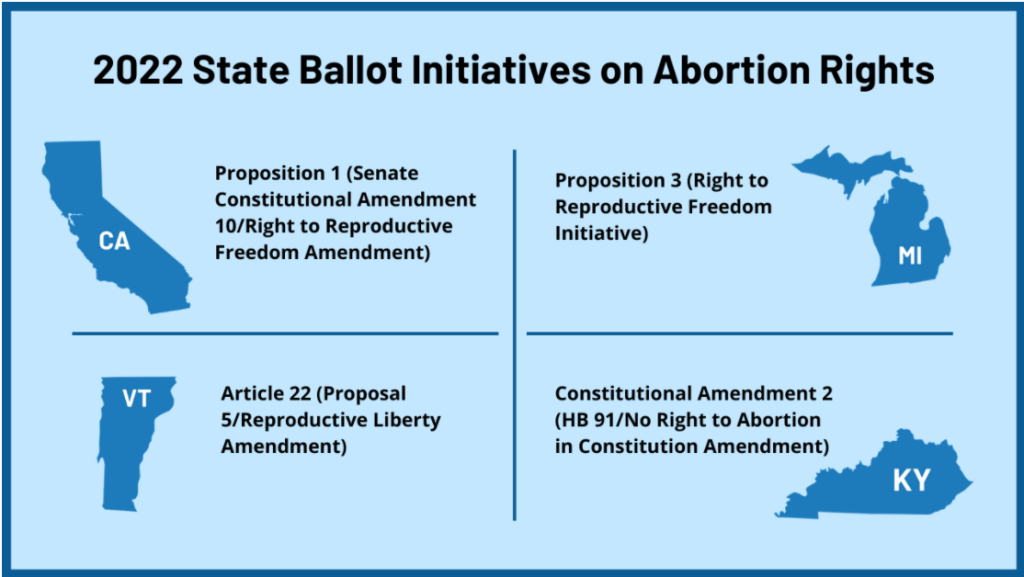
Photo taken from: Michelle Long / kff.org
Policy Summary
[SSB theme=”Official” align=”center” counter=”true” ]
As the dust settles from the 2022 mid-term election, it’s clear that the threat to abortion rights helped galvanized activists into bringing the prospect of a “red wave” down to a small tidal shift in Republican representation. An Emerson College poll conducted in July already predicted a tightening of the races after the Supreme Court overturned Roe V. Wade.
It’s clear that abortion access motivated voters to the ballots. Despite the United State’s economic issues and low presidential approval ratings, which historically indicates a major shift in representation, Republicans are predicted to hold just a small majority in the House. An in-depth analysis between states with anti-abortion policies and states on the brink of abortion rights can provide more insight.
Policy Analysis
Anti-Abortion States
Anti-abortion states ultimately held their ground during the mid-term election cycle on high-profile candidates. Governors Gregg Abbot, Brian Kemp, and Ron DeSantis were reelected to their positions in Texas, Georgia, and Florida. Republican nominee Sarah Huckabee Sanders won decisively in the election for Governor of Arkansas. Also, Republicans J.D. Vance and Ron Johnson defeated Democratic candidates for Senate seats in Ohio and Wisconsin.
However, three major exceptions to the anti-abortion siege happened in the states of Montana, Kentucky, and Arizona. Montana rejected a ballot measure that would allow criminal penalties for health care workers providing abortion procedures. Also, Kentucky rejected a measure that would amend their constitution to state that abortion is not a protected right.
Arizona was also a state where legal definitions of abortion were thrown into chaos after the recent Roe V. Wade Supreme Court decision. Arizona’s 1864 law on banning abortion immediately became a predicament to activists in the state. The recent election results can be interpreted as a referendum on the archaic law.
Republican nominee Kari Lake lost her election for state governor to Democratic Secretary of State Katie Hobbs. Also, Republican Senate nominee Blake Masters lost the election to Arizona gubernatorial candidate Mark Kelly.

Photo taken from: Getty Images
Precipice States
States on the precipice of protecting abortion rights ultimately favored the right to choose. Michigan voted in favor of a ballot measure that would enshrine the right to an abortion under their state constitution. Vermont and California also voted in favor of similar measures.
Michigan Governor, Gretchen Whitmer’s approval rating was bolstered enough, after the Roe V. Wade decision, for a decisive win over Republican challenger Tudor Dixon. Michigan Attorney General, Dana Nessel held her ground against Republican challenger Matt DePerno, who supported banning abortion with no exceptions.
Other major losses for the anti-abortion agenda in Michigan include Republican nominees for the 3rd and 7th Congressional Districts John Gibbs and Tom Barret.
In the state of Pennsylvania, Attorney General Josh Shapiro defeated Republican Nominee Doug Mastriano for state governor. Democratic Lieutenant Governor John Fetterman beat Dr. Mehmet Oz for Senate in Pennsylvania. Both Oz and Mastriano made clear their anti-abortion beliefs during the campaign.
It’s no question that abortion activism helped prevent the predictions of a “red wave” taking over the United States. However, a major election between Georgia’s Democratic Senator Raphael Warnock and Republican challenger Herschel Walker remains undecided as a runoff will take place on December 6th. Donating to his campaign may help ensure a stronger majority in the Senate and the future of abortion rights in the United States.
Engagement Resources
Click or tap on resource URL to visit links where available


The Ukraine Crisis; Situation Update #16
The Ukraine Crisis; Situation Update #16
Foreign Policy Brief #158 | By: Abran C | November 24, 2022
Header photo taken from: Facebook
Follow us on our social media platforms above
Browse more foreign policy briefs from the top dashboard

Photo taken from: Inquam Photos
Policy Summary
[SSB theme=”Official” align=”center” counter=”true” ]
Deadly missile strikes in Ukraine have made headlines in recent days for the widespread destruction and chaos being generated through their use. Last week a missile strike killed two civilians in Poland’s eastern region near its border with Ukraine. The missiles were at first thought to have been fired by Russian forces, which would have indicated a Russian attack on a NATO member state. The situation created such panic that an emergency NATO roundtable was held on the sidelines of the G20 summit to address the attack.
However, it was later revealed that the missiles were in fact accidentally fired by Ukranian forces. Polish authorities believe that the strike was most likely caused by Ukrainian air defense attempting to intercept a missile fired by the Russian military. Though obviously tragic regardless of who fired the missiles, the knowledge that it was not Russian forces who attacked a NATO member provided relief for a global community fearing a major escalation in the war. In response to the attack Poland’s Defence Minister Mariusz Błaszczak announced that Poland would accept German patriot missile launchers near its eastern border to defend against possible further attacks.
The confusion over who was responsible for the missile strike in Polish territory stemmed from the fact that after their recent withdrawal from Kerson, Russian forces launched an intense wave of airstrikes on cities across Ukraine. The strikes created widespread blackouts and hit residential buildings in multiple cities including in the capital, Kyiv. The barrage targeted key cities from Lviv in the west to Kharkiv in the northeast, destroying infrastructure in what was one of the largest coordinated attacks of the war thus far.
The strikes have wreaked havoc on Ukraine’s power grid and will leave millions in the dark as winter has begins. The head of Ukraine’s national power grid operation has described the damage dealt to Ukrainian power infrastructure by Russian missile attacks as “colossal”.
Azerbaijan-Russian Gas Deal
A deal signed between Azerbaijan and the EU earlier this year was meant to help remove dependence on Russia for Europe’s energy needs and find alternatives to brace for the coming winter.
Now it seems that as a result of the deal Azerbijan has begun to import gas from Russia in order to meet its own domestic demand for energy. On November 18, Russian gas producer Gazprom announced that it had begun supplying gas to Azerbaijan’s state gas company SOCAR.
Azerbaijan is seeking to maintain supplies to its domestic gas customers while also meeting its export commitments to various countries such as Georgia, Turkey, and now its recently expanded trade with Europe. More gas was needed and the Azeri government turned to Russia to help fill the gap.
This clearly creates problems for the EU’s commitment to ween itself off of Russian energy.

Photo taken from: BP
If the EU’s purchase of gas from Azerbaijan is directly leading to the purchase of more gas from Russia, it creates major holes in the EU attempts to sanction and punish Russia for its invasion of Ukraine.
The Makings of a Global Conflict

Photo taken from: Tasnim News Agency
As we have seen over the past few months, the war in Ukraine is not a self contained event without spill over into the rest of the global community. Different countries have taken different sides and approaches to the war. in some instances previous allies have aligned themselves into different camps, others have instead strengthened their ties and resolve. Still others have more solidly solidified their hostility towards perceived enemy nations. One stark example, the US has accused North Korea of secretly supplying Russia with artilery shells. US officials believe both North Korea and Iran have supplied Russia with weaponry needed to continue its invasion.
Meanwhile, the US announced this month that it intends to buy 100,000 rounds of artillery ammunition from South Korean arms manufacturers to provide to Ukraine. The arrangement allows South Korea to circumvent its pledge that it would not send lethal aid to Ukraine. There have already been increasing tensions on the Korean peninsula and it is worrisome that the two Koreas would provide weaponry to a war between two neighbors in Europe. On Tuesday at a World Cup match, Hungarian Prime minister Viktor Orban, wore a scarf depicting the old Hungarian imperial territory that existed before Austria-Hungary’s defeat in World War One.
The territory depicted on Orban’s revisionist map presented territory from Romania and Ukraine as within Hungary’s borders. Orban is one of Putin’s strongest allies in Europe and the only one in the EU. Ukraine’s foreign ministry spokesman Oleg Nikolenko said Kyiv was summoning Hungary’s ambassador to express severe disapproval of the move.
Though the act itself was not violent, it sends a powerful message as to what this leader within the EU sees as his country’s rightful territory and even raises fear about alliances and the possibility of future land disputes rather than unity and peace. It shows that the war in Ukraine has had profound international effects in a number of sphere.

Abortion: How Abortion Rulings Could Affect Women in America
Abortion: How Abortion Rulings Could Affect Women in America
Health & Gender Policy Brief #149 | By: Inijah Quadri | November 22, 2022
Header photo taken from: PBS Newshour
Follow us on our social media platforms above
Browse more health and gender policy briefs from the top dashboard

Photo taken via Facebook
Policy Summary
[SSB theme=”Official” align=”center” counter=”true” ]
By basically overturning Roe v. Wade, six unelected Supreme Court judges took away the right of tens of millions of women to make their own decisions about their bodies. After their ruling, several areas in the United States were to be transformed into a dystopian nightmare of online tyranny, where even a Google search for “abortion medication” could be used as evidence against people seeking abortions. Your location data could also be used against you if you try to have an abortion in another state where it is still allowed. This was considered a total nightmare for most people.
Surprisingly, the New York concealed carry law was knocked down by the same Supreme Court the day after Roe v. Wade was reversed, making it easier to carry a concealed weapon in public. Thus, the Supreme Court made a ruling the same week that states do not have the authority to adopt their own gun-control laws but do have the right to establish their own women’s control measures. This caused a lot of uproar, some of which suggested that women should “start lobbying to get uteruses recognized as a legitimate type of assault weapon.”
Policy Analysis
In the wake of recent abortion bans being passed in several states , many women are left wondering what this could mean for their reproductive rights. While the full effects of these bans are yet to be seen, it is most likely that they would have a negative impact on women’s health and well-being.
For one, abortion bans could lead to an increase in the number of unsafe, illegal abortions. This is because women who are unable to get legal abortions may resort to desperate measures in order to end their pregnancies. This could put their health and even their lives at risk.
In addition, abortion bans could also make it more difficult for women to access other essential reproductive healthcare services, such as birth control and prenatal care. This is because many of these services are provided by the same clinics that offer abortions.
Third, women who need or want abortions would be forced to either travel to another state or another country to get one. This would put them at risk of both physical and legal harm. Women who can’t afford to travel or take time off from work would be especially harmed by these bans.
Fourth, abortion bans would also likely lead to an increase in unplanned pregnancies. This would put a strain on both the women themselves, as it would limit women’s career aspirations. It could also lead to several employers refusing to employ “childbearing” women, even if they are not pregnant at the time of seeking the job. This will inevitably cause inequality down the line between men and women.

Photo taken from: Teresa Crawford / The Associated Press
(click or tap to enlargen)
What Voters Did To Protect Abortion Rights in the Recent Elections
Voters in various places where the issue of abortion rights was on the ballot unanimously voted to uphold women’s access to safe and legal abortion. Many states, including Kentucky, Michigan, Vermont, California, and Montana, saw a surge in support for abortion rights.
Voters also rejected a bid to alter the Constitution to explicitly outlaw abortion in Kentucky, an extremely conservative state. In Montana, a majority of voters opposed a measure that would have further restricted access to abortion.

Chart taken from: The Conversation (.com)
Conclusion
In conclusion, it is clear that abortion bans could have a significant impact on women in America. Not only would they be criminalized for having an abortion, but they would also face a number of other challenges. While it is impossible to know exactly how many women would be affected by an abortion ban, it is clear that most American men and women are not waiting to find out; with the recent elections, it is clear that at least a few men and women are willing to consider abortion bans.
We hope that this citizen outcry will lead to a more open dialogue between individuals in the United States corridors of power about abortion and the role it plays in people’s lives. In addition, we hope that this dialogue will lead to a reinstatement of Roe v. Wade which will see an increased number of women having abortions when they need them.
Engagement Resources
Click or tap on resource URL to visit links where available

CBS New York: (https://www.cbsnews.com/newyork/live-updates/supreme-court-new-york-concealed-carry-gun-law/)
CNN Business: (https://edition.cnn.com/2022/06/24/tech/abortion-laws-data-privacy/index.html)
CNN Politics: (https://edition.cnn.com/2022/11/09/politics/abortion-rights-2022-midterms/index.html)

Occupy Democrats: (https://m.facebook.com/OccupyDemocrats/photos/a.347907068635687/1728121793947534/)

PBS News Hour: (https://www.pbs.org/newshour/politics/watch-what-the-abortion-debate-in-kentucky-will-mean-for-a-post-roe-america)

The New York Times: (https://www.nytimes.com/interactive/2022/us/abortion-laws-roe-v-wade.html)

Time: (https://time.com/6232659/montana-abortion-referendum-fails-midterms-2022/)

Wikipedia: (https://en.wikipedia.org/wiki/Roe_v._Wade)

The Move Away from Plastic is Looking Just as Flimsy
The Move Away from Plastic is Looking Just as Flimsy
Environmental Policy Brief #150 | By: Todd J. Broadman | November 24, 2022
Header photo taken from: iStock
Follow us on our social media platforms above
Browse more environmental policy briefs from the top dashboard

Photo taken from: Reuters / Pierre Albouy
Policy Summary
[SSB theme=”Official” align=”center” counter=”true” ]
We are a world addicted to plastic, the most perceivable, persistent and pervasive indicator of the Anthropocene. Plastics are produced from natural gas, feedstocks derived from natural gas processing, and each year more is produced. The current production rate is 400 million metric tons and is the source of 5% of CO2 emissions. By 2030 it will be 600 million metric tons, and 800 by 2040.
In addition to its contribution to greenhouse gas in its production, 91% of plastic is not recycled and much of it ends up in the ocean, about 200 million tons by current estimates; about 10 million tons are added each year with some of it flowing to one of five major gyres, ocean currents that gather marine garbage into their vortexes.
To limit plastics use, there was an agreement put in place in 2018: the EMF Global Commitment. Since its inception, global corporate brands like Coca-Cola, PepsiCo, and Mars actually increased the amount of plastic they create since its launch in 2018. Companies like Nestlé point a finger at the lack of infrastructure as the main barrier for a plastic-free future. Nestlé is therefore actively advocating for a legally binding global plastics treaty and the prospect of new, harmonized national regulations.
95% of their packaging will be made for recycling by 2025; Coca-Cola, a major COP27 sponsor, has chimed-in saying that 100% of their packaging will be recyclable by 2025. Coca-Cola produces around 120 billion oil-based plastic bottles annually, according to anti-plastics campaigners Break Free from Plastics. Around 99% of the bottles are produced with fossil fuels and most are not recycled.
The ocean is showing signs of succumbing to toxic microplastics. By 2050, there could be more plastic in the oceans, by weight, than fish. Cleaning up what is there is proving a technical challenge. In fact, Katie Matthews, chief scientist at the nonprofit advocacy group Oceana, said that we need to face a reality in which “We can’t clean up our way out of plastic pollution.” Microplastics have made their way throughout the food chain from phytoplankton to zooplankton, in turn consumed by mollusks and small crustaceans like shrimp, and eventually all the way to the bodies of baleen and blue whales. Research shows that zooplankton actually graze directly on microplastics. So ubiquitous, there is a layer of sea called the plastisphere. On land, microplastics are found in human blood, feces, and in the placentas of unborn babies. Their impacts on health are yet to be determined and are under research.
Policy Analysis
91% of plastics end up either in landfills or in the water system. Over time, the plastic is broken down into pepper flake sizes, all-combined they tally up to half a million tons. Much of it not from obvious sources, these microplastics come from synthetic clothing, personal care products, tires, city dust, and from the breakdown of plastic debris. Sewage treatment plants are not equipped to filter them and they end up in the ocean. Studies of ocean sediments find that the amount of plastics found correlates with production increases over time.
Large scale ocean clean-up at this juncture will not take place. While cleanup technologies have a role to play in cleaning up ocean plastic, no single solution can effectively reduce ocean plastic. Just 1% of ocean plastic ends up in the large patches or gyres and the remainder is spread thin over thousands of square miles. What researchers agree on is that societies must undergo a fundamental and systemic change that includes the banning of single-use plastics, using compostable materials, and mandating recycling for everything else.
“We’re pretty close to it all being too late,” said Judith Enck, founder of Beyond Plastics and a former regional director for the U.S. Environmental Protection Agency. She references the large number of ethane cracking facilities, the latest in high technology plastics production. “If even a quarter of these ethane cracking facilities are built,” she says, “it’s locking us into a plastic future that is going to be hard to recover from.”
Though spotty, governments around the world have been taking action. Many US cities, including New York and Chicago, ban or tax plastic bags. The European Union went as far as banning single-use plastics outright in June of 2021. The goal of the ban is to establish a circular economy that emphasizes the needs of reuse, repair, and recycle in the design and manufacturing of plastics and plastic products.
In March of 2022, the United Nations Environment Assembly (UNEA) passed a resolution that mandated a treaty be created to address plastic pollution throughout the entire production cycle. The treaty will be legally binding – the equivalent of the Paris Accords on climate change. It is to include micro- and nanoplastics and associated toxic chemicals. Details are too finalized by 2024.
Like the Paris Agreement, targets were set and are not expected to be met in large part because economies have not taken the necessary steps to transition away from petroleum-based products and services.


Chart taken from: Dynisco, Photo taken from Getty
(click or tap to enlargen)
“In the context of a world trying to shift off of fossil fuels as an energy source,” says Steven Feit, a staff attorney at the Center for International Environmental Law, “plastics are where [oil and gas companies] see the growth.”
While those efforts are taking shape, Shell’s $6 billion ethane cracking plant – a facility that turns ethane into ethylene, a building block for many kinds of plastic – is now operational in Pennsylvania. That plant alone has the capacity to produce up 1.6 million tons of plastic. This represents the “renaissance in U.S. plastics manufacturing,” whose output goes not only into packaging and single-use items such as cutlery, bottles, and bags, but also longer-lasting uses like construction materials and parts for cars and airplanes.
On a positive note, the use of virgin plastic by major brands is going down in favor of recycled material. The Ellen MacArthur Foundation has spearheaded the Business Coalition for a Global Plastics Treaty which they say will feed into the U.N.’s upcoming treaty. Yet as industry is given a green light to continue with plastics production, there is a lack of investment in recycling infrastructure and flexible packaging. There are no plastics off-ramps that government is offering and the production of reusable plastic is actually falling year on year.
Engagement Resources
Click or tap on resource URL to visit links where available

https://www.hrw.org/ investigates and reports on abuses happening in all corners of the world.

https://www.plasticsoupfoundation.org/ focuses on the link between plastics and human health.

https://www.smartgreenpost.com/ a blog on environmental issues, from climate change to recycling.

https://www.foodpackagingforum.org/ enables stakeholders to make better decisions on the environmental impacts of food packaging.

Examining the Integrity of Voting Systems
Examining the Integrity of Voting Systems
Technology Policy Brief #73 | By: Steve Piazza | November 15, 2022
Header photo taken from: Brett Deering / Getty Images
Follow us on our social media platforms above
Browse more technology policy briefs from the top dashboard

Photo taken from: Center on Extremism
Policy Summary
[SSB theme=”Official” align=”center” counter=”true” ]
In 2002, President George W. Bush signed into law the Help America Vote Act (HAVA). HAVA’s passage enhanced existing policy established under the 1971 Federal Election Campaign Act, which created the National Clearinghouse for Information on the Administration of Elections.
The purpose of the newer legislation, which grew out of the contentious election of 2000, was to improve communication between election officials. It also transferred oversight from the Federal Election Commission to the newly formed Election Assistance Commission (EAC).
Amongst other things, HAVA fosters the ongoing commitment to improving technology that replaces outdated, unreliable balloting equipment. This includes adherence to its national elections guidelines addressing the development, certification, and verification processes of voting related operating systems.
It should be noted that EAC acts as a clearinghouse for information and not as a decision making body mandating which voting machines are to be used. That is left up to the states.
Policy Analysis
Following unsubstantiated allegations of voter fraud during the 2020 election, voting equipment suddenly found itself at the center of intense scrutiny. Select images of antiquated and assailable equipment, controversial topics which had been brewing for years, suddenly motivated 2020 election result deniers to seize on the opportunity and attempt to lay blame on everything from the machines to the manufacturers themselves.
Use of electronic voting equipment dates all the way back to the original lever machines of the 1890s. More modern versions surfaced in the 1960s when punch cards and scanned paper ballots came into being. Since the 1970s, direct recording electronic (DRE) voting machines and other paper ballot tabulation systems have become commonplace, though some hand counting still exists in a few locations.
The Voter-Verified (or Verifiable) Paper Audit Trail (VVPAT) was also established and has become more widespread. To date, the use of mobile and other remote devices has been discouraged because of the difficulties in being able to generate a secure paper trail.
According to the National Conference of State Legislatures (CSL) local jurisdictions select and purchase voting systems, but before they are able to do so the system must go through a testing process to ensure that it meets state standards and in some cases federal standards as well.
Voting system vendors are responsible for ensuring that the system is tested—often through a federally accredited Voting Systems Test Laboratory or VSTL—to the required standards. Once testing is complete, approval is issued at the state level and local jurisdictions may purchase the system. Thirty-eight states and the District of Columbia use some aspect of the federal testing and certification program in addition to state-specific testing and certification of systems:
Recently, millions and millions of dollars have been spent on equipment in the United States that has resulted in a number of different configurations. These range from optical scan voting systems that read hand marked paper ballots to DREs providing a touchscreen that generates a paper printout which then must be fed through a scanner to tabulate.

Diagram taken from: Brennan Center for Justice
(click or tap to enlargen)
During the U.S. 2022 midterms, and largely because of reactionary changes in state legislation, nearly 70% of Americans used the optical scan method while almost 25% used a DRE of some kind. By contrast, 92% of countries worldwide use manual paper balloting, and only 10% use a mix of paper ballot and voting machines.
Voting technology world-wide has become much more advanced and is not as vulnerable as some may think, mostly because machines are not on the Internet, a common misconception, and most countries use them adhering to established standards of functionality based on functionality, security, privacy, usability and accessibility (NCSL).
For example Brazil has a nationwide system of voting that only uses voting machines. The entire country votes on one day using the same voting machines which tabulate a result at the end of the day. In Brazil’s most recent presidential election, where soon to be defeated President Jair Bolsonaro railed against the possibility of rigged machines without providing evidence, the election resumed only when it was agreed that the military step in and administer the final counts.
Though the military did report that vulnerabilities for malicious code do exist, it must be emphasized that no irregularities were proven, testimony to the country possessing one the best machine-based election systems in the world.

Photo taken from: Kevin Dietsch / Getty Images
One had to expect that the midterms would lead to claims of faulty machines. Almost immediately on election day, a number of minor complaints and attempts to perpetuate conspiracy theories surfaced, mostly on social media. These included:
- A computer snafu in Detroit resulted in duplicate numbered ballots.
- In Arizona, printer errors occurred in 60 locations and voting tabulators malfunctioned in another 44.
- A scanner malfunctioned in Mercer County, New Jersey.
- Some printers ran out of paper in Luzerne County, Pennsylvania.
- In New York City, complaints over voting difficulties circulated after a voter inadvertently tried to use the AutoMark machine, an assistive ballot device for marking not tabulating.
Minor glitches like these were quickly resolved and there was no evidence of widespread fraud, just as in the 2020 election. Officials claim that any problems were from accidental human error and that the real culprit here is disinformation, a lingering symptom to be sure.
Voting machines still contain some vulnerability to being accessed improperly. But that’s why the popularity of the paper trail strategy is still growing, and that ongoing analysis of voting machine technology is vital. The United States as a whole has a mixed (machine and paper-based) system for recording the votes of citizens. The system seems to be working as witnessed by the last 2 election cycles that have been conducted with no large scale fraud.
Engagement Resources
Click or tap on resource URL to visit links where available

Here is a link to the U.S. EAC page on everything pertaining to voting equipment across the country: https://www.eac.gov/voting-equipment/system-certification-process

The Verified Voting Foundation is a non profit organization advocating for election security in the use of technology: https://verifiedvoting.org/

Learn more about processes and equipment used in your state by clicking here: https://ballotpedia.org/Voting_methods_and_equipment_by_state

Taking a Look at the Georgia Runoff Election
Taking a Look at the Georgia Runoff Election
Elections & Politics Policy Brief #45 | By: Ian Milden | November 16, 2022
Header photo taken from: 11alive.com
Follow us on our social media platforms above
Browse more elections & politics policy briefs from the top dashboard

Photo taken from: The Associated Press / Bob Strong / Reuters
Policy Summary
[SSB theme=”Official” align=”center” counter=”true” ]
Georgia’s Senate Race is going to a runoff. The runoff will be held on December 6th. This brief will explain the concept of runoff elections and take a look at what both parties are doing to prepare for the runoff.
Policy Analysis
Runoff elections are a second round of elections held if no candidate received a majority of the vote. In the United States, runoffs tend to be part of the election system in southern states and usually are only in place after primary elections. Georgia has runoffs in general elections in addition to primary elections.
After the Democratic victories in the 2021 runoff elections, Republicans in the Georgia state legislature voted to change the laws regarding runoffs. They voted to shorten the time between the general election and the runoff to four weeks. They also put new restrictions on early voting and registering new voters between election day and the runoff.
Runoff elections tend to have low voter turnout rates because many voters are not aware of their existence or forget the date of the runoff election, so campaigns tend to emphasize turning out voters who make up their party’s base. The new rules for runoffs reinforce this dynamic and severely limit strategic alternatives for campaigns.
The DSCC, the official campaign arm of Senate Democrats, announced plans to heavily invest in voter contact and turnout to help the campaign of Senator Raphael Warnock (D-GA). The DSCC can also legally coordinate its efforts with the Warnock campaign.
Republicans are turning to Georgia Governor Brian Kemp (R-GA), who just won a second term, to help Herschel Walker (R-GA). Kemp will loan his campaign’s get-out-the-vote operation to the Senate Leadership Fund, a Super PAC run by people with close ties to Mitch McConnell. This loan includes members of Kemp’s staff as well as his data analytics operations. The Super PAC will cover all of the associated costs. There are legal restrictions on the ability of Super PACs to coordinate with official campaign operations.

Photo taken from: Nicole Craine / The New York Times
(click or tap to enlargen)
This is a significant strategic shift for the Super PAC because they have never conducted voter turnout operations. Their previous major expenses to help campaigns were usually television and digital ads. While Kemp’s team is very experienced in helping Brian Kemp win elections in Georgia, Herschel Walker trailed Kemp’s vote count by over 200,000 votes due to voters being unwilling to look past Walker’s long list of scandals. This was a trend that early polling detected in this year’s elections.
The results of the November election were what the polls suggested was the most likely outcome. Raphael Warnock led Herschel Walker by a close margin, but he did not get enough votes to avoid a runoff. I would expect the runoff election to also be close and have a lower voter turnout rate than the November election did.
This race will be decided by who shows up to vote. Based on the results of the November election and the strategic decisions that Republicans and Democrats have announced, Warnock winning re-election is a slightly more likely outcome, but Walker can win if Democrats don’t show up to vote on December 6th.
Engagement Resources
Click or tap on resource URL to visit links where available

Senator Warnock’s Campaign Website
https://warnockforgeorgia.com/

DSCC – Official Campaign Arm of Senate Democrats