

JOBS POLICIES, ANALYSIS, AND RESOURCES
Latest Jobs Posts
States Continue Efforts to Remove Facts from History
Brief #60 – Education Policy
By Steve Piazza
Six states have recently signed into law restrictive measures regarding the teaching of race in K-12 schools. New laws in Florida, Georgia, Kentucky, Mississippi, South Dakota, and Tennessee consist of, amongst other things, measures prohibiting anything appearing on a list of “divisive concepts.”
George Santos and the Character of Congress
Brief #62 – Elections and Politics
By Maureen Darby-Serson
George Santos, elected to the House of Representative through an upset in a New York seat, has been at the center of several scandals since the election. What first became a question of his resume soon turned into legal questions about where campaign finances came from.
The GOP’s Alarming Opposition to Raising the Debt Ceiling
Brief #52 – Economic Policy
By Caroline Howard
The United States is currently heading toward the path of a debt default, for the first time in the nation’s history. This could have catastrophic effects not only on the American economy but on the entire world economic order. The country already went past its debt ceiling in January, going over the 31.4 trillion dollar limit it set for itself in December 2021.
America’s Old-Growth Forests in Need of New Protections
Brief #152 – Environment Policy
By Todd J. Broadman
Just over a third of what remains as forested land in America is classified as “old-growth forest,” equivalent to 167 million acres. By definition, old-growth is at least 80 years old, and just 24% of old-growth forest is fully protected – the balance exposed to the risk of logging. 58 million acres of this old-growth forest are on federal lands under management by either the U.S. Forest Service or Bureau of Land Management.
Alaska Republicans Should Learn a Lesson About Altering Election Rules from Georgia
Brief #51 – Elections & Politics
By Ian Milden
After Democrat Mary Peltola (D-AK) won a special election for a U.S. House seat and the subsequent general election, Republicans in the Alaska state legislature are attempting to abolish the all-party primary system that was established by a voter referendum before the special election.
The Week That Was #3
Brief #168 – Foreign Policy
By Abran C
A new series to catch you up on the top stories that occurred around the world last week.
Brazil indigenous genocide | US secretary of state Anthony Bliken visits the Middle East | France protests against raising the retirement age
North Dakota Anti-Trans Law Will Jail Librarians For Displaying Books About Sexual and Gender Identity
Brief #156 – Health and Gender Policy
By Caroline Howard
A new law introduced in North Dakota will make it a class-b misdemeanor for librarians in public libraries to have any books on display that are deemed “sexually explicit”. Within this list of topics that meet the definition of sexually explicit, are the classifications of sexual identity, and gender identity.
Fox News’ Role in FIFA Corruption Trial
Brief #167 – Foreign Policy
By Reilly Fitzgerald
The Fédération Internationale de Football Association, more famously known as FIFA, is the global face of football (or soccer, for Americans). They make the rules of the sport, they can sanction players and teams for misconduct on the pitch, they decide the when and where of major tournaments, they decide the TV rights for tournaments, and they also decide where to take bribes from.
Corruption and global sports have always been entwined; just as sports and politics have been. In regards to the most recent world cups in Qatar (2022), Russia (2018), and Brazil (2014), there has been a consistent documented pattern of corruption in which individual executives and corporations have been banned, imprisoned, sanctioned.
China’s “Zero-COVID”: Was it worth it?
Brief #154 – Health and Gender
By Geoffrey Small
During December, 2022, citizens of China took to the streets and sparked a mass protest against the government’s “zero-COVID” policies that had been in place for over two years.
According to Human Rights Watch, prolonged lockdowns, administered unpredictably, by the CCP (Chinese Communist Party) have hampered accessibility to necessities like food and proper healthcare.


Nice Democracy You’ve Got Here. Shame If Something Happened To It.
Nice Democracy You’ve Got Here. Shame If Something Happened To It
Elections and Politics Policy Brief #36 | By: David A. Graham | September 19, 2022
Header photo taken from: The Atlantic
Follow us on our social media platforms above
Browse more elections & politics policy briefs from the top dashboard

Photo taken from: Alex Kent / Agence France-Presse — Getty Images
[SSB theme=”Official” align=”center” counter=”true” ]
Originally posted for The Atlantic
The line between imagination and delusion is thin, as Donald Trump’s initial reaction to an FBI search at Mar-a-Lago in August demonstrated. In the first days afterward, the former president saw the search as a political gift, not a blow: a chance to rally his base, put would-be challengers like Ron DeSantis in their place, and reconsolidate his eroding position as the leader of the Republican Party.
Over time, it has become clear that the FBI finding reams of top-secret documents at his club is not, in fact, a boon to Trump. Even with the presidential-records investigation slowed down by a sympathetic judge, the probe has exacted costs both political and monetary, including a $3 million prepayment to a lawyer aware of Trump’s tendency to stiff people who provide services.
Nearly every Trump adviser you’ve ever heard of, plus a few you haven’t, has been subpoenaed by the Justice Department in an investigation into election subversion, and the House committee looking into the same matter will return to public hearings later this month. The New York attorney general just rejected a settlement offer in an investigation into Trump’s business.
No single strategy can handle the range of problems Trump faces. With some clever forum-shopping, he managed to get the FBI investigation into the hands of a judge whom he appointed late in his term—she was confirmed after the 2020 election—and whose rulings have baffled and appalled legal experts. But this is a stalling tactic, not a solution, and not every judge draw will be so lucky. A second strategy is to cry political persecution, which is good at rallying the minority of the population who already stands behind him but unlikely to win over those who don’t, especially because the claims are so unpersuasive.
This brings us to a third gambit: threats. If the people pursuing these criminal investigations into his conduct don’t back off, he warns, someone—not him, mind you—might do something dangerous. In this heads-I-win, tails-you-lose logic, the justice system can either exempt Trump from the rule of law or risk someone destroying it by other means. Nice democracy you’ve got here. Shame if someone tried to make it great again, again.
In an interview yesterday, the conservative radio host Hugh Hewitt, a Trump critic turned flatterer, asked whether being criminally indicted would dissuade Trump from running for president in 2024. Trump took the answer in a dark direction.
“I don’t think the people of the United States would stand for it,” he said. “I think if it happened, I think you’d have problems in this country the likes of which perhaps we’ve never seen before. I don’t think the people of the United States would stand for it.”
The implication was clear enough that Hewitt felt the need to throw Trump a preemptive lifeline: “You know that the legacy media will say you’re attempting to incite violence with that statement.”
“That’s not inciting,” Trump replied. “I’m just saying what my opinion is. I don’t think the people of this country would stand for it.”
But there’s no need to believe he’s merely making an analytical judgment. Anyone else can see as clearly as Hewitt what Trump is doing. As The Atlantic’s editor in chief, Jeffrey Goldberg, has noted, Trump commonly uses this mob-boss-derived method: He speaks in fluent innuendo and implication, making his desires clear while leaving himself just enough vagueness to be able to smirkingly deny it.
Like a Mafia don’s warnings, this Don’s warnings serve as a kind of intimidation, trying to make authorities who care a great deal about the government, civil peace, and the reputations of their agencies (as Attorney General Merrick Garland clearly does) wonder whether it’s really worth enforcing the law against this particular would-be defendant.

Photo taken from: Forbes
(click or tap to enlargen)
These threats might also actually occasion violence. By now, everyone—Trump, Hewitt, you, me—has seen this happen. Sometimes, the violence comes from mentally disturbed individuals who think they’re doing what Trump wants, such as Cesar Sayoc, who sent bombs to Trump critics shortly before the 2018 midterms, or Ricky Walter Shiffer, who was killed after attempting to attack an FBI office in Cincinnati just days after the Mar-a-Lago search.
Other times, the violence comes from Trump backers who simply listen to what he says: the kinds of people who slugged protesters at campaign rallies after he waxed nostalgic for the “good old days” of rough treatment and offered to pay legal bills, or who stormed the Capitol on January 6, 2021, after Trump called on them to “fight like hell.”
If there was a time when Trump didn’t know how people would respond when he makes these veiled threats, it has passed. He understands now, and does it anyway. His persistence also helps show why his claims that his exhortations on January 6 were not incitement are not to be believed.
This very real menace also makes Trump’s threats ultimately self-defeating. When he speaks this way—or when he embraces QAnon, or whatever fringe view he happens to be espousing at the moment—it riles up his backers, but it also drives away voters he needs to be a viable political force. This means the threats are unlikely to be Trump’s salvation, even as they could inflict real harm on American democracy. He seems not to care.

The Controversial Texas Voting Access Bill: Its Effects on the Coming Mid-Terms
The Controversial Texas Voting Access Bill: Its Effects on the Coming Mid-Terms
Elections & Politics Policy Brief #36 | By: Inijah Quadri | September 22, 2022
Header photo taken from: Evan L’Roy/The Texas Tribune
Follow us on our social media platforms above
Browse more elections & politics policy briefs from the top dashboard

Photo taken from: Bob Daemmrich / ZUMA Press Wire / REX / Shutterstock
Policy Summary
[SSB theme=”Official” align=”center” counter=”true” ]
The Republican-dominated Texas Legislature on August 19th passed an election bill that Democrats and advocates say will restrict voting rights for minorities.
Republicans inflicted a crushing defeat on Democrats, who fought for months against what they saw as a brazen attempt to disenfranchise minorities, including African-Americans, and other voters who are more likely to vote Democrat.
Once in force, which is expected at the upcoming mid-term elections, the nearly 75-page bill, will notably limit the hours of voting, prohibit drive-through voting, require new ID requirements, and will give increased powers to partisan observers.
Policy Analysis
In a statement released minutes after the bill passed, Governor Greg Abbott, a Republican governor, said he had looked forward to signing a piece of legislation that would make it easier to vote, make fraud harder, and ensure the integrity of elections in Texas. But, did this bill make voting any easier? Take a look below.
The Bill Limits the Hours of Voting
The Bill limits the hours of voting to between 6 a.m. and 10 p.m., instead of the 24-hour period that was in place before. The reasoning behind this change is that it would already cover the usual times people go to the polls, and it would also reduce the potential for fraud.
Postal Voting Changes
The law establishes a new procedure for voters to make changes to their mail-in votes if they are at risk of being rejected due to a technological problem. A new online ballot tracker, authorized by the legislature, would allow voters to make these changes electronically. If a voter makes a mistake on their application for a mail-in ballot, they will be able to fix it under the new law.
The Bill Prohibits Drive-Through Voting
The bill prohibits drive-through voting. This prohibition came about as a result of concerns about the security and integrity of election processes. As such, it is now illegal for Texas voters to cast their ballots through a drive-through window. This restriction prevents individuals from voting outside of conventional polling locations.
The Bill Requires New ID Requirements
Under the new bill, voters would need to provide one of several forms of identification in order to cast a mail-in ballot. These include a driver’s license number or the last four digits of their SSN, rather than the previous name and address on their voter registration card.

Chart taken from: Fair Fight
(click or tap to enlargen)
This change is intended to prevent voter fraud and make the voting process more secure. Critics argue that the new requirements may disenfranchise some voters, particularly those who cannot easily obtain required identification documents.
The Bill Gives Increased Powers to Partisan Observers
This bill also gives partisan observers increased powers during elections. This would include the ability to monitor voting procedures freely. The only restriction would be within the polling booth itself, in which they are not allowed.
How African-Americans and Other Minorities Will Be Impacted by New Texas Voting Law
Research shows that the racial turnout disparity widened when states passed tough voter ID laws. In a similar vein, according to the findings of yet another study, the proportion of Black and Latino voters in Texas who would be disenfranchised in the absence of the state’s “Reasonable Impediments Declaration” (a court-ordered remedy that allows voters who do not have proper IDs to participate) is disproportionately high.
Conclusion
In conclusion, the Texas voting access bill passed recently may have serious consequences on the midterm elections. The bill allows new requirements and procedures, which we have shown you above.
As you may understand, these changes could affect many voters who are not able to (or who may struggle to) meet these requirements. Whatever the case may be, it is best for voters in Texas to be aware of these changes and make sure they are, if need be, prepared to work around them and cast their ballots when the mid-terms come.
Engagement Resources
Click or tap on resource URL to visit links where available

The New York Times: (https://www.nytimes.com/2021/08/31/us/politics/texas-voting-rights-bill.html)

The Wall Street Journal: (https://www.wsj.com/articles/texas-voting-bill-what-you-need-to-know-11630667069)

Explaining Alaska’s Election Reforms: Ranked Choice Voting
Explaining Alaska’s Election Reforms: Ranked Choice Voting
Elections & Politics Policy Brief #37 | By: Ian Milden | September 28, 2022
Header photo taken from: Mark Thiessen / The Associated Press
Follow us on our social media platforms above
Browse more elections & politics policy briefs from the top dashboard

Photo taken from: CNN
Policy Summary
[SSB theme=”Official” align=”center” counter=”true” ]
In the recent special election to replace the late Congressman Don Young (R-AK), Mary Peltola (D-AK) defeated former Governor Sarah Palin (R-AK) and Nick Begich (R-AK). This brief will examine the recent election reforms in Alaska that led to the upset and how they may affect the U.S. House and Senate races this year. The brief will also briefly discuss the implications of ranked choice voting.
Policy Analysis
Alaska implemented a ranked choice voting system after approving it in a ballot referendum in 2020. The system has a primary where all candidates compete for four spots on the general election ballot. The primary is not separated by party, similar to primary elections in California and Louisiana. The four slots on the general election ballot are reserved for the candidates with the four highest vote totals, regardless of party affiliation.
In the general election, voters then have the option to rank candidates. If no candidate receives a majority of the vote in the initial ballot count, the votes for the last-place candidate are redistributed to the second-choice candidate of those voters. This process is repeated with the third-place candidate if no candidate has a majority of the votes after the last-place candidate is eliminated. Voters are not obligated to pick a second or third choice.
Nick Begich (R-AK) was the third-place candidate in the special election, so the people who selected him over Sarah Palin and Mary Peltola had their votes redistributed. Many of Begich’s supporters did not choose to support Palin or Peltola. Some of Begich’s supporters had Peltola as their second choice due to their distaste for Palin, which helped Peltola win.
U.S. House Race
The special election only filled the seat for the remainder of Don Young’s term, which expires in January of 2023. Mary Peltola, Sarah Palin, and Nick Begich will all be in the general election again in November. While the candidates will be the same, the results can be different this fall.

Graph taken from: Sightline Institute
(click or tap to enlargen)
Special elections have unusual voter turnout patterns and low participation rates, so a normalized electorate may help the Republicans perform better in November. It’s also possible that Republicans vote differently to improve the chances of a Republican winning the election after seeing the results of the special election.
However, there isn’t any history to examine to make predictions on voter behavior.
U.S. Senate Race
Senator Lisa Murkowski (R-AK) is running for re-election. Her main opponent is Kelly Tshibaka. Democrat Patricia Chesboro and Republican Buzz Kelley will also appear on the general election ballot, but neither of them got over 10% of the vote in the primary. Kelley recently suspended his campaign and endorsed Tshibaka, though his name will still be on the ballot.
Tshibaka has held roles in the Alaska state government with the most recent being in the Alaska Department of Administration. Tshibaka is positioning herself to be a more conservative alternative to Senator Murkowski. Based on the primary votes and my educated guess on voter behavior, Murkowski will likely pick up Chesboro’s supporters when votes are redistributed if no candidate receives a majority of the votes. Murkowski finished ahead of Tshibaka in the primary and won a majority of the Republican vote in the primary.
The Senate Leadership Fund, a super PAC aligned with Senator Mitch McConnell (R-KY), recently canceled an advertising campaign planned to help Senator Murkowski’s campaign. Officials with the super PAC said that they canceled the reserved campaign ad time because they expect Murkowski to win.
Implications of Ranked Choice Voting
Ranked Choice Voting is not necessarily better or worse than the plurality winner systems used by most jurisdictions in the United States. Ken Arrow’s Impossibility Theorem argues that no election system is perfect. While I am not personally endorsing or condemning ranked choice voting, voters may have to consider the benefits and consequences of ranked choice voting.

Photo taken from: Daniel Clark / The Nevada Independent
(click or tap to enlargen)
Some organizations, such as the nonprofit FairVote, are pushing for the implementation of ranked choice voting through ballot initiatives, like the one that will appear on Nevada’s ballot this fall. The supporters of ranked choice voting may present an overly optimistic view of ranked choice voting that glosses over or ignores the potential challenges and drawbacks of ranked choice voting, such as the long time it takes to redistribute votes from eliminated candidates. This process took three weeks in Alaska’s special election.
A major selling point for ranked choice voting is that it allows voters to do more to express their preferences. While ranked choice voting may allow voters to express some form of preference among the available candidates, the ranking and redistribution of votes may not accurately reflect the overall preferences of the electorate. The special election for Alaska’s U.S. House race reflects this because most voters would have preferred a Republican candidate for the seat, but a Democrat ended up winning because the Republican candidate with more votes after the first round was unpopular within her own party. As long as Alaska continues to use this election system, the redistribution of votes can impact election results in this manner.

The U.S. Must Assure Voting Access for All and Free and Fair Elections
The U.S. Must Assure Voting Access for All and Free and Fair Elections
U.S. Resist News Op Ed | By: Abigail Hunt, Inijah Quadri, Steve Piazza, Rod Maggay and Ron Israel | September 26, 2022
Header photo taken from: Getty Images

Photo taken from: Jay Janner / Austin American-Statesman / The Associated Press
Policy Summary
At the core of the American republic is the principle of consent of the governed, or as Alexander Hamilton put it, “Here, sir, the people govern” (Alexander Hamilton “Remarks on the U.S. House of Representatives, at the New York state convention on the adoption of the Federal Constitution,” July 27, 1788
And yet in recent years there have been efforts in several states, e.g. Georgia, Texas, Florida, to restrict the right to vote. Many of these efforts seem to be aimed restricting minority access to the ballot box and keeping Republicans in power.
They have been enacted in response to the Trump big lie that the 2020 election was stolen. They respond to problems that heretofore have not existed. The regulations threaten the fairness and the outcomes of the 2022 and 2024 federal elections.
U.S. RESIST NEWS offers the following suggestions to prevent these regulations from going into effects. In the long-term Congress needs to pass several important pending federal legislative proposals that will put all federal elections on a fair and equal footing for American citizens.
These proposals include passage of pending Federal voting rights legislation aimed at ensuring and maximizing voter access, transparent counting of ballots, and the security of election workers. Much needed efforts also are underway in several states to do away with the practice gerrymandering by establishing non-partisan Independent Redistricting Commissions
Policy Analysis
Options are limited for addressing new state-level voting restrictions before the mid-terms. However there are some actions that have already been taken and may help. These include the following:

Photo taken from: New York Civil Liberties Union
- Mounting legal challenges to the new restrictions, are are being done by the ACLU and the Department of Justice.

Photo taken from: PBS Newshour
- Taking steps to protect poll workers from harassment, as is being done through a new Law Enforcement Election Task Force established by the Department of Justice, the FBI, and the Department of Homeland Security.

Photo taken from: Our Common Purpose
- Accelerate voter education and voter turnout efforts that make people aware of the new voter restrictions and how to address them.
Open, free and fair voting processes are at the heart of our democracy. We must protect the right to vote at all cost.

Is Saudi Arabia a Gulf State … or a Golf State?
Is Saudi Arabia a Gulf State … or a Golf State?
Foreign Policy Brief #149 | By: Reilly Fitzgerald | September 21, 2022
Header photo taken from: First Sportz
Follow us on our social media platforms above
Browse more foreign policy briefs from the top dashboard

Photo taken from: Getty Images
Policy Summary
[SSB theme=”Official” align=”center” counter=”true” ]
This summer has seen the ongoing disagreement and to some degree ‘war’ between LIV Golf and the PGA Tour. The traditional American viewing experience for generations has been the PGA Tour. Millions of viewers tune into individual tournaments throughout the season to see the worlds’ top golf professionals compete on American television. Now, a Saudi-backed challenger has stepped into the arena and has started to offer a significant challenge to the traditional golf watching, and competing, experience around the world.
The Saudi Arabian government has for some time now spent money investing into various sports leagues around the world. The Saudi Public Investment Fund (PIF) is their organization in charge of the splashing of money around the world of professional sports.
During the 2021-2022 English Premier League season, the world was shocked by the financial take-over of Newcastle United by the PIF, an investment which turned Newcastle United into the most expensive professional football club in the world above the likes of FC Barcelona, Real Madrid, Manchester City FC (also has Middle Eastern ownership), Paris Saint-Germain, or Manchester United. Recent reports, in the past week or two, suggest that the PIF may even purchase Italian power-house football club Inter Milan.
These purchases are not just a way for Saudi Arabia to splash money around for fun; as we have discussed at length through many articles and briefs for U.S. Resist News, sports is an essential tool in the world of soft power international relations. Saudi Arabia’s Prince Mohammed bin Salman is not buying these clubs for the sole pleasure of enjoying great football and golf.
Policy Analysis
Liv Golf differs from the PGA on many levels. First off, they host a distinctly different set of tournaments at venues across the world – and are trying to find an entirely different vibe to golf than the PGA Tour has not done. The Liv Golf tour is all about quick team-playing golf, and money.
The PGA Tour events have a roster of 100 athletes who play, individually, for four rounds (and half the field is cut after the end of the second round based on scores); which can lead to very long events that can take the better half of a day to watch for a spectator, or to play as a golfer.
Liv Golf has found a fresher way to play golf with 48 golfers competing (no cuts at any time) consisting of teams of twelve teams of three, also with a shotgun format allowing the teams to start at different holes, but at the same time. This entirely new format allows the game to progress at a much faster rate than the PGA Tour.
LIV Golf has also made it entirely clear that they are willing, and able, to pay each and every competitor regardless of their place in the standings at a particular tournament; the last place finisher walks away with $120,000. In addition golfers receive contracts with large up-front funding when they sign on to play for Liv.
The final finisher at a PGA Tour event gets cut and walks away with no pay for the day. The purse money for LIV Golf events is also much higher with the tournament in London holding a purse of $25 million ($20 million spent on the golfers, and the other $5 million going to the top three teams).
According to Golf Digest, the LIV Golf tour also pays for the travel and accommodations of the athletes, their families, their coaches, and caddies; which is something the PGA Tour has never done. LIV Golf even broadcasts their events live on YouTube for free, without commercials.

Graphic taken from: Melange Magazine
(click or tap to enlargen)
The LIV Golf tour also plans on allowing individuals or corporations to purchase an individual team and run it like any other major sports team by selling and purchasing new athletes, or trading athletes; along with this comes all of the major economic boosts such as sponsors, uniforms, and much more.
The money being invested into the LIV Golf Tour by the PIF is attracting players from all over the world; and the amount of money is greater than what some professionals make throughout their career.
The Public Investment Fund is a part of the Saudi Arabian government. The Saudi government rolled out their economic development plan, known as Vision 2030, and part of this ‘Vision’ is planning for a post-oil global economy and attempting to diversify the revenue streams that support the wealth of the Saudi Arabian economy.
Every country in the world is attempting to find renewable energy sources to divest from the oil market as much as possible, and automobile manufacturers are turning to entire electric vehicles to make up more of their production. The goals of the world to combat climate change and dependence on fossil fuels are causing the Saudi Arabians to rethink the amount of money they will be able to draw from the global oil market.

Photo taken from: Andrej Isakovic – Pool / Getty Images
(click or tap to enlargen)
Sports is just a piece of the entire cake that is the investment portfolio of the PIF and the Saudi government’s plans for Vision 2030.
The Public Investment Fund’s spending in sports, renewable energy industries, and other industries has come under scrutiny, as well. The public perception of these new ventures is seen as Prince Mohammed bin Salman trying to repair his image after killing the journalist Jamal Kashoggi in 2018. The Crown Prince has been at the center of this controversy regarding journalism and the free press ever since. It is entirely possible that the motivation, alongside the positive ideas in Vision 2030, is just to save face and improve his image after severely tarnishing it.
LIV Golf is just the latest major sports investment that Saudi Arabia is making; even though there are rumors and ties between other major sporting industries or teams, such as Inter Milan in the Italian Serie A football league. The world is changing quickly, and Saudi Arabia’s royal family appears to have recognized this and is moving to change their ways to accommodate a greener future. In the case of the purchase of Newcastle United, the reactions seem to be fairly mixed; while the PGA Tour has an open lawsuit against LIV Golf, currently.
Engagement Resources
Click or tap on resource URL to visit links where available

Vision 2030 ( https://www.vision2030.gov.sa/v2030/overview/ )

Public Investment Fund (https://www.pif.gov.sa/en/Pages/AboutPIF.aspx )

Mikhail Gorbachev – a Knight of Lightness or Dark?
Mikhail Gorbachev – a Knight of Lightness or Dark?
Foreign Policy Brief #148 | By: Yelena Korshunov | September 19, 2022
Header photo taken from: The Associated Press
Follow us on our social media platforms above
Browse more foreign policy briefs from the top dashboard

Photo taken from: marca (.com)
Policy Summary
[SSB theme=”Official” align=”center” counter=”true” ]
Mikhail Gorbachev was one of the most controversial figures in world politics. The Former USSR (Union of Soviet Socialist Republics) President died at the age of 92 in Moscow on Tuesday, August 30, after a severe and prolonged illness. The last, fifth general secretary of the Soviet Communist Party, Gorbachev was also the the last president of the USSR. He is not popular in today’s Russia, while his actions are often appreciated in the Western world. Many Russians believe that Gorbachev solely ruined the “powerful country” (USSR). However previous Communist regimes had led the Soviet Union to the point when it couldn’t exist anymore in its wobbly model, both economically and ideologically.
Attempt at Building Democracy
Gorbachev is considered the main initiator of a policy called “perestroika”.
The term refers to the restructuring or reforming the economic and political system. Perestroika referred to increased automation and labor efficiency, but came to entail greater awareness of economic markets and the ending of central planning.
The word “glasnost” was another phrase that became a symbol of Gorbachev’s era. “Glasnost” meant open decision-making and free access of citizens to information. It was an explosion of unprecedented freedom in the dark censored world of fearful whispers behind the tightly closed kitchen doors.

Photo taken from: Mr. Allsop History
”Perestroika” and “glasnost” were intended to “stir up” the country. However inconsistent domestic policy and primarily chaotic economic reforms led to a deepening crisis in all spheres of society. This was expressed not in the abstract figures of statistical reports, but in everyday reality. Towards the end of his reign the country returned to the long-forgotten Soviet system of coupons (limited purchase of particular goods). Coupons existed for all essential food items, such as sugar, and even for soap.
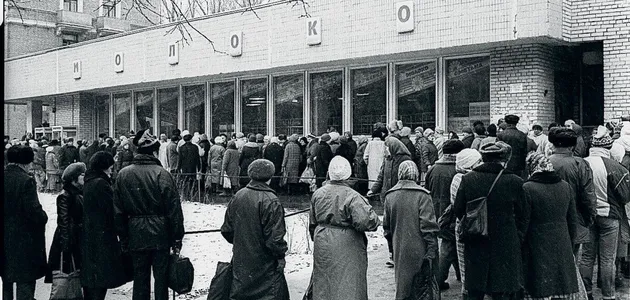
Photo taken from: obozrevatel
Bloody inter-ethnic strife also broke out in the Soviet Union. The fire of conflicts flared up in Central Asia, Transcaucasia, and Moldova. The nation blamed the many misfortunes of that time, first of all, on Gorbachev himself.
“New thinking” foreign policy
The foreign policy of “new thinking” associated with the name of Mikhail Gorbachev contributed to a radical change in international relations. “New Thinking” was Gorbachev’s slogan for a foreign policy based on shared moral and ethical principles to solve global problems rather than on Marxist-Leninist concepts of irreconcilable conflict between capitalism and communism.
Under this concept of foreign policy, relations between the Soiviet Union and other countries improved. Better relationships with the United States resulted in a thawing of the Cold War between the two countries. Russia’s war in Afghanistan was stopped by Gorbachev, and political connections with China improved.
Member states of the Soviet Union broke away and declared their independence. “Velvet” revolutions sprang up in the countries of Eastern Europe, and the unification of Germany took place. On November 9, 1989, the Berlin Wall fell – a symbol of the division of the city, the German nation and the whole continent that lasted 40 years.
The Nobel Peace Prize in 1990 was awarded to Gorbachev for his contribution to easing international tensions
Policy Analysis
Speaking about Gorbachev’s period in general, we cannot underappreciate his attempts of saving the collapsing country, building democracy in the world’s biggest traditionally totalitarian state, stopping the Cold War, and destroying the iron curtain.
Nowadays Russia’s government aims its active propaganda to idealize the dictatorship of the old Soviet Union and even make bloodthirsty Stalin a national hero again. It supports the belief that Mikhail Gorbachev is a person that ruined an ever powerful Soviet country.
About a month before Gorbachev’s death, journalist Alexei Venidiktov, who was his close friend, expressed to Forbes Russia that Gorbachev was “upset” at the current state of Russia and felt that his “life’s work” had been undone.

Location Tracking Under Scrutiny
Location Tracking Under Scrutiny
Technology Policy Brief #68 | By: Mindy Spatt | September 20, 2022
Header photo taken from: Minh Uong / The New York Times
Follow us on our social media platforms above
Browse more technology policy briefs from the top dashboard

Photo taken from: Anusuya Datta
Policy Summary
[SSB theme=”Official” align=”center” counter=”true” ]
All day, every day, our phones are tracking our locations, collecting minute by minute data on our whereabouts that phone companies, apps can use or sell. Customers may agree to location tracking in order to use a GPS or a fitness monitor, but be less aware of how many others are getting in on the act; Facebook, Amazon, Microsoft are just a few examples of the many apps and services that are continuously keeping track of where we go and what we do. I can’t remember whether I ever gave any of them permission, can you?
The data is frighteningly specific. It isn’t just whether you shopped at Bloomingdales or Target, it is which counters you visited while you were there. Not just whether you went to the drugstore, but whether you looked at allergy meds or aspirin. This data is enormously valuable, spawning an industry now estimated to be worth $12 billion.
Privacy advocates have sounded the alarm in the past but location tracking has remained largely unregulated. With many states banning and criminalizing abortions, the issue has taken on new significance. Data on visits to abortion clinics is easily available for purchase and can be accessed by just about anyone, including law enforcement.
Policy Analysis
According to Business Law Today, “the sheer volume of location data tracked, disclosed, and repurposed is tremendous…[in part due to] the use of multiple systems to track location, and the use of data analytics to combine location data with other personal data, [which] enables both the identification of anonymous data and the compilation of comprehensive and precise profiles of tracked individuals.”
While at one time the industry defended itself by claiming that much of the location data it collects is anonymous, it is now clear that individuals and their interests, activities and personal characteristics can be identified through unique location patterns.
In an extensive investigation into location tracking by the NY Times in 2018, a database purchased from a single company revealed “people’s travels in startling detail, accurate to within a few yards and in some cases updated more than 14,000 times a day.” More recently, Vice Media was able to purchase, from data broker SafeGraph, “information related to visits to clinics that provide abortions including Planned Parenthood facilities, showing where groups of people visiting the locations came from, how long they stayed there, and where they then went afterwards.” Vice paid $160 for the information.
Vice’s report may have what brought SafeGraph to the attention of Senator Elizabeth Warren, who successfully urged SafeGraph and Placer.ai, another data broker, to stop selling the location data of visitors to abortion clinics. Warren noted in her request that the companies were putting the safety of anyone visiting a clinic at risk.
Despite that win Warren warned in a press release that “we can’t rely on the goodwill of Big Tech to protect Americans’ data and safety.” Warren’s goal is to pass legislation, the Health and Location Data Protection Act, that would permanently ban brokers from selling location and health data and establish serious privacy protections for consumers.

Photo taken from: Vice
In the meantime, the Federal Trade Commission is also taking steps to protect abortion related location data, It recently filed sued against Idaho-based Kochava, a data broker that purchases vast troves of location information derived from hundreds of millions of mobile devices. That information is then sold in customized data feeds that match mobile devices to timestamped location information.
According to the FTC “customers are often unaware that their location data is being purchased and shared by Kochava and have no control over its sale or use.”
The FTC alleges that customized data feeds sold by Kochava allow purchasers to identify and track specific mobile device users. “For example, the location of a mobile device at night is likely the user’s home address and could be combined with property records to uncover their identity. In fact, the data broker has touted identifying households as one of the possible uses of its data in some marketing materials.”
If the Kochava suit is successful, the FTC presumably won’t stop there. Themarkup.org identified 47 companies in the data broker business, the majority of whom are likely still selling this type of data and still putting providers and patients at risk.
Engagement Resources
Click or tap on resource URL to visit links where available

There’s a Multibillion-Dollar Market for Your Phone’s Location Data

A uniquely dangerous tool’: How Google’s data can help states track abortions
https://www.politico.com/news/2022/07/18/google-data-states-track-abortions-00045906

Warren, Wyden, Murray, Whitehouse, Sanders Introduce Legislation to Ban Data Brokers from Selling Americans’ Location and Health Data. https://www.warren.senate.gov/imo/media/doc/Health%20and%20Location%20Data%20Protection%20Act.pdf

California Shows What it Means to Protect Children on Social Media
California Shows What it Means to Protect Children on Social Media
Technology Policy Brief #67 | By: Steve Piazza | September 20, 2022
Header photo taken from: Tony Avelar / Associated Press
Follow us on our social media platforms above
Browse more technology policy briefs from the top dashboard

Photo taken from: Getty Images
Policy Summary
[SSB theme=”Official” align=”center” counter=”true” ]
In late August, 2022 the California State Legislature passed AB-2273, The California Age-Appropriate Design Code Act. Built upon existing California laws. AB-2273 is aimed at protecting anyone under 18 from possible harmful effects of social media.
The nearly unanimous agreement is presently on Governor Newsom’s desk awaiting his signature.
If enacted, beginning July 1, 2024 businesses providing platforms that children are likely to access must safeguard their privacy through carefully configured default settings. Such companies are also prohibited from misusing child personal information.
Businesses will also be required to provide a Data Protection Impact Assessment before any new platforms and/or features are introduced. The assessment must determine if the platform poses any potential harm via content or contacts and whether their algorithms and advertisements may target children. Non-compliant companies face fines of $2500 for negligence and $7500 if the violation is deemed intentional
Policy Analysis
The ongoing battle for industry self governance as opposed to government regulation is once again intensifying, this time in the name of security and privacy for children while online.
AB-2273 is a response to a lack of willingness on the part of the social networking industry to put substantive safeguards for young people in place. Recent public outcries against disclosures that Facebook, Instagram, and other platforms are doing considerable harm to the self-esteem of young people have motivated legislators to take action.
The catalyst just may have been Frances Haugen, a former Facebook Project Manager, who shared thousands of pages of internal documents providing evidence that Facebook (now Meta) was aware of the negative effects its platform has on its users, including children, while sacrificing personal well being for corporate growth. California legislators and AB-2273 co-authors, Betty Wicks (D) and Jordan Cunningham (R), cite those leaks as influential in the development of the legislation.
Not surprising, social media companies and their supporters have pushed back on such accusations in an attempt to downplay any lack of concern. Defending Meta, Mark Zuckerburg tweeted that there is no need for criticism because the company already cares. “Many of the claims don’t make any sense. If we wanted to ignore research, why would we create an industry-leading research program to understand these important issues in the first place?” A red herring to be sure.
And RampRate CSO Alex Veyste asks in Fortune “If a business saw an existential crisis looming, would it do absolutely nothing about it?” His answer is “of course not,” but just like anything else, universal attempts at reasoning don’t hold up. One just has to refer to similar past behavior by the the alcohol, cigarette, gasoline, and palm oil industries to see how absolute their efforts were.

Chart taken from: Pew Research Center
(click or tap to enlargen)
Requiring social media companies to modify their safety features might be viewed by some as not going far enough, but it is way overdue.
Since the beginning of the social media boom 20 years ago, there has been plenty of evidence that technology use by youth has both good and bad effects, but belief in the harmful consequences have become more widespread, especially on platforms that are not designed specifically for such young users.
Recent studies on children around the world have shown the correlation between increased social media usage and emotional and psychological effects.
Surveys by Pew Research and leading universities indicate the widespread belief that social media have severe consequences in the development of adolescents. Media outlet narratives regularly cite polls that indicate potential negative effects.
And the call for action itself is supported. According to a national poll conducted by Common Sense Media in 2018, over 90% of parents would like more transparency when it comes to the collection of use of personal information.
AB 2273 is not the first of its kind and is loosely based on recent legislation out of Great Britain. But it does have the most bite.
And it won’t be the last, as another California bill, The Social Media Platform Duty Children Act, would allow parents to actually sue companies for prastices harmful to children. Besides, as usual with laws out of California, this activity will be an impetus for other states and the federal government to take more action.
The battles between Silicon Valley and the government will continue, but hopefully will be short lived so that involved parents and educators who know they have some responsibility in children’s online experiences will not have to feel the futility of outside forces working against them.
Engagement Resources
Click or tap on resource URL to visit links where available

The text of AB-2273 can be found here:
https://leginfo.legislature.ca.gov/faces/billTextClient.xhtml?bill_id=202120220AB2273

In addition to providing resources for schools and parents, Common Sense Media studies the effects of the digital world on children: https://www.commonsensemedia.org/press-releases/common-sense-and-surveymonkey-poll-finds-privacy-matters-for-parents-and-teens-on-social-media

This link connects to a tool kit for parents, students and educators: https://www.humanetech.com/families-educators

For a good overview of the issue and what can be done above and beyond what the government and industry can do, click the following: https://edsource.org/2022/citing-the-impact-on-children-officials-ramp-up-efforts-to-regulate-social-media/668911

Mar – a – Lago Search Takes Disappointing Turn After Court Rulings
Mar-a-Lago Search Takes Disappointing Turn After Court Rulings
Civil RightsPolicy Brief #194 | By: Rodney A. Maggay | September 16, 2022
Header photo taken from: The Associated Press
Follow us on our social media platforms above
Browse more civil rights policy briefs from the top dashboard

Photo taken from: ABC
Policy Summary
[SSB theme=”Official” align=”center” counter=”true” ]
One year after leaving office in January 2022, former President Donald J. Trump and the National Archives and Records Administration (NARA) entered into discussions for the return of fifteen boxes of presidential records that were being kept at the former President’s home in Mar – a – Lago, Florida.
In February 2022, the agency revealed in a letter to the House Committee on Oversight and Reform that classified information was believed to be in the boxes. Communications between the former President and NARA continued throughout the spring to urge Mr. Trump to return the fifteen boxes of documents. The entire set of boxes were not returned and remained at Mr. Trump’s estate.
On August 8, 2022, the Federal Bureau of Investigation (FBI) executed a search warrant at the Mar – a – Lago estate to try and locate the documents and boxes and retrieve them from the premises. The search warrant was issued by U.S. Magistrate Judge Bruce Reinhart who determined that there was probable cause for the search.
Agents who entered the premises went and opened Mr. Trump’s safe because of suspicions that he had stored documents there. Additionally, agents photographed folders marked classified which also showed that the folders were empty. On September 6, 2022 the Washington Post revealed that the reason for the FBI search of Mar – a – Lago was to retrieve documents that included sensitive nuclear weapons information. Days later, it was revealed that documents relating to a foreign government’s nuclear capabilities were among the documents believed to be in Trump’s possession although the identity of the foreign government was not revealed.
On August 12, Judge Reinhart unsealed the search warrant. The warrant revealed possible violations of federal law, including the Espionage Act. On August 26, the affidavit in support of the search warrant was unsealed albeit in a heavily redacted form. On August 22, Trump’s lawyers filed a motion in the Federal District Court for the Southern District of Florida to request a Special Master under Federal Rules of Procedure (FRCP) 53 to review all seized materials for documents that might be covered under either attorney – client or executive privilege.
On September 5, 2022 Judge Aileen Cannon ruled that she would grant Trump’s request for a Special Master. The DOJ objected to the ruling and requested that she stay her ruling. But on September 15, 2022, Judge Cannon agreed to appoint former federal judge Raymond Dearie as Special Master and upheld her September 5 ruling ordering a stop to the use of the seized documents for investigative purposes until the Special Master had reviewed them. LEARN MORE, LEARN MORE
Policy Analysis
The situation occurring at former President Trump’s Mar – a – Lago estate and resort raises a number of very serious questions. It can be viewed in a number of different ways from the preservation of government documents, the handling of top secret documents and to why highly sensitive nuclear materials were found outside secure government facilities. There are also the legal aspects of the case that offer additional troubling details in addition to the situations listed above.
While the search warrant issued by U.S. Magistrate Judge Bruce Reinhart and executed by the FBI was based on probable cause the case took a darker turn when the case was assigned to Judge Aileen Cannon for a ruling from Trump lawyers and their request for a Special Master under FRCP 53.
That rule provides that a judge may appoint a person to perform duties at the request of the judge and make recommendations as to how to proceed. The problem with their use in this case is that the appointment of a special master in this case has never been done before.
What appears from the ruling issued by Judge Cannon is that she went out of her way, including ignoring legal precedent and misconstruing federal statutes to ensure that President Trump would be able to use a Special Master to review the seized materials. Had the plaintiff been anyone other than President Trump, a court would have likely denied the plaintiff use of a Special Master.
President Trump appears to have gotten a favorable ruling and treatment when no other citizen would have. There is no prior instance of a person who is the focus of a law enforcement investigation being granted a Special Master.

Photo taken from: Yahoo
(click or tap to enlargen)
Additionally, Judge Cannon’s ruling has been highly criticized for poor legal reasoning and interpretations of legal rules and concepts. In the case of privilege the two concepts – attorney – client and executive privilege – simply do not apply to this case.
An attorney – client privilege only applies if Trump had been conferring with an attorney, which seems dubious in this case since we are talking about seized documents and not any conversation the President may have had with a lawyer. And executive privilege cannot apply because, among a number of reasons, the privilege can only be invoked by a sitting President which Mr. Trump is not.
Judge Cannon’s ruling was so poorly written and reasoned that experts questioned whether the Judge understood the concept of executive privilege at all. It was an incredible stretch for the Judge to rule that a Special Master was required to review documents if they fell under a claim of privilege when it was clear that the privilege did not apply.
Lastly, the impact of Judge Cannon’s September 15th ruling deals with the timing of the investigation into the seized documents. Her ruling also barred the intelligence community from using the seized documents in their analysis of the security risk that may have occurred with the exposure of the documents.
In terms of national security, this is unprecedented as the intelligence community needs to determine what harm has developed when the boxes were not returned from Florida. By not allowing the intelligence community to use the documents Judge Cannon has effectively closed off any inquiry into what damage Mr. Trump has caused. This could put the United States at a disadvantage on the international stage.
Maybe not now, but in the future. And, her appointment of retired federal judge Raymond Dearie as Special Master also allows Mr. Trump to delay the case. Instead of proceeding into hearing the merits of the case in the next few weeks, the case is extended until at least November 30th which is the deadline Judge Dearie has to review the documents. This is simply a delaying tactic for Mr. Trump to avoid accountability and inquiry into his questionable handling of sensitive documents.
And with likely appeals on the horizon the case now looks likely to extend into 2023 without an answer as to why classified materials ended up at Trump’s Mar – a – Lago estate. LEARN MORE, LEARN MORE, LEARN MORE
This brief was compiled by Rod Maggay. If you have comments or want to add the name of your organization to this brief, please contact rodwood@email.com.
Engagement Resources
Click or tap on resource URL to visit links where available

Lawfare – in depth analysis and criticisms of Judge Cannon’s September 5, 2022 ruling.

Washington Post Special Report – exclusive report on search for classified nuclear materials at Mar – a – Lago.

It’s Time to Codify Marriage Equality in the US
It’s Time to Codify Marriage Equality in the US
Health & Gender Policy Brief #144 | By: Emily Scanlon | September 20, 2022
Header photo taken from: Health Affairs
Follow us on our social media platforms above
Browse more health and gender policy briefs from the top dashboard

Photo taken from: USA Today
Policy Summary
[SSB theme=”Official” align=”center” counter=”true” ]
After the overturn of Roe v. Wade in June 2022, the GOP Supreme Court Justices made it clear: Marriage equality is next. In the Court’s decision, Justice Thomas wrote, “In future cases, we should reconsider all of this Court’s substantive due process precedents, including Griswold, Lawrence, and Obergefell.” Justice Alito included Loving v. Virginia in his draft opinion, though Justice Thomas left it out.
In response, the Respect for Marriage Act (H.R. 8404) was introduced to the House on July 18th, 2022. The Respect for Marriage Act would require the federal government to recognize the validity of same-sex and interracial marriages, thus codifying the Supreme Court decisions on Loving v. Virginia (1967) and Obergefell v. Hodges (2015), which ruled that state laws barring interracial and same-sex marriages, respectively, were unconstitutional. The act would repeal the Defense of Marriage Act, signed by President Bill Clinton in 1996, which allowed states to refuse to recognize same-sex marriage.
On July 19th, the Respect for Marriage Act passed in the House 267-157. 47 Republicans voted to pass, a shockingly high amount. Members of both parties were surprised by the high number of Republicans supporting the bill, though many Republican members maintain the bill is nothing more than a distraction from inflation and other high-priority issues.
The Republican Party has been slowly inching away from their stark opposition to same-sex marriage, especially the younger members. Even Mitch McConnell (R-KY) has not said whether he would support the bill, citing the need to reach suburban, moderate Republican voters. Support among Americans for same-sex marriage has been rising, with a new Gallup poll finding that 71% of Americans support same-sex marriage being recognized as valid by the law.
Despite passing in the House, the bill faces uncertainty in the Senate with a 50-50 split. Democrats need to win 10 Republican votes to avoid a filibuster. Currently, there are 5 Republicans who have said they would vote yes: Susan Collins (ME), Lisa Murkowski (AK), Rob Portman (OH), Thom Tillis (NC), and Ron Johnson (WI).
Policy Analysis

Chart taken from: Gallup News
(click or tap to enlargen)
On September 15th, Senate Democrats announced they will delay a vote on the Respect for Marriage Act until after the November midterm elections. Senator Tammy Baldwin (D-WI), the lead sponsor of the bill, has expressed her confidence in gaining support from 10 Republicans by that time. The additional hope, of course, is that the midterm elections will bring more Democrats into the Senate.
The move is a risky one; many Republican Senators have breathed a sigh of relief at the news. Many Republicans, by refusing to take a stance, are attempting to play to both sides of their party.
Opposing the bill would mean they face backlash from their moderate supporters, while supporting it would enrage their more radical supporters. With the delay of the vote, then, Republican voters will not be swayed by Senators’ decisions on the bill.
That being said, the Republican base may be shifting away from the Party even without this vote. Moderate Republican voters, already having been turned off by the GOP’s move to overturn Roe v. Wade, may grow even more distant from the party if marriage equality is struck down. The Republican Party, it seems, is dramatically underestimating the importance of these social issues to their base.
Regardless of the November midterm results, the time has long past for marriage equality to be codified in America. As Senator Elizabeth Warren (D-MA) stated, “Every single member of Congress should be willing to go on the record. And if there are Republicans who don’t want to vote on that before the election, I assume it is because they are on the wrong side of history.”
Engagement Resources
Click or tap on resource URL to visit links where available. Please get involved:


LovingDay is the anniversary of the landmark court decision for interracial marriage, Loving v. Virginia. Every year on June 12th, it’s a global day of visibility, education, and community.