

JOBS POLICIES, ANALYSIS, AND RESOURCES
Latest Jobs Posts
Law Prohibiting Chinese Nationals From Buying Real Property Being Challenged In Florida
Brief #205 – Civil Rights Policy
by Rodney A. Maggay
On May 22, 2023 the American Civil Liberties Union (ACLU) Foundation, the ACLU of Florida and the Asian American Legal Defense and Education Fund (AALDEF) along with a number of other entities filed a lawsuit in the federal district court for the Northern District of Florida.
What Makes Good Immigration Policy and Why Does it Matter?
Brief #134 – Immigration Policy
by Arvind Salem
With the expiration of Title 42, a pandemic era immigration policy that allowed the United States to turn away immigrants seeking asylum due to public health concerns, the United States…
The Ukraine Crisis Situation Update #23
Brief #79 – Foreign Policy
by Abran C
On June 1, 2023, Russia launched a pre-dawn missile attack on Ukraine’s capital Kyiv, killing 3 people including a 9 year old and her mother.
Fintech Loans: Breakthrough in Payday Lending or Just Another Way to Bilk Consumers?
Brief #91 – Technology Policy
by Mindy Spatt
Earned Wage Access app users are living paycheck to paycheck, and being sucked into loans that hide their full costs, which can add up to the same 400 percent APR payday lenders charge.
Expanded Border Technology Raises Human Rights Concerns
Brief #90 – Technology Policy
by Steve Piazza
The 4th Amendment, amongst other things, protects civilians against warrantless actions by the government.
Balancing Power: The Anti-Trust Dilemma in the Tech Era
Brief #53 – Economic Policy
by Inijah Quadri
The concern here is not merely about dominance, but also about how these companies use their dominance.
Safeguarding Personal Data: Navigating Technology and Our Human Rights to Privacy in the Age of Information
Brief #89 – Technology Policy
by Inijah Quadri
As personal data, preferences, and activities are routinely collected, stored, and analyzed by various entities, significant privacy concerns arise.
The Increasing Use of Drugs to Enhance Performance in International Triathlons
Brief #78 – Foreign Policy
by Reilly Fitzgerald
Triathlon has a fairly short, when compared with the likes of cycling and running, history of doping. As the sport really was not founded until late in the 1970s.
The Implications of the George Santos’ Indictment
Brief #78 – Elections & Politics Policy
by Ian Milden
On May 10th, Congressman George Santos (R-NY) was indicted by federal prosecutors on charges of money laundering, wire fraud, theft of public funds, and making false statements to the government.


IMPROVING THE EFFECTIVENESS OF CONGRESS
IMPROVING THE EFFECTIVENESS OF CONGRESS
U.S. Resist News Op Ed. | By: U.S. Resist News | February 15, 2023
Header photo taken from: Reuters

Photo taken from: Francis Chung / Politico
IMPROVING THE EFFECTIVENESS OF CONGRESS
The current ineffectiveness of Congress is one of the biggest threats to our democracy. Increasingly Americans are losing faith in the ability of Congress to pass meaningful legislation and respond to their needs. In this Op ED U.S. RESIST NEWS Reporters offer practical suggestions that will enable Congress to act as the legislative body the founders intended it to be.
Establish Term Limits for Senators and Representatives
The absence of term limits encourages Congressmen and women from becoming more focused on staying in power than in serving their constituents or voting their conscience. It helps dampen the opportunities for new voices and perspectives to be heard.
In recent years there has been some movement within Congress to establish term limits but it has not gotten enough support. We encourage the President and leaders of both parties to put this on their agenda, and pass a bill that limits each Senator and representative to two terms. We also recommend reducing the length of a term of a Senator from six to four years.
Infographic taken from: Daily Signal, US Term Limits

Abolish Gerrymandering

Infographic taken from: Priceonomics
Gerrymandering describes the intentional manipulation of district boundaries to discriminate against a group of voters on the basis of their political views or race. In many states the responsibility for determining voting districts rests with the political party in power.
It is very tempting therefore for the party in power at the state level to arrange voting districts in ways that favor them.
One way around this is for states to appoint independent commissions and give them the responsibility for redistricting. This is a practice being followed in several localities right now. It needs to be adapted by all states.
Do Away with the Filibuster
The rules in the U.S. Senate currently allow any senator to filibuster a bill by not letting it come to a vote until 60 of the 100 senators agree to stop debate. With today’s Senate evenly split, this means no votes can occur except on budget and rules questions (on which a simple majority wins).
Although the filibuster is intended to promote compromise, it doesn’t work that way; so when either party doesn’t like a proposal, they simply filibuster it and prevent a vote altogether. We believe the filibuster is outdated and should be eliminated.

Photo taken from: Tracy Matsue Loeffelholz
Reform Campaign Finance Laws

Photo taken from: Our Common Purpose
In a 2010 case called Citizens United, the Supreme Court overturned certain long-standing restrictions on political fundraising and spending – transforming the entire political landscape of the country.
Most notably, Citizens United granted corporations, nonprofits, and unions unlimited political spending power. This has resulted in large increases in the budgets and costs of running political campaigns, favoring those candidates with deep pockets and ties to the corporate world.
If Citizens United were overturned it could open up Congressional races to more people who are knowledgeable and care about issues but who can’t afford the money needed to compete.
Overturning Citizens United would require federal, state, and local governments to regulate, limit, or prohibit political contributions or expenditures, including those made by a candidate, and would require any permissible political contributions and expenditures to be publicly disclosed.
Strengthen Congressional Ethics
Congress needs to make and enforce stronger rules that govern the ethical conduct of its member. Members should be required to undertake an ethics background check before they can be seated or even run for office. Congress also needs to enact a rule that prohibit stock trading by its members.
Limit the Amount of Topics Addressed in a Legislative Package
Too often the passing of a legislative package includes additional bills that are unrelated to the focus the legislation. These bills are allowed to be included in order to assure additional votes for the legislation. The result of this practice is legislative packages that contain a hodgepodge of laws that get buried in the overall legislation but which may offend many voters once they learn about them. This practice needs to be stopped. Each legislative bill should be voted upon separately on its own merits.
Prohibit the Political Banning of Member Committee Assignments
Each political party should have the right to appoint its own members, with relevant experience, to Congressional Committees. The Speaker of the House and the Ruling Party should not have the ability to ban someone from another party to a Committee assignment. We need to end the practice of “revenge appointments.”
Establish a Congressional Citizen Report Card
An independent bi-partisan Commission should be established to annually issue a Report on the effectiveness of Congress. The Report should provide the pubic with information on such effectiveness indicators as the number of bills that were proposed, the number that passed; the number that had bi-partisan support; the number of funded bills that met or exceeded goals, and the ways in which the funding in bills was allocated across the states

The Ukraine Crisis: Situation Update: #19
The Ukraine Crisis: Situation Update: #19
Foreign Policy Brief #169 | By: Abran C | February 13, 2023
Header photo taken from: Getty Images
Follow us on our social media platforms above
Browse more foreign policy briefs from the top dashboard

Photos taken from: Reuters
War continues to rage almost one year on…
[SSB theme=”Official” align=”center” counter=”true” ]
We are now a week out from the one year anniversary of the Russian invasion of Ukraine. The war has led to huge loss of life, damaged economies, created food shortages worldwide, caused political divisions within alliances like the EU and NATO, and continues to threaten the security of all of Eastern Europe. This weekend Ukraine’s top military commander said the country’s forces are holding their ground along the front line in the eastern region of Donetsk, including the besieged town of Bakhmut, where some of the fiercest battles of the war are currently taking place.
The fighting by the Russians in this region is being waged and managed by the private mercenary company, The Wagner Group. Yevgeny Prigozhin, the head of Russia’s Wagner mercenary group, recently said that Russia must capture the strategic city of Bakhmut in order to proceed with their war campaign. This signals that if and when Bakhmut is captured it will only serve as a stepping stone for further aggression. Though the Russian forces over the course of the war have had trouble obtaining and maintaining territorial gains and avoiding heavy casualties.
The UK ‘s Ministry of Defence said this weekend that over the past two weeks, Russia has suffered its highest rate of casualties since the beginning of the invasion. It is estimated that the number of Russian troops killed and wounded in a year of war is about 200,000. A signal that the war has gone and continues to go disastrously for the Kremlin and Valdimir Putin. On the Ukrainian side a verified total of 7,155 civilians have been killed as a result of the fighting, though this is likely below the true figure.
Heavy Weaponry
In a speech to the European Parliament on February 9, 2023, Ukrainian President Volodymyr Zelensky reiterated requests for military support against Russia, linking Ukraine’s fate to that of Europe as a whole, “Free Europe cannot be imagined without free Ukraine,” Zelensky said. Earlier this month in response to Ukrainian pleas for military aid the German government approved the delivery of its Leopard 2 tanks to Ukraine, something Germany had previously been reluctant to do.
The Leopard 2 was originally designed in the 1970s for the West German army in response to Soviet threats during the Cold War. They are built to move quickly over a variety of terrain and confront enemy armor, they are also widely used among other European countries and could be more easily sent over as a single unit of heavy weapons to Ukraine by multiple countries.

Photo taken from: Kenzo Tribouillard / AFP
(click or tap to enlargen)
The U.K. has also pledged to send some of its Challenger 2 tanks and is considering sending fighter jets, while the U.S. has said it will send M1 Abrams tanks. Russia sees the decision to send more advanced weapons to Ukraine as a very dangerous escalation of the war.

States Continue Efforts to Remove Facts from History
States Continue Efforts to Remove Facts from History
Education Policy Brief #60 | By: Steve Piazza | February 6, 2023
Header photo taken from: MGN
Follow us on our social media platforms above
Browse more education policy briefs from the top dashboard

Image taken from: Education Week / Emma Patti Harris and Eesha Pendharkar
Policy Summary
[SSB theme=”Official” align=”center” counter=”true” ]
Six states have recently signed into law restrictive measures regarding the teaching of race in K-12 schools. New laws in Florida, Georgia, Kentucky, Mississippi, South Dakota, and Tennessee consist of, amongst other things, measures prohibiting anything appearing on a list of “divisive concepts.” Similar legislation that barely failed last year in Alabama is re-emerging, while Governor Glenn Youngkin of Virginia has joined in the fray by signing an executive order brandishing such a list.
These specified restrictions do not include actions by 23 states that have either banned, or are in the process of banning Critical Race Theory in curricula despite the fact that evidence of its existence as any formal, systematic instruction remains unsubstantiated.
By contrast, California, Colorado, Delaware, Maine, Massachusetts, Nevada, New Jersey, New Mexico, and Washington have passed laws that are antithetical to restrictions on teaching about race. These nine states require expanding the focus on cultural and diversity studies in an attempt to encourage inclusion and reduce potential for negative attitudes and behavior inspired by hatred.
The results of these and similar actions indicate that states are moving in opposite directions when it comes to teaching about race.
Policy Analysis
Attempts by some political entities to modify or whitewash facts in curricula have far reaching consequences. Rather than allowing for the good judgment of practitioners working closely on sensitive topics with scholars, academics, school leaders, and parents, the reckless and opportunistic actions of elected officials affects the stability of the entire school community.
This is especially true in terms of curriculum, where classroom content and lessons can be reduced to what’s implicit in the extreme language of political grandstanding. Florida Governor Ron DeSantis’ recent criticism of how race is taught and his call for bans on unpleasant topics is a good example.
Last year, Florida passed the controversial Stop WOKE Act, which included restrictions on the handling of racism in classrooms. The stated purpose of the law was to prevent “discomfort, guilt, anguish, or any other form of psychological distress.” Yet, such restrictions only promise to perpetuate it, something the state more recently had a chance to prove.
In January, DeSantis reacted strongly to a leaked proposal of the College Board’s AP History course redesign by threatening to ban the course in state schools. His stance was that elements of the course were not only inaccurate, but were a violation of state law.
Calling the syllabus a political agenda that affects students, DeSantis said ”…we don’t believe they should have an agenda imposed on them when you try to use Black history to shoehorn in queer theory.”
This resulted in protests and threats by liberals across the country, most notably by Illinois Governor J.B Pritzker. Pritzker said in a letter to the College Board printed in the Chicago Sun Times that the state would reject the curriculum’s final draft if modified “in order to fit Florida’s racist and homophobic laws.”

Document screenshot taken via Twitter
(click or tap to enlargen)
He goes on to state, “One Governor should not have the power to dictate the facts of U.S. history,” calling the Florida Governor and his allies “extremists.”
The state objected to topics that include Black Lives Matter and queer black women, terms like intersectionality and systemic marginalization that address discrimination, and works by select African Americans writers, such as Henry Louis Gates, Te-Nehisi Coates, and Michelle Alexander.
The College Board claims that it did not bow to political pressure from Florida’s Governor and its Department of Education. Teresa Reed of the University of Louisville and member of the committee drafting the course, told NPR that the whole thing is a misunderstanding.
Reed says “There are other elements of the course that are still under construction, one of which is a very powerful online platform called AP Classroom which supports all AP courses.”
Debate on race and curricula is nothing new. And if anything, our imperfect history has shown we must understand that present rhetoric amounts to desperation by opportunists looking to advance their political standing.
Decision makers have to come clean and admit that they know it’s okay for students to feel uncomfortable about the past. What’s left out matters, and historical facts are not optional.
Censoring history is only sacrificing one select group of kids’ discomfort for another, while at the same time jeopardizing the stability of a civil society all students will someday be responsible for maintaining.
Engagement Resources
Click or tap on resource URL to visit links where available

For a look at efforts to restrict and expand curricular content on race, click here: https://www.chalkbeat.org/22525983/map-critical-race-theory-legislation-teaching-racism

Texas Freedom Fighters is an example of a group that that is inclusive while fighting censorship and misinformation in curricula https://tfn.org/#

The National Council for Social Studies stands behind truth in the teaching of history: https://www.socialstudies.org/current-events-response/response-attacks-social-studies-education-state-legislatures-and-local

This is an example of state legislation (enacted in Massachusetts, 2021) requiring instruction in grades 6-12 about genocide for the purposes of combatting racism: https://malegislature.gov/Laws/SessionLaws/Acts/2021/Chapter98

George Santos and the Character of Congress
George Santos and the Character of Congress
Elections and Politics Policy Brief #62 | By: Maureen Darby-Serson | February 9th, 2023
Header photo taken from: Reuters
Follow us on our social media platforms above
Browse more elections and politics policy briefs from the top dashboard

Photo taken from: Haiyun Jiang / The New York Times, New York Post
Policy Summary
[SSB theme=”Official” align=”center” counter=”true” ]
George Santos, elected to the House of Representative through an upset in a New York seat, has been at the center of several scandals since the election. What first became a question of his resume soon turned into legal questions about where campaign finances came from.
Santos first became under fire when news outlets were unable to confirm his educational and employment background. The college he had claimed to have graduated from and the financial firms he claimed to work for stated they had no record of him being there.
Lying issues soon became legal issues as questions about a 2008 Brazilian check fraud case came to light. This case was reopened this year and is pending in court. In addition, Santos was charged with theft in 2017 but the case was later dismissed. He was charged after multiple checks written in his name bounced after he tried to buy dogs from a dog breeder.
This past week, House Speaker Kevin McCarthy stated the Santos would be referred to the House Ethics Committee. In addition, Democrats introduced a resolution to expel Santos from the House of Representatives.
Policy Analysis
What does this mean for Santos, politics, and the Democrats? George Santos is under a lot of pressure, both politically and legally. While he needs to tread lightly, he continues to stand up for his claims and states he has not lied. He also says he has not done anything illegal.
Every vote is a key vote for the Republicans in the House. If Santos was to resign or be removed, a special election would likely take place. With his win being such a small margin and the seat being historically Democrat, the Republicans may lose that seat and that vote.
Republicans have been split on the topic of George Santos. Some of them openly criticize him and callfor his removal while others have backed him. If Sanstos survives as a Representatve his character will be anotherv stain on the character of Congress.

Photo taken from: Brigette Stelzer
(click or tap to enlargen)
Engagement Resources
Click or tap on resource URL to visit links where available

https://www.nytimes.com/2022/12/19/nyregion/george-santos-ny-republicans.html

https://nymag.com/intelligencer/2023/02/the-everything-guide-to-george-santoss-lies.html

https://www.cnn.com/2023/02/07/politics/house-ethics-committee-probe-george-santos/index.html

The GOP’s Alarming Opposition to Raising the Debt Ceiling
The GOP’s Alarming Opposition to Raising the Debt Ceiling
Economic Policy Brief #52 | By: Caroline Howard | February 7, 2023
Header photo taken from: Bill Clark / CQ Roll Call
Follow us on our social media platforms above
Browse more economic policy briefs from the top dashboard

Photo taken from: CNN
Policy Summary
[SSB theme=”Official” align=”center” counter=”true” ]
The United States is currently heading toward the path of a debt default, for the first time in the nation’s history. This could have catastrophic effects not only on the American economy but on the entire world economic order. The country already went past its debt ceiling in January, going over the 31.4 trillion dollar limit it set for itself in December 2021. On the 19th of January, when it was official that the debt limit had been passed, Treasury Secretary Janet Yellen announced that she was taking “extraordinary measures” in order to keep the United States current on all of its obligations. These measures mainly include stopping investments in different investment funds for government employees. She said that after a debt ceiling agreement is passed and signed, they will resume the investments as usual.
Speaker McCarthy had a meeting with President Biden to discuss the debt ceiling last Wednesday, and came out of the meeting hopeful, saying “I think that at the end of the day, we can find common ground.” The Washington Post reported on the fifth of February that members of the GOP caucus have pushed forward seven ideas that they want in a potential debt ceiling deal. One idea that is being floated, is massive cuts to domestic discretionary spending. The proposal would set discretionary spending at what the government spent during the 2022 fiscal year.
Most government programs, except for military spending or veterans benefits, would get a potential 20% cut. This would mean less funding for programs like Pell Grants, and energy assistance for impoverished Americans. Other ideas include cutting spending on Medicare and Social Security. However, this is not a very popular option, and McCarthy even assured reporters after the meeting that cutting spending to Social Security or Medicare is off the table.
Other ideas include undoing Biden’s funding of the IRS, which would cut about 80 billion dollars from federal spending over the next ten years while eliminating the estimated 204 billion dollar increase in government revenue over the same period of time. Or, as some Republicans are saying, we could just default on the debt entirely. Representative Andy Biggs tweeted on the 17th of January that ”We cannot raise the debt ceiling. Democrats have carelessly spent our taxpayer money and devalued our currency. They’ve made their bed, so they must lie in it.”.
Policy Analysis
All of these options definitely have major downsides for the most impoverished among us. Taking massive spending cuts to vitally needed programs that will result in too many unneeded deaths will only cause harm to this country. Republicans are tied to the military-industrial complex, and will never cut a dime to the part military spending, which is scheduled to reach over 800 billion dollars this fiscal year.
This massive amount of spending always increases with little to no debate as to why we need to continually funnel money into weapons contractors every year.
However, when a person is impoverished and just needs a little bit of help to get by for that month, every penny that’s spent is scrutinized. Going back on IRS funding will only help the rich benefactors that donate to the GOP, and drive the US into even more debt, because the IRS will lose the ability to track down money owed by high income tax-payers.
The U.S. defaulting on its debt would be one of the most disastrous outcomes of this whole situation. Our credit rating will be downgraded again, and investment in our economy will shrink.

Chart taken from: Reuters
(click or tap to enlargen)
If the U.S. can’t get its act together and actually solve this crisis, the consequences for everyone involved will be severe, maybe even with the dollar losing its standing as the world standard for economic trade.
Engagement Resources
Click or tap on resource URL to visit links where available

Congressional Budget Office: https://www.cbo.gov | Since 1975, CBO has produced independent analyses of budgetary and economic issues to support the Congressional budget process. Each year, the agency’s economists and budget analysts produce dozens of reports and hundreds of cost estimates for proposed legislation.

Center on Budget and Policy Priorities: https://www.cbpp.org | We are a nonpartisan research and policy institute that advances federal and state policies to help build a nation where everyone — regardless of income, race, ethnicity, sexual orientation, gender identity, ZIP code, immigration status, or disability status — has the resources they need to thrive and share in the nation’s prosperity.

Economic Policy Institute: https://www.epi.org | The Economic Policy Institute (EPI) is a nonprofit, nonpartisan think tank created in 1986 to include the needs of low- and middle-income workers in economic policy discussions. EPI believes every working person deserves a good job with fair pay, affordable health care, and retirement security.

America’s Old-Growth Forests in Need of New Protections
America’s Old-Growth Forests in Need of New Protections
Environment Policy Brief #152 | By: Todd J. Broadman | February 6, 2023
Header photo taken from: Ben Hasty / Getty Images
Follow us on our social media platforms above
Browse more environmental policy briefs from the top dashboard

Photo taken from: Don Ryan / The Associated Press
Policy Summary
[SSB theme=”Official” align=”center” counter=”true” ]
Just over a third of what remains as forested land in America is classified as “old-growth forest,” equivalent to 167 million acres. By definition, old-growth is at least 80 years old, and just 24% of old-growth forest is fully protected – the balance exposed to the risk of logging. 58 million acres of this old-growth forest are on federal lands under management by either the U.S. Forest Service or Bureau of Land Management.
President Joe Biden signed Executive Order 14072 to protect mature and old-growth forests. A respite for many, after Trump era rollbacks. Executive Orders though, do not carry the force of law – as does an Act of Congress. Rather, Biden’s intention is to direct the Department of the Interior to “define, identify, and complete an inventory of old-growth and mature forests on Federal lands, accounting for regional and ecological variations, as appropriate.” The longer-term aim is to “institutionalize climate-smart management and conservation strategies that address threats to mature and old-growth forests on Federal lands.” The Executive Order will do little to halt the logging schedule already in place which puts over 300,000 acres at risk, according to a recent report by non-profit group, Climate Forests.
Biden had announced a 30 by 30 Plan, termed “America the Beautiful,” in January of 2021, aiming to protect 30% of U.S. land and water. This initiative would empower local communities and tribal nations to realize its targets. New state laws, like the Revested Lands Sustained Yield Management Act (RLSYMA), run counter to full protection and will continue to present a challenge. RLSYMA will guide logging activities over 2 million acres in Oregon and California.
The U.S. Forest Service focuses on projects that address “demand for wood products, safe roads, wildfire protection, and enhancing recreation experiences.” Along with the Bureau of Land Management (BLM), both agencies manage timber sales and are constantly in court, sued by environmental groups for those actions. A recently proposed timber sale of 18,000 acres of old-growth forest was blocked by a District Court in Oregon because it violated the Endangered Species Act – a threat to the northern spotted owl.
Another common argument against logging is that large diameter trees play a critical role in maintaining biodiversity and mitigating climate change and that logging activities over the last 100 years have greatly reduced large trees and their habitat. According to Lauren Anderson, Climate Forest Program Manager for the conservation group Oregon Wild, “Getting forest managers to really think about old-growth trees the same way that other states think about [renewable technologies like] solar panels and wind turbines is the culture shift that needs to happen.”
Policy Analysis
Preserving old-growth forests can be a cornerstone of global climate change and biodiversity leadership. There is widely held agreement on such protections in the scientific community.
If Biden’s Executive Order to do a comprehensive inventory of old-growth and mature forest stands on federal land results in durable protections through state and national laws, then it can be seen as a worthwhile activity. The BLM and USFS though, continue to prioritize industrial timber production. Complicating matters, their budgets are tied to timber production quotas.
For example, timber sales currently taking place include: 4,573 old-growth acres as part of the Poor Windy Project in southwest Oregon; 12,000 acres as part of the Fourmile Vegetation Project in the Chequamegon-Nicolet National Forest in Wisconsin.
These large trees and trees like them store 35% to 70% more carbon than newer forests; they offer increased watershed protections and wildfire resilience as well. The old-growth forest biodiversity – genetic biodiversity and species biodiversity, is necessary for long-term resilience of the environment.
Much of the “harvested” old-growth timber goes towards pulpwood which is made into paper and plywood. In other words, precious mature trees are logged, ground down, and turned into low-value products, products that could just as easily be supplied by younger trees. Analogous to making hamburger meat from endangered elephants.

Photo taken from: Michael Ciaglo / Getty
(click or tap to enlargen)
As less than a quarter of old-growth is fully protected, a big win came recently in the form of protections for 9.37 million acres in the Alaskan Tongass National Forest – the world’s largest intact temperate rainforest. Legal protections will “support the ecological, economic and cultural values of Southeastern Alaska.”
Engagement Resources
Click or tap on resource URL to visit links where available

https://healthyforests.org/ a grassroots coalition that supports the need for active, sustainable forest management to improve and sustain forest health.

https://oregonwild.org/ works to protect and restore Oregon’s wildlands, wildlife, and waters as an enduring legacy for future generations.

https://wildearthguardians.org/ protects and restores the wildlife, wild places, wild rivers, and health of the American West.

Alaska Republicans Should Learn a Lesson About Altering Election Rules from Georgia
Alaska Republicans Should Learn a Lesson About Altering Election Rules from Georgia
Elections & Politics Policy Brief #51 | By: Ian Milden | February 2, 2023
Header photo taken from: Sightline Institute
Follow us on our social media platforms above
Browse more elections and politics policy briefs from the top dashboard

Photo taken from: The Associated Press
Policy Summary
[SSB theme=”Official” align=”center” counter=”true” ]
After Democrat Mary Peltola (D-AK) won a special election for a U.S. House seat and the subsequent general election, Republicans in the Alaska state legislature are attempting to abolish the all-party primary system that was established by a voter referendum before the special election.
This Brief will discuss why this won’t get Alaska Republicans the result they want by examining the 2022 elections in Alaska. To support my arguments, I’ll also look at the Georgia runoffs from 2020 and 2022, where Republicans changed the rules and still didn’t win.
Policy Analysis
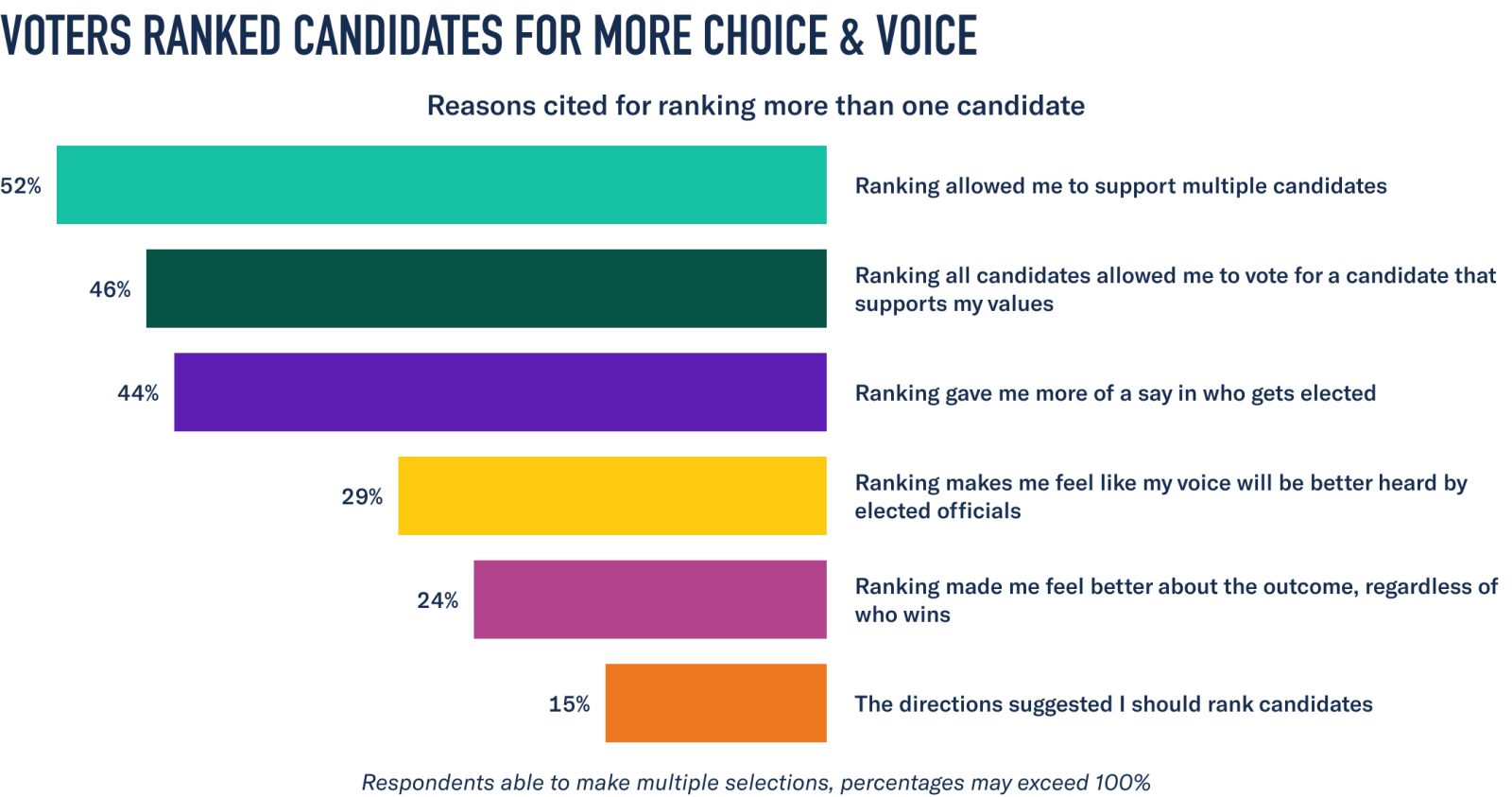
For example, in a three-person race, the moderate candidate may be preferred to each of the more extreme candidates by a majority of voters. However, voters with far-left and far-right views will rank the candidate in second place rather than in first place. Since ranked-choice voting counts only the number of first-choice votes (among the remaining candidates), the moderate candidate would be eliminated in the first round, leaving one of the extreme candidates to be declared the winner, which is what happened in Alaska.
Chart taken from: Unite America, The Hill
(click or tap to enlargen)
In the 2020 election, voters in Alaska approved a ballot initiative that changed the primary system to have everyone compete in the same primary. The top four candidates from the primary advance to the general election.
I wrote about this system in a previous brief after the Special Election last year. In wake of the Democrat’s victories in 2022, a bill has been filed to repeal the new election system in Alaska. While it is unclear what the chances of this bill passing are, this legislation mirrors a recent trend of Republicans filing legislation at the state level to make changes to election rules based on trends they did not like.
Of all of the states where Republicans changed election laws, the best state that Republicans can take away a lesson from is Georgia. After Democrats won both U.S. Senate seats in a runoff in 2021, Republicans in the state legislature passed legislation to reduce the length of time for the runoff and severely restrict new registrations before the runoffs. One of the two U.S. Senate seats was up in 2022 (due to the 2020 election being a special election), and Republicans lost.
The reason Republicans lost was that they nominated a candidate, Herschel Walker, who had trouble getting the support of all Republican voters. Walker and his campaign also never successfully figured out how to respond to stories about his character or questions about his qualifications for public office, which hurt his chances of winning.
Alaska Republicans had the same problem in 2022. Sarah Palin is disliked by many Republicans, and that prevented her from being able to win. Some Republicans disliked Palin so much that they voted for Peltola, the Democrat, after Republican candidate Nick Begich was out of the running.
Changing the rules to a traditional partisan primary and general election system likely would not have changed the result. Palin had more support among Republicans than any other candidate in the primary, but she did not have enough support to win the winner-take-all General Election. The limited existing body of polling data from 2022 reinforces this argument.
If Republicans are serious about taking steps to win back the U.S. House seat in Alaska, they need to focus on recruiting and supporting better candidates for public office. Sarah Palin is very well-known, polarizing, and thoroughly caricatured by Saturday Night Live. There was little that Palin could have done to get voters to improve their impressions of her.
While Palin is a unique figure in Alaska politics, the challenges that Republicans face in recruiting and supporting better candidates for public office are a problem nationally. Republicans did not unseat any incumbent Democrats in U.S. Senate races last year because the candidates Republicans chose had significant issues with their backgrounds and qualifications for office and took positions on issues such as abortion that alienated some members of their party’s coalition.
Until Republicans figure out how to improve their selection process for their own nominees, they won’t achieve the results they are hoping for by tampering with election rules.

The Week That Was #3
The Week That Was #3
Foreign Policy Brief #168 | By: Abran C | January 31, 2023
Header photo taken from: the Associated Press / Eraldo Peres
Follow us on our social media platforms above
Browse more foreign policy briefs from the top dashboard

Photo taken from: Ricardo Stuckert / Reuters
Brazil Indigenous Genocide
[SSB theme=”Official” align=”center” counter=”true” ]
Last week Brazil’s Ministry of Health declared a state of emergency in the Yanomami indigenous peoples territory. The Yanomami territory, Brazil’s largest indigenous reservation, is located in the northern Amazonian region of the country near it’s border with Venezuela. The state of emergency was called following hundreds of children dying from malnutrition and diseases caused by poisoning of the water supply due to illegal gold mining.
A decree by the government of newly elected President Luiz Inacio Lula da Silva said the aim of the declaration was to restore health services to the Yanomami people that had been dismantled by his far-right predecessor Jair Bolsonaro. In four years of Bolsonaro’s presidency, 570 Yanomami children died of curable and preventable diseases, mainly malnutrition, malaria, diarrhea, and deformities caused by mercury poisoning.
The Yanomami people’s lands have been invaded by illegal gold miners for decades, but the frequency and intensity of the incursions skyrocketed under former President Bolsonaro, who allowed and encouraged such mining activity in what should be protected lands. Brazilian federal police are investigating a case of genocide against the Yanomami people by the Bolsonaro administration. President Lula himself upon seeing the state of the Yanomami said “More than a humanitarian crisis, what I saw in Roraima was genocide: a premeditated crime against the Yanomami, committed by a government insensitive to suffering”.
US Secretary of State Anthony Bliken visits the Middle East
US Secretary of State Anthony Bliken landed in Egypt to begin a three day tour of the Middle East and North African region (MENA) on Sunday. In Egypt Blinken is expected to discuss North African regional issues such as conflicts in Libya and Sudan. After his stop in Cairo, Blinken will travel on Monday and Tuesday to Jerusalem and Ramallah, where he will meet Israeli Prime Minister Benjamin Netanyahu and Palestinian Authority President Mahmoud Abbas, respectively.
The trip has taken on new urgency in light of ongoing violence in the occupied territories and Israel’s incoming ultra-nationalist far-right government that saw the return of PM Benjamin Netanyahu. On Thursday Israeli forces killed nine Palestinians during a raid on the Jenin refugee camp.
The number of Palestinians killed by Israeli forces during raids in the West Bank and East Jerusalem in January has risen to at least 29 people, including five minors. Soon after the raids a Palestinian, in retaliation, carried out a gun attack and killed seven Israelis in East Jerusalem.

Photo taken from: EPA-EFE
(click or tap to enlargen)
Following the attack Prime Minister Benjamin Netanyahu announced plans to make it easier for Israelis to obtain and carry guns. High tensions in Israel-Palestine will take up the majority of the discourse on this diplomatic mission, Bliken will likely repeat calls for calm and restate support for a two state solution. However it is unlikely peace talks will occur anytime soon.
France protests against raising the retirement age

Photo taken from: Benoit Tessier / Reuters
Over a million people protested on the streets of Paris last week amid plans by the government to raise the retirement age from 62 to 64. Emboldened by the mass show of resistance, French unions announced new strikes and protests. Macron has acknowledged the public’s discontent but claimed that the reforms are necessary to save the French pension system.
In a country with an aging population and growing life expectancy where everyone gets a state pension, the government says the reforms are the only way to keep the system functional. Unions however proposed a tax on the wealthy to finance the pension system instead. Were the strikes to continue they could hobble the French economy at a time when the country is struggling with inflation and trying to boost growth.

North Dakota Anti-Trans Law Will Jail Librarians For Displaying Books About Sexual and Gender Identity
North Dakota Anti-Trans Law Will Jail Librarians For Displaying Books About Sexual and Gender Identity
Health and Gender Policy Brief #156 | By: Caroline Howard | January 31, 2023
Header photo taken from: Nadezhda Soboleva / Eyeem / Getty Images
Follow us on our social media platforms above
Browse more health and gender policy briefs from the top dashboard

Photo taken from: Rick Bowmer / The Associated Press
Policy Summary
[SSB theme=”Official” align=”center” counter=”true” ]
A new law introduced in North Dakota will make it a class-b misdemeanor for librarians in public libraries to have any books on display that are deemed “sexually explicit”. Within this list of topics that meet the definition of sexually explicit, are the classifications of sexual identity, and gender identity.
Public libraries in this case are defined as “a library containing collections of books or periodicals for the general population to read, write, borrow, or refer to which is supported with funds derived from taxation.” If a librarian refuses to take down books that have either sexual or gender identity-related topics, they will be either given a fine of $1,500 or will be detained for a maximum period of 30-days, which is standard for under North Dakota’s criminal definition of a class-b misdemeanor.
Policy Analysis
What this policy is attempting to accomplish in many ways is to drive trans, gay, and queer people in general out of the mainstream of society, and relegate them to the outskirts. It has been proven empirically that when someone knows a person who is of a marginalized group, in this case, a transgender person, they are more likely to accept trans people in general.
With that, the more people that start to accept trans people into the mainstream as just something that is normal (because it is normal), the harder it is for people who want bills like this implemented to be able to attack the trans community without consequences.
One of the main ways that it attempts to achieve this goal is by lumping being gay or transgender with a whole litany of other topics that absolutely do meet criteria of a sexually-explicit nature, and should most certainly not be allowed in public libraries. When people are able to successfully compare being transgender to something like pedophilia, it is a lot easier to dehumanize transgender folks, which can lead to much deadlier consequences down the line.
This is already being attempted across the country with the narrative that all people who are in the LGBTQ+ community are “groomers” who want to harm children. Such a narrative also led to the mass shooting at Club-Q in Colorado a couple of months ago, as well as the countless murders of transgender people across the U.S. that have both been reported and not reported.

Photo taken from: WBEZ Chicago
(click or tap to enlargen)
It is a lot harder to attack a bill that has some good qualities to it, like banning other forms of sexual content that would actually harm children, because then the groomer label gets thrown in your face, and the potential harm can come your way.
This rhetoric is very dangerous and only serves the purpose to tie trans and queer people in with pedophiles and abusers of children. The only thing that is accomplished is pushing transgender people to the outskirts of society, where it is much likelier that they are dehumanized generally, and at worst killed. Even if this bill passes, it is not very likely that it will be implemented, at least for now. Court battles will rage on, and potentially rise up to the Supreme Court.
From there, there is really no telling whether or not the Justices would allow a bill like this to be implemented. Gorsuch in 2020 voted on the side of adding transgender and gay people to the list of people covered under the anti-discrimination portion of the Civil Rights act, so there is a small bit of hope there.
If this bill fails in the courts, it is still a reminder of the legislation, and harm politicians in the GOP will try to wage on marginalized groups, and how it is imperative that we do not let it spread to the federal level. They are speaking loud and clear on what their intentions for queer people in America are, and it is time for all of us to listen.
Engagement Resources
Click or tap on resource URL to visit links where available

ACLU: https://www.aclu.org | “The ACLU has evolved in the years since from this small group of idealists into the nation’s premier defender of the rights enshrined in the U.S. Constitution. With more than 1.7 million members, 500 staff attorneys, thousands of volunteer attorneys, and offices throughout the nation, the ACLU of today continues to fight government abuse and to vigorously defend individual freedoms including speech and religion, a woman’s right to choose, the right to due process, citizens’ rights to privacy and much more.”

The LGBT Task Force: https://www.thetaskforce.org/new-analysis-shows-startling-levels-of-discrimination-against-black-transgender-people/ | The National LGBTQ Task Force advances full freedom, justice and equality for LGBTQ people. We are building a future where everyone can be free to be their entire selves in every aspect of their lives.

Trans Lifeline: https://translifeline.org | Trans Lifeline is a grassroots hotline and microgrants 501(c)(3) non-profit organization offering direct emotional and financial support to trans people in crisis – for the trans community, by the trans community.

Fox News’ Role in FIFA Corruption Trial
Fox News’ Role in FIFA Corruption Trial
Foreign Policy Brief #167 | By: Reilly Fitzgerald | January 23, 2023
Header photo taken from: Kamil Krzaczynski / Associated Press
Follow us on our social media platforms above
Browse more foreign policy briefs from the top dashboard

Photo taken from: Reuters / John Taggart
Policy Summary
[SSB theme=”Official” align=”center” counter=”true” ]
The Fédération Internationale de Football Association, more famously known as FIFA, is the global face of football (or soccer, for Americans). They make the rules of the sport, they can sanction players and teams for misconduct on the pitch; they decide the when and where of major tournaments; the TV rights for tournaments, and also where to take bribes from. Corruption and global sports have always been entwined; just as sports and politics have been.
In regards to the most recent world cups in Qatar (2022), Russia (2018), and Brazil (2014), there has been a consistent documented pattern of corruption in which individual executives and corporations have been banned, imprisoned, sanctioned.
In the ongoing corruption investigation against FIFA by the US Department of Justice, it has come to light that the Fox Corporation is involved in the corruption schemes by giving away hundreds of millions of dollars in bribes to receive exclusive TV rights to major global soccer tournaments, including the FIFA World Cup.
Policy Analysis
Corruption in regards to FIFA has been an ongoing issue and legal battle for FIFA. The image of FIFA has been noticeably tarnished throughout the past decade, if not more than that. The organization made headlines for awarding the World Cup to human rights abusers such as Qatar, Russia, and Brazil – each one with documented human rights abuses. It also should not come as a huge surprise to most that there is an air of corruption around this organization, and the decisions it has made throughout the past decade.
It may surprise people, especially to American television viewers, to see the Fox Corporation involved in corruption with FIFA. Since 1994, ESPN had been, solely, given the TV rights to air the World Cup in the United States. However in 2011, it was announced by Fox that it was granted the TV rights to upcoming World Cups, such as in Russia 2018, Qatar 2022, and the future World Cup in North America in 2026.
The information being used at trial has been provided by Alejandro Burazco, who is a former banker, according to Sports Illustrated and the New York Times. He has provided information on the people involved at Fox and details regarding the financial aspects of the corruption.
Burazco’s ‘job’ was to act as an intermediary between Fox and FIFA to help win the TV rights to two major South American tournaments: the Copa Libertadores, and the Copa Sudamericana.

Photo taken from: Elizabeth Williams / The Associated Press
(click or tap to enlargen)
According to reporting from the New York Times based on Burazco’s statements, ESPN and other networks thought that the bidding process was blind; meaning that FIFA should not have been aware of which companies were bidding at any given time, or based on any amount of money.
The issues surrounding FIFA and the corruption that seems to follow them at every turn, and that has also tarnished the world’s beautiful game will continue into the next World Cup. Hopefully, the Justice Department and the trial against FIFA will result in a cleaner environment for this sport to flourish without scandal and controversy.
Engagement Resources
Click or tap on resource URL to visit links where available

Timeline of FIFA Corruption From ESPN (https://www.espn.com/soccer/fifa-world-cup/story/2468845/a-timeline-of-fifa-corruption-allegations)