

JOBS POLICIES, ANALYSIS, AND RESOURCES
Latest Jobs Posts
The Impact of Social Media on Politics and Society
Brief #52 – Technology Policy
By Inijah Quadri
Social media has revolutionized the way we communicate, access information, and engage with politics and society. Platforms such as Facebook, Twitter, and TikTok have become an integral part of our daily lives, connecting us with friends and family, news, and entertainment.
January 10th Revealed the Need to Update Our Aviation Safety Technology
Brief #51 – Technology Policy
By Steve Piazza
The Federal Aviation Administration (FAA) requires that all pilots receive NOTAMs (Notice To Airmen, or Notice to Air Missions in the United States) prior to takeoff. The purpose of these notifications is to provide pilots with information regarding obstacles they may encounter along the way.
Russia Continues to Kill Ukrainians. Children are Targeted.
Brief #166 – Yelena Korshunov
By Yelena Korshunov
On January 14th a Russian missile hit a residential high-rise building in Dnipro – a big industrial Ukrainian city. According to the head of the Ukrainian regional military administration, Valentin Reznichenko, on January 17th the removal of rubble had been going on for more than 60 hours. At that moment, 90% of the wreckage of the destroyed nine-story building had been dismantled.
Location Data Still Putting Abortion Seekers At Risk
Brief #153 – Health & Gender
By Mindy Spatt
After the Supreme Court’s decision in Dobbs and resultant abortion bans, online access to abortion information became increasingly important, and advocates for choice began expressing concern about the vulnerability of location data.
Important Elections in the First Half of 2023
Brief #50 – Elections & Politics
By Ian Milden
While the start of the presidential race tends to get most of the election coverage around this time of year, there are a couple of important elections in the early months of 2023. This brief will discuss two of these races and why they matter.
The Week That Was #2
Brief #165 – Foreign Policy
By Abran C
On Janurary 8, 2022 thousands of far right insurrectionists stormed the Brazilian congress and supreme court in an event reminiscent of the January 6, 2021 capitol attack in the United States. In addition to the similar time of year, the reason behind the insurrection in Brazil is eerily similar to the attack on the US capital in that supporters of the outgoing president claim the election was stolen.
The Ukraine Crisis: Situation Update: #18
Brief #164 – Foreign Policy
By Abran C
This is the 18th in a special U.S. RESIST NEWS series that updates our readers on the latest developments in Russia’s invasion of Ukraine.
Who Will Be the Gatekeepers in 2023?
Brief #78 – Technology Policy
By Mindy Spatt
If anything is clear from Elon Musk’s takeover of Twitter, it is that he is ill equipped to be the arbiter of who or what should be banned from the platform. He appears to be the last person on earth anyone would choose for the job. Former CEO Jack Dorsey had no particular qualifications to do so, but his decisions didn’t garner the publicity or public dismay Musk’s have.
Damar Hamlin’s Recovery: What a U.S. Worker Deserves
Brief #152 – Health and Gender
By Geoffrey Small
On January 2nd, 2023 NFL Buffalo Bills safety Damar Hamlin suffered from cardiac arrest after a tackle to the chest during a Monday-night football game with the Cincinnati Bengals.
As he laid motionless on the field for approximately ten minutes, first responders applied CPR, an AED (automated external defibrillation), oxygen, and an intravenous solution in order to prevent brain damage that can occur after cardiac arrest.


Is Saudi Arabia a Gulf State … or a Golf State?
Is Saudi Arabia a Gulf State … or a Golf State?
Foreign Policy Brief #149 | By: Reilly Fitzgerald | September 21, 2022
Header photo taken from: First Sportz
Follow us on our social media platforms above
Browse more foreign policy briefs from the top dashboard

Photo taken from: Getty Images
Policy Summary
[SSB theme=”Official” align=”center” counter=”true” ]
This summer has seen the ongoing disagreement and to some degree ‘war’ between LIV Golf and the PGA Tour. The traditional American viewing experience for generations has been the PGA Tour. Millions of viewers tune into individual tournaments throughout the season to see the worlds’ top golf professionals compete on American television. Now, a Saudi-backed challenger has stepped into the arena and has started to offer a significant challenge to the traditional golf watching, and competing, experience around the world.
The Saudi Arabian government has for some time now spent money investing into various sports leagues around the world. The Saudi Public Investment Fund (PIF) is their organization in charge of the splashing of money around the world of professional sports.
During the 2021-2022 English Premier League season, the world was shocked by the financial take-over of Newcastle United by the PIF, an investment which turned Newcastle United into the most expensive professional football club in the world above the likes of FC Barcelona, Real Madrid, Manchester City FC (also has Middle Eastern ownership), Paris Saint-Germain, or Manchester United. Recent reports, in the past week or two, suggest that the PIF may even purchase Italian power-house football club Inter Milan.
These purchases are not just a way for Saudi Arabia to splash money around for fun; as we have discussed at length through many articles and briefs for U.S. Resist News, sports is an essential tool in the world of soft power international relations. Saudi Arabia’s Prince Mohammed bin Salman is not buying these clubs for the sole pleasure of enjoying great football and golf.
Policy Analysis
Liv Golf differs from the PGA on many levels. First off, they host a distinctly different set of tournaments at venues across the world – and are trying to find an entirely different vibe to golf than the PGA Tour has not done. The Liv Golf tour is all about quick team-playing golf, and money.
The PGA Tour events have a roster of 100 athletes who play, individually, for four rounds (and half the field is cut after the end of the second round based on scores); which can lead to very long events that can take the better half of a day to watch for a spectator, or to play as a golfer.
Liv Golf has found a fresher way to play golf with 48 golfers competing (no cuts at any time) consisting of teams of twelve teams of three, also with a shotgun format allowing the teams to start at different holes, but at the same time. This entirely new format allows the game to progress at a much faster rate than the PGA Tour.
LIV Golf has also made it entirely clear that they are willing, and able, to pay each and every competitor regardless of their place in the standings at a particular tournament; the last place finisher walks away with $120,000. In addition golfers receive contracts with large up-front funding when they sign on to play for Liv.
The final finisher at a PGA Tour event gets cut and walks away with no pay for the day. The purse money for LIV Golf events is also much higher with the tournament in London holding a purse of $25 million ($20 million spent on the golfers, and the other $5 million going to the top three teams).
According to Golf Digest, the LIV Golf tour also pays for the travel and accommodations of the athletes, their families, their coaches, and caddies; which is something the PGA Tour has never done. LIV Golf even broadcasts their events live on YouTube for free, without commercials.

Graphic taken from: Melange Magazine
(click or tap to enlargen)
The LIV Golf tour also plans on allowing individuals or corporations to purchase an individual team and run it like any other major sports team by selling and purchasing new athletes, or trading athletes; along with this comes all of the major economic boosts such as sponsors, uniforms, and much more.
The money being invested into the LIV Golf Tour by the PIF is attracting players from all over the world; and the amount of money is greater than what some professionals make throughout their career.
The Public Investment Fund is a part of the Saudi Arabian government. The Saudi government rolled out their economic development plan, known as Vision 2030, and part of this ‘Vision’ is planning for a post-oil global economy and attempting to diversify the revenue streams that support the wealth of the Saudi Arabian economy.
Every country in the world is attempting to find renewable energy sources to divest from the oil market as much as possible, and automobile manufacturers are turning to entire electric vehicles to make up more of their production. The goals of the world to combat climate change and dependence on fossil fuels are causing the Saudi Arabians to rethink the amount of money they will be able to draw from the global oil market.

Photo taken from: Andrej Isakovic – Pool / Getty Images
(click or tap to enlargen)
Sports is just a piece of the entire cake that is the investment portfolio of the PIF and the Saudi government’s plans for Vision 2030.
The Public Investment Fund’s spending in sports, renewable energy industries, and other industries has come under scrutiny, as well. The public perception of these new ventures is seen as Prince Mohammed bin Salman trying to repair his image after killing the journalist Jamal Kashoggi in 2018. The Crown Prince has been at the center of this controversy regarding journalism and the free press ever since. It is entirely possible that the motivation, alongside the positive ideas in Vision 2030, is just to save face and improve his image after severely tarnishing it.
LIV Golf is just the latest major sports investment that Saudi Arabia is making; even though there are rumors and ties between other major sporting industries or teams, such as Inter Milan in the Italian Serie A football league. The world is changing quickly, and Saudi Arabia’s royal family appears to have recognized this and is moving to change their ways to accommodate a greener future. In the case of the purchase of Newcastle United, the reactions seem to be fairly mixed; while the PGA Tour has an open lawsuit against LIV Golf, currently.
Engagement Resources
Click or tap on resource URL to visit links where available

Vision 2030 ( https://www.vision2030.gov.sa/v2030/overview/ )

Public Investment Fund (https://www.pif.gov.sa/en/Pages/AboutPIF.aspx )

Mikhail Gorbachev – a Knight of Lightness or Dark?
Mikhail Gorbachev – a Knight of Lightness or Dark?
Foreign Policy Brief #148 | By: Yelena Korshunov | September 19, 2022
Header photo taken from: The Associated Press
Follow us on our social media platforms above
Browse more foreign policy briefs from the top dashboard

Photo taken from: marca (.com)
Policy Summary
[SSB theme=”Official” align=”center” counter=”true” ]
Mikhail Gorbachev was one of the most controversial figures in world politics. The Former USSR (Union of Soviet Socialist Republics) President died at the age of 92 in Moscow on Tuesday, August 30, after a severe and prolonged illness. The last, fifth general secretary of the Soviet Communist Party, Gorbachev was also the the last president of the USSR. He is not popular in today’s Russia, while his actions are often appreciated in the Western world. Many Russians believe that Gorbachev solely ruined the “powerful country” (USSR). However previous Communist regimes had led the Soviet Union to the point when it couldn’t exist anymore in its wobbly model, both economically and ideologically.
Attempt at Building Democracy
Gorbachev is considered the main initiator of a policy called “perestroika”.
The term refers to the restructuring or reforming the economic and political system. Perestroika referred to increased automation and labor efficiency, but came to entail greater awareness of economic markets and the ending of central planning.
The word “glasnost” was another phrase that became a symbol of Gorbachev’s era. “Glasnost” meant open decision-making and free access of citizens to information. It was an explosion of unprecedented freedom in the dark censored world of fearful whispers behind the tightly closed kitchen doors.

Photo taken from: Mr. Allsop History
”Perestroika” and “glasnost” were intended to “stir up” the country. However inconsistent domestic policy and primarily chaotic economic reforms led to a deepening crisis in all spheres of society. This was expressed not in the abstract figures of statistical reports, but in everyday reality. Towards the end of his reign the country returned to the long-forgotten Soviet system of coupons (limited purchase of particular goods). Coupons existed for all essential food items, such as sugar, and even for soap.

Photo taken from: obozrevatel
Bloody inter-ethnic strife also broke out in the Soviet Union. The fire of conflicts flared up in Central Asia, Transcaucasia, and Moldova. The nation blamed the many misfortunes of that time, first of all, on Gorbachev himself.
“New thinking” foreign policy
The foreign policy of “new thinking” associated with the name of Mikhail Gorbachev contributed to a radical change in international relations. “New Thinking” was Gorbachev’s slogan for a foreign policy based on shared moral and ethical principles to solve global problems rather than on Marxist-Leninist concepts of irreconcilable conflict between capitalism and communism.
Under this concept of foreign policy, relations between the Soiviet Union and other countries improved. Better relationships with the United States resulted in a thawing of the Cold War between the two countries. Russia’s war in Afghanistan was stopped by Gorbachev, and political connections with China improved.
Member states of the Soviet Union broke away and declared their independence. “Velvet” revolutions sprang up in the countries of Eastern Europe, and the unification of Germany took place. On November 9, 1989, the Berlin Wall fell – a symbol of the division of the city, the German nation and the whole continent that lasted 40 years.
The Nobel Peace Prize in 1990 was awarded to Gorbachev for his contribution to easing international tensions
Policy Analysis
Speaking about Gorbachev’s period in general, we cannot underappreciate his attempts of saving the collapsing country, building democracy in the world’s biggest traditionally totalitarian state, stopping the Cold War, and destroying the iron curtain.
Nowadays Russia’s government aims its active propaganda to idealize the dictatorship of the old Soviet Union and even make bloodthirsty Stalin a national hero again. It supports the belief that Mikhail Gorbachev is a person that ruined an ever powerful Soviet country.
About a month before Gorbachev’s death, journalist Alexei Venidiktov, who was his close friend, expressed to Forbes Russia that Gorbachev was “upset” at the current state of Russia and felt that his “life’s work” had been undone.

Location Tracking Under Scrutiny
Location Tracking Under Scrutiny
Technology Policy Brief #68 | By: Mindy Spatt | September 20, 2022
Header photo taken from: Minh Uong / The New York Times
Follow us on our social media platforms above
Browse more technology policy briefs from the top dashboard

Photo taken from: Anusuya Datta
Policy Summary
[SSB theme=”Official” align=”center” counter=”true” ]
All day, every day, our phones are tracking our locations, collecting minute by minute data on our whereabouts that phone companies, apps can use or sell. Customers may agree to location tracking in order to use a GPS or a fitness monitor, but be less aware of how many others are getting in on the act; Facebook, Amazon, Microsoft are just a few examples of the many apps and services that are continuously keeping track of where we go and what we do. I can’t remember whether I ever gave any of them permission, can you?
The data is frighteningly specific. It isn’t just whether you shopped at Bloomingdales or Target, it is which counters you visited while you were there. Not just whether you went to the drugstore, but whether you looked at allergy meds or aspirin. This data is enormously valuable, spawning an industry now estimated to be worth $12 billion.
Privacy advocates have sounded the alarm in the past but location tracking has remained largely unregulated. With many states banning and criminalizing abortions, the issue has taken on new significance. Data on visits to abortion clinics is easily available for purchase and can be accessed by just about anyone, including law enforcement.
Policy Analysis
According to Business Law Today, “the sheer volume of location data tracked, disclosed, and repurposed is tremendous…[in part due to] the use of multiple systems to track location, and the use of data analytics to combine location data with other personal data, [which] enables both the identification of anonymous data and the compilation of comprehensive and precise profiles of tracked individuals.”
While at one time the industry defended itself by claiming that much of the location data it collects is anonymous, it is now clear that individuals and their interests, activities and personal characteristics can be identified through unique location patterns.
In an extensive investigation into location tracking by the NY Times in 2018, a database purchased from a single company revealed “people’s travels in startling detail, accurate to within a few yards and in some cases updated more than 14,000 times a day.” More recently, Vice Media was able to purchase, from data broker SafeGraph, “information related to visits to clinics that provide abortions including Planned Parenthood facilities, showing where groups of people visiting the locations came from, how long they stayed there, and where they then went afterwards.” Vice paid $160 for the information.
Vice’s report may have what brought SafeGraph to the attention of Senator Elizabeth Warren, who successfully urged SafeGraph and Placer.ai, another data broker, to stop selling the location data of visitors to abortion clinics. Warren noted in her request that the companies were putting the safety of anyone visiting a clinic at risk.
Despite that win Warren warned in a press release that “we can’t rely on the goodwill of Big Tech to protect Americans’ data and safety.” Warren’s goal is to pass legislation, the Health and Location Data Protection Act, that would permanently ban brokers from selling location and health data and establish serious privacy protections for consumers.

Photo taken from: Vice
In the meantime, the Federal Trade Commission is also taking steps to protect abortion related location data, It recently filed sued against Idaho-based Kochava, a data broker that purchases vast troves of location information derived from hundreds of millions of mobile devices. That information is then sold in customized data feeds that match mobile devices to timestamped location information.
According to the FTC “customers are often unaware that their location data is being purchased and shared by Kochava and have no control over its sale or use.”
The FTC alleges that customized data feeds sold by Kochava allow purchasers to identify and track specific mobile device users. “For example, the location of a mobile device at night is likely the user’s home address and could be combined with property records to uncover their identity. In fact, the data broker has touted identifying households as one of the possible uses of its data in some marketing materials.”
If the Kochava suit is successful, the FTC presumably won’t stop there. Themarkup.org identified 47 companies in the data broker business, the majority of whom are likely still selling this type of data and still putting providers and patients at risk.
Engagement Resources
Click or tap on resource URL to visit links where available

There’s a Multibillion-Dollar Market for Your Phone’s Location Data

A uniquely dangerous tool’: How Google’s data can help states track abortions
https://www.politico.com/news/2022/07/18/google-data-states-track-abortions-00045906

Warren, Wyden, Murray, Whitehouse, Sanders Introduce Legislation to Ban Data Brokers from Selling Americans’ Location and Health Data. https://www.warren.senate.gov/imo/media/doc/Health%20and%20Location%20Data%20Protection%20Act.pdf

California Shows What it Means to Protect Children on Social Media
California Shows What it Means to Protect Children on Social Media
Technology Policy Brief #67 | By: Steve Piazza | September 20, 2022
Header photo taken from: Tony Avelar / Associated Press
Follow us on our social media platforms above
Browse more technology policy briefs from the top dashboard

Photo taken from: Getty Images
Policy Summary
[SSB theme=”Official” align=”center” counter=”true” ]
In late August, 2022 the California State Legislature passed AB-2273, The California Age-Appropriate Design Code Act. Built upon existing California laws. AB-2273 is aimed at protecting anyone under 18 from possible harmful effects of social media.
The nearly unanimous agreement is presently on Governor Newsom’s desk awaiting his signature.
If enacted, beginning July 1, 2024 businesses providing platforms that children are likely to access must safeguard their privacy through carefully configured default settings. Such companies are also prohibited from misusing child personal information.
Businesses will also be required to provide a Data Protection Impact Assessment before any new platforms and/or features are introduced. The assessment must determine if the platform poses any potential harm via content or contacts and whether their algorithms and advertisements may target children. Non-compliant companies face fines of $2500 for negligence and $7500 if the violation is deemed intentional
Policy Analysis
The ongoing battle for industry self governance as opposed to government regulation is once again intensifying, this time in the name of security and privacy for children while online.
AB-2273 is a response to a lack of willingness on the part of the social networking industry to put substantive safeguards for young people in place. Recent public outcries against disclosures that Facebook, Instagram, and other platforms are doing considerable harm to the self-esteem of young people have motivated legislators to take action.
The catalyst just may have been Frances Haugen, a former Facebook Project Manager, who shared thousands of pages of internal documents providing evidence that Facebook (now Meta) was aware of the negative effects its platform has on its users, including children, while sacrificing personal well being for corporate growth. California legislators and AB-2273 co-authors, Betty Wicks (D) and Jordan Cunningham (R), cite those leaks as influential in the development of the legislation.
Not surprising, social media companies and their supporters have pushed back on such accusations in an attempt to downplay any lack of concern. Defending Meta, Mark Zuckerburg tweeted that there is no need for criticism because the company already cares. “Many of the claims don’t make any sense. If we wanted to ignore research, why would we create an industry-leading research program to understand these important issues in the first place?” A red herring to be sure.
And RampRate CSO Alex Veyste asks in Fortune “If a business saw an existential crisis looming, would it do absolutely nothing about it?” His answer is “of course not,” but just like anything else, universal attempts at reasoning don’t hold up. One just has to refer to similar past behavior by the the alcohol, cigarette, gasoline, and palm oil industries to see how absolute their efforts were.

Chart taken from: Pew Research Center
(click or tap to enlargen)
Requiring social media companies to modify their safety features might be viewed by some as not going far enough, but it is way overdue.
Since the beginning of the social media boom 20 years ago, there has been plenty of evidence that technology use by youth has both good and bad effects, but belief in the harmful consequences have become more widespread, especially on platforms that are not designed specifically for such young users.
Recent studies on children around the world have shown the correlation between increased social media usage and emotional and psychological effects.
Surveys by Pew Research and leading universities indicate the widespread belief that social media have severe consequences in the development of adolescents. Media outlet narratives regularly cite polls that indicate potential negative effects.
And the call for action itself is supported. According to a national poll conducted by Common Sense Media in 2018, over 90% of parents would like more transparency when it comes to the collection of use of personal information.
AB 2273 is not the first of its kind and is loosely based on recent legislation out of Great Britain. But it does have the most bite.
And it won’t be the last, as another California bill, The Social Media Platform Duty Children Act, would allow parents to actually sue companies for prastices harmful to children. Besides, as usual with laws out of California, this activity will be an impetus for other states and the federal government to take more action.
The battles between Silicon Valley and the government will continue, but hopefully will be short lived so that involved parents and educators who know they have some responsibility in children’s online experiences will not have to feel the futility of outside forces working against them.
Engagement Resources
Click or tap on resource URL to visit links where available

The text of AB-2273 can be found here:
https://leginfo.legislature.ca.gov/faces/billTextClient.xhtml?bill_id=202120220AB2273

In addition to providing resources for schools and parents, Common Sense Media studies the effects of the digital world on children: https://www.commonsensemedia.org/press-releases/common-sense-and-surveymonkey-poll-finds-privacy-matters-for-parents-and-teens-on-social-media

This link connects to a tool kit for parents, students and educators: https://www.humanetech.com/families-educators

For a good overview of the issue and what can be done above and beyond what the government and industry can do, click the following: https://edsource.org/2022/citing-the-impact-on-children-officials-ramp-up-efforts-to-regulate-social-media/668911

Mar – a – Lago Search Takes Disappointing Turn After Court Rulings
Mar-a-Lago Search Takes Disappointing Turn After Court Rulings
Civil RightsPolicy Brief #194 | By: Rodney A. Maggay | September 16, 2022
Header photo taken from: The Associated Press
Follow us on our social media platforms above
Browse more civil rights policy briefs from the top dashboard

Photo taken from: ABC
Policy Summary
[SSB theme=”Official” align=”center” counter=”true” ]
One year after leaving office in January 2022, former President Donald J. Trump and the National Archives and Records Administration (NARA) entered into discussions for the return of fifteen boxes of presidential records that were being kept at the former President’s home in Mar – a – Lago, Florida.
In February 2022, the agency revealed in a letter to the House Committee on Oversight and Reform that classified information was believed to be in the boxes. Communications between the former President and NARA continued throughout the spring to urge Mr. Trump to return the fifteen boxes of documents. The entire set of boxes were not returned and remained at Mr. Trump’s estate.
On August 8, 2022, the Federal Bureau of Investigation (FBI) executed a search warrant at the Mar – a – Lago estate to try and locate the documents and boxes and retrieve them from the premises. The search warrant was issued by U.S. Magistrate Judge Bruce Reinhart who determined that there was probable cause for the search.
Agents who entered the premises went and opened Mr. Trump’s safe because of suspicions that he had stored documents there. Additionally, agents photographed folders marked classified which also showed that the folders were empty. On September 6, 2022 the Washington Post revealed that the reason for the FBI search of Mar – a – Lago was to retrieve documents that included sensitive nuclear weapons information. Days later, it was revealed that documents relating to a foreign government’s nuclear capabilities were among the documents believed to be in Trump’s possession although the identity of the foreign government was not revealed.
On August 12, Judge Reinhart unsealed the search warrant. The warrant revealed possible violations of federal law, including the Espionage Act. On August 26, the affidavit in support of the search warrant was unsealed albeit in a heavily redacted form. On August 22, Trump’s lawyers filed a motion in the Federal District Court for the Southern District of Florida to request a Special Master under Federal Rules of Procedure (FRCP) 53 to review all seized materials for documents that might be covered under either attorney – client or executive privilege.
On September 5, 2022 Judge Aileen Cannon ruled that she would grant Trump’s request for a Special Master. The DOJ objected to the ruling and requested that she stay her ruling. But on September 15, 2022, Judge Cannon agreed to appoint former federal judge Raymond Dearie as Special Master and upheld her September 5 ruling ordering a stop to the use of the seized documents for investigative purposes until the Special Master had reviewed them. LEARN MORE, LEARN MORE
Policy Analysis
The situation occurring at former President Trump’s Mar – a – Lago estate and resort raises a number of very serious questions. It can be viewed in a number of different ways from the preservation of government documents, the handling of top secret documents and to why highly sensitive nuclear materials were found outside secure government facilities. There are also the legal aspects of the case that offer additional troubling details in addition to the situations listed above.
While the search warrant issued by U.S. Magistrate Judge Bruce Reinhart and executed by the FBI was based on probable cause the case took a darker turn when the case was assigned to Judge Aileen Cannon for a ruling from Trump lawyers and their request for a Special Master under FRCP 53.
That rule provides that a judge may appoint a person to perform duties at the request of the judge and make recommendations as to how to proceed. The problem with their use in this case is that the appointment of a special master in this case has never been done before.
What appears from the ruling issued by Judge Cannon is that she went out of her way, including ignoring legal precedent and misconstruing federal statutes to ensure that President Trump would be able to use a Special Master to review the seized materials. Had the plaintiff been anyone other than President Trump, a court would have likely denied the plaintiff use of a Special Master.
President Trump appears to have gotten a favorable ruling and treatment when no other citizen would have. There is no prior instance of a person who is the focus of a law enforcement investigation being granted a Special Master.

Photo taken from: Yahoo
(click or tap to enlargen)
Additionally, Judge Cannon’s ruling has been highly criticized for poor legal reasoning and interpretations of legal rules and concepts. In the case of privilege the two concepts – attorney – client and executive privilege – simply do not apply to this case.
An attorney – client privilege only applies if Trump had been conferring with an attorney, which seems dubious in this case since we are talking about seized documents and not any conversation the President may have had with a lawyer. And executive privilege cannot apply because, among a number of reasons, the privilege can only be invoked by a sitting President which Mr. Trump is not.
Judge Cannon’s ruling was so poorly written and reasoned that experts questioned whether the Judge understood the concept of executive privilege at all. It was an incredible stretch for the Judge to rule that a Special Master was required to review documents if they fell under a claim of privilege when it was clear that the privilege did not apply.
Lastly, the impact of Judge Cannon’s September 15th ruling deals with the timing of the investigation into the seized documents. Her ruling also barred the intelligence community from using the seized documents in their analysis of the security risk that may have occurred with the exposure of the documents.
In terms of national security, this is unprecedented as the intelligence community needs to determine what harm has developed when the boxes were not returned from Florida. By not allowing the intelligence community to use the documents Judge Cannon has effectively closed off any inquiry into what damage Mr. Trump has caused. This could put the United States at a disadvantage on the international stage.
Maybe not now, but in the future. And, her appointment of retired federal judge Raymond Dearie as Special Master also allows Mr. Trump to delay the case. Instead of proceeding into hearing the merits of the case in the next few weeks, the case is extended until at least November 30th which is the deadline Judge Dearie has to review the documents. This is simply a delaying tactic for Mr. Trump to avoid accountability and inquiry into his questionable handling of sensitive documents.
And with likely appeals on the horizon the case now looks likely to extend into 2023 without an answer as to why classified materials ended up at Trump’s Mar – a – Lago estate. LEARN MORE, LEARN MORE, LEARN MORE
This brief was compiled by Rod Maggay. If you have comments or want to add the name of your organization to this brief, please contact rodwood@email.com.
Engagement Resources
Click or tap on resource URL to visit links where available

Lawfare – in depth analysis and criticisms of Judge Cannon’s September 5, 2022 ruling.

Washington Post Special Report – exclusive report on search for classified nuclear materials at Mar – a – Lago.

It’s Time to Codify Marriage Equality in the US
It’s Time to Codify Marriage Equality in the US
Health & Gender Policy Brief #144 | By: Emily Scanlon | September 20, 2022
Header photo taken from: Health Affairs
Follow us on our social media platforms above
Browse more health and gender policy briefs from the top dashboard

Photo taken from: USA Today
Policy Summary
[SSB theme=”Official” align=”center” counter=”true” ]
After the overturn of Roe v. Wade in June 2022, the GOP Supreme Court Justices made it clear: Marriage equality is next. In the Court’s decision, Justice Thomas wrote, “In future cases, we should reconsider all of this Court’s substantive due process precedents, including Griswold, Lawrence, and Obergefell.” Justice Alito included Loving v. Virginia in his draft opinion, though Justice Thomas left it out.
In response, the Respect for Marriage Act (H.R. 8404) was introduced to the House on July 18th, 2022. The Respect for Marriage Act would require the federal government to recognize the validity of same-sex and interracial marriages, thus codifying the Supreme Court decisions on Loving v. Virginia (1967) and Obergefell v. Hodges (2015), which ruled that state laws barring interracial and same-sex marriages, respectively, were unconstitutional. The act would repeal the Defense of Marriage Act, signed by President Bill Clinton in 1996, which allowed states to refuse to recognize same-sex marriage.
On July 19th, the Respect for Marriage Act passed in the House 267-157. 47 Republicans voted to pass, a shockingly high amount. Members of both parties were surprised by the high number of Republicans supporting the bill, though many Republican members maintain the bill is nothing more than a distraction from inflation and other high-priority issues.
The Republican Party has been slowly inching away from their stark opposition to same-sex marriage, especially the younger members. Even Mitch McConnell (R-KY) has not said whether he would support the bill, citing the need to reach suburban, moderate Republican voters. Support among Americans for same-sex marriage has been rising, with a new Gallup poll finding that 71% of Americans support same-sex marriage being recognized as valid by the law.
Despite passing in the House, the bill faces uncertainty in the Senate with a 50-50 split. Democrats need to win 10 Republican votes to avoid a filibuster. Currently, there are 5 Republicans who have said they would vote yes: Susan Collins (ME), Lisa Murkowski (AK), Rob Portman (OH), Thom Tillis (NC), and Ron Johnson (WI).
Policy Analysis

Chart taken from: Gallup News
(click or tap to enlargen)
On September 15th, Senate Democrats announced they will delay a vote on the Respect for Marriage Act until after the November midterm elections. Senator Tammy Baldwin (D-WI), the lead sponsor of the bill, has expressed her confidence in gaining support from 10 Republicans by that time. The additional hope, of course, is that the midterm elections will bring more Democrats into the Senate.
The move is a risky one; many Republican Senators have breathed a sigh of relief at the news. Many Republicans, by refusing to take a stance, are attempting to play to both sides of their party.
Opposing the bill would mean they face backlash from their moderate supporters, while supporting it would enrage their more radical supporters. With the delay of the vote, then, Republican voters will not be swayed by Senators’ decisions on the bill.
That being said, the Republican base may be shifting away from the Party even without this vote. Moderate Republican voters, already having been turned off by the GOP’s move to overturn Roe v. Wade, may grow even more distant from the party if marriage equality is struck down. The Republican Party, it seems, is dramatically underestimating the importance of these social issues to their base.
Regardless of the November midterm results, the time has long past for marriage equality to be codified in America. As Senator Elizabeth Warren (D-MA) stated, “Every single member of Congress should be willing to go on the record. And if there are Republicans who don’t want to vote on that before the election, I assume it is because they are on the wrong side of history.”
Engagement Resources
Click or tap on resource URL to visit links where available. Please get involved:


LovingDay is the anniversary of the landmark court decision for interracial marriage, Loving v. Virginia. Every year on June 12th, it’s a global day of visibility, education, and community.

The New School Year Brings Legal Challenges to LGBTQ Representation
The New School Year Brings Legal Challenges to LGBTQ Representation
Health and Gender Policy Brief #143 | By: Geoffrey Small | September 16, 2022
Header photo taken from: Lucy Jones / The Atlantic
Follow us on our social media platforms above
Browse more health and gender policy briefs from the top dashboard

Photo taken from: Jenn Ackerman / The Washington Post
Policy Summary
[SSB theme=”Official” align=”center” counter=”true” ]
A 2020 Connecticut University study indicated that having a GSA (gay–straight alliances) program in school can help mitigate LGBTQ students’ concerns about bias. The study, which conducted surveys with LGBTQ students, reported that individuals were bullied less on topics related to their sexual identity and gender in schools that had GSA programs. As students are returning to their education across the country, there are currently legal challenges being waged in U.S. Congress, The Supreme Court, and local municipalities regarding LGBTQ representation.
The Equality Act, a new law supporting LGBTQ rights, is currently stalled in the Senate after it was approved twice in the House of Representatives over the past two years. The Supreme Court issued a ruling on an injunction that recognized an LGBTQ club at Yeshiva University in New York. Also, the Miami-Dade County Public School Board in Florida reversed a decision made last year to formally recognize October as LGBTQ History Month.
Policy Analysis
On September 14th, 2022, the Supreme Court ruled in favor of GSA program YU Pride Alliance regarding an injunction that requires Yeshiva University to immediately recognize the LGBTQ club while the case is argued before New York state courts. The case is currently in the appeal process after YU Pride won their argument. The state courts ruled in June that the University was incorporated as an educational institution and not a religious institution.
Therefore, Yeshiva should immediately recognize the GSA program under New York City’s human rights laws. The injunction was temporarily halted on September 9th by Justice Sonya Sotomayor after an amicus brief was filed by the NCLA (New Civil Liberties Alliance), claiming that the New York ruling infringed upon the University’s religious liberty. In response to the Supreme Court decision, Yeshiva University has reportedly announced they will halt all student clubs until further notice.
On September 7th, the The Miami-Dade County Public School Board in Florida voted 8 to 1 on reversing its decision to support October’s LGBTQ History Month.

Photo taken from: YU Pride Alliance
(click or tap to enlargen)
The reversal was made after hours of testimony during a public hearing from members of the community, parents of school children, and Christian coalitions. The change in the board’s decision comes after Governor Ron DeSantis signed the Florida’s Parental Rights Act in March.
The law forbids education in sexual orientation and gender identity for students in kindergarten to third grade.
Despite the school board members citing DeSantis’ new law as the reasoning behind the reversal, the school board attorney reported to local WSVN Miami that recognizing LGBTQ History Month would not be a conflict because it isn’t defined as mandated instruction.
GSA programs and LGBTQ advocates are still challenging the legal arguments that religious liberty takes priority over LGBTQ rights. Since YU Pride Alliance is not recognized as an organization from Yeshiva University, they rely on gofundme donations to conduct meetings and publicity that are normally provided for undergraduate clubs.
Also, a donation to the LGBTQ History Month organization can help spread the message of equal representation for recognizing community icons during the month of October.
Engagement Resources
Click or tap on resource URL to donate

https://www.gofundme.com/f/help-fund-the-yu-pride-alliance


Politics and Vengeance—How the Death Penalty Costs Us
Politics and Vengeance—How the Death Penalty Costs Us
Social Justice Policy Brief #140 | By: Abigail Hunt | September 12, 2022
Header photo taken from: Fort Worth Criminal Attorneys
Follow us on our social media platforms above
Browse more social justice policy briefs from the top dashboard

Photo taken from: Chip Time / Somodevilla / Getty Images
[SSB theme=”Official” align=”center” counter=”true” ]
Twenty-seven states have the death penalty, and twenty-four of those states still execute prisoners. The U.S. military and government both enforce capital punishment. According to the Nevada State Legislature website, a 2008 study by the Urban Institute showed Maryland’s average cost for a death penalty case was $3 million. In Texas, a capital trial costs $2.3 million, more than three times what it would cost to keep the convicted imprisoned in a maximum-security unit for 40 years.
Why do states pursue execution when the process is so cost-prohibitive? The argument made for capital punishment is an emotional one – a district attorney appeals to a juror’s individual sense of outrage. Fiscally, it does not make sense – the death penalty is more expensive. Politically though, that’s another story. District attorneys are elected officials in many states. Like abortion and gay marriage, the death penalty is a potentially divisive hot-button topic.
In 1989, by the time Florida executed infamous serial killer Ted Bundy, his case had cost taxpayers approximately $5 million. In July and August 2020, the first five executions the Trump administration ordered to be carried out cost nearly $5 million – almost $1 million per prisoner executed. Study after study shows the death penalty to be far more expensive than life imprisonment – Indiana, North Carolina, Texas, California, Florida – the cost of a capital trial and the subsequent required appeals process outstrips the costs of any other criminal proceeding by a long shot.
Capital punishment is outlawed in more than 70 percent on the globe. The most recent nations to outlaw the death penalty are Kazakhstan (2021) and Papua New Guinea (2022). Several nations have suspended executions even though capital punishment technically remains legal.
There are only 55 countries that maintain a barrier-less legal avenue to state execution. China holds the top spot, executing thousands of its citizens annually, though, according to World Population Review (WPR), the real numbers may be higher. WPR reports that China, North Korea, Vietnam, Syria, and Afghanistan withhold information about death penalty use in their countries – for this reason and others, it is not possible to get an accurate estimate of cost from those nations.
The death penalty is not a crime deterrent, but it seems the lack of it may be – one international study found that 10 out of 11 countries that abolished the death penalty saw a decrease in murder rate in the decade after its abolition. According to the FBI’s Unified Crime Reports for the past three decades (1989-2019), the murder rate in death penalty states is consistently and sometimes significantly higher than in states without the death penalty.
There appears to be a relationship between legal capital punishment and a higher rate of violent crime. There are many who take part in putting a person to death, whether they be jury, judge, board member, governor, or executioner.
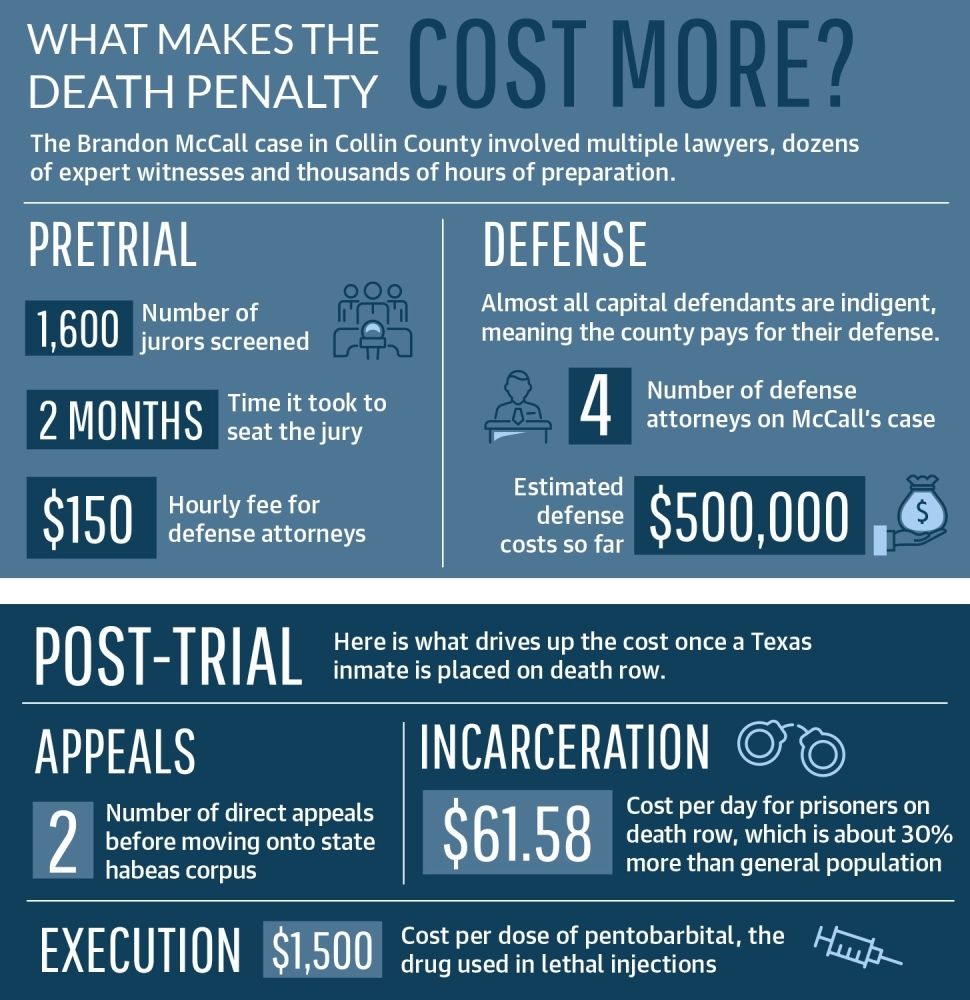
Infographic taken from: Community Impact
(click or tap to enlargen)
Those sentenced to die are disproportionaterly people of color (POC) and poor. Politicians use capital punishment as a ploy to gain votes. It is a waste of state and federal resources to prosecute death penalty cases due to the costs of the courts; that money could be better spent on methods of reformative justice that lower crime rates and reduce costs, something that most, regardless of borders or ethnicity, would agree are positive things.
Performed in the sanitized theatre of a prison chamber, executions today are just as grotesque as those of days past, when public hangings were town entertainment.
On a personal and moral level, we must ask ourselves – does creating more violence and more murderers solve our problem of killing one another?
Medieval torture devices are no longer legal; likewise, the death penalty should fall by the wayside. It is madness to keep doing the same thing and expect a different result. As Gandhi said, “an eye for an eye makes the whole world blind.” The death penalty is not justice, it is vengeance, and a human rights violation. Law exists to protect our rights, not to violate them. Vengeance has no place in law.
Engagement Resources
Click or tap on resource URL to visit links where available

International Commission Against the Death Penalty believes the death penalty is incompatible with human rights and human dignity and works to raise awareness in the fight to end capital punishment. https://icomdp.org/

Since 1966, the Center for Constitutional Rights has advocated for justice from integral problems in our society, including racism, gender oppression, systems that lead to socioeconomic inequalities, and excessive government. https://ccrjustice.org/

Founded in 1990, the Death Penalty Information Center is a national non-profit based in the U.S. that provides reports and analysis on capital punishment, producing informative annual data. https://deathpenaltyinfo.org/
Learn More
Click or tap on resource URL to visit links where available
Murder Rate of Death Penalty States Compared to Non-Death Penalty States. Death Penalty Info Center. Accessed September 12, 2022. https://deathpenaltyinfo.org/facts-and-research/murder-rates/murder-rate-of-death-penalty-states-compared-to-non-death-penalty-states
Study: International Data Shows Declining Murder Rates After Abolition of Death Penalty. Death Penalty Info Center. January 3, 2019. Accessed September 12, 2022.
Records Disclose Taxpayers Picked Up a Nearly Million Dollar Price Tag for Each Federal Execution. Death Penalty Info Center. February 3, 2021. Accessed September 12, 2022. https://deathpenaltyinfo.org/news/records-disclose-taxpayers-picked-up-a-nearly-million-dollar-price-tag-for-each-federal-execution

Countries with the Death Penalty 2022. World Population Review. Accessed September 12, 2022. https://worldpopulationreview.com/country-rankings/countries-with-death-penalty

Nevada Legislature, Nevada State Home Page. Accessed September 12, 2022.

Capital Punishment, The Costs Of Capital Punishment. Law Library – American Law and Legal Information. Accessed September 12, 2022.
https://law.jrank.org/pages/5002/Capital-Punishment-COSTS-CAPITAL-PUNISHMENT.html

Preview of US Senate Races in Florida and Utah
Preview of US Senate Races in Florida and Utah
Elections & Politics Policy Brief #34 | By: Ian Milden | September 8, 2022
Header photo taken from: KSAT
Follow us on our social media platforms above
Browse more politics and elections policy briefs from the top dashboard

Photo taken from:
Policy Summary
[SSB theme=”Official” align=”center” counter=”true” ]
Control of the U.S. Senate will be up for grabs in the 2022 mid-term elections. Competitive races in key states will determine the balance of power. In this brief, I will preview the U.S. Senate races in Florida and Utah.
Policy Analysis
Florida
In Florida, Senator Marco Rubio (R-FL) is running for a third term. Rubio was first elected to the Senate in 2010 after winning a three-way race. He won re-election in 2016 after losing the Republican nomination for President.
Democrats have nominated Congresswoman Val Demings to run against Rubio. She currently represents the Orlando area in Congress. Before her election to Congress in 2016, Val Demings was the chief of police in Orlando. Demings has posted strong fundraising numbers, and her campaign has spent heavily on advertising.
Quality polling for the U.S. Senate race in Florida is hard to find. A University of North Florida poll found Demings ahead by four percentage points, but many well-connected Democrats in Florida are skeptical of those numbers. The University of North Florida’s poll for the Governor’s race had the eventual nominee Charlie Crist (D-FL) trailing Agriculture Commissioner Nikki Fried (D-FL) by four points just before the primary occurred (Crist won the primary by over 20 points).
Some polls conducted for outside groups that support Democrats have found that the race is within the margin of error, though that would likely be a best-case scenario for Democrats in Florida.
Val Demings is a good candidate, but I am skeptical of her chances of winning due to the challenges that Democrats are facing in Florida. Democrats no longer lead Republicans in voter registration numbers.

Photo taken from: The Miami Herald / AP / Tribune
(click or tap to enlargen)
The state party is having several organizational challenges. National donors are reluctant to invest substantial amounts of money in statewide races in Florida specifically due to the expensive nature of running television ads statewide and repeated election cycles of disappointment for Democrats in Florida.
Senator Rubio also tends to overperform in Miami when compared to most Republicans, which also hurts Demings’ chances of winning in the fall. The 2020 Presidential election results illustrate why this is a challenge for Demings. If you look at the 2020 Presidential map in Florida, Joe Biden underperformed in Miami compared with other recent Presidential nominees.
While Biden did marginally better than previous Democratic nominees in many of the other urban areas in Florida, it wasn’t enough to overcome his underperformance in Miami. Congresswoman Demings will almost certainly face a similar challenge this fall. Given these challenges, a Rubio victory in the fall is the most likely outcome.
Utah

Photo taken from: KUER
(click or tap to enlargen)
In Utah, Senator Mike Lee (R-UT) is running for a third term. Lee defeated Senator Bob Bennett (R-UT) in 2010 to take the seat. Since taking office, Lee has had one of the highest rates of voting against bills in the U.S. Senate.
Senate races in Utah are not usually competitive. Republican candidates have typically won U.S. Senate races in Utah by large margins. The last Democrat to win a U.S. Senate race in Utah was Frank Moss in 1970.
Frank Moss will still be the last Democrat to win a U.S. Senate race by the time Mitt Romney’s seat is up for reelection in 2024 because the Democrats did not nominate a candidate to face Mike Lee.
Lee’s main challenger this fall is Evan McMullin, an independent candidate who is best known for running as a protest candidate for President in 2016.
In 2016, McMullin only got on the ballot in a few states. His best performance was in his home state of Utah, where he won 21.5% of the vote. Before his run for President, McMullin worked as a CIA officer and a staff member for the House Foreign Relations Committee. He also worked for the House Republican Conference.
McMullin argues that Mike Lee needs to be replaced in the Senate because he is not productive for Utah and Lee is too closely aligned with Trump. McMullin specifically cites Lee’s involvement in identifying people who would help Trump overturn the results of the 2020 election. McMullin is attempting to form a coalition of unaffiliated voters, anti-Trump Republicans, and Democrats. Former Congressman Ben McAdams (D-UT) agreed to support McMullin and help get Democrats in Utah to support McMullin.
McMullin supports environmental conservation, protecting voting rights, and reducing the influence of money in political campaigns, which appeal to Democrats. He also supports increased funding and training for police departments, increased security at the border, and measures to counter terrorist activity, which appeal to Republicans. Combatting inflation and reducing the costs of healthcare are also priorities that McMullin lists on his website.
A poll conducted by Dan Jones and Associates for the Deseret News in mid-July found Senator Lee to be ahead by five percentage points. This margin was similar to where the race was when they polled the race in mid-May. Nearly 20% of voters said they were not sure whom they would vote for or would vote for one of the third-party candidates. This suggests that voter persuasion is going to be more important in this election than in many other elections for U.S. Senate seats.
McMullin had the support of 63% of Democrats, 41% of unaffiliated voters, and 28% of Republicans. This data suggests McMullin has the potential to increase his support among Democrats. However, increasing support among Democrats is challenging without alienating the Republicans who support McMullin. Lee performs very poorly among self-identified moderate voters, and McMullin may have some room to increase his support there, although it is difficult to tell by how much with the available data.
McMullin faces a difficult balancing act trying to get support from Democrats and Republicans, which requires him to persuade voters that he’s worth voting for as a more pragmatic option. Voters are not always in the mood to vote for a pragmatic candidate, especially if they have several policy disagreements with the candidate.
Additionally, Utah is a very conservative state and that gives Mike Lee a solid floor of support. Lee’s campaign argues that his internal polling shows him further ahead than the public polls do. With the challenges McMullin faces as a candidate, Lee is more likely to win re-election. However, McMullin has a real chance of winning this race.
Engagement Resources
Click or tap on resource URL to visit links where available

Val Demings’s campaign website

Evan McMullin’s campaign website

DSCC – Official Campaign Arm of Senate Democrats

Ongoing Government Efforts to Keep Homeless Children and Youth in School
Ongoing Government Efforts to Keep Homeless Children and Youth in School
Education Policy Brief #55 | By: Steve Piazza | September 8, 2022
Header photo taken from: The New York Times
Follow us on our social media platforms above
Browse more education policy briefs from the top dashboard

Photo taken from: Elaine Thompson / AP
Policy Summary
[SSB theme=”Official” align=”center” counter=”true” ]
After being approved last March by the House and Senate strictly along party lines, the American Rescue Plan Act (ARP) of 2021 was signed into law by President Biden. The ARP is a program supplement to Title VII-B of the McKinney-Vento Act, and focusesfederal action that addresses homelessness and that has gone through various iterations since 1986.
The ARP designated $123 billion to the Elementary and Secondary School Emergency Relief Fund (ESSER) as part of a relief effort during the height of the Covid pandemic. Additionally, $800 million dollars was appropriated to The Homeless Children and Youth Fund (ARP-HCY) in order to provide support specifically for homeless students.
The ARP-HCY was created to help identify homeless children in an attempt to keep them in school and stay involved in school activities. The funds were also designated to secure wrap-around services, or coordinated efforts between agencies positioned to individualize support and in this case primarily in the context of COVID-19.
Following approval of plans submitted by each state (all states submitted and had plans approved), The U.S. Department of Education released the money to each state in two phases over the last year. In turn, states are required to directly grant 75% to LEAs, or local educational agencies, with the remainder of the funds to be used for state level efforts.
Policy Analysis
Most people are familiar with signs of homelessness in our society. It is heartbreaking to see the number of people requesting help on street corners, in front of shopping centers, and around overcrowded shelters.
But what is not often in plain sight are children and youth who are homeless.
Though they are commonly sharing housing, living in foster care, staying at shelters, or sleeping in motels, rarely are they seen out on their own. Yet, their numbers are simply staggering. According to the National Center for Homeless Education (NCHE), approximately 1.2 million, 2.5% of all public school students nationally, were considered homeless at some point during the 2019-20 school year.
To combat this, notable action that has been taken by states, municipalities, and local systems using ARP-HCY funds in the effort to increase resources to homeless students includes:
- New York and California: established centers that provide technical assistance
- Kentucky and Tennessee: improved student management systems
- Georgia: worked with its Afterschool Network to implement summer programming
- Iowa and Minnesota: expanded the federal Full-Service Community Schools Model which fosters cooperation amongst local child service agencies, especially in high poverty areas

Chart taken from: Voices of Youth Count
(click or tap to enlargen)
- Louisiana: collaborated with the Harvard Innovation Lab to pilot round the clock mental health counseling and to reach out to over 10,000 homeless students with tutoring services
- North Carolina: supplied student backpacks consisting of communication devices, hygiene products, and food
- Washington, D.C.: transported students from emergency shelters to summer enrichment programs
- Kansas City Public Schools: distributed prepaid mobile phones to high school seniors
- Paducah Public Schools: purchased a van using local donations, and worked with schools to provide basic needs like food and personal hygiene items
Data on the success of the program is still being collected, but even then it will be difficult to separate out the impact from all that has been put in place for homeless students over the years prior to the pandemic. Christina Endres of the NCHE states “that the four-year adjusted cohort graduation rate was increasing in the majority of states before the pandemic and that even in School Year 2020-21 the percentage of students who were chronically absent was decreasing.” Reports on the last two school years are in the works and should at the very least shed light on whether that trend will continue.
The American Rescue Plan has been severely criticized by Republicans as another example of a liberal agenda that only increases taxes. However, one is hard-pressed to find reproval specifically of the ARP-HCY, since any negative statement on support for homeless children would not be in a politician’s best interest, specifically in anticipation of the midterms. Criticism would be more easily reserved for results of the program once they come in since it’s too early to tell.
There’s still a lot to learn about how much good the funding does, and about what works and what doesn’t. If anything, it’s important to prioritize the efforts to keep homeless students visible, and in schools.
Engagement Resources
Click or tap on resource URL to visit links where available

This is a good source of background information on government efforts regarding students homelessness: https://nche.ed.gov/wp-content/uploads/2018/12/ehcy_profile.pdf
For a report on student homelessness in the school years 2017–2018 to 2019–2020, click here:
https://nche.ed.gov/wp-content/uploads/2021/12/Student-Homelessness-in-America-2021.pdf

Here is the text of H.R.1319 – The American Rescue Plan Act of 2021: https://www.congress.gov/bill/117th-congress/house-bill/1319/text

This information is from a non-profit advocating for homeless Students: https://schoolhouseconnection.org/wp-content/uploads/2022/03/How-to-Use-ARP-Funds.pdf