

JOBS POLICIES, ANALYSIS, AND RESOURCES
Latest Jobs Posts
Re-Energizing the Nations’ EV Infrastructure
Brief #82 – Technology Policy
by Steve Piazza
The bipartisan Infrastructure Law passed back in November, 2021 has reportedly already provided funding for over 20,000 projects related to strengthening the nation’s present and future transportation and energy needs. Beyond providing support for more traditional activities focusing on highways and bridges, the law has paved the way for advancements in electric vehicle (EV) technologies.
Dark Money in Politics: Understanding its Impact, Origins, and How to Combat It
Brief #71 – Elections & Politics
by Inijah Quadri
In recent years, there has been a growing concern about the influence of money in politics, particularly in the form of “dark money.” “Dark money” refers to political spending by groups that are not required to disclose their donors. Dark money can be used for a variety of political activities, including advertising campaigns, direct mail campaigns, and issue advocacy.
The Ukraine Crisis: Situation Update: #21
Brief #177 – Foreign Policy
by Abran C
The International Criminal Court (ICC) has issued an arrest warrant for Russian President Vladimir Putin for the alleged crime of overseeing the abduction of Ukrainian children. According to the ICC there is credible evidence of Ukrainian children being forcibly removed from their homes and being sent into Russia at the orders of President Putin.
Banning TikTok Won’t Make the Data Safe
Brief #81 – Technology Policy
by Mindy Spatt
TikTok is under attack from all sides. The Biden Administration is threatening to ban the app altogether, the Justice department is investigating it, advocates say it is dangerous to children, a school district is suing, and governments in the US and the UK won’t allow their workers to use it.
Dominion Voting Machines and Its Case Against Fox
Brief #70 – Elections & Politics
by Maureen Darby-Serson
Dominion, known publicly for the use of their voting machines during the 2020 election, sued Fox news for defamation in court, with some documents being made public this past month.
Important Elections in the First Half of 2023: Municipal Elections
Brief #65 – Elections & Politics
by Ian Milden
While the year before a Presidential election doesn’t often feature major federal elections, many local offices are up for election this year. Municipal officeholders have the power to shape policy on issues such as transportation, infrastructure, housing, public safety, and other government services.
The Diversification of US Soccer
Brief #176 – Foreign Policy
By Reilly Fitzgerald
The North American Soccer League was a league developed in the mid-1960s and lasted until the mid-1980s. It was a VERY poor league when it started, in every sense of the word. It did not have a lot of money, as soccer was not a major athletic interest in the United States (even though it was being played in Europe and around the world since the late 1800s). The quality of play in the sport was severely lacking, so much so that the immigrant communities in the US were not interested at all, according to an article from The Conversation. Also, European players who attempted to come and play in the United States were quickly frustrated and didn’t even consider it to be the same sport as European football. To address this lack of talent, and quality, the NASL decided to try and tempt high quality players from under-represented countries, in world football, to come to the United States to play.
Department of Labor Rescinds Religious Exemption Rule Used To Discriminate
Brief #202 – Civil Rights
By Rodney A. Maggay
In 2019, the Trump Administration proposed a Department of Labor (DOL) rule that expanded the interpretation of the Religious Freedom Restoration Act of 1993 as applied to employees of federal contractors.
The Week That Was #5
Brief #175 – Foreign Policy
By Abran C
A new series to catch you up on the top stories that occurred around the world last week.


Petersburg and Moscow Deputies Demand Putin’s Resignation
Petersburg and Moscow Deputies Demand Putin’s Resignation
Foreign Policy Brief #156 | By: Yelena Korshunov | November 14, 2022
Header photo taken from: Radio Free Europe
Follow us on our social media platforms above
Browse more foreign policy briefs from the top dashboard
In September 2022, the deputies of the St. Petersburg municipal district Smolninskoye turned to the State Duma (Congress) with a proposal to dismiss president Vladimir Putin and additionally accuse him of treason for the violent war in Ukraine. Within a week, the deputies were accused of “discrediting the army” and fined, and the court launched a procedure for the dissolution of the municipal council.

Photo taken from: meduza.io
[SSB theme=”Official” align=”center” counter=”true” ]
Meantime millions of people had already left Ukraine, and the deaths of thousands of Ukrainian civilians — including hundreds of children — had already been documented. “I set out these statistics in a letter,” says one of the initiators of the appeal, municipal deputy Nikita Yuferev in his interview to Russian oppositionist portal Meduza, “and sent it to Putin, demanding that he give the order to end the “military operation” for humanitarian reasons. In a while, I received a response from the presidential administration stating “Your proposal has been reviewed. We inform you that a special military operation is underway for demilitarization and denazification.”
“It is important to clarify that we understand that our appeals are not read, at best they are watched by assistants or advisers”, says Mr. Yuferev. “We understand that this will not have any effect on them, they will not burst into tears and will not end the “special military operation”, but we are carrying out these actions so that people who are in Russia and who do not agree [with the authorities] know that they are not alone. Now everyone is surrounded by an information bubble of state propaganda, which convinces them that everyone is for Putin.
We are trying to show people that they are not alone and that there is a whole municipal government that opposes the current government and its policies. In my opinion, the main change has to happen in people’s minds. After we voted for a letter with an appeal to the State Duma to dismiss the president, on the night of September 8th I received an SMS [text message] that they were waiting for me at the police department. In the morning we went there with a lawyer to give explanations. The following week, we were all convicted of “discrediting” and ordered to pay a fine. But the main effect of this letter has already happened: thousands of people write to us about how they support us.”
“Moreover, the very next day after our meeting,” continuous Yuferev, “ the council of deputies of the Lomonosovsky municipality in Moscow made a similar statement. They wrote a beautiful and elegant letter where they explained to Putin himself why he does not suit Russia and why his methods are outdated and do not work. Following this, my Moscow colleague Ksenia Torstrem launched a petition for municipal deputies from all over Russia demanding that Putin resign.
As far as I know, deputies from 35 municipalities have already signed it. In total, she has about 70 verified signatures of municipal deputies. Of course, we may be prosecuted criminally, there is such a fear. Last year, on August 4, 2021, an explosive device detonated at our meeting, injuring four deputies. Therefore, a fine, in my opinion, is not the worst thing that can happen. It is clear that all this is a fight against windmills, but the deputies are determined. We cannot change everything in Russia, but we must do something to the best of our ability.”
Policy Analysis

Photo taken from: glavcom.ua
I hope these brave people and their families are safe and not thrown into prison as were many others who dared to protest against the unleashed war. Even if at a first glance it looks like their voices are a “fight against windmills”, the estaphet seems to be passed up high, to the Russia’s president’s surroundings.
A couple of media sources reported that a significant figure in Putin’s court, Wagner founder Yevgeny Prigozhin, privately confronted the Russian president in recent weeks. The British intelligence previously stated that Putin’s entourage, particularly Prigozhin, is increasingly criticizing the Russian military command and provoking discussions about civil war.
“Yevgeny Prigozhin and social networks associated with Wagner are increasingly talking about the ineffectiveness of traditional Russian military institutions and social problems, which can indirectly undermine the power of the Kremlin,” said experts of the Institute for the Study of War.
And that is what Prigozhin recently posted on the Vkontakte (a Russian social media platform) speaking about Ukrainian president Volodimir Zelensky, “Although he is the president of a country that’s hostile to Russia right now, Zelensky is a strong, confident, pragmatic and nice guy.”
Don’t underestimate him,” he wrote later. In the perspective of hundreds of thousands of Russians leaving the country as a result of the “partial” mobilization call, the retreat of Russian troops in Ukraine, protests on the streets, and disagreement in the highest echelons of power, Vladimir Putin’s authority started weakening and his seemingly sturdy throne showed some cracks.

The Implications of November 8th, 2022
The Implications of November 8th, 2022
Elections & Politics Policy Brief #44 | By: Maureen Darby-Serson | November 10, 2022
Header photo taken from: Sean Rayford / Getty Images
Follow us on our social media platforms above
Browse more elections & politics policy briefs from the top dashboard
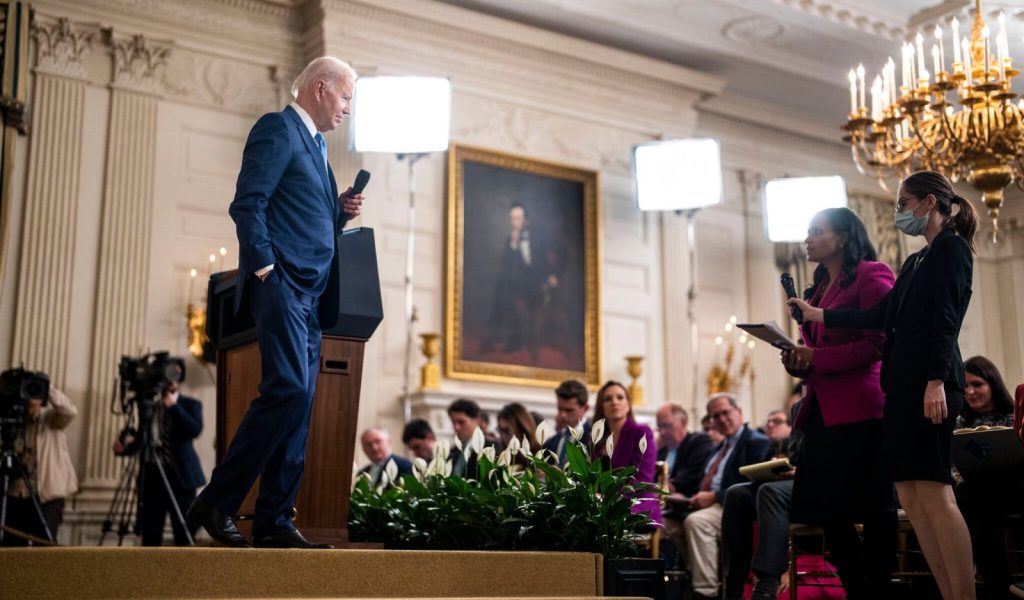
Photo taken from: Doug Mills / The New York Times
Policy Summary
[SSB theme=”Official” align=”center” counter=”true” ]
The elections on Tuesday November 8th, 2022, may be one of the most impactful elections we will have seen in our lifetime to date. With the US House of Representative and US Senate up for grabs, Democrats were preparing for the worst but hoped for the best.
It looks like they were met with results somewhere in the middle. History tells us that the political party that holds the presidency, which is the Democrats right now, tend to not do well in midterm elections. With the current numbers in the House and Senate and this historical fact, this means that the Democrats could have lost Congress and lost big. Many were expecting a “Red Wave”, where Republicans sweep elections and take over several seats. This did not occur this past Tuesday.
Of note, there are still some elections waiting to be decided. Namely, Georgia, Nevada, and Arizona. Georgia will likely see a run-off election in December as neither candidate reached the 50% threshold for votes. As of writing this article, the Senate is split with each party having 48 seats and the Republicans controlling the House with 208 seats versus the Democrats 188. But again, there are still some seats waiting to be decided.
Policy Analysis
This means a lot for President Joe Biden and his agenda. With the Republicans potentially controlling the House, he may not be able to get some of his agenda items on to the floor to be voted on and passed into law. This will make him look like an ineffective president, when, it is an ineffective government who is not willing to work with the other party for the good of the nation.
This also means that President Biden has made history with one of the best midterm elections a sitting president has seen in recent times. What does this mean? It could be several things. Many Trump-backed candidates did not win, so maybe people are tired of the Republican rhetoric.
Women came out to vote, maybe due to the overturning of Roe v. Wade. Younger people came out to vote, maybe because they are tired of not being heard on gun control.

Illustration by: Jeff Koterba
(click or tap to enlargen)
Either way, this means good things for Democrats. Will this mean good things to come? We shall see in 2024.
Engagement Resources
Click or tap on resource URL to visit links where available

https://it.usembassy.gov/what-are-midterm-elections-and-why-are-they-important/

https://apnews.com/article/2022-midterm-elections-live-updates-896439f8b5fe09824d8f6cd98580a051

Situation Update: # 15 The Ukraine Crisis
Situation Update: #15 The Ukraine Crisis
Foreign Policy Brief #155 | By: Abran C | November 10, 2022
Header photo taken from: Viacheslav Ratynskyi / Reuters
Follow us on our social media platforms above
Browse more foreign policy briefs from the top dashboard

Photo taken from: Metin Aktas / Getty Images
Fighting and Retreat from Kherson
[SSB theme=”Official” align=”center” counter=”true” ]
After 260 days of war, the fighting in Ukraine is still raging as firece as ever, yet Ukranian forces have made more gains in recent weeks than they had in the first months of the war. Russia on Wednesday ordered its forces to withdraw from the city of Kherson, the only regional capital captured by Russian forces since the invasion began back in February. The withdrawal of Russian forces from the city signals another blow to the Kremlin’s efforts in Ukraine.
Kherson is one of the four regions that Putin proclaimed back in September to be incorporating into Russia. The annexation of the territory came after a sham referendum that was condemned as illegal by Ukraine and much of the international community. Yet only two months later, the Kremlin has at least for now, lost control of what is supposedly Russian territory.
Additionally, only hours before the withdrawal, the Russian-installed deputy of Kherson, Kirill Stremousov, was killed in a car crash, making him the second Russian official killed in Kherson this since June. Stremousov was a dual Ukrainian and Russian citizen, and was one of the most prominent faces of Russia’s occupation in Ukraine’s territory. He had been urging civilians to evacuate Kherson and flee across the Dnieper River in the wake of the Ukrainian counteroffensive to retake the city.
With the Russian retreat from Kherson and weeks of losses in Ukraine, Putin announced that 50,000 reservists, which were called up under Moscow’s partial mobilization, have been deployed and are now involved in active warfare. A signal that Moscow intends to continue the fight and recapture territory liberated by Ukrainian forces. Ukranian officials are wary that the withdrawal may only be a regrouping for another push that is likely to come later.
International Support of Russia

Photo taken from: Radio Free Europe
Russia has become increasingly isolated in the international community and certainly among Western states. Western countries have made trade and even travel for Russian tourists increasingly difficult as a result of the Kremlin’s war.
Though even with the barrage of sanctions, restrictions, and condemnation from Western leaders, there has been relief for Russia from other global players. India has announced it will continue buying Russian oil ahead of a G7 meeting where Western powers had hoped to meet and agree to put further pressure on Russia. This week Indian foreign minister, Subrahmanyam Jaishankar, in his first visit to Russia since the invasion of Ukraine, said, “We have seen that the India-Russia relationship has worked to our advantage. If it works to my advantage, I would like to keep that going.”
The move counters Western efforts to cripple Russia’s economy with sanctions that explicitly target its energy export sectors. Russia and India are also considering the joint production of modern defence equipment. Moscow has been India’s biggest supplier of military equipment for decades, with India having imported arms worth more than $20 billion between 2011 and 2021.
Russia’s security chief, Nikolai Patrushev, also this week met with his Iranian counterpart and the Iranian president in an effort to deepen ties between the two countries that have been isolated by Western powers.
The Iranian president said Iran remains opposed to the war as a fundamental policy, nevertheless the two countries would be upgrading relations to a new “strategic” level, something he said is “a decisive response to the policy of sanctions of the United States and its allies. Iran has been accused by Ukraine of supplying Russia with drones used to attack Ukrainian infrastructure.
Ukraine has faced blackouts, with 40% of the country’s energy infrastructure having been damaged after weeks of Russian attacks using Shahed-136 kamikaze drones and other types of unmanned aerial vehicles manufactured by Iran. The Iranian government has acknowledged that it had supplied drones to Russia, but claims the sale of weapons occurred before the invasion and not after.

Brittney Griner’s Sentencing in Russian Trial
Brittney Griner’s Sentencing in Russian Trial
Foreign Policy Brief #154 | By: Reilly Fitzgerald | November 10, 2022
Header photo taken from: AFP / Getty Images
Follow us on our social media platforms above
Browse more foreign policy briefs from the top dashboard

Photo taken from: Getty Images
Policy Summary
[SSB theme=”Official” align=”center” counter=”true” ]
WNBA star Britney Griner is one of several American citizens wrongfully detained in Russia. Her arrest took place within about one week of the start of Russia’s war in Ukraine. She was arrested on trumped up charges of ‘drug smuggling’ while traveling to Russia to play on a team during the WNBA off-season. She was convicted of drug smuggling, due to her carrying a small amount of cannabis oil into Russia, which she was prescribed by her doctor in the United States.
Russia over the summer conducted a trial, and found her guilty of drug smuggling and recentlysentenced her to nine years in a penal colony. She is not the only American citizen wrongfully imprisoned in Russia though; Paul Whelan is an American detained on espionage charges; and Mark Fogel is another American citizen who was sentenced to 14 years imprisonment for carrying cannabis into Russia with a prescription from his doctor, very similar to Britney Griner.
Policy Analysis
Russia is well-known for its ‘zero tolerance policy’ toward illicit drugs, which is how the Russian government views cannabis. However, Russia is also infamous for its well-documented alcoholism rates and addiction problems.
So, it may seem a little disingenuous for Russia to be claiming a ‘zero tolerance policy’ towards illicit drugs and addictive behaviors – none of which Griner has exhibited by an American standard where cannabis use is legalized in many states. She was prescribed the cannabis oil by a licensed physician.
Griner’s sentencing to nine years in a penal colony is extremely alarming. First off, the location of the penal colony is unknown, as of yet. The penal colonies that are in use in Russia are often on the sites of former gulags; former Russian prison work camps that were used, in the height of the Soviet Union’s reign, to jail political opposition.
The gulags, and now these penal colonies, were, and are, well-known for their horrific and inhumane conditions. Prisoners are often working outside doing manual labor (akin to forced labor or enslavement); they have poor hygiene conditions and lack health care services.
PBS Newshour interviewed Julia Ioffe, a distinguished Russian-American journalist, recently and she explained that these penal colonies are often the most common sentence for women, especially foreigners, who are found guilty on drug charges. Ioffe also stated that Griner was going to be “guilty no matter what” in the current state of Russian affairs.
Ioffe also made the point that she worries for Griner’s safety in these penal colonies as these camps are already intensely political amongst the prisoners and the fact that Griner does not speak Russian will be a major hindrance to her ability to remain safe. Ioffe also pointed out that these penal colonies are rife with sexual violence towards the prisoners from the guard staff.

Photo taken from: Marijuana Moment
(click or tap to enlargen)
The White House is still trying to discuss with Moscow the release of Griner, and the other Americans wrongfully detained in Russia; although, these talks have been not progressing well. There were rumors regarding a potential prisoner exchange between the two countries as the United States has jailed Viktor Bout, a former international arms dealer. However, these discussions, according to Julia Ioffe have been difficult as Moscow has increased their demands on the United States by adding more prisoners that they would like sent back to Russia; one example given by Ioffe was the release of a former FSB officer who is imprisoned in Germany for assassinating a person in a park.
These types of demands are impossible for the United States to negotiate with as President Biden cannot control, nor interfere, with the legal proceedings of the German government. As long as these types of demands are made by the Russians, the likelihood of a prisoner exchange for Griner seems to diminish.
The jailing of Griner and others took place just before the start of the Russian war in Ukraine. Russia has viewed the war in Ukraine almost as a proxy-war against the United States, as the US has been a large supporter of Ukraine militarily and financially through this conflict.
The imprisonment of Griner is a part of this political puzzle and a way for the Russian government to inflict some harm and damage to the United States government. President Putin and his allies are essentially kidnapping American citizens for political reasons.
Engagement Resources
Click or tap on resource URL to visit links where available

James W. Foley Legacy Foundation (https://jamesfoleyfoundation.org/american-hostage-advocacy )

Russia – DrugPolicyFacts.org (https://www.drugpolicyfacts.org/region/russia)

Amazon is a Hazardous Place to Work, But Don’t Dare Tell the Company to Change
Amazon is a Hazardous Place to Work, But Don’t Dare Tell the Company to Change
Technology Policy Brief #72 | By: Mindy Spatt | November 8, 2022
Header photo taken from: Chris J Ratcliffe | AFP | Getty Images
Follow us on our social media platforms above
Browse more technology policy briefs from the top dashboard

Photo taken from: Claudine Hellmuth / E&E News
[SSB theme=”Official” align=”center” counter=”true” ]Workers, regulators even its own investors want Amazon to improve its abysmal worker safety record. But the company has fought tooth and nail to quash those efforts.
Working conditions at Amazon’s warehouses are among the worst in the US. High quotas and constant surveillance likely contribute to injury rates for Amazon workers that are substantially higher than for comparable businesses; Amazon’s injury rate for warehouse workers was more than twice as high as Walmart’s in 2020, and its serious injury rate for warehouse workers was about 80% higher than for the industry overall.
These alarming statistics drove the company’s own investors, including Digital investment platform Tulipshare, to propose resolutions at Amazon’s 2022 annual meeting calling for the company to report on worker health and safety and the treatment of its warehouse workers.
The company’s board opposed the resolution which predictably failed, along with 14 others on worker safety. “Whilst we are disappointed that our proposal did not pass today, this vote was just the beginning in the fight for workers’ rights,” said Antoine Argouges, CEO and founder of Tulipshare, adding that Amazon had not yet disclosed by what percentage the proposal was rejected.
Argouges also said he believed there was widespread support for the resolution among investors, and indicated his intention to continue “the fight for better working conditions at Amazon.”
In its home state, Amazon is battling with the Washington Department of Labor & Industries over hazardous conditions at a warehouse in Kent, Washington.The Department found that workers were under pressure to lift, carry, and twist at a rapid pace, which the Board said was likely to lead to injury. The Department fined Amazon a paltry $60,000 and ordered the company to change these practices and decrease the potential harm to workers.
Amazon Would Rather Fight Than Change
Rather than comply Amazon appealed the order, claiming the citation requiring the company to reduce to the alleged safety hazards before any appeal could be heard, would require expensive changes to its warehouse design and retraining warehouse employees.
In its appeal Amazon complained that the process required by the board would be extremely disruptive to its operation and cost millions.
And Amazon brazenly asserted its corporate personhood, claiming the order by the Department of Labor and Industries order violated its right to equal protection under the 14th Amendment to the US Constitution.
The federal Occupational Safety and Health Administration, in collaboration with the U.S. Attorney’s Office for the Southern District of New York. is also investigating potential workplace safety hazards at Amazon warehouses nationwide, CNBC recently reported.
OSHA inspectors are looking at many of the same practices mentioned above, including Amazon’s ergonomics program and Power Industrial Truck (known as PIT) operations. Employees working in this sector are required to drive forklifts to reach high shelves, move heavy items, and operate other potentially dangerous equipment.
OSHA may also be looking into extreme heat in Amazon facilities. Heat-related hazards are a new emphasis for the agency, and were one of the complaints that spurred a walkout in August by 160 employees at the Amazon’s San Bernardino International Airport facility

Photo taken from: Amazon, Wired
(click or tap to enlargen)

Photo taken from: kadmy / iStockphoto
(click or tap to enlargen)
Amazon’s Solution
Amazon has zeroed in on robots as the solution. “The movement of heavy packages, as well as the reduction of twisting and turning motions by employees, are areas we continually look to automate to help reduce risk of injury,” Amazon said.
But critics allege that not only do the robots not make workers safer, they may be making things worse. They claim injuries are on the increase in warehouses with workers, because they cause managers to “raise performance quotes.” So far, it looks like workers can’t win.
Engagement Resources
Click or tap on resource URL to visit links where available

The Strategic Organizing Center (SOC) is a democratic coalition of four labor unions: Service Employees International Union (SEIU), International Brotherhood of Teamsters (IBT), Communications Workers of America (CWA) and United Farmworkers of America (UFW). Together, SOC-affiliated unions represent more than 4 million workers.
https://thesoc.org/news/amazons-safe-new-robot-wont-fix-its-worker-injury-problem/

Amazon warehouses face expanded probes into safety hazards as investigators visit three more sites by Annie Palmer, Aug. 2, 2022
https://www.cnbc.com/2022/08/02/three-more-amazon-warehouses-part-of-osha-safety-investigation.html

Inland Empire Amazon Workers United https://www.facebook.com/ieamazonworkers

Checking in on US Senate Races Before Election Day, Part 2
Checking in on US Senate Races Before Election Day, Part 2
Elections & Politics Policy Brief #42 | By: Ian Milden | November 2, 2022
Header photo taken from: Scott Olson—Getty Images
Follow us on our social media platforms above
Browse more elections and politics policy briefs from the top dashboard

Photo taken from: Rachel Woolf / The New York Times
[SSB theme=”Official” align=”center” counter=”true” ]
Election Day is November 8th. This Brief will take a look at some of the Senate Races I previewed over the summer and early fall and provide some short updates on the state of those races.
Colorado – For a Republican to win in Colorado, they would have to win not only conservative voters, but also a significant share of unaffiliated voters. Republican Nominee Joe O’Dea tried doing this in the primary and won over an underfunded conspiracy theorist.
Shortly after the primary, O’Dea got into a war of words with Trump, which may cost him votes from Trump’s supporters. Republicans didn’t make a significant investment in the state due to the unexpected expense in Ohio. Senator Michael Bennet (D-CO) should win reelection, though the margin might be closer than Democrats would prefer.
New Hampshire – Republicans held their primary in September and nominated Don Bolduc, a retired general known for appearances on Fox News. The types of statements that got Bolduc on Fox News don’t sit well with many of New Hampshire’s moderate voters.
He’s been trying to backtrack on some of his more controversial statements on topics like the 2020 election and abortion in hopes that some voters have short memories. With the polls getting slightly tighter, a Super PAC with ties to the Heritage Foundation is spending money to help Bolduc. This is a closer race than Democrats hoped to have, but Bolduc is a flawed candidate. Senator Maggie Hassan (D-NH) should still be favored to win reelection.

Photo taken from: WSAV-TV
Arizona – Blake Masters (R-AZ) was trailing significantly in most polls at the start of the General Election. As a result, the Senate Leadership Fund, the primary Super PAC supporting Republican candidates for the U.S. Senate, canceled its plans to run ads in the state. The NRSC has reinvested some money into the race, but it hasn’t made up for the cuts made by the Super PAC or Masters’ fundraising difficulties. The national environmental trends and polling trends within Arizona for all statewide races have moved towards the Republicans in recent weeks.

Photo taken from: The Associated Press
(click or tap to enlargen)
Senator Mark Kelly (D-AZ) still leads narrowly in most polls (and often within the margin of error), and Masters still has a poor image among Arizona voters. I think Senator Kelly will still win as long as Democrats mail their ballots back, but I wouldn’t completely rule out Arizonans supporting Republicans in many state races this year.
Wisconsin – Mandela Barnes’ (D-WI) polling lead didn’t last long. Senator Ron Johnson (R-WI) is now leading after spending on TV ads criticizing Barnes on crime.
Democrats have not been able to invest enough to prevent the ads from having an effect. The general election campaign has not only harmed Barnes’ image, but according to the Marquette University Law School Poll, Johnson’s image has improved. If Democrats don’t defeat Senator Johnson this year, then that will likely prompt some difficult conversations within the party about strategic directions.
Florida – I didn’t give Democrats a very good chance of winning the Florida Senate Race when I previously wrote about this race. National and statewide Democrats haven’t invested a significant amount of money in Florida for this year’s statewide elections. Florida probably shouldn’t be considered a swing state until Democrats develop a better strategy to compete in statewide elections.
Utah – There are not many polls for this race. The Dan Jones and Associates poll has gathered new data about every other month. The most recent one I could find was from early October. It still shows Senator Mike Lee (R-UT) in the lead, but unaffiliated candidate Evan McMullin has been slowly gaining support.
A more recent poll from Emerson College shows Lee with a wider lead. Voter perceptions of McMullin appear to be worse in the Emerson College poll when compared to earlier polls, which suggests that his chances of pulling off an upset are still slim.
Engagement Resources
Click or tap on resource URL to visit links where available

DSCC – Official Campaign Arm of Senate Democrats

Abbott Running Scared: Texas Incumbent Limited Voter Access to Polls Ahead of Midterms
Abbott Running Scared: Texas Incumbent Limited Voter Access to Polls Ahead of Midterms
Elections & Politics Policy Brief #43 | By: Abigail Hunt | November 2, 2022
Header photo taken from: Shelby Tauber / The Texas Tribune
Follow us on our social media platforms above
Browse more elections & politics policy briefs from the top dashboard

Photo taken from: Brandon Bell / Getty Images
[SSB theme=”Official” align=”center” counter=”true” ]
For the disillusioned and jaded non-conservatives of the Lone Star state, seeing Beto O’Rourke within spitting distance of Greg Abbott in a dead heat for governor thrills our withered-but-still-beating Grinchy little hearts. From 1847 to 1979, with the exception of a few years here and there, Texas was Democratic. The most-beloved governors in our history are Democrats – Sam Houston, Ann Richards. I suspect there may be a greater number of Texans watching these election results with interest – we could make history this year.
There are many events that can influence any election outcome, and this one is no exception. Reports are already rolling in of ballot tampering, voter intimidation, closed polling locations, and denied mail-in ballots. For the first time, I had to vote on an electronic machine that then printed a ballot sheet, on which my votes were printed. I then had to insert that page into a separate machine, a scanner, in order for my vote to be counted. It added a couple of extra steps to the process. This is just my anecdotal experience, but it is disconcerting.
Adding steps that could further complicate things for those with language barriers, impairments, and disabilities who already have to deal with barriers to access. Another barrier to access for a majority youth voter population is the lack of voting options for college students. In an article from Alex Nguyen, the Texas Tribune reports limited access to voting locations for thousands of students at smaller universities across the state, stating that for some campuses the nearest polling site is several miles away. Student IDs are not considered acceptable forms of identification. Despite these barriers, voter turnout from 2014 to 2018 more than tripled for voters under 30, from 8 to 26 percent.
Alex Nguyen. College voters held back by Texas election law, lack of on-campus polling sites. October 28, 2022.
https://www.texastribune.org/2022/10/28/texas-young-voter-turnout-access/
So who is our governor? Greg Abbott made a windfall from a devastating back injury that crippled him for life. After he achieved a political position of power, he supported legislation that made it harder for someone to get a settlement similar to his own. He made choices that furthered his own political interests but were detrimental to others. He has passed laws that outlaw abortion and prevents the teaching Critical Race Theory (CRT) in schools; Abbott is out for #1 – himself. Greg Abbott did nothing after children were massacred in Uvalde, just like the Texas police there stood by and did nothing, and every one of those individuals needs to, at minimum, lose their jobs.
Abbott does not care about the danger to the average Texan – man, woman, or child. He let Texans freeze when the power went out, because he had power. His child attends private school. He has no familiarity to a relationship with pregnancy. If it does not personally affect him, he doesn’t care who it hurts or kills.
There are “dark money” groups influencing politics in the state – a Texas Tribune
An article by Patrick Svitek discusses two of these groups, No It Couldn’t LLC and Coulda Been Worse LLC. However, the monies contributed by these groups are in the tens of thousands, compared to the millions spent by the gubernatorial candidates themselves.
More than the money, the creative productions by these groups are making an impact. The ad campaigns produced by the aforementioned groups, as well as those made by the PAC Mothers Against Greg Abbott, have elicited powerful responses across social media.
Mothers Against Greg Abbott. Greg Abbott Chose This – https://youtu.be/AmmgN-Nkn1Q
Mothers Against Greg Abbott. “Whose Choice?” https://youtu.be/faTNMTVsgAA
Patrick Svitek. Uvalde shooter footage in ad criticizing Abbott’s gun policies. October 27, 2022. https://www.texastribune.org/2022/10/27/dark-money-ad-greg-abbott-uvalde/
Beto O’Rourke is the people’s champion. People want Robin Hood more than the Sheriff of Nottingham, and Beto is definitely closer to Robin, enough to alienate many conservatives.
Anti-O’Rourke ads produced by Abbott’s campaign talk about Beto’s criminal record. A bit hypocritical since one of Texas’s most-successful former governors who went on to become President was a Republican with a criminal record – George W. Bush. Because the fact is that one-third of adult citizens have a criminal record in the U.S. People have an inflated sense of superiority for not having a criminal record.

Photo taken from: Todd Wiseman / The Texas Tribune
Most of us have broken at least one minor law; much of the difference between someone with a criminal record and someone without is that only one of the two was caught and prosecuted. Our criminal justice system disproportionately affects the poor and people of color. Some of us have loved ones with a criminal record and//or have a criminal record ourselves – is it not representative of the people to have someone like themselves, including criminal history, in power?
Robin Hood is the protagonist despite the fact that he robs people, because it is understood in the telling of the story that the rich people are lazy, indulgent, spoiled, and cruel, and that the workers who exert the effort and keep the country running are oppressed, abused, and deprived of even minor comforts. Robin Hood is balancing the scale we can all see is unevenly tipped.
Abbott did not bring Texas to greatness, and neither did Rick Perry before him – the economic machine of Texas developed from dirt-poor settlements inhabited by industrious Mexicans and Southerners on whose backs an empire was built, many years before either of those men existed.
National Conference of State Legislatures Barriers to Work: People with Criminal Records: Improved Access to Licensed Occupations for Individuals With Criminal Records. July 17, 2018. https://www.ncsl.org/research/labor-and-employment/barriers-to-work-individuals-with-criminal-records.aspx

Screenshot taken via: Twitter
In anticipation of the real threat of Texas flipping blue and cementing itself as a swing state, Greg Abbott is advertising for governor as he has never had to do before. A 2016 Twitter post wherein Abbott describes Clarissa Phalen, a police officer in Texas, as his “wife’s niece” is now infamous for the reference. The post celebrates Phalen becoming a law enforcement officer. Recently, Greg Abbott’s “wife’s niece” made a commercial at his behest to attempt to reconnect with the people – it is as cringe-y as it sounds. The Tío Greg commercial, paid for by the Abbott campaign, can be viewed here:
Greg Abbott Youtube. Tío Greg. https://m.youtube.com/watch?v=803XV392sTk&feature=youtu.be
In the lead up to Election Day, the polls are flip-flopping way more than usual. For those of us hoping to make history and return to our roots with Beto, there is the slightest glimpse of light at the end of a tunnel. Here is to hoping that light is the return of the sun on the other side of a dark tunnel rather than impending end.

Education Takes a Back Seat in the 2022 Midterms
Education Takes a Back Seat in the 2022 Midterms
Education Policy Brief #57 | By: Steve Piazza | October 31, 2022
Header photo taken from: The Associated Press Photo / Jeff Amy
Follow us on our social media platforms above
Browse more eduation policy briefs from the top dashboard

Photo taken from: Reuters / Evelyn Hockstein
Policy Summary
[SSB theme=”Official” align=”center” counter=”true” ]
Most polls show that 2022 midterm election voters seem to have prioritized the economy over all other issues. Not surprisingly, since it often holds voter interest more than crime, foreign affairs, health, and the environment.
Education finds itself at the bottom of most recent surveys, if it’s visible at all. When it is, specific hotbed issues like student debt relief or parental rights are more likely to be reflected as a concern for voters than curricular overhauls, improving school performance, and sadly, preventing school shootings.
Subsequently, political candidate discussions on children learning and safety seem to be conspicuously absent in mainstream congressional contests.
It’s not totally omitted, though. Across the country there are seven state superintendent races, and 51 pertaining to state boards of education. Yet, these races, especially in Arizona, Florida, and South Carolina, are more about cultural ideologies than policy on learning and safety.
The same is true where amendments and referenda are on the ballot. Voters are deciding on issues ranging from funding initiatives to legislative oversight of the state’s board of education. But infrastructure and protocol matters, though important, have taken precedence and become a substitute for progress in student achievement.
Policy Analysis
Education is something that directly affects all American citizens, not just parents and children. Whether somebody is a product of a public, private, or home school, everybody has a stake because a democratic society depends on an educated populace.
So why is it that debate over teaching and learning in public schools seems neglected during campaigns, and especially congressional races?
To be sure, it’s a risky undertaking for politicians to take on educational issues. Just think of what happened to Democrat Terry McAuliffe’s gubernatorial campaign in Virginia after his remarks that alienated parents.
Waning public sentiment about education can also be a factor. An October 2, 2022 Morning Consult poll shows voters declaring education as “very important” only 50% of the time. The economy (80%) and crime (61%) were the top two choices while education was fifth. In a similar poll by Monmouth University, education barely makes it into the top 10, and that has to do with student loan debt specifically. Even then it rated “extremely or very important” only 31% of the time.
All this despite the concerns of time missed during Covid and recent results of the National Assessment of Educational Progress (NAEP), or the nation’s report card. The first since the pandemic started, it shows that eighth grade students showed a proficiency in math of 26%, down 8% from 2019. Fourth grade scores were down 5%. Scores for reading were also down, though that’s part of a trend prior to 2020.
Some say that too many people just don’t understand educational issues, let alone the political process. Many schools and organizations have already introduced civics initiatives to better educate future voters, but it takes time to increase substantive viewpoints and involvement beyond voting.
Others say politicians and parents have no place in the discussions, that practitioners should decide curricular matters. That debate has been around for decades and is one that needs to be resolved with all stakeholders in mind.
Yet one more reason education doesn’t take center stage could be a result of long term-political strategies.

Photo taken from: The Hill / Julia Nikhinson
(click or tap to enlargen)
For over sixty years, the Democrats have seen themselves as the party of education. They do have a decorated history of passing significant public school education initiatives at the federal level.
But while Democrats have been persistently touting their support for education for some time, some believe many conservatives never got over the 1954 United States Supreme Court decision requiring desegregation, and the Republican Party and its wealthy benefactors have been quietly waging a cultural war against schools ever since.
By 1988, the Republicans had had enough and the quiet frustration manifested itself into a clamorous push for vouchers and school choice. More recently, dubious Critical Race Theory (CRT) fears and inflated parental rights measures have contributed to the noise. In fact, data from Pew Research shows more than twice as many Republicans believe public schools are having a negative impact on the country.
It’s not a stretch to say that too many voters in general elections are in the habit of voting for parties rather than issues and assume that the party leaders will then make the right decisions. But decisions based on populist notions do not teach children how to read or do math.
Both parties may feel they will win the strategy battle outside the classroom, but what actually happens inside still needs to be seriously addressed.
Engagement Resources
Click or tap on resource URL to visit links where available
To find out more about who and what’s on the ballot this year, visit these sites:


If you’re interested, in learning more about curricula by state, you can use a tool designed by Education World to perform a search:

https://www.educationworld.com/standards/
These are links to resources on educating students about the election process:

https://www.edutopia.org/article/using-election-teaching-tool


Medicare Drug Prices: Listen to the Organizations that Matter
Medicare Drug Prices: Listen to the Organizations that Matter
Health and Gender Policy Brief #148 | By: Geoffrey Small | November 1, 2022
Header photo taken from: Phelan M. Ebenhack / The Associated Press
Follow us on our social media platforms above
Browse more Health and Gender policy briefs from the top dashboard

Chart taken from: The Kaiser Family Foundation 2022 Report “An Overview of the Part D Prescription Drug Benefit”
Policy Summary
[SSB theme=”Official” align=”center” counter=”true” ]
President Biden traveled to Irvine, California and Portland, Oregon during the month of October to promote the Inflation Reduction Act. As open enrollment for Medicare begins, the Biden administration is highlighting how seniors can benefit from health insurance savings made possible by the new policy. The Inflation Reduction Act aims to reduce senior health care premiums by an average of $800 annually.
To mark the beginning of his trip, Biden signed an executive order requiring the Department of Health and Human Services to submit a report detailing ways seniors can save on drug costs and have access to innovative drug therapies. However, the California GOP released a response, claiming that the Inflation Reduction Act “will not reduce inflation” as elections draw closer.
The Chairman of the California GOP, Jessica Millan Patterson, stated “Californians are suffering under the reckless policies of Joe Biden and the California Democrats who enable his failed agenda.” When dealing with contradictory claims related to this new policy, established medical and social organizations can provide better insight into how beneficial the Inflation Reduction Act truly is for seniors.
Policy Analysis
The American Medical Association
On August 17th, 2022, the AMA issued a press release on their assessment of the Inflation Reduction Act. The AMA stated that the bill includes strategies that the organization has been advocating. Not only do they support the extended Affordable Care Act tax credits and the bill’s commitment to fight climate change, which the AMA declared as a public health crisis in June, but the organization also supports the ability for Medicare to negotiate drug prices. The AMA’s only critique of the bill was that it didn’t go far enough in stopping the Medicare payment cuts for physicians, which is scheduled to take place on January 1st.
The American Association of Retired Persons
The AARP has been one of the major advocates in lowering drug prices for seniors since the Inflation Reduction Act was advancing through Congress. AARP CEO, Jo Ann Jenkins, went to Capitol Hill to personally advocate for prescription savings. They also sent a petition with 4 million American signatures and helped AARP members send thousands of emails, as well as phone calls, urging Congressional members to pass the bill. Jenkins wrote a letter to AARP members in September stating “Drug companies have for decades raked in record profits by charging Americans three times what people in other countries pay for the same medications. Now that will begin to change.” She stated that the Inflation Reduction Act is a “historic victory for consumers.”
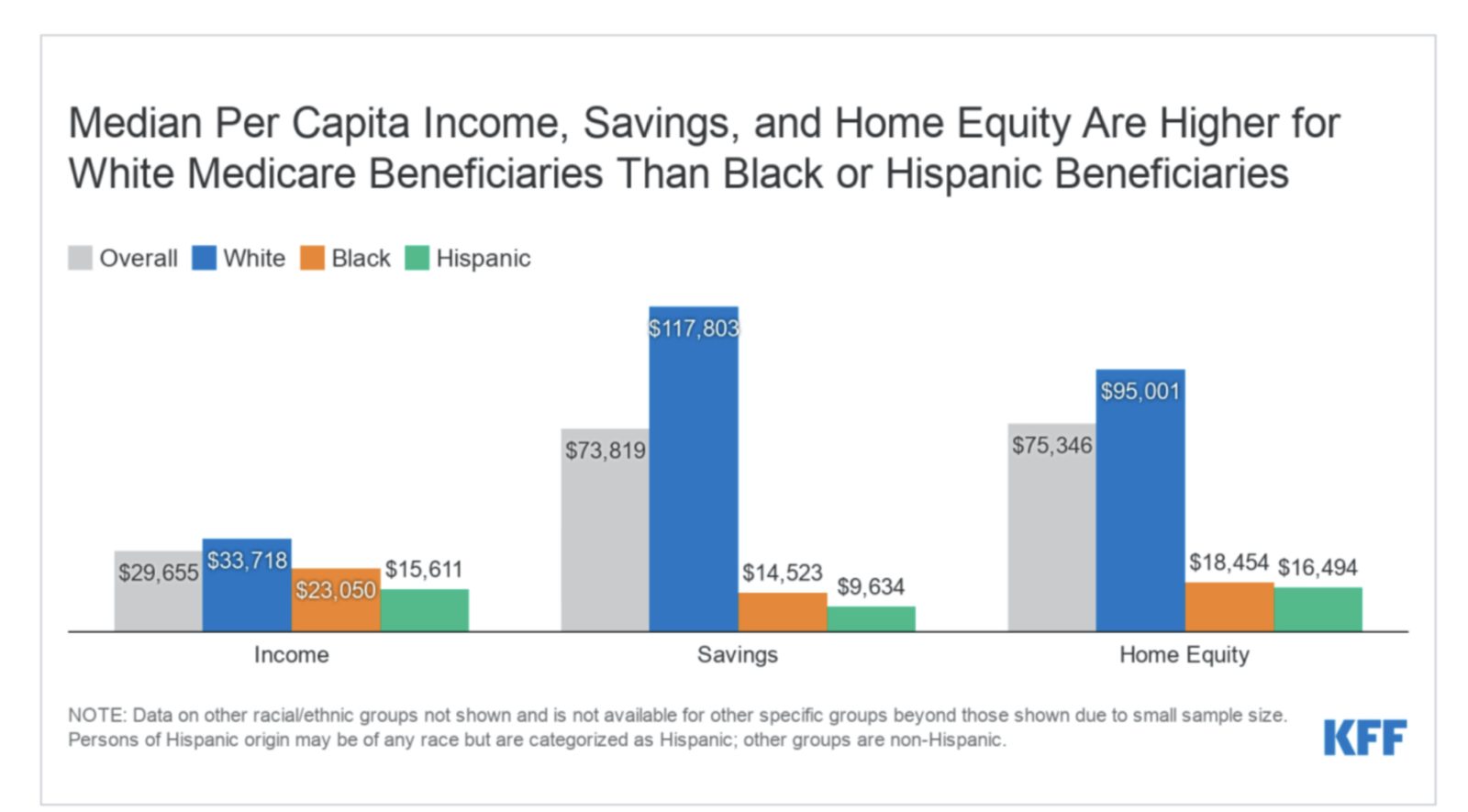
Chart taken from: The Kaiser Family Health Foundation 2021 Report “Racial and Ethnic Health Inequities and Medicare”
(click or tap to enlargen)
The National Association for the Advancement of Colored People (NAACP)
The NAACP issued a press release on Biden’s executive order the same day it was signed. The release stated “With one in four middle-class Americans struggling to afford the cost of their prescriptions, all efforts to reduce these costs are essential.” Keisha Deonarine, the Director of the NAACP’s Center for Opportunity, Race and Justice Center of Innovation, also stated “For Black Americans, thirty percent are not taking medications as prescribed due to cost. This results in under-usage of necessary medications resulting in poor health outcomes.”
Understanding these organizations’ assessments on the benefits of reducing drug prices and inflation is necessary during a time when election seasons lead to misleading political rhetoric. Donating to the AARP foundation and the NAACP can help keep Americans informed and balanced when making decisions about the future of health care and senior benefits in the United States.
Engagement Resources
Please donate:

https://www.aarp.org/aarp-foundation/


Checking in on US Senate Races Before Election Day
Checking in on US Senate Races Before Election Day
Elections & Politics Policy Brief #40 | By: Ian Milden | October 31, 2022
Header photo taken from: Demetrius Freeman / The Washington Post
Follow us on our social media platforms above
Browse more elections & politics policy briefs from the top dashboard

Photo taken from: Sean Simmers / The Associated Press
Policy Summary
[SSB theme=”Official” align=”center” counter=”true” ]
Election Day is November 8th. This brief will take a look at some of the Senate Races I previewed over the summer and provide some short updates on the state of those races.
Policy Analysis
Georgia – The headlines have not improved for Herschel Walker (R-GA) since I last wrote about this race. He’s been accused of paying for his mistress’ abortion and criticized by his son for his behavior. He’s still in the race because he still has the support of the Republican Party and most Republicans in Georgia. Senator Raphael Warnock (D-GA) appears to be in a good position, though this race could still head to a runoff if nobody gets a majority of the vote.
Republicans might appreciate a runoff because that might help their chances of winning the seat. Republicans might dread a runoff because they would have to campaign with Herschel Walker for two more months.
Pennsylvania – The margin in the polls has become tighter as I thought it would. Lt. Governor John Fetterman (D-PA) still leads Dr. Mehmet Oz (R-PA).
Dr. Oz has struggled to improve his image among the electorate as most polls, including ones with more favorable results for Republicans, indicate a high percentage of voters still hold negative opinions of Dr. Oz. His tasteless attacks on Fetterman’s health likely did not help. This race remains Democrats’ best hope of picking up a Republican-held Senate race.


Photo taken from: John Lochner / Associated Press
Nevada – The polls have moved a few points in the direction of Republican Adam Laxalt, which isn’t a great sign for Senator Catherine Cortez-Masto (D-NV).
The polls still show a margin of error race and Nevada has a reputation for being a difficult state to get an accurate poll from, so Democrats still have a shot to keep the seat. However, the movement in the polls and the internal squabbles within the Democratic Party make this race the most concerning one for Democrats where they have an incumbent to defend.
North Carolina – This race hasn’t gained the national attention that some other U.S. Senate races have received. Most polls show margin of error races with several polls showing both candidates having support in the mid-40s.
That’s a sign that voters don’t know the candidates very well, which I indicated might be an issue for both candidates several months ago. This race will be decided based on who turns out to vote. Over the past decade, that has worked out better for the Republicans in North Carolina.
Photo taken from: Charles Rex Arbogast / Associated Pres
Ohio – Republican Super PACs are spending about $3 million in TV ads a week in Ohio, which they didn’t plan on doing. Republicans had to invest that much money to prop up J.D. Vance (R-OH) because it is hard for Republicans to win back control of the U.S. Senate if they lose in Ohio. Congressman Tim Ryan (D-OH) has kept this a margin of error race despite little investment from national Democratic groups. It doesn’t seem likely that Congressman Ryan will win, but the race is close enough where a Democratic win isn’t impossible.
Iowa – I wrote back in July that Democrats were not going to win in Iowa unless something substantially changes the race by late October. I have not seen anything that substantially changes from that assessment. Republicans have been running more ads on TV than Democrats, not just in the race for the U.S. Senate seat, but also in races for U.S. House seats and several statewide offices. Election night is likely to bring more disappointment for Democrats in Iowa.
Engagement Resources
Click or tap on resource URL to visit links where available
DSCC – Official Campaign Arm of Senate Democrats