

JOBS POLICIES, ANALYSIS, AND RESOURCES
Latest Jobs Posts
The Ukraine War: One Year on
Brief #171 – Foreign Policy
By Abran C
We have arrived at the one year mark of the invasion of Ukraine, a war that has caused widespread destruction, displacement, and death as Ukraine still continues to fight back against Russia’s invading army with no end in sight. One year ago Russian forces at the command of Vladimir Putin launched the largest war on the European continent since World War II.
Montana Debates Letting Doctors Refuse Care to LGBTQ Citizens
Brief #157 – Health and Gender Policy
By Caroline Howard
The Montana House of Representatives recently debated and then passed a bill which is being referred to as a medical right of conscience law. This act, as the Montana Free Press put it, would allow “medical institutions, providers and other health care employees to deny services based on their ‘ethical, moral, or religious beliefs or principles’”.
Congress Needs to Act on Bills Regulating Data Brokers
Brief #79 – Technology Policy
By Steve Piazza
Ever since Congress enacted the Electronic Communications Privacy Act of 1986 it has been unable to secure legislation to increase privacy protection that better reflects the technologies of today.
An Early Look at the 2023 Mississippi Governor’s Race
Brief #63 – Elections & Politics
By Ian Milden
Three states hold elections for governor in years before the Presidential Election. This brief will look at the governor’s race in Mississippi, the only race this year where it is currently clear who the nominees will be. This brief will also discuss some current issues in Mississippi politics that could become important issues in the campaign.
Judicial Credibility At Issue In North Carolina Supreme Court Case
Brief #200 – TBA
By Rodney A. Maggay
In 2018, North Carolina voters approved a constitutional amendment that would require a voter to present a valid photo ID in order to vote in – person. In response, North Carolina’s Republican majority state legislature enacted S.B. 824, which would implement the amendment even though Governor Roy Cooper vetoed the bill.
The Week That Was #4
Brief #170 – Foreign Policy
By Abran C
A new series to catch you up on the top stories that occurred around the world last week.
Facebook’s Advertising Practices Run Afoul of Privacy Protection Rules in Europe
Brief #53 – Technology Policy
By Mindy Spatt
A groundbreaking decision by European regulators is pushing Meta, parent company of Facebook and Instagram, to make changes to its advertising policies. The ruling goes further than any US authority has gone in limiting Facebooks’ ability to collect users’ data. Meta is expected to appeal.
IMPROVING THE EFFECTIVENESS OF CONGRESS
U.S. RESIST NEWS OP ED
U.S. Resist News
The current ineffectiveness of Congress is one of the biggest threats to our democracy. Increasingly Americans are losing faith in the ability of Congress to pass meaningful legislation and respond to their needs. In this Op ED U.S. RESIST NEWS Reporters offer practical suggestions that will enable Congress to act as the legislative body the founders intended it to be.
The Ukraine Crisis: Situation Update: #19
Brief #169 – Foreign Policy
By Abran C
We are now a week out from the one year anniversary of the Russian invasion of Ukraine. The war has led to huge loss of life, damaged economies, created food shortages worldwide, caused political divisions within alliances like the EU and NATO, and continues to threaten the security of all of Eastern Europe. This weekend Ukraine’s top military commander said the country’s forces are holding their ground along the front line in the eastern region of Donetsk, including the besieged town of Bakhmut, where some of the fiercest battles of the war are currently taking place.


California Joins the Antitrust Chorus Against Amazon
California Joins the Antitrust Chorus Against Amazon
Technology Policy Brief #69 | By: Mindy Spatt | October 13, 2022
Header photo taken from: Roger Kisby for The New York Times
Follow us on our social media platforms above
Browse more technology policy briefs from the top dashboard

Photo taken from: AP Photo / Eric Risberg
[SSB theme=”Official” align=”center” counter=”true” ]
State AGs are coming for Amazon, while major antitrust actions by the FTC and Congress loom.
Efforts to rein in Amazon’s market power are ramping up in the nation’s capital and at the state level. Amazon was accused of anticompetitive practices by California’s Attorney General, Rob Bonta, who filed suit against the online giant in September. Bonta claims Amazon is violating California’s Unfair Competition Law and Cartwright Act in order to avoid price competition from other e-commerce sites.
The suit alleges that “Amazon requires merchants to enter into agreements that severely penalize them if their products are offered for a lower price off-Amazon.” Those agreements “thwart the ability of other online retailers to compete, contributing to Amazon’s dominance in the online retail marketplace…”
Amazon’s market dominance make it a must-have distributor for merchants, a growing number of whom sign on every day despite the high cost of doing business on the site. In a press release, Bonta said “Amazon coerces merchants into agreements that keep prices artificially high, knowing full well that they can’t afford to say no.”
According to the lawsuit, the policy was previously known as the “Pricing Parity Provision” and included in Amazon’s agreements with Amazon Marketplace sellers. In 2019 Congress began asking questions about the policy and Amazon got rid of the language. But, Bonta’s suit claims, the policy remained, in the form of high penalties on sellers that offer their products for lower prices elsewhere.
California’s lawsuit comes in the wake of the a successful effort by Washington Attorney General Bob Ferguson to hold Amazon accountable for its anticompetitive practices. His work ended in Amazon being forced to shut down its “Sold by Amazon” program nationwide.
The “Sold by Amazon” program allowed the company to negotiate prices with third-party sellers, rather than compete with them. Ferguson filed suit on antitrust grounds, claiming the practice restrained competition in order to protect profits. In a consent decree Amazon agreed to end the program and paid $2.5 million to fund antitrust enforcement by the AG.
In the Senate, the American Innovation and Choice Online Act, introduced by Sens. John Kennedy (R-La.), Amy Klobuchar (D-Minn.) and Chuck Grassley (R-Iowa) looms. “Big Tech has a track record of unfairly limiting consumer choices and thwarting free-market competition,” Kennedy said.
“The American Innovation and Choice Online Act would help offer consumers more options at competitive prices from businesses online, which is what the American economy is supposed to do best.”
And the Federal Trade Commission, now helmed by Lina Kahn, is widely expected to be cooking something up. Biden’s appointment of Kahn to lead the agency leaves no doubt as to where he stands on Amazon’s anti-competitive activities.

Screenshot taken from: Twitter, Bloomberg
(click or tap to enlargen)
Kahn’s groundbreaking 2017 paper in the Yale Law Journal, Amazon’s Antitrust Paradox, suggested that turn-of-the-century antitrust laws and rules needed to be updated for the modern digital age. With classic, railroad style monopolies the fear was that they would use their market dominance to jack up prices. Kahn argued that undercutting the competition can also be monopolistic. Amazon’s lower prices give it so much market power it can easily dominate its competitors.
Amazon and Facebook objected vociferously when President Biden appointed Kahn to the FTC and it’s easy to see why. She wrote her seminal paper as a student. Now, as an agency head who won bipartisan support in her confirmation hearings, she’s in a position to put her ideas into action.
Engagement Resources
Click or tap on resource URL to visit links where available

Why Amazon Is Wrong About the American Innovation and Online Choice Act
by Bill Baer, June 14, 2022

Amazon sued by California on Allegations it Blocks Price Competition
https://www.retaildive.com/news/amazon-sued-california-price-competition-allegations/631910/
by Ben Unglesbee, Sept. 15, 2022

Amazon Acts to End EU Antitrust Investigations, Avoid Fine
By Foo Yun Chee, July 14, 2022

The Nationwide Right to Organize Act: Explained
The Nationwide Right to Organize Act: Explained
Social Justice Policy Brief #141 | By: Emily Scanlon | October 10, 2022
Header photo taken from: Getty Images
Follow us on our social media platforms above
Browse more social justice policy briefs from the top dashboard

Photo taken from: Samuel Corum / Getty Images
[SSB theme=”Official” align=”center” counter=”true” ]
What is the Nationwide Right to Unionize Act?
On September 8th, Senator Elizabeth Warren (D-MA) and Representative Brad Sherman (D-CA-30) reintroduced the Nationwide Right to Unionize Act. Labor unions are organizations formed by workers who join together and use their strength to have a voice in their workplace. The bill would support the right to unionize in the workplace by overturning so-called “right-to-work” laws. As labor unions grow in size and popularity, this bill would increase the strength of labor unions and give power back to the American worker.
What problems would the Nationwide Right to Unionize Act solve?
In the aftermath of a major wave of strikes in 1945 and 1946, Congress enacted the Taft-Hartley Act of 1947. President Harry Truman attempted to veto the bill, but many Democrats crossed party lines to override the veto. The Taft-Hartley Act limited the strength of unions by banning several union practices. One of these practices was what’s known as “union shops,” which are places of employment which require all employees to be part of the union. Because union shops were made illegal, states were given the authority to enact “right-to-work” laws. Right-to-work laws allow a person to get or keep a job regardless of if they join or pay the union.
Because of the Taft-Hartley Act, federal law already prevents discrimination based on union status. The difference between this and right-to-work laws is that these laws go one step further by requiring unions to represent non-union employees, regardless of how much money or time it costs the union. Essentially, they allow employees to enjoy the benefits of being in a labor union without paying their share of the cost of the union.
Today, 26 states have right-to-work laws. Employees in right-to-work states have yearly salaries that are, on average, $11,059 lower than states without these laws. This is a 17.1% decrease, even when adjusted for factors such as education level, job opportunities across the state, and the age of workers. These states also see a decrease in unionization rates by 5%.
Finally, workers in states without right-to-work laws are more likely to receive health insurance and pensions than states with these laws—3.8 million and 2 million, respectively. These discrepancies in compensation are the reason why “right-to-work” laws have been known more informally as “right-to-work for less” laws. By passing the Nationwide Right to Unionize Act, people living in right-to-work states would see an increase in their wages, benefits, and quality of life over time.

Photo taken from: Ringo H.W. Chiu / AP
What would the proposal do?
The Nationwide Right to Unionize Act has one goal: end so-called “right-to-work” laws across all states. It would repeal Section 14(b) of the Taft Hartley Act and allow for private companies to make their own decisions on unionization. This would lead to less restrictions on unions, giving employees the power to bargain with employers on a more even playing field. It would tip the power scale between employers and employees. The interests of workers in the US and workers’ rights would be prioritized, resulting in better outcomes for all.
What are proponents and opponents saying?
While the Nationwide Right to Unionize Act itself is not gaining much attention, a previous bill proposed by Senator Warren, the Protecting the Right to Organize Act, has been discussed at length. Additionally, the debate of “right-to-work” laws has been around for decades. Here is where proponents and opponents of each stand:
Opponents of right-to-work laws:
- Balance power scales between employees and employers.
- Prioritize the interests of workers.
- Strengthen unions.
- Raise wages and benefits.
- Protect the First Amendment right to assemble.
Proponents of right-to-work laws:
- Ironically, protect the First Amendment right to free speech.
- Keep business costs down because of lower labor costs.
- Grow employment rates.
- It is important to note that this is an untrue assumption. Of 27 states that have adopted right-to-work laws, 23 states have failed to increase employment rates. In fact, states who have recently adopted these laws are actually seeing a reversal of previous expanding trends in employment. This means that right-to-work laws are not only unhelpful, in many states they are actively harmful to employment rates.
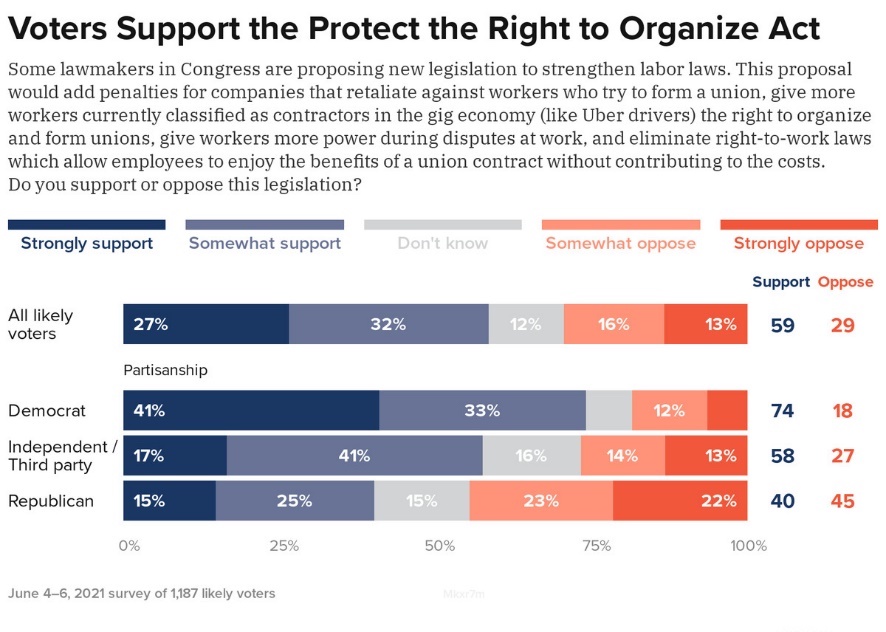
Chart taken from: Vox / Data for Progress
As for the popularity of the Protecting the Right to Organize Act, support among American voters is much higher and more bipartisan than expected. The chart above, retrieved from Vox, shows that 40% of Republicans, 74% of Democrats, and 58% of Independents support the act. While these results still show the strongest support among Democrats, the trend among Republican voters is much more favorable than Republican legislators. Given the similarities between the Protecting the Right to Organize Act and the Nationwide Right to Unionize Act, we would except similar trends of popularity.
What is the bill’s future?
Senator Warren has introduced this bill before as the Protecting the Right to Organize Act in 2017, and again in 2020. Representative Sherman has introduced similar bills in the House every session since 2008. None have gone far in any of these attempts.
However, in March of 2021, the Protecting the Right to Organize did pass in the House but failed in the Republican-controlled Senate. Today, the Nationwide Right to Unionize Act has 26 cosponsors in the House and 18 cosponsors in the Senate. In both chambers, it has been introduced in committee but has not made it out. For it to become law it must go through this process:
- Pass in the House Committee on Education and Labor.
- Pass in the House of Representatives with a simple majority of 218 votes.
- Pass in the Senate Committee on Health, Education, Labor, and Pensions.
- Pass in the Senate with a simple majority of 51 votes.
- Be signed by President Biden.
With that being said, the bill as of now does not have a strong likelihood of passing. GovTrack, an independent website that tracks the status of legislation, estimates its likelihood of passing is around 30%. Despite its low chances of passing, this bill is continuing an important conversation about workers’ rights and unionization in the US today.
Engagement Resources
Click or tap on resource URL to visit links where available

American Federation of Labor and Congress of Industrial Organizations (AFL-CIO)

Service Employees International Union (SEIU)

American Federation of State, County & Municipal Employees (AFSCME)

Americans Find Toxic Water at The Bottom of Their Well
Americans Find Toxic Water at The Bottom of Their Well
Environment Policy Brief #149 | By: Todd J. Broadman | October 10, 2022
Header photo taken from: Justin Metz / Consumer Reports
Follow us on our social media platforms above
Browse more environmental policy briefs from the top dashboard

Photo taken from: Michael M. Santiago / News 21
Policy Summary
[SSB theme=”Official” align=”center” counter=”true” ]
Worldwide, 1 in 10 people cannot access clean water within a 30-minute walk from their home and by 2030 this situation is projected to grow and displace up to 700 million. Closer to home, as the water treatment infrastructure in the U.S. continues to deteriorate, many Americans are facing a similar plight.
In terms of that plight, Jackson, Mississippi serves as one stark example among thousands, of a water infrastructure given way to neglect. Jackson is a city of 160,000 residents who no longer have clean drinking water. The city’s water treatment plant shut down last August due to a major pump failure. Since then, a massive effort led by the National Guard to distribute bottled water has been in place.
Nationwide, the American Society of Civil Engineers has issued a grade of C-minus to the drinking water infrastructure. Virtually all funding for water treatment and associated infrastructure rests with states and local taxing authorities. The federal government contribute less than 4%. In low-income districts. This means that the necessary tax revenue for water maintenance and improvements falls far short of requirements, what is termed “systemic disinvestment.”
The average U.S. water-network pipe is 45 years old, with some cast-iron pipes more than a century old. “Absent an emergency, cash-strapped water utility managers will continue to deal with aging water systems by economizing on routine maintenance and deferring upgrades for as long as possible,” is Berkeley Professor David Sedlak’s grim prognosis.
The result of being highly localized means there are approximately 50,000 separately managed water systems operating in the U.S. — compared to only 3,300 electric utilities. A relatively small number of the water systems are privately run, about 12%, the vast majority operated by municipal governments. Local governments are faced with the difficult balance between investing in necessary and costly upgrades, and increasing water rates to pay for those upgrades.
The estimated cost to fix Jackson’s water plant is over a billion dollars. New York City has already spent $6 billion to complete one third of the new water tunnel necessary to repair two older tunnels constructed a century ago. About one third of its water leaks out through the two aging pipes.
The exorbitant infrastructure costs are paid not only through water consumption taxes, but also through the issuance of bonds. And here also we find great disparity between higher and lower income water districts. Private investors purchase bonds based upon their rating and return.
For example, in the case of Jackson, Mississippi, Moody’s Investor Service downgraded their bond rating to junk status, declaring, “The downgrade reflects the city’s support of and exposure to the stressed City of Jackson Water and Sewer Enterprise” and the “low wealth and income indicators of residents.” This means that bondholders had to be paid more interest for the increased risk of default. Jackson would have to pay up to an additional $4 million annually in interest alone.
As water customers are faced with unclean drinking water, they invariably take officials to court. The crisis in Flint, Michigan resulted in former Michigan governor Rick Snyder being charged with willful neglect of duty for redirecting Flint’s water supply to the Flint River without proper treatment — the catalyst for that city’s crisis. Four residents in Jackson have filed a lawsuit against the city for failing to protect the water supply from extreme weather events, in their case a flood.
There are also “environmental justice” concerns as expressed by EPA head Michael S. Regan, in areas like Jackson that are low income and majority Black. These are areas of “long-standing concerns in historically marginalized communities.” In the Chicago area, levels of lead in the water were found to be highest in Black and Hispanic neighborhoods. Native American households face a similar predicament. The city of Baltimore recently detected E. coli in its public water system.
Policy Analysis
The huge scale of infrastructure upgrades and new capital projects, in not just water, but in roads, bridges, dams, and other services, have not been given the attention they need. This is because the projects are long-term and they do not coincide well with shorter term election cycles.
They also reveal the fragmentation and disparity between economic classes and racial groups. For water infrastructure alone, over the next decade, upgrade estimates across the country tally to over a trillion dollars!
At a paltry $55 billion, the amount of funding allocated from President Biden’s Infrastructure Investment and Jobs Act for safe drinking water, the federal contribution to fix this looming crisis barely makes a dent. “This is becoming a chronic problem, and we’re not going to grant our way out of it; the federal government is not going to be able to allocate the needed capital to fix these problems,” said Robert Powelson, president of the National Association of Water Companies, a trade group representing investor-owned utilities.
The deeper issue, according to The Washington Post, is rooted in racism – which translates into environmental injustice. For example, when federal courts forced Jackson schools to desegregate back in 1970, white families left in big numbers (estimated at 40,000) and with them went the tax base for infrastructure. The sense of contributing to the collective social good also followed them out of the city.

Chart taken from: The EPA
(click or tap to enlargen)
Jackson’s recent effort to raise Mississippi’s state sales tax failed as did their effort to authorize a bond sale. They face a Republican, white, dominated state legislature, and one that is now tabling the move to privatize the water system.
The bulk of the water infrastructure funding under the recent legislation is being distributed through the EPA’s drinking water and clean water revolving loan programs.
The drinking water program has $30.7 billion (including $15 billion for replacing lead pipes) and the clean water program — mainly wastewater treatment and managing stormwater — has $12.7 billion. The remaining billions are distributed through programs that target specific problems or communities. A formula determines each state’s designated share. There is also a required state match of between 10% and 20%.
Engagement Resources
Click or tap on resource URL to visit links where available

https://www.thelancet.com/journals/lanam/home both a destination for publication and a platform to advance the global impact of research.

https://www.pbs.org/ the nation’s largest stage for the arts and a trusted window to the world.

https://www.americanprogress.org/ an independent, nonpartisan policy institute that is dedicated to improving the lives of all Americans through bold, progressive ideas, as well as strong leadership and concerted action.

The Ukraine Crisis: Situation Update #14
The Ukraine Crisis: Situation Update #14
Foreign Policy Brief #151 | By: Abran C | October 3, 2022
Header photo taken from: Associated Press
Follow us on our social media platforms above
Browse more foreign policy briefs from the top dashboard

Photo taken from: Creative Commons
Annexation
[SSB theme=”Official” align=”center” counter=”true” ]
Russia’s President Vladimir Putin on September 30, 2022 signed accession treaties formalizing the annexation of four occupied regions that make up 15% (at least 40,000 square miles ) of Ukraine’s territory. The annexation, which is the largest land grab in Europe since World War II, comes on the heels of what the UN and Western powers described as sham referendums held in Eastern Ukraine to authenticate Putin’s goals.
Referendums on joining the Russian federation were held in Donetsk, Luhansk, Kherson and Zaporizhzhia with each region seemingly voting to break away from Ukraine. News agencies run by the pro-Kremlin administrations in Donetsk and Luhansk reported up to 99.23% of people voted in favor of joining Russia, a wildly high and unrealistic percentage for almost any free and fair election.
Ukrainian President Zelensky accused Russia of brutally violating the UN statute and international law by trying to annex territories seized by force. At a session of the United Nations Security Council, Russia alone vetoed a resolution condemning the annexation, with other global powers such as China, India and Brazil abstaining from the vote.
The US in response to the annexation imposed a new round of sanctions on hundreds of Russian individuals and companies. Additionally President Joe Biden, stated: “Make no mistake, these actions have no legitimacy. The United States will always honor Ukraine’s internationally recognised borders” signaling his intent to remain firm in not recognizing Putin’s illegal action.
Putin’s decision to annex the territories is seen as a response to Russia’s growing difficulties on the battlefield. Even as the territories are now being claimed as a part of the Russian federation, not all areas are controlled by Russia. In recent weeks Ukraine has made gains in retaking captured territories and driven back Russian forces. With the annexation Putin appears to be attempting to make his actions seem worthwhile to a Russian public that has suffered heavy losses and faced economic hardship.
The annexation now makes the prospect for diplomacy much harder, Ukraine is seemingly unable to use the succession of certain territories as a bargaining chip now that Russia formally recognizes the territories as its own. Zelensky has also said his administration would no longer negotiate with Russia as long as President Vladimir Putin remains in power.
The annexation further escalates the already deadly war in an even more desperate manner. Putin has stated that any attack on the now “Russian territories” would be regarded as an attack on Russian soil, meaning that any attempt to retake the territory by Ukraine or assistance from allies in the region could now be met with the full force of Russia’s military, including nuclear weapons.
Ukrainian President Zelensky on the same day announced that Ukraine would be submitting an accelerated application to join NATO. It is unclear and unlikely that the application would be accepted considering fighting already taking place in Ukraine would necessitate an immediate response from other NATO members and engulf the alliance and Russia into a World war.
Civilians Suffer
On September 30, 2022 the same day as Putin claimed to have liberated Eastern Ukraine, at least 30 civilians were killed in a Russian strike on a convoy of civilian cars in southern Ukraine.
The convoy had been assembling at a market in the city of Zaporizhzhia, preparing to leave Ukrainian controlled territory to visit relatives and deliver supplies in an area occupied by Russia.
The Office of the UN High Commissioner for Human Rights has verified a total of about 6,000 civilians that have been killed in fighting with many more likely unaccounted for.

Photo taken from: Reuters
(click or tap to enlargen)

Photo taken from: REUTERS / Maxim Shemetov
Russian Conscription
In Russia a mobilization targeted 300,000 draftees to join the war likely to replace the large quantities of killed and wounded soldiers.
Many draftees are from Russia’s ethnic minority groups who often rank lower on the social hierarchy than Russia’s slavic majority in its Western region. In Moscow, hundreds gathered to protest after Putin’s mobilization announcement. Police officers reportedly began giving draft notices to those they detained at the protest. Subsequently, neighboring states such as Georgia and Finland all saw huge queues forming at their border crossings as people tried to flee conscription.
With the huge numbers of recent border crossings Finland joined Poland, Estonia, Latvia, and Lithuania and closed its borders to Russians seeking to enter the country without a visa. Additionally earlier this month, the EU also decided to make it more expensive and difficult for Russian citizens to get visas by suspending a visa deal between the EU and Russia.
Nord Stream Gas Pipeline Ruptures

Photo taken from: CNBC
(click or tap to enlargen)
Major leaks erupted this week in the Nord Stream gas pipelines that carry fuel from Russia to Europe under the Baltic Sea. There is a consensus among all parties that the pipeline was sabotaged, but it remains unclear as to who is responsible. Russia has blamed the West with President Vladimir Putin stating that the United States and its allies blew up the Nord Stream pipeline, “The sanctions were not enough for the Anglo-Saxons: they moved on to sabotage” he said.
The EU stated that they believe the damage was caused by sabotage but have stopped short of naming anyone. Ukraine has frequently called for Europe to halt all purchases of Russian fuel – stating that purchasing Russian energy helps fund the war.
A damaged Nord Stream pipeline brings its call for a full Russian fuel embargo closer to reality.The damage means Russia loses its energy leverage over Europe, now it cannot threaten to cut off gas supplies as it has no capability to deliver it.
The ruptures of the gas pipeline has also led to what has been called the biggest single release of climate damaging methane ever recorded, according to the United Nations Environment Programme. “This is really bad, it is most likely the largest emission event ever detected,” said Manfredi Caltagirone, head of the International Methane Emissions Observatory.

Reducing the Separation of Religious Schools and Public Money
Reducing the Separation of Religious Schools and Public Money
Education Policy Brief #56 | By: Steve Piazza | October 4, 2022
Header photo taken from: MATTHEW SOBOCINSKI, USAT
Follow us on our social media platforms above
Browse more education policy briefs from the top dashboard

Photo taken from: CNS / Tyler Orsburn
Policy Summary
[SSB theme=”Official” align=”center” counter=”true” ]
In line with a recent string of United States Supreme Court (USSC) decisions lauded by many as protecting religious freedoms, the USSC overturned a lower court decision that prevented state money from being used for religious school tuition. The June 21, 2022 6-3 decision in Carson v. Makin was arrived at by an ideologically divided court.
The issue centered on Maine’s policy that provided funds for rural county students to attend private, nonsectarian schools if the distance to public schools proved too prohibitive. Parents had sued claiming religious discrimination after they attempted to apply the funds to a religious institution but were denied.
Writing for the majority, Chief Justice John Roberts states, “ As we held in Espinoza [Espinoza V. Montana Department of Revenue (2020)], a ‘State Need not subsidize private education. But once the state decides to do so, it cannot disqualify some private schools solely because they are religious.’”
Justice Stephen Breyer asserts in the dissent that it’s more about what is being taught, and how. “Here, again Maine denies tuition money to schools not because of their religious affiliation, but because they will use state funds to promote religious views.
Policy Analysis
By the time a case reaches the USSC, it may have taken on a larger context than when it began. What starts as a parental complaint over school tuition can find itself at the center of a longstanding, contentious national debate.
For many, it becomes a fight against religious discrimination. For others it’s about defending public schools from sectarian advocates. Still others see it as the larger question hitting right at the core of first amendment rights, if not the moral fabric of the country itself.
Just for context, of the more than 30,000 private schools in the U.S. in 2019-2020, almost two thirds were considered religious, according to a survey by the National Center for Educational Statistics. This is compared to 97,500 public schools.
And though the number of private schools has decreased, the number of religious schools have increased. This may be due to a number of dynamics, not the least of which is that currently 28 states and D.C. offer school voucher and/or tax credit programs.
Nonetheless, it is clear here that this USSC majority does not consider funding religious schools as a violation of the church and state clause, any more than it did when ruled in favor of religious expression by an Idaho football coach in the case of Kennedy v. Bremerton School District [2022].
But it’s not simply a philosophical exercise.

Chart taken from: YouGov America
(click or tap to enlargen)
This of course leads us further to yet another level of context: whether members of the USSC are activist justices or not. It’s not hard to accept that the conservative appointed justices on this court are amenable to conservative and theocratic agendas.
After all, the plaintiffs’ case in Carson was argued by attorneys from the Institute for Justice, a conservative organization that has close ties to the Koch family and Betsy DeVos.
The case itself may even have been chosen since, according to EdChoice, a conservative pro choice organization, Maine ranks fifth nationally in money given to private schools as percentage of its total education revenues; moreover, while having just 5% of the Illinois population it spends 10 times more than Illinois using that calculation.

To point, cases like this do not solve religious discrimination. In fact, they can even perpetuate it.The dividing line between church and state is a cornerstone of US democracy. Over the years the line has been both defended and crossed in the decisions of the Supreme Court.
At present, the line is being crossed by conservative special interests on the court that have gamed the system in their favor, a trend that is yet another example of how vulnerable our democracy truly is.
It’s not quite the charge of the USSC to directly make rules, but more so test their constitutionality. However, court interpretations of the constitutionality of certain laws can lead to changes in regulations at the state and local level that fly in the face of constitutional wisdom, as is currently the case in the court decisions cited above. Such court decisions should compel the other branches of government into action to preserve the integrity of church state division.
It should be noted that the child of the original plaintiffs graduated high school before the decision and was never able to benefit from it.
Engagement Resources
Click or tap on resource URL to visit links where available

The text for the ruling in Carson v. Makin can be found here: https://www.supremecourt.gov/opinions/21pdf/20-1088_dbfi.pdf

Here is a link to an organization advocating for public funding of schools: https://pfps.org/home/

Americans United has long been supporting the separation of church and state in order to protect all religions as they interact with public life: https://www.au.org/#

For more reading, try The Journal of Church and State: https://academic.oup.com/jcs

The Radicalization of the Anti-Abortion Movement
The Radicalization of the Anti-Abortion Movement
Health & Gender Policy Brief #146 | By: Emily Scanlon | September 30, 2022
Header photo taken from: Joy Asico / AP Images for the Center of Reproductive Rights
Follow us on our social media platforms above
Browse more TBA policy briefs from the top dashboard

Photo taken from: Alex Wong / Getty Images
Policy Summary
[SSB theme=”Official” align=”center” counter=”true” ]
For years, the anti-abortion movement has been focused on one main goal: the overturn of Roe v. Wade. Because of this unifying goal, the movement has not had to grapple with fringe beliefs. Now that their main goal has been accomplished, anti-abortion groups are considering next steps and facing more radical ideas within the movement.
From this comes a group of self-proclaimed “abolitionists” who believe abortions, under any circumstance, should be treated as homicide from conception. The group believes fetuses should receive the same protection as all US citizens. While the majority of the anti-abortion movement does not support the criminalization of women who receive abortions, the “abolitionist” ideas are gaining traction within the movement.
Across the country, states are reflecting these fringe sentiments and pushing the limits on the anti-abortion movement. States that have proposed radical abortion bans and punishments include Indiana, Texas, Arizona, and Kansas. These laws largely contradict public opinion, as 62% of people say abortion should be legal in all or most cases.Yet here are a few examples of radical ideas being discussed:
- Doug Mastriano, the Republican nominee for the 2022 Pennsylvania Gubernatorial election, sponsored a bill in the Pennsylvania General Assembly that would treat abortion as homicide as soon as cardiac activity is detected, around 6 weeks.
- A bill in Louisiana would criminalize doctors who perform in-vitro fertilization, a fertility treatment that has been used by millions in the US. This bill was passed in committee and made it to the State floor, where it was ultimately defeated after much debate.
- The Southern Baptist Convention—the largest Protestant denomination and a strong measure of the opinion of Evangelicalism—passed a resolution calling for the abolition of abortions.
There is one striking similarity across all of these proposed bills: they are all exclusively sponsored by men. More than half of US adults—51% of men and 60% of women—believe women should have more say than men in abortion policy.

Chart taken from: National Abortion Federation
(click or tap to enlargen)

Chart taken from: Pew Research Center
(click or tap to enlargen)
The main issue with a male-dominated conversation around abortion is that many of these men fundamentally misunderstand what their proposed bills mean and what effects they would have.
- Ohio lawmaker John Becker sponsored a bill that would limit insurance coverage for abortion but said the bill would allow exceptions for treatment of ectopic pregnancies. He suggested that ectopic pregnancies—which are unviable in 100% of cases and are often life-threatening—could be removed from the fallopian tube and reinserted in the uterus, a made-up and medically impossible procedure.
- Missouri Congressman Todd Adkin suggested that exceptions made for rape were unnecessary because in a “legitimate” rape, “the female body has ways to shut it down.”
- Alabama State Senator Clyde Chambliss, when asked about in-vitro fertilization treatment and the fertilized eggs that are destroyed in the process responded by saying, “The egg in the lab doesn’t apply. It’s not in a woman. She’s not pregnant.”
Senator Chambliss’ comment, above all, shows what abortion rights activists have been saying all along: Abortion laws are not about preserving life, they are about controlling people who can become pregnant. If it were about the preservation of life, these lawmakers would see a fertilized egg as life whether in a lab or in a pregnant person. The new push for the criminalization of abortion proves this further. There is a sick irony to calling for harsher punishments, including the death penalty, under the guise of being “pro-life.”
Engagement Resources
Click or tap on resource URL to visit links where available


The Healthcare Industry is Reeling from COVID-19
The Healthcare Industry is Reeling from COVID-19
Health & Gender Policy Brief #145 | By: Geoffrey Small | October 3, 2022
Header photo taken from: Getty Images
Follow us on our social media platforms above
Browse more health and gender policy briefs from the top dashboard

Photo taken from: Alberto Giuliani, Wikimedia Commons
Policy Summary
[SSB theme=”Official” align=”center” counter=”true” ]
President Joe Biden has declared that the COVID-19 pandemic is over. Many experts in the scientific community may agree or disagree with Biden’s assessment, but the prospect of herd immunity, public awareness, and methods of prevention have undoubtedly come a long way since the coronavirus first made its global impact. As U.S. society is transitioning back to pre-pandemic social norms, the healthcare industry is still reeling from COVID-19. Studies indicate U.S. healthcare workers’ emotional exhaustion and burnout is worsening, increasing the likelihood of frequent staff turnover.
As staffing becomes a major issue, physician groups across the country are consolidating at an accelerating pace in an effort to save costs and promote greater efficiencies in the delivery of services. Some experts believe this consolidation of services could lead to more corporate influence. These changes in the dynamics of the healthcare industry come at a time when global demand and cost for services continues to rise. Also, another development in the health care industry related to are cent Texas Federal District court decision may hamper accessibility for the Affordable Care Act and its cost-reduction policies in the United States.

Policy Analysis
Two surveys conducted by Duke University analyzed 107,122 U.S healthcare workers’ responses between September 2019 and January 2022. The surveys indicated that emotional exhaustion in the healthcare industry rose from 31.8% to 40.4%. The authors of the study indicated that current well-being programs for healthcare workers may not be enough to address the significant increase in emotional exhaustion rates. Lack of accessibility to healthcare worker well-being programs, such as counseling and support groups, are part of the issue.
These services are also not immune to increased staffing turnover and burnout. Staffing shortages will also be exacerbated by an aging workforce. According to a Association of American Medical Colleges study, “more than two of five currently active physicians will be 65 or older within the next decade.” The U.S. will face a shortage of physicians by 2034 if the rate of medical graduates doesn’t increase.
Graph above taken from: Association of American Medical Colleges
As systemic issues with emotional exhaustion, burnout, and an aging workforce increase in the healthcare industry, physician groups are consolidating IN PART to help address these compounding burdens.
The Physicians Advocacy Institute reported that 31,300 physicians practices were acquired by corporate entities between January 2019 and January 2022. This comes at a time when the American Medical Association reported that 2020 was the first year in modern medical history where fewer than half of the physicians worked in a private practice. Experts in the physician community believe that corporations absorbing private practices can potentially interfere with physicians’ judgement on care and a patient’s best interests.

Graph taken from: American Medical Association
As physician groups are consolidating, world-wide expenditures are projected to rise annually by 3.4% according to a global healthcare study. This is due to a high demand for healthcare access in lower and middle-income countries, as well as global population increases. The demand is especially high for age groups 50 years and older in a post-pandemic world. The United States may also experience immediate cost increases, due to a recent court decision involving the Affordable Care Act. A Texas Federal District Court Judge recently ruled in a lawsuit against the Affordable Care Act’s policy of requiring health insurance companies to pay the full cost of a patient’s preventative services, stating that the law is unconstitutional.
Medical staffing issues, high global demand for quality healthcare, and corporate influence can lead to a perfect storm of accessibility issues for patients. It is important to recognize that healthcare workers need better access to well-being programs that mitigate burnout and prevent staffing shortages. Project Hope is one of the major non-profit organizations that is distributing protective equipment, training, and mental health support to health care workers still fighting COVID-19. Donating to organizations like these can help mitigate the issues the United States faces in a post-pandemic society.
Engagement Resources
Click or tap on resource URL to visit links where available


Protest Against “Partial Mobilization” in Russia
Protest Against “Partial Mobilization” in Russia
Foreign Policy Brief #150 | By: Yelena Korshunov | October 3, 2022
Russian special forces detained a protester. Header photo taken from: Meduza.io
Follow us on our social media platforms above
Browse more foreign policy briefs from the top dashboard

Photo taken from: Getty Images
Policy Summary
[SSB theme=”Official” align=”center” counter=”true” ]
On September 21, Russia’s president Putin announced the start of “partial mobilization” in Russia. He signed a law amending the Criminal Code, according to which the Russian Federation introduces punishment for voluntary surrender and desertion during the period of mobilization and refusal to participate in hostilities. Violators face punishment of up to 10 years in prison for voluntary surrender and up to 15 years in prison for desertion.
Putin announced the draft as Ukraine continues pushing Russian troops back from territory they seized during the war. This month, Ukraine launched a major counter-offensive that resulted in the recapture of thousands of square kilometers of territory. Ukrainian President Volodymyr Zelensky offered guaranteed protection to Russian soldiers who voluntarily surrendered. He said that Ukraine could guarantee them safety. According to Zelensky, such Russians will be treated in a civilized manner, the circumstances of their surrender will remain undisclosed, and Ukraine will find a way to ensure that those who do not want to return to Russia are not exchanged.
Immediately after the start of mobilization on September 21, queues arose at the Russian border with Georgia, Kazakhstan, and Mongolia. There are multiple reports on social networks showing how individuals were forbidden from crossing the border out of Russia. Initially, the military commissars of the regions of the Russian Federation forbade people who were subject to conscription for mobilization to travel outside their city or district, and on September 23, bans on leaving Russia appeared in their orders.
A source close to the Presidential Administration of the Russian Federation told the information agency Meduza that the Russian authorities are going to close the borders for all men of mobilization age “after the referendums” that are held in the self-proclaimed DPR (Donetsk People’s Republic), LPR (Luhansk People’s Republic), and in the partially occupied territories of the Kherson and Zaporozhye regions of Ukraine. They will end on the evening of September 27th.
After Vladimir Putin announced the mobilization, military commissariats and administration buildings were set on fire with renewed vigor throughout the country. During the first six months of a full-scale invasion of Russia, at least 20 military commissariats were set on fire. Now the frequency of such incidents has dramatically increased.
Responding to Putin’s announcement of “partial mobilization”, a new wave of protests takes place in many Russian cities. The actions were violently dispersed, and many of their participants were detained.

Photo taken from: Meduza.io

Photo taken from: Reuters / Scanpix / LETA

Photo taken from: Ukrainska Pravda
On September 25, residents of Dagestan, a subdivision of Russia, held several protests against the mobilization, and the largest was in Makhachkala, the capital of Dagestan. Around 3pm that day local residents, mostly women, began to gather in the city center, near the Puppet Theater. Calls to come to the rally were published by the Morning Dagestan telegram (social media) channel, to which a little more than 30,000 people had subscribed before the start of the rally.
The Dagestan informal newschannel Chernovik reported that “mothers with children, representatives of the adult generation, and youth gathered.” In total, several hundred people participated in the protests in Makhachkala, judging by the video of eyewitnesses. The protesters, in particular, chanted “No war!”, “No mobilization!” and “Our children are not fertilizer!”
Policy Analysis
Day by day, reality is becoming more cruel for the people of Russia. According to Ukraine, about 55,000 Russian soldiers have died in Putin’s war in Ukraine, and this number is growing every day. Only a small number of brave people dare to take part in the protests, which are brutally suppressed by police and special forces.
The arbitrariness of power, violence, and cruelty have turned the majority of the nation into obedient slaves, frightened and silent, or blindly supporting their leader. The unlimited permissiveness and absolute power of Russia’s president have led to a war in which more and more Russians will ingloriously and uselessly die unless they find the courage to resist Putin’s dictatorship.

The Troubling Influence of Corporate Money
The Troubling Influence of Corporate Money
Elections & Politics Policy Brief #38 | By: Abigail Hunt | September 24, 2022
Header photo taken from: Daniel Huizinga
Follow us on our social media platforms above
Browse more elections and poltics policy briefs from the top dashboard

Photo taken from: Getty Images
[SSB theme=”Official” align=”center” counter=”true” ]
Lobbying is as necessary as it is corruptive. The origin of the word lies in the earliest version of lobbyists – men who stood in the lobby of a legislative building to catch government representatives in order to plea their cause.
To lobby is to appeal to a government official on behalf of a person or organization. There are different types of lobbying. Grassroots lobbying employs the influence of the voting public to encourage legislators to make changes, while direct lobbying is considered outspoken communication with a member of the legislative government.
In the U.S., each state has its own definition of lobbying and its own guidelines for registration and reporting requirements. State lobbying laws laws are not just nuanced, they are muddled; Texas, for example, only requires lobbyists to register once they have received a certain amount of money in exchange for their services.
Although legislation to re-affirm limits on lobbying is passed each year, the laws are paper-tiger limitations that in reality have no teeth. The last legislation to limit lobbying—the Lobbying Disclosure Act– was passed in 1995. The Act provides for the disclosure of lobbying activities to influence the Federal Government. It requires lobbyists to register and to report income over a certain amount and to file a report regarding each of their clients, including how much money they were paid by them for lobbying services.
However, lobbyists find ways to get around the provisions of the Lobbying Disclosure Act – by keeping contributions under different names or certain amounts and percentages, those involved in lobbying can skirt registration while complying with the law. It has been more than a quarter century since any new federal legislation, dealing with loopholes in existing law, has been passed.
RepresentUs is a nonpartisan organization that fights corruption in politics.
The American Anti-Corruption Act (AACA), provides a list of 14 provisions to combat conflicts of interest and political bribery. Developed by RepresentUs, the AACA has been a framework for federal and state lobbying legislation, used to draft anti-lobbying legislation on the local and state level across the country. Per the RepresentUs website, the AACA has been used in legislation in 161 municipalities across the country, but we still have a long way to go.
According to the independent and nonpartisan nonprofit OpenSecrets.org – which tracks money in politics – from 1998 to 2022, lobbyists spent more than $80 billion. Just the top 10 entities that spent the most to influence politics during that time paid out more than $7. 8 billion. The top ten contributors, their spending totals, and the industries associated are as follows:
| US Chamber of Commerce | $1.7 billion | Business Associations |
| National Association of Realtors | $742.5 million | Real Estate |
| American Hospital Association | $480 million | Hospitals/Nursing Homes |
| American Medical Association | $473.5 million | Health Professionals |
| Pharmaceutical Research and Manufacturers of America | $464.8 million | Pharmaceuticals/Health Products |
| Blue Cross/Blue Shield | $435.7 million | Insurance and Health Services/HMOs |
| General Electric | $378.7 million | Oil & Gas, Pharmaceuticals/Health Products, Air Transport, Railroads, Misc Manufacturing & Distributing |
| Business Roundtable | $359.3 million | Business Associations |
| Boeing Co. | $320.8 million | Air Transport |
| Northrop Grumman | $315.3 million | Defense Aerospace, Sea Transport |
OpenSecrets tracks more than money – it tracks the people, corporations, and influence behind the money. In another section on their website titled Revolving Door, there are 460 former members of Congress listed who are now working as lobbyists. The Congressional committees with the greatest number of employees who have gone to work with special interest groups or came from special interest groups into politics are as follows:
| Senate Finance | 222 |
| House Ways & Means | 217 |
| Senate Judiciary | 179 |
| Health, Education, Labor, & Pensions | 178 |
| House Energy & Commerce | 171 |
| House Appropriations | 164 |
| Senate Appropriations | 153 |
| Senate Commerce, Science, & Transporation | 152 |
| House Government Reform | 145 |
| Senate Governmental Affairs | 139 |
Per Open Secrets’ tally for the 2022 election cycle, Democratic Senator Chuck Schumer received more from just lobbyists than any other member of Congress to the tune of $711,742. Second in line is Republican Senator Kevin McCarthy with a total – so far – at $477,236.
The Democratic Senatorial Campaign Committee has received $2.2 million so far this year from lobbyists; likewise, also in 2022, the National Republican Senatorial Committee has accepted $1.9 million and change in payouts from lobbyists. The national Democratic and Republican Congressional campaign committees accepted $1.3 million and $1.4 million respectively.
The interests of the majority will never be prioritized by our representatives as long as they are in corporations’ pockets. If we do not make sweeping changes limiting lobbyists’ influence, our voices will continue to fade into the background, no matter how we clamor.


Infographics taken from: Represent.us
(click or tap to enlargen)
Engagement Resources
Click or tap on resource URL to visit links where available

Open Secrets, a nonpartisan nonprofit independent research group tracking money in U.S. politics. The site was founded in 1996 by the Center for Responsive Politics and is now the leading provider of information on money in politics.

Public Citizen, founded in 1971, has half a million members across the country. It is a non-profit independent organization unaffiliated with either party and not beholden to any entity for financial reasons. Public Citizen is a voice for the people, and the people alone.

RepresentUs, founded in 2012, is a leading, nonpartisan organization advocating for pro-democracy and fighting corruption in politics. The organization has won 161 victories for democracy across the country since its inception. Article on lobbying. https://represent.us/action/is-lobbying-good-or-bad/
Writer’s Resources
Click or tap on resource URL to visit links where available

Duke Health Government Relations. “Lobbying Definitions, Exceptions, and Examples.” 2022.
https://govrelations.duke.edu/ethics-and-compliance/lobbying-definitions-exceptions-and-examples. Accessed September 21, 2022.
Open Secrets, Following the Money in Politics. “Top Recipients of Contributions from Lobbyists, 2022 Cycle.” 2022. https://www.opensecrets.org/federal-lobbying/top-recipients. Accessed September 21, 2022.
Quist P. et al. “Layers of Lobbying: Federal and state lobbying trends in spending, representation and messaging.” June 2, 2022. https://www.opensecrets.org/news/reports/layers-of-lobbying. Accessed September 25, 2022.

Quiner, Mark. “How States Define Lobbying and Lobbyist.” National Conference of State Legislators. September 3, 2021. https://www.ncsl.org/research/ethics/50-state-chart-lobby-definitions.aspx. Accessed September 21, 2022.
RepresentUs. The American Anti-Corruption Act. https://anticorruptionact.org/whats-in-the-act/. Accessed September 21, 2022.

Senate Office of Public Records. “Lobbying Disclosure Act Guidance.” February 28, 2021. https://lobbyingdisclosure.house.gov/ldaguidance.pdf. Accessed September 27, 2022.

Mar-a-Lago Search Takes Disappointing Turn After Court Rulings
Mar-a-Lago Search Takes Disappointing Turn After Court Rulings
Civil Rights Policy Brief #195 | By: Rodney A. Maggay | September 29, 2022
Header photo taken from: Saul Loeb / AFP via Getty Images
Follow us on our social media platforms above
Browse more civil rights policy briefs from the top dashboard

Photo taken from: Mario Tama / Getty Images
Policy Summary
[SSB theme=”Official” align=”center” counter=”true” ]
In a September 16, 2022 entry on this news site, we recounted the facts of the classified documents saga that culminated in the Federal Bureau of Investigation’s (FBI) search of former President Donald J. Trump’s office at his home in Mar – a – Lago, Florida.
Very briefly, the National Archives and Records Administration (NARA) were trying to retrieve classified documents from President Trump’s home. These were eventually revealed to be documents containing sensitive nuclear weapons information. Some documents were retrieved. However, a dispute arose as to whether the documents in question could be used by the government in its criminal investigation. President Trump claimed the documents were shielded from use because of a legal privilege.
President Trump claimed executive privilege over the documents and also the attorney – client privilege. Judge Aileen Cannon ruled in favor of the former President and in a legally unprecedented move appointed a Special Master to review the seized documents to determine if any of the documents were covered by a legal privilege. Additionally, Judge Cannon ordered that the documents could not be used by the Office of the Director of National Intelligence and the FBI in their criminal investigation into the handling and storage of the documents. The DOJ disagreed with the rulings and appealed Judge Cannon’s order to the United States Court of Appeals for the Eleventh Circuit.
On September 21, 2022 a three – judge panel of the appeals court issued its opinion. In its ruling the court analyzed the case in terms of whether Judge Cannon’s ruling should be stayed. The appeals court unanimously granted the stay. The ruling now permits the DOJ access to the seized materials to continue their criminal investigation and no longer requires the Special Master to review the documents marked classified. LEARN MORE
Policy Analysis
The ruling handed down from the United States Court of Appeals for the Eleventh Circuit meticulously took apart the arguments President Trump’s lawyers had made to Judge Cannon and was definitely a win for the Department of Justice.
While the ruling was not a ruling on the core issues raised in the case the court did find a way to address the substantive issues in the context of its analysis of a stay of Judge Cannon’s ruling. As to the privilege issues, the appeals court first analyzed whether the plaintiff (Mr. Trump) had any individual interest in the documents. The individual interest is important because it determines which party has a stake in the proceedings. The documents at issue belong to the United States and not President Trump in a personal capacity.
The documents are significant because the interest lies in safeguarding the nation and not because of any individual interest centered around President Trump’s personal affairs as a private citizen. This is key because without that individual interest than it would be incredibly difficult, if not impossible, for Trump to claim a privilege over the documents and have them shielded from review.
Mr. Trump even made the argument that the documents should be shielded because it contained his “medical records, correspondence related to taxes and accounting information.” While this may apply to some documents if it contained that, it certainly does not apply to documents relating to strategic nuclear weapons information.
The court cleverly undercuts President Trump’s privilege claim by showing that he has no individual interest in the documents. With no individual interest, than a privilege claim goes out the window. And the court goes further by saying that if the documents are released the injury will not be one the former President personally suffers but will instead be a harm to the people of the U.S. and her national security interests. This key distinction illustrates that this is a matter of public concern and not a matter that relates to the activities of only one person.

Photo taken from: Kevin Dietsch / Getty Images
(click or tap to enlargen)
Lastly, the appeals court addressed Judge Cannon’s ruling barring the Office of the Director of National Intelligence from reviewing the seized materials for criminal investigative purposes. This ruling was highly criticized and the appeals court agreed here. The court reasoned that the U.S. faced likely harm if the intelligence office could not review the materials. The intelligence office could not be barred from reviewing the classified documents because it needed to determine the identity of anyone who may have accessed the classified documents, whether any particular materials were compromised and whether any documents were unaccounted for.
These documents are so sensitive that having a Special Master review them would create a danger of exposure if the appointed Master and his team reviewed them. The appeals court recognized this likely harm and correctly concluded that the better and more prudent course would be to have the intelligence office use and review the seized documents for possible unauthorized access and exposure. And, possible violations of federal law under the Espionage Act.
The court of appeals delivered the correct ruling here by considering the national security interests of the United States. Now, it remains to be seen whether President Trump will make an appeal to the United States Supreme Court which is a distinct possibility. LEARN MORE, LEARN MORE, LEARN MORE
Engagement Resources
Click or tap on resource URL to visit links where available

Lawfare – in depth analysis and criticisms of Judge Cannon’s September 5, 2022 ruling.

Washington Post Special Report – exclusive report on search for classified nuclear materials at Mar – a – Lago.