

JOBS POLICIES, ANALYSIS, AND RESOURCES
Latest Jobs Posts
Explaining Alaska’s Election Reforms: Ranked Choice Voting
Brief #37 – Elections & Politics
By Ian Milden
In the recent special election to replace the late Congressman Don Young (R-AK), Mary Peltola (D-AK) defeated former Governor Sarah Palin (R-AK) and Nick Begich (R-AK). This brief will examine the recent election reforms in Alaska that led to the upset and how they may affect the U.S. House and Senate races this year. The brief will also briefly discuss the implications of ranked choice voting.
The U.S. Must Assure Voting Access for All and Free and Fair Elections
U.S. RESIST NEWS OP ED – September 2022
By Abigail Hunt, Inijah Quadri, Steve Piazza, Rod Maggay and Ron Israel
At the core of the American republic is the principle of consent of the governed, or as Alexander Hamilton put it, “Here, sir, the people govern” (Alexander Hamilton “Remarks on the U.S. House of Representatives, at the New York state convention on the adoption of the Federal Constitution,” July 27, 1788
Is Saudi Arabia a Gulf State … or a Golf State?
Brief #149 – Foreign Policy
By Reilly Fitzgerald
This summer has seen the ongoing disagreement and to some degree ‘war’ between LIV Golf and the PGA Tour. The traditional American viewing experience for generations has been the PGA Tour. Millions of viewers tune into individual tournaments throughout the season to see the worlds’ top golf professionals compete on American television. Now, a Saudi-backed challenger has stepped into the arena and has started to offer a significant challenge to the traditional golf watching, and competing, experience around the world.
Mikhail Gorbachev – a Knight of Lightness or Dark?
Brief #148 – Foreign Policy
By Yelena Korshunov
Mikhail Gorbachev was one of the most controversial figures in world politics. The Former USSR (Union of Soviet Socialist Republics) President died at the age of 92 in Moscow on Tuesday, August 30, after a severe and prolonged illness. The last, fifth general secretary of the Soviet Communist Party, Gorbachev was also the the last president of the USSR. He is not popular in today’s Russia, while his actions are often appreciated in the Western world.
Location Tracking Under Scrutiny
Brief #68 – Technology
By Mindy Spatt
All day, every day, our phones are tracking our locations, collecting minute by minute data on our whereabouts that phone companies, apps can use or sell.
Customers may agree to location tracking in order to use a GPS or a fitness monitor, but be less aware of how many others are getting in on the act; Facebook, Amazon, Microsoft are just a few examples of the many apps and services that are continuously keeping track of where we go and what we do. I can’t remember whether I ever gave any of them permission, can you?
California Shows What it Means to Protect Children on Social Media
Brief #67 – Technology Policy
By Steve Piazza
In late August, 2022 the California State Legislature passed AB-2273, The California Age-Appropriate Design Code Act. Built upon existing California laws. AB-2273 is aimed at protecting anyone under 18 from possible harmful effects of social media.
Mar – a – Lago Search Takes Disappointing Turn After Court Rulings
Brief #194 – Civil Rights
By Rodney A. Maggay
One year after leaving office in January 2022, former President Donald J. Trump and the National Archives and Records Administration (NARA) entered into discussions for the return of fifteen boxes of presidential records that were being kept at the former President’s home in Mar – a – Lago, Florida.
It’s Time to Codify Marriage Equality in the US
Brief #144 – Health & Gender Policy
By Emily Scanlon
After the overturn of Roe v. Wade in June 2022, the GOP Supreme Court Justices made it clear: Marriage equality is next. In the Court’s decision, Justice Thomas wrote, “In future cases, we should reconsider all of this Court’s substantive due process precedents, including Griswold, Lawrence, and Obergefell.”
Justice Alito included Loving v. Virginia in his draft opinion, though Justice Thomas left it out. In response, the Respect for Marriage Act (H.R. 8404) was introduced to the House on July 18th, 2022.
The New School Year Brings Legal Challenges to LGBTQ Representation
Brief #143 – Gender and Health
By Geoffrey Small
A 2020 Connecticut University study indicated that having a GSA (gay–straight alliances) program in school can help mitigate LGBTQ students’ concerns about bias. The study, which conducted surveys with LGBTQ students, reported that individuals were bullied less on topics related to their sexual identity and gender in schools that had GSA programs.
As students are returning to their education across the country, there are currently legal challenges being waged in U.S. Congress, The Supreme Court, and local municipalities regarding LGBTQ representation.


Support for the Separation of Church and State Should be Part of the Democrats Platform in the 2022 Mid-terms
Support for the Separation of Church and State Should be Part of the Democrats Platform in the 2022 Mid-terms
U.S. RESIST OP ED | May 19, 2022
Header photo taken from: Pew Research Center
Follow us on our social media platforms above
Browse more US Renew op eds from the top dashboard

Photo taken from: South Bend Tribune
Policy Summary
[SSB theme=”Official” align=”center” counter=”true” ]
In the upcoming Congressional elections Democrats should emphasize their commitment to supporting a democratic pluralistic society that respects individual rights, and the principle of separation of church and state, and how not showing support for these values opens the doors for outlawing abortions, banning books and other culture war issues. They need to highlight how many Republicans are backing laws that seek to impose a particular religious point of view on the lives of all Americans..
We are a nation of diverse peoples representing different religious, ethnic, and racial groups. Our Constitution recognizes and give us the ability to worship as we choose, freely express ourselves, and feel that our rights as individuals are protected
The First Amendment Bill of Rights reads “congress shall make no law respecting the establishment of religion,” and has been referred to as the establishment clause. Though not explicitly stated in the First Amendment, the clause often has been interpreted by the Supreme Court and others to mean that the Constitution requires the separation of church and state.
Recently the separation clause has been threatened by right wing religious extremists whose views are working their way into the political platform and cultural assertions of the Republican party and the Supreme Court. Republican efforts to assert an Evangelical Christian point of view and way of life span many areas.
The most high profile of these is the anticipated forthcoming Supreme Court decision to overturn Roe v Wade and make abortion illegal, denying women the constitutional right to control their own bodies. Other religious right culture war offensives include efforts to have schools ban books and classroom discussions that focus on issues related to sex education, gay and transgender rights, and racial discrimination, and efforts to enforce religious school prayer.
Majorities in all major religions believe in human induced global warming. However, many evangelicals believe our current global warming and climate change are simply part of a natural cycle and not caused by humans.

Photo taken from: Politico
(click or tap to enlargen)
Democrats need to push back on this trend by defending the values of a pluralistic democracy and making a defense of separation of church and state a key part of their own platform in the upcoming Fall elections.
As the late Mario Cuomo said in a speech at Notre Dame University in 1984. “The Catholic who holds political office in a pluralistic democracy — who is elected to serve Jews and Muslims, atheists and Protestants, as well as Catholics — bears special responsibility,” Cuomo said. “He or she undertakes to help create conditions under which all can live with a maximum of dignity and with a reasonable degree of freedom; where everyone who chooses may hold beliefs different from specifically Catholic ones — sometimes contradictory to them; where the laws protect people’s right to divorce, to use birth control and even to choose abortion.”

Therapeutic Effect of Classical Music After a Pandemic
Therapeutic Effect of Classical Music After a Pandemic
Health & Gender Policy Brief #150 | By: Yelena Korshunov | May 17, 2022
Header photo taken from: PRS for Music
Follow us on our social media platforms above
Browse more health and gender policy briefs from the top dashboard

Policy Summary
[SSB theme=”Official” align=”center” counter=”true” ]
Two years of the pandemic drastically affected our life. Although the COVID-19 curve recently increased, we are eager to make steps toward revival. Theaters opened doors for the public in the 2021/22 season, museums welcomed visitors, and indoor performances became more frequent. We want to have our pre-pandemic routine back. Some of us feel comfortable taking a seat at the stuffed theater, others still prefer to avoid crowded places, but we all acutely need to move away from the long-term stress and get back to our comfort zone.
It was a cold but nice sunny day. People were walking along Broadway in Manhattan when at the corner of 62nd Street they were stopped by sounds of beautiful music flowing over the busy streets. Piano and violin harmony from the Musical Storefront made people stop and enjoy it in front of the large window where the musicians played. They performed inside the venue with speakers outside, and everyone could see and listen to the concert. People applauded loudly, and no one left before the performance was over.
It was a free classical music concert of Julia Jones and Alex Ruvinstein, organized by Kaufman Music Center, and whoever wanted could listen to it outside of a crowded indoor place. People smiled enjoying the music, feeling that this is the life they used to have, and this life is coming back now. I asked Alex Ruvinstein, a New York piano performer, about his feeling of the renaissance of music performance today and how it affects the audience.
-Alex, what did you do during the long COVID quarantine when music venues were closed and concerts were canceled? How did you feel about it?
-Although I played a couple of online concerts during this time and had a number of recordings, it’s not the same as when you play for a live audience. You react to the energy coming from the listeners and perform differently.
-How has the audience reacted to resumed live concerts?
-Very enthusiastically. You could see how people missed live music and how happy they were to return to this harmony between them and a musician. Every single performance became a celebration. People come to you after the concert to talk, like old friends after being away for a long time.
– What is the therapeutic impact of live classical music on the audience?
– When people are so stressed out, music makes them feel safer and relaxed. They recall the sentimental moments of their lives and look forward with optimism and hope.
– You are used to playing in concert halls. What inspired you and your colleague Julia when you performed for passersby at the Musical Storefront today?
– It is a completely different feeling compared to performing at the music hall. Today’s experience was something dynamic, momentary, when people would come after the program had already started and could leave before it ended. It was especially rewarding when people stayed to listen to the entire concert. We had three performances in a row, and some people stayed to listen to the same program over and over.
Policy Analysis
According to the North Shore University of Health System, “music can improve mood, decrease pain and anxiety, and facilitate opportunities for emotional expression. “ Research has shown that blood flows more easily when music is played. It can also reduce heart rate, lower blood pressure, decrease cortisol (stress hormone) levels and increase serotonin and endorphin levels in the blood.” This research also found out that besides relieving symptoms of depression, music stimulates memories, and even eases pain.
It helps people eat less. “Playing soft music in the background (and dimming the lights) during a meal can help people slow down while eating and ultimately consume less food in one sitting.” Research also found that listening to workout tracks increases endurance during an exercise session. We need to choose music that brings us into harmony with ourselves. It may be different for relaxation and for exercising, but it will make us feel happier.
It is widely known that music brings us a more positive state of mind, helping to reduce anxiety and depression, and to elevate mood. It can help prevent or decrease stress, and keep creativity and makeoptimism levels higher. In the research “Mozart, Music and Medicine”, Ernest K.J. Pauwels and his colleagues found out that “music may modulate the immune response, among other things, evidenced by increasing the activity of natural killer cells, lymphocytes and interferon-γ, which is an interesting feature as many diseases are related to a misbalanced immune system.”
It is clear that the positive effect of classical music should be counted when funds are spent on people’s health needs. We will benefit from using today’s renaissance of music performances for therapeutic treatment of our pandemic stress and its side effects. Free outdoor concerts, and performances such as at the Musical Storefront, when indoor concerts are accessible for public audiences, should be added to the local and federal health improvement planning, especially during the long-lasting pandemic.

(click or tap to enlargen)
You may wonder whether classical music is especially beneficial for our health, more so than other genres? Research shows that classical music does our body good, and specifically, our heart. In a study published in the journal Deutsches Aerzteblatt International in 2016, researchers compared the effect of the music of Mozart and Strauss with that of ABBA on issues related to heart health. They found that “those who listened to Mozart and Strauss had markedly lower systolic and diastolic blood pressure, as well as lower heart rates. ABBA’s tunes, on the other hand, didn’t produce the same effects.” Michael Schneck, MD, a neurologist with Loyola Medicine in Chicago explains that “it is the emphasis of listening to the harmonies and rhythms of classical music that may provide a calming effect for people, thus helping to lower their blood pressure. This could occur with classical music or jazz music.”
Classical music knowingly reveals our hidden emotions, helps us sleep, improves memory, and even makes us smarter. Catherine Jackson, a clinical psychologist and neurotherapist, has noticed a similar effect during neurotherapy sessions when she plays light or classical music while patients engage in deep breathing. “Music impacts how we feel, which in turn impacts how we perform on cognitive tasks” she says. “A happy brain is a healthy brain and music, especially music that evokes positive memories, can help to increase dopamine and neuroconnectivity, keeping the aging brain healthier.”
It is clear that the positive effect of classical music should be counted when funds are spent on people’s health needs. Open concerts, such as at the Musical Storefront, may expose new listeners to classical music, whose physical and mental health may become in some degree better when they have a chance to acquire a habit to enjoy this harmony.
We benefit from using today’s renaissance of music performances for therapeutic treatment of our pandemic stress and its side effects. Free outdoor concerts, and performances such as at the Musical Storefront, when indoor concerts are accessible for public audiences, should be added to the local and federal health improvement planning, especially during the long-lasting pandemic.
Engagement Resources
Click or tap on resource URL to visit links where available

USA Outdoor Classic Festival Guide
https://www.visittheusa.com/experience/festival-guide-where-classical-music-meets-epic-scenery

Top Outdoor 25 Music Venues in the US
https://beats.binauralrecords.com/music-lists/top-outdoor-music-concert-venues-amphitheaters-in-us/

Music Festival Search Wizard
https://www.musicfestivalwizard.com/festival-guide/us-festivals/
Writer’s References
Click or tap on resource URL to visit links where available

9 Health Benefits of Music
https://www.northshore.org/healthy-you/9-health-benefits-of-music/

Mozart, Music and Medicine

Wombsday
Wombsday
Health & Gender Policy Brief #149 | By: Anora Morton, J.D. | May 18, 2022
Header photo taken from: The Washington Post
Follow us on our social media platforms above
Browse more health and gener policy briefs from the top dashboard

Photo taken from: The Press Democrat
Policy Summary
[SSB theme=”Official” align=”center” counter=”true” ]
On December 1, 2021, Dobbs v. Jackson Women’s Health Organization, the bombshell abortion case originating in Mississippi, was argued in front of the highest court of the land. On May 2, 2022, a legitimate draft of the Supreme Court opinion indicating the Court’s intent to overturn Roe v. Wade was leaked to the press. Today we await Wombsday – the day the Court officially repeals all abortion right precedent.
Policy Analysis
Remember pictures of that malnourished tree in elementary school? With only three little branches? The Legislative, Executive, and Judicial branches of government with The United States Supreme Court championing over the Judicial branch. Basically, when a case gets no resolve over and over again, it can, on a rare occurrence, end up in the Supreme Court to be judged by all nine of the Supreme Court justices. Whatever these justices decide is law for all of us. In short, this Mississippi case you keep hearing about only matters because the outcome of it could soon determine what can you do, or perhaps more accurately, what you cannot do with your uterus.
Now, if we’re on the same page, you too are scratching your head pondering how in the world women’s autonomy over their own uteruses is still a hot button issue in 2022. This issue was handled back in the seventies when bell bottom pants and platform shoes were popular the first time with the Roe v. Wade Supreme Court decision! Roe permitted women to abort in their first trimester (first 13 weeks or 3 months) of pregnancy yet prohibited abortions in the third and final trimester of pregnancy (last 27 to 40 weeks) because the Court in 1973 held that during that third trimester, a fetus was viable – capable of surviving outside the womb. 410 US 113 (1973).
Essentially, Roe prohibited states from interfering with a woman’s right to abort pre-viability. In 1992, Planned Parenthood v. Casey, eliminated the trimester scheme in Roe while adding that states were prohibited from imposing undue burdens on women legally seeking abortions – such as requiring women to notify their husbands before aborting. 505 US 833.
While questioning the viability of a fetus, it is essential to note that no birthing person’s pregnancy journey is as cut and dry as six men in black robes on the Supreme Court would have you to believe. Each woman starts their period at different ages, each woman ovulates for different amounts of time – point being the variability of pregnancy from one woman to another is too distinct to ever be dictated by law.

Photo taken from: Findlaw
(click or tap to enlargen)
In fact, most women do not realize they are pregnant until they are about 5-8 weeks pregnant. At no fault of their own, of course, it’s just that nature trumps logic and law. In sum, this Mississippi Dobbs case is a big deal. If the Supreme Court sides with Mississippi law that viability begins after the 15-week mark of pregnancy, then women’s autonomy over their bodies will be confined drastically as they will have less time to make that crucial decision. Equally as discriminatory, birthing persons’ fundamental right to privacy would be completely obliterated as if it was never constitutionally guaranteed.
While we wait in angst for an official unleaked decision on this Mississippi case, the reality is that the topic of abortion has been litigated in state courts, in federal courts, and in the U.S. Supreme Court more times than we can count. This is not new. Dobbs v. Jackson essentially forces the Supreme Court to decide whether all pre-viability prohibitions on elective abortions are unconstitutional.
For the Supreme Court to make this decision, it must first reconsider Roe and Casey and decide whether they should be overruled to hand the issue of abortion back to the states. Like abortion litigation, leaking of Supreme Court rulings is not new. The Roe ruling was leaked to the press before it was officially publicized. However, never before has a legitimate draft of a Supreme Court opinion been leaked to the public.
The opinion draft outwardly states: “We hold that Roe and Casey must be overruled… It is time to heed the Constitution and return the issue of abortion to the people’s elected representatives.” Meaning that the Court is planning to eliminate the abortion precedent and let the laws of abortion be dictated on a state-by-state basis instead of a federal blanket rule! What that means for you is that you need to expect your state’s laws to have final say on the issue of abortion.
No longer will there be a federal precedent to challenge your state law’s authority over your uterus. The culprit has yet to be identified. Whether it was a conservative hoping to put state lawmakers on notice to draft new challenging abortion laws or if it was an outraged liberal law clerk compelled to put the nation on notice, the result is the same. Wombsday is coming. Vote for your state legislators wisely.
Engagement Resources
Click or tap on resource URL to visit links where available

Planned Parenthood has always been my choice of health provider for my gynecological needs. They’ve stayed after hours for me, they’ve held my hand during biopsies, they’ve always cared for me. Planned Parenthood will always advocate for women’s rights:

NARAL Pro Choice America can educate you on leaders in your community running for office that will support reproductive rights once elected.

Qatar, Human Right, and the World Cup
Qatar, Human Right, and the World Cup
Foreign Policy Brief #136 | By: Reilly Fitzgerald | May 16, 2022
Header photo taken from: Middle East Eye
Follow us on our social media platforms above
Browse more foreign policy briefs from the top dashboard

Photo taken from: InsideTheGames
Policy Summary
[SSB theme=”Official” align=”center” counter=”true” ]
The intersection of sports and politics have largely focused on this winter’s Olympic Games in China, and also the banning of Russian athletes globally. However, one gargantuan sport competition is set to take place this fall, and the controversy surrounding it has been to a large degree overshadowed by other parts of the world. The FIFA Men’s World Cup is set to take place at the end of November and into December in Qatar, and the sport of football’s largest competition has been mired in controversy since it was selected in December of 2010.
The world of international sports has always been intertwined with politics. The Olympics have been and always will be more about political prestige and international reputation than it is about a single sport, or athlete. The World Cup is the largest football tournament in the world, and hosting it is a privilege bestowed upon a country every four years. It is an opportunity, like the Olympics, to showcase the best parts of your country. However, just like the Olympics, this can lead to oppressing people and violating their human rights if they are in the path of trying to showcase your culture and people.
Just like the Olympics there has been an increasingly concerning pathway of selecting countries with dismal records regarding human rights. Qatar is the most recent country that will host the World Cup; however, this is not the first time that a country with a questionable human rights record has hosted the World Cup; the likes of Russia and Brazil have hosted in recent years.
Policy Analysis
Qatar’s hosting of the FIFA World Cup came as a shock to much of the world as the Middle East has been a region impacted heavily by climate change, war, and human rights violations by many countries. Qatar has spent billions of dollars to build and prepare for the tournament and the media and tourism frenzy that accompanies it, according to Sky News. This process has, reportedly, been fraught with human rights abuses and scandals. According to The Guardian, as of February 2021, over 6,500 workers have died as a direct result of the preparations being made by the Qatari government for the World Cup. As of March 2022, Human Rights Watch reported that many workers in Qatar had been unpaid for the previous five months as well.
The controversy does not end there either. The Qatari government also has laws that strictly prohibits LGBTQ activities and relationships, according to Human Rights Watch. The government surveils and arrests LGBTQ citizens, and they censor media regarding the LGBTQ community. The government has made assurances that they will allow visitors to express themselves, but locals will continue to be unable to do so under the Qatari penal code.
The behavior of the Qatari government for their treatment of LGBTQ people has been criticized since they were selected to host the World Cup tournament. Concerns were raised early on as to whether or not LGBTQ athletes should participate in the tournament as a means of protesting the Qatari policies – currently, the only openly gay participant is Australia’s Josh Cavallo.

Photo taken from: The Creative Ham
(click or tap to enlargen)
Furthermore, the selection of Qatar is posing challenges for corporate sponsors of the event. Various companies are pulling their sponsorships of several national teams to make way for humanitarian messaging on gearto take place instead. Danske Spil, the Danish lottery, is planning to give away their sponsorship locations on the Danish National Team gear to make way for humanitarian messages – a direct affront to the Qatari government and their governance. ING Group is a sponsor for both the Dutch National Team and the Belgian National Team and is planning to not use any of their allocated sponsorship tickets for the tournament to protest the World Cup; it has has decided to focus its time and resources on the Women’s European Championship being played in England instead.
Finally, the Ukrainian National Team has been training in exile in Slovenia. They have played club teams in charity matches to prepare for their upcoming World Cup qualifying matches, which were postponed due to the Russian invasion, against Scotland. A win against Scotland would put Ukraine into Group B in the tournament with England, the United States, and the Islamic Republic of Iran. Meanwhile, Russia has already been banned from taking part in the tournament.
Engagement Resources
Click or tap on resource URL to visit links where available

Human Rights Watch – 10 Questions Journalists Should Ask FIFA and Qatari Officials About Rights Abuses ( https://www.hrw.org/news/2022/03/29/10-questions-journalists-should-ask-fifa-and-qatari-authorities-about-rights-abuses#Nine )

2022 FIFA World Cup ( https://www.fifa.com/tournaments/mens/worldcup/qatar2022 )

Why Overruling Roe v. Wade is a Democratic Party Failure
Why Overruling Roe v. Wade is a Democratic Party Failure
Elections and Politics Policy Brief #35 | By: Roarke Cullenbine | May 16, 2022
Header photo taken from: The New York Times
Follow us on our social media platforms above
Browse more elections and politics policy briefs from the top dashboard

Photo taken from: MR Online / C-Span
Policy Summary
[SSB theme=”Official” align=”center” counter=”true” ]
With the leak of the Justice Alito’s draft opinion for Dobbs v. Jackson Women’s Health, the court’s clear disregard for respecting prior precedent sets aside any concerns for the institution’s legitimacy. The real issue, of course, is the loss of the right to have bodily autonomy.
Conservatives did not work alone to achieve this infamous chapter in American history as this is undoubtedly also a Democratic Party failure. The party has known for years that a decision such as Dobbs was only a matter of time and continuously promised to support the right to abortion as a means to receive votes every election season without any actions to support their promises. Most notably, the party was put on notice in 1992 by the drafting of Planned Parenthood v. Casey. In that case, the majority of the court planned to overturn Roe if it was not for Justice Kennedy who joined in an opinion to not overrule but modify Roe to establish the right to access an abortion up to viability and prohibit undue burdens on women who seek them.
Since then, the most notable failure of the party was former President Barack Obama’s 2007 promise to codify Roe as a statutory protected right. Within his first hundred days, he admitted that it was not a pressing issue and did not follow through on his promise to sign the Freedom of Choice Act. While celebrated for many good reasons, he was still championed by the Party and was reelected in 2012, setting the foundation for Roe’s demise in 2022. Further, Nancy Pelosi’s ongoing support for Representative Henry Cuellar for Texas after his seventeen years of anti-choice leadership provides him with a stamp of approval from the Democratic Party. This is why voting is no longer enough. The Democratic Party needs a clear platform with a commitment to keeping each other accountable for their promises.
The Party fails to take stronger stands on issues such as abortion for fear of a loss of party congressional control. When appeasing Senators Joe Manchin and Kyrsten Sinema, in an attempt to keep a Congressional majority, it weakens the party’s uniformity for unrealistic concerns that they would switch parties given that the only unique thing they triumph is acting as Republicans with a Democratic Party label.
Policy Analysis
On May 2, Justice Alito’s drafted majority opinion for Dobbs v. Jackson Women’s Health was leaked, and the contents were of no surprise. Being the modern Pentagon Papers for the Supreme Court, many conservatives are proclaiming how unprecedented and unlawful such a leak was, risking the loss of legitimacy within the institution, while simultaneously championing the news that women across the US will lose their right to bodily autonomy.
This “leak issue” should be of no concern. The Court has known that an overruling of Roe would challenge its legitimacy and it has avoided such a ruling until today. One principle that bars Court review is stare decisis, conceptually meaning “let the decision stand”, and is hailed as an absolute bar from case review by many conservatives, unless of course the issue is abortion. Real concerns for Court legitimacy ceased when its own majority threw them away; instead, there are real, material consequences to the proposed ruling and the Dobbs decision will be infamously remembered as a direct consequence of the Democratic Party’s failure to take stronger action on abortion rights.
Predictions of Court outcomes has become, and has long been, a numbers game. If you can count five conservative heads that make up the Court, a conservative ruling is almost certain.
Roe was considered a “super-precedent”, clearly demonstrated by the ongoing public outrage and historical deference as federal law since 1973, yet its impending demise has been long known to the Democratic Party. When discussing Roe, many also implicitly include Planned Parenthood v. Casey from 1992.

Photo taken from: Issues, Etc.
(click or tap to enlargen)
In Casey, Pennsylvania challenged the inherent right to self bodily autonomy by requiring approval from others when a woman decided to have an abortion, such as an approval from her husband.
In 1992, the Court was going to overrule Roe, but Justice Kennedy changed his mind after a draft opinion was created by Justice Rehnquist, resulting in a joint opinion that upheld but modified Roe, permitting abortion up to viability but prohibiting undue burdens on those who seek them. Since then, the Democratic Party has long stated that it would codify Roe as US law. However, when viewed in hindsight, this has been mere puffery for political support. This is why simply voting is not going to be enough.
So, what result? If Justice Alito’s opinion is published, it is likely that about half of the states will essentially prohibit abortion in its entirety, with many others having great restrictions placed without the protections of Roe and Casey. Further, Democratic states such as Michigan and Wisconsin may be forced to revert to old laws banning abortion that were never changed after Roe, regardless of whether the state governors agree.
Additionally, many states are likely to create new laws that either punish abortion or support women who seek them. Justice Alito’s opinion attempts to limit itself to abortion but if contraceptives were placed where abortion is cited, the opinion would read just the same. This may not end at abortion as Justice Alito suggests. This is why it is vital that as many people as possible go beyond the call to vote and get politically active. These are American rights that are at stake, with real lives at risk with over half a million US women receiving abortions yearly.
Engagement Resources
Click or tap on resource URL to visit links where available

Frontera Fund

Center for Reproductive Rights
Planned Parenthood

NARAL Pro-Choice America

Texas Equal Access Fund

The AFIYA Center

Gender Justice

Bold Futures

Why Hasn’t the DOJ Launched an Investigation into Trump’s Efforts to Overturn the Election?
Why Hasn’t the DOJ Launched an Investigation into Trump’s Efforts to Overturn the Election?
Social Justice Policy Brief #34 | By: Maureen Darby-Serson | May 16, 2022
Header photo taken from: ABC
Follow us on our social media platforms above
Browse more social justice policy briefs from the top dashboard

Photo taken from: Forbes
Policy Summary
[SSB theme=”Official” align=”center” counter=”true” ]
While the January 6th committee filed in federal court claiming that former President Donald Trump corruptly obstructed an official proceeding and conspired to defraud the United Stated on the day of the Capital riot, the US Department of Justice has yet to file charges or do a thorough investigation into Trump’s efforts to overturn the 2020 Presidential Election. Why is that?
It appears that Attorney General Merrick Garland is waiting for the Committee to do their investigation and call their witnesses before the DOJ starts an investigation, if there will even be one.
He also may be waiting for this to wrap up to avoid the appearance of the investigation being politically motivated. In addition, there are several potential legal questions that need to be answered before proceeding with charges against Donald Trump. One major question is related to the concept that a sitting President cannot be criminally charged. The US Constitution does not, and US Supreme Court have not said anything on this matter. This is why the answer to the question is so unclear.
Policy Analysis
Something like this has never happened before. A sitting President has never tried to question the results of an election and tried to get the Vice President to not certify the election results. That is what makes the questions of criminal charges for Trump so difficult to answer in this situation.
The closest example we have to a sitting President being charged is former President Richard Nixon. Nixon was threatened with impeachment, not a DOJ criminal investigation.
When Watergate happened, the DOJ adopted a policy of not indicting a sitting president. This policy has stood since that time, even with the DOJ stating that Special Counsel Ken Starr could indict former President Bill Clinton during the investigation into his relationship with then Intern Monica Lewinsky.

Photo taken from: The Denver Post
(click or tap to enlargen)
We will most likely have to wait for the January 6th Committee to complete their process before we have a definite answer to the question of criminal charges against former President Donald Trump.
Engagement Resources
Click or tap on resource URL to visit links where available

January 6th Committee Brief:

US President and criminal charges: https://www.reuters.com/article/us-usa-trump-russia-indictment-explainer/can-a-sitting-u-s-president-face-criminal-charges-idUSKCN1QF1D3

Goodbye Inefficient Light Bulbs, You Are No Longer Needed
Goodbye Inefficient Light Bulbs, You Are No Longer Needed
Environmental Policy Brief #143 | By: Jacob Morton | May 9, 2022
Header photo taken from: The New York Times
Follow us on our social media platforms above
Browse more environmental policy briefs from the top dashboard

Photo taken from: The Hill
Policy Summary
[SSB theme=”Official” align=”center” counter=”true” ]
For more than a century, incandescent light bulbs have illuminated our homes, offices, factories, and businesses. Their proliferation changed the way we design buildings and even led to the lengthening of the average workday. Their legacy, however, is coming to an end. On April 26th, the Biden administration announced two new rules setting stricter energy efficiency standards for light bulbs that will effectively phase out incandescent bulbs beginning on January 1, 2023.
The new regulations announced by the Department of Energy (DOE) will require manufacturers to produce bulbs that create at least 45 lumens per watt, the metric used to determine how much visible light is emitted vs. the amount of electricity used. LED lights are much more efficient, estimated to last as much as 50 times longer than incandescent bulbs while using a fraction of the electricity. A typical 60-watt incandescent bulb uses as much as 12 times the electricity as a 5-watt LED that provides the same amount of light. And, at 3 hours of use per day, an incandescent bulb would be good for 1 to 3 years, while a typical LED would last at least 10 years. Further, the DOE reports that the average cost of LED bulbs has dropped by 90 percent since 2008.
According to the DOE, when these rules come into effect next year, “Americans will collectively save $3 billion a year on their utility bills.” Additionally, the new standards are estimated to reduce CO2 emissions by 222 million metric tons over the next 30 years. The DOE says, “that is an amount equivalent to the emissions generated by 28 million homes in one year.”
The new rules set forth by the Biden administration are not original and would have actually gone into effect back on January 1, 2019, as required under a law passed in 2007 during the George W. Bush administration. However, the Trump administration halted that effort, appealing to requests from some of the world’s largest incandescent light bulb manufacturers. Then secretary of energy, Dan Brouillette, who was a former auto lobbyist, said the Trump administration had chosen “to protect consumer choice by ensuring that the American people do not pay the price for unnecessary overregulation from the federal government.”
Brouillette said the rule was unnecessary because innovation and technology were already “increasing the efficiency and affordability of light bulbs without federal government intervention.” Similarly, back in 2019, The National Electrical Manufacturers Association, the trade group for manufacturers of light bulbs, had said that government requirements for greater bulb efficiency were unnecessary because Americans were already buying more efficient bulbs and that the regulations “[would] not impact the market’s continuing, rapid adoption of energy-saving lighting.”
Despite those previous claims, research shows that lower-end retailers like dollar stores or convenience shops serving primarily low-income communities continue to sell traditional or halogen incandescent bulbs, whereas stores in more affluent communities have shifted to exclusively selling LEDs. A 2018 study by the University of Michigan found that LED bulbs are not only less available in poorer areas, “they also tended to cost on average $2.50 more per bulb than in wealthier communities.”
Today, some light bulb manufacturers still argue that moving away from incandescent bulbs too quickly would damage their bottom line and create a glut of incandescent bulbs that have already been manufactured but can no longer be sold, leading to more waste in our landfills.
For the world’s largest manufacturers, such as Signify, the Dutch multinational company that makes Philips light bulbs, profit margins for incandescent lights are significantly higher than for LEDs, partly because their investments in manufacturing equipment for incandescent bulbs have already been paid off and there is little competition among manufacturers. Meanwhile the LED market has seen the rise of new manufacturers and significantly more competition.
Continuing to produce and market incandescent bulbs is thus a lucrative strategy that manufacturers, like Signify, do not want to see disappear. A closer look at Signify’s financial reports reveals that profit margins for its incandescent lights are significantly higher than for its LED’s. According to reporting by the New York Times, “in its corporate reports, Signify has called extracting value from its conventional lighting a “cash engine” for the company.”
By contrast, Signify and other companies that continue to produce and sell incandescent bulbs in the US, have already adhered to a phaseout of incandescent bulbs in the European Union, beginning back in 2017. According to recent data, “about 30 percent of standard bulbs sold in the United States in 2020 — excluding California, which phased out most halogen and incandescent light bulbs in 2020 — were still incandescent or halogen bulbs.” In the European Union, that percentage has been close to zero since 2018. With President Biden’s climate agenda stalled in Congress, new regulations, such as these, are intended to restore many of the environmental rules rolled back by Donald Trump, as the Biden administration continues to push for bolder action to limit climate change.
Policy Analysis
In a statement regarding the new rules, Energy Secretary, Jennifer Granholm, says, “The lighting industry is already embracing more energy efficient products, and this measure will accelerate progress.” Similarly, the National Electrical Manufacturers Association (NEMA), the trade group for manufacturers of light bulbs, has said the shift to LED lighting that is already underway has been “an unqualified success.” NEMA’s vice president of public affairs, Spencer Pederson, says the group “appreciates the administration’s recognition of the challenges industry faces in complying with the rule and the adoption of a more manageable compliance time frame.”
However, while environmental and sustainable energy groups praised the new rules, many argue that the regulatory timeline gives manufacturers too much time to move away from an outdated technology when a suitable and affordable replacement is already widely available. Steven Nadel, executive director of the American Council for an Energy-Efficient Economy, argues, “LEDs have become so inexpensive that there’s no good reason for manufacturers to keep selling 19th-century technology that just isn’t very good at turning electrical energy into light.”

Photo taken from: CNBC
(click or tap to enlargen)
Most traditional incandescent bulbs have already largely disappeared from the market, but the halogen-filled types, which are not much more efficient, yet are often marketed as environmentally friendly, are still easy to find in most stores. Andrew deLaski, executive director of the Appliance Standards Awareness Project, says, “Many of the energy-guzzling bulbs have labels claiming they save energy, and it’s infuriating. Responsible chains ought to get them off their shelves as soon as possible and certainly by the end of this year.”
Engagement Resources
Click or tap on resource URL to visit links where available

American Council for an Energy-Efficient Economy (ACEEE.org) – Through research, education, and advocacy, ACEEE advances the efficient use of energy to rapidly and equitably spur economic well-being and combat climate change.

Appliance Standards Awareness Project (appliance-standards.org) – ASAP organizes and leads a broad-based coalition effort that works to advance, win, and defend new appliance, equipment, and lighting standards that cut emissions that contribute to climate change and other environmental and public health harms, save water, and reduce economic and environmental burdens for low- and moderate-income households.
Writer’s Resources
Click or tap on resource URL to visit links where available

Erickson, J. (2019, May 28). Energy injustice? cost, availability of energy-efficient lightbulbs vary with poverty levels. University of Michigan News. Retrieved May 8, 2022, from https://news.umich.edu/energy-injustice-cost-availability-of-energy-efficient-lightbulbs-vary-with-poverty-levels/

Schwartz, J. (2019, December 20). Trump administration blocks energy efficiency rule for light bulbs. The New York Times. Retrieved May 8, 2022, from https://www.nytimes.com/2019/12/20/climate/trump-light-bulb-rollback.html
Tabuchi, H. (2022, April 26). New rules will end the century-long run of classic light bulbs. The New York Times. Retrieved May 8, 2022, from https://www.nytimes.com/2022/04/26/climate/biden-incandescent-led-light-bulb.html

Touchberry, R. (2022, April 27). Biden to ban inefficient incandescent light bulbs, reversing trump-era rule. The Washington Times. Retrieved May 9, 2022, from https://www.washingtontimes.com/news/2022/apr/27/biden-ban-inefficient-incandescent-light-bulbs-rev/?msclkid=70337127cfa311ec926dd395b02d7789

U.S. Department of Energy. (2022). General Service Lamps. Appliance Standards Rulemakings and Notices. Retrieved May 8, 2022, from https://www1.eere.energy.gov/buildings/appliance_standards/standards.aspx?productid=4

What Does It Mean to be Held in Contempt of Congress?
What Does It Mean to be Held in Contempt of Congress?
Social Justice Policy Brief #33 | By: Maureen Darby-Serson | May 11, 2022
Header photo taken from: FindLaw
Follow us on our social media platforms above
Browse more social justice policy briefs from the top dashboard

Photo taken from: Time
Policy Summary
[SSB theme=”Official” align=”center” counter=”true” ]
Several subpoenas sent out by the January 6thcommittee have gone unanswered, holding certain individuals in contempt of congress for not appearing to speak to Former President Donald Trump’s participation in the insurrection at the US Capital. What does this mean?
In summary, not much. Not answering subpoenas could turn into a criminal charge – a misdemeanor, which if convicted, could include up to a year in jail and a $1,000 fine. Around 24 people have been held in contempt of congress since the 1970s but only one person has seen any jail time, and this was for lying to congress, not a conviction for being held in contempt. There have been several individuals who were referred for criminal charges over the years, but the US Justice Department did not process these referrals.
This list has not been updated to include unanswered subpoenas that have been sent by the January 6th committee, specifically to Mark Meadows and Steve Bannon. The two have been considered in contempt of congress for unanswered subpoenas sent to them by the January 6th committee late last year. The US Justice Department would have to bring formal charges against the two for a criminal conviction. It is unclear if this will occur..
As with most individuals who are held in contempt of congress, the two still can appear in front of Congress and/or produce the required documents for the committee. This is what most people end up doing and contempt charges eventually get dropped.
Policy Analysis
With the criminal charge having minimal penalties, why would someone who has something to hide appear before the January 6th committee?
Former Presidents Richard Nixon and Bill Clinton, found it was easier to resign from office than face Congress. Since most of the individuals subpoenaed by the January 6th committee are already out of office, resigning as a strategy does not exist.
This tradition of not appearing before Congress has blown up in the Trump Era, with Trump himself refusing to appear in front of multiple offices investigating his misconduct and his businesses. For example, Trump is currently being considered in contempt of court order for failing to comply with a subpoena from New York state’s Attorney General. He is being fined $10,000 a day until he complies.

Photo taken from: OPB
Engagement Resources
Click or tap on resource URL to visit links where available

Congressional Research Service: https://crsreports.congress.gov/
Jan 6th: https://crsreports.congress.gov/product/pdf/LSB/LSB10649

U.S. Justice Department: https://www.justice.gov/archives/jm/criminal-resource-manual-279-subpoenas

ACLU Podcast on Former President Trump’s subpoenas: https://www.aclu.org/podcast/all-presidents-subpoenas-ep-106

The Ukraine Crisis: Situation Update # 8
The Ukraine Crisis: Situation Update # 8
Foreign Policy Brief #125 | By: Abran C | May 10, 2022
Header photo taken from: PBS
Follow us on our social media platforms above
Browse more foreign policy briefs from the top dashboard

Photo taken from: NPR
Policy Summary
[SSB theme=”Official” align=”center” counter=”true” ]
On May 8, 2022, it was reported by the governor of the Luhansk region in Ukraine that a Russian missile killed 60 people sheltering inside a school. The Luhansk region has seen fierce combat as Russian troops and separatist fighters seek to surround government forces in their eastward offensive. Thus far the UN estimates 3,280 civilians have been killed in the war, though this is likely a large underestimate. After the recent implementation of a humanitarian corridor Ukrainian President Zelensky has announced that all civilians have evacuated from the besieged steel plant in Mariupol. Yet as civilians make their way out Ukrainian fighters at the steelwork plant have said they would not surrender to Russian forces which have issued them an ultimatum “Surrender or die”.
Russian forces control large swathes of the south and have caused a humanitarian catastrophe due to their long siege of the port city of Mariupol located in Ukraine’s Donbas region. The mayor of the city has said that more than 10,000 civilians were killed in the Russian siege, but ongoing fighting has meant there has yet to be a confirmation of the true number. Seizing Mariupol would give Russia the opportunity to create a landbridge between Mariupol and Crimea. If Mariupol is completely seized, Russia would also end up with full control of more than 80% of Ukraine’s Black Sea coastline essentially cutting off maritime trade and further isolating it from the world.
Policy Analysis
Just before he launched the war, Putin recognized all of Luhansk and Donetsk as independent states. Former U.S. Ambassador to Russia Michael McFaul commented on May 3, 2022, on Twitter, saying “Putin has given up on his more ambitious goals completely and it is very striking how they have changed the name of their war to ‘special military operation in defense of Donbas”. Once Russia’s military invasion failed to capture Kyiv it diverted its attention to “achieving a new main goal, the “liberation” of Donbas to secure both regions of Donetsk and Luhansk. The objective now is a face-saving measure for Putin, to capture these areas to use as leverage in any peace negotiations and remove the possibility of Ukraine ever regaining control of the territories. The shift is an effort to make gains in the war appear worth it to a Russian public hit by sanctions and travel restrictions that will affect them for years to come.
The geo-economic war between the West and Russia continues to be waged. On May 4, the European Union proposed plans to phase out the purchase of Russian oil. From the launch of its invasion on February 24 and the time of this writing, Russia has earned $21 billion from oil sales to the EU. The Kremlin is likely to cut off other EU countries and companies from energy sales as it already has with Poland and Bulgaria. Germany, which has been reluctant for some time to agree to ban energy imports from Russia, now wants to reduce and eventually cut off Russian energy imports. Last week Germany’s finance Minister Christian Linder, in an interview with CNN said, “I can assure you that Germany is ready to reduce oil imports, we know others are considering this question carefully”

Photo taken from: CNN
(click or tap to enlargen)
In addition to Western states, other countries have backed moves to punish Russia economically. A $300 million superyacht owned by sanctioned Russian oligarch Suleiman Kerimov was recently seized by Fijian authorities. The move was part of a partnership between Fijian officials and US authorities under the Biden administration’s new task force, dubbed KleptoCapture, to enforce sweeping sanctions imposed on Russian elites who have helped to finance the war in Ukraine. In addition, legislation was passed by the House of Representatives on April 27 that would allow the U.S. to sell seized Russian properties worth more than $2 million in order to help fund the Ukrainian war effort. “We’re going to seize their yachts, their luxury homes, and other ill-begotten gains,” Biden said on April 28 at the White House.
Two countries near Russia that have yet to join NATO, Finland, and Sweden have begun discussing applying for membership into the military alliance. Their membership would mark a major policy shift for the Nordic region. The Swedish parliament is conducting a security policy review of the pros and cons of joining the alliance, with the results due in on May 13. There is already a majority in the Swedish parliament that support NATO membership. Still, ratification can take a year as parliaments of all 30 NATO countries need to approve new members. The US and UK have promised Sweden “increased military presence, more in-depth military exercises and ‘strong political’ support from NATO countries”. These developments indicate that one of Putin’s main objectives in decreasing NATO’s relevance and influence in the region has already failed miserably.
Justice Department Announces Environmental Justice Strategy
Justice Department Announces Environmental Justice Strategy
Environmental Policy Brief #142 | By: Stephen Thomas | May 8, 2022
Header photo taken from: Grist
Follow us on our social media platforms above
Browse more environmental policy briefs from the top dashboard
Photo taken from: NPR
Policy Summary
[SSB theme=”Official” align=”center” counter=”true” ]
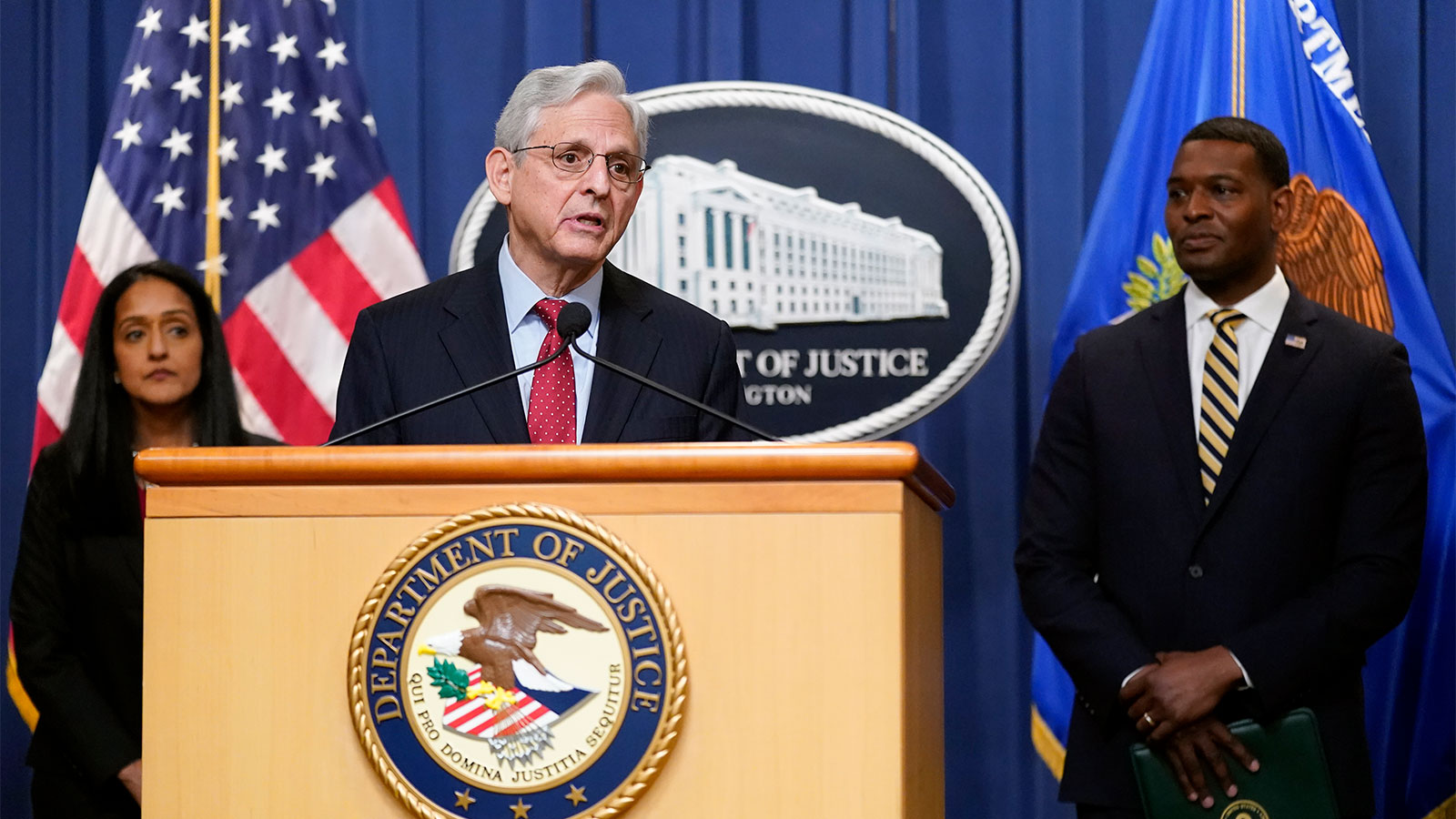
Attorney General Merrick B. Garland announced in Washington May 5, 2022, a multifaceted program in conjunction with the Environmental Protection Agency to protect and improve the environment and address climate change.
The effort is consistent with an executive order that President Joseph R. Biden Jr. issued Jan. 27, 2021.
Policy Analysis
The first step in the Biden administration’s approach to environmental protection is the implementation of an “environmental justice” strategy, which, according to Associate Attorney General Vanita Gupta, entails “meaningful involvement of affected communities in making the decisions that impact them,” to include reducing “environmental harms on overburdened and underserved communities, including communities of color, tribal populations and low-income rural and urban communities.”
The second step is the creation of the “Justice Department’s first-ever Office of Environmental Justice to oversee and help guide the Justice Department’s wide-ranging environmental justice efforts,” Garland said in his prepared remarks at the kickoff announcement.
Step three is a proposed interim final rule published in the Federal Register on Tuesday, May 10, 2022, intended to restore “supplemental environmental projects” as a tool to mitigate environmental impacts as a part of settlement agreements between the federal government and polluters that are caught red-handed. Under administrative rule making, Congress gives federal agencies authority, by statute, to write rules that will become part of the Code of Federal Regulations.
“The Justice Department has three essential responsibilities: upholding the rule of law, keeping our country safe, and protecting civil rights,” Garland said in his opening speech. “Seeking and securing justice for communities that are disproportionately burdened by environmental harms is a task demanded by all three of those responsibilities. It is a task we gladly undertake.”
EPA Administrator Michael S. Regan reinforced the dual-agency commitment following Garland’s remarks.
“EPA and the Justice Department’s partnership to protect overburdened and underserved communities across America has never been stronger,” Regan said. “This environmental justice enforcement strategy epitomizes the Biden-Harris Administration’s commitment to holding polluters accountable as a means to deliver on our environmental justice priorities. Critical to that is the return of Supplemental Environmental Projects as a tool to secure tangible public health benefits for communities harmed by environmental violations.”

Photo taken from: Global Government Forum
(click or tap to enlargen)
Supplemental environmental Projects are methods by which polluters agree in their settlements with the Justice Department to undertake efforts to mitigate or prevent risks to public health that their environmental harm imposes. In his memorandum to the nation’s U.S. attorneys dated the same day as the announcement, Garland said the SEPs are a form of “redress to communities most directly affected by violations of federal environmental laws.”
The Biden Justice Department’s rule making on the SEP has been intended to reverse the process that the administration of President Donald Trump initiated Dec. 16, 2020. Trump-era rules state that “in no case shall any settlement agreement require defendants in environmental cases, in lieu of payment to the Federal Government, to expend funds to provide goods or services to third parties for Supplemental Environmental Projects,” according to a Trump administration Federal Register notice.
Engagement Resources
Click or tap on resource URL to visit links where available
Justice Department Announcement-YouTube
Justice Department Launches Comprehensive Environmental Justice Strategy – YouTube
Attorney General Merrick B. Garland’s Speech
Attorney General Garland’s Memorandum to U.S. Attorneys
Actions to Advance Environmental Justice, AG Memo May 5, 2022
Attorney General Photo

President Joseph R. Biden’s Executive Order on Environmental Justice
Executive Order on Tackling the Climate Crisis at Home and Abroad | The White House

Interim Final Rule Published Tuesday, May 10, 2022 (Pre-Published Version)
2022-10036.pdf (federalregister.gov)

Trump Administration Rule Against Supplemental Environmental Projects