Search Results

Pardons, Power, and Payback: Trump’s Legacy of Clemency — Part I (Social Justice Policy Brief #174)

Pardons, Power, and Payback: Trump’s Legacy of Clemency — Part I (Social Justice Policy Brief #174)

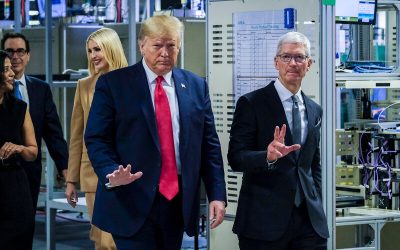
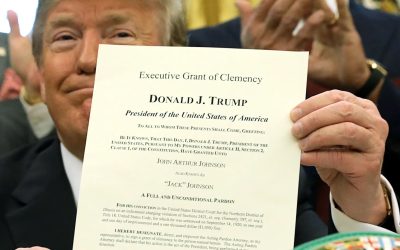
The presidential pardon is a constitutional power granted to the President of the United States under Article II, Section 2 of the U.S. Constitution. It allows the President to grant reprieves and pardons for federal offenses, except in cases of impeachment. While originally intended to offer clemency as a form of mercy or to correct miscarriages of justice, the use of pardons has evolved—and at times, been weaponized for political purposes.

Trump’s Big Beautiful Gifts to Artificial Intelligence Companies (Technology Policy Brief # 149)

Trump’s Big Beautiful Gifts to Artificial Intelligence Companies (Technology Policy Brief # 149)

In his first few days in office, Donald Trump announced a $500 billion joint venture with OpenAI, Oracle, and Softbank to invest in growing the US’s AI infrastructure and rescinded former President Joe Biden’s executive order requiring safety submissions from AI developers.  His big, beautiful bill showers much more money in the industry, and aims to eliminate state oversight or regulation of AI companies as well.

The Future of Student Loans in Trump’s Presidency (Education Policy Brief #203)

The Future of Student Loans in Trump’s Presidency (Education Policy Brief #203)

Since Trump’s attack on the Department of Education, there has been some confusion surrounding the future of student loans. During the Biden Administration, there were discussions on a $20,000 loan forgiveness plan for each borrower, but that has since been struck down by the Supreme Court. Since then, there have been no discussed plans of mass loan forgiveness, but instead, mandatory loan repayments will be enacted.

The Distinction Between Law and Policy And The Role of The Courts

The Distinction Between Law and Policy And The Role of The Courts

he beginning of President Trump’s second term saw a slew of executive orders on a number of policies and also saw numerous responses to those orders. More than two hundred legal challenges have been brought to oppose the implementation of these executive orders. The results have been mixed.

The World’s Spiritual Leaders: Who They Are and How Big Their Flocks Are

The World’s Spiritual Leaders: Who They Are and How Big Their Flocks Are

In an era marked by escalating global crises—from climate change and geopolitical conflicts to rising authoritarianism and social inequality—spiritual leaders continue to wield significant influence over billions worldwide. Their roles transcend religious rituals, often intersecting with geopolitics, human rights, and social justice. This article profiles the current heads of major global faiths—Catholicism, Tibetan Buddhism, Judaism, Islam, Hinduism, Anglicanism, and Eastern Orthodoxy—examining their leadership styles, political entanglements, and the size of their followings. These figures shape not only the spiritual lives of their adherents but also the moral frameworks through which societies interpret justice, peace, and progress.

Week That Was: Global News In Review

Week That Was: Global News In Review

International pressure has been mounting as Israel continues its bombardment and siege of Gaza. The renewed assault has left thousands more dead in just the last weeks since the breaking of the ceasefire deal in January 2025. Over 52,615 Palestinians are reported to have been killed, though the true number is likely to be far higher and to remain unknown until international journalists and aid agencies are allowed into the strip. Last week, United Nations Secretary-General Antonio Guterres, warned that Israel’s escalating aggression and prolonged blockade have pushed the population to the brink of famine, stating Palestinians are enduring “what may be the cruelest phase of this cruel conflict”. The UN has released projections that up to 14,000 children are at risk of dying of famine in the Gaza strip if aid is not allowed in soon.

Habeas corpus: What is it, and can it be suspended? (Elections & Politics Brief #185)

Habeas corpus: What is it, and can it be suspended? (Elections & Politics Brief #185)

One of the most fundamental aspects of a fair and just legal system is the ability to challenge one’s detention, often referred to as “habeas corpus”. Habeas corpus is an old but crucial pillar of justice, dating back to the 13th-century Magna Carta, which stated that “No man shall be arrested or imprisoned…except by the lawful judgment of his peers and by the law of the land.”

x
x
Support fearless journalism! Your contribution, big or small, dismantles corruption and sparks meaningful change. As an independent outlet, we rely on readers like you to champion the cause of transparent and accountable governance. Every donation fuels our mission for insightful policy reporting, a cornerstone for informed citizenship. Help safeguard democracy from tyrants—donate today. Your generosity fosters hope for a just and equitable society.

Pin It on Pinterest