

JOBS POLICIES, ANALYSIS, AND RESOURCES
Latest Jobs Posts
The Economics of an Aging Population
Brief #144 – Health & Gender Policy
By Rosalind Gottfried
The aging of the baby boom generation will continue to change the shape of the American labor force. Curremtly,16.5% of the US population of 328 million, or 54 million, are over the age of 65. By 2030, the figure will be 74 million and the fastest growing group are those over 85.
Secret Unit in U.S. Customs and Border Patrol Agency Raises Freedom of the Press Issues
Brief #179 – Civil Rights
By Rodney A. Maggay
On December 11, 2001 investigative journalist Jana Winter published an explosive article on Yahoo News that exposed a secret unit within the Counter Network Division of the U.S. Customs and Border Patrol (CBP) agency. At the heart of the disturbing story is that a CBP employee staffed to the secret unit was authorized to investigate a national security journalist named Ali Watkins with regards to her confidential sources for the source of her work.
Understanding The Crisis in Ukraine
Brief #138 – Foreign Policy
By Abran C
Ukraine and Western allies are concerned about a Russian troop buildup near its border that may signal a plan for a further invasion into Ukraine. As a former Soviet republic, Ukraine shares deep social and cultural ties with Russia and, in certain parts of the country, Russian is widely spoken.
Record Numbers of People Quitting Jobs But Employment Remains High
Brief #133 – Economic Policy
By Rosalind Gottfried
The number of people quitting or switching jobs reached a record high of 4.5 million in November, the fourth episode of record setting in 2021. As seen in previous assessments, the biggest changes are in lower paying occupations such as restaurant/bar and retail staffs.
Federal Laws Versus States Rights Re-Visited
U.S. RESIST NEWS EDITORIAL
By U.S. RESIST NEWS Reporters (Scout Burchill, Ron Israel, Tim Loftus, Rod Maggay and Lynn Waldsmith)
The United States has a democratic federal form of governance with law-making responsibilities divided between the federal government and our 50 states. The U.S. Constitution, written in 1789, seeks to provide a framework for areas of governance that belong to the states and those that belong to the federal government.
The Politics of Heating Buildings
Brief #132 – Environment Policy
By Todd J. Broadman
Seventy million American homes and businesses depend on natural gas, oil, or propane on-site for heating, hot water, and cooking. The annual carbon dioxide generated is 560 million tons or 40% of total US emissions when you include the carbon used in building construction. The amount of methane, a far more potent CO2 gas, that routinely leaks as part of the gas distribution process, is equivalent to all US vehicle emissions.
How YouTube Stokes Political Division
Brief #67 – Technology Policy
By Erik Pillar
Social media algorithms, political echo chambers, and more are feeding into an ever-increasing disparity between rightwing-leftwing political perspectives.
Pandemic Related Mental Health Crisis Hits U.S. Schools
Brief #62 – Education Policy
By Lynn Waldsmith
Therapy dogs. Sensory rooms with comfy furniture, tents and weighted blankets. Playing with sand or building with Legos. These are the kinds of things that many schools throughout the country are making available to students when they need a break or when it just becomes too hard to cope in the classroom. But it’s not about fun and games.
EPA Strengthens Policy Against Lead in Drinking Water, But Is It Enough?
Brief #131 – Environment Policy
By Katelyn Lewis
Federal officials announced Thursday their plan to tighten restrictions on the amount of lead allowed in drinking water in an effort to reduce the health hazards such exposure has caused in poor, often minority communities across the U.S.


What Happens When It’s Too Hot To Work?
What Happens When It’s Too Hot To Work?
Environment Policy Policy Brief # 124 | By: Katelyn Lewis | August 20, 2021
Header photo taken from: iStock
Follow us on our social media platforms above
Browse more environmental policy briefs here
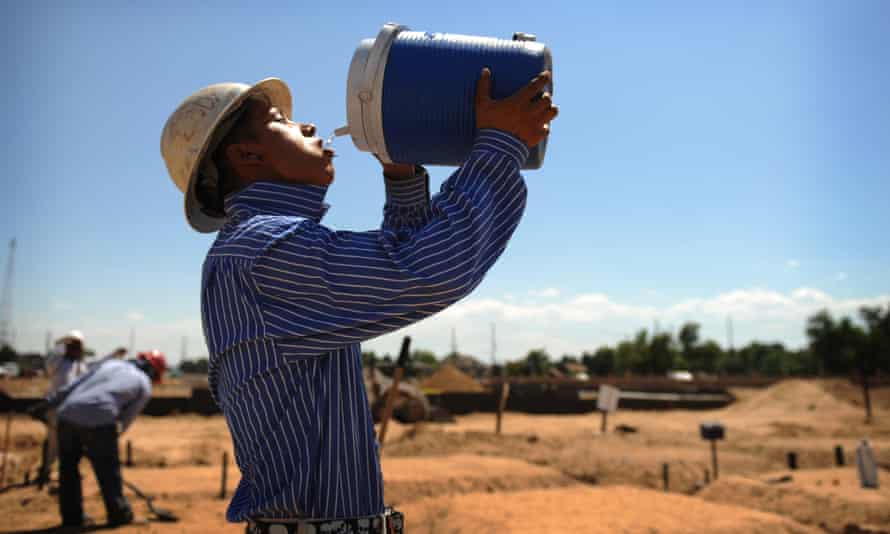
Photo taken from: The Guardian
Policy Summary
[SSB theme=”Official” align=”center” counter=”true” ]
Around 32 million people in the United States’ workforce are risking their health for their jobs on hot summer days – a scenario likely to increase dramatically by mid-century if there is slow or no action to reduce global emissions, a new analysis finds.
The Union of Concerned Scientists report found outdoor workers – including construction workers, farmhands, emergency responders, roofers, and landscapers – are likely to triple or quadruple their heat exposure by 2065, putting at risk $55 billion in income as the number of days with a heat index above 100*F are projected to increase.
“Outdoor workers have up to 35 times the risk of dying from heat exposure than does the regular population,” the report cites. “With climate change making days of extreme heat more frequent and more intense, the number of hours and days when outdoor work is unsafe will increase further unless employees and employers are willing and able to adapt to changing conditions.”
As it stands, less than 10% of outdoor workers lose work days to extreme temperatures. But the report projects that number could increase to as much as 60% of workers losing at least a week of work due to heat by 2050 if no action is taken to curb emissions. The fall-out from no action would cost an average outdoor worker about $1,700 each year, equating to about $55 billion lost annually for all outdoor workers.
“Even with adaptations to climate change, outdoor workers could be forced to choose between their health and a paycheck,” the report says.
Policy Analysis
The report artfully points out another aspect of climate change that will negatively alter our workforce and economy: extreme heat.
At least 384 U.S. workers died from environmental heat exposure in the last decade, according to an investigation by NPR and Columbia Journalism Investigations. While that number may sound low, their examination of federal data from the Bureau of Labor Statistics found the three-year average worker heat deaths to have doubled since the early 1990s, and – with no federal heat standard set – it remains a growing statistic for an entirely preventable situation.
In March, congressional Democrats introduced a bill directing the Occupational Safety and Health Administration to provide standards related to extreme heat, such that employers would be required to provide adequate water, shade, and rest breaks for outdoor workers. No action has been taken on the bill in either the Senate or House of Representatives at the time of this new brief.
People at particular risk to the effects of extreme heat are outdoor workers as well as people who already have chronic illness, those who face health disparities, or those dealing with health inequities on a daily basis.
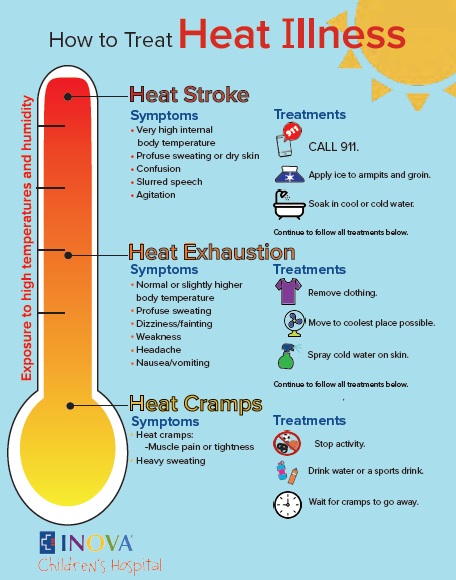
Photo taken from: Inova Children’s Hospital
Symptoms of heat stroke include extremely high temperature; red, hot, and dry skin; a rapid, strong heartbeat; and mental confusion and unconsciousness. Meanwhile, heat exhaustion can present itself in heavy sweating; cold, pale, and clammy skin; a fast, weak pulse; tiredness or weakness; muscle cramps; dizziness; headaches; fainting; and nausea or vomiting, according to the Centers for Disease Control and Prevention.
The Union of Concerned Scientists’ analysis points to a few assumptions and limitations in its calculations – such as whether the use of U.S. Census data may over- or underestimate migrant and undocumented workers in outdoor occupations, or if some outdoor work comes with a mixture of indoor tasks.
Still, the argument remains: With global warming, more days with higher temperatures pose higher risks for those who have outdoor jobs, which disproportionately affects Black/African American and Hispanic/Latino communities.
It presents a potential growth in workforce disparities as the world warms, for jobs indispensable to feeding, building, and serving our communities.
Engagement Resources
Click or tap on image to visit resource website.
Public Citizen –
Article Resources & Additional Reading
Click or tap on image to visit resource website.

Centers for Disease Control and Prevention – Warning Signs and Symptoms of Heat-Related Illness (Sept. 1, 2017) –
https://www.cdc.gov/disasters/extremeheat/warning.html

National Public Radio – Heat is Killing Workers In The U.S. – And There Are No Federal Rules to Protect Them (Aug. 17, 2021) –

National Oceanic and Atmospheric Association – June 2021 was the 5th warmest June on record for the globe (July 13, 2021) –
https://www.noaa.gov/news/june-2021-was-5th-warmest-june-on-record-for-globe

PBS – Farmworkers are dying in extreme heat. Few standards exist to protect them. (Aug. 6, 2021) –

The Guardian – Too hot to work: the dire impact of extreme heat on outdoor US jobs (Aug. 17, 2021) –
https://www.theguardian.com/us-news/2021/aug/17/outdoor-jobs-us-heat-impacts

U.S. News & World Report – Beating the Heat, For Your Health (July 6, 2018) –

Union of Concerned Scientists Too Hot to Work: Assessing the Threats Climate Change Poses to Outdoor Workers (Aug. 17, 2021) –
https://ucsusa.org/resources/too-hot-to-work#read-online-content

Vox – Extreme heat is killing American workers (July 21, 2021) –
https://www.vox.com/22560815/heat-wave-worker-extreme-climate-change-osha-workplace-farm-restaurant

A Case for Getting Rid of the Filibuster
A Case for Getting Rid of the Filibuster
Elections and Politics Policy Brief # 26 | By: Ryan Campbell | August 20, 2021
Header photo taken from: Long Wharf Theatre
Follow us on our social media platforms above
Browse more elections and politics policy briefs here

Photo taken from: City Journal
Policy Summary
[SSB theme=”Official” align=”center” counter=”true” ]
After recent Supreme Court rulings against the Voting Rights Act, many want to pass new voter rights laws, however, the path is blocked by the filibuster.
The filibuster is a political procedure in the US Senate (as well as other governmental bodies) where a Senator or Senators may speak for as long as they want on any topic that they choose (i.e. Senator Ted Cruz (R-TX) once filibustered by reading from Green Eggs and Ham). This will allow the party (or individual) to essentially run out the clock and deny the party moving in favor of the legislation an opportunity to ever have said legislation voted on. This can only be broken if 60 senators vote for “cloture,” or a motion to bring debate to an end.
A cloture motion can only be used for budgetary matters, and so does not apply to every bill. Should this threshold not be met and cloture not be available, any Senator objecting to the legislation could bring the business of the Senate to a halt by invoking the filibuster, never allowing a vote on the legislation to happen.
This occurs in an age when laws can be increasingly tailored to look nondiscriminatory on the surface, but in reality be sophisticated attempts to undermine voting in indirect ways. This can be most clearly seen in the issue of the “poll tax.”
Considering how a vote on voter rights legislation would not be eligible for cloture and would be all but impossible to get around a filibuster in these divided times, the only realistic way of preventing continued voter discouragement is by doing away with the filibuster.
Policy Analysis
Currently, the hottest topic in legislation is essentially building on the Voting Rights Act, a law which has been drastically weakened recently by the Supreme Court. This law was previously used to prevent discrimination, and after the Supreme Court weakened the Voting Rights Act by removing “pre-clearance,” the US saw a wave of laws passed that would have previously have gone through a rigorous Justice Department test.
This weakening happened in two recent cases where Arizona law banned the collection of absentee ballots by anyone other than a relative or caregiver and threw out any ballots cast in the wrong precinct. The question of enforcing the Voting Rights Act came before the Supreme Court, and the Court held that states with a history of discrimination no longer had to get advanced clearance from the Justice Department for changes in how their elections are run.

Photo taken from: Georgia Recorder
The filibuster has a long history of being the result of a race to the bottom of those who are the last holdouts against civil rights: it lets one Senator take the heat, often on an issue wouldn’t affect them, and the rest of the Senators in their party to not deal with the issue. Although the filibuster is, as lawyers would call, “facially neutral” (that is, not intended to benefit or hinder a group within the language of the law) the way in which it has been used has been incredibly slanted against civil rights.
The filibuster has a long history of being the result of a race to the bottom of those who are the last holdouts against civil rights: it lets one Senator take the heat, often on an issue wouldn’t affect them, and the rest of the Senators in their party to not deal with the issue. Although the filibuster is, as lawyers would call, “facially neutral” (that is, not intended to benefit or hinder a group within the language of the law) the way in which it has been used has been incredibly slanted against civil rights.
A particularly relevant example of a facially neutral law would be the “poll tax.” A poll tax, which began in the 1890’s, was a way to use the law to keep Black voters from voting essentially as a voting fee. There would often be carve outs to allow poor southerners (and these laws were typically in the part of the South that would later be covered by the Voting Rights Act) to still vote. This would include clauses that grandfathered in anyone who had voted before the Civil War, which, while again facially neutral, heavily discriminates against Blacks who were enslaved and not registered to vote prior to the Civil War.

Photo taken from: Eisenhower Presidential Library
As an example of how a facially neutral procedure is used to cover facially neutral laws, the record holder for longest filibuster, made at a time when you had to be on your feet speaking the entire time, was South Carolina Senator Strom Thurmond. He was filibustering the Civil Rights Act of 1957, a law that has become a cornerstone of American civil rights legislation.
States are still continuing to pass restrictive voting laws, and there seems to be no change in the stances in the Senate to allow for updated voter rights legislation to be passed. With mounting political pressure to act and the near certainty of a filibuster in the senate, the question now is whether voter rights legislation will be the pressure needed to attempt to change or do away with the filibuster.
A particularly relevant example of a facially neutral law would be the “poll tax.” A poll tax, which began in the 1890’s, was a way to use the law to keep Black voters from voting essentially as a voting fee. There would often be carve outs to allow poor southerners (and these laws were typically in the part of the South that would later be covered by the Voting Rights Act) to still vote. This would include clauses that grandfathered in anyone who had voted before the Civil War, which, while again facially neutral, heavily discriminates against Blacks who were enslaved and not registered to vote prior to the Civil War.
Engagement Resources
Click or tap on image to visit resource website.


Prospects for the Biden Agenda
Prospects for the Biden Agenda, Part 2
Elections and Politics Policy Brief # 25 | By: William Bourque | August 19, 2021
Header photo taken from: Business Standard
Follow us on our social media platforms above
Browse more elections and politics policy briefs here

Photo taken from: Reuters
In this series U.S. RESIST NEWS Reporter William Bourque examines the feasibility of implementing the different components of President Biden’s ambitious policy agenda. In Part 2 of the series we examine prospects for passage of Biden proposals in the areas of infrastructure and immigration.
Infrastructure
[SSB theme=”Official” align=”center” counter=”true” ]
For President Biden’s Administration, infrastructure has been a top priority, as clearly shown by the release of the “American Jobs Plan” which is one of the Presidents’ cornerstone policies. The plan aims to increase American jobs while repairing infrastructure which was thrown to the wayside because of President Trump’s “wall”. Biden plans to modernize 20,000 miles of highways, roads, and main-streets, while also repairing 10,000 of the most out of date bridges in America. Additionally, a large portion of repair will be done to “the 10 most economically significant bridges in the country in need of reconstruction.” Evidently, this is a problem that needs to be dealt with and Biden has made it clear that it is at the very top of the to-do list. In fact, the American Jobs Plan is one of the main priorities of the new $3.5 trillion budget the Senate laid out recently. Luckily, infrastructure is one of the more bipartisan issues that we currently face, so Biden shouldn’t have too much trouble pushing the more pressing infrastructure issues through. Look for much of this work to begin next year, once the delta variant of the coronavirus is more controlled.
Immigration
The Biden Administration has faced some of its harshest critics in recent months because of the practices in use at the United States’ southern border. During the Trump presidency, it was evident that refugees fleeing persecution weren’t being treated as humans. It seems as though the Biden administration hasn’t perfected their approach to the border yet, but it is a work in progress. The Administration outlined their plans in a press release on July 27th, saying “We will always be a nation of borders, and we will enforce our immigration laws in a way that is fair and just. We will continue to work to fortify an orderly immigration system.”
One of Biden’s main goals with the border is to redirect funds that were being used towards Trump’s wall to more useful projects, such as funding the border patrol officers on the front lines. Also, the Administration has stated that they intend to slow the expedited removal process of those arriving at the border. Essentially, this mean that folks who arrive at the border will have a chance to have their circumstances heard before a decision is made on their immigration status.

Photo taken from: The New York Times
This allows families to reunite and those fleeing persecution to have a stable, safe place to stay while their case is heard. Biden is also putting some of the border wall funds towards improving the United States human trafficking investigation operations. This is something that the Trump administration had neglected because of the obsession over the wall, and is certainly long overdue. Finally, the communications team at the White House will be put to work on immigration, releasing messages that encourage and “promote safe, legal, and orderly migration.” The Biden administration certainly has a lot of its plate, but they will be eager to maintain their campaign promises.

Mexico Sues U.S. Gun Manufactures Over Illegal Trafficking
Mexico Sues U.S. Gun Manufactures Over Illegal Trafficking
Social Justice Policy Brief # 23 | By: Zack Huffman | August 19, 2021
Header photo taken from: NPR
Follow us on our social media platforms above
Browse more social justice policy briefs here

Photo taken from: Los Angeles Times
Policy Summary
[SSB theme=”Official” align=”center” counter=”true” ]
The government of Mexico is taking several US. gun companies to federal court, claiming that they have negligently allowed illegal gun trafficking to flood Mexico with firearms.
The lawsuit lists seven Massachusetts-based gun manufactures as well as a wholesale firearm distributor as defendants, and demands millions of dollars in reparations, and for the defendant companies to implement a strong monitoring system to track trafficked guns.
Before any trial starts, Mexico will have to establish that it has proper standing to sue in a US. court, but if they fail at that, the pretrial process will allow the country to possibly expose negligent practices of the defendant companies as well as the overall problem of gun trafficking into Mexico from the United States.
Policy Analysis
From 2007 to 2012, the number of guns manufactured in the United States, more than doubled, according to data from Mexico’s lawsuit. At the same time, homicides in Mexico also spiked at the same rate, indicating a corollary between the two.
A 2021 report from the Government Accountability Office found that from 2014 to 2018, 70% of all illegal guns seized by Mexican federal authorities were originally from the United States. The report noted that proper data was lacking, because guns seized by state and local authorities in Mexico were not submitted to the US. for tracing.
The report listed recent efforts from the Department of Alcohol, Tobacco and Firearms, ICE and the State Department to crack down on gun trafficking, but noted that data from those efforts was lacking.
“However, none of the agencies have fully developed performance measures for their efforts to disrupt firearms trafficking to Mexico, and thus they have limited ability to assess progress,” said the 56-page report.

Photo taken from: Central Oregon Medical Society
“Every year, about a half million guns — many of them semiautomatic assault rifles — are illegally trafficked from the United States into Mexico. In 2019, those guns were used to murder 17,000 people in our country — that’s 46 funerals every day for a year, an unendurable tragedy for many heartbroken families,” wrote Alejandro Celorio Alcantara of Mexico’s Ministry of Foreign Affairs in an August 14 op-ed.
Celorio Alcantara also argued against the concept of firearms simply being tools as an oversimplification.
“Hammers are not evil in themselves,” he wrote. “But we would all rightly condemn a hardware store that continued to sell heavy-duty hammers to customers with a known track record of using them to kill and create mayhem.”
Mexico’s government has tight regulations that make it difficult for anyone to legally obtain a gun, according to the 139-page lawsuit. The country only has one legal gun store, and it issues fewer than 50 gun permits a year.
The Mexican government estimates that about half a million guns are illegally trafficked into the country from the United States and the named defendants account for about 68% of those illegal guns.
The lawsuit targets those companies’ distribution systems and what the lawsuit describes as a total lack of monitoring. It also alleges that the manufacturers deliberately design and market weapons that are desirable to Mexican cartels, including Barrett’s sniper rifle or Colt’s “El Jefe,” “El Grito,” and “Emiliano Zapata 1911” editions of .38-caliber pistols.

Photo taken from: Common Dreams
The Supreme Court ruled that a foreign nation can pursue legal action against an American individual or company about 150 years ago. The case, known as “The Sapphire,” involved France attempting to retrieve damages after a boat collision with a private American ship.
Mexico’s government is seeking a court order mandating that gun manufacturers “abate and remedy the public nuisance they have created in Mexico.”
Specifically, Mexico wants these companies to create a stronger system for monitoring the distribution of their guns, incorporate all available safety features into their firearms, and fund studies, programs and advertising campaigns that address unlawful trafficking.
The National Shooting Sport Foundation, which is a gun industry advocacy group, criticized the lawsuit as unfairly targeting American businesses.
“Mexico’s criminal activity is a direct result of the illicit drug trade, human trafficking and organized crime cartels that plague Mexico’s citizens,” said NSSF Senior Vice President Lawrence Keane in a release statement. “It is these cartels that criminally misuse firearms illegally imported into Mexico or stolen from the Mexican military and law enforcement. Rather than seeking to scapegoat law-abiding American businesses, Mexican authorities must focus their efforts on bringing the cartels to justice.”
Regardless of Mexico’s success in court, the legal action could provide an opportunity to publicly discuss the problem of gun trafficking outside of the United States.
Cecilia Farfán-Méndez, of the Center for US.-Mexican Studies UC San Diego, told NPR that she believed the lawsuit was an effort to respond to US. concerns over drug trafficking with the counter point that Mexico is suffering from gun trafficking.
Thus far, the case does not include any emergency motions so new developments are likely to come slowly. Much of the useful information that may come to light through this case will likely come during the pretrial, when evidence, reports, and other pieces of vital information are submitted. Even without a positive verdict for Mexico, that information is likely to be the most valuable thing to come out of it this case – assuming it can hold the public’s interest that long.
Engagement Resources
Click or tap on image to visit resource website.

The Government Accountability Office’s report on gun trafficking into Mexico
https://www.gao.gov/assets/gao-21-322.pdf

Washington Post:
Op-ed explaining the lawsuit by Alejandro Celorio Alcantara of Mexico’s Ministry of Foreign Affairs

Justia
Summary of The Sapphire case
https://supreme.justia.com/cases/federal/us/78/164/

The National Shooting Sport Foundation
NSSF Responds to Mexico’s Civil Lawsuit Against US Firearm Manufacturers

NPR:
Mexico’s Suit Against US Gun Companies May Seek More Than A Court Win
https://www.npr.org/2021/08/07/1025636092/mexico-lawsuit-united-states-gun-companies-analysis

Alarming Reports Regarding Poor Conditions of Detained Migrant Children in Biden Administration Emergency Shelters
Alarming Reports Regarding Poor Conditions of Detained Migrant Children in Biden Administration Emergency Shelters
Immigration Policy Brief #127 | By: Kathryn Baron | August 17, 2021
Header photo taken from: Reuters
Follow us on our social media platforms above
Browse more immigration policy briefs here

Photo taken from: Getty Images
Policy Summary
[SSB theme=”Official” align=”center” counter=”true” ]
As of early August 2021, nearly a third of migrant children detained in government custody are being held in emergency shelters. Migrant teens are housed in long trailers with little space for recreation, and some reports allege they have to wash their clothes in bathroom sinks and occasionally endure bouts of food poisoning. Some reports have circulated that even children kept in facilities for more than 2 months, do not receive clean bedding and clothes. A lawyer with a Texan nonprofit organization that offers pro-bono legal services to migrants stated children he met with felt “confined, distressed and like they are being punished.”
The average stay time has fluctuated between 2 weeks and a month, with some closer to 60 days. There are not enough case managers to accelerate the process of safely releasing detained migrant children. In some of the larger emergency shelters, like Fort Bliss in Texas, tent camps are overcrowded and distraught. Immigration advocates express concerns for detained children’s mental health and risk of contracting COVID-19.
Unaccompanied migrant children are defined as migrants below the age of 18 who do not have lawful status in the US and no parent or legal guardian to care for them. This does not necessarily mean they entered the US alone; minors who are separated from their families and/or abandoned by fellow migrants or human smugglers at the border may also be deemed unaccompanied minors.

Photo taken from: Council on Foreign Relations
The Department of Homeland Security (DHS) is the first federal agency to handle these cases. DHS is primarily responsible for 1) apprehension, 2) processing, and if necessary, 3) deportation. Once minors are deemed unaccompanied, Health and Human Services (HHS) becomes responsible for them throughout their time in federal custody. They are placed in transition camps until a judge has determined whether there entry into the U.S. is legally justifiable.
If so they are placed in group homes, foster care, and/or federal facilities (state-licensed, federally funded independent, and emergency unlicensed influx) to provide education, social, health and legal services. The USCIS (United States Citizenship and Immigration Services ) rules on asylum cases while the Justice Department handles other immigration cases.
If a migrant child loses, they are deported by ICE to their country of origin; if a child wins, they may legally stay in the US; and if a child becomes a legal adult while their case processes, they may be released or detained in adult facilities for the remainder of their court proceedings. There are currently about 17,000 migrant children in federal custody right now, a huge spike from the 120 at the beginning of the pandemic (March 2020).
Policy Analysis
Contractors are employed to oversee and monitor the camps – with little to no training in childcare or guidance regarding their roles. These contractors are responsible for monitoring large tents, sometimes with up to 1,500 children. In practice, what they do is more aligned with crowd control than youth care. Many of these contractors also lack Spanish and/or childcare skills or experience. Many of the migrant children are monitored for escape attempts, panic attacks and self-harm as a result of detention and trauma associated with immigration.
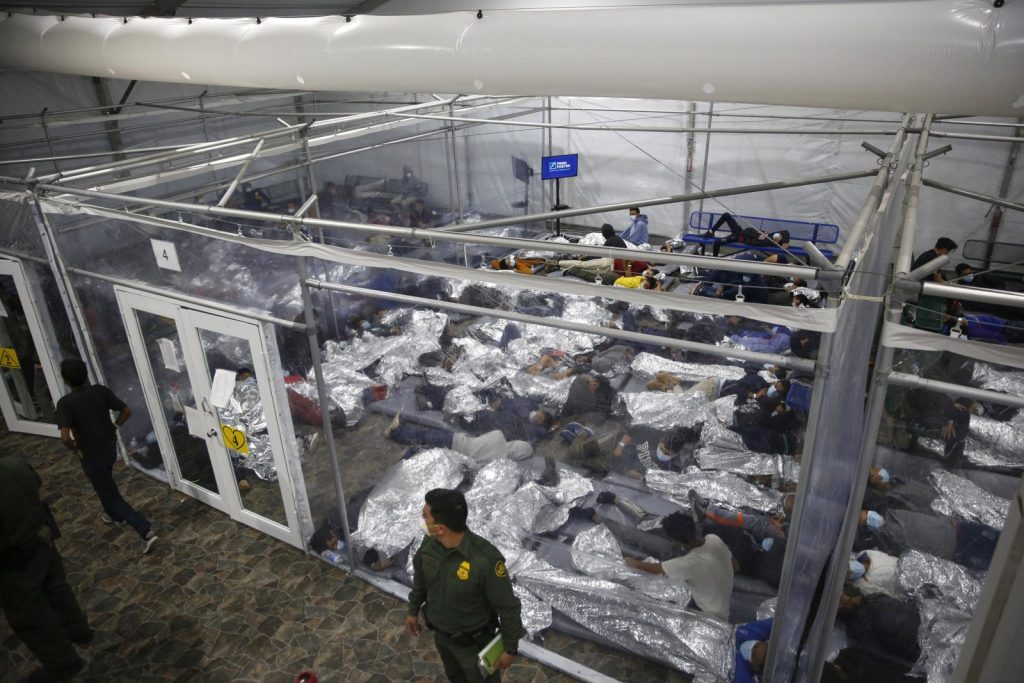
Photo taken from: AP News
These alarming reports sound an alarm to hold the Biden Administration accountable for their campaign promises, upholding the provisions of the 1997 Flores Agreement that ensures migrant children’s rights throughout the immigration process.
Engagement Resources
Click or tap on image to visit resource website.

- The National Immigration Law Center: an organization that exclusively dedicates itself to defending and furthering the rights of low income immigrants and strives to educate decision makers on the impacts and effects of their policies on this overlooked part of the population.
- Center for Disease Control: the CDC provides updated information surrounding COVID-19 and the US responses

- Kids in Need of Defense: an organization that promotes the protection of children as they migrate alone in search of safety and ensuring children’s rights are upheld and respected.

- First Focus on Children: a Washington, DC based advocacy organization dedicated to making children and their families a priority in federal policy and budget decisions.

Congress Focuses on the Security of Judges in the Wake of Brutal Attack
Congress Focuses on the Security of Judges in the Wake of Brutal Attack
Civil Rights Policy Brief # 170 | By: Rodney A. Maggay | August 15, 2021
Header photo taken from: ABA Journal
Follow us on our social media platforms above
Browse more civil rights policy briefs here

Photo taken from: Stacker
Policy Summary
[SSB theme=”Official” align=”center” counter=”true” ]
On July 16, 2021 both of New Jersey’s Senators – Bob Menendez and Cory Booker – introduced The Daniel Anderl Judicial Security and Privacy Act of 2021 in the U.S. Senate. Four additional Senators co – sponsored the bill – Dick Durbin (D-IL), Diane Feinstein (D-CA), Lindsey Graham (R-SC) and John Kennedy (R-LA). A companion bill was simultaneously introduced in the House of Representatives by Representatives Brian Fitzpatrick (R-PA) and Mikie Sherrill (D-NJ).
The Anderl bill seeks to safeguard and protect members of the federal bench and their families and judiciary staff from violent acts and threats that arise in the course of their work. The bill is named after the son of New Jersey federal judge Esther Salas after a violent attack by a disgruntled lawyer at their home. On June 19, 2020 Roy Den Hollander arrived at their home dressed as a delivery person. He knocked and when the door was opened he shot and killed Judge Salas’ twenty year old son Daniel Anderl. He also shot her husband Mark who was wounded but would eventually survive the attack. Judge Salas was in the basement of her home and was not injured by the assailant. The assailant, who later died of a self – inflicted gunshot wound, had been able to target Judge Salas and her family by retrieving publicly available information on the internet to find her home address as well as pictures of her home and personal vehicles.
The Anderl bill would shield the personally identifiable information of judges and their families in online databases. It would also prohibit government agencies from posting identifiable info on their website and authorize a mechanism for a judge to request removal within seventy – two (72) hours if personally identifiable information is published. Additionally, the act authorizes funding for the Administrative Office of U.S. Courts (AO), the U.S. Marshals Service and DOJ so that those departments can monitor and track online threats, maintain records, investigate complaints and address acts of aggression. Grant funding is also authorized for state and local governments to cover costs for programs that prevent release of personally identifiable information for judiciary staff at the state and local level. LEARN MORE
Policy Analysis
The Anderl bill is a move to protect those who work in the federal judiciary and should be approved and signed into law as soon as possible.
The highlight of the bill is the way the bill is designed to shield personally identifiable information of judges that can be found online, such as social security numbers and addresses. This is key because the availability of that information online is one way the assailant of Judge Salas’ family was able to locate her home address. Information like that can be available for free on federal databases and on third party websites from data collectors at minimal cost.
One thing that this bill does is allow federal judges to perform their duties free from intimidation and harassment. Judges often have to make tough calls and decisions that will usually leave one party upset and frustrated at the outcome. The fact of the matter is that inappropriate communications and threats against judges have been increasing. According to the U.S. Marshals Service these inappropriate communications have skyrocketed from 926 incidents in 2015 to 4,261 in 2020.

Photo taken from: GovTrack.us
With such a steep rise in threatening communications against judges and court staff, shielding personally identifiable information is necessary for the judges to perform their work free from undue influence as well as for their personal safety.
“Scrubbing” and removing personally identifiable information online is one way to protect judges and court personnel but it is also the ability to monitor persons and threats before they are acted on that can prevent these kinds of attacks. Hiring intelligence analysts and more marshals and being able to monitor persons of interest can go a long way in preventing these incidents.
Overall, the Anderl bill is an important and an overdue law and due to the wide bi – partisan support it has it should be quickly passed and signed into law. LEARN MORE
Engagement Resources
Click or tap on image to visit resource website.

United States Courts – official website of U.S. Courts discussing need to protect judiciary personnel.

American Bar Association (ABA) – association’s infopage on judicial security resources.
This brief was compiled by Rod Maggay. If you have comments or want to add the name of your organization to this brief, please contact Rod@USResistnews.org.

Trouble in Haiti Part 1: The Assassination of President Moise
Trouble in Haiti Part 1: The Assassination of President Moise
Foreign Policy Brief # 125 | By: By Erin Mayer | August 17th , 2021
Header photo taken from: The New Yorker
Follow us on our social media platforms above
Browse more foreign policy briefs here
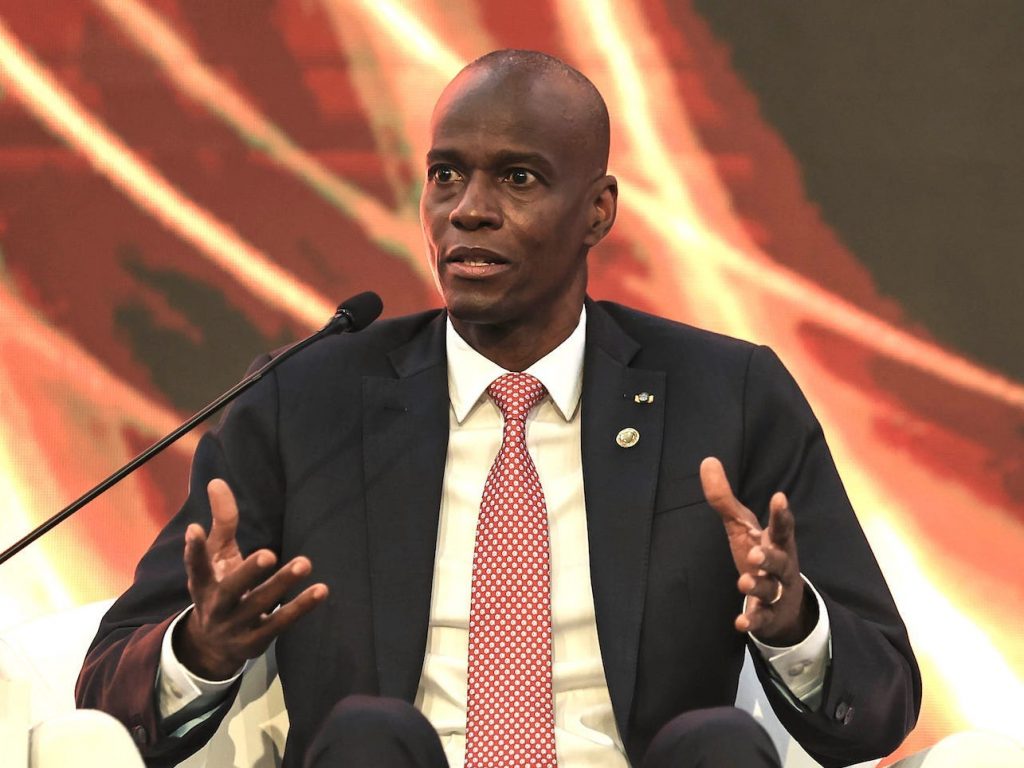
Photo taken from: businessinsider.com
Policy Summary
[SSB theme=”Official” align=”center” counter=”true” ]
A band of armed men assassinated President Jovenel Moïse of Haiti. The President’s wife was also wounded during a home invasion on July 7th. Police killed four of the attackers.Two others were arrested the same day. Though there have been arrests in regards to Moïse’s prosecution yet to take place..
A number of those rumored to have been involved in Moïse’s death were from Colombia. Approximately 20 Colombian mercenaries are thought to have been connected to the murder. Authorities in Colombia, Haiti and the United States continue to investigate. Additionally, a “former Haitian guerrilla; a convicted cocaine smuggler and DEA informer called ‘Whiskey’; a US-based evangelist with dreams of becoming Haiti’s president; and a Miami security firm which apparently took its name from the television series 24” are linked to Moïse’s murder. However the reasoning for the assassination still is not thoroughly understood.
The Haitian ambassador to the United States, Bocchit Edmond, said that the murder of President Moïse “was carried out by foreign mercenaries and professional killers — well-orchestrated.” Edmond went on to explain that the men were impersonating officials from the local U.S. Drug Enforcement Administration office, in Port-au-Prince, at the time of the attack.
After the assassination Prime Minister Claude Joseph requested U.S. assistance in deploying armed services to help maintain order. President Biden denied the request and made his intentions clear when he clarified that sending troops to assist the island nation’s government was “not on the agenda.” “We’re only sending American Marines to our embassy to make sure that they are secure and nothing is out of whack at all. But the idea of sending American forces into Haiti is not on the agenda at this moment,” Biden said.
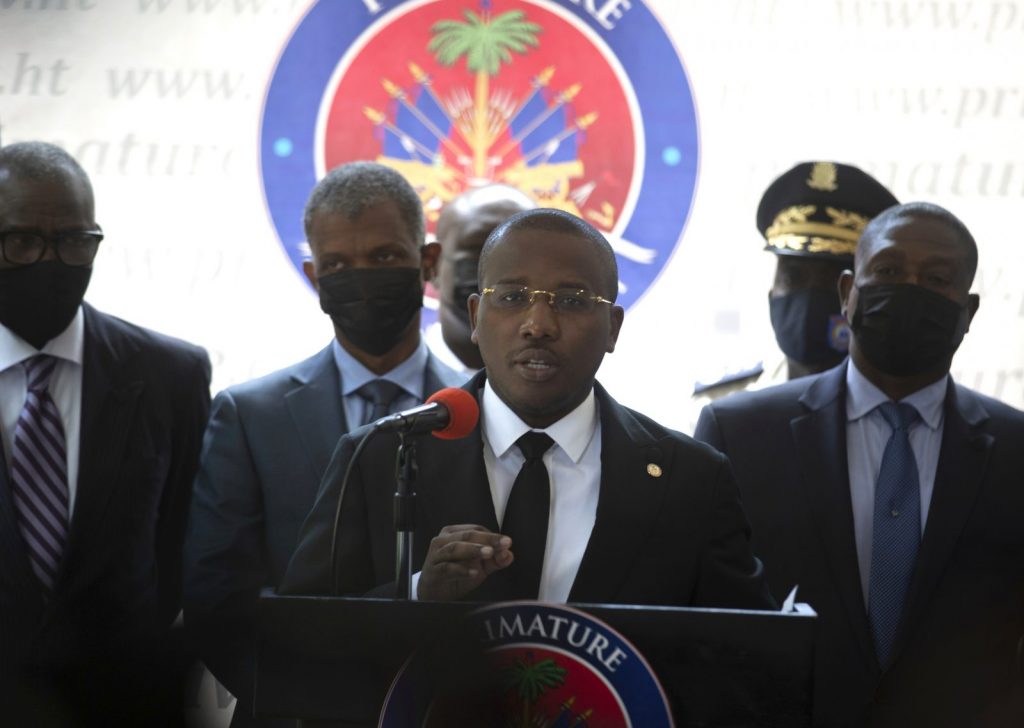
Photo taken from: The Washington Post
Joseph then agreed to step down in order to ensure stability on the island nation. Power was transferred to Ariel Henry, a former neurosurgeon, who had been appointed Haiti’s prime minister just barely 24-hours prior to Mr. Moïse’s death. Henry had the support of the CORE Group, a network of concerned countries from Europe and the U.S. Mr. Joseph agreed to step into a position as foreign minister in Henry’s cabinet.
Haiti had previously been experiencing reported revolts and mob violence due to the expanding authoritarian control exercised by Moïse. Over the weeks following Moïse’s death, masses of Haitian citizens have been forced to find sanctuary in churches and other safe havens. Others are often afraid to leave their homes at all but risk exposure to local attacks. An estimated 19,000 Haitians have fled areas that have become battle zones, worsening already deteriorating circumstances. This is especially true in neighborhoods surrounding the capital.
Policy Analysis
During a Visit to Haiti U.S. United Nations Ambassador Thomas-Greenfield’s was able to meet the new Prime Minister Ariel Henry as well as Claude Joseph. Thomas-Greenfield said, “Our delegation is here to bring a message to the Haitian people: You deserve democracy, stability, security, and prosperity, and we stand with you in this time of crisis. So, we come here in solidarity with the Haitian people during this difficult time.
And also, it’s important that we share our condolences with First Lady Martine Moïse and her family. But we also come to show our support for democracy and democratic process.” Thomas-Greenfield also urged Prime Minister Henry to ensure stability in order to conduct proper presidential elections “as soon as feasible.”
Jake Sullivan, U.S. National Security Advisor, expressed concern over the growing turmoil in the island nation. In a recent statement he said , “We strongly urge all parties to express themselves peacefully, and call on Haiti’s leaders to be clear that their supporters must refrain from violence.”
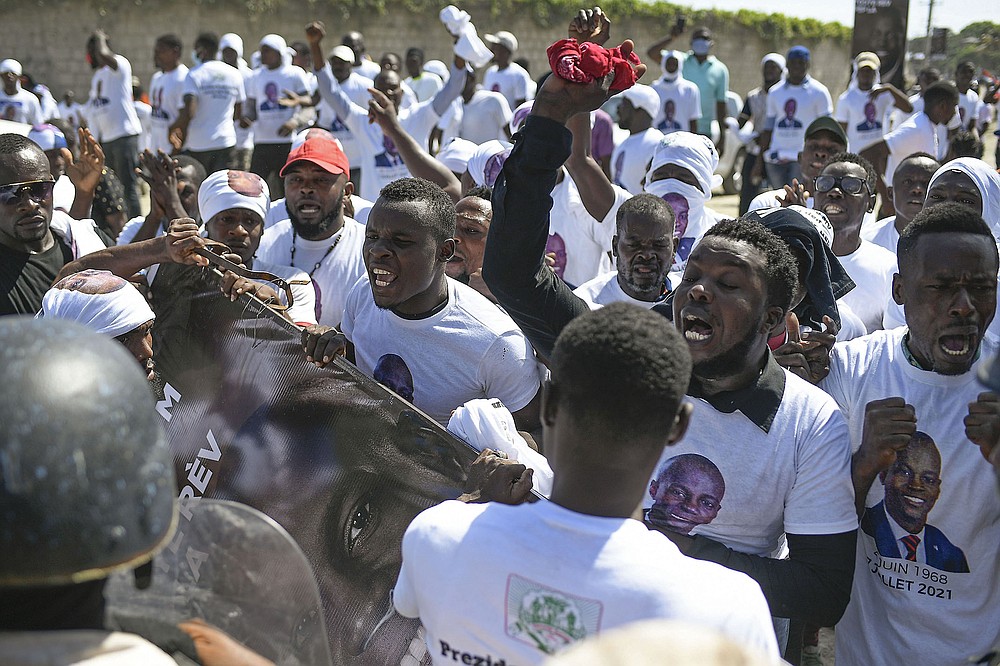
Photo taken from: The Arkansas Democrat-Gazette
Haiti, a country which is typically spoken about in regards to tragedy and disaster, is now a country in political turmoil and whose resources are dwindling. The future of the island rests in the hands of the local media, activists, scholars and academics. With any luck, the true sentiments and concerns of the Haitian citizens, who are exposed to violent crime daily, will be expressed through these channels. Moïse’s murder was shocking. However Haitians now have an opportunity to rewrite their own story; they have a chance to push for their own objectives. If Haitian citizens speak loudly enough, they can change the future of their island nation.
Engagement Resources
Click or tap on image to visit resource website.

HELP’s mission is to create, through merit and needs based scholarships, a community of young professionals and leaders who will promote a more just society in Haiti.

Hope for Haiti is focused on providing support and partnership for the Haitian people, specifically children, every single day.

The Lambi Fund tout a proven record of success in assisting Haitian communities to not just rebuild, but become sustainable.

Sow A Seed places a focus on orphans in the Caribbean. The organization provides training for teachers, assisting students with the tools and encouragement they need to continue their education, fighting malnutrition with the help of different food organizations, and building a sense of cultural identity and creative expression with arts programs.

The Politics of Mask Mandates
The Politics of Mask Mandates
Health & Gender Policy Brief # 124 | By: S. Bhimji | August 16th, 2021
Header photo taken from: Getty Images
Follow us on our social media platforms above
Browse more health & gender policy briefs here

Photo taken from: Wisconsin Public Radio
Policy Summary
[SSB theme=”Official” align=”center” counter=”true” ]
Almost every month over the past year, healthcare experts have been offering different views on the wearing of masks in public places and schools. The subject has become very controversial and now permeates the political arena. In July of this year, most schools had plans for reopening but now with the rapid spread of the delta variant, schools have had to readjust their plans.
Because there are no Covid vaccines for children under the age of 12, the only preventive method today is social distancing and masks. But the new mandatory rules governing the use of masks in schools have created enormous turmoil and controversy especially in southern states with a high number of unvaccinated individuals.
Mask mandates and other mitigation measures have led to an ongoing debate among government-run schools and raging parents who want to be the ones to make the decision rather than the school or the government. Many school board meetings regarding mask mandates have resulted in chaos, screaming, and shouting by irate parents who have hurled threats at healthcare workers and school board members.
At issue is the recently reinstated mask mandate in many schools that require all students to wear a mask in the classroom when they return to school in the fall. The core problem is that many parents feel that their personal freedom is being compromised, in a nation that has always valued liberty and independence. But liberty also comes with responsibilities. While one can choose not to vaccinate themself or don a mask, there is a risk that they may harm another individual or impose healthcare costs on the hospital, if the fall ill. More important liberty does not release that person the liability from any harmful consequences of their choice.
The mask mandates that have appeared intermittently over the past year have now become a thorny subject and many Americans feel that the government is bullying them. In addition, the draconian measures that led to business shutdowns and loss of jobs are still fresh in the memory of most Americans. In many parts of the nation, there is a deep distrust and resentment towards the government and healthcare workers.
Policy Analysis
The two states where the mask mandates have created extreme controversy are Florida and Texas. Recently the governors of both these states banned school districts from making mask mandates.
And while some schools have agreed with the governor’s orders, others have resisted. The Broward County School Board in Florida has ignored governor DeSantis’s ban on mask requirements and vowed to keep the masks in place for staff, students, and teachers. To further worsen the problem, Governor DeSantis has defied President Biden and his mask recommendations for schools, telling the president to first secure the border.
DeSantis has gone one step ahead and threatened to withhold salaries of school district officials who ignore his mask mandate ban. This has spurred the White House to support Florida schools that defy Governor DeSantis’s order with federal dollars if the governor withholds money from them.
Earlier this week, four teachers in the same county in Florida died from Covid 19, three of whom were unvaccinated.

Photo taken from: WLRN
Like Florida, the governor of Texas has also prevented schools from introducing mask mandates but some schools have opposed his ruling; in fact, a recent Texas court ruling announced that Governor Abbot’s ban on mask mandates is not legally binding.
Healthcare experts warn that the politics around mask mandate may allow the delta variant to rapidly spread across the nation, especially in people who are not vaccinated and even in children, for whom there is no vaccine. Just this past week 94,000 Covid 19 cases were reported in children and nearly 4.3 million children have tested positive for the infection since the onset of the pandemic.

Photo taken from: ABC News
President Biden has strongly criticized the politicization of the mask mandate by the governors of Texas and Florida, stating they are undermining the safety of millions of children. Hundreds of Florida physicians have asked DeSantis to repeal his executive order restriction on mask mandates in schools but the governor has not budged.
Dr. Francis Collins, director of the U.S. National Institutes of Health has urged Americans to understand the benefits of masks. Collins recently stated, “This is not a political statement or invasion of your liberties. This is a life-saving medical device, and asking kids to wear a mask is uncomfortable, but kids are pretty resilient,”
Engagement Resources
Click or tap on image to visit resource website.
Guidance for Wearing Masks
https://www.cdc.gov/coronavirus/2019-ncov/prevent-getting-sick/cloth-face-cover-guidance.html

Risk compensation and face mask mandates during the COVID-19 pandemic
https://www.ncbi.nlm.nih.gov/pmc/articles/PMC7862259/

Face Masks, Including Surgical Masks, and Respirators for COVID-19

Republicanism is Dead: How Today’s Global Challenges Invalidate Current Republican Politics.
Republicanism is Dead: How Today’s Global Challenges Invalidate Current Republican Politics
Elections and Politics Policy Brief # 24 | By: Adrian Cole | August 16, 2021
Header photo taken from: The Atlantic
Follow us on our social media platforms above
Browse more elections and politics policy briefs here

Photo taken from: The New Yorker
Many people on the Left have for decades considered Republican politics anathema. But as the twenty-first century advances into ever-more perilous territory, Republicans are clinging to political and ideological stances which simply defy common sense, logic, reality and efficacy. Bearing in mind the existential nature of the problems facing the country and the world, it is clear that the foundational pillars of today’s Republican party are all premised on untenable positions, false assumptions, bad science and ill-faith, and will, if pursued, lead us all into further crisis.
They are already largely responsible for wasting several decades in the struggle to control our climate; climate obfuscation is almost a religion among today’s Republicans, such has been their determination to deny reality and obstruct positive change in terms of fossil fuel emissions.
Recently, probably in response to a summer unlike any other in human history, a few Republican lawmakers have begun to deviate from the party line on climate change. The penny, as my mother would have put it, referring to my teenage brain, is beginning to drop. As ten-thousand-year floods inundated subways in Henan Province, rivers in Germany washed away villages, and a heat dome hovered over the perennially temperate Pacific Northwest, a few lawmakers who had hitherto insisted that any discernable change in weather was attributable to natural cycles, began to sing a different song.
Senator Rick Scott, former governor of Florida, known for his inaction on climate change in a state which has spent more than 100 billion dollars on climate-related disasters (according to the federal government) now appears to recognize the reality of climate change, but—because of his tenacious adherence to Republican positions—is unable to propose any solutions. Said solutions, according to the global scientific community, begin with de-cabonization. But to Scott, de-carbonization rhymes with economic instability (even if it doesn’t). As the recent IPCC report makes crystal clear, the planet needs to effect radical change, now. But for Scott: “I’m not doing anything to raise the cost of living for American families.”
Several assumptions—and deeply held Republican positions—are at play here. The first assumption is that Republicans like Scott care about American families (and not the large corporations that extract fossil fuels). That’s a low blow, I know, but one strongly suspects that any reluctance to impinge on the dominance of the fossil fuel industry is about just that, not American families. Another assumption is that American families won’t be affected by climate change. Strangely enough though, they already are being affected by climate change, and disproportionately amongst the poor. Talk to survivors of Hurricane Katrina.
Another assumption—and this is perhaps the big one—is that investing in our planet’s future will actually hurt American families, presumably by taxing them more to pay for a “Green Revolution,” or whatever solutions are proposed by the “socialist” democrats. The notion of rising taxes—and by extension expanding government—is a key Republican hot-button, which, as Scott demonstrates, is responded to by knee-jerk, flat-out rejection.
Republicans are more afraid of tax increases than they are of the prospect of an uninhabitable earth. The Republican religion of business uber alles is what has gotten us into this pretty pass. Adherence to neoliberal, laissez faire economics has, and will continue to, present obstacles to the business of slowing the warming of the climate.

Photo taken from: Home Sweet Home
Laissez faire economics and the cult of business are cozy bedmates with Republicans’ other obsession: small government. Seeing government, as Reagan put it, as “the problem” is very unhelpful these days; the problems we face as a global community cannot be resolved with an anti-government ideology.
The two recent Republican administrations, that of King Donald, and his vastly preferable predecessor, G.W., both worked assiduously to reduce the size of government based, not on a scientific approach to government and economics, but a slavish adherence to an ideology originating in a quasi-scientific dogma birthed by Milton Friedman, and harking back to his predecessor Friedrich Hayek. G.W. only failed to reduce government to a skeleton crew because he chose to go to war, twice, and needed all the resources available to humanity to do so. To riff on Reagan’s epithet, however, one could say that Laissez faire economics is not the solution to our problems, it is the cause of our problems. We have, for decades now, let be, to revert to English for a second. And, as they say in Spain, aqui estamos.
Laissez faire economics and small government are hand-in-glove conspirators in the ending of the world as we know it. The more you let go, the less government you need. Justice is then meted out by militias. Or vigilantes. Corporations regulate themselves, financially, environmentally, which is great, because for business and industry to rule, in a free market, nothing must get in their way, not even clean air, water and soil. In the real world, however, Government, with all its bureaucratic meddlesomeness and inefficiency, is necessary in order to guarantee a semblance of equality and to protect the vast majority of the population from the acquisitive, rapacious minority. To paraphrase Winston Churchill on Democracy, government is the worst system of social organization that we have. Except for all the other systems of social organization.

Photo taken from: csmonitor.com
The Other way in which Rick Scott’s rhetoric about “American families,” represents key, unhelpful, Republican pillars is the “American” bit. As we found with Trump and his America First priorities, modern Republicanism like other nationalisms around the world these days, cannot get to grips with global problems because they don’t really recognize the global community and cannot see past their own borders. Such borders are of course largely invented, because nations are fictions. “Nationalism,” said the preeminent historian of nationalism, Ernest Gellner, “is not the awakening of nations to self-consciousness: it invents nations where they do not exist.”
Having said that, there is nothing per-se wrong with nationalism. Nations developed for a reason. Historian Yuval Hariri writes about how ancient tribes along the Nile Valley could not cope, individually, with the river’s annual flooding. But together as a much larger entity—a nation—they could effect change for everyone. But the problem starts, says Hariri, “when benign patriotism morphs into chauvinistic ultranationalism. Instead of believing that my nation is unique…I might begin feeling that my nation is supreme…” Hariri is referring to the difference between patriotism and nationalism, the former often defined as love of country, the latter as hate of other people’s.
But in terms of effective governance, nationalism might have been just that in the pre-war period. After 1945, in the new era of nuclear weapons, there were reasons to look for a more overarching authority to control the world’s propensity for self-destruction. For the first time in history there were global problems which required global solutions. Now, with ecological collapse and climate change, that is more true than ever. There are notable differences, however, between the nuclear crisis and the environmental crisis, as far as nationalist politics are concerned. Nuclear weapons are an immediate and imminent threat that cannot be ignored. Climate (perhaps until very recently) has been more abstract, allowing some politicians to ignore the threat, or even deny the existence of it.

Photo taken from: sciencemag.org
“It isn’t a coincidence,” writes Hariri, “that skepticism about climate change tends to be the preserve of the nationalist right…Since there is no national answer to global warming, some nationalist politicians prefer to believe that the problem does not exist.”
The recent softening of some Republican positions on climate tend to recognize climate change, and even humanity’s role, but fall short of doing anything meaningful about it. Bill Cassidy of Louisiana, for example, (“We cannot live without fossil fuels or chemicals. Period. End of Story,”) helped craft the recent 1 trillion-dollar infrastructure bill which included billions to protect coastal states from sea level rise.
He will not, however, support policies to curb the amount of oil drilled off the Louisiana coast, the burning of which contributes to ice caps melting and rising sea levels. Other Republican senators, like Kevin Cramer of North Dakota, promote mitigation policies, such as cleaning up the gases produced by burning fossil fuels, instead of limiting the burning of such fuels themselves. All of this is to protect the fossil fuel industry, which pushes the same line: we’ve got this; we’re going to use science to mitigate the problem.
In summation, then, this little handful of core beliefs, to which Republicans cling like a group of seals on a rapidly-melting chunk of ice, laissez faire economics, small government and nationalism, have been extraordinarily destructive. Such ideologies cannot provide a way out of humanity’s current predicament.
If we are to limit warming to well below 2 degrees, and still have a habitable planet, there will have to be governmental action and public spending on a huge scale and it will have to be carried out by a community of nations who act cooperatively for the same goal, all the while listening to scientists. Republicans, however, if they cannot think themselves out of the box of their own narrow economic status quo, will take us all down with them.

No One is Safe From the Data Brokerage Industry
No One is Safe From the Data Brokerage Industry
Technology Policy Brief #61 | By: Scout Burchill | August 13, 2021
Header photo taken from: Minc Law
Follow us on our social media platforms above
Browse more technology policy briefs here

Photo taken from: Avast
Policy Summary
[SSB theme=”Official” align=”center” counter=”true” ]
While you may not be familiar with the shadowy world of the data brokerage industry, there’s a good chance that it knows a lot about you. Data brokers are the unsavory middlemen in our rampant, unregulated surveillance economy. In short, they collect, purchase and aggregate our personal data from the smartphone applications we use and then refine, re-package and sell it for profit. A recent scandal involving the outing of a closeted Catholic priest validates critics’ worst fears about this predatory industry: no one is safe.
Monsignor Jeffrey Burrill, the former secretary general of the U.S. bishop’s conference, resigned from his post in late July after a little known Catholic newsletter by the name of The Pillar used commercially available location tracking data from Grindr, a gay dating application, to trace, identify and ultimately out Burrill.
Although app signal data does not identify the names of users, each mobile device is identifiable by a unique numerical identification number that can be used to unmask the identities of individuals. To identify Burrill, The Pillar cross-referenced the Grindr location data it got a hold of from a “data vendor” with other publicly available information and were able to correlate his Grindr locations with other places known to be frequented by Burrill, such as the Catholic Bishop staff residences, Burrill’s family lake house, the homes of Burrill’s family members, and Burrill’s own apartment.
As The Pillar puts it, “app data signals correlated to Burrill’s mobile device shows the priest also visited gay bars and private residences while using a location-based hookup app in numerous cities from 2018 to 2020, even while traveling on assignment for the U.S. bishops’ conference.”
Whatever opinion you may have about Msgr. Burrill’s private actions in relation to his public position, this affair exposes the Big Lie of the surveillance economy: that all the information companies collect on us is anonymous. The truth is, any actor with the wherewithal to do so can use so-called anonymous data to track the movements and unmask the identity of any individual.

Photo taken from: The New York Post
Policy Analysis
Currently, Americans couldn’t be in a more lopsided relationship with digital brokerage companies. The digital traces we leave in our wake after family outings, first dates, financial hardships, personal milestones, and intimate conversations are voraciously gobbled up and harvested by these digital vultures for any number of questionable ends. This granular and highly personal data of both our past and present can easily be weaponized against us, and the truth is, there is very little we can do about it. In fact, there is not one single comprehensive federal law on the books that safeguards the digital rights and privacies of Americans. As long as federal privacy protections are left neglected by lawmakers, our civil liberties, rights to privacy and even our national security will be left to the whims of the worst actors imaginable.
The data brokerage industry represents the murky and secretive underbelly of the surveillance economy. At the heart of this sordid industry is a central contradiction. To consumers and regulators, tech and data companies claim the data they collect, store and sell is anonymous. However, large data brokers also tout the accuracy and detail of the data sets they sell, which contain information on millions, and even billions of people. Look no further than a 2013 Senate report on the dangers of the data brokerage industry to see how this data is marketed in incredibly disturbing ways. For example, say you run a payday loan company and are looking to target poor, rural Americans with advertising for your highly exploitative services.
You would probably want to purchase the “Rural and Barely Making It” data set from a reputable data broker. But why not also purchase the “Ethnic Second-City Strugglers” data set as well, to really break into those poor, urban communities beset with decades of disinvestment and racial disparities? The point is, the more data points and details a brokerage can offer on income level, race, gender, marital status, or online behavior, the better the product.

Photo taken from: The New York Times
This is where the idea that this data is anonymous becomes totally untenable. A 2013 study found that location data was often more than enough to ‘de-anonymize’ individuals from a data set. Researchers studied 15 months of human mobility data from 1.5 million people and were able to uniquely identify 95% of the individuals! This means that even the coarsest data sets providing only rough location and time information provide little anonymity.
In fact, in February the New York Times used smartphone location data collected by apps to identify individuals who stormed the Capitol on January 6th. The piece reads, “While there were no names or phone numbers in the data, we were once again able to connect dozens of devices to their owners, tying anonymous locations back to names, home addresses, social networks and phone numbers of people in attendance.
In one instance, three members of a single family were tracked in the data.” Whatever you may think of this kind of reporting, it is easy to imagine a not so distant future in which anonymous sources pay for and hand over data to journalists in order to undermine political, social or business rivals. Even the authors of the New York Times piece stress their deep concern about the perils of “the advertising infrastructure that undergirds unchecked corporate data collection.”

Photo taken from: CSO Online
But let’s zoom out even further. It’s not just predatory companies, journalists and individuals with personal vendettas who can weaponize this data. American law enforcement agencies, the Department of Homeland Security, the FBI, and the U.S. military routinely use this data to track, monitor and gain intelligence on American citizens as well as foreign nationals. The U.S. military receives a lot of personal data from a Muslim prayer and Quran app, according to reporting at Motherboard. The Department of Homeland Security uses cell phone location data to track undocumented people and deport them. Police departments also use these databases in tandem with social media mining programs to track protestors, activists and citizens. Contracting through unscrupulous data brokers allows our domestic institutions and agencies to both sidestep democratic accountability and evade their constitutional responsibilities.
Although this industry directly affects our lives and freedoms just as much as the Big Tech giants, the names of even the top players in the data brokerage industry are virtually unknown to the wider public. When was the last time you heard of Venntel, who supplies cell phone location data to the FBI, or Oracle, Acxiom, and CoreLogic? Probably never, but your representatives on Capitol Hill probably have. According to reporting by The Markup, 25 data brokerage companies spent upwards of $29 million on lobbying in 2020, rivaling even the Big Tech money machines. Oracle, the biggest spender of 2020 by far at close to $10 million, is notorious for promoting its products and services to the Chinese government and other repressive regimes, often by marketing its successful usage by American law enforcement agencies.
The bottom line is that the data brokerage industry represents a clear and present threat to civil liberties, personal privacy, and the health of American democracy. The federal government must step up to safeguard the rights of Americans from the excesses and dangers of the surveillance economy. The good news is that American lawmakers can look across the pond to existing frameworks for guidance. In 2018, the European Union implemented sweeping data protection laws dictating how personal data can be processed and transferred. It’s about time that American lawmakers start playing catch up.
Engagement Resources
Click or tap on image to visit resource website.
Ban Surveillance Advertising:
https://www.bansurveillanceadvertising.com/coalition-letter

International Coalition to Ban Surveillance Advertising:
Sources
Click or tap on image to visit resource website.

The Pillar Article:
https://www.pillarcatholic.com/p/pillar-investigates-usccb-gen-sec

Motherboard Reporting on Data Brokerage Industry:
https://www.vice.com/en/article/pkbxp8/grindr-location-data-priest-weaponization-app
https://www.vice.com/en/article/jgqm5x/us-military-location-data-xmode-locate-x

New York Times Tracking January 6th Rioters:
https://www.nytimes.com/2021/02/05/opinion/capitol-attack-cellphone-data.html

Wired on Data Brokers as Threat to Democracy:
https://www.wired.com/story/opinion-data-brokers-are-a-threat-to-democracy/
Vermont’s Attempt to Regulate Data Brokers:

Academic Research on Location Data and Anonymity:
https://www.nature.com/articles/srep01376

The Markup Report on Lobbying:

Oracle Marketing to Chinese Government:
https://theintercept.com/2021/05/25/oracle-social-media-surveillance-protests-endeca/

European Union Digital Privacy Laws:
https://digital-strategy.ec.europa.eu/en/policies/digital-privacy