

JOBS POLICIES, ANALYSIS, AND RESOURCES
Latest Jobs Posts
The Impact of Social Media on Politics and Society
Brief #52 – Technology Policy
By Inijah Quadri
Social media has revolutionized the way we communicate, access information, and engage with politics and society. Platforms such as Facebook, Twitter, and TikTok have become an integral part of our daily lives, connecting us with friends and family, news, and entertainment.
January 10th Revealed the Need to Update Our Aviation Safety Technology
Brief #51 – Technology Policy
By Steve Piazza
The Federal Aviation Administration (FAA) requires that all pilots receive NOTAMs (Notice To Airmen, or Notice to Air Missions in the United States) prior to takeoff. The purpose of these notifications is to provide pilots with information regarding obstacles they may encounter along the way.
Russia Continues to Kill Ukrainians. Children are Targeted.
Brief #166 – Yelena Korshunov
By Yelena Korshunov
On January 14th a Russian missile hit a residential high-rise building in Dnipro – a big industrial Ukrainian city. According to the head of the Ukrainian regional military administration, Valentin Reznichenko, on January 17th the removal of rubble had been going on for more than 60 hours. At that moment, 90% of the wreckage of the destroyed nine-story building had been dismantled.
Location Data Still Putting Abortion Seekers At Risk
Brief #153 – Health & Gender
By Mindy Spatt
After the Supreme Court’s decision in Dobbs and resultant abortion bans, online access to abortion information became increasingly important, and advocates for choice began expressing concern about the vulnerability of location data.
Important Elections in the First Half of 2023
Brief #50 – Elections & Politics
By Ian Milden
While the start of the presidential race tends to get most of the election coverage around this time of year, there are a couple of important elections in the early months of 2023. This brief will discuss two of these races and why they matter.
The Week That Was #2
Brief #165 – Foreign Policy
By Abran C
On Janurary 8, 2022 thousands of far right insurrectionists stormed the Brazilian congress and supreme court in an event reminiscent of the January 6, 2021 capitol attack in the United States. In addition to the similar time of year, the reason behind the insurrection in Brazil is eerily similar to the attack on the US capital in that supporters of the outgoing president claim the election was stolen.
The Ukraine Crisis: Situation Update: #18
Brief #164 – Foreign Policy
By Abran C
This is the 18th in a special U.S. RESIST NEWS series that updates our readers on the latest developments in Russia’s invasion of Ukraine.
Who Will Be the Gatekeepers in 2023?
Brief #78 – Technology Policy
By Mindy Spatt
If anything is clear from Elon Musk’s takeover of Twitter, it is that he is ill equipped to be the arbiter of who or what should be banned from the platform. He appears to be the last person on earth anyone would choose for the job. Former CEO Jack Dorsey had no particular qualifications to do so, but his decisions didn’t garner the publicity or public dismay Musk’s have.
Damar Hamlin’s Recovery: What a U.S. Worker Deserves
Brief #152 – Health and Gender
By Geoffrey Small
On January 2nd, 2023 NFL Buffalo Bills safety Damar Hamlin suffered from cardiac arrest after a tackle to the chest during a Monday-night football game with the Cincinnati Bengals.
As he laid motionless on the field for approximately ten minutes, first responders applied CPR, an AED (automated external defibrillation), oxygen, and an intravenous solution in order to prevent brain damage that can occur after cardiac arrest.


The New School Year Brings Legal Challenges to LGBTQ Representation
The New School Year Brings Legal Challenges to LGBTQ Representation
Health and Gender Policy Brief #143 | By: Geoffrey Small | September 16, 2022
Header photo taken from: Lucy Jones / The Atlantic
Follow us on our social media platforms above
Browse more health and gender policy briefs from the top dashboard

Photo taken from: Jenn Ackerman / The Washington Post
Policy Summary
[SSB theme=”Official” align=”center” counter=”true” ]
A 2020 Connecticut University study indicated that having a GSA (gay–straight alliances) program in school can help mitigate LGBTQ students’ concerns about bias. The study, which conducted surveys with LGBTQ students, reported that individuals were bullied less on topics related to their sexual identity and gender in schools that had GSA programs. As students are returning to their education across the country, there are currently legal challenges being waged in U.S. Congress, The Supreme Court, and local municipalities regarding LGBTQ representation.
The Equality Act, a new law supporting LGBTQ rights, is currently stalled in the Senate after it was approved twice in the House of Representatives over the past two years. The Supreme Court issued a ruling on an injunction that recognized an LGBTQ club at Yeshiva University in New York. Also, the Miami-Dade County Public School Board in Florida reversed a decision made last year to formally recognize October as LGBTQ History Month.
Policy Analysis
On September 14th, 2022, the Supreme Court ruled in favor of GSA program YU Pride Alliance regarding an injunction that requires Yeshiva University to immediately recognize the LGBTQ club while the case is argued before New York state courts. The case is currently in the appeal process after YU Pride won their argument. The state courts ruled in June that the University was incorporated as an educational institution and not a religious institution.
Therefore, Yeshiva should immediately recognize the GSA program under New York City’s human rights laws. The injunction was temporarily halted on September 9th by Justice Sonya Sotomayor after an amicus brief was filed by the NCLA (New Civil Liberties Alliance), claiming that the New York ruling infringed upon the University’s religious liberty. In response to the Supreme Court decision, Yeshiva University has reportedly announced they will halt all student clubs until further notice.
On September 7th, the The Miami-Dade County Public School Board in Florida voted 8 to 1 on reversing its decision to support October’s LGBTQ History Month.

Photo taken from: YU Pride Alliance
(click or tap to enlargen)
The reversal was made after hours of testimony during a public hearing from members of the community, parents of school children, and Christian coalitions. The change in the board’s decision comes after Governor Ron DeSantis signed the Florida’s Parental Rights Act in March.
The law forbids education in sexual orientation and gender identity for students in kindergarten to third grade.
Despite the school board members citing DeSantis’ new law as the reasoning behind the reversal, the school board attorney reported to local WSVN Miami that recognizing LGBTQ History Month would not be a conflict because it isn’t defined as mandated instruction.
GSA programs and LGBTQ advocates are still challenging the legal arguments that religious liberty takes priority over LGBTQ rights. Since YU Pride Alliance is not recognized as an organization from Yeshiva University, they rely on gofundme donations to conduct meetings and publicity that are normally provided for undergraduate clubs.
Also, a donation to the LGBTQ History Month organization can help spread the message of equal representation for recognizing community icons during the month of October.
Engagement Resources
Click or tap on resource URL to donate

https://www.gofundme.com/f/help-fund-the-yu-pride-alliance


Politics and Vengeance—How the Death Penalty Costs Us
Politics and Vengeance—How the Death Penalty Costs Us
Social Justice Policy Brief #140 | By: Abigail Hunt | September 12, 2022
Header photo taken from: Fort Worth Criminal Attorneys
Follow us on our social media platforms above
Browse more social justice policy briefs from the top dashboard
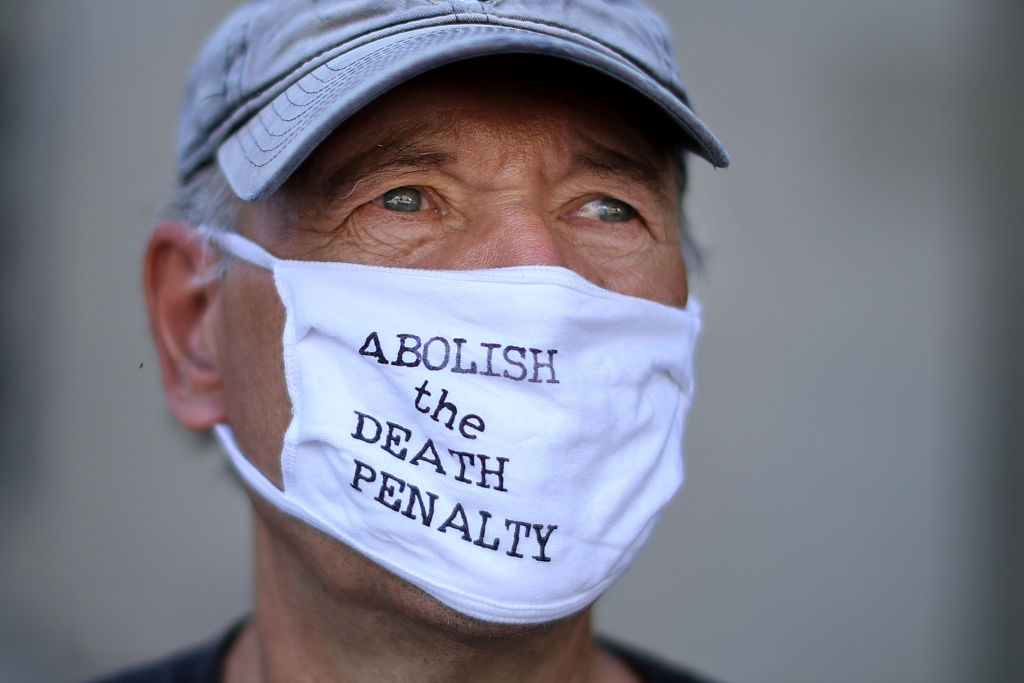
Photo taken from: Chip Time / Somodevilla / Getty Images
[SSB theme=”Official” align=”center” counter=”true” ]
Twenty-seven states have the death penalty, and twenty-four of those states still execute prisoners. The U.S. military and government both enforce capital punishment. According to the Nevada State Legislature website, a 2008 study by the Urban Institute showed Maryland’s average cost for a death penalty case was $3 million. In Texas, a capital trial costs $2.3 million, more than three times what it would cost to keep the convicted imprisoned in a maximum-security unit for 40 years.
Why do states pursue execution when the process is so cost-prohibitive? The argument made for capital punishment is an emotional one – a district attorney appeals to a juror’s individual sense of outrage. Fiscally, it does not make sense – the death penalty is more expensive. Politically though, that’s another story. District attorneys are elected officials in many states. Like abortion and gay marriage, the death penalty is a potentially divisive hot-button topic.
In 1989, by the time Florida executed infamous serial killer Ted Bundy, his case had cost taxpayers approximately $5 million. In July and August 2020, the first five executions the Trump administration ordered to be carried out cost nearly $5 million – almost $1 million per prisoner executed. Study after study shows the death penalty to be far more expensive than life imprisonment – Indiana, North Carolina, Texas, California, Florida – the cost of a capital trial and the subsequent required appeals process outstrips the costs of any other criminal proceeding by a long shot.
Capital punishment is outlawed in more than 70 percent on the globe. The most recent nations to outlaw the death penalty are Kazakhstan (2021) and Papua New Guinea (2022). Several nations have suspended executions even though capital punishment technically remains legal.
There are only 55 countries that maintain a barrier-less legal avenue to state execution. China holds the top spot, executing thousands of its citizens annually, though, according to World Population Review (WPR), the real numbers may be higher. WPR reports that China, North Korea, Vietnam, Syria, and Afghanistan withhold information about death penalty use in their countries – for this reason and others, it is not possible to get an accurate estimate of cost from those nations.
The death penalty is not a crime deterrent, but it seems the lack of it may be – one international study found that 10 out of 11 countries that abolished the death penalty saw a decrease in murder rate in the decade after its abolition. According to the FBI’s Unified Crime Reports for the past three decades (1989-2019), the murder rate in death penalty states is consistently and sometimes significantly higher than in states without the death penalty.
There appears to be a relationship between legal capital punishment and a higher rate of violent crime. There are many who take part in putting a person to death, whether they be jury, judge, board member, governor, or executioner.
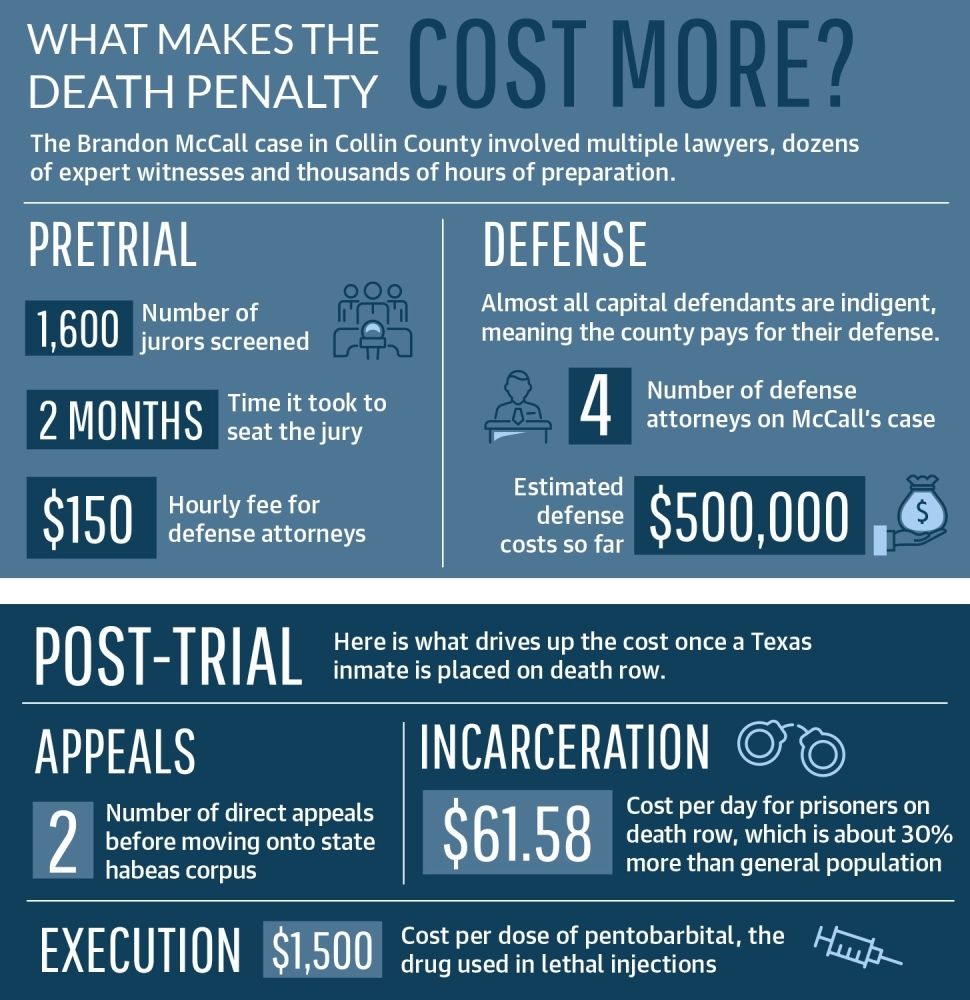
Infographic taken from: Community Impact
(click or tap to enlargen)
Those sentenced to die are disproportionaterly people of color (POC) and poor. Politicians use capital punishment as a ploy to gain votes. It is a waste of state and federal resources to prosecute death penalty cases due to the costs of the courts; that money could be better spent on methods of reformative justice that lower crime rates and reduce costs, something that most, regardless of borders or ethnicity, would agree are positive things.
Performed in the sanitized theatre of a prison chamber, executions today are just as grotesque as those of days past, when public hangings were town entertainment.
On a personal and moral level, we must ask ourselves – does creating more violence and more murderers solve our problem of killing one another?
Medieval torture devices are no longer legal; likewise, the death penalty should fall by the wayside. It is madness to keep doing the same thing and expect a different result. As Gandhi said, “an eye for an eye makes the whole world blind.” The death penalty is not justice, it is vengeance, and a human rights violation. Law exists to protect our rights, not to violate them. Vengeance has no place in law.
Engagement Resources
Click or tap on resource URL to visit links where available

International Commission Against the Death Penalty believes the death penalty is incompatible with human rights and human dignity and works to raise awareness in the fight to end capital punishment. https://icomdp.org/
Since 1966, the Center for Constitutional Rights has advocated for justice from integral problems in our society, including racism, gender oppression, systems that lead to socioeconomic inequalities, and excessive government. https://ccrjustice.org/

Founded in 1990, the Death Penalty Information Center is a national non-profit based in the U.S. that provides reports and analysis on capital punishment, producing informative annual data. https://deathpenaltyinfo.org/
Learn More
Click or tap on resource URL to visit links where available
Murder Rate of Death Penalty States Compared to Non-Death Penalty States. Death Penalty Info Center. Accessed September 12, 2022. https://deathpenaltyinfo.org/facts-and-research/murder-rates/murder-rate-of-death-penalty-states-compared-to-non-death-penalty-states
Study: International Data Shows Declining Murder Rates After Abolition of Death Penalty. Death Penalty Info Center. January 3, 2019. Accessed September 12, 2022.
Records Disclose Taxpayers Picked Up a Nearly Million Dollar Price Tag for Each Federal Execution. Death Penalty Info Center. February 3, 2021. Accessed September 12, 2022. https://deathpenaltyinfo.org/news/records-disclose-taxpayers-picked-up-a-nearly-million-dollar-price-tag-for-each-federal-execution

Countries with the Death Penalty 2022. World Population Review. Accessed September 12, 2022. https://worldpopulationreview.com/country-rankings/countries-with-death-penalty

Nevada Legislature, Nevada State Home Page. Accessed September 12, 2022.

Capital Punishment, The Costs Of Capital Punishment. Law Library – American Law and Legal Information. Accessed September 12, 2022.
https://law.jrank.org/pages/5002/Capital-Punishment-COSTS-CAPITAL-PUNISHMENT.html

Preview of US Senate Races in Florida and Utah
Preview of US Senate Races in Florida and Utah
Elections & Politics Policy Brief #34 | By: Ian Milden | September 8, 2022
Header photo taken from: KSAT
Follow us on our social media platforms above
Browse more politics and elections policy briefs from the top dashboard

Photo taken from:
Policy Summary
[SSB theme=”Official” align=”center” counter=”true” ]
Control of the U.S. Senate will be up for grabs in the 2022 mid-term elections. Competitive races in key states will determine the balance of power. In this brief, I will preview the U.S. Senate races in Florida and Utah.
Policy Analysis
Florida
In Florida, Senator Marco Rubio (R-FL) is running for a third term. Rubio was first elected to the Senate in 2010 after winning a three-way race. He won re-election in 2016 after losing the Republican nomination for President.
Democrats have nominated Congresswoman Val Demings to run against Rubio. She currently represents the Orlando area in Congress. Before her election to Congress in 2016, Val Demings was the chief of police in Orlando. Demings has posted strong fundraising numbers, and her campaign has spent heavily on advertising.
Quality polling for the U.S. Senate race in Florida is hard to find. A University of North Florida poll found Demings ahead by four percentage points, but many well-connected Democrats in Florida are skeptical of those numbers. The University of North Florida’s poll for the Governor’s race had the eventual nominee Charlie Crist (D-FL) trailing Agriculture Commissioner Nikki Fried (D-FL) by four points just before the primary occurred (Crist won the primary by over 20 points).
Some polls conducted for outside groups that support Democrats have found that the race is within the margin of error, though that would likely be a best-case scenario for Democrats in Florida.
Val Demings is a good candidate, but I am skeptical of her chances of winning due to the challenges that Democrats are facing in Florida. Democrats no longer lead Republicans in voter registration numbers.

Photo taken from: The Miami Herald / AP / Tribune
(click or tap to enlargen)
The state party is having several organizational challenges. National donors are reluctant to invest substantial amounts of money in statewide races in Florida specifically due to the expensive nature of running television ads statewide and repeated election cycles of disappointment for Democrats in Florida.
Senator Rubio also tends to overperform in Miami when compared to most Republicans, which also hurts Demings’ chances of winning in the fall. The 2020 Presidential election results illustrate why this is a challenge for Demings. If you look at the 2020 Presidential map in Florida, Joe Biden underperformed in Miami compared with other recent Presidential nominees.
While Biden did marginally better than previous Democratic nominees in many of the other urban areas in Florida, it wasn’t enough to overcome his underperformance in Miami. Congresswoman Demings will almost certainly face a similar challenge this fall. Given these challenges, a Rubio victory in the fall is the most likely outcome.
Utah

Photo taken from: KUER
(click or tap to enlargen)
In Utah, Senator Mike Lee (R-UT) is running for a third term. Lee defeated Senator Bob Bennett (R-UT) in 2010 to take the seat. Since taking office, Lee has had one of the highest rates of voting against bills in the U.S. Senate.
Senate races in Utah are not usually competitive. Republican candidates have typically won U.S. Senate races in Utah by large margins. The last Democrat to win a U.S. Senate race in Utah was Frank Moss in 1970.
Frank Moss will still be the last Democrat to win a U.S. Senate race by the time Mitt Romney’s seat is up for reelection in 2024 because the Democrats did not nominate a candidate to face Mike Lee.
Lee’s main challenger this fall is Evan McMullin, an independent candidate who is best known for running as a protest candidate for President in 2016.
In 2016, McMullin only got on the ballot in a few states. His best performance was in his home state of Utah, where he won 21.5% of the vote. Before his run for President, McMullin worked as a CIA officer and a staff member for the House Foreign Relations Committee. He also worked for the House Republican Conference.
McMullin argues that Mike Lee needs to be replaced in the Senate because he is not productive for Utah and Lee is too closely aligned with Trump. McMullin specifically cites Lee’s involvement in identifying people who would help Trump overturn the results of the 2020 election. McMullin is attempting to form a coalition of unaffiliated voters, anti-Trump Republicans, and Democrats. Former Congressman Ben McAdams (D-UT) agreed to support McMullin and help get Democrats in Utah to support McMullin.
McMullin supports environmental conservation, protecting voting rights, and reducing the influence of money in political campaigns, which appeal to Democrats. He also supports increased funding and training for police departments, increased security at the border, and measures to counter terrorist activity, which appeal to Republicans. Combatting inflation and reducing the costs of healthcare are also priorities that McMullin lists on his website.
A poll conducted by Dan Jones and Associates for the Deseret News in mid-July found Senator Lee to be ahead by five percentage points. This margin was similar to where the race was when they polled the race in mid-May. Nearly 20% of voters said they were not sure whom they would vote for or would vote for one of the third-party candidates. This suggests that voter persuasion is going to be more important in this election than in many other elections for U.S. Senate seats.
McMullin had the support of 63% of Democrats, 41% of unaffiliated voters, and 28% of Republicans. This data suggests McMullin has the potential to increase his support among Democrats. However, increasing support among Democrats is challenging without alienating the Republicans who support McMullin. Lee performs very poorly among self-identified moderate voters, and McMullin may have some room to increase his support there, although it is difficult to tell by how much with the available data.
McMullin faces a difficult balancing act trying to get support from Democrats and Republicans, which requires him to persuade voters that he’s worth voting for as a more pragmatic option. Voters are not always in the mood to vote for a pragmatic candidate, especially if they have several policy disagreements with the candidate.
Additionally, Utah is a very conservative state and that gives Mike Lee a solid floor of support. Lee’s campaign argues that his internal polling shows him further ahead than the public polls do. With the challenges McMullin faces as a candidate, Lee is more likely to win re-election. However, McMullin has a real chance of winning this race.
Engagement Resources
Click or tap on resource URL to visit links where available

Val Demings’s campaign website

Evan McMullin’s campaign website

DSCC – Official Campaign Arm of Senate Democrats

Ongoing Government Efforts to Keep Homeless Children and Youth in School
Ongoing Government Efforts to Keep Homeless Children and Youth in School
Education Policy Brief #55 | By: Steve Piazza | September 8, 2022
Header photo taken from: The New York Times
Follow us on our social media platforms above
Browse more education policy briefs from the top dashboard

Photo taken from: Elaine Thompson / AP
Policy Summary
[SSB theme=”Official” align=”center” counter=”true” ]
After being approved last March by the House and Senate strictly along party lines, the American Rescue Plan Act (ARP) of 2021 was signed into law by President Biden. The ARP is a program supplement to Title VII-B of the McKinney-Vento Act, and focusesfederal action that addresses homelessness and that has gone through various iterations since 1986.
The ARP designated $123 billion to the Elementary and Secondary School Emergency Relief Fund (ESSER) as part of a relief effort during the height of the Covid pandemic. Additionally, $800 million dollars was appropriated to The Homeless Children and Youth Fund (ARP-HCY) in order to provide support specifically for homeless students.
The ARP-HCY was created to help identify homeless children in an attempt to keep them in school and stay involved in school activities. The funds were also designated to secure wrap-around services, or coordinated efforts between agencies positioned to individualize support and in this case primarily in the context of COVID-19.
Following approval of plans submitted by each state (all states submitted and had plans approved), The U.S. Department of Education released the money to each state in two phases over the last year. In turn, states are required to directly grant 75% to LEAs, or local educational agencies, with the remainder of the funds to be used for state level efforts.
Policy Analysis
Most people are familiar with signs of homelessness in our society. It is heartbreaking to see the number of people requesting help on street corners, in front of shopping centers, and around overcrowded shelters.
But what is not often in plain sight are children and youth who are homeless.
Though they are commonly sharing housing, living in foster care, staying at shelters, or sleeping in motels, rarely are they seen out on their own. Yet, their numbers are simply staggering. According to the National Center for Homeless Education (NCHE), approximately 1.2 million, 2.5% of all public school students nationally, were considered homeless at some point during the 2019-20 school year.
To combat this, notable action that has been taken by states, municipalities, and local systems using ARP-HCY funds in the effort to increase resources to homeless students includes:
- New York and California: established centers that provide technical assistance
- Kentucky and Tennessee: improved student management systems
- Georgia: worked with its Afterschool Network to implement summer programming
- Iowa and Minnesota: expanded the federal Full-Service Community Schools Model which fosters cooperation amongst local child service agencies, especially in high poverty areas

Chart taken from: Voices of Youth Count
(click or tap to enlargen)
- Louisiana: collaborated with the Harvard Innovation Lab to pilot round the clock mental health counseling and to reach out to over 10,000 homeless students with tutoring services
- North Carolina: supplied student backpacks consisting of communication devices, hygiene products, and food
- Washington, D.C.: transported students from emergency shelters to summer enrichment programs
- Kansas City Public Schools: distributed prepaid mobile phones to high school seniors
- Paducah Public Schools: purchased a van using local donations, and worked with schools to provide basic needs like food and personal hygiene items
Data on the success of the program is still being collected, but even then it will be difficult to separate out the impact from all that has been put in place for homeless students over the years prior to the pandemic. Christina Endres of the NCHE states “that the four-year adjusted cohort graduation rate was increasing in the majority of states before the pandemic and that even in School Year 2020-21 the percentage of students who were chronically absent was decreasing.” Reports on the last two school years are in the works and should at the very least shed light on whether that trend will continue.
The American Rescue Plan has been severely criticized by Republicans as another example of a liberal agenda that only increases taxes. However, one is hard-pressed to find reproval specifically of the ARP-HCY, since any negative statement on support for homeless children would not be in a politician’s best interest, specifically in anticipation of the midterms. Criticism would be more easily reserved for results of the program once they come in since it’s too early to tell.
There’s still a lot to learn about how much good the funding does, and about what works and what doesn’t. If anything, it’s important to prioritize the efforts to keep homeless students visible, and in schools.
Engagement Resources
Click or tap on resource URL to visit links where available

This is a good source of background information on government efforts regarding students homelessness: https://nche.ed.gov/wp-content/uploads/2018/12/ehcy_profile.pdf
For a report on student homelessness in the school years 2017–2018 to 2019–2020, click here:
https://nche.ed.gov/wp-content/uploads/2021/12/Student-Homelessness-in-America-2021.pdf

Here is the text of H.R.1319 – The American Rescue Plan Act of 2021: https://www.congress.gov/bill/117th-congress/house-bill/1319/text

This information is from a non-profit advocating for homeless Students: https://schoolhouseconnection.org/wp-content/uploads/2022/03/How-to-Use-ARP-Funds.pdf

Situation Update #13: The Ukraine Crisis
Situation Update #13: The Ukraine Crisis
Foreign Policy Brief #147 | By: Abran C | September 8, 2022
Header photo taken from: Heidi Levine / The Washington Post
Follow us on our social media platforms above
Browse more foreign policy briefs from the top dashboard

Here is a review of the major events in the Russia/Ukraine conflict during tke last two weeks.
Photo taken from: Reuters / Alexander Ermochenko
Energy
[SSB theme=”Official” align=”center” counter=”true” ]
The International Atomic Energy Agency (IAEA) has called for the establishment of a security zone around Ukraine’s Zaporizhzhia nuclear plant to protect it from intense fighting. The occupation of Europe’s largest nuclear power plant has sparked fears of a nuclear disaster as both sides trade blame for shelling the site. In 2021 more than half of Ukraine’s electricity was produced with nuclear power and it is likely that millions will now be without power during the coming winter.
Russia additionally has halted gas exports to Europe via its Nord Stream 1 pipeline. It cites punitive economic sanctions imposed by the West as responsible for the indefinite halt to gas supplies to Europe. Europe now faces its biggest energy crisis in decades as natural gas supplies from Russia have come to a complete halt. European gas prices spiked as much as 30% on Monday stoking renewed fears about shortages and gas rationing in the EU this winter.
Looking Eastward to Alleviate Economic Troubles

Photo taken from: Stanislav Kasilnikov / AP
Speaking at the eastern economic forum on Tuesday in Russia’s far eastern city of Vladivostok, Putin said Russia saw more opportunities in entering markets in the Middle East and Asia rather than in the West. Of course, this is following the imposition of the most severe sanctions in modern history in response to Russia’s invasion of Ukraine.
Putin said the sanctions are akin to a declaration of economic war. The Russian economy shrank by 4% from April to June compared to a year earlier and the economy is projected to experience a 12-15% inflation rate and have a deeper contraction next year.
Space

Photo taken from: Zhao Juecheng / GT
Since the “Agreement Concerning Cooperation in the Exploration and Use of Outer Space for Peaceful Purposes,” signed in Moscow on May 1972, Russia and the US have traditionally worked together on space exploration and science even when relations back on earth were fraught. With the end of the space shuttle program, Russian rockets over the previous decade were key in carrying American astronauts to the ISS.
However, recently with companies such as SpaceX having filled that void, there is no need for the US to rely on Russia to carry its astronauts, and tensions here on earth have made their way into space causing extraterrestrial cooperation to come to an end. Earlier this year Russia announced it would be pulling its participation with international partners from the ISS. It also announced that it plans to co-construct an international lunar research station with China.
This comes as the US and its partners announce a Lunar space station of their own. Both the US and China are spending billions of dollars to put humans back on the moon to gain access to resources on the lunar surface and possibly send spacecraft to Mars. Terrestrial rivalries are now making their way into space, creating factions where there was once cooperation with each country vying to become the dominant space power.
Demographic Cost of War

Photo taken from: Al Jazeera, The World Bank
Both Russia and Ukraine have not shared numbers of the number of soldiers killed and wounded. US intelligence agencies estimate that there are 80,000 Russian casualties, with about 15,000 Russian soldiers having died on the battlefield.
The Ukrainian side is estimated to have lost 10,000 soldiers, nearly 6,000 civilians, and millions who have fled the country. The number of lost lives presents a large problem for both countries, Russia and Ukraine have had declining populations since the fall of the Soviet Union in the 1990s. Russia’s population fell by 311,000 in the first four months of 2022.
The outflows of working-age people as well as a low birth rate for those who remained behind have taken a toll on the demographics of both countries. Life expectancy in both Russia and Ukraine is about 66 years for men and 76 for women, one of the lowest in the developed world.
The birth rate in Ukraine stands at about 1.23 children per woman, and 1.5 in Russia which has in recent years pushed hard to increase the country’s birth rate. A low life expectancy, declining birth rate, and large emigration outflows have put the two countries in a tough spot for the future of their workforces, economies, and armies.
Recently in a show of the looming demographic crisis, the Russian government announced it was reviving the Soviet-era honorary title “Mother Heroine” for women who have 10 or more children. Any woman with 10 or more children would be awarded a lump sum of 1 million rubles ($16,645). The Ukrainian population is projected to shrink by about half over the course of the next generation or two, and Russia’s will likely shrink by 25%, assuming there is no migration to either country.
An important part of the reconstruction effort after the war will be for Ukraine to encourage refugees to return home and ensure a future for their country.

Environmental Provisions of the 2022 Inflation Reduction Act
Environmental Provisions of the 2022 Inflation Reduction Act
Environment Policy Brief #148 | By: Jacob Morton | September 5, 2022
Header photo taken from: NBC
Follow us on our social media platforms above
Browse more environment policy briefs from the top dashboard

Photo taken from: Jason Houston / World Wildlife Fund
Policy Summary
[SSB theme=”Official” align=”center” counter=”true” ]
On August 16, 2022, President Joe Biden signed into law the Inflation Reduction Act (IRA), H.R. 5376. The new law is essentially a scaled-back version of the Biden administration’s Build Back Better Act, intended to reduce the national deficit and lower inflation while investing in domestic energy production, creating jobs, and lowering healthcare drug costs.
The law will extend the Affordable Care Act program for three years, through 2025, and allows Medicare to negotiate lower prescription drug prices, which will ensure affordable medications for those most in need. As for its environmental implications, the law calls for significant investments designed to lower energy costs, increase cleaner energy production, and reduce carbon emissions by 40% by 2030. Spending designated for energy security and climate change represent the largest investment made by the Inflation Reduction Act, totaling $369 billion, making this law “the single largest investment in climate and energy in American history.”
To make these investments possible while simultaneously reducing the deficit and lowering inflation, the law generates revenue by imposing a 15% corporate minimum tax on companies making more than a billion dollars per year, but without imposing any new taxes on families that make $400,000 or less or on certain small businesses. According to Democrats in Congress, the law will invest a total of $437 billion for its programs, but is expected to raise $737 billion, resulting in a deficit reduction of more than $300 billion. Since the law raises more revenue than it spends, the remaining difference becomes available for deficit reduction.
The $369 billion of spending designated for energy security and climate change programs consists of various incentives and tax credits for businesses and consumers, regulations on the use of public lands, drought resiliency aid for farmers and foresters in the West, and other miscellaneous provisions:
- Business Incentives and Tax Credits
- The federal government is offering incentives and tax credits to businesses for utilizing lower-carbon and carbon-free energy sources, for investing in and production of clean energy sources and carbon capture technology, as well as investments in battery storage and biogas. Bonuses will also be given to companies based on how much they pay their employees and for the domestic manufacturing of steel, iron, and other components in the U.S.
- Business and Consumer Incentives
- The new law offers homeowners tax credits towards the costs of installing residential clean energy technology, including rooftop solar, heat pumps, and small wind energy systems, as well as tax credits for business owners for energy efficiency improvements in commercial buildings. Tax credits will also be made available of up to $7,500 for the purchase of new electric vehicles (EVs) and $4,000 for used EVs.
Grants and loans will be offered to help companies reduce methane emissions from the burning of oil and gas, and fees will be levied on producers who emit excess levels of methane gas. Additionally, $27 billion will be invested in providing further incentives for the development and deployment of clean energy technologies, and to provide incentives for companies and consumers to make “cleaner energy choices.”
- Use of Public Lands
- The Inflation Reduction Act establishes stricter requirements for the federal government to be able to sell leases for new oil and gas production on public lands, however, the new law also seeks to stimulate more domestic fossil fuel production by requiring the Interior Department to hold at least three more offshore oil and gas lease sales by next October, and in a controversial move, calls for the reinstatement of a recent offshore oil and gas lease sale that was struck down on environmental grounds.

Photo taken from: Reuters / Adriano Machado
The law also intends to better capitalize on domestic fossil fuel production by increasing the minimum royalties for companies that extract oil and gas on public lands and waters, as well as establishing an additional royalty on public lands and waters for the extraction of gas that is later burned off or released as “waste” instead of being sold as fuel. This “waste” methane will now come with a fee if the amount released exceeds the facility’s assigned maximum threshold.
Additionally, the IRA adds seven new sections to the Clean Air Act, all of which appropriate funding to the EPA for new grant programs, and GHGs are explicitly stated, for the first time legislatively, as being considered air pollutants under the Clean Air Act. However, this new designation of GHGs only impacts the new sections of the Clean Air Act and will not impact West Virginia’s major coal burning facilities. Regarding President Biden’s Environmental Justice agenda, the IRA will support environmental justice initiatives by providing funding for several new grant programs that address air pollution and GHGs.
According to a press release by Democratic senators, the $3 billion Neighborhood Access and Equity Grants included in the IRA support “neighborhood equity, safety, and affordable transportation access” by providing competitive grants to “reconnect communities divided by existing infrastructure barriers, mitigate negative impacts of transportation facilities or construction projects on disadvantaged or underserved communities, and support equitable transportation planning and community engagement activities.”
The new law also seeks to help underserved communities through the previously mentioned tax credits for used electric vehicles, grant programs for energy and water efficiency installations, and more than $200 million in funding for Air Pollution Monitoring that will benefit communities exposed to areas with persistent air pollution.
The new law also appropriates $5 billion for conservation efforts, specifically sustainable forestry. Forests play a huge role in regulating our climate; they can sequester carbon, cool surrounding areas, and provide essential habitat for wildlife. However, proper management is the key difference between a forest that remains resilient in the face of wildfire, disease, and climate extremes and one that weakens or gets destroyed completely.
The new law will not initiate new projects, instead, most funding will be used to bolster the budgets of existing programs or extend their operational lifespans. Most of the money for forestry in the IRA is destined for management projects, including the Forest Service’s Urban and Community Forestry Program, federal wildfire mitigation and prevention, an initiative to catalog and protect old growth forests, and grants to support non-federal forest management.
Policy Analysis
Susan Prichard, a research scientist at the University of Washington, says she is “really supportive of more funding going to more proactive management” of our forests.” She says, “I hope [the IRA] allows the Forest Service and public agencies to staff up—it takes so much planning, and then there’s a dearth of professionals that can get on the ground right now.”
Nadine Block, a vice president at the nonprofit Sustainable Forestry Initiative, which develops certifications and advocates for sustainable forestry, agrees with Prichard. Block says, “This bill creates tremendous opportunity… It’s really heartening to be getting some funding and getting projects moving to address the backlog of needs.”
While the Inflation Reduction Act falls far short of the original Build Back Better bill, most environmentalists agree that it is an important first step.
Even by the most optimistic projections, the law will not reach Biden’s goal of cutting the nation’s GHG emissions by 50% by 2030. However, climate policy think tank Energy Innovation and two other expert modeling groups predicted the IRA will reduce U.S. GHG emissions by about 40% by 2030, putting the U.S. within reach of that original target. Plus, the law gives the U.S. EPA new tools to drive emissions down even lower.
According to Don Fullerton, the Gutgsell Professor of Finance at the Gies College of Business at the University of Illinois Urbana-Champaign, a senior scholar at the Institute of Government and Public Affairs, and an expert in energy and environmental policy, the new law has its shortcomings, but is a necessary step in the right direction.
Fullerton says, “The government estimates it will create millions of green jobs in the clean energy sector. That estimate, of course, doesn’t count the jobs that might be lost over the long run in the fossil fuel sector, so the net change in jobs is probably small.

Chart taken from: Nasdaq
(click or tap to enlargen)
But the law does extend and encourage a major transformation of energy in the U.S. that is already underway… It encourages progress on the all-important batteries necessary to store the power generated during sunny days and windy periods,… and by spending $369 billion on greenhouse gas-reduction investments, the Inflation Reduction Act can help the U.S. set an example for the rest of the world, especially when so many other countries look to the U.S. for the leadership necessary to get 200 nations on board to reduce this global climate crisis.”
Democratic Senator Joe Manchin of West Virginia, who has strong ties to the coal industry and is the Democrats’ own greatest critic of the Build Back Better agenda, said of the new law, “I support a plan that will advance a realistic energy and climate policy that lowers prices today and strategically invests in the long game.
This legislation ensures that the market will take the lead, rather than aspirational political agendas or unrealistic goals, in the energy transition that has been ongoing in our country.”
Even Bill Gates agrees, writing in the New York Times: “Through new and expanded tax credits and a long-term approach, this bill would ensure that critical climate solutions have sustained support to developing new industries.”
As EPA Administrator Michael Regan writes of the new law, “It’s been a long time coming.” Regan says, “It’s taken the heart and soul, sweat and tears of so many people to get us to this point. But President Biden pledged to deliver a clean, secure, and equitable future for our children. He worked with stakeholders across labor, climate, business, and environmental justice — and he delivered.”
Engagement Resources
Click or tap on resource URL to visit links where available

- Sustainable Forestry Initiative (forests.org): At the Sustainable Forestry Initiative®, we believe that sustainable forests are critical to our collective future. SFI® is a sustainability leader through our work in standards, conservation, community, and education. As an independent, non-profit organization, we collaborate with our diverse network to provide solutions to local and global sustainability challenges. SFI works with the forest sector, brand owners, conservation groups, resource professionals, landowners, educators, local communities, Indigenous Peoples, governments, and universities.

- Clean Air Task Force (catf.us): Pushing for the change in technologies and policies needed to get to a zero-emissions, high-energy planet at an affordable cost. The CATF imagines a world where the energy needs of all people are met efficiently without damaging the atmosphere.

- Incentives for you! (cnbc.com): Check out this article by CNBC on how you can take advantage of the Inflation Reduction Act and save big on climate smart investments.
Writer’s Resources
Click or tap on resource URL to visit links where available

Ciciora, P. (2022, September 1). How will the Inflation Reduction Act affect US environmental policy? Phys.org. Retrieved September 5, 2022, from https://phys.org/news/2022-09-inflation-reduction-affect-environmental-policy.html

McGinn, M. (2022, August 19). 4 ways the Inflation Reduction Act invests in healthier forests and Greener Cities. Popular Science. Retrieved September 5, 2022, from https://www.popsci.com/environment/inflation-reduction-act-forests/
Newburger, E. (2022, August 22). Schumer-Manchin Reconciliation Bill has $369 billion to fight climate change – here are the details. CNBC. Retrieved September 5, 2022, from https://www.cnbc.com/2022/07/27/inflation-reduction-act-climate-change-provisions.html

Noyes, G., Bozzello, C., & Gunasekara, M. (2022, August 23). Inflation reduction act hits the mark on Energy and Environment. InsideSources. Retrieved September 5, 2022, from https://insidesources.com/inflation-reduction-act-hits-the-mark-on-energy-and-environment/

Oge, M. (2022, August 31). Inflation reduction act doesn’t meet Biden’s climate goals: How to close the gaps on transportation. The Hill. Retrieved September 5, 2022, from https://thehill.com/opinion/energy-environment/3622646-inflation-reduction-act-doesnt-meet-bidens-climate-goals-how-to-close-the-gaps-on-transportation/

Otum, P., Pujari, D., Gold, D., Reinheimer, C. A., Morrissey, S., Kelsh, C., & Opalach, T. (2022, September 1). Inflation reduction act: Environmental provisions. WilmerHale. Retrieved September 5, 2022, from https://www.wilmerhale.com/en/insights/client-alerts/20220901-inflation-reduction-act_environmental-provisions

Perls, H. (2022, August 31). Breaking down the environmental justice provisions in the 2022 Inflation Reduction Act. Harvard Law School. Retrieved September 5, 2022, from https://eelp.law.harvard.edu/2022/08/ira-ej-provisions/
Perls, H. (2022, August 31). The inflation reduction act’s implications for Biden’s climate and environmental justice priorities. Harvard Law School. Retrieved September 5, 2022, from https://eelp.law.harvard.edu/2022/08/ira-implications-for-climate-ej-priorities/

Regan, M. (2022, August 26). The Inflation Reduction Act: A Big Deal for People and the Planet. EPA. Retrieved September 5, 2022, from https://www.epa.gov/perspectives/inflation-reduction-act-big-deal-people-and-planet

The United States Government. (2022, August 17). Fact sheet: Inflation reduction act advances environmental justice. The White House. Retrieved September 5, 2022, from https://www.whitehouse.gov/briefing-room/statements-releases/2022/08/17/fact-sheet-inflation-reduction-act-advances-environmental-justice/

Uber and Lyft Flex Their Lobbying Muscle
Uber and Lyft Flex Their Lobbying Muscle
Technology Policy Brief #66 | By: Mindy Spatt | September 1, 2022
Header photo taken from: Richard Vogel / AP
Follow us on our social media platforms above
Browse more technology policy briefs from the top dashboard

Photo taken from: Daniel Kim / The Sacramento Bee
Policy Summary
[SSB theme=”Official” align=”center” counter=”true” ]
Who’s Afraid of a President, or a Presidential Front Runner? Uber and Lyft are lobbying to kill legislation supported by President Biden, and Lyft is pushing a California ballot initiative that likely presidential candidate Governor Gavin Newsom is staunchly opposed to.
Uber and Lyft proved their political muscle in California with their deceptive campaign for Proposition 22 in 2020, enlisting respected nonprofits, spending record millions and tricking voters into overriding legislatively approved worker protections. They took that playbook all across the country, forming and funding PACs to fight for “Independent Work” in states including Washington, New York and Illinois, and Colorado, and now have a national arm as well.
As the national campaign heats up, Lyft is taking on popular Governor Gavin Newsom with another self-serving ballot initiative. Some environmental organizations have already signed on to Proposition 30, Lyft’s plan to tax the wealthy to fund electric vehicles, although the initiative is not a grassroots effort. It comes straight out of Lyft’s corporate offices. Governor Newsom is pinning his opposition on just that problem.
Lyft also is putting significant support into the passage of California Proposition 30. Prop 30 places a 1.75% tax on the income of wealthy Californians (those earning abofe 2 million), and uses the revenue to help people (including Lyft drivers) purchase electric vehicles.
Policy Analysis
Lyft has spent $15 million on Prop 30 so far. The Prop 22 campaign cost the companies $200 million, presumably a small price to pay to overturn legislation that would have classified some gig workers as employees, granting them access to basic benefits such as health care and sick leave.
The pricey campaign was widely criticized as deceptive and confusing, and for buying community support. For example, former NAACP California President Alice Huffman’s public relations firm received $95,000 from the campaign before she published opinion pieces in black community newspapers urging passage of Prop 22.
The ads for Prop 22 often featured earnest people of color who stated mournfully they would not be able to attend college or take care of their children without the “flexibility” gig work offered. The ads appeared to be coming from workers and implied a trade-off that didn’t exist; providing benefits or a minimum wage would in no way impact driver’s flexibility.
Similar tactics will likely be employed in Lyft’s campaign for Prop 30. Lyft is already trying to sell Prop 30 as advantageous for low income people and bringing huge environmental benefits to California. But rideshare companies are basically super-polluters and thus far have been unwilling to put any of their own money into a meaningful EV transition. An article in WIRED a few months ago listed a litany of problems with the companies’ paltry efforts to move toward EVs including a $1. per ride incentive for EV drivers and a plan for drivers to rent ultra-expensive Teslas.

Photo taken from: Getty Images
(click or tap to enlargen)
In the nation’s capital, Uber and Lyft have joined with Doordash, Instacart and others to ramp up their lobbying efforts with a recently formed organization, Flex.
The goal of Flex is to make sure the PRO Act, which would classify some gig workers as employees and allow them to form unions, never becomes law.
The Act has already passed the House of Representatives, and President Biden has indicated he would sign it, but it was stopped by Republicans in the Senate. Flex is worried enough to have come out of the gate with a $1 million ad buy. Another coalition, the “App-Based Work Alliance,” has already spent millions on the same goal.
So far Uber and Lyft have been able to crush their political opposition, but both Biden and Newsom have crushed plenty of opposition themselves. And maybe California will be a bit more skeptical this time around. The normally tech friendly San Jose Mercury News blasted Lyft’s initiative in an editorial, saying “Prop. 30 is yet another measure that would disproportionately benefit a special interest. In this case, that’s Lyft.”
Engagement Resources
Click or tap on resource URL to visit links where available

Union of Concerned Scientists: Steering a Growing Industry Toward a Clean Transportation Future, by Don Anair, Jeremy Martin, Maria Cecilia Pinto de Moura, Joshua Goldman, Feb 25, 2020. https://www.ucsusa.org/resources/ride-hailing-climate-risks

The Gig Workers Rising campaign launched in 2018 to support app-based workers who are organizing for better wages, working conditions and respect on the job. https://gigworkersrising.org.

Uber and Lyft Donated to Community Groups Who Then Pushed the Companies’ Agenda, by Dara Kerr and Maddy Varner, June 17, 2021. https://themarkup.org/news/2021/06/17/uber-and-lyft-donated-to-community-groups-who-then-pushed-the-companies-agenda

A Path to Reducing Reducing Wildfires
A Path to Reducing Reducing Wildfires
Environmental Policy Brief #147 | By: Haley Moore | August 30, 2022
Header photo taken from: Center for Disaster Philanthropy
Follow us on our social media platforms above
Browse more environmental policy briefs from the top dashboard

Photo taken from: Bill Clark / Getty Images
Policy Summary
[SSB theme=”Official” align=”center” counter=”true” ]
A new law ensures a future for forests with the environment in mind.
The Inflation Reduction Act (IRA) was passed into law on August 16, 2022. $375B will go to aid the climate crisis over the course of the next decade.
$4.8B will be allocated directly to forest conservation and restoration. Through years of research and devastating wildfires, scientists have learned how stand density and vegetation management both play a crucial role in wildfires.
Policy Analysis
Early forest scientists were focused on planting and manufacturing a high level of forest products. Over stocked forests increased stand density — a mathematical equation that forest specialists use to describe how many trees are planted per acre — of certain regions, primarily California and the Pacific Northwest.
These scientists did not adequately factor in the risks of developing these products like protecting homes and ecological values.
In addition, early forest planting created problems for the climate in those areas by releasing too much carbon in the air. Cool moist winters and hot dry summers, that are only getting warmer, create a near-perfect ecosystem for wildfires.
Professor Emeritus J. Kieth Gilless, from University of California Berkley, in an interview with U.S. RESIST NEWS, said that IRA funding toward wildfire prevention will primarily go to vegetation management. But, it won’t eliminate wildfires.
“It may create more opportunities for establishing a control point on them before they get larger.” said Gilless, “And perhaps more importantly, they may reduce the intensity of the fire on the ground.”
Gilless says folks in the west have learned to co-evolve with forest fires.
“We all remember waking up to an orange sky in San Francisco,” said Gilless.
Diving deeper into the sticky weave of climate policy, part of the new federal funding will go to climate smart forestry and boosting carbon sequestration.
Climate-Smart Forestry (CSF) is a collection of strategies and management actions that increase the carbon storage benefits from forests and the forest sector, in a way that also supports ecosystem services and cultural values. It 1) reduces carbon emissions, 2) increases forest resilience to climate change, and 3) supports forest economies by increasing forest productivity and incomes.

Chart taken from: Springer Link
(click or tap to enlargen)
Gilless said the issues for something like climate smart forestry gets tricky because there is a lack of market for low value wood which makes thinning operations very difficult. Thinning reduces stand density and thus, can reduce how fast a wildfire spreads.
“We have to think about how we set in motion a stand after a fire or a harvest to achieve forest products and achieve landscape, but in a fire resilience way,” said Gilless.
Gilless says boosting carbon sequestration is important in forest management because you want to capture as much carbon as possible without catastrophically releasing too much. Thankfully, forest and wildfire researchers are already working to solve these complex issues.
“I think there is an increasing realization there that we need to get a handle not just on the visible impact of the fire on infrastructures and ecosystems — but also on the public health impact of imposing that long lasting air pollution,” said Gilless.
For folks who live in areas where wildfires are prevalent, Gilless said following local wildfire regulations is crucial to reducing hazards. In addition, he advises against wood roofs and recommends investing in a fire-resistance one.
“Change the vents in your attic to make sure embers can’t go in there. A lot of houses burn from wildfires because embers blow through vents and ignite the house from the inside,” said Gilless.
No amount of funding will ever eliminate wildfires, but there are several ways legislation and the public can work together to prevent them.
Engagement Resources
Click or tap on resource URL to visit links where available

https://www.farmprogress.com/farm-policy/inflation-reduction-act-passes-ag-climate-investments





https://www.agri-pulse.com/articles/18090-historic-climate-funding-package-clears-senate

The Field Report: What the Historic Climate Bill Means for Farmers and the Food System

https://www.agriculture.senate.gov/imo/media/doc/ag_reconciliation_one-pager.pdf
https://www.congress.gov/bill/117th-congress/senate-bill/1356?s=1&r=45
https://www.congress.gov/bill/117th-congress/house-bill/5376/text


https://www.eiu.edu/energy/center_for_american_rural_energy.php

https://www.democrats.senate.gov/imo/media/doc/inflation_reduction_act_of_2022.pdf

Executive Order 14067: Considerations for Leveling the Digital Assets Playing Field
Executive Order 14067: Considerations for Leveling the Digital Assets Playing Field
Technology Policy Brief #65 | By: Steve Piazza | August 29, 2022
Header photo taken from: Alston & Bird
Follow us on our social media platforms above
Browse more technology policy briefs from the top dashboard

Photo taken from: The Regulatory Review
Policy Summary
[SSB theme=”Official” align=”center” counter=”true” ]
On March 9 of this year, President Biden issued Executive Order 14067 “Ensuring Responsible Development of Digital Assets.” Its impetus is a directive for governmental departments and agencies to examine the government’s role regarding the centralization of digital assets, specifically those pertaining to financial transactions.
Digital assets refer to anything representing value that is exchanged as payment, investment, or any other type of digital transaction using distributed ledger technology (DLT), or decentralized database of transactions. This includes cryptocurrencies, securities, and other financial instruments. Non fungible assets (NFTs), like digital recordings and images, will require additional attention at another time.
The directive calls for analyses that involve safeguarding digital assets, establishing a central bank digital currency (CBDC), and assuring that the United States remains a leader in the global financial system.
The comprehensive Executive Order requires coordinated research to be performed and communicated by year’s end. Specified entities are to report on the impact of CBDCs and other digital assets on financial and technological infrastructures, end users, law enforcement, and climate.
Policy Analysis
The need for and value of government involvement regarding digital assets is made clear enough in the language of the Executive Order. For that, it has been generally well received, from the financial world to the crypto community.
Those who are concerned specifically about all end users should also be somewhat encouraged.
Though the Executive Order offers no clarity beyond the terms “consumers, investors, and businesses,” it does make reference to promoting “the ability to exercise human rights; financial inclusion and equity,” and considers that “the rise in use of digital assets, and differences across communities, may also present disparate financial risk to less informed market participants or exacerbate inequities.”
To be fair, the advantages of investing and trading in digital assets are already well known and do apply to all users regardless of socioeconomic status. Anyone with a device such as a smart phone or computer is eligible for an account. And by design, the accounts are already extremely secure for all users because the unique network spreads out encrypted user information from one device or computer to the next forming the blockchain (a DLT utilizing a permanent cryptographic signature known as a hash).
In fact, the developing world has started reaping the benefits of digital assets. These include the speed at which critical financial aid can go right into a digital wallet additionally secured by ID biometrics, as well as the ease of migrant workers sharing money with family back in home countries. Little or no transaction fees allow for more capital access which is beneficial especially in countries where capital flow is limited.

Photo taken from: World Bank Group
(click or tap to enlargen)
The disadvantages, it must be said, are also common knowledge, and they are significant enough to cause usage barriers. Some exchanges charge fees and even have different rules, and tax implications can be confusing. Sometimes blockchain and cryptocurrency platforms are difficult for some to manage, as some people just have difficulty moving from paper to digital. In remote areas in the U.S., and especially in developing countries, access to broadband might be limited.
Those less optimistic about any lack of end user specificity in the Executive Order will have to rely on the promise of its intent and settle for now on use of words like “inclusion,” “inequity,” and “disparate.” Certainly, any administration, and some more than others, would not want to assume it is their place to tell industry the exact processes they need to employ to deal with their customers. But all administrations cannot ignore the concept of regulation and must find the most appropriate means to do so one way or another. The Biden Administration has chosen theirs.
Time will tell what impact the Executive Order and the resulting reporting might have. Since it’s been released, some reporting has been completed and even several legislative measures have been introduced in the House and Senate.
At most, the Executive Order signals in broad strokes the Biden Administration’s stance on the future of digital assets. It might not state particulars enough for some critics, but it does recognize that since the technology is still rapidly evolving and the platforms can be quite volatile, the government needs to play a role.
An action merely calling for ideas might not seem like action, but it’s a start.
Engagement Resources
Click or tap on resource URL to visit links where available
To read the text of the Executive Order, click here: https://www.whitehouse.gov/briefing-room/presidential-actions/2022/03/09/executive-order-on-ensuring-responsible-development-of-digital-assets/

Learn more about The Harvard Business Review’s support for universal access to CBDC networks and governmental support for regulatory standards by clicking here: https://hbr.org/2020/08/could-digital-currencies-make-being-poor-less-costly

Cryptonews recognizes the value of government involvement:
https://cryptonews.com/exclusives/this-is-why-the-government-is-not-going-to-ban-digital-assets.htm

Here is an example of one of the governmental agency reports, this one submitted by Attorney General Merrick Garland on internationally coordinated efforts of law enforcement regarding digital assets: https://www.justice.gov/ag/page/file/1510931/download
This is one of the proposed bipartisan bills to, amongst other things, protect the interests of consumers:

The Art of Brainwashing: Russia’s Mass Media’s Successful Project
The Art of Brainwashing: Russia’s Mass Media’s Successful Project
Foreign Policy Brief #146 | By: Yelena Korshunov | August 30, 2022
Header photo taken from: Radio Free Europe
Follow us on our social media platforms above
Browse more foreign policy briefs from the top dashboard

Photos taken from: Pikabu.ru
Policy Summary
[SSB theme=”Official” align=”center” counter=”true” ]
“But all are afraid of us!”
Since the day when Russia started a so-called “special operation in Ukraine”, the iconic phrase of the average Russian has become “But all are afraid of us!” When a Siberian grandma tells you that she doesn’t have heating, water, and electricity in her old house in February when the outside temperature falls to -13F and the air in her unheated bedroom is freezy, and her family still uses a wobbly wooden toilet in the backyard, she will proudly add “But all are afraid of us!” This mantra means that the Western World, especially America, is trembling at the thought of Russia’s military power.
“How can the entire nation be so zombified?” you will wonder. The answer is easy peasy. Russia’s mass media succeeded in brainwashing millions of minds who sacredly believe that all Ukrainians are “nazi” that need to die, and that calling the war a war is a mortal sin. And also that they must line up in the shape of a letter “Z” to demonstrate who is the mightiest nation in the world. And that Russia is a great empire that has to expand its borders, and that Putin is a mighty Lord, and whatever he says is set in stone. And that the entire world that does not support Putin is their enemy.
Policy Analysis
“Ukraine is just an intermediate stage”
Russia’s mass media is extremely convincing. They convinced people that the reason for their poverty is the hostile Western forces. “If you think that we will stop in Ukraine,” says Russian media star Vladimir Solovyov,” think 300 times. Let me remind you that Ukraine is just an intermediate stage in ensuring the strategic security of the Russian Federation.”

Photo taken from: rosbalt.ru
“Opposing the West, Russia is fighting against the unipolar world with the US dictatorship and the spread of Nazism. Anti-Russian sanctions failed to affect the daily life of Russians,” echoed by the passionate speakers of the Russian special issue TV series “Za Mir” (For Peace).
“Russian society is uniting around support for the special operation, the President, the mission of Russia and the new opportunities that are opening up today. Citizens of Russia are increasingly united by the belief that their country will cope with any problems and will inevitably occupy one of the central places in the world.”

Photo taken from: The Atlantic Council
(click or tap to enlargen)
“Strengthen the economy”
And that is what is told about economics to a wide Russian-speaking audience: “Russia creates and strengthens economic ties with the most dynamically developing part of the international economic community. The basis for the future economic development of Russia is the support of entrepreneurial initiative.
The President once again stressed that the government-supported initiatives of active and conscientious people will be the key to the growth of the domestic economy. The plan of the President of the Russian Federation is to use the maximum opportunities provided by the current situation and the accumulated internal reserves to significantly strengthen the economy, form technological sovereignty and improve the living standards of people.”
That is what the Russian nation digests instead of nutritious meals, and actually that is what has motivated the Russian mentality throughout the centuries of serfdom, despotic rule, famine, and Stalin’s personality cult.
Yes, we are hungry and cold, but the tzar says that everything is fine, so the bright happy future is around the corner. We will fight our enemies, demonstrate our power to the whole world, and prosperity will come to us.

Screenshot taken from: https://iryston.tv/teleproject_release/o-splochyonnosti-rossiyan-na-fone-spetsialnoj-voennoj-operatsii/
“Resisting evil”
This propaganda is literally proclaimed on Russia’s TV channels today, inspiring the zombified audience listening to their eloquent idols: “National cohesion is especially important in resisting evil. Russia demonstrates multinational unity and respect as opposed to world Nazism, a readiness to defend together its history, values and aspirations.
The record number of participants in the Immortal Regiment processions in 2022 – about 12 million people – is clear evidence of the unity of Russian society. The “Donbass Consensus” is an effect of rallying Russian society, uniting citizens of different views, supporters of various political forces in Russia around the figure of the president and his decisions to protect Russia, its people, as well as those who feel themselves involved in Russian culture. Eight years after the “Crimean Consensus” – unification against the backdrop of the return of Crimea – a new impetus for unification arose” – confidently asserts another speaker in a popular political TV show.
Back to Dark Ages
This style of contemporary Russian mass media propaganda exactly copies TV speeches of the darkest years in the USSR, pronounced on the same pitch from the stands of the Communist Party Congress. The torrential word-flow from people who are rich, who are close to Putin’s royal court, favors and generosity, brainwash millions of Russia’s residents and those Russian emigrants who are still glued to Russia’s TV channels. There are no longer the few opposition mass media sources that were allowed to exist previously, before February 24, 2022. They are now declared the enemies of the nation and banned.
The smaller part of Russia’s residents who see through the government lies and propaganda mostly keep silent to save their and their families’ lives. Many oppositionists, along with Alexei Navalny, are thrown in prison. Some objectionable oppositionists like Boris Nemtsov were murdered throughout years, one by one, or were forced into hiding abroad. The Cold War dark ages have now finally come back to Russia, and Orwell’s “1984” is their new reality. The Iron Curtain of lies and isolation is down again.