

JOBS POLICIES, ANALYSIS, AND RESOURCES
Latest Jobs Posts
Supreme Court Abortion Decision Sparks New Privacy Concerns
Brief #140 – Health & Gender
By Alexandra Ellis
On June 24, 2022, the United States Supreme Court released the published opinion of Dobbs v. Jackson Women’s Health Organization.19-1392, 597 U.S. ___. In a 6-3 majority opinion, a group of unelected officials stripped people bare of the right to choose whether they will carry a pregnancy to term and left this determination up to the states.
Misinformation Money
Brief #64 – Technology Policy
By Maureen Darby-Serson
Last month, conspiracy theorist Alex Jones was ordered to pay the families of the Sandy Hook massacre over $49 million in damages for spreading false claims that the mass shooting was a hoax. He was forced to pay to a group of parents that sued him and to an individual parent that sued him separately. And this is just one recent instance of a conspiracy theorist being forced to face the music after making hurtful claims about individuals or events.
Monkeypox: Is the Biden Administration Learning from COVID-19 Mistakes?
Brief #139 – Health & Gender Policy
By Geoffrey Small
A 2020 United Nations report outlined multiple factors contributing to the likelihood that the world will experience another pandemic. Global issues such as unsustainable agriculture, population growth, and climate change will have a significant impact on the severity and frequency of the next zoonotic diseases like monkeypox and COVID-19. The report recommended better overall international coordination.
Advance with Caution: Analyzing the Implications of Potential Supreme Court Reforms
Brief #42 – Elections & Politics
By Ian Milden
In wake of the Dobbs v Jackson Women’s Health decision overturning Roe v .Wade, there have been calls to reform the Supreme Court. In this brief, I will examine the implications of potential reforms. Specifically, I will look at reforms to the nomination process, expanding the court, and term limits.
Assessing Nancy Pelosi’s visit to Taiwan
Brief #143 – Foreign Policy
By Abran C
On Tuesday August 2, 2022, House Speaker Nancy Pelosi touched down in Taiwan, becoming the highest-ranking US official to visit the island since former Speaker Newt Gingrich in 1997. Her trip was not officially approved by the Biden administration as a diplomatic mission.
The Chinese government had warned against the visit to the island that it regards as a part of its territory. The US officially recognizes Taiwan as a part of China per the one China policy, yet the US also has a long-standing relationship with Taiwan independent of China, and is its major source of military equipment.
IT’S TIME TO REFORM THE SUPREME COURT
U.S. RESIST NEWS OP ED
By Rod Maggay, Ian Milden, Geoff Small, Ian Sultan and Managing Editor Ron Israel
The events at the Supreme Court, such as the over-turn of Roe v Wade and the political actions of Justice Clarence Thomas’s wife, cast light on the need to reform the workings of the Court. In this Op Ed, U.S. RESIST NEWS makes suggestions for ways in which the Supreme Court can become more reflective of all Americans and not just a narrow few, and become more accountable for its actions.
The Ukraine Crisis: Situation Update #11
Brief #142 – Foreign Policy
By Abran C
On July 31, 2022 Ukranian President Zelensky ordered civilians to evacuate from the Donetsk region. Between 200,000 and 220,000 civilians still live in the unoccupied area of Donetsk, according to Ukrainian estimates.
Preview of US Senate Races in Colorado and New Hampshire
Brief #41 – Elections & Politics
By Ian Milden
Control of the U.S. Senate will be up for grabs in the 2022 mid-term elections. Competitive races in key states will determine the balance of power. In this brief, I will preview the US Senate races in Colorado and New Hampshire.
A Conservative Supreme Court Handicaps the EPA in its Fight Against Climate Change
Brief #145 – Environmental Policy
By Jacob Morton
On June 30th, the US Supreme Court, in a 6-3 vote, issued a ruling to limit the Environmental Protection Agency’s (EPA) ability to regulate greenhouse gas emissions released by power plants that burn fossil fuels. The Court’s conservative majority argues that only Congress has the power to make such grand regulations, even though Congress already granted the EPA this authority. Dissenting liberal justices say the conservative majority is making up rules to protect Big Coal.


As Cannabis is Increasingly Being Legalized, What Are Its Health Risks and Benefits?
As Cannabis is Increasingly Being Legalized, What Are Its Health Risks and Benefits?
Health and Gender Policy Brief #148 | By: Inijah Quadri | March 20, 2022
Header photo taken from: Medical News Today
Follow us on our social media platforms above
Browse more health and gender policy briefs from the top dashboard

Photo taken from: The Daily Beast
Policy Summary
[SSB theme=”Official” align=”center” counter=”true” ]
In 36 states, medicinal marijuana is permitted, and in 14, it is lawful to consume marijuana recreationally. On the subject of legalizing marijuana, this article examines papers published in top economic, public policy, and medical publications, concentrating on the health repercussions of cannabis legalization.
Our article examines the impacts of legalization on adult and adolescent cannabis users. The legalization of recreational cannabis use in the US has drastically cut the price of cannabis, increased its potency, and made it more available to consumers. As such, the regular use of cannabis should be monitored. Cannabis legalization and regulation necessitate the study of the health repercussions of these policy changes, and this knowledge should be used to design ways of regulating marijuana that minimize negative health effects.
There is strong evidence that where medicinal marijuana is permitted, alcohol-dependent individuals consume less alcohol. However, the impact of recreational marijuana legalization on other critical public health outcomes needs to be discussed. Research is being done, but additional data needs to be obtained, allowing us to make more solid findings.
Policy Analysis
Cannabis is known by many different names: dope, weed, marijuana, hemp. According to the National Institute on Drug Abuse, cannabis is the second most often used psychoactive drug in the United States after alcohol and before nicotine. Cannabis is most often used by adolescents and young adults. Cannabis, formerly seen as a deadly gateway drug, is now more widely accepted as a drug that can be used on its own. Recreational marijuana use is increasingly legal in more and more places throughout the world.
So is it good for the populace? Is marijuana a gateway drug that should be avoided, or is it a cure-all? In the last several months, numerous studies have been released demonstrating both the dangers and the advantages of the hemp plant and its various compounds.
Researchers recently released the results of a study, which indicated that cannabis users have increased sexual function and greater orgasms. A reduction in fear and guilt (as a result of cannabis use) can lead to better sex, according to the experts. To put it another way, those who consume alcohol or smoke marijuana may have better sex.
On the other hand, contrary to popular belief, cannabis usage can cause long-term cognitive decline, especially in children and adolescents whose brains are still growing. There is a negative impact on decision-making and cognitive abilities, as well as on the amount of time it takes to accomplish mental tasks. And the effects of such “drunkenness” might last for a long time.

Photo taken from: Nature
(click or tap to enlargen)
Another European research study, published in 2019, found that everyday marijuana smokers are three times more likely to suffer from psychotic episodes than those who do not use the drug. Another group of researchers found an eightfold increase in psychoses.
Advocates of legalizing cannabis argue that making it available at state-run dispensaries, as well as limiting the amount of THC in the medicine and requiring additives to be clearly labeled, will significantly lessen the substance’s health risks.
Proponents also argue that removing the stigma associated with being a cannabis user will allow for more open access to treatment and preventative programs. Without fear of repercussions from the law and/or public stigmatization, people might learn about the dangers of cannabis use and discuss their concerns with trained professionals who can help them.
Engagement Resources
Click or tap on resource URL to visit links where available

Addiction (https://onlinelibrary.wiley.com/doi/abs/10.1111/add.15764)
Di Forti M, Quattrone D, Freeman TP, Tripoli G, Gayer-Anderson C, Quigley H, Rodriguez V, Jongsma HE, Ferraro L, La Cascia C, La Barbera D, Tarricone I, Berardi D, Szöke A, Arango C, Tortelli A, Velthorst E, Bernardo M, Del-Ben CM, Menezes PR, Selten JP, Jones PB, Kirkbride JB, Rutten BP, de Haan L, Sham PC, van Os J, Lewis CM, Lynskey M, Morgan C, Murray RM; EU-GEI WP2 Group. The contribution of cannabis use to variation in the incidence of psychotic disorder across Europe (EU-GEI): a multicentre case-control study. Lancet Psychiatry. 2019 May;6(5):427-436. Doi: 10.1016/S2215-0366(19)30048-3. Epub 2019 Mar 19. PMID: 30902669; PMCID: PMC7646282. (https://pubmed.ncbi.nlm.nih.gov/30902669/)

Gahr M, Ziller J, Keller F, Schönfeldt-Lecuona C. Increasing Proportion of Cannabinoid-Associated Psychotic Disorders: Results of a Single-Center Analysis of Treatment Data From 2011 to 2019. J Clin Psychopharmacol. 2020 Nov/Dec;40(6):642-645. Doi: 10.1097/JCP.0000000000001278. PMID: 33009227. (https://pubmed.ncbi.nlm.nih.gov/33009227/)

National Institute on Drug Abuse (https://nida.nih.gov/publications/research-reports/marijuana/what-scope-marijuana-use-in-united-states)

Roman, Pablo & Ortiz-Rodriguez, Ana & Romero-Lopez, Ana & Rodriguez-Arrastia, Miguel & Ropero-Padilla, Carmen & Sánchez-Labraca, Nuria & Rueda-Ruzafa, Lola. (2022). The Influence of Cannabis and Alcohol Use on Sexuality: An Observational Study in Young People (18–30 Years). Healthcare. 10. 71. 10.3390/healthcare10010071. (https://www.researchgate.net/publication/357478672_The_Influence_of_Cannabis_and_Alcohol_Use_on_Sexuality_An_Observational_Study_in_Young_People_18-30_Years)

Subbaraman M. S. (2014). Can cannabis be considered a substitute medication for alcohol?. Alcohol and alcoholism (Oxford, Oxfordshire), 49(3), 292–298. (https://doi.org/10.1093/alcalc/agt182)

Supreme Court Gerrymandering Ruling Opens Door To Potential Redistricting Problem
Supreme Court Gerrymandering Ruling Opens Door To Potential Redistricting Problem
Civil Rights Policy Brief #184 | By: Rodney A. Maggay | March 11, 2022
Header photo taken from: The New York Times
Follow us on our social media platforms above
Browse more civil rights policy briefs from the top dashboard

Photo taken from: Tim Ryan Williams / Vox
Policy Summary
[SSB theme=”Official” align=”center” counter=”true” ]
On November 4, 2021 in North Carolina the state legislature adopted a congressional map which gave the Republican Party in the state a huge advantage – it seemed likely that Republicans would win ten of the fourteen available congressional seats in the state despite total votes cast in state elections being evenly split between Republicans and Democrats. The Princeton Gerrymandering Project graded the map an “F” because of its extreme partisan bias in drawing the map. North Carolina voters challenged the map in court and the North Carolina Supreme Court invalidated the map and directed a state trial court to lead the efforts to create a new state map. Experts were brought in and a new map was drawn which was upheld by the North Carolina Supreme Court. State Republican legislators appealed to the U.S. Supreme Court and requested that the original map drawn by the state legislature be used instead of the map approved by the state trial court.
In Pennsylvania, a similar situation developed due to the drawing of the state congressional map. Because of the 2020 Census, Pennsylvania lost a congressional seat and had to draw a map with seventeen congressional districts in the state. The Republican led legislature drew a map that had nine likely Democratic districts and eight likely Republican districts. However, even with that one seat advantage the Democratic Governor vetoed the plan. A group of Pennsylvania voters brought a lawsuit that urged the adoption of a second map, known as the “Carter Plan,” which would add one more Democratic leaning district and merge two Republican leaning districts into one district.
The Pennsylvania Supreme Court later intervened and directed a state trial court to submit a report for a redistricting plan. The trial court recommended the original map drawn by the state legislature. However, the state supreme court ignored the recommendation and adopted the “Carter Plan.” This time, a candidate for a congressional district, brought another lawsuit because he claimed there was no certainty as to what map will be used and which district he will represent and so he did not know how to proceed with his campaign. After being denied at the trial court level, an appeal was made to the U.S. Supreme Court.
On March 7, 2022 the U.S. Supreme Court in Toth v. Chapman and Moore v. Harper issued orders denying a writ of injunction and application for a stay of the Pennsylvania and North Carolina cases. Since the orders issued by the Supreme Court were only about rejecting the petition to temporarily suspend the use of the new maps in each state the Supreme Court did not actually rule on the legal arguments put forth by the petitioners. The dissents issued in the case only hinted at what might be forthcoming in a future gerrymandering case. Nevertheless, this move effectively rejected for the time being Republican requests to use the congressional maps that they had preferred for the 2022 election. LEARN MORE, LEARN MORE
Policy Analysis
The move taken by the U.S. Supreme Court in the North Carolina and Pennsylvania gerrymandering cases was a rebuke to Republican efforts at gerrymandering maps in key swing states. But the orders generated alot of discussion because of dissents written by Justices Samuel Alito and Brett Kavanaugh that focused on a unique legal theory that could have far reaching consequences in the future.
When the plaintiffs in North Carolina and Pennsylvania brought their appeal to the U.S. Supreme Court they argued their position because of the word “legislature” in the U.S. Constitution’s Elections Clause. Article I, Section 4 provides that “[t]he Times, Places and Manner of holding Elections for Senators and Representatives, shall be prescribed in each State by the Legislature thereof.” A strict reading of this clause would probably only permit the state legislature of each state to decide on how a map of congressional districts in the state should be drawn and how a final map would look. Because of this unique position of only having a state legislature – and no one else – decide on how congressional districts would be drawn the plaintiffs in each of these cases are looking to exclude other participants such as the Governor and the state trial courts (and by extension, state independent redistricting commissions) from having a say in how maps are drawn.
This is a very dangerous road to go down because it will result in state legislators drawing and manipulating state and congressional district maps without being accountable to anyone. The process of having only the state legislature draw a new state map had gotten so bad that a number of states decided on creating state independent redistricting commissions to do the job in order to leave state politicians out of it.

Photo taken from:
Rolling Stone
(click or tap to enlargen)
The intent was to reduce the amount of partisan bias that would go into drawing a state map because politicians had an incentive to draw a map that would ensure their continued re-election and keep their preferred political party in power even if the populace might have preferred the other political party. If the plaintiffs have their way with their legal argument, all of the changes and safeguards that have been implemented through the years would be discarded and it would be back to square one where only the state legislatures again would be responsible for drawing the state map. There would be no limitations on the kind of gerrymandering that a state legislature could do.
The Supreme Court should be wary about going down this road. Instead of reading words narrowly and giving words a strict interpretation without looking at what unintended consequences might occur, the Court should look at the progress that has been made in making redistricting more transparent.
However, Justice Alito and his conservative colleagues have signaled in their unneccessary dissent (known as the “shadow docket” when orders and/or dissents are issued that lack the full briefing and oral arguments that a usual case would receive) that they would be open to this line of thinking in future gerrymandering cases. LEARN MORE, LEARN MORE, LEARN MORE
This brief was compiled by Rod Maggay. If you have comments or want to add the name of your organization to this brief, please contact Rod@USResistnews.org.
Engagement Resources
Click or tap on resource URL to visit links where available

National Conference of State Legislatures (NCSL) – Redistricting Commissions – info page on how state independent redistricting commissions are comprised by states that use them.

Campaign Legal Center – info page from non – profit group fighting gerrymandering.

Brennan Center for Justice – info page on what gerrymandering is and the problems it creates.

High Profile Hostage: Free Brittney Griner and Make Some Noise About It
High Profile Hostage: Free Brittney Griner and Make Some Noise About It
Foreign Policy Brief #149 | By: Randy Wyrick | March 15, 2022
Header photo taken from: The New York Times
Follow us on our social media platforms above
Browse more foreign policy briefs from the top dashboard

Photo taken from: CNN
Policy Summary
[SSB theme=”Official” align=”center” counter=”true” ]
American basketball superstar Brittney Griner is a political prisoner in Russia. To see her plight any other way is to fail to see it at all.
The Russians claim that, at the airport for her trip back to the U.S. (and who wouldn’t want to leave Russia) they found vape cartridges in her luggage. The Russians unlawfully detained Griner on Feb. 17, as they were warming up their tank engines for what they wrong-headedly believed would be a springtime romp through Ukraine. She was celebrated in Russia for seven seasons. Now she’s their political prisoner.
Jonathan Franks, an attorney who has negotiated the release of prisoners in similar straits, is livid that western media parrots Russia’s allegations against Griner as facts. They’re likely not, and says Griner’s detention has the “hallmarks of a wrongful and arbitrary detention.” Like something out of a Terrorism for Dummies manual, the Russians paraded Griner in front of cameras. Her mug shot was displayed like some kind of hunting trophy. She’s facing decades in a Russian prison.
“I think that it is unlikely that Ms. Griner will get a fair trial,” Franks said, “because nobody gets a fair trial in Russia.”
Along with Griner, Russia is holding two other Americans as political prisoners – Paul Whelan and Trevor Reed. Russians have held Reed since August 2019. Around the globe, hostile governments are unlawfully detaining more than 50 Americans.
Policy Analysis
Why was she in Russia?
Griner, 31, has earned Olympic gold twice, an NCAA title at Baylor, a WNBA title, and is a seven-time all star. The WNBA’s 2020 collective bargaining agreement raises salaries up to half a million, a far cry from the tens of millions NBA stars are paid.
So, Griner and about 70 other WNBA stars play in other parts of the world during the offseason. Griner earned $1.5 million per season with her Russian team. The WNBA says everyone but Griner had already left Russia and Ukraine before the invasion. However, news of her captivity did not break in the U.S. until March 5, when global economic sanctions dropped on Russia.
Who knows what to do?
Jason Rezaian knows exactly what this is like. Rezaian was the Washington Post’s Tehran bureau chief when he was taken prisoner July 22, 2014, charged by Iran with espionage and “propaganda against the establishment.” In a closed-door Iranian trial he was declared guilty. He was finally released January 16, 2016.
He urges people to make some noise, and make it now. He says maintaining “diplomatic niceties” about Griner will not get her released.

Photo taken from: First Sportz
The NBA, one of the world’s most powerful sports leagues, owns the WNBA, Griner’s employer, Franks says the leagues’ reactions should be more “robust.”
Griner is the WNBA’s equivalent of Lebron James. Imagine the firestorm that would follow what amounts to a political abduction if it were James and not Griner, a black lesbian.
While working for the Washington Post in Tehran, Rezaian made countless trips in and out of Iran.
“I never had any problems until I did,” he says.
It’s possible Russia targeted Griner as leverage against the United States and the sanctions … in other words, a political prisoner. Rezaian says that, like him, Griner’s detention may turn out to be a marathon, not a sprint.
Engagement Resources
Click or tap on resource URL to visit links where available

Sports Journalist Tamryn Spriull has launched a petition on Change.org, More than 50,000 people have signed it so far.
Contact WNBA Commissioneer Cathy Engelbert at leaguepasssupport@wnba.com

Rep. Colin Allred (D-Texas) is working with the U.S. State Department to determine a way forward to secure Brittney Griner’s release.
Contact his Washington, D.C. office at:
114 Cannon House Office Building
Washington, D.C.
Phone: 202-225-2231

Profiles of White Supremacist Groups in America
Profiles of White Supremacist Groups in America
Social Justice Policy Brief #35 | By: Erika Shannon | March 14, 2022
Header photo taken from: NBC News
Follow us on our social media platforms above
Browse more social justice policy briefs from the top dashboard

Photo taken from: Southern Poverty Law Center
[SSB theme=”Official” align=”center” counter=”true” ]
The United States is attempting to heal in many ways since Donald Trump’s term as our President. One of the effects of a Trump Presidency in America was the rise in membership in many right-wing hate groups. Members of these groups took the former President’s silence on their views as silent agreement on their behavior , and ran with it. Right wing groups gained new members and new momentum. The boldness of these groups became evident on January 6, 2021, when members of the Proud Boys, Oath Keepers, and several other extremist groups attempted to storm the Capitol Building and stop the counting of electoral votes for the 2020 election.
In order to figure out a way to eradicate hate groups in the U.S., it is important to understand the demographics of these groups. While the Southern Poverty Law Center (SPLC) estimates there are over 733 hate groups across the U.S., we’ve compiled information on three of these groups whose names have frequently been in the media over the past several years. We wanted to know who seeks membership in them, where are the primary states of membership, and since Trump has left office, do these right-wing extremist organizations still have the momentum they did at the end of his term?


L-R: The Proud Boys (est. 2016), The Oath Keepers (est. 2009), and The Rise Above Movement (est. 2017). Two of these hate groups formed in the wake of Trump-era politics.
Photos taken from: Southern Poverty Law Center, The Anti-Defamation League, and The Conversation
(click or tap to enlargen)
Proud Boys
The Proud Boys were established during the 2016 presidential election season by VICE Media co-founder Gavin McInnes. According to SPLC, the Proud Boys are self-described as “Western chauvinists,” and frequently deny any connection to the racist “alt-right.” However, the group is known for spouting white nationalist and anti-Muslim rhetoric. They also believe the media pushes an anti-white agenda, and white people are the “true minority.” There are four degrees of Proud Boy Membership, and the first degree is simply to declare the phrase, “I am a Western chauvinist, and I refuse to apologize for creating the modern world.” The second degree involves being beaten until you can yell out the names of five breakfast cereals to demonstrate adrenaline control. The third degree is getting a Proud Boys tattoo, and to enter the fourth degree you must get in a fight for the cause.
The Proud Boys have 119 active chapters across 46 states that are nationally recognized by the organization. There are also international chapters in Canada, Britain, Ireland, Germany, Norway, Sweden, Australia, and the Philippines. Their colors are primarily black and yellow. While the Proud Boys have not made much waves since the January 6th Insurrection last year, they have been tied to anti-mask and anti-vaccine activism. This includes showing up at school board meetings and related protests and rallies to show opposition to mask and vaccine mandates.
Oath Keepers
The Oath Keepers are an anti-government, right-wing political organization whose mission is to defend their interpretation of the U.S. Constitution against all enemies, foreign and domestic. They have associations with the militia movement, which believes that the federal government is part of a conspiracy to strip Americans of their natural rights and freedoms. They were founded in 2009 by Stewart Rhodes, an Army veteran, and have approximately 5,000 or so members, though they claim to have upwards of 30,000 members. The group only obeys commands that do not violate their “Declaration of Orders.” Those orders have been outlined by the Anti-Defamation League and can be read here. The Oath Keepers respond and support local communities when law and order breaks down or when they feel law enforcement officers have overstepped their Constitutional bounds.
The efforts of the Oath Keepers, however, are not well intentioned by normal standards of society. They often promote disobedience to authority and put forth racist rhetoric. Their presence was seen when they confronted protesters at ANTIFA and Black Lives Matters rallies, and they took part in the January 6 capitol riot. Twelve members of the organization face conspiracy charges stemming from the January 6 insurrection. The group is large enough to pose a significant threat to society, though their disorganization may be their downfall when trying to assert their ideals.
Rise Above Movement
The Rise Above Movement is a white supremacist group based in Southern California, whose members wish to fight against a modern world corrupted by liberals, Jews, Muslims, and non-white immigrants. While the group began in Southern California, today’s membership is mostly online-only, and the group’s current leader, Robert Rundo, is living in Eastern Europe. They are a violent group, and members allegedly train to fight physical battles with their ideological foes. The Rise Above Movement refers to themselves as the “premier MMA club of the alt right” and often spout racist, anti-Semitic views and other acts of intolerance at events and online.
In recent years, membership has waned, and there is thought to be less than twenty active members in the group. Since several members were arrested in association with the Unite the Right Rally in Charlottesville, the group has shifted their efforts to mostly online, with less public appearances since the 2019 arrests and charges. While they do not have power in numbers as other far-right groups do, they are a violent group and that in and of itself could be cause for concern.
It is clear that far right hate groups have been in the spotlight far more than in year’s prior, and that was in part due to the rhetoric of former President Trump. In order for America to continue to renew itself and purge itself of the hate that built up over the course of four years of the Trump administration, we must find ways to disassemble these white supremacist groups. Understanding membership and ideals of these groups can help to steer people clear of them and their toxic ideologies; and hopefully, help stop the spread of hate in the United States.
Engagement Resources
Click or tap on resource URL to visit links where available

To get involved with the Anti-Defamation League’s movement to Fight Hate for Good, visit their webpage.

To view an interactive map of hate groups across the U.S., visit the SPCL’s Hate Map.

Situation Update #5: The Ukraine Crisis
Situation Update #5: The Ukraine Crisis
Foreign Policy Brief #149 | By: Abran C | March 10, 2022
Header photo taken from: AP News / Serhii Nuzhnenko
Follow us on our social media platforms above
Browse more foreign policy briefs from the top dashboard

Photo taken from: US News (.com)
[SSB theme=”Official” align=”center” counter=”true” ]
As the Russian invasion of Ukraine enters its second week, the destruction and death toll have continued to worsen. Nearly 2 million people or 4.5% of the population, have fled Ukraine. Most refugees have made their way to neighboring countries such as Hungary, Poland, Moldova, and Slovakia. The EU on March 8, 2021 allocated 500 million Euros for humanitarian aid to Ukraine, and expects millions of more refugees to arrive at its borders. Thus far 516 Ukranian civilians have been killed in the two weeks that war has been raging, with another 1000 civilians wounded. The true toll is likely much higher and will only become clear once the war has ended.
At two weeks into the war, Russia has struggled more than expected as the Ukranian military and civilians have fought keeping them at bay and out of the capital Kyiv. The Ukranian government has requested a NATO no-fly zone be implemented in order to assist in the fight against the invading forces, the request has been rejected multiple times. Implementing a no-fly zone in Ukraine would be dangerous and costly. It would require the US and NATO air power to be in direct conflict with Russian forces. The risks of such a move could drastically escalate the conflict and result in an all out war or even devolve into nuclear strikes. Putin has already signaled his readiness to rely on nuclear weapons with Western interference in the war. Putin has also stated he would not tolerate unlimited U.S. or NATO arms supplied to Ukraine. NATO, in turn, warned Russian against the conflict spilling into a NATO country like Poland or Romania.
Countries opposed to the war have so far relied mainly on sanctions as their primary means of combating the Russian invasion. The US and its allies have already removed Russian use of the SWIFT financial system, sanctioned Putin and officials close to him, as well as frozen Russia’ s assets in the West. Additionally, the US has now banned Russian oil in what are the most restrictive sanctions ever imposed on a major power. The EU has also committed to scaling back use of Russian energy imports by the end of the year, down ⅔ of their average consumption, which would be a tremendous blow to Russia’ s already battered economy.
Even Switzerland has dropped its long held neutral stance and has sanctioned Russian assets. These sanctions, along with a number of businesses that have cut ties with Russia, have made it impossible to conduct business as usual in the country. The Russian ruble has fallen to record lows amid the sanctions. Now it is worth less than one penny.
Oil prices in the US, which were already on the rise, have been pushed up even further with the announcement of Russian oil sanctions. Energy prices are contributing to the worst inflation in 40 years, consumer prices jumped 7.5% compared to last year. The US has held talks with Venezuela to find an alternative source of oil to fill the void left by Russian sanctions. The US had previously cut ties with Venezuela and does not recognize Nicolás Maduro as the legitimate president of the South American nation. This move could be seen as one to isolate Russia even further by replacing its oil with Venezuelan oil in the US and European states, and scratch off one of the few allies Russia has left.
Free speech has become another casualty of the Russian invasion of Ukraine. In order to combat public isolation, Russia has banned journalists from calling its actions in Ukraine a ‘war’ or an ‘invasion’. On March 4, 2022 President Putin signed a law making the spread of what the government would classify as false information about the armed forces illegal. Journalists caught doing so could be jailed for up to 15 years. The move prompted several international media outlets to pull out of Russia in order to avoid having their journalists prosecuted and jailed.
There has also been a host of criticism of the West’s double standards in its handling of refugees and in reporting on the war. The EU’s quick humanitarian response to the refugees fleeing Ukraine has drawn calls of unequal responses. Contrast those of a European background fleeing war and being welcomed with open arms to Middle Eastern and North African refugees, many of which have spent years, if not decades, attempting to seek asylum in Europe.
Certain media coverage of the ongoing crisis has also come under scrutiny for the use of offensive and racist language.


Photo taken from: Reuters / Mahmoud Hassano
(click or tap to enlargen)
Comments made by Western journalists have been widely circulated in media, for example, CBS News’ Charlie D’Agata stated last week that “ Ukraine isn’t a place, with all due respect, like Iraq or Afghanistan… This is a relatively civilized, relatively European – I have to choose those words carefully, too – city, one where you wouldn’t expect that, or hope that it’s going to happen”.
There have also been reports of minorities in Ukraine experiencing racist treatment by Ukrainian security and border officials. African and Asian students in Ukraine had reportedly been denied access to escape routes alongside Ukrainians fleeing the Russian onslaught. “Only Ukrainians. That’s all. If you are Black, you should walk”, were the words reportedly told to one African student attempting to get on a bus to across the border into Poland.
On Wednesday March 9, 2021 Russian airstrikes hit three hospitals including a maternity hospital. The strikes were carried out to destroy so- called chemical weapons labs. On the same day, the power supply to the Chernobyl nuclear power plant was cut. Ukrainian authorities have said the invading Russian forces were to blame for the blackout at the site and warned it could lead to nuclear discharge.
While the war has created a massive problem for the citizens of Ukraine and neighboring European states, but it has also taken a massive toll on Russia and will probably frustrate Russian officials who may not have foreseen the extent of the consequences of their actions. A lagging and demoralized army, along with a squeezed and battered economy, may anger Putin into escalating the war in dangerous ways.

Russia’s Bombs Target Women in Mariupol
Russia’s Bombs Target Women in Mariupol
Foreign Policy Brief #148 | By: Yelena Korshunov | March 10, 2022
Header photo taken from nv.ua
Follow us on our social media platforms above
Browse more foreign policy briefs from the top dashboard

Photo taken from: The New York Times
[SSB theme=”Official” align=”center” counter=”true” ]
My friend Maria is a New York volunteer who collects clothes, blankets, and medicines for Ukrainian hospitals. She sends it to Poland volunteers, paying for express air shipping from her own pocket. Maria was born in Mariupol. Had you ever heard about this place before the devastating war in Ukraine started? Mariupol was a beautiful green Ukrainian city on the coast of the Sea of Azov. If you travel there before February 24th, 2022, you would love this quiet nice place.
Maria has been living in New York for 20 years, but her parents and siblings with their families live in this Ukrainian city. Such as in any place like Mariupol, adults work, children go to school, friends and families celebrate holidays. Precisely, it was like this before February 24th, 2022.
After that date the entire world was stunned watching news from Ukraine. And today, on March 9th, videos and pictures from Mariupol’s ruined maternity hospital appeared in all the world news. Around 4:30 pm, the Russian invaders dropped several powerful bombs from aircraft on the maternity hospital and a children’s hospital in the center of the city.
As reported by “Ukrainskaya Pravda”, as a result of an air strike on the Mariupol maternity hospital No. 2, 17 people were injured, among them the staff and those who gave birth. “Now there are 17 confirmed wounded among the staff and women in labor. Three people died, among them is a little girl.”, said on Ukrainian TV the head of the Donetsk regional military administration Pavlo Kirilenko.
According to Kirilenko, it is difficult to confirm information about dead civilians and keep any statistics, but as of the morning of March 9th, he was informed of 1207 civilian casualties from Mariupol. Mariupol is under constant bombardment by aircraft and artillery of the Russian forces. Kirilenko reports that for more than a week, the occupiers have been cordoning off the city and frustrating all attempts to evacuate civilians through “humanitarian corridors.”
Mariupol residents report that the Russian military does not allow them to remove corpses from the streets. Mobile and Internet connection is inconsistent.
Representatives of Ukraine filed an official lawsuit with the International Court of Justice on the commission of war crimes against the civilian population by the Russian occupation forces, in particular, the deliberate destruction of hospitals, schools, child care centers, etc. Ukraine president Volodymir Zelensky said today that “what the occupiers are doing to Mariupol is already beyond atrocity. A children’s hospital, a maternity hospital. How did they threaten the Russian Federation?
What kind of country is this – the Russian Federation, which is afraid of hospitals, is afraid of maternity hospitals and destroys them? Pregnant women were going to shoot at Rostov? Someone in the maternity hospital humiliated the Russian-speakers? What was that, the denazification of the hospital?” the president asks.


Photos taken from: EBRD Green Cities and nv.ua
(click or tap any to enlargen)
Reportedly, on March 8th, the occupiers offered the residents of Mariupol to evacuate at gunpoint to Rostov-na-Donu in the Russian Federation. What will be the people’s choice? To be the next victims of “Russian peace” in Mariupol or to “evacuate” to Russian territory at gunpoint and cameras of Russian TV reporting how happy these “saved” people will be under the rule of those who killed their friends and relatives?
And how many more newborns and children will be killed and wounded before the world will stop this atrocious war?

The U.S. House Select Committee Investigation of the January 6 Attack on the Capitol: Part 9
The U.S. House Select Committee Investigation of the January 6 Attack on the Capitol: Part 9
Social Justice Policy Brief #34 | By: Erika Shannon | March 9, 2022
Header photo taken from: Saloon (.com)
Follow us on our social media platforms above
Browse more social justice policy briefs from the top dashboard

Photo taken from: Orange County Register
[SSB theme=”Official” align=”center” counter=”true” ]
The investigation into the attack on our nation’s capitol last January has been underway for several months now. Countless subpoenas have been issued, to both companies and individuals, and thousands of pieces of video and photographic evidence has been submitted. The House Select Committee has been winding down a long list of people who are connected in some way to the events that transpired on and around January 6, 2021 in Washington, D.C. In a recent bombshell, the Committee has stated that there is enough evidence to conclude that former President Donald Trump and allies may have conspired to commit fraud and obstruction by misleading Americans on the outcome of the 2020 election and attempting to overturn the election results.
The finding of the Committee were released in a legal brief issued in federal courts regarding former President Trump’s lawyer John Eastman. Eastman has attempted to hide records and email from the House Committee’s investigation, alleging that he is under the umbrella of attorney-client privilege. The Committee is looking into whether or not there may be a crime-fraud exception to this attorney-client privilege rule; they believe Eastman’s emails indicate that he helped the former President advance a corrupt scheme to obstruct the counting of Electoral College 2020 ballots, and a conspiracy to impede the transfer of power.
John Eastman’s attorney, Charles Burnham, has made it clear that Eastman has a responsibility to protect client confidentiality, even at great personal risk. He claims they will respond in due course, and for now it looks like the Committee will have to wait for the information they are seeking from Eastman. In order for the House Committee to prove Trump committed felony obstruction, investigators would need to show that he “corruptly” intended to impede an official proceeding. The Committee says Trumps’ working with Eastman to pressure former Vice-President Mike Pence to take illegal acts could satisfy that requirement. Only time will now tell if a federal judge will require Eastman to provide his own emails to congressional investigators.
As time goes on, the Committee continues to subpoena individuals in relation to the January 6th, capitol riots. Most recently, the Committee subpoenaed Kimberly Guilfoyle, former trump campaign aid and fiancée to Donald Trump, Jr. The House Select Committee purports to have evidence that Guilfoyle was in direct contact with key individuals, raised funds for the rally immediately preceding the violent attack on the U.S. Capitol, and participated in that event. Guilfoyle spoke at the rally on the Ellipse in support of the former President and his claims of election fraud. Since Guilfoyle backed out of her voluntary interview, the Committee is hoping that this subpoena will compel her to testify before them.
The House Select Committee has also issued subpoenas to six individuals who promoted false claims that the 2020 president election was fraudulent, and also participated in or encouraged various actions based on those false claims. The six individuals named are Cleta Mitchell, Kenneth Chesebro, Christina Bobb, Katherine Friess, Kurt Olsen, and Phillip Kline. The Committee hopes the testimony of these individuals will help them further understand various strategies employed to potentially affect the outcome of the 2020 election.

Photo taken from: Yahoo
(click or tap to enlargen)
The National Archives has also released documents to the House Select Committee that were previously kept hidden by the former President. This includes a schedule of the former President’s morning on January 6, 2021. That afternoon the former President spoke at the Ellipse at the Save the America Rally, where he continued to make unsubstantiated claims about the 2020 election’s outcome.
In another small victory for the House Select Committee, former Attorney General William Barr has said that he would be willing to further cooperate with the committee.
Barr said he believes that the former President was responsible for the January 6 riot in a “broad sense” but did not lay down any legal implications. Barr is thought to have relevant information to the panel’s investigation and may help push their investigation in ways that will ensure the events that transpired in January of 2021 do not repeat themselves.
This brief is part of an ongoing series in the Select Committee’s investigation; further updates will be provided as the investigation continues.
Engagement Resources
Click or tap on resource URL to visit links where available

To read the panel’s most recent court filing, click here.
For the latest news regarding the January 6th Investigation, click here.

The Olympic Games: Sports, Politics, or Both?
The Olympic Games: Sports, Politics, or Both?
Foreign Policy Brief #147 | By: Reilly Fitzgerald | March 4, 2022
Header photo taken from: NBC News
Follow us on our social media platforms above
Browse more foreign policy briefs from the top dashboard

Photo taken from: Encyclopedia Britannica
Policy Summary
[SSB theme=”Official” align=”center” counter=”true” ]
Like everyone else, the Olympic Games have been mesmerizing to watch; the athletes that have given everything to reach the pinnacle events in their sport. The dedication alone to become an Olympian representing a country is spectacular. The 2022 Olympic Games in Beijing have also been full of political tension. We saw athletes get accused of doping, some athletes have renounced their citizenship, some teams like China’s Men’s Hockey Team were made up of a lot of foreign nationals rather than just Chinese players, and we even had athletes using their platform to try and steer the world away from war in Ukraine – only to be told to be silent about politics.(.
The Olympics originated, as the world knows, in Ancient Greece. It was an event held in four year increments to rally and unite the city-states to celebrate athletics … but it was also a time for the city-states to speak to one another in one place about political matters. The city-state of Elis was the first to create the tradition of the Olympic Truce which applied to the city-states coming to the games and the spectators; it allowed the games to be held without the risk of conflicts interrupting the celebration. According to the Penn Museum, the Spartans violated the truce in 420 BC by holding a military training exercise with their army and were fined and excluded from the Olympic Games afterward.
The Olympic Games have not been ongoing since the Ancient Greeks were walking the Earth; they ended in 394 CE but were restarted in 1896 as the first “modern” Olympic games. According to the Olympic Games website, the Ancient Games were ended due to the Roman Emperor Theodoseus viewing the Games as a pagan celebration.
The history of the modern Olympic Games has been wrought with controversy, politics, and many other elements besides athletics and sportsmanship. The Games have frequently been used as propaganda by countries with tyrannical governments, the most glaring examples of this was the 1936 Olympics held in Berlin at the height of the Nazi Regime before the start of World War II – while the persecution of Jewish people was in full motion.
Some of the most recent games have been full of controversy as well – the 2014 Winter Games in Sochi, Russia, uncovered a State run national doping program that infiltrated almost all of the Olympic events, and it was done at the direction of Russian President Vladimir Putin. The Summer Olympics in Rio in 2016 were fraught with human rights violations as the local government was forcibly removing people from their homes and neighborhoods to create space to host the games. The 2022 Winter Olympics are being hosted in China while China persecutes the Uyghur population in their country – though they deny this and pretend to be ‘re-educating’ this minority group.
Policy Analysis
Sports and politics have always been intertwined, especially the Olympic Games (ancient or modern). The Games have had a history of many highly political moments such as the hosting of the Games in Berlin in 1936 under the Nazi regime; or the 1980 Summer Olympic Boycott against the Soviet Union; or the uproar after the 1968 Olympics Black Power salute atop the podium; and many other instances.
The fact of the matter is that the Olympic Games and some of the requirements of hosting the games can often lead to human rights issues. It was well documented during the 2016 Rio Olympics that the Brazilian government was displacing people to either build new venues for the events or to restrict access and criminal activity in certain locations. According to a Sports Illustrated article, from 2015, there were approximately 4,000 families that experienced human rights abuses in Brazil directly tied to the Olympic Games. Some of these violations included violence via police officers, evictions and forced displacement, and other actions taken by the state. The government of Rio denied all of the allegations. Unfortunately, most of the countries in the world attended these games and did not deem these abuses to be severe enough to warrant a boycott.
However, in the 1980 Moscow Summer Olympics, there was a massive international boycott ( in protest of Russia’s invasion of Afghanistan) that included countries like the United States, West Germany, and many other smaller countries. In the 2022 Beijing Winter Games, some countries like the United States, conducted a diplomatic boycott to protest China’s treatment of the Uyghurs. The 1980 Boycott forced some athletes to compete for other countries, if possible; just like we are seeing with these Olympic Games where foreign citizens or citizens of other countries are competing for China in events like hockey or skiing.

Photo taken from: Yahoo Sports UK
The United States’ foreign policy decisions regarding the Olympic Games since 1980 have never reached the tension that was caused by the Moscow Games. The United States has since had boycotts of games, but diplomatic boycotts; which bar politicians, officials, and dignitaries from going to and/or participating in the games – it does not restrict athletes. However, this type of decision does call into question the credibility of the values that the United States’ foreign policy attempts to uphold around the world such as respect, dignity, democracy, and human rights. The Rio Games are a great example of the United States turning a blind eye to these ideals when there was clear documentation and studies completed that exposed the displacement of people, and the inhumane treatment endured by the people in Rio to prepare for the games.
Unfortunately, the Olympic Games are a huge money-making opportunity for the International Olympic Committee which organizes the games; it is a money-maker for the host country and city, though there is often a large sum of debt that is associated with hosting; and it is one of the largest non-violent ways to demonstrate your superiority as a country – by winning the medal count.
All of these factors were at play in 2014 Sochi Winter Olympics when Russian President Vladimir Putin created a state-run doping program by which athletes, representing Russia, in almost every single sport tested positive for banned substances. This caused political pressure from other countries to ban the Russian Federation from competing under their own flag – so for now they compete as either “Athletes From Russia”, or “Russian Olympic Committee”. This has not stopped Russians from doping either as a 15 year old figure skater, Valieva, tested positive for a banned heart medication. Gold medals are great for the athletes personally, but even better for a country in need of a PR lift.
As I am writing this several days after the Games concluded with the Closing Ceremonies, it should be noted that Russia has invaded Ukraine. Much of the political blustering and drama during these Winter Games surrounded the anticipation of war in Europe. It appears, to many, that Russia has violated the spirit of the Olympic Truce – and this war will be a major and significant foreign policy event for all nations involved. Athletes during the games were told to not use their platforms, while at the games, for political messaging – in anticipation of backlash toward China for their treatment of the Uyghurs and also backlash against Putin’s preparations for war. However it was rumored that President Putin of Russia told President Xi of China of his plans to invade Ukraine, and President Xi asked Putin to delay the start of the invasion until after the Olympics were over.
Engagement Resources
Click or tap on resource URL to visit links where available

Penn Museum – Olympics Section ( https://www.penn.museum/sites/olympics/olympicorigins.shtml )

Minority Rights Group International ( https://minorityrights.org/minorities/uyghurs/ )

Council on Foreign Relations – Olympics Section ( https://www.cfr.org/olympics )

An Update on US GDP and the Economic Effects of Russia’s Invasion of Ukraine
An Update on US GDP and the Economic Effects of Russia’s Invasion of Ukraine
Economic Policy Brief #136 | By: Greg Ziegler | March 5, 2022
Header photo taken from: Getty Images
Follow us on our social media platforms above
Browse more economic policy briefs from the top dashboard

Photo taken from: CNBC
Policy Summary
[SSB theme=”Official” align=”center” counter=”true” ]
The Bureau of Economic Analysis (“BEA”) released the second estimate of 2021 Q4 Gross Domestic Product (“GDP”) on Thursday, February 24th. The first advanced estimate was released on January 27th which showed fourth quarter growth in 2021 of 6.9% and third quarter growth in 2021 of 2.3%. The second estimate was consistent with the first advanced estimate and showed that GDP increased at an annual rate of 7% in the fourth quarter. This estimate is based on a more complete data set than what was available for the first advanced estimate.
The BEA stated that the increase in fourth quarter growth reflected the continued economic impact of the COVID-19 pandemic, and that in the fourth quarter, COVID-19 resulted in continued restrictions and disruptions in the operations of establishments in some parts of the country. In a technical note accompanying the advanced estimate the BEA noted that several legislative acts, such as the Coronavirus Aid, Relief, and Economic Security (CARES) Act, the Coronavirus Response and Relief Supplemental Appropriations (CRRSA) Act; and the American Rescue Plan (ARP) Act, (the “Acts”), provided temporary funding for existing federal programs to support individuals, communities, and businesses impacted by the pandemic.
Because the effects of the Acts were in the form of transfers to individuals, subsidies to businesses, and grants to state and local governments, their effects on GDP show up indirectly through components of GDP, such as consumer spending. In its technical note to the second estimate the BEA noted that the increase in GDP primarily reflected increases in private inventory investment, exports, consumer spending, and nonresidential fixed investment.
Policy Analysis
GDP is used as a gauge to measure the overall health of the economy and represents the value of all the finished goods and services produced in the United States. (For example, the economy is often considered to be in a recession after two consecutive quarters showing a decline of GDP)
Just as the economy is beginning to emerge from the economic effects of COVID-19, the United States economy, and the economies’ of all nations will face the effects of a war in Europe as Russia invaded Ukraine on February 24th. The price of oil steadily ticked up as a Russian invasion became more and more certain. The price of Western Intermediate Crude (“WTI”) was $89.60 on 2/4, $90.61 on 2/11, and $92.89 on 2/18 closing at $92.81 on 2/24 (one year ago on 2/24/21 the price of oil was $63.53).

Photo taken from: The Balance
(click or tap to enlargen)
The Automobile Association of America (“AAA”) stated that the national average for a gallon of regular gasoline has increased and that the increasing oil prices will continue to play a role in pushing prices higher.
As the war continues and additional economic sanctions are levied against Russia oil markets will continue to reflect the volatility in the world and the energy markets, the impact that these world events have on the United States economy is only just beginning to be seen.
Engagement Resources
Click or tap on resource URL to visit links where available

https://www.bea.gov/news/2022/gross-domestic-product-fourth-quarter-and-year-2021-advance-estimate
https://www.bea.gov/sites/default/files/2022-01/tech4q21_adv.pdf
https://www.bea.gov/news/current-releases
https://www.bea.gov/data/gdp/gross-domestic-product


https://markets.businessinsider.com/commodities/oil-price?type=wti

https://www.up.com/customers/surcharge/wti/prices/index.htm

As Oil Prices Surge, Drivers Should Brace For More Pump Price Increases
West Virginia School District Sued For Forcing Students To Attend Religious Assembly During School Hours
West Virginia School District Sued For Forcing Students To Attend Religious Assembly During School Hours
Civil Rights Policy Brief #183 | By: Rodney A. Maggay | March 2, 2022
Header photo taken from: NPR
Follow us on our social media platforms above
Browse more civil rights policy briefs from the top dashboard

Photo taken from: The News & Observer
Policy Summary
[SSB theme=”Official” align=”center” counter=”true” ]
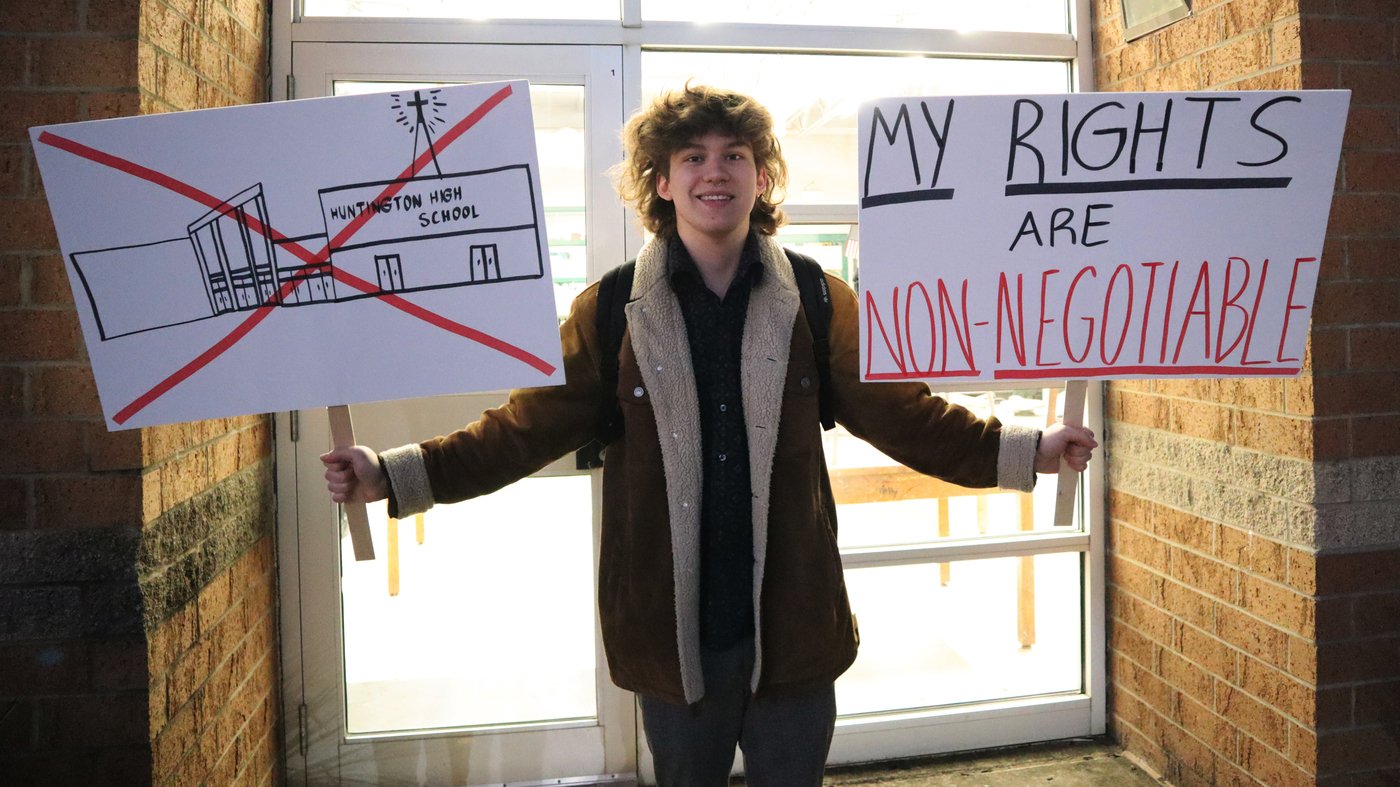
On February 2, 2022 two homeroom classrooms at Huntington High School in the Cabell County School District in southwestern West Virginia were brought to a school assembly. The assembly was hosted by Nik Walker of Nik Walker Ministries. Nik Walker is an evangelical preacher and his group had been hosting revival events in the area with the purpose of exposing persons to Jesus Christ and Christianity.
Two of the teachers who escorted their homeroom class to the assembly told their class that they were required to attend. The homeroom classes were brought over but when one student who did not feel comfortable attending the event asked to leave, he was told that the room was locked. At the event, Nik Walker encouraged the students to pray with him by sending adults into the crowd to lead the students in prayer and admonished the students “to follow Jesus or face eternal torment.”
Approximately one week later, more than one hundred students staged a walkout during school hours to protest their required attendance at the Nik Walker Ministries event. In addition to the walkout, many of the students signed a petition seeking an apology from the West Virginia Board of Education.
Later a lawsuit was filed in the U.S. District Court for the Southern District of West Virginia on behalf of a number of families whose students were coerced into attending the evangelical revival event. The lawsuit was filed by the Freedom From Religion Foundation (FFRF) and seeks a permanent injunction barring the Cabell County School District from sponsoring any religious worship services, adult led religious activities during the school day or participation of students in such events during school hours.
Policy Analysis
The First Amendment to the United States Constitution provides that “Congress shall make no law respecting an establishment of religion” and the Supreme Court has applied this law to public schools in a variety of scenarios. Classroom scripture readings and prayers were found to be in violation of the First Amendment as well as moments of silence to pray at the beginning of classes, the posting of the Ten Commandments in public schools and the requirement to teach “creationism” in schools.
The overall principle of many of these decisions as it relates to public schools is that the First Amendment of the Constitution forbids schools from endorsing a religious position or any religious faith as part of a student’s school day.
During the student led walkout to protest the religious assembly held on campus students chanted, “Separate the church and state” and “My faith, my choice.” Based on what happened at Huntington High School on February 2nd it is clear that the teachers and the high school erred by requiring their students to attend the Christian revival assembly during school hours. But while some are trying to argue that this is merely a one – time honest mistake that won’t happen again, the history of the Cabell County School District shows that this school district has a history of trying to use school assemblies to force religious expression on students and of trying to coerce them to accept Christian thoughts and values.
In 2017 the Cabell County School District was notified about hosting two religious assemblies at Huntington High School during school hours. And in 2019 the school district was again notified because parents discovered that adult led religious clubs were being run in district schools during school hours.

Photo taken from: News Observer (.com)
(click or tap to enlargen)
Both notices were seemingly ignored by the Cabell County School District with no record of whether any action had been taken to prohibit those and similar activities in the future.
The Cabell County School District’s tolerance of religious activities during school hours instead appears to be a systematic effort to ignore the commands of the Constitution and try to impose religious teachings and host religious themed activities in their school district. But the law is the law and they cannot continue with this pattern of behavior at schools in the district.
The problem is that the school district is obviously taking a position by saying Christianity is the only accepted faith that should be followed. And they are pushing this position during school hours on young minds that might be forced to accept.
The permanent injunction asked for in the lawsuit brought by the Freedom From Religion Foundation can help to try and stem the incidents that have been going on in the district and can send the message that public school students should not be coerced into listening or adopting unwanted Christian viewpoints during school hours. LEARN MORE, LEARN MORE, LEARN MORE
This brief was compiled by Rod Maggay. If you have comments or want to add the name of your organization to this brief, please contact Rod@USResistnews.org.
Engagement Resources
Click or tap on resource URL to visit links where available

Freedom From Religion Foundation – non – profit group webpage about the lawsuit they brought on behalf of Huntington High School families and their work advocating for the separation of church and state.

American Civil Liberties Union (ACLU) – quick info bulletin on public schools and religion and the Establishment Clause of the First Amendment of the U.S. Constitution.