

TRUMP RUSSIA INVESTIGATIONS
Get your latest Op Eds from U.S. Resist News.
Latest U.S. Resist Op Eds
THE DEPARTMENT OF JUSTICE SHOULD INDICT FORMER PRESIDENT TRUMP
U.S. RESIST NEWS OP-ED
By Ron Israel
The January 6th Committee, through its publicly televised hearings has revealed that it has enough evidence to indict former President Donald Trump. The indictment would be focused on Trump’s illegal efforts to overturn the results of the 2020 Presidential elections.
The Center Lane is Wide Open
U.S. Resist News Op Ed
By John Halpin
New polling shows that Americans are unique in viewing their political leaders as ideological extremists.
What to Expect During the First January 6th Committee Open Hearings
Brief #37 – Elections and Politics
By Maureen Darby-Serson
On Thursday June 2nd, the January 6th committee announced when it would hold its first round of public hearings. The first open hearing will be Thursday, June 9th at 8pm. Primetime. No other details were released, but more information would be made available next week. For example, no witness list was published.
Support for the Separation of Church and State Should be Part of the Democrats Platform in the 2022 Mid-terms
In the upcoming Congressional elections Democrats should emphasize their commitment to supporting a democratic pluralistic society that respects individual rights, and the principle of separation of church and state, and how not showing support for these values opens the doors for outlawing abortions, banning books and other culture war issues.
Lessons for American Democracy from the Russian War with Ukraine
Russia’s invasion and war with Ukraine has been unfolding in real time in front of our eyes. The war has succeeded in bringing out the courage of Ukrainian President Zelensky and the Ukrainian people and the ruthlessness and cruelty of President Putin and the Russian army.
SUGGESTIONS DEMOCRATS NEED TO WIN THE MID-TERMS
At the moment things look a bit dire for the chances of Democrats maintaining control of the House and Senate in the 2020 mid-term elections. Their attempt to pass voting rights legislation has been blocked (thanks to people in their own party), the massive Build Back Better Bill also has stalled in the Senate, inflation is on the rise, COVID is still very much with us, and President Biden’s favorability rating is at an all-time low.
Federal Laws Versus States Rights Re-Visited
U.S. RESIST NEWS EDITORIAL
By U.S. RESIST NEWS Reporters (Scout Burchill, Ron Israel, Tim Loftus, Rod Maggay and Lynn Waldsmith)
The United States has a democratic federal form of governance with law-making responsibilities divided between the federal government and our 50 states. The U.S. Constitution, written in 1789, seeks to provide a framework for areas of governance that belong to the states and those that belong to the federal government.
Was Obama Our First Multiracial President?
U.S. Resist News Op Ed
By Ron Israel
There is an excellent new HBO documentary on the President of Barack Obama -our 44th President. Much of the documentary focuses on Obama’s efforts (many of them outstanding ) to deal with race and racism, It points out the inner conflict of Obama being the first “black” President and his desire to be seen as a President for all Americans; of his deliberate outreach to black Americans who almost universally supported him, though some felt he could have done more to address racism and the economic needs of the black community.
ENSURING FAIR ELECTIONS HELPS ENSURE DEMOCRACY
U.S. RESIST NEWS EDITORIAL
By Ron Israel
The United States of America was intended by our founders to be a democratic republic. Our Declaration of Independence enshrines our commitment to the core values of equality, freedom, and self-government. As Abraham Lincoln said in his Gettysburg address, we are a government “of the people, for the people, and by the people.”

Lessons for American Democracy from the Russian War with Ukraine
Lessons for American Democracy from the Russian War with Ukraine
U.S. RESIST NEWS EDITORIAL | March 28, 2022
Header photo taken from: The Moscow Times
Follow us on our social media platforms above
Browse more editorials from the top dashboard

Photo taken from: BreezyScroll
[SSB theme=”Official” align=”center” counter=”true” ]
Russia’s invasion and war with Ukraine has been unfolding in real time in front of our eyes. The war has succeeded in bringing out the courage of Ukrainian President Zelensky and the Ukrainian people and the ruthlessness and cruelty of President Putin and the Russian army.
The war also has many important lessons for American democracy currently in a state of disrepair. Presented below are examples:

Photo taken from: LaFargue, Raphael / ABACA
The moral strength of a democratically united country.
Tiny Ukraine, which has a third of the population of Russia has nevertheless put up a united front in the face of the Russian invasion. In similar situations in other countries, leaders would have fled and a country like Ukraine would have been easily occupied, e.g. witness Afghanistan. But the Ukrainians thus far have put up a united front that has been able to slow down the ability of Russia to meet its objectives. What was once thought to be a quick Russian conquest has turned into a conflict now entering its fourth week with no end in sight.
The importance of having democratic leaders who have the support of their people.
Certainly President Zelensky is a charismatic and courageous leader, but his success draws upon the fact that his government has the universal support of the Ukrainian people. You don’t have a political environment in Ukraine where bickering between rival political parties, such as in the United States, paralyzes the ability of the government to act.
The divisiveness that occurs as a result of media misinformation.
As a result of the Russia-Ukraine war we have gained an insight into the ways in which Russia controls the flow of information to its citizens, and the misinformation that results. It appears that most Russians have little knowledge about what Russia is doing in Ukraine. State-run media tells Russians that it army is seeking to liberate Ukraine from Nazis who govern the country. The government threatens with jail time anyone who calls its actions in Ukraine “a war.” Although thankfully America still supports free and open media information, several news organizations, such as Fox News, regularly spread disinformation in support of right wing and authoritarian political views. People in the U.S. who watch these channels can be led to believe that President Putin is “a genius,” and that his actions in Ukraine are justified.

Photo taken from: NBC
The impact of having a war where everyone fights.
In America up until 1973 there was a universal draft, known as the Selective Service System, that we used to fight our wars. All males between 18 and 37 had to register with the system and were eligible. To be called up to fight as members of one of our Armed Services. The Selective Service System democratized military service by making everyone participate. Wars were truly our country’s wars; much the way in which Ukraine is fighting its war with Russia. In Ukraine all males between the ages of 18 and 60 have been asked to fight. Everyone is a part of the war effort, making it into a national unifying operation.
The importance of standing up to authoritarianism.
President Biden has aptly termed the period we are living in as a battle between democracy and authoritarianism. Over the past few decades the world has witnessed the rise of authoritarian style leaders such as Xi in China, Bolsinaro in Brazil, Victor Orban in Hungary and of course Trump and Putin. Ukraine squarely and unabashedly rightly calls itself a democracy and has positioned its conflict with Russia as a battle between an authoritarian ruler (Putin) and a democratically elected government. Media coverage of the war in Ukraine has enabled people around the world to see the ruthlessness and cruelty that happens when an authoritarian, answering only to himself, is allowed to unleash an unprovoked war on another country. In standing up to Putin the Ukrainians are showing the world the importance of the need to challenge authoritarian regimes.

Photo taken from: Newsweek
The need to revisit the issue of nuclear disarmament.
The conflict in Ukraine has re-raised the possibility of the use of nuclear weapons and a larger global nuclear war; something that has not been talked about for decades. During the early stages of the conflict President Putin indicated he was putting Russia, which has an arsenal of over 6,000 nuclear warheads, in a state of nuclear alert. President Biden and European leaders, also in command of nuclear weapons, have gone out of their way not to take steps, such as a no fly zone, that could prompt Putin to launch a nuclear strike. The prospect of a nuclear war, long ignored by the world community has been reignited. Regardless of what happens in Ukraine the world has re-awoken to the danger of nuclear weapons and the need to control and disarm them.
The need for a better global system to address the world’s growing number of refugees.
Over 3 million Ukrainians have become refugees since the start of their country’s with Russia. Their suffering and needs are placing enormous strains on nearby countries to which many of them have fled. But the Ukrainians are only the latest group in a growing number of refugees made stateless due to wars, internal conflicts in their countries as well as climate change. But their plight further highlights for the global community to develop a new system for dealing with refugees and displaced persons that is appropriate for these troubled times.
So there is much we all should learn from Russia’s war of choice with Ukraine. It’s tragic it has taken such a horrendous war to teach us these lessons.
SUGGESTIONS DEMOCRATS NEED TO WIN THE MID-TERMS
SUGGESTIONS DEMOCRATS NEED TO WIN THE MID-TERMS
A U.S. RESIST NEWS EDITORIAL
February 01, 2022
Header photo taken from: Climate Advisers
Follow us on our social media platforms above
Browse more U.S. Resist News editorials from the top dashboard

Photo taken from: Salon (.com)
[SSB theme=”Official” align=”center” counter=”true” ]
At the moment things look a bit dire for the chances of Democrats maintaining control of the House and Senate in the 2020 mid-term elections. Their attempt to pass voting rights legislation has been blocked (thanks to people in their own party), the massive Build Back Better Bill also has stalled in the Senate, inflation is on the rise, COVID is still very much with us, and President Biden’s favorability rating is at an all-time low.
So, is there any hope? Can the Democrats turn things around between now and November? We at U.S. RESIST NEWS believe it’s possible, but Democrats must take some important actions at the Federal, state and local levels to give themselves a chance. Here’s what we suggest they do:
# 1 Place the blame on the Republican Obstructionism: Democrats need to emphasize that the inability of government to better meet the needs of its citizens is mainly the result Republican inaction and oppositional tactics. The Dems can point out how Republican opposition to voting rights, climate change, education and health programs has been largely responsible for the inability of Congress to pass much needed legislation in these areas.

Photo taken from: Grist
# 2 Keep asking the question: What do Republicans stand for? As for as we can tell Republicans stand for little more than seizing power and clinging to it. In this current Congress (and during much of the Trump administration) Republicans have put forward no major policy proposals and spend most of their time voting down Biden’s legislative agenda. The Democrats should turn Republican obstructionism against Republicans, and ask at every campaign rally: “What do Republicans stand for? What do they stand for?”

Photo taken from: Al Jazeera
# 3 Publicize the January 6th Committee’s investigation: The House Committee to investigate the January 6th insurrection seems to be making headway. Despite the refusal of leading Trump associates to testify, the Committee has interviewed hundreds of witnesses and compiled extensive documentation related to January 6th. They seem poised to tell a fairly detailed story of efforts led by President Trump to overturn the 2020 presidential election and democracy itself. This story needs to be widely told so that the American people have the facts of what really happened on Jan 6th. The House Committee plans to hold televised hearings on January 6th, which will be a great way to expose the atrocity the deliberate efforts before, during, and after that day to overturn the election results

Photo taken from: KTVZ
# 4 Make abortion rights a key campaign issue
The Supreme Court has been sending signals that it may soon overturn the doctrine of a woman’s right to choose to have an abortion. That doctrine was estaboished in the Roe v Wade decision in 1973. The Court’s recent decision to let stand an anti-abortion law in Texas, and its promise to render decisions on the legality of anti-abortion legislation in Mississippi, indicate that near-term court rulings may soon make Roe v Wade obsolete. It will be an extremely unpopular decision in the eyes of the vast numbers of American women who support abortion rights. Democrats should go all out to voice their opposition to any effort to overturn or limit Roe v Wade. Doing so would help the Dems garner the support of millions of American women.

Photo taken from: Women’s eNews
#5 Introduce More Targeted Legislation
The pieces of legislation the Democrats can get pass through Congress the better their ability to score points with voters. During this past year, Democrats failed to get large pieces of their legislative agenda passed. Part of the problem was the size and scope of their proposals. Both the Build Back Better Bill and the Voting Rights Bills had many different and varied components within them. The size of the bills made them difficult to explain to the general public and made it easy for Senators opposed to certain parts of the legislation to say “no” to the entire package. For example, take the climate change and universal pre-school components of the Build Back Better bill out of that bill and propose them as stand-alone legislation. The two voting rights bills could be d-coupled and broken out into small legislative proposals. By breaking these large pieces of legislation up into smaller pieces, Democrats will also force Republicans to go public with their opposition to popular pieces of legislation.

Photo taken from: The Republic Monitor
# 6 Support voter turnout and election monitoring efforts: It goes without saying that the Democrats will need to do more than their usual get-ot-the-vote efforts if they have any hope of winning the mid-terms. Especially in Red States that have enacted hostile voter registration and election laws the Democrats will need to implement intense voter turnout campaigns, post legal challenges to restrictive voter laws in states that have them, and perhaps consider placing voting monitors at polling places to ensure that no one is pressured and every citizen who shows up gets the opportunity to vote.
These suggestions constitute a challenging but doable set of actions for Democrats to take in their approach to the mid-terms. Party leaders at the national, state and local levels, and of course the Democratic National Committee need to get behind such a strategy if the Democrats want to expand their leadership positions in the House and Senate.

Photo taken from: Center for American Progress
Federal Laws Versus States Rights Re-Visited
Federal Laws Versus States Rights Re-Visited
U.S. RESIST NEWS EDITORIAL
By: U.S. RESIST NEWS Reporters
(Scout Burchill, Ron Israel, Tim Loftus, Rod Maggay and Lynn Waldsmith)
January 1, 2022
Header photo taken from: Attorneys Worldwide
Follow us on our social media platforms above
Browse more U.S. Resist News editorials from the top dashboard

Photo taken from: Pew Research Center
Introduction
[SSB theme=”Official” align=”center” counter=”true” ]
The United States has a democratic federal form of governance with law-making responsibilities divided between the federal government and our 50 states. The U.S. Constitution, written in 1789, seeks to provide a framework for areas of governance that belong to the states and those that belong to the federal government. The way in which the Constitution was written reflects a compromise between mostly urban-based advocates of a strong central government, led by Alexander Hamilton, and the mainly rural-based part of our country led at the time by Thomas Jefferson.
Throughout the course of U.S. history the role of the federal government, in relationship to states rights, has shifted- from weak to strong and back to weak again. This shift in the locus of power has taken place in response to the changing historical/economic and social circumstances in which the country finds itself. The federal government tends to play a larger role in times of social and economic upheaval and a lesser role during periods of peace and calm.
Today is a time of upheaval as civil discourse is disappearing, misinformation is widespread, and old forms of conduct and democratic institutions are under attack. If we stay together as a nation there is a need for our federal government to assert itself, bring us together, and play a strong leadership role.
U.S. RESIST NEWS asked members of our reporter team to make the case for greater or lesser federal governance in key public policy areas during the times in which we live. Here is what they wrote:
Civil Rights
The big issue today in civil rights, maybe even the entire country, is voting rights. It is one of the few issues that makes headlines across the U.S. when Congress debates reforms at the federal level and individual states pass new voting rights laws.
The Constitution in Article One, Section Four, Clause One actually gives each state legislature the power over the time, place and manner of elections but qualifies that grant of power by stating that Congress may “make or alter such Regulations.”

photo taken from: The Guardian
The focus of the argument shouldn’t be a simple choice between state power and federal power. It should be on whether access to the ballot box is being unduly burdened and if either the state or the federal government can do anything about it. Recently, in line with former President Trump’s false claim that the election was stolen from him, a number of states have enacted laws that have made it harder to cast a ballot. While new absentee ballot restrictions was an easy target for new laws, it can be said that some of the new restrictions were not necessary and were only passed in response to President Trump’s unfounded claims of fraud.
In this instance, the federal government can step in and offer ways to counter some of the misplaced efforts going on in the states – they can pass new laws that every state must follow and offer new guidance and minimum standards.
The Environment
Other natural resources, such as wildlife, are left largely to states to manage with their own set of regulations. Here, federal law essentially establishes a threshold of minimum species existence below which the federal Endangered Species Act takes over to set the rules for species recovery.

photo taken from: US Fish and Wildlife Service
Marine fisheries management on the other hand is largely a federal responsibility, but one that involves regional management councils and interstate commissions. States are allowed to manage within the first three miles of their coastline before the federal role triggers for management within the three-200 nautical mile from coastline, U.S. exclusive economic zone.
In most of these cases where the resources are seen as common-pool rather than private property, federal law sets a minimum standard of resource protection and leaves it to states to manage resources at or above those standards. Federal law in effect acts as a guide for states that are free to “improve” on federal guidance for the betterment of the resource or society, but states cannot regulate at levels that ignore federal guidance. Marine fisheries management is more nuanced and cooperative in practice.
The judicial branch of federal government plays a crucial role in interpreting the laws as they are either upheld or ignored by states and/or other entities (e.g., private individuals, corporation, federal agencies charged with implementing law.) The matter of environmental protection, therefore, is neither a solely federal oversight nor a strictly states’ rights issue, but rather a cooperative venture in joint governance with mediation provided as necessary by the court system. An informed citizenry also has a role to play in ensuring that laws and rulemaking at both levels remain current and effective.
Healthcare
Although healthcare is not included in the U.S. Bill of Rights, it is included in the Universal Declaration of Human Rights adopted by the United States and 191 other countries. Health care as a basic right has become part of the lexicon of many U.S. politicians on both sides of the aisle.

photo taken from: Forbes
However, with few but noteworthy exceptions (e.g., Medicare) federal legislation has failed to support the widespread belief in health care as a human right. The U.S. public health system is fragmented with the federal government limited in what it can prescribe and with states having the ability to enact their own regulations in many areas vis-à-vis the prevention and treatment of disease.
However, illness and disease, like climate change, know no political boundaries. The current Covid 19 global pandemic is testimony to that assertion. The Covid 19 virus will not be contained in any single country until people in all countries are fully protected from the virus; nor in any one U.S. states until people in all 50 states are fully protected.
Unfortunately progress in stopping Covid within the United States has been slow because many states for political reasons refuse to enact vaccination and mask mandates, and because many citizens believe that such mandates are an infringement of their civil rights. The politics of Covid are perhaps the first time in U.S. history when public health has become so politicized. In a public policy arena greatly in need of federal leadership and management, the cry of states’ rights and individual citizen rights are being used to mitigate our ability to keep people healthy.
Education
The federal government has a limited role in education. This is mainly because public schools are mostly funded at the local and state level, while states fund state universities and private organizations establish schools and colleges as well.
This myriad of institutions leads to a variety of curricula and educational standards throughout the country.

photo taken from: Center for American Progress
While local and state school systems should and do have the right to teach students in their jurisdictions as they see fit, the federal government historically has intervened when necessary.
For example, when Southern states refused to educate former slaves after the Civil War, Congress created federal schools to do so. In the early 20th century, Congress funded vocational education programs to train immigrants for employment. In the 1950s and ’60s, after the Soviet Union launched a satellite into space, Congress funded major new efforts to improve the teaching of science and mathematics. And the passing of Civil Rights laws eventually made it possible for Black students to receive access to the same education as their white peers.
Education in the U.S. is a complex system and the federal government should try to stay out of decisions that are best left to governors, state legislators, school boards, superintendents, and teachers. However, when local leaders are unable or unwilling to provide for all children’s needs, federal policy makers have an obligation to become involved.
The federal government should focus its educational efforts on these four areas:
Universal Pre-K
A wealth of research shows that high-quality preschool programs tend to be extraordinarily effective in helping kids succeed in school, but access to pre-K is painfully inadequate in most of the country, especially for children from low-income families.
Teacher quality
Teacher recruitment, preparation, and retention were already problems before the pandemic. Meager wages, lack of respect, poor working conditions and burnout have been exacerbated during the Covid-19 crisis, leading to teacher shortages.
Funding
The funding of public education needs to be overhauled. Local property taxes continue to be a major source of educational funding in most states, which allows affluent communities to allocate more money per pupil. According to the Organization for Economic Cooperation and Development, the American approach to school funding is one of the most dysfunctional systems in the world: “[The] vast majority of [advanced] countries either invest equally in every student or disproportionately more in disadvantaged students. The U.S. is one of the few countries doing the opposite.”
Safety
School shootings are every parent’s worst nightmare and the country is reeling from far too many of them. Given the gun violence epidemic in this country with student anxiety and depression at all-time highs, occasional active shooter drills are simply not enough. The federal government needs to adopt and enforce proactive and proven safety measures at every school in the U.S.
Social Justice
Social justice issues in the U.S. are ever-growing. From voting rights to racial injustice to gun violence in America, there is a demand for the federal government to act on behalf of its citizens.
Social justice issues should be addressed at the federal level through various types of legislation and organizations dedicated to reforming the issues that matter.

photo taken from: Harvard Gazette – Harvard University
In the past, we have seen the U.S. government pass laws regarding some of these issues. For example, there have been small efforts by the new administration to reform gun control – however, these laws are usually not far-reaching enough to make an impact. What is needed is a government who is willing to pass laws that will not only prevent tragedies and social injustice but prosecute those who willingly harm other people to ensure they cannot do it again.
This is not something that can be achieved solely at the state level. There are states that are unwilling to pass laws to protect their citizens, believing the 2nd Amendment has priority over the safety and security over their residents. This calls for the federal government to step in and draft laws that will help address things like gun violence and racial injustice. Mass shootings are on the rise in the U.S., and we are lacking the legislation (and cooperation) to protect our citizens from tragedy. Something must be done by lawmakers to curb violence in all states and make America a safe place for people to live again.
Technology
Almost two years into a pandemic, the power of technology to shape our societies, economies and everyday lives is clearer than ever.
From Zoom-schooling, meme-stocks and Twitter-driven political discourse to skyrocketing inequality, cyberwarfare, surveillance capitalism and disinformation, the nation needs a bold and unifying vision that addresses the issues of our exponential age. Unfortunately, when it comes to our nation’s leadership, clarity of purpose is blurry at best.

photo taken from: The New York Times – “Ohio’s battle to classify Google as a public utility”
Too often, our nation’s politics are purely reactive, lacking in foresight and beset by petty political in-fighting. Systems only adjust, if ever, after damage is done. In the rapidly emerging sphere of digital governance, this state of affairs has us barreling toward an uncertain future as technology rapidly alters the fabric of our society, and our ability to proactively shape its influence is stymied by political morass, big money interests and a loss of faith in our own institutions’ ability to govern.
To amplify the benefits and reign in the harms of technology, the federal government needs to rise from its slumber and rediscover its raison d’etre – to serve, protect and guarantee the rights of all Americans. Currently there are no federal laws on the books protecting our data privacy from ravenous data brokers or enshrining our digital rights. As the vague distinction between our online and offline worlds grows more indistinguishable, the federal government’s lack of action imperils us all.
This has pushed states to take matters into their own hands, resulting in some interesting experimentation in the areas of digital governance. Some examples that come to mind are: Ohio’s battle to classify Google as a public utility, Vermont’s stringent data protection laws, the 40 states that came together to file an anti-trust suit against Facebook, and even Florida’s half-cocked attempt to stop Big Tech censorship.
No doubt, some of these initiatives can produce good models going forward, but more often than not, the overall result is a fractured patchwork of states pushing and pulling in various directions. Furthermore, state initiatives that truly take on the concentrated power of Big Tech are almost bound to fail given that tech interest groups tend to have far more patience and much deeper pockets than most state attorneys and legislatures.
There will be no unified vision, no concerted effort, without the federal government leading the charge. States may try to forge their own paths, but without the leadership and vision of a determined federal government, the odds are squarely stacked against them.
Conclusion
Our Reporters make a strong case for stronger federal legislation in most of the public policy issues covered by this Editorial.
The arguments for stronger states’ rights and individual liberties lose their luster at a time when so many issues like climate change cannot be contained just at the state level; when the importance of public health and safety take precedence over the behavior of people who believe they have the right to purchase an AK 47 or not to wear a mask in the midst of a pandemic.

photo taken from: Cincinatti.com
Was Obama Our First Multiracial President?
Was Obama Our First Multiracial President?
U.S. Resist News Op Ed | By: Ron Israel | September 6, 2021
Header photo taken from: Hilltop Views
Follow us on our social media platforms above
Browse more op eds here

Photo taken from: HBO Max
There is an excellent new HBO documentary on the President of Barack Obama -our 44th President. Much of the documentary focuses on Obama’s efforts (many of them outstanding ) to deal with race and racism, It points out the inner conflict of Obama being the first “black” President and his desire to be seen as a President for all Americans; of his deliberate outreach to black Americans who almost universally supported him, though some felt he could have done more to address racism and the economic needs of the black community.
But technically speaking President Obama came from a multiracial background not just an African-American one. His mother was a white woman from Kansas and his father an African from Kenya and he grew up in multi-racial Hawaii.. This multi-racial heritage could have influenced his makeup as a person and his outlook on the world.
The results of the 2020 Census show that the US population is much more multiracial and more racially and ethnically diverse than what was measured in the past. Census results show that the multiracial population in almost every county in the United States grew between 2010 and 2020. In Puerto Rico, half of the people said they were more than one race — a trend that demographers say happened across the US as people shifted to multiracial identities.
President Obama’s multiracial background mirrors this trend towards multiracialism that is going on across our country. Those who classify themselves as multiracial are still in the minority according to the Census, so it would not have been wise for Obama to identify himself as multiracial. In his public statements he always identified as being black.. But the truth, at least from a genetic perspective, is that he is a person of mixed racial heritage and our first multiracial President.
ENSURING FAIR ELECTIONS HELPS ENSURE DEMOCRACY
ENSURING FAIR ELECTIONS HELPS ENSURE DEMOCRACY
U.S. RESIST NEWS EDITORIAL | By: Ron Israel, Managing Editor | July 26, 2021
Header photo taken from: Center for American Progress
Follow us on our social media platforms above
Browse more US Renew editorials here

Photo taken from: Fair and Just Prosecution
[SSB theme=”Official” align=”center” counter=”true” ]
The United States of America was intended by our founders to be a democratic republic. Our Declaration of Independence enshrines our commitment to the core values of equality, freedom, and self-government. As Abraham Lincoln said in his Gettysburg address, we are a government “of the people, for the people, and by the people.” Those who govern America are accountable to the citizens they serve. This accountability gets renewed on a regular basis through an election system that is intended to be fair and transparent, with all citizens being given the opportunity to vote.
Over the past decade our electoral system has come under attack, first by Supreme Court decisions that diminished the effectiveness of the Voting Rights Act of 1965 and by a recent series of state level voting laws that are targeted at placing restrictions on minority voting rights ; second by the increasing use of state-level partisan gerrymandering to reapportion the way Congressional seats are chosen, third through a decision by the Supreme Court that allows corporations to make election contributions and allow unlimited special amounts of money to be spent , thereby favoring candidates supported and tethered to interests; and fourth by continued reliance on the outdated, undemocratic use of an electoral college system for determining the outcome presidential elections.
The Biden administration urgently needs to take steps to address these threats to our election system that in turn threaten to weaken our democracy. U.S. RESIST NEWS views the need to restore the equity and fairness of our voting system as more important than any other issue on President Biden’s agenda. We recommend that the administration put its utmost energies into passage of the following electoral reforms.
1.) Pass Federal voting rights legislation that ensures voting rights and easy access to the ballot box for all.
First and foremost, this means passage of the For The People Voting Rights Bill (HR 1) and the John Lewis Voting Rights Advancement Act now before Congress. The For the People Bill would expand voting rights, change campaign finance laws to reduce the influence of money in politics, ban partisan gerrymandering, and create new ethics rules for federal officeholders.
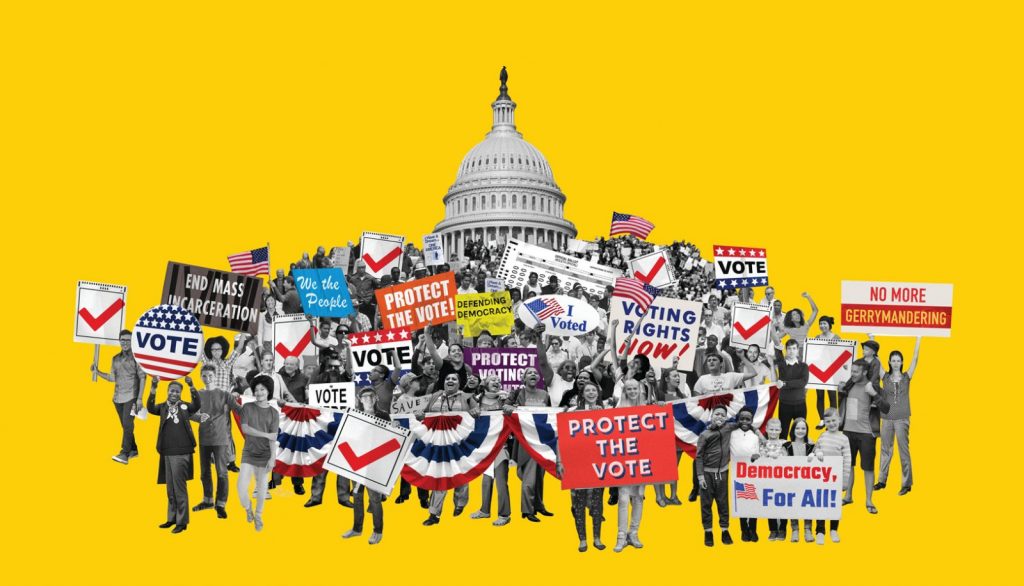
Photo taken from: Brennan Center for Justice
The John Lewis Voting Rights Advancement would restore the 1965 Voting Rights Act back to its original and full power which would prevent future discriminatory bills from being passed. The passage of these 2 bills will pre-empt ongoing Republican backed efforts to pass state level bills that severely restrict voting rights, especially for minorities, the disabled and young people.
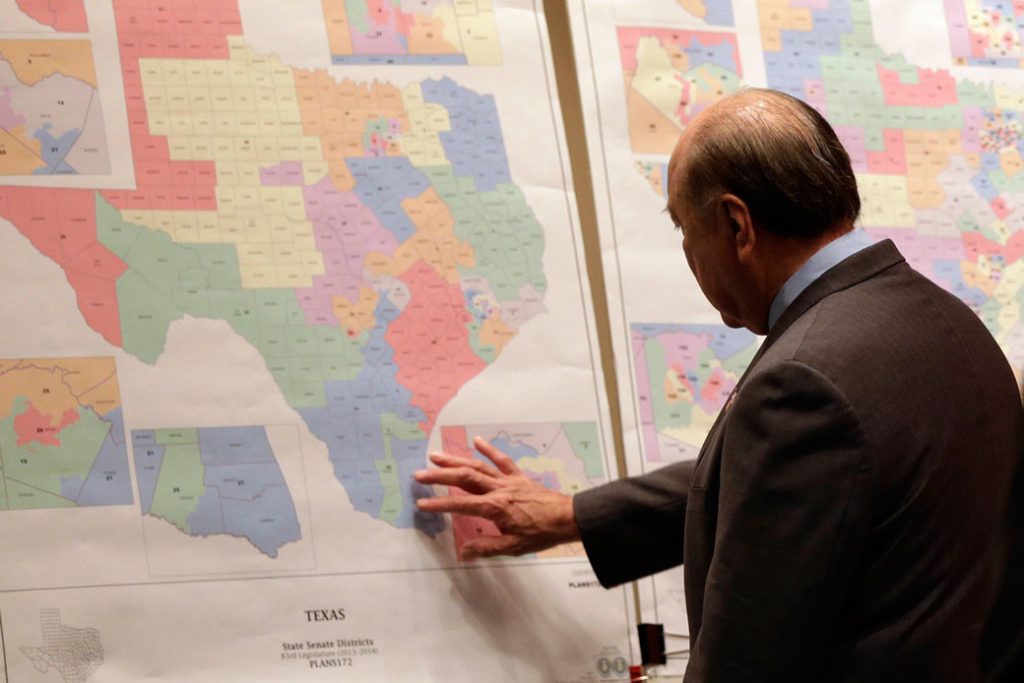
Photo taken from: Center for American Progress
2) Support efforts to establish state level non-partisan independent commissions responsible for re-districting.
The success of such commissions is largely dependent on their structure and i internal system of checks and balances. Carefully designing a commission to promote core values like independence, inclusivity, good-faith negotiation, and transparency is critical to fair redistricting that guards against partisan and racial gerrymandering.
Currently, 21 U.S. states have some form of non-partisan or bipartisan redistricting commission. Of these 21 states, 13 use redistricting commissions to exclusively draw electoral district boundaries. In 2015, the Supreme Court ruled that redistricting commissions, whose redistricting commission process is independent of the state legislature, were constitutional.
Learn more at https://www.brennancenter.org/our-work/policy-solutions/better-way-draw-districts
3) Initiate a legal challenge to overturn the Supreme Court’s Citizens United decision.
The idea is that a city or state can create a law cracking down on some of the big-money election tactics that have become commonplace, expecting that that law will then be challenged. Once challenged, the fight will advance through the court system and advocates hope, ultimately reach the Supreme Court.
At that point, the court will have the opportunity to reconsider the legal framework of the Citizens’ United case.
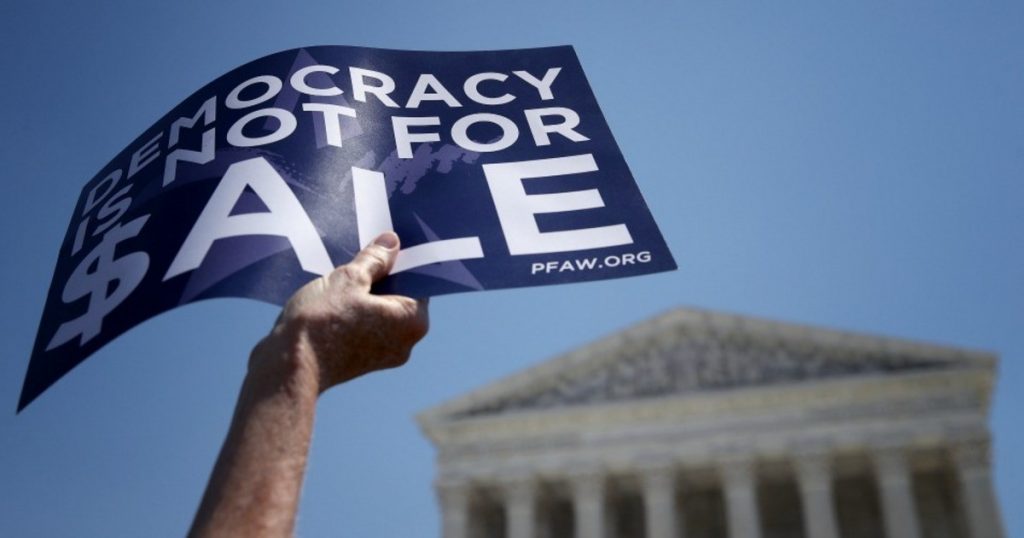
Photo taken from: Common Dreams
It also should be noted that a provision of the For the People Act-see # 1—above—calls for public financing of elections and support for a constitutional amendment to overturn the Citizens United Decision.
Learn more at www.defendourdemocracy.org.
4) Support the National Popular Vote Interstate Compact aimed at deciding presidential elections by popular vote.
The Compact will guarantee the Presidency to the candidate who receives the most popular votes across all 50 states and the District of Columbia. It ensures that every vote, in every state, will matter in every presidential election. The National Popular Vote Interstate Compact will go into effect when enacted by states possessing a majority of the electoral votes—that is, enough to elect a President (270 of 538).
So far, The National Popular Vote Compact has been endorsed by 16 jurisdictions possessing 195 electoral votes, including 4 small states (DE, HI, RI, VT), 8 medium-sized states (CO, CT, MD, MA, NJ, NM, OR, WA), 3 big states (CA, IL, NY), and the District of Columbia. The bill will take effect when enacted by states with 75 more electoral votes.
Learn more at www.nationalpopularvote.com
Learn more at www.defendourdemocracy.org.
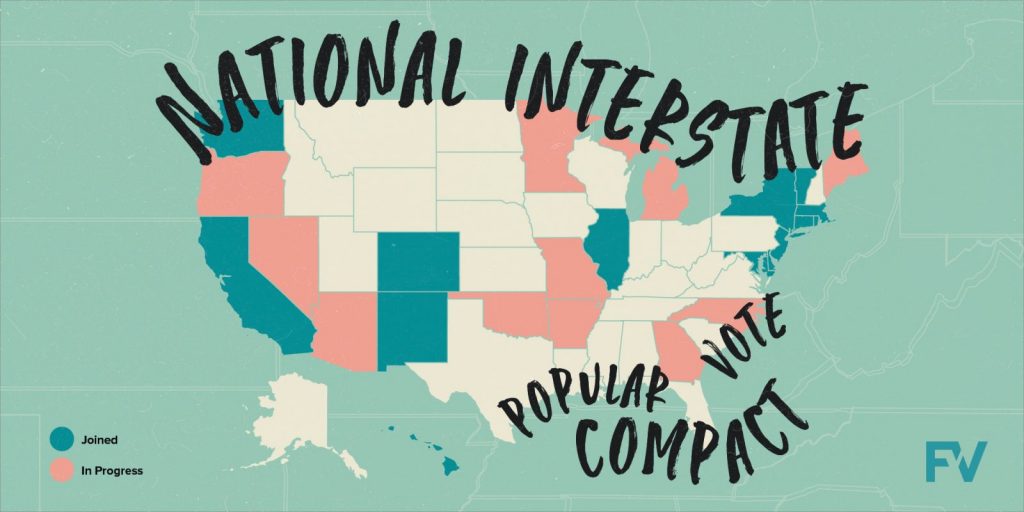
Photo taken from: Fairvote
Implementing these electoral reform proposals pose a challenge for the Biden administration, given our current highly charged political atmosphere. But it is a challenge well worth taking on if we are to preserve the democratic values and principles upon which our country and government stand.
The Wisdom in Bipartisanship
The Wisdom in Bipartisanship
U.S. RESIST NEWS EDITORIAL
By: Ron Israel | July 9, 2021
Header photo taken from: The University News
Follow us on our social media platforms above
Browse more U.S. RESIST NEWS editorials here

Photo taken from: Bloomberg.com
Many political observers question President Biden’s emphasis on bipartisanship. Why they ask should Biden put so much emphasis on bipartisanship when the other side of the aisle doesn’t seem interested.
Indeed today’s Republican party presents itself as a group of politicians aligned with former President Trump and his “big lie” that the election was stolen; who seem to want to see the Biden administration fail at all costs; who place power and party over country. The party’s Senate leader, Mitch McConnell, has pledged a platform of non-cooperation with the Biden agenda.
So what gives with President Biden? Why does he seem to be so obsessed with bipartisanship? The answer I believe is that Biden sees the main goal of his presidency to be the preservation of our democracy; to heal it from the wounds of the Trump administration. Biden sees bipartisan legislative agreement is a means to help achieve his goal.
And his approach may be beginning to work. Last month a bipartisan group of Republican and Democratic Senators agreed to a $1.2 trillion “hard infrastructure” bill to repeal America’s broken, bridges ports, and roads. While the bill has many hurdles to cross before being signed into law, it is an important signal that, even in this polarizing time, bipartisanship may be possible. Biden is trying to be a President for all Americans and his infrastructure bill is intended for everyone and not just for Democrats at the exclusion of Republicans.
Historically bipartisanship in most cases involves compromise. It means reaching an agreement on an issue that may disappoint those on both sides on the extreme ends of a political argument. But without compromise our country for the past several decades has languished in political gridlock as our quality of life diminishes.
So Biden may be justified in his obsession with bipartisanship. Bipartisan political agreement may be an important way of restoring Americans’ faith in our democratic system. It also might help drive a wedge between pro-Trump extreme right wingers and moderate Republicans who see the wisdom in bipartisan legislation.
Should the Supreme Court Have Term Limits?
Should the Supreme Court Have Term Limits?
US Renew Op Ed |
By: Paul M. Collins & Artemis Ward | July 6, 2021
Header photo taken from: Progress Texas
Follow us on our social media platforms above
Browse more US Renew Op-Eds here
Reprinted from The Coversation (www.theconversation.com)
[SSB theme=”Official” align=”center” counter=”true” ]
Pressure on Supreme Court Justice Stephen Breyer to step downwill likely grow now that the court’s session has ended.
Breyer, 82, joined the court in 1994. His retirement would allow President Joe Biden to nominate his successor and give Democrats another liberal justice, if confirmed.
Supreme Court justices in the U.S. enjoy life tenure. Under Article 3 of the Constitution, justices cannot be forced out of office against their will, barring impeachment. This provision, which followed the precedent of Great Britain, is meant to ensure judicial independence, allowing judges to render decisions based on their best understandings of the law – free from political, social and electoral influences.
Our extensive research on the Supreme Court shows life tenure, while well-intended, has had unforeseen consequences. It skews how the confirmation process and judicial decision-makingwork, and causes justices who want to retire to behave like political operatives.
Problems with lifetime tenure
Life tenure has motivated presidents to pick younger and younger justices.
In the post-World War II era, presidents generally forgo appointing jurists in their 60s, who would bring a great deal of experience, and instead nominate judges in their 40s or 50s, who could serve on the court for many decades.
And they do. Justice Clarence Thomas was appointed by President George H.W. Bush at age 43 in 1991 and famously said he would serve for 43 years. There’s another 13 years until his promise is met.
The court’s newest member, Donald Trump’s nominee Amy Coney Barrett, was 48 when she took her seat in late 2020 after the death of 87-year-old Justice Ruth Bader Ginsburg.

Brooks Kraft LLC/Corbis via Getty Images
Ginsburg, a Clinton appointee who joined the court at age 60 in 1993, refused to retire. When liberals pressed her to step down during the presidency of Democrat Barack Obama to ensure a like-minded replacement, she protested: “So tell me who the president could have nominated this spring that you would rather see on the court than me?”
Partisanship problems

William Thomas Cain/Getty Images
Justices change during their decades on the bench, research shows.
Justices who at the time of their confirmation espoused views that reflected the general public, the Senate and the president who appointed them tend to move away from those preferencesover time. They become more ideological, focused on putting their own policy preferences into law. For example, Ginsburg grew more liberal over time, while Thomas has become more conservative.
Other Americans’ political preferences tend to be stable throughout their lives.
The consequence is that Supreme Court justices may no longer reflect the America they preside over. This can be problematic. If the court were to routinely stray too far from the public’s values, the public could reject its dictates. The Supreme Court relies on public confidence to maintain its legitimacy.
Life tenure has also turned staffing the Supreme Court into an increasingly partisan process, politicizing one of the nation’s most powerful institutions.
In the 1980s and 1990s, Supreme Court nominees could generally expect large, bipartisan support in the Senate. Today, judicial confirmation votes are almost strictly down party lines. Public support for judicial nominees also shows large differencesbetween Democrats and Republicans.
Life tenure can turn supposedly independent judges into political players who attempt to time their departures to secure their preferred successors, as Justice Anthony Kennedy did in 2018. Trump appointed Brett Kavanaugh, one of Kennedy’s former clerks, to replace him.
The proposed solution
Many Supreme Court experts have coalesced around a solutionto these problems: staggered, 18-year terms with a vacancy automatically occurring every two years in nonelection years.
This system would promote judicial legitimacy, they argue, by taking departure decisions out of the justices’ hands. It would help insulate the court from becoming a campaign issue because vacancies would no longer arise during election years. And it would preserve judicial independence by shielding the court from political calls to fundamentally alter the institution.
Partisanship would still tinge the selection and confirmation of judges by the president and Senate, however, and ideological extremists could still reach the Supreme Court. But they would be limited to 18-year terms.
The U.S. Supreme Court is one of the world’s few high courts to have life tenure. Almost all democratic nations have either fixed terms or mandatory retirement ages for their top judges. Foreign courts have encountered few problems with term limits.
Even England – the country on which the U.S. model is based – no longer grants its Supreme Court justices life tenure. They must now retire at 70.
Similarly, although many U.S. states initially granted their supreme court judges life tenure, this changed during the Jacksonian era of the 1810s to 1840s when states sought to increase the accountability of the judicial branch. Today, only supreme court judges in Rhode Island have life tenure. All other states either have mandatory retirement ages or let voters choose when judges leave the bench through judicial elections.

C.M. Bell/Library of Congress/Corbis/VCG via Getty Images
Polling consistently shows a large bipartisan majority of Americans support ending life tenure. This likely reflects eroding public confidence as the court routinely issues decisions down partisan lines on the day’s most controversial issues. Although ideology has long influenced Supreme Court decisions, today’s court is unusual because all the conservative justices are Republicans and all the liberal justices are Democrats.
In April 2021, President Biden formed a committee to examine reforming the Supreme Court, including term-limiting justices. To end the justices’ life tenure would likely mean a constitutional amendment requiring approval from two-thirds of both houses of Congress and three-fourths of U.S. states.
Ultimately, Congress, the states and the public they represent will decide whether the country’s centuries-old lifetime tenure system still serves the needs of the American people.
Democracy Now | The Lethal Nexus: Mass Shootings and Domestic Violence
The Lethal Nexus: Mass Shootings and Domestic Violence
Amy Goodman & Denis Moynihan
June 3, 2021
You know the United States is emerging from the COVID-19 pandemic when the pace of mass shootings gets back to “normal.” As of June 2nd, there were 244 mass shootings in the U.S. this year. That’s one to two per day. The place and time of the next of these horrific acts is unknown, but that one will happen is a certainty. Then another, and another. One consequence of the number of mass shootings in the U.S. is that we possess data related to the crimes, which show a correlation between mass shooters and domestic violence. A majority of the men who commit mass shootings (and men commit at least 97% of them) also have a history of domestic violence. That knowledge, along with sensible, fully-enforced gun control measures, could help stem the epidemic of mass shootings that blights our society, and save the lives of women threatened by intimate partner violence.
Early in the morning of May 26th, as workers at the Santa Clara Valley Transportation Authority light rail hub prepared trains for the morning commute, employee Samuel Cassidy, 57, arrived and within an hour embarked on a shooting rampage, killing nine of his coworkers before taking his own life. He had three pistols with him, as many as 32 magazines, at least some of which were illegal in California, and dozens more guns at home. The guns he used were all registered and purchased legally.
Cecilia Nelms, Cassidy’s ex-wife, told the New York Times that he said of his coworkers several times, “I wish I could kill them.” Nelms and Cassidy divorced in 2004 after 10 years of marriage, during which time Cassidy became increasingly given to fits of rage and uncontrollable anger with her. In 2009, Samuel Cassidy sought a restraining order against an ex-girlfriend. In her court filing rebutting his accusations, the ex-girlfriend detailed occasions when Cassidy raped her and other times when he attempted to do so. She described episodes of his alcohol-fueled mood swings and violent rages.
“The nexus between firearms violence and domestic violence is a particularly lethal one,” Julia Weber of the Giffords Law Center and an expert on domestic violence policy, said on the Democracy Now! news hour. “We have over a million women alive today in the United States who have been shot or shot at by male partners. We have 600 women a year, at least, who are killed by their intimate partners as a result of firearms violence. That’s one about every 14 hours or so.”
Giffords is the gun violence prevention organization co-founded by former Congresswoman Gabby Giffords, who was shot in the head in Tucson while meeting constituents in a shopping center parking lot on January 8th, 2011. She survived, with brain injuries that she continuously works to overcome. Six people were killed by the mass shooter that day, and twelve were injured.
Julia Weber described some of the actions that would help stop perpetrators of domestic violence from committing acts of mass violence: “Getting the firearms from someone who currently owns firearms and becomes prohibited. Ensuring that we have universal background checks, so that if someone who is prohibited attempts to purchase firearms or ammunition, they would be denied. We also need to do a much better job addressing misogyny and domestic violence from the start — recognizing that there’s real harm that occurs as a result of gender bias.”
A recent study from researchers at the University of Indianapolis found that “[m]ale abusers with guns who take the lives of their intimate partners are much more likely to take the lives of others at the same time.” The study also summarized earlier findings that “the presence of a firearm in the home has been shown to increase the risk of death in domestic violence situations as much as five-fold.”
In 2020, Bloomberg News published a study of 749 mass shootings, finding that 60% of those mass shootings were perpetrated during an act of domestic violence or by a man with a history of domestic violence. Bloomberg also found that mass shootings perpetrated by domestic abusers had a consistently higher body count.
The COVID-19 pandemic trapped countless women at home with their abusers, sparking increased calls to domestic abuse hotlines. There was also a surge in gun purchases. Small Arms Analytics reported that, in a country already awash with over 300 million guns, more than 26 million guns were sold in the U.S. in 2020.
Two necessary steps to stop mass shootings is to deny men who beat and abuse women at home the freedom they currently enjoy to buy and own guns, and to take violence against women seriously, strengthening the laws and institutions that protect them from their abusers.
——————-
Amy Goodman – Award-winning investigative journalist and syndicated columnist, author and host/executive producer of Democracy Now! www.democracynow.org
Denis Moynihan is a writer and radio producer who writes a weekly column with Democracy Now’s Amy Goodman.
Show some courage! Defy your tribe!
Show some courage! Defy your tribe!
Someday the world, and maybe even your tribe, will thank you.
By Robert Wright from Robert Wright’s Nonzero Newsletter
(available on Substack)
April 26,2021
Last week LeBron James, who has 50 million Twitter followers, tweeted a picture of a policeman in Columbus, Ohio who had shot a 16-year-old Black girl to death. The tweet said, “You’re next. #Accountability.”
Coming right after the verdict in the Derek Chauvin trial, the tweet seemed to mean that this cop, like Chauvin, would be convicted of murder and imprisoned—though some took James’s message as more menacing: a threat of vigilante justice.
On either interpretation, the tweet didn’t make sense. The cop’s body cam had captured the killing, and the video told this story:
A cop responding to a 911 call arrives on the scene and sees the 16-year-old, Ma’Khia Bryant, with a knife in her hand, approaching another girl. The other girl is backed up against a parked car, with no means of escape, as Bryant draws the knife back and seems poised to stab her. The cop opens fire.
There are good questions you can ask about the cop’s conduct. Couldn’t he have fired one shot, not four? Or, instead of shooting Bryant, could he have rushed her, hoping any stabbing attempt would be ineffective and he could wrestle her to the ground before she did real damage? But if I were the girl the knife was pointed at, I probably wouldn’t be complaining about the decisions he made. In any event, he acted within standard policing guidelines, which say you can use your gun to end a lethal threat to yourself or anyone else.
During the first couple of days after the shooting, my Twitter feed, which tilts to the left, featured a number of tweets that, like James’s, condemned the cop. And it contained almost no tweets making the point I just made—that, though this was a white cop shooting a Black person, it was also a white cop shooting someone who seemed to be trying to stab a Black person.
I sensed a need for someone—like me, for example—to push against the prevailing narrative, to tweet something that might help clarify things. So what did I tweet? Nothing. Why? Because I lacked courage. I just didn’t feel up to dealing with blowback from people on Twitter who, forced to choose between evaluating your argument and attacking you, reliably opt for thermonuclear war.
I’m more and more convinced that there are lots of people like me out there. No, I don’t mean cowards. And I don’t just mean people who think there are too many misleading and inflammatory social media posts by influential people. Obviously, lots of people in red America think there are too many of those posts coming from blue America and lots of people in blue America think there are too many of those posts coming from red America.
What I mean is that there are lots of people who think there are too many of those posts coming from their own tribe—whether red or blue or some other tribe—but are afraid to speak up about it.
I say we start speaking up! Here are some reasons that, at least from my own tribal perspective, speaking up seems like a good idea.
1) If my tribe doesn’t seize the moment, the other tribe will. Ben Shapiro, formerly an editor at Breitbart and currently a right-wing troll, got tons of mileage out of a tweetcomplaining that liberals were resisting the truth about the Columbus shooting. He’d have gotten at least somewhat less mileage if liberals hadn’t in fact seemed to be resisting the truth about the Columbus shooting. When your tribe is denying something that’s obviously true because it doesn’t fit into your tribe’s standard menu of talking points, that’s often a gift to the other tribe. And it can add to the power of people in the other tribe who seize the moment. I personally don’t want to add to Ben Shapiro’s power.
2) If my tribe doesn’t seize the moment, the world will be more likely to enter a spiral of doom. You knew this was coming, right? After all, if I couldn’t connect the theme of courage to the apocalypse, why would I be writing about courage in a newsletter that is devoted to the Apocalypse Aversion Project?
You may ask: But isn’t apocalypse aversion largely about international politics—avoiding wars, building structures of international governance to tackle problems nations can’t tackle alone, and so on? Yes, but:
It’s hard to build coherent international governance on a foundation of incoherent nations. An America lacking in cohesion, divided along red-blue lines, won’t have the political will to do ambitious, politically difficult things. Such as: crafting and then participating in new forms of international cooperation designed to prevent things like pandemics, environmental calamities, and arms races in space or in bioweapons or in AI.
To get a little more granular: Doing these things will require convincing some skeptical Americans—definitely including some who are right of center—that these things make sense. And these Americans will be hard to convince if the people trying to convince them come from a tribe they hate—all the more so if one reason they hate the tribe is because it can’t be trusted to gets its facts straight (like when it accuses cops of racism or murder even when there’s no good evidence of either).
In short: standing up to your own tribe can strengthen its ability to argue persuasively for important policies, including anti-apocalypse policies.
There’s another sense in which courage can aid in the building of good international governance. It takes a little explaining, but the explanation begins with a simple, almost self-evident premise: It’s hard to build coherent international governance on a foundation of international division. Obviously, the more time nations spend at odds—whether fighting actual wars, engaging in tense standoffs, or enduring chilly relations—the less likely international cooperation is.
Now, sometimes being at odds with other nations is the only real option. If a country invades another country, or egregiously mistreats its own people, pushing back against that, sometimes forcefully, can make sense.
But in some cases we overdo the pushback, and one common reason is that we overstate the transgressions we’re pushing back against. Often the way this works is that people who are deeply invested in hostility toward a country exaggerate its transgressions, and hardly anybody has the courage to challenge the exaggeration.
The exaggeration isn’t always, or even usually, intentional. Often people who agitate against, say, Russia or China feel (like LeBron James) that they’re just telling the truth. And sometimes they are. But various cognitive biases make it quite possible that they’re wrong—that they’re unconsciously exaggerating how menacing a country is or how cruel it is to its own people. Depending on the nature of their claims and the prevailing zeitgeist, it can take courage to challenge them.
For example: During the runup to the 2003 Iraq War, it took courage to challenge the claim that Saddam Hussein was building weapons of mass destruction. And by “challenge” I don’t mean denying that he was building them—I just mean saying, “Are we really sure about this?” It’s hard to explain to people who are too young to remember those days why it wasn’t easy to ask a question like that. But the mass psychology of a moralistic rush to war is a strangely powerful thing.
Some kinds of pro-war narratives are especially hard to challenge. In the runup to the earlier war against Iraq, the Persian Gulf War of 1991, a Kuwaiti teenager testified before a congressional committee that while she was volunteering in a Kuwaiti hospital she had watched as Iraqi soldiers “took the babies out of the incubators, took the incubators, and left the children to die on the cold floor.” President Bush repeated that story 10 times in the coming weeks, as support for invading Iraq grew.
Who wants to challenge a Kuwaiti teenager who tells a story like that? Who wants to be called an “apologist” for baby killers? Nobody. But it turned out she was lying. Two years later we learned that she was the daughter of the Kuwaiti ambassador to the US and had been coached by the public relations firm Hill and Knowlton.
But that’s all in the past! And the past is where it’s easy to find examples like that. Finding them in the present is harder. One reason is that it takes courage to sound a note of skepticism about such claims in real time, when emotions are running high. So they tend not to get investigated until after they’ve done their damage.
Right now there are good examples of this—claims about bad behavior by foreign actors that may, for all we know, be exaggerated or even flat-out wrong. You can find examples having to do with the governments of Russia, China, Iran, and Syria. Want to hear about them? Sorry, I’m not feeling that courageous at the moment. But I’ll get back to some of them soon in this newsletter.
Meanwhile, I close on a note of hope: After a period of reflection, LeBron James deleted his tweet.
Who gets a second chance?
Original Post Here
In theory, second chances are a good thing. I mean, we all need them. Many of the ancient religions counsel mercy, and second chances are the natural consequence of that. Situations are not identities. Your worst deed is merely a situation. You should have the chance to become more than that deed, to transcend it.
But as the Trump era fades and a new wave of second-chance-seeking gets under way, I have been wondering: Who gets second chances and who doesn’t, what must you do to get one, and how is that connected to all the people who don’t even get first chances in America?
After President Trump’s acquittal in the Senate, what we’ve known all along was confirmed once again, and flagrantly: that certain people, especially if they are rich and powerful and white and male, enjoy total impunity in American public life. There will be no consequences for Donald Trump. Maybe some prosecutor somewhere will find a spine, but I wouldn’t bet my coffee on it.
So now, with a kind of constitutional sanction, Trump will get his thousandth second chance. Just as he got after every business failure, just as he got every time he crossed some supposed red line in office. And is this surprising? Is this second chance to resume a role in public life all that different from the impunity of every police officer who has shot an unarmed Black person? Is it different from the impunity of every Republican who laid the ground for Trumpism, then bailed at the last minute, only to reinvent themselves as a democracy-is-fragile guru? Is it different from the impunity of the speculators who caused the 2008 financial crisis? Is it different from the impunity of those who brought us Guantanamo and torture and Iraq and Katrina and climate change and voter suppression and suffocating plutocracy and more?
Not only are these powerful figures who maim or defraud or starve or oppress other people immune from accountability in America today. They come back better than ever. The 21st-century second chance is a flashy, well-publicized, flex of a reentry in which one expects more than a chance to be back in polite society. One expects to lead, to become an expert in the problem one caused, in the vanguard of the search for solutions to the problem that one is, the fire chief of the department investigating the arson one has set.
See, for example, how many highly culpable figures of the George W. Bush presidency have now become well-published writers on the topic of saving democracy — saving it from the totally predictable consequences of everything they once worked toward. Or how the Lincoln Project guys, before the organization imploded, became media darlings, despite having somehow had no problem with the pre-Trump Republican Party of “welfare queen” slander, the Southern strategy, trickle down, WMDs, Sarah Palin, and more. Or how the Wall Street speculators who brought you the 2008 crisis around the world now run “impact” and “social” funds, promising to solve through their investing genius the problem of poverty to which they helped contribute. Or how Jeff Bezos is now donating money to fund free preschool for children from low-income families, which is another way of saying the families Bezos and his friends underpay and thwart from unionizing.
If you play your cards right, you don’t even need to atone for one of these second chances. You can go straight from the arson to the firefighting, straight from causing the problem to leading the search for solutions to it. You can do this by starting a foundation, or writing some attention-getting magazine cover, or, as Kellyanne Conway did the other day, dancing on “American Idol” to begin the reputation-laundering process that will surely get her a cable explanatory job soon.
This oversimplifies it somewhat, but I imagine a certain older arc of atonement that went something like: Sin>Accountability>Redemption. What we often see now is a very different arc, more like Sin>Sin-related expertise>Leadership of sin prevention. It will not be long before some of the most craven collaborators of Donald Trump are teaching seminars and leading panels on how to guard against future autocracy.
So one of the problems with this kind of second chance that so dominates our public life is that it isn’t really a second chance, because people don’t atone, don’t seek mercy, don’t show they’ve changed. They just clean their stink, which is different. And they go right to the helm of supposed solution-seeking, cutting in line everyone who was right all along, in fact battling them all along.
But another, more fundamental problem with these costless second chances for those at the top is they entrench a reality in which second, and often first, chances are withheld from most people. There is a zero-sum relationship between these second chances at the top and the chances people enjoy below the stratosphere. Because if bankers who wreck the housing market get costless second chances, bankers keep doing what they did, and people down below don’t get second chances to own a home after losing one to foreclosure. If people who lie the nation into war get costless second chances, there will be more lying into wars, and more young men and women who, meeting an IED on some dusty road, get no second chance. If people who enable fascism get costless second chances on cable and reality TV, it reduces the price of enabling fascism, and that makes it that much more likely that a refugee from violence won’t get a new start here. If the tax avoiders and union busters get costless second chances through reputation-laundering philanthropy, their workers will see their chances of ever experiencing a day of economic security withering and dying.
Their second chances, high up there, are the reason you perhaps often feel you don’t have a first one. Not everything in life is simple. This is. Either they keep getting second chances they don’t deserve — or you start getting first chances you do.