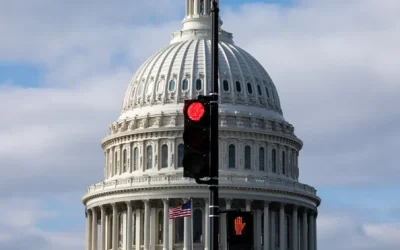
In a surprise move, on August 22nd Donald Trump’s administration and the global technology company Intel announced a deal. In it, the United States government will make an $8.9 billion purchase of Intel stock, giving it around a 10% stake in the company.
Search Results
AI Dirties the Air and Drives Demands for Environmental Justice (Technology Policy Brief #155)
Artificial Intelligence is more ubiquitous in our daily lives than you may realize. It drives the constant stream of personalized ads, instant navigation directions when driving, voice assistants such as Siri and Alexa, shows up first in our Google searches, and much more. The massive data centers powering all that instant intelligence are less visible to those of us who use it the most. But they have become ubiquitous in lower-income communities of color, communities with the least access to high-speed home internet and some of the worst air pollution in the country.
The Week That Was Around The Globe (Foreign Policy Brief #216)
Relatives of people killed by Israeli fire while they were waiting to receive humanitarian aid mourn outside al-Shifa hospital in Gaza City. Photograph: Anadolu/Getty Images
Where Gerrymandering Comes From—and Where It’s Going (Elections & Politics Brief #193)
Gerrymandering began as a nineteenth-century power play in Massachusetts, when Governor Elbridge Gerry signed a state senate redistricting bill whose oddly shaped Essex County district reminded a newspaper illustrator of a salamander. The nickname stuck, and so did the tactic: drawing electoral district lines to advantage a party or faction and to weaken cohesive communities of interest.
Law and Order or Overreach? When Soldiers Become Police (Immigration Policy Brief #191)
As summer draws to an end, President Trump is once again utilizing federal military forces for law enforcement, this time in the nation’s capital. In California, Trump cited immigration protests for the use of the National Guard & ultimately the deployment of U.S. Marines. Now we see the President citing crime & the inability of D.C. Democrats to stop it. President Trump’s coast-to-coast use of federal military force in Los Angeles and Washington, D.C. during 2025 highlights the growing tensions between public safety, constitutional boundaries, and presidential power, raising critical questions about the future of American democracy and civil-military relations.
The Downsizing of Student Learning Assessments (Education Policy Brief #208)
As the Trump Administration carries out its crusade to reduce the size of government, one of the targets has been the Department of Education (DOE). The DOE is made up of a number of agencies and offices that have been severely impacted by these actions, one of which is the Institute of Education Sciences (IES).
The U.S. Government Turns the Other Cheek to Resolving the Israel–Palestinian Conflict (Foreign Policy Brief #215)
Under the Trump administration, U.S. policy has shifted in tone, language, and substance: Washington has openly embraced Israeli priorities while sidelining Palestinian rights and claims. What had long been presented as a balancing act—security guarantees for Israel paired with a rhetorical commitment to Palestinian statehood—has become a policy that favors one side almost exclusively.
Suggestions for the Democratic 2026 Mid-Term Platform
The 2026 mid-term elections offer the Democratic party an opportunity to regain control of the House and Senate. However, Democrats face an uphill battle challenged by Trump policies, anti-Democratic rhetoric, internal divisions, and political maneuvers such as re-districting. To address these challenges the Democratics need to articulate a political platform with issues that resonate with voters. While the need in every race is to prioritize concerns of local communities, a set of party-wide policy priorities that can be adapted to fit local needs would be helpful.
The Texas and California Re – Districting Fight Explained
At the end of July 2025 President Trump suggested that Texas should re – district (or, redraw) their state congressional map prior to the 2026 general election. Trump’s purpose in suggesting a redraw of the map was to add five more reliably Republican districts in Texas. This would likely give the Texas congressional delegation five additional members of the House of Representatives in Washington. Texas Governor Greg Abbott then called a special session of the Texas State Legislature to consider the issue and issue a new map ahead of the 2026 elections.
Duped by Putin for months on end, Trump must now hold the line on Russia (Foreign Policy Brief #212)
Trump’s egregious pre-election claim that he could “end the war in a day” between Russia and Ukraine has instead resulted in Russia’s huge surge of attacks on Ukraine and an increasing number of civilian deaths. While Trump often tries to deflect his responsibility for handling this war onto past U.S. presidents, he is now in fact the commander in chief and must take action to support an ally in Ukraine, help prevent further carnage, and demonstrate American democratic mettle vis-a-vis a ruthless dictator in Putin.