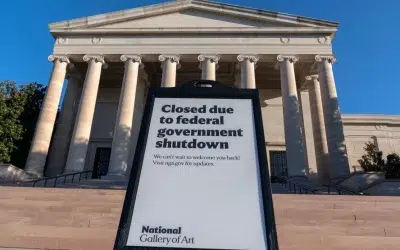
While the full federal government reopened in early 2026, the United States remains in a state of economic volatility due to a lingering partial shutdown of the Department of Homeland Security (DHS), now entering its 67th day.
Search Results
Generational Change
Op Ed | Ron Israel | Managing Editor, USRESIST NEWS | April 19, 2026 Look at the evolution of life in America over the last several generations. I did this recently after my daughter came and asked me how she would be able to live well during her later years, when...
Grindr Hosts Networking Event Ahead of WH Correspondents’ Dinner to Advocate for LGBT Policy Change (Social Justice Policy Brief #190)
LGBT hookup app, Grindr, will host its inaugural White House Correspondents’ Dinner Weekend Party on April 24, one day before the White House Correspondents’ Dinner.
The Week That Was: Global News in Review (Foreign Policy Brief #232)
Iran has vowed retaliation after a US destroyer fired on an Iranian-flagged cargo ship in the Gulf of Oman late last week.
Issues Affecting Democrat Messaging in the Upcoming Midterm Elections (Elections and Politics Brief #204)
With the 2026 midterm general elections approaching, analytics show Democrats rebuilding national attention. Though it is early, special election results, voter enthusiasm and new candidates suggest what some analysts call a possible Democratic “blue wave.”
New York (2026 Democratic Primary Preview Series Brief #19)
New York often sits in the average voter’s mind as a solid blue state, almost as a homogenous Democrat stronghold. With the recent election of Zohran Mamdani as the mayor of NYC, one wouldn’t be faulted for assuming that the rest of the state is skewed towards the left to some degree. Representatives like Alexandria Ocasio-Cortez, House Minority Leader Hakeem Jeffries, and Senate Minority Leader Chuck Schumer lend credence to this impression.
New Jersey (2026 Democratic Primary Preview Series Brief #18)
After the 2024 election there was talk of New Jersey having become a swing state. For the first time since George H.W. Bush, a Republican president, had been within 5 points of taking the state (Trump still lost, however). Before then, almost every presidential election had gone blue by around 14 points.
Space Junk and Corporate Accountability in Orbit (Foreign Policy Brief # 231)
Space exploration has transitioned from a public endeavor driven by international cooperation to a heavily privatized industry dominated by billionaire-backed mega-corporations. At the center of this shift is Low Earth Orbit (LEO), defined by the Inter-Agency Space Debris Coordination Committee (IADC) and NASA as the region of space at an altitude of 2,000 kilometers (1,240 miles) or less. Low Earth Orbit, once viewed as a pristine global commons, is rapidly becoming a celestial dumping ground. The exponential deployment of satellite megaconstellations by private tech monopolies has drastically accelerated the accumulation of space junk, raising profound environmental and safety concerns. While these networks boast of bridging global connectivity gaps, their unchecked proliferation commodifies the orbital environment, prioritizing corporate dominance over the long-term sustainability of the cosmos.
Will the Meta Verdicts Spur Change? (Technology Policy Brief #166)
Do social media companies try to hook children on their products? Do they fail to adequately protect those children from harmful content, predators, and exploitation? Millions of parents would probably agree with the juries in California and Texas that recently answered those questions with a resounding yes. As a result, one young plaintiff was awarded $6 million from YouTube and Meta in one case, and Meta was ordered to pay $374 million in civil penalties in the other. Meta and YouTube have, of course, vowed to appeal. Despite a growing awareness of the risks to children and teens online, new legislation on children’s online safety remains stalled in Congress, and a robust regulatory system is nowhere in sight.
The Removal of the Climate Science Chapter From The U.S. Judiciary’s Scientific Reference Manual (Environmental Policy Brief #164)
In early February 2026, the Federal Judicial Centre removed a chapter explaining climate science from the Reference Manual on Scientific Evidence. Judges used this manual to evaluate scientific testimony in U.S. courtrooms. The removal was prompted after Republican state attorneys argued that the chapter presented climate science in a manner that could influence litigation against fossil fuel companies. The chapter,