

JOBS POLICIES, ANALYSIS, AND RESOURCES
Latest Jobs Posts
Recounts, Lawsuits, and Headaches: How Certification of the Election Could Stall
In 2000, George W. Bush won the election against Al Gore. This was after months of legal proceedings, recounts, and political maneuvers, turning the 2000 election into one of the most controversial in American history.
Ukraine is Borrowing a Strategy from Robert E. Lee. Can it Avoid Pickett’s Charge?
In 1863, the Confederate States of America was in an untenable situation. The Union blockade had suffocated the CSA’s economy. Vicksburg was under siege. Its fall would cut the Confederacy in two along the Mississippi River.
Partisan Echoes & Information Silos: Navigating the Media Landscape of Rural West Texas
More and more, politically aware Americans seem to be having entirely different conversations based on their political affiliations. It’s a running joke in left-leaning media that one would have to frequent fringe message boards like 4Chan or platforms like Truth Social to understand what Trump is talking about.
Mars Exploration: Is It Worthwhile?
Mars exploration offers the tantalizing possibility of extending human life beyond Earth, but the journey to colonize the Red Planet is fraught with immense technical, ethical, and financial challenges. As excitement grows over private ventures like Elon Musk’s SpaceX, critics question whether the pursuit of Mars distracts from addressing the urgent crises facing our home planet.
Female Autocrats: Navigating Power, Gender Bias, and Political Survival
Morgan Davidson uncovers the untold dynamics of female autocrats, exploring how they navigate gender bias and power struggles in authoritarian regimes. With compelling examples from Sheikh Hasina to Catherine the Great, this piece examines how these leaders defy expectations and adopt fierce policies to maintain control.
No More Than a BAND-AID: Instagram’s New Teen Accounts
Meta’s newly launched Instagram Teen Accounts aim to address concerns over online safety, but many argue it’s just a superficial fix. With significant gaps in protection for teens and the onus falling heavily on parents, the platform’s measures may not be enough to shield young users from harassment, discrimination, and predatory behavior.
Situation Update: The War in Ukraine
Ukrainian President Volodymyr Zelensky’s visit to the U.S. aims to secure ongoing support and approval for expanded military actions, including strikes deep into Russian territory. As Ukraine intensifies drone attacks and pushes into the Russian Kursk region, the stakes are rising, with Zelensky urging American leaders to maintain their commitment amid shifting political dynamics and ongoing investigations into Russian war crimes.
Swing States Will Decide the Election: It’s Anyone’s Game
As the 2024 election reaches its fever pitch, the fate of the presidency hinges on just a few swing states like Arizona and Pennsylvania. With razor-thin polling margins, the final days of campaigning could determine whether Harris or Trump secures enough electoral votes for victory.
Tech Wants Kamala – and More!
Kamala Harris’ Silicon Valley fundraising has quickly outpaced Trump’s, despite his early inroads. But these wealthy tech donors have made no secret about what they might want in return, raising alarm bells with watchdog groups.


AI: Is It Worth the Climate Cost?
AI: Is It Worth the Climate Cost?
Technology Policy Brief #113 | By: Mindy Spatt | June 31, 2024
Featured Photo by Indy Silva for U.S. Resist News, 2024
__________________________________
A dire one-sentence warning from the Center for AI Safety reads “Mitigating the risk of extinction from A.I. should be a global priority alongside other societal-scale risks, such as pandemics and nuclear war. It was signed by prominent engineers and executives in the field including Sam Altman, chief executive of Open AI, and Dario Amodei, chief executive of Anthropic. The threat AI poses to the environment wasn’t included, but by all estimates is equally alarming and is already having a huge impact on greenhouse emissions and water use.
Analysis
Google grabbed headlines a few years ago by announcing that it intended to be carbon neutral by 2030. However, a recent company report shows that goal is further away than ever before; emissions last year were 48% higher than in 2019. Tech giants Microsoft and Meta have also reported higher emissions and increased water use. The culprits? Data centers and the rapid rise of Artificial Intelligence (AI).
With that growth, policymakers and researchers are raising critical concerns about the vast amounts of water and energy AI requires, which is growing by leaps and bounds. That’s because data centers consume energy in proportion to their computational workload. Training AI models involves continuous and intricate computations on vast databases using increasingly larger hardware setups. All this energy consumption generates heat, hence the need for vast amounts of water to cool things down.
According to the World Economic Forum, the energy required to power AI is accelerating by up to 36 percent annually. In addition, the “computational power required for sustaining AI’s rise is doubling roughly every 100 days. This means by 2028, AI could be using more power than the entire country of Iceland used in 2021.”
The International Energy Agency estimates the energy use from data centers that power AI will double in just the next two years, reaching 1,000 terawatts, as much energy as the entire country of Japan uses.
These estimates don’t include the additional energy drain of cooling, the amount of which is dependent on where data centers are located; in some locations, it could add as much as 50% to energy use.
The impacts of that energy use also vary. A report by the nonprofit environmental advocacy organization Friends of the Earth (FOE) predicts that absent major changes AI will “only exacerbate environmental injustice. Marginalized communities continue to bear the brunt of climate change and fossil fuel production, and studies are already finding that AI’s carbon footprint and local resource use tend to be heavier in regions reliant on fossil fuels.” FOE’s view is that the risk of misinformation about the climate being created and disseminated by AI is also an urgent concern.
The World Economic Forum and other critics suggest that AI’s negative impacts on the environment can be mitigated by the potential of the technology for innovation in the energy industry including improvements in weather predictions, making smart grids even smarter, and streamlining methods of delivering renewable energy. These arguments are very similar to the ones made by California utilities during the Smart Meter wars of the 2010s when expensive new digital meters were installed over customers’ objections under the guise that the usage data they produced would help consumers use electricity more efficiently and help utility companies avoid wildfires. Neither has proven true.
And in the end isn’t the smartest solution, perhaps the only solution to climate change, to reduce emissions? And the dumbest to increase them?
Alex de Vries, a data scientist in the Netherlands who studies the energy costs of emerging technologies and has critiqued cryptocurrency for its carbon footprint, said in an interview with Scientific American “I think it’s healthy to at least include sustainability when we talk about the risk of AI. When we talk about the potential risk of errors, the unknowns of the black box, or AI discrimination bias, we should be including sustainability as a risk factor as well.”
And he raises the obvious question that other analysts seem to avoid. Do we really need to be using this technology in the first place?
Engagement Resources:
- Friends of the Earth, Artificial Intelligence Threats to Climate Change
- Peter Herweck, Climate Change Won’t Wait for AI — And We Must Not Either, World Economic Forum Annual Meeting Jan 8, 2024
- David Berreby, As Use of A.I. Soars, So Does the Energy and Water It Requires, Feb. 6, 2024
Check out USResistNews.org/AI for more news on Artificial Intelligence policies, technologies, and trends.
Stay in-the-know with the latest updates from our reporters by subscribing to the U.S. Resist News Weekly Newsletter. We depend on support from readers like you to aide in protecting fearless independent journalism, so please consider donating to keep democracy alive today!

Judge Aileen Cannon’s Dismissal of Trump’s Case Ignores Legal Precedent and History
Judge Aileen Cannon’s Dismissal of Trump’s Case Ignores Legal Precedent and History
Civil Rights Policy Brief #228 | By: Rod A. Maggay | July 29, 2024
Featured Photo: www.secure.numero.ai
__________________________________
On Jul 15, 2024, Judge Aileen Cannon of the United States District Court for the Southern District of Florida issued an order granting former President Trump’s Motion to Dismiss Superseding Indictment in the criminal case United States v. Trump. The basis of Judge Cannon’s order is that the appointment of Special Prosecutor Jack Smith to pursue the case against Mr. Trump was in violation of two sections of the United States Constitution – the Appointments Clause and an Appropriations Limitation Clause found in Article One, Section 9 of the Constitution.
Article II, Section Two, Clause Two of the Appointments Clause provides that the President shall appoint all Ambassadors, members of the Supreme Court and all other officers. Additionally, the President is empowered to make all other appointments (usually referred to as “inferior officers”) that are established by law. Article One, Section Nine, Clause Seven of the Constitution refers to funding and while Judge Aileen Cannon mentions that Special Prosecutor Jack Smith’s appointment violated this clause too because of the indefinite period of funding for his activities, she did not rely on it to dismiss the case. She relied only on the Appointments Clause. LEARN MORE
Policy Analysis: In the long history of the use of special counsels and special prosecutor’s in this nation’s history, how did it get to the point where a federal district judge seemingly out of the blue declared them unconstitutional?
It starts with former President Trump’s federal election interference case in Washington, D.C. Trump appealed to the Supreme Court that he had broad immunity for a number of actions he took while President. The Supreme Court issued their landmark decision and made it a point that presidential immunity must distinguish between official acts and unofficial acts before proceeding with a criminal case. Justice Clarence Thomas issued a concurring opinion in the case (not joined by any other member of the Court) that questioned the constitutionality of the appointment of special counsels and prosecutors. Justice Thomas reasoned that if a special counsel is a “principal officer” then he must be appointed by a President and then be confirmed by the Senate, similar to the selection of Supreme Court Justices. If a special counsel is considered an “inferior officer” Senate approval would not be required but a congressional statute authorizing a special counsel would still be needed. Currently, there is no congressional statute on the books authorizing the appointment of a special counsel or special prosecutor. This language in Justice Thomas’ concurring opinion is what Judge Cannon seized on to rule on her motion dismissing Trump’s criminal case.
However, Judge Aileen Cannon may have committed judicial malpractice in her order because of how she ignored legal precedents, even a unanimous prior Supreme Court case. In the 1974 case United States v. Nixon that arose out of the Watergate scandal, the Supreme Court unanimously held that a President had to hand over documents and tapes to a special prosecutor. They also analyzed the appointment of the special prosecutor and found it to be valid under the law at the time. The rule appointing special prosecutors was later changed in the 1990’s and written into Department of Justice regulations with input by members of Congress. However, since Congress did not officially vote to make these new regulations law, the appointment of special prosecutors is viewed in some circles as not legally valid. But other lower court cases have reviewed the appointment of special counsels and held them to be valid – notably in 1987 when reviewing the appointment of a special counsel for the Iran – Contra scandal and in 2019 when reviewing the appointment of Robert Mueller III to investigate ties between the Trump campaign and Russian individuals. However, Judge Cannon has rejected all of these precedents and proceeded to use Justice Thomas’ concurring opinion as the basis for her order dismissing the case.
The amazing thing about Justice Thomas’ concurring opinion in the presidential immunity case was that it was not necessary. Judges and Justices are trained to only rule on the issues before them and only those issues are binding precedent on all other lower courts. But by bringing up the issue of the constitutionality of appointment of special prosecutors, Justice Thomas put the issue out there for other judges and Trump defense attorneys to grasp on. A judge has now decided to use it as the basis for her order and sets up the possibility that other Trump cases will use this issue to delay the case, set up a likely lengthy appeals process and maybe even have other Trump cases dismissed. As disappointing as Judge Cannon’s decision was, Special Prosecutor Jack Smith and his team are now in the process of appealing Judge Aileen Cannon’s order to see if they can have her misguided order overturned. LEARN MORE, LEARN MORE, LEARN MORE
Engagement Resources
- VOA News – history of special counsel investigations.
- PBS – history of special counsels with more analysis of the cases and legal issues involved.
This brief was compiled by Rod Maggay. If you have comments or want to add the name of your organization to this brief, please contact rodwood@email.com.
Stay in-the-know with the latest updates from our reporters by subscribing to the U.S. Resist Weekly Newsletter. We depend on support from readers like you to aide in protecting fearless independent journalism, so please consider donating to keep democracy alive today!

President Biden Drops Out, Vice President Harris Moves In
President Biden Drops Out, Vice President Harris Moves In
Elections & Politics Policy Brief #134 | By: Arvind Salem| July 25, 2024
Featured Photo: www.wpr.org
__________________________________
President Biden, on July 21st, ended his candidacy for re-election stepping down and then endorsing Vice President Harris for the nomination, although the convention is technically open and anyone can win the nomination. Biden promises to address the nation later this week to further explain his dramatic decision.
Biden withdrew over concerns about his mental acuity and repeated polls showing that he was down nationally and that he could drag down-ballot candidates down with him if he remained on the ticket. His poor performance in the debate, a disappointing follow up interview, and continued gaffes, resulted in a cascade of Democratic donors, party insiders, and even grassroots voters calling for Biden’s resignation. Some were so concerned there was speculation about forcing Biden out even with his pledged delegates.
The Democratic party since this withdrawal, has lauded Biden for making the right decision. Yet that leaves the party in disarray just over 3 months until Election Day. Mobilizing the infrastructure and political momentum to beat Donald Trump when he is at his strongest, and the Democratic Party is close to their weakest, will be difficult regardless of the new nominee. If this nominee doesn’t work out, there is no time to replace them.
Analysis:
Vice President Harris has access to the Biden campaign’s millions of dollars in funding, which could prove to be a huge advantage. Additionally, Harris has significant experience as vice-president and has been tested on a national stage, which some other possible replacements (the governors) have not been. Harris also has the advantage of the public backing of Rep Jim Clyburn, who has acted as a kingmaker for the Democratic party, since his support for Biden was crucial in his 2020 primary win.
Extremely strong candidates, such as Governors Whitmer and Newsom, have publicly stated they wouldn’t contest the nomination even if Biden stepped aside. They then publicly endorsed Vice President Harris. A bevy of governors also threw their support behind Harris, including some that were viewed as possible candidates themselves: Pennsylvania Governor Josh Shapiro, Maryland Governor Wes, Illinois Governor JB Pritzker, Kentucky Gov. Andy Beshear, Minnesota Governor Tim Walz (Minn.), Wisconsin Governor Tony Evers. Voices at the top rung of the party have also endorsed Harris, including House Speaker Nancy Pelosi and the Clintons. Notably, President Obama hasn’t yet endorsed Harris, but it is widely thought that is because he is against intervening in the nomination process by principle, rather than having reservations against Harris. Some of those who endorsed Harris, chiefly Andy Beshear and Josh Shapiro, are viewed as strong picks for vice-president.
According to polls Harris is making up ground relative to Biden against Donald Trump, but Trump is still ahead. There is huge variance in these polls, and they tested Harris as a hypothetical nominee, whereas now she is the presumptive nominee. Those polls clearly show that Harris has the potential to beat Trump, whereas Biden towards the end had essentially no chance. The views on Harris tend to be less concrete, meaning she has a lower floor, but a higher ceiling than Biden, and that these next few months will be crucial in shaping her image. This switch also takes away the Republicans chief criticism of the Democrats, which was Biden’s senility, and resets the news cycle to focus on Harris rather than the favorable news coverage towards Trump (Biden’s poor debate performance, failed assisination attempt, and pressure on Biden to withdraw). Harris’s candidacy is also re-energizing the party: she raised a record 81 million in the first 24 hours of her candidacy.
Engagement Resources:
- Harris for President: Readers interested in donating or otherwise supporting Harris’s campaign for President can go to this site to get involved.
- ActBlue: ActBlue allows people to donate to a host of Democratic organizations, candidates, and causes. Readers who want to support the whole Democratic party can visit this website to learn more.
Stay in-the-know! Always get the latest updates from our reporters by subscribing to the U.S. Resist News Weekly Newsletter. Your support is crucial in safeguarding fearless independent journalism. If you appreciate our content, please consider donating today to help protect democracy and empower citizenship.

Trump Got Shot: Is It Time for Another Debate About Gun Ownership Laws?
Trump Got Shot: Is It Time for Another Debate About Gun Ownership Laws?
Social Justice Policy Brief #168 | By: Inijah Quadri | July 25, 2024
Featured Photo: www.cnn.com
__________________________________
The recent attempt on Donald Trump’s life has reignited the intense debate over gun ownership laws in the United States. The attack, involving an AR-15-style rifle, has highlighted the ongoing conflict between gun rights advocates and those calling for stricter gun control measures. The incident has brought to the forefront questions about the adequacy of current gun laws and whether more stringent regulations are necessary to prevent such events in the future.
The AR-15, often a focal point in discussions about gun control, has been involved in several high-profile shootings, raising concerns about its availability to the general public. Gun reform advocates argue that the ease of access to such weapons poses a significant threat to public safety. The debate centers on balancing Second Amendment “ right to bear arms” with the need to protect citizens from gun violence.
Analysis
Gun ownership and control have been deeply divisive issues in American politics. Former President Donald Trump is a staunch supporter of gun rights, receiving endorsements from the National Rifle Association (NRA) and advocating for the protection of the Second Amendment. His administration took steps to loosen certain gun restrictions while focusing on mental health as a factor in gun violence.
Conversely, President Joe Biden has pushed for more stringent gun control measures, including a ban on assault weapons and high-capacity magazines. Biden’s legislative efforts have aimed at enhancing background checks and closing loopholes that allow individuals deemed dangerous to purchase firearms.
The shooting incident at the Trump rally has intensified calls from gun control advocates for renewed legislative action. Organizations like Brady: United Against Gun Violence and prominent activists such as David Hogg continually demand a reassessment of current gun laws, emphasizing the potential for such laws to prevent future tragedies. Studies, such as one from Northwestern University, suggest that an assault weapons ban could significantly reduce the number of mass shootings and casualties.
However, legislative efforts face substantial opposition. The Supreme Court’s conservative majority has made it challenging to enact new restrictions, requiring that any new laws align with the nation’s historical tradition of gun ownership. This interpretation creates a high bar for passing modern gun control measures, complicating efforts to address the issue comprehensively.
The attempt on Trump’s life underscores the urgent need for a nuanced debate on gun ownership laws in the United States. Policymakers must navigate the complex landscape of constitutional rights, public safety concerns, and political realities. While there are strong arguments on both sides, the primary goal should be to develop policies that effectively reduce gun violence while respecting the rights of law-abiding citizens.
Engagement Resources:
- The Giffords Law Center (https://giffords.org/lawcenter/): Provides comprehensive information on gun laws and advocacy for policy change.
- Everytown for Gun Safety (https://www.everytown.org/): Focuses on campaigns to end gun violence and promote safer communities.
- NRA-ILA (https://www.nraila.org/): Defends Second Amendment rights and provides resources for gun owners and advocates.
- Center for Disease Control and Prevention (CDC) – Violence Prevention (https://www.cdc.gov/violenceprevention/firearms/index.html): Offers data and research on gun violence and prevention strategies.
Wanna stay in-the-know? Always get the latest updates from our reporters by subscribing to the U.S. Resist News Weekly Newsletter, and please consider contributing to ‘Keeping Democracy Alive’ by donating today! We depend on support from readers like you to aide in protecting fearless independent journalism.

Who is JD Vance?
Who is JD Vance?
Elections & Politics Policy Brief #133 | By: Arvind Salem| July 25, 2024
Featured Photo: www.cnn.com
__________________________________
After possibly the best month of his political career, complete with heroically surviving assassination and a triumphant debate performance spurring calls for his opponent to leave the race, Donald Trump had one last major political task: selecting a vice-president. Dissatisfied with Mike Pence for his refusal to help Trump overturn the 2020 election, Trump turned to a new candidate, one that has publicly expressed he would do what Pence wouldn’t on January 6th: JD Vance.
JD Vance burst into the spotlight after the publication of his memoir Hillbilly Elegy. The memoir was even taken up by Hollywood and made into a movie. Taken as a narrative, the memoir tells the inspirational story of how J.D. Vance grew up in a poor, broken household yet still managed to rise to the highest echelons of American society. The book was a very product of his rise to this level of society, as it was Yale Law Professor Amy Chua that encouraged Vance to write it in the first place. The book was published in 2016, before Vance would be selected for Vice-President or even win his election to the Senate (which he won in 2022). However, Hillbilly Elegy received backlash from many members of Appalachia as overly critical of Appalachia’s culture and history, and they argued that Vance was using his anecdotal experience to make unsubstantiated, broad statements about Appalachia as a whole. The broader, controversial, argument of Hillbilly Elegy that Vance explicitly states is that culture and laziness are the root cause of poverty rather than uncontrollable economic circumstance. Politically, Hillbilly Elegy became significant as a way to justify Trump’s appeal to formerly blue collar, Democrat industrial towns in 2016, leading to the collapse of the “Blue Wall” in Trump’s victory over Hillary Clinton.
Analysis:
As a person, JD Vance has a deeply inspiring story. However, in terms of policy, JD Vance’s positions represent dangerous chameleon tendencies (also observed by JD’s mentor David Frum, a speechwriter in the George W. Bush administration, who helped Vance early in his career).
There is no clearer example of this, than JD’s position on Donald Trump, where he first called him a “fraud,” “a moral disaster” and “cultural heroin” but then sought Trump’s endorsement in a crowded Republican primary in Ohio and has been one of his loyalists ever since. Since then, he’s mirrored and even extended many of the right’s political positions. In the Senate, he “introduced a bill seeking to establish English as the official national language” and has called for the deportation of “every single person who invaded our country illegally.” On abortion, he’s more extreme than even Trump himself, who wants to leave it to the states, saying that he would support a national abortion ban after 15 weeks. He supports halting aid to Ukraine and cracking down on dissidents at universities.
Some of these positions are well within the acceptable window of common public discourse, namely halting aid to Ukraine, but the root of the problem stems from JD’s obsequiousness towards Donald Trump on issues that should not be in the realm of discussion (such as overturning a democratic election in 2020). Before January 6th, in modern history, there has not really ever been a choice between following a President or protecting democracy. JD made clear that given that choice: he would choose Trump and ask the states to explore multiple slates of electors, which is a power left to the states and not the vice-president: an ironic turn of events for the party of devolution.
Engagement Resources:
- Brennan Center; The Brennan Center for Justice at NYU Law School is an organization that promotes reforms to American democracy and argues against many practices today such as gerrymandering and mass incarceration. Readers who are concerned about the health of democracy in light of this pick may wish to donate to this organization.
- Act for America; Act for America is an organization that seeks to educate and mobilize Americans against foreign and domestic threats, and advocates for bills to achieve these aims. Those who feel that this pick constitutes a breakdown of justice may wish to support this organization.
- ActBlue; ActBlue allows people to donate to a host of Democratic organizations, candidates, and causes. Readers are likely to find organizations that are opposing the Trump -Vance ticket on this site and may wish to donate money to further that cause.
Stay in-the-know! Always get the latest updates from our reporters by subscribing to the U.S. Resist News Weekly Newsletter. Your support is crucial in safeguarding fearless independent journalism. If you appreciate our content, please consider donating today to help protect democracy and empower citizenship.

Political Violence in America: A Troubling Trend
Political Violence in America: A Troubling Trend
Social Justice Policy Brief #167 | By: Morgan Davidson | July 22, 2024
Featured Photo: npr.org
__________________________________
Much has been made about political violence in America, with the most recent event being the assassination attempt on Donald Trump. Was the attempted assassination simply due to recent campaign rhetoric, or is it indicative of a larger issue? From the Congressional Baseball Shooting, racially motivated shootings like in El Paso and Buffalo, the BLM riots, January 6th, and now with the attempted assassination of a former president, the evidence is undeniable that political tensions and violence are on the rise. This Brief covers what political violence is, why it happens, historical and recent trends, what can be done to decrease the threats, and concludes with some final thoughts.
Instances of political violence include verbal intimidation, harassment, physical abuse, property damage, and assassinations motivated by politics. Although verbal violence is less severe than physical violence, it affects political processes and mental health, potentially leading to further violence. Non-physical violence, like the Brooks Brothers Riot, can disrupt political processes. Defining violence this way aligns with how people perceive and experience political violence.
Analysis
When violence occurs in political contexts, it often stems from feelings of distrust, anger, being forgotten, beliefs the government does not care about me, a lack of familiarity with political counterparts or government processes, and viewing violence as a justifiable way to achieve political ends. Political violence is also subject to tit-for-tat episodes and cycles of retaliation. Ending this violence is challenging as in-group members tend to support and perpetuate violence against the out-group.
Historically, much of the political violence in America has been driven by racial tensions, with events such as Bacon’s Rebellion, the Civil War, the Tulsa Massacre, and Jim Crow-motivated assaults highlighting this trend. These tensions persist today, evidenced by shootings in Buffalo and El Paso linked to the far-right’s embrace of replacement theory.
Various factors in the socio-political environment influence acts of political violence, such as encouragement by political leaders, existence of political support groups, and an individual’s motivation and capacity. Political violence can be spawned by so-called support groups and militias. For example, groups such as the Proud Boys and Oath Keepers played prominent roles in the violent insurrection at our nation’s capital on January 6th.
There are growing growing laws and norms that can be used to help curtail political violence, such as hate crime and gun regulation laws, but their effectiveness varies.Outside of legal options to decrease violence, people must understand each other on a personal level and understand how the government works. Returning to where people see their neighbors as neighbors, not partisans, is vital to decreasing violence. Further, fostering a better understanding of government functions and promoting non-violent ways to voice political grievances and drive change can help diminish violence.
Instances like the attempted assassination of Donald Trump provide us as Americans with an inflection point. While polarization will almost certainly plague American democracy for the foreseeable future, there is work that can be done to mitigate the violent effects of hostility and hatred stemming from such steep polarization. If we silo citizens with partisan information, they will be operating under a limited set of facts and views. It is crucial to communicate with and understand the people in your community who may not align with your political identity. We are all Americans and have a vested interest in achieving outcomes together that better all of us.
Engagement Resources:
- The Violence Project researches violence, including political violence, to understand its causes and develop strategies for prevention. https://www.theviolenceproject.org/
- CSIS analyzes and researches political violence, extremism, and related issues, including domestic and international aspects. https://www.csis.org/
- SPLC tracks hate groups and extremist activities in the U.S. and conducts research on political violence and its root causes. https://www.splcenter.org/
Wanna stay in-the-know? Always get the latest updates from our reporters by subscribing to the U.S. Resist News Weekly Newsletter, and please consider contributing to ‘Keeping Democracy Alive’ by donating today! We depend on support from readers like you to aide in protecting fearless independent journalism.

Slowing Down Fast Fashion
Slowing Down Fast Fashion
Environment Policy Brief #171 | By: Allie Amato | July 17, 2024
Featured Photo: hellomackies.com
__________________________________
It takes about 700 gallons of water for the fashion industry to produce one, solitary, cotton shirt. The amount of water used in jean production is even more exorbitant, needing roughly 2000 gallons to churn out just one pair. The reality of fast fashion is that about 87% of these garments ultimately end up in landfills. Clothing manufacturers like Shein, Zara, and H&M are labeled as fast fashion brands due to their quick turnaround of low-cost garments to keep up with the latest trends. These energy-intensive practices come at a high price, creating a significant amount of waste, and polluting the atmosphere, water, and wildlife habitats. Congress, however, is starting to take notice with the conception of the Slow Fashion Caucus, the first-ever effort of its kind. At its helm is House Representative, Chellie Pingree of Maine. In late June, Pinegree announced the caucus, the Democrat saying the aim is to develop “climate-smart policies” to reduce the fashion industry’s outsized consumption of natural resources.
Analysis:
While most industries are highly regulated, the fashion industry goes almost entirely unregulated. Legislation to curb fast fashion has already passed in rare unanimity through the lower house of the French Parliament. On the other hand, the United States has been lagging in terms of public policy. With a topic as polarizing as climate change at the center of this issue, it will likely be an uphill battle for American lawmakers to get the fashion industry in check. Representative Pinegree’s efforts though are backed by notable lawmakers including New York Democrats, Jerry Nadler and Alexandra Ocasio-Cortez. The Slow Fashion Caucus also has the support of sustainable fashion industry leaders, like Patagonia, thredUP, L.L. Bean, and the RealReal. The caucus hopes to jump-start change through incentives and circular economy policies. Considering fashion is one of the world’s biggest manufacturing industries and the second-largest consumer of water, Pinegreen believes brands “have the power to be part of the solution”
On top of excessive water consumption, apparel manufacturers in fast fashion account for as much as 10% of greenhouse gas emissions. The United Nations predicts that by 2030, emissions from textile manufacturing will surge to 6 times that amount. Textiles made using fossil-derived synthetics like polyester shed microplastics too. This pollutes our waterways and leads to marine animals ingesting the non-biodegradable debris. The shedding of microplastics threatens biodiversity for animals in every ecosystem. A circular economy could be a great start, as it promotes the reuse, repair, and recycling of textiles. It’s one of the main principles the Slow Fashion Caucus has adopted in hopes of ensuring less pollution and waste. The Fibers Fund is another backer of the Slow Fashion Caucus. They provide financial support for small American natural textile producers, focused on creating an equitable alternative to fast fashion. The fund’s managing director, Sarah Kelly champions the caucus calling it a “Collaborative action towards an equitable and regenerative textile industry.” A circular economy model would also force the industry’s hand to reduce the strain on egregiously underpaid and overworked garment workers in the global south and beyond.
Among fast-fashion’s biggest players are Temu, Shien, Zara UNIQLO, Forever 21, and H&M. It can be daunting to realize the Earth and its inhabitant’s livelihood relies heavily on the actions of huge, seemingly untouchable companies. Hope remains, as there are ways to play a part in change through voting, supporting environmental organizations, and educating others through climate activism.
Engagement Resources:
- The Ethical Brand Directory features companies that value sustainability and hold themselves accountable for where their garments end up.
- The Climate Reality Project was founded by former Vice President and climate activist, Al Gore. Their goal is net zero and they want to accomplish that through leadership training by renowned scientists and policymakers to help advocates lead the charge in their own communities.
- American Circular Textiles (ACT) is a coalition aiming to reduce textile waste and establish circular fashion policies.

What Should the Democrats Do?
What Should the Democrats Do?
JUNE OP ED | By: Ron Israel & the U.S. Resist News Staff | July 2024
Featured Photo: axios.com
__________________________________
Although some Democrats would like someone else to be their candidate it does not look like Joe Biden wants to step aside. Maybe this is foolish narcissism on his part, but also maybe he has a good case to make for himself. This is what that case looks like.
‣ He has a lifetime of experience in doing this stuff, having worked the front office desks and back alleys of US politics for years.
‣ He delivered more good public policy and programs during his first term than almost any other President in our history. The Pandemic came to an end, millions of new jobs have been created, inflation itself has been greatly reduced, huge public and private investments are being made in clean energy, US semi-conductor industry has been boosted, our alliances with other countries, especially in Europe, have been greatly strengthened, Russia has been stymied in its efforts to conquer Ukraine, China’s expansionist efforts have been largely contained, student debt has been reduced, the price of insulin has been capped, among other things.
‣ Implementing an alternative national primary would stand a good chance of being highly chaotic. There is little time in which to do this and no other candidate comes close to Biden in terms of experience and accomplishments.
‣ Kamala Harris is the only person who conceivably could step in and replace Biden at the top of the ticket, but she is not going to do that unless Biden steps aside. However if Biden wins a 2nd term it is comforting to know that Kamala as VP could take over should something happen to him.
‣ Biden already has the committed delegates he needs to win the Democratic nomination. He also has the support of influential stakeholder groups like labor unions, the Black and Hispanic caucuses, and many state Governors and mayors.
It does not appear that Biden wants to leave, believing that he can make up the current gap between him and Trump before the election. The sooner the Democratic party can accept this and unify behind Biden, the better their chances of winning the election are. Prolonging the Biden/no-Biden debate only plays into the hands of Trump.
This is even more true after the recent attempted assassination attempt on Trump; this incident, among other things reinforces the need for stability in our political system and the upcoming election. To attempt to implement an alternative primary system, as a few Democrats are proposing, would breathe more chaos into an already chaotic situation.
He probably would not like us saying this but Joe Biden has a little bit of Donald Trump stubbornness in him. In addition he has age-old wisdom and experience, an ability to design and implement effective public policy, and a sincere love for his country and its people. He does stutter, occasionally mixes up words, and has an elderly person’s stiff gait. However these afflictions of age don’t come close to outweighing the attributes he brings to this very important election.
Stay informed with the latest insights from our dedicated reporters by subscribing to the U.S. Resist Democracy Weekly Newsletter. Your support is crucial in safeguarding fearless, independent journalism. If you appreciate our content, please consider donating today to continue in helping to protect democracy and empower citizenship.

Global Election Watch
Global Election Watch
Foreign Policy Brief #149 | By: Abran C | July 13, 2024
Featured Photo: latimes.com
__________________________________

The election delivered a chaotic result, with no party taking enough seats for a majority in parliament, plunging French politics into turmoil that could last months. | Carl Court/Getty Images
French Elections
After the shock of the European parliamentary elections that saw far-right parties top polls in several European countries, including France, where the far-right National Rally won 31.5% of the vote, more than twice that of the ruling Renaissance party. President Emmanuel Macron made the decision to call snap parlimentary elections last month. After the voting ended, all parties fell well below the 289 seats needed to control the 577 seat National Assembly. A coalition of the French left won the most seats, beating back a far-right surge but failing to win an outright majority.
The results have left France facing the prospect of a hung parliament and political stagnation. The results showed that in first place, with just over 180 seats, was the New Popular Front leftist coalition; then came the centrist Renaissance party of French President Emmanuel Macron, with more than 160 seats. Finally, the far-right National Rally party and its allies won third place, with more than 140 seats in parliament. Later that day, centrist Prime Minister Gabriel Attal announced his resignation. President Macron said he would not step down and will stay president until his term ends in 2027. Still, the far-right has made considerable gains in France over the years, increasing its seats in parliament from seven in 2017 to over 140 today, and is unlikely to give up its attempt to come to power in the coming years.

Britain’s incoming Prime Minister Keir Starmer and leader of the Labour Party, and his wife Victoria pose on the steps of 10 Downing Street in London on July 5, 2024.
UK Elections
The United Kingdom general elections on July 5, 2024, provided the center left Labour Party with a landslide election victory, bringing the party to power for the first time in 19 years. With far-right parties ascendant elsewhere in Europe, the UK has swung in the opposite direction. For the Conservatives (the Tories) under outgoing Prime Minister Rishi Sunak, it was the worst defeat in their party’s nearly 200-year history. Smaller parties also made gains in this election.
The environmentalist Green Party had its most successful election night winning a record four seats, up from only one in the last parliamentary election in 2019. The far-right, anti-immigrant Reform UK party will enter Parliament for the first time, with five seats and among them, its leader and far-right politician, Nigel Farage, who ran and lost seven times previously. The results represent one of the largest swings in British political history, and a huge defeat for the Conservative Party.

Iranian reformist candidate Masoud Pezeshkian reacts after casting his ballot during the presidential runoff in Shareh Qods, west of Tehran on Friday July 6 2024 Atta Kenare/AFP via Getty Images
Iranian Elections
On July 6, 2024 reformist candidate Masoud Pezeshkian won Iran’s presidential election, besting hard-liner Saeed Jalili. Pezeshkian ran on a platform promising to reach out to the West and ease enforcement on the country’s mandatory headscarf law. After years of sanctions and protests squeezing the country the Iranian population sought to keep a hardliner conservative candidate out of the presidency.
Iranian officials estimate about 30 million people turned out in Friday’s vote, or about 49% of eligible voters, which is considered low for presidential elections in the country. Pezeshkian will face an uphill battle implementing reforms as Supreme Leader Ayatollah Ali Khamenei is the final arbiter of all matters of state in the country.

Narendra Modi, India’s prime minister, greets supporters at the Bharatiya Janata Party (BJP) headquarters during election results night in New Delhi, India, on June 4, 2024. Prakash Singh/Bloomberg via Getty Images
Indian Elections
Early last month, Prime Minister Narendra Modi declared victory for his governing alliance in India’s general election. Modi’s ruling Bharatiya Janata party lost seats to a stronger than expected opposition. The results demonstrate a push back against his mixed economic record, and polarizing nationalist-ethno-religious politics. For the first time since his Hindu nationalist party swept to power in 2014, it did not secure a majority on its own. It instead won 240 seats, far short of the record 303 it won in the 2019 election. That means Modi will need the support of other parties in a coalition. More than 640 million votes were cast in the marathon election held over a span of six weeks in what is referred to as the world’s largest democratic exercise.

Claudia Sheinbaum waves to supporters in Mexico City on June 3. Raquel Cunha/Reuters
Mexican Elections
Mexico on June 2, 2024 elected Claudia Sheinbaum, the former mayor of the capital, as the country’s first female president in the country’s 200 year history. The 61 year old environmental scientist-turned-politician was a protege of Mexico’s outgoing President Andres Manuel Lopez Obrador and will replace him as head of the ruling MORENA party. In October, she will assume leadership of a nation confronting a range of challenges with security issues at its forefront. Sheinbaum’s Morena party also held its majorities in both chambers of Congress.
For more updates, articles, in-depth analysis and weekly reviews on Global News, click here.
Stay informed with the latest insights from our dedicated reporters by subscribing to the U.S. Resist Democracy Weekly Newsletter. Your support is crucial in safeguarding fearless, independent journalism. If you appreciate our content, please consider donating today to continue in helping to protect democracy and empower citizenship.
The Week That Was: Global News In Review
The Week That Was: Global News In Review
Foreign Policy Brief #148 | By: Abran C | July 12, 2024
Featured Photo: latimes.com
__________________________________
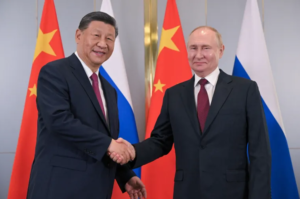
President Xi, left, meets President Putin on the sidelines of the Shanghai Cooperation Organisation summit in Astana [Sergei Guneev/Sputnik via Reuters]
Shanghai Cooperation Organisation Summit
Last week in Kazakhstan’s capital of Astana, the 24th gathering of leaders from the Shanghai Cooperation Organisation (SCO) took place. The SCO is a regional bloc that was founded in 2001, but has grown to greater importance in recent years. The group is made up of China, Russia, Belarus, India, Iran, Kazakhstan, Kyrgyzstan, Uzbekistan, Pakistan and Tajikistan. UN Secretary-General Antonio Guterres, who was visiting Central Asia also attended the summit, showing support for the bloc. Turkey, a NATO member, recently expressed interest in joining the Shanghai Cooperation Organization as a full member. China’s President Xi Jinping and Russia’s Vladimir Putin voiced their ambitions at the summit for closer security, political and economic cooperation between countries of the Eurasian region as a counter to Western alliances.

A man holds up a flag of Kenya as police use tear gas to disperse protesters during a demonstration in Nairobi, Kenya [Monicah Mwangi/Reuters]
Kenyan Protests
Waves of protests have swept through Kenya, triggered by controversial proposed tax hikes, the movement has evolved into a wider campaign for more accountable governance in the country. The protests, dubbed “occupy parliament”, were co-ordinated and mobilized on social media, Kenyan President William Ruto, who at first claimed the protests were illegitimate and orchestrated by criminals, finally gave in and agreed to shelve the contentious tax hike legislation, called Finance Bill 2024, on 26 June.
Despite the win, demonstrators vowed to press on and demand for president Ruto to resign in a wider campaign against his rule under the hashtag “RutoMustGo”. Kenya’s national debt stands at around $80 billion, about three quarters of its annual economic output, and 65% of annual revenue goes to repaying the country’s debt. Most of the unpopular policies fall under a set of reforms that Kenya has agreed to implement with the International Monetary Fund (IMF). Kenya is just the latest country on the continent to have experienced large-scale fallout stemming from the economic pain.

Palestinian schoolchildren stand at the courtyard of a school in the West Bank village of Urif, south of the northern city of Nablus, backdropped by buildings of the Israeli settlement of Yitzhar [File: Jaafar Ashtiyeh/AFP]
Israel Approves Three Settlement Outposts, Thousands of Homes in West Bank
The Israeli government has approved plans to build nearly 5,300 new homes in illegal settlements in the occupied West Bank. The move comes on the heels of the Israeli government having approved the largest West Bank land seizure in more than three decades. The construction of Israeli settlements in Palestinian territory is illegal under international law and settlement expansion is widely seen as a major obstacle to the viability of a Palestinian state.
The far-right Netanyahu administration is itself dominated by settlers. The hard-line nationalist finance minister, Bazalel Smotrich, himself a settler, is in charge of settlement policy and has said his rapid expansion drive is in intended to ensure a Palestinian state cannot be created. In an escalation over past months, settlers have carried out more than 1,000 attacks on Palestinians towns and villages, causing deaths, damaging property and in some cases prompting Palestinians to flee villages.
![Damaged houses and building along the shore are seen in a drone photograph after the passage of Hurricane Beryl, on the island of Carriacou, Grenada [Arthur Daniel/Reuters]](https://www.usresistnews.org/wp-content/uploads/2024/07/Screenshot-2024-07-12-193928-300x181.png "The Week That Was: Global News In Review 9")
Damaged houses and building along the shore are seen in a drone photograph after the passage of Hurricane Beryl, on the island of Carriacou, Grenada [Arthur Daniel/Reuters]
Mexico and Caribbean Battered by Hurricane Beryl
Last week Hurricane Beryl swept through Jamaica, Grenada, Saint Vincent and the Grenadines, northern Venezuela, and Mexico. While passing through the Caribbean the storm left at least eleven people dead in its wake before then making its way to Mexico’s Yucatan peninsula where it then moved into the Gulf of Mexico and, where it is forecast to take a path toward Mexico and southern Texas. The Hurricane reportedly damaged or destroyed a staggering 95% of homes on a pair of islands in St Vincent and the Grenadines. This storm has been recorded as the fiercest storm ever this early in the Atlantic hurricane season, a new reality scientists say has been fuelled by climate change.
For more updates, articles, in-depth analysis and weekly reviews on Global News, click here.
Stay informed with the latest insights from our dedicated reporters by subscribing to the U.S. Resist Democracy Weekly Newsletter. Your support is crucial in safeguarding fearless, independent journalism. If you appreciate our content, please consider donating today to continue in helping to protect democracy and empower citizenship.