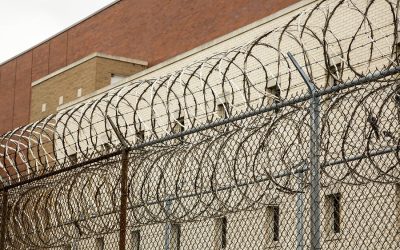
One of the most fundamental aspects of a fair and just legal system is the ability to challenge one’s detention, often referred to as “habeas corpus”. Habeas corpus is an old but crucial pillar of justice, dating back to the 13th-century Magna Carta, which stated that “No man shall be arrested or imprisoned…except by the lawful judgment of his peers and by the law of the land.”

Search Results
The Prison-Industrial Complex: Profiting Off Punishment in America (Economic Policy Brief #85)
The prison-industrial complex (PIC) in the United States represents a deeply entrenched system where incarceration is commodified, intertwining the interests of government agencies and private enterprises. This nexus has transformed the U.S. criminal justice system into a profit-driven enterprise, often at the expense of marginalized communities.
The Little Covered Big War in Congo and Rwanda (Foreign Policy Brief #201)
To the average westerner, and especially to Americans, the African continent seems to be politically and economically monolithic. One could recall instances where an interviewed passerby on Jay Leno or Jimmy Kimmel’s show would refer to Africa as a country. This point of view makes the western public less capable of discerning and debating foreign policy as it relates to Africa. Therefore, it is the mission of this brief to inform readers of an infamous armed group that has made headlines for its brutality and human rights abuses, but whose history and status remain vague in the casual reader’s news feed: M23.
The Department of Justice Voting Section’s Shift In Priorities
A number of news outlets have recently reported that the United States Department of Justice’s (DOJ) Civil Rights Division Voting Section has changed their mission statement and its priorities.
The Growing 2025 Anti-Trump Protests: Hands Off, No Kings Day, and More
In just over 100 days of Trump 2.0, a reinvigorated Democratic opposition has taken shape. AOC and Bernie have been headlining rallies across the country. Cory Booker broke the record for the longest filibuster in Senate history. Beto O’Rourke is back on the road, holding town halls across Texas. Together, along with others, they’re making it clear: the fight is on. These examples all show how Democrats are fighting against the actions of the Trump administration, raising awareness around the authoritarian tendencies of the administration, & importantly testing the waters for potential runs.
Israel’s Use of AI in Gaza Sparks Protest at Tech Companies in the U.S.
The Israeli military uses Artificial Intelligence to find and target Hamas fighters, but with a civilian death toll estimated at 52,000, critics allege the system is not reliable and may even be providing cover for widespread bombing and ethnic cleansing. And that US companies are complicit.
American Policy in Africa: US Retreats as China Advances
On 22 April, Secretary of State Marco Rubio revealed plans to reorganize the State Department with the justification of increasing efficiency, rooting out ‘radical political ideology’, and delivering Trump’s foreign policy agenda. The details of the plan focus on reducing the size of the State Department and its budget over time: consolidating regional bureaus and embassies, shutting down redundant offices, and ending non-statutory programs that the administration determines to be irrelevant to American interests.
Old Growth Forest Policy Made at the 19th Hole (Environment Policy Brief #180)
Through an Executive Order issued March 1, 2025, there is to be an expansion of American timber production that meets goals to achieve “sound forest management, reduce time to deliver timber, and decrease timber supply uncertainty.” Approximately 100 million acres, the equivalent of 60% of our national forests, are to be within earshot of a chainsaw. In so doing, the Trump administration declares this a “new era” in national forest management. Legally protected forest land and parts of old growth forest are slated be part of the expanded production.
A Primer on Political Interest Groups
Political interest groups play a central role in shaping policy in the United States. From corporate-funded lobbying arms to grassroots-driven caucuses, these groups influence electoral outcomes, legislative priorities, and public discourse. Their power lies in their ability to mobilize voters, fund campaigns, and set political agendas, often behind closed doors. The disproportionate influence of wealthy donors and elite organizations has made representative democracy more vulnerable to manipulation, with policies reflecting corporate interests rather than the public good. Understanding these interest groups is essential not just to map where power lies, but to challenge it.
Danger in Economic Uncertainty: A Lesson From Trump’s Tariff Policies
The dust is still being settled a month after the U.S. President Donald Trump’s “Liberation Day.” He was never coy about his desire to wield tariffs to achieve his geopolitical goals. Both in his previous administration and on the campaign trail, he promised that they are the way to rebuild American manufacturing and repair trade imbalances.