Montana’s 2026 election cycle remains an uphill battle for Democrats in a state that has consistently favored Republicans in federal races. Still, Democrats are fielding candidates in both U.S. House districts and the U.S. Senate contest, aiming to compete through grassroots organizing, rural outreach, and working-class economic messaging in hopes of improving margins and testing the state’s political trajectory in a midterm year.

Search Results
2026 Democratic Primary Preview Series: Michigan (Brief #16)
Michigan will be one of the most competitive Democratic Senate primaries of the 2026 cycle following Senator Gary Peters’ decision to retire and not run for re-election. As a battleground state that has flip-flopped in recent federal elections, Michigan’s Senate seat is a top priority for the Democrats. In order to win, Democratic nominee will need to garner support from the party’s urban voter base, perform well in suburban areas, and furthermore perform well with working-class voters all across the state.
2026 Democratic Primary Preview Series: Maine (Brief #15)
Shifting to the Pine Tree State, Maine features one of the most consequential Senate races for Democrats in 2026, alongside two U.S. House contests. The primary will be June 9th followed by the general on November 3rd.
2026 Democratic Primary Preview Series: Kentucky (Brief #14)
In Kentucky, the Bluegrass State, voters will decide one U.S. Senate race and all six U.S. House seats in 2026. The marquee contest follows the retirement of Mitch McConnell, ending decades of Republican leadership in Washington. McConnell’s tenure included serving as Senate Majority Leader and playing a central role in shaping the modern federal judiciary. His relationship with former President Donald Trump deteriorated following the January 6th attack on the U.S. Capitol, limiting his standing within the party’s populist wing, but his institutional influence remained significant through the end of his career.
The Expanding Web: ICE Detention and the Machinery of Mass Removal (Social Justice Policy Brief #188)
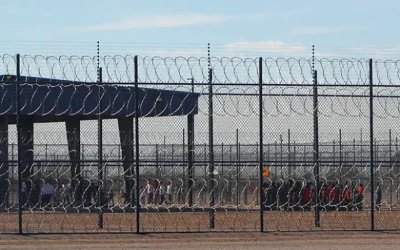
The American immigration detention system is currently undergoing an unprecedented and rapid metamorphosis, transitioning from a network of civil holding centers into a massive carceral apparatus designed for industrial-scale deportation. As of February 2026, the number of individuals held in U.S. Immigration and Customs Enforcement (ICE) custody has reached a historic peak of over 70,000 people across 225 facilities nationwide. This surge represents a nearly 75 percent increase in the detained population since early 2025, fueled by the staggering 45 billion dollars in ICE funding authorized under the signature One Big Beautiful Bill Act. The administration’s current strategic roadmap aims to bring upwards of 108,000 detention beds online by the end of this year, with a long-term capacity target of 135,000 beds to facilitate the largest mass removal operation in the history of the United States.
Blue States Initiate Legal Pushback After Administration Overturns Endangerment Finding (Environment Policy Brief #190)
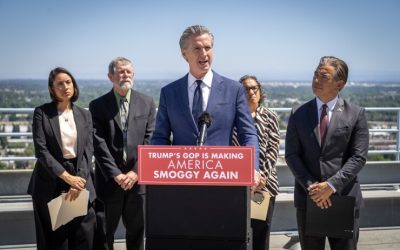
Federal climate regulation is at risk as the U.S. Environmental Protection Agency (EPA) rescinded the 2009 “endangerment finding” on February 12, 2026. The EPA called the engagement finding “the single largest deregulatory action in U.S. history.” States like California and Wisconsin, as well as several organizations, are preparing for a legal battle that could eventually reach the Supreme Court, which could take years. They argue that the U.S. could be left with far less ability to regulate emissions at a national level.
Dangers lurk as Zeldin repeals EPA’s endangerment finding (Environment Policy Brief #189)
Scientists first suspected a link between greenhouse gases and climate in the mid-19th century. Swedish scientist Svante Arrhenius won the Nobel Prize in chemistry with calculations in 1897 that linked burning coal to global warming. From that time onwards, scientists took up studying this linkage with better tools, more resources, and coordination.
JD Vance Blames the Victims (Elections & Politics Policy Brief #203)
Long before Vice President JD Vance shrugged off the killings of American civilians Immigration and Customs Enforcement (ICE) agents in Minneapolis, he had already established his brutal pattern of showing remorselessness for the victims. But with the senseless and savage killings of Good and Pretti, Vance has gone even lower to actively blaming the victims, and pushing baseless claims about them to absolve their killers.
Trump Government Suspends Childcare Funds for Five Democrat-led States (Social Justice Policy Brief #187)
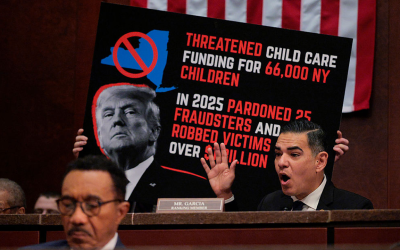
Social Justice Policy Brief #187 | Yelena Korshunov | February 23, 2026 About 170 years ago, Frederick Douglass proclaimed that “it is easier to build strong children than to repair broken men.”Few would argue with the idea that a child growing up in a family in...
The Beijing Summit: Global Capital, Nationalist Rhetoric, and the Future of U.S.–China Coexistence (Foreign Policy Brief #227)
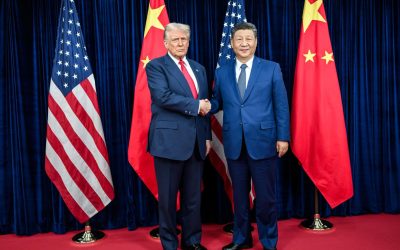
As the global community enters the second quarter of 2026, the geopolitical landscape is dominated by the upcoming summit between President Donald Trump and President Xi Jinping, scheduled for the first week of April in Beijing. This meeting follows a period of extreme volatility in bilateral relations that defined the first year of the second Trump administration. Throughout 2025, the relationship was characterized by a reignited trade war, with the United States imposing aggressive reciprocal tariffs that at times reached triple digits on Chinese imports. These measures were met with targeted Chinese retaliation, including boycotts of American agricultural products and export controls on rare earth minerals. However, a significant turning point occurred in October 2025 during a meeting in Busan, South Korea, where both leaders agreed to a one-year trade truce. This temporary reprieve rolled back the most punitive levies and led to a resumption of Chinese purchases of American soybeans and energy, providing a fragile stability that the April summit seeks to formalize and extend.