U.S. Resist NewsKeeping Democracy Alive: A Mission We Take To Heart

Europe Is Getting Hotter (Foreign Policy Brief #233)

Florentines say July has been unusually hot this year. Outside, temperatures climb to 105 degrees Fahrenheit. It is not much cooler indoors. Tommaso, the son of the woman who owns the apartment where we are staying, says summers seem to be getting hotter every year. The heat is impossible to ignore. Inside the Uffizi Gallery, the air feels heavy and the temperature is high. Because of the oppressive heat, the museum is closing for two days to visitors without advance reservations. Standing among some of the world’s greatest masterpieces, I find myself wondering how the collection is protected under such conditions. Can extreme heat really have no effect on paintings that have survived for centuries?

Efforts At Governance Across AI, Digital Privacy, and Cryptocurrency (Economic Policy Brief #196)

The unchecked expansion of multinational technology conglomerates across artificial intelligence, digital privacy, and cryptocurrency represents a critical threat to public sovereignty, labor rights, and ecological stability. These interconnected domains function as a new frontier of extractive capitalism, demanding urgent international democratic governance to rein in tech monopolies that treat personal data as raw material and planetary resources as expendable. This systemic crisis stems from a deliberate business model designed to outpace legislative oversight, concentrating unprecedented wealth and structural power into the hands of a few unaccountable corporate executives and speculative investors.

Palantir’s Intrusive Technologies Infringe Upon Our Liberties (Technology Policy Brief #170)

Palantir Technologies Inc. is an American software company that builds large-scale data integration and analytics platforms for government agencies, military branches, and commercial businesses. Palantir’s technology lies at the heart of the government systems that enable mass surveillance and militarization at home and abroad, and is now moving into healthcare.  The profits go to founder Peter Thiel and CEO Alex Karp, tech oligarchs who spend millions to promote a political agenda that favors free-market policies and increasingly supports Republican candidates and Trump-aligned PACs.  Protests and public acrimony are growing.

Understanding China’s Foreign Policy (Foreign Policy Brief #232)

Foreign policy is a collection of goals, strategies, and actions that a government uses to guide its relationships with other countries and international organizations. Such goals include national security, economic prosperity, global stability, and values promotion. China’s foreign policy seeks to advance all of these goals using the tools of diplomacy, economic measures, military power and soft power (sharing a nation’s culture, values, and media to build good will and influence opinions).

A Private Mercenary Force Takes Over In Haiti (Foreign Policy Brief #234)

A private American mercenary company is now running a large share of Haiti’s fight against its own gangs, operating drone strikes, raids, and intelligence gathering under a contract the government has never made public.

Week That Was: Global News in Review (Foreign Policy Brief #233)

The US war on Iran has now passed the six-month mark, negotiations have been abandoned and last week saw renewed fighting with Tehran attacking American bases across the Middle East. This came after a US strike was alleged to have hit a home hosting a wedding event, killing five people and wounding dozens. Washington  also launched a new aggressive economic pressure campaign and blockade to coerce Iran into submission. Tehran on its part is now threatening military escalation and a wider war.  The head of Iran’s National Security Council said recently that Tehran is planning to announce a maritime “exclusion zone” outside the Strait of Hormuz where it intends to stop vessels attempting to transit the waterway without Iranian permission.  The conflict currently appears to have no likely end  in sight.

Stalemate in the Russia-Ukraine War (Foreign Policy Brief Brief #231)

The ongoing war in Ukraine seems to have slipped into the back of collective consciousness. If the war enters the news cycle it’s usually new footage of the sides trading missile and drone attacks on energy infrastructure, weapon factories, or apartment buildings.

Changing Attitudes Toward Israel and AIPAC (Technology Policy Brief #167)

As Israel’s attacks on the Palestinian people draw international condemnation, its support among US voters is shrinking, and with it the influence of the American Israel Public Affairs Committee (AIPAC), the wealthy and powerful pro-Israel lobbying organization.  AIPAC’s backing, once crucial to candidates, is no longer a sure path to election and in some progressive districts is becoming a liability.

Trending Now

Generational Change

Op Ed | Ron Israel | Managing Editor, USRESIST NEWS |  April 19, 2026 Look at the evolution of life in America over the last several generations. I did this recently after my daughter came and asked me how she would be able to live well during her later years, when...

Featured Articles

The Summer of Wildfires Part 1: The U.S. (Environmental Policy Brief #166)

So far this year, over 45,000 wildfires have burned more than 12 million acres across the U.S. and Canada, and it’s only July. The U.S. has seen more wildfires so far this year than any January to July in the past decade. The ever-worsening climate crisis increases the risk of wildfires, the length of wildfire season, and limits responders’ ability to contain the fires.

United States Supreme Court Upholds Mail Ballot Receipt Grace Periods (Civil Rights Policy Brief #254)

Civil Rights Policy Brief #254 | July 5, 2026 | Rodney A. Maggay Policy Summary: In 2024 prior to the United States elections the Republican National Committee and the Trump Campaign filed numerous legal challenges that sought to invalidate mail voting ballot receipt...

Efforts At Governance Across AI, Digital Privacy, and Cryptocurrency (Economic Policy Brief #196)

The unchecked expansion of multinational technology conglomerates across artificial intelligence, digital privacy, and cryptocurrency represents a critical threat to public sovereignty, labor rights, and ecological stability. These interconnected domains function as a new frontier of extractive capitalism, demanding urgent international democratic governance to rein in tech monopolies that treat personal data as raw material and planetary resources as expendable. This systemic crisis stems from a deliberate business model designed to outpace legislative oversight, concentrating unprecedented wealth and structural power into the hands of a few unaccountable corporate executives and speculative investors.

read more

Corporate Greenwashing of the Environmental Practice of Regenerative Agriculture (Economic Policy Brief #195)

Industrial agriculture remains a primary driver of ecological degradation and greenhouse gas emissions, pushing communities toward the brink of climate collapse. In response, regenerative agriculture has emerged as a proposed pathway for climate adaptation. Historically rooted in Indigenous land stewardship, genuine regenerative practices prioritize holistic soil health, biodiversity, and ecosystem restoration over maximum yield. These methods aim to adapt to changing climate realities by building resilient landscapes capable of withstanding extreme weather events while sequestering carbon.

read more
US Resist Logo 2022 White

Keeping Democracy Alive

US Resist Logo 2022 White

Keeping Democracy Alive

A Preview of Supreme Court June Cases (Civil Rights Policy Brief #253)

A Preview of Supreme Court June Cases (Civil Rights Policy Brief #253)

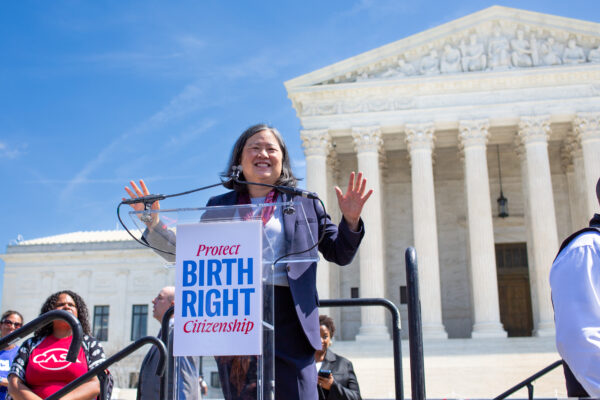
President Donald Trump may have gotten what he most wanted from the U.S. Supreme Court when it ruled on July 1, 2024 – by a 6-3 vote – that former presidents have absolute immunity from criminal prosecution by, essentially, being president. Trump named three justices to the high court during his first term in office – Neil Gorsuch, Brett Kavanaugh and Amy Coney Barrett – and all three ruled in his favor in Trump v. United States (Barrett in part). The latest raft of major SCOTUS rulings, due next month, may continue to largely meet with Trump’s approval, or at least conservative priorities, but by no means is the court’s October 2025 term, as it’s officially known, likely to be a slam dunk for the right.

read more
donation

Reporter Spotlight

Journalist of the Month - November 2024

Mindy Spatt, a published essayist and freelance journalist, has written for publications including the San Francisco Chronicle and Lambda Book Report. Her background includes legal editing and union organizing, and she served as Communications Chief for a California nonprofit advocating for fair energy and telecom policies.

x
x
Support fearless journalism! Your contribution, big or small, dismantles corruption and sparks meaningful change. As an independent outlet, we rely on readers like you to champion the cause of transparent and accountable governance. Every donation fuels our mission for insightful policy reporting, a cornerstone for informed citizenship. Help safeguard democracy from tyrants—donate today. Your generosity fosters hope for a just and equitable society.

Pin It on Pinterest