
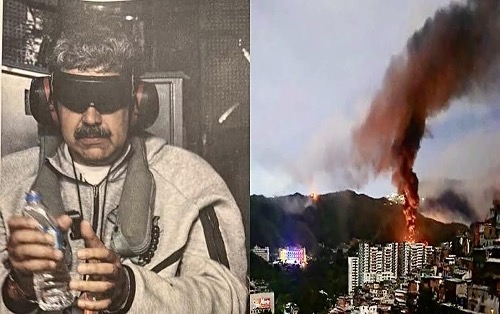
In the early hours of Jan. 3, 2026 the United States carried out an attack in Venezuela that saw the removal and capture of Venezuelan President Nicolas Maduro. The incursion followed months of military operations in the Caribbean Sea, targeting small boats and oil tankers along the Venezuelan coast. The operation dubbed, Operation Absolute Resolve, saw US forces enter Venezuelan territory, carry out strikes on military sites around the country and in the capital Caracas. Nicolas Maduro and his wife, Cilia Flores, were taken by US forces from Fuerte Tiuna, the country’s largest military complex. Maduro was first flown to a US military base and then transported aboard the USS Iwo Jima, which brought Maduro and his wife to a detention centre in New York, where he is being held and indicted on charges of narcoterrorism and conspiracy to import cocaine into the United States.
How did we get here?
Back in his first term, Donald Trump sought to replace Maduro by recognizing Juan Guaidó, the leader of the opposition-led National Assembly in Venezuela, as the new replacement president of the South American country. Ultimately there was little international support for Guaidó and the attempt to replace Maduro proved ineffective. Now in his second term, Trump and his administration switched gears to military action. Beginning in August 2025, the US began deploying Navy destroyers, along with thousands of military personnel, to the edge of Venezuelan territorial waters claiming to be attempting to thwart drug trafficking.
Beginning in September, 2025 the Trump Administration began strikes on more than 30 boats that killed at least 115 in the Caribbean and the Pacific alleged to be transporting drugs to the US. In November 2025, the administration designated Maduro as the head of what it called the “Cartel de los Soles” as a terrorist organisation. In December 2025, The US seized an oil tanker off the coast of Venezuela after the ship left that country with about 2 million barrels of crude. The culmination of months of pressure and use of the military force resulted in the US invading Venezuela and forcefully removing Maduro from the country.
Domestic and International reactions
Domestically, once disapproving of using the US military to invade Venezuela, the vast majority of Republicans, at least 78% per a recent Yougov poll, now say they approve of President Trump’s military action and the capture of Nicolas Maduro. In contrast just 14% of Democrats supported the military invasion of Venezuela. Democratic leaders responded with anger to the Trump administration’s military intervention in Venezuela, with multiple members of congress slamming it as an illegal act carried out in the absence of required congressional approval. On January 8, 2025, the Senate backed the War Powers Resolution with a vote 52-47, to curb President Donald Trump’s ability to carry out further military action against Venezuela without congressional approval. Several senators claimed they felt misled by earlier briefings in which administration officials suggested they did not intend to carry out strikes on Venezuelan territory.
International reaction to the incursion into Venezuela has also been mixed but largely negative. Many Latin American leaders have condemned the US actions. Brazil’s President Luiz Inacio Lula Da Silva said that the actions “cross an unacceptable line… and were a flagrant violation of international law”. Colombian President Gustavo Petro called the strikes an “assault on the sovereignty” of Latin America. Chile’s President Gabriel Boric expressed “concern and condemnation”. Cuban President Miguel Diaz-Canel accused the US of a “criminal attack”. Mexican President Claudia Sheinbaum characterized the attack as an “unacceptable violation of Venezuelan sovereignty”.
The Chinese Foreign Ministry said in a statement that it was “deeply shocked” by what it described as a “blatant use of force against a sovereign state and action against its president”. A statement from The United Nations said it was “deeply alarmed” by the US attacks and capture of Maduro, suggesting it violated international law. In contrast, the US’ European allies did not express condemnation but straddled the fence, instead calling for a transition of government in Venezuela. EU foreign policy chief Kaja Kallas said that , “the EU has repeatedly stated that Mr Maduro lacks legitimacy and has defended a peaceful transition”. French President Emmanuel Macron said he “neither supported nor approved” of the US military operation and stated Frances’ readiness to support a transition.
What Happens Now?
Nicolas Maduro and his wife have pleaded not guilty in court appearances in New York on January 5, 2026. They remain in US custody, with the next court hearing set for March 17, 2026. As of time of writing, the government in Venezuela remains the same. The country’s Vice President, Delcy Rodríguez, was sworn in as Venezuela’s interim president on Jan. 5. Rodríguez, a longtime Maduro ally and oil minister, has received the public backing of the Trump Administration for the time being. Although Trump threatened that she would pay a very heavy price, if she does not comply with US demands. It is unclear whether the new Venezuelan President will play along with the United States, and if she does not, will the Trump administration be willing to engage in a longer-term war in order to achieve their aims.
Trump has held meetings with oil executives and suggested that his administration could subsidize US oil companies moving into the country. Additionally, following the operation in Venezuela, the Trump administration has redirected its attention to Cuba. Donald Trump has urged Cuba to “make a deal” or face dire consequences, and warned that the flow of Venezuelan oil and other aid would stop, leaving the already difficult situation to grow even worse. Cuban leader Miguel Diaz-Canel stated that his government will stand against US threats. “Nobody tells us what to do… Cuba is prepared to defend the homeland until the last drop of blood” he said.
The Trump administration in recent weeks has expressed its interest in further regime change and territorial expansion. Along with intervention in Venezuela and Cuba, the Trump administration and allies have made comments on possible strikes in Colombia and Mexico, seeking regime change in Iran and acquiring Greenland, whether forcibly or otherwise. The administration’s attempt at intervention involves a more quick actioned “in and out” style of military force rather than full scale invasion. That may be more of what we see occur in the other countries where military action is being discussed, and it also demonstrates the administration’s understanding of how unpopular new multiyear wars are with the American public. Yet it appears likely the US will engage in further military conflicts in 2026, the newly dubbed “Donroe Doctorine” all but guarantees it.