

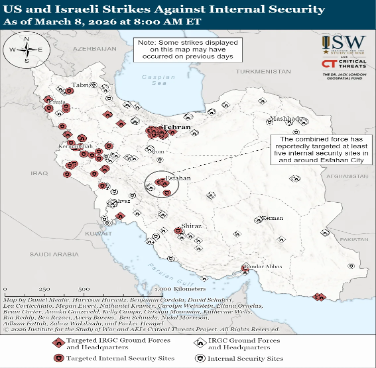
US-Israel War With Iran
On February 28 2026, Israel and the United States engaged in joint attacks on Iranian territory, far larger and more devastating in scale than the first direct attacks on Iran in June 2025. Secretary of War, (Defnse) Pete Hegseth has said the US is only “accelerating, not decelerating” its war on Iran, with more assets heading to the region as the conflict ricochets from Dubai, to Saudi Arabia, Turkey to Sri Lanka where an Iranian ship was recently sunk using torpedoes. The UK, France, and Germany recently made statements indicating that they could join in the war, reportedly taking steps to defend both their own and allied interests in the region by “enabling necessary and proportionate defensive actions to destroy Iran’s capability to launch missiles and drones”. Iran has warned Europeans against joining the conflict or taking military actions against it.
Over the course of two weeks the war has escalated dramatically. Over 1,300 people in Iran have been reported killed as a result of US-Israeli attacks. At least seven American soldiers have been killed in the war thus far, with Iran claiming the true number of Americans killed at over 500. Iran recently named a new supreme leader, Mojtaba Khamenei, just over a week after his father, Ayatollah Ali Khamenei, was killed in US-Israeli strikes. Mojtaba Khamenei was selected as the third leader of the Islamic Republic by Iran’s Assembly of experts. President Donald Trump stated that any choice made without his approval would be “unacceptable” and that he wanted to be involved in choosing the new supreme leader of the country. This now regional war, which has the potential to become a global conflict, is only two weeks old but has seen escalations not seen in any previous wars in the region. Israeli Prime Minister Benjamin Netanyahu recently made statements, promising “many surprises” for the next phase of the conflict.
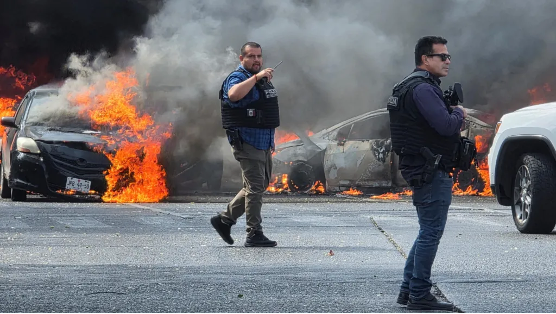
Cars burn in Zapopan, near Guadalajara, after El Mencho’s death on Sunday, 22 February, 2026
Violence in Mexico
https://www.bbc.com/news/articles/c1jkw18e19jo
In a recent operation, the Mexican military in coordination with US intelligence, killed Nemesio Oseguera Cervantes “El Mencho” the leader of the Jalisco New Generation Cartel (CJNG). The operation was carried out on Feb. 22 in Tapalpa, Jalisco. What followed was not surrender but a furious wave of retaliation that targeted multiple cities, roads and airports across at least 20 Mexican states. Armed cartel members torched vehicles, ambushed security forces, killing at least 25 National Guard troops in the first days alone. With the backdrop of the World Cup which will be co-hosted by Mexico later this summer, as well as a group of qualifiers in late March, questions have arisen over the safety of fans who are set to soon visit the country. President Claudia Sheinbaum has sought to reassure the public, stating that the situation was under control. Security forces remain on high alert, particularly in Jalisco and Michoacán, where cartel influence is strongest.
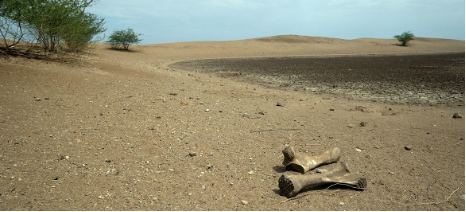
© UNCCD/Mwangi Kirubi Elephant bones lie by a dried-out water source in Turkana County in the north of Kenya.
UN Declares Global Water Bankruptcy
The United Nations University Institute for Water, Environment and Health issued a major report for 2026. The report declares that for the first time in recorded history, the planet has entered an era of Global Water Bankruptcy. Nearly three-quarters of the world’s population lives in countries classified as water-insecure or critically water- insecure. Around the world groundwater now provides about 50% of global domestic water use and over 40% of irrigation water, tying both drinking water security and food production directly to rapidly depleting aquifers. Tshilidzi Marwala, UN undersecretary general, said: “Water bankruptcy is becoming a driver of fragility, displacement and conflict. Managing it fairly is now central to maintaining peace, stability and social cohesion”. The report calls for a fundamental reset of how water is protected and used around the world.
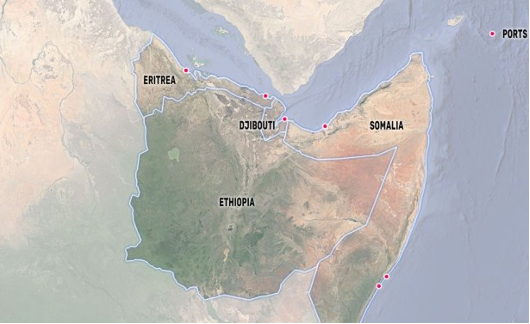
VOA. A map of ports in the Horn of Africa. Peace with Eritrea could give landlocked Ethiopia more access to the Red Sea.
Ethiopia-Eritrea War
https://allafrica.com/view/group/main/main/id/00095085.html
Ethiopia and Eritrea both say they are preparing for the possibility of war. Landlocked Ethiopia claims it needs access to the Red Sea and its claims are seen as a provocation by Eritrea. In 1993, Eritrea broke away from Ethiopia after a series of insurgencies and wars starting in 1961. The two countries went to war against each other from 1998 to 2000, which was then followed by a border conflict that lasted for nearly two decades. In 2018 in an agreement that won Ethiopian Prime Minister Abiy Ahmed the Nobel Peace Prize, the two countries agreed to normalize relations.
The tension between the two countries stems from the geographical loss Ethiopia suffered from Eritrea’s independence which resulted in Ethiopia losing its access to the Red Sea. Now Eritrea’s President Isaias Afwerki recently claimed in an interview that once again Ethiopia was carrying out a war against his country. Ethiopia in turn claims that Eritrean troops have entered border areas in its embattled Tigray region, raising concerns about a return to full scale war in the horn of Africa.