
Summary
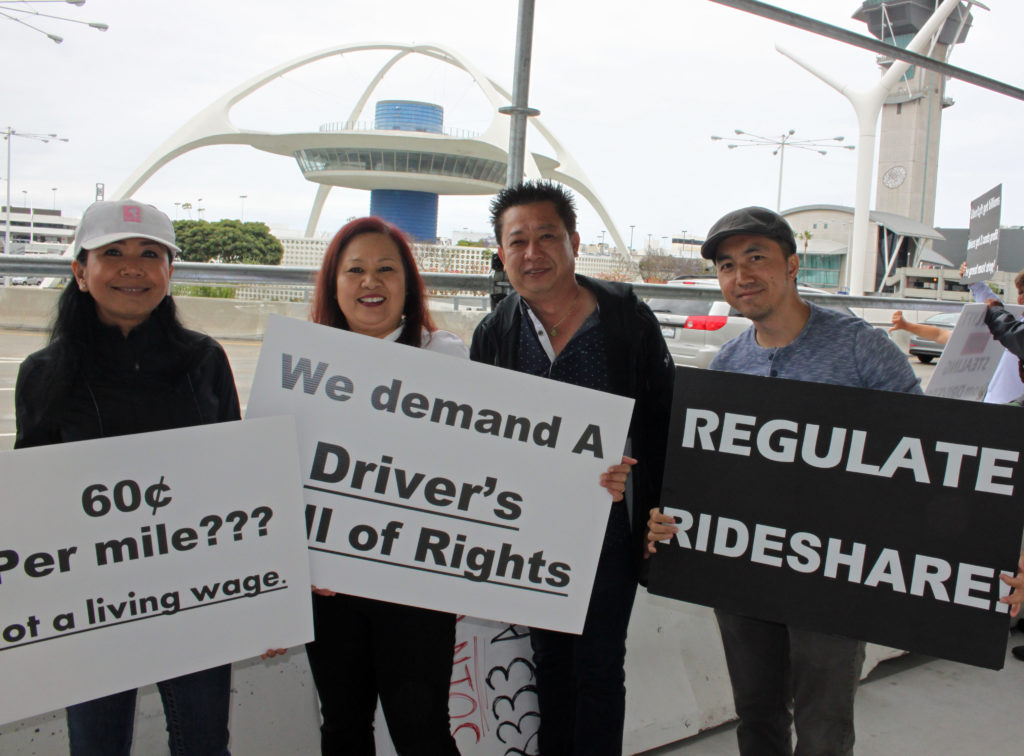
When Uber and Lyft came on the scene, taxi drivers protested vociferously. Now it’s the rideshare drivers protesting, as their earnings go down and the threat of autonomous vehicles looms. Organizing by rideshare drivers has had some success, but how effective hard-won changes will be remains to be seen. Workers scored an apparent victory in securing collective bargaining rights in California. But a similar law in Massachusetts has yet to yield results and the California law was a compromise that included enormous giveaways to the companies.
Analysis
The news is mostly bad for Uber and Lyft drivers, who have staged a series of protests across the country as they see their already minimal earnings decrease and work without any employment protections. Here in San Francisco, automated Waymos are everywhere. The pricing is similar to Lyft and Uber, but costs to consumers may be lower since no tip is necessary. Analysts say Waymo’s earnings are already cutting into Uber’s
There is worse to come for drivers. Uber and Lyft have made no secret of their intention to move toward automated vehicles as well. Rollouts will begin in 2026 and eventually will replace drivers altogether. Some drivers have already gotten side gigs training the AI vehicles that will supplant them.
Still, the companies have been able to crush efforts by drivers to obtain meaningful employment protections. Organizing drives have had some success, but it may be too little too late.
In New York, the Taxi Workers Alliance sponsored a protest that attracted hundreds of Uber and Lyft drivers. They claimed the companies were locking them out of the apps for hours or days at a time in a deliberate attempt to avoid the city’s minimum pay regulations by keeping them off the road for extended periods. Their protests were heard as the Taxi Commission eventually voted to restrict such lockouts, requiring advance notice to affected drivers and forbidding lockouts for at least 16 hours after a first trip, but failing to stop the practice entirely.
In Nashville, protesters were less successful. Five drivers from the Tennessee Drivers Union were banned from Nashville International Airport after leading a protest for better pay and working conditions there. That means those drivers, who get most of their business from Airport rides, have lost most of their income.
Shrinking earnings led Uber and Lyft drivers at Milwaukee Mitchell International Airport to stage a strike of sorts against the two rideshare companies by gathering at the staging lot for the apps and shutting off their apps. The drivers hope that action will spark an organizing campaign.
Massachusetts drivers won that right through Question 3, a ballot measure that passed in November 2024. But the law does not reclassify drivers as employees, which would allow them to benefit from the rights afforded by the National Labor Relations Law; it only allows collective bargaining. A campaign is underway to certify a bargaining unit. Critics say that as long as drivers are classified as independent contractors, they cannot have fair employment rights and point out that Uber and Lyft didn’t bother to oppose Question 3.
The same is true for a recently passed law enabling rideshare workers to organize in California, where the companies spent a record-breaking $200 million to pass a ballot measure preventing drivers from being classified as employees. Not only did they not oppose AB 1340, a law allowing collective bargaining for rideshare drivers, but they actually signed off on the bill. In exchange, they were gifted a reduction in insurance coverage, lowering their costs while severely limiting recovery for individual Californians harmed by uninsured or underinsured drivers.
The California law was lauded as a huge expansion of collective bargaining rights and a historic step in empowering over 800,000 rideshare drivers working for companies like Uber and Lyft. But Rideshare Drivers United, a Los Angeles-based advocacy group of 20,000 drivers, said in a blog post that they were not at the table for the final version of the bill, which represented a compromise between the companies and the Service Employees International Union (SEIU), which is vying to represent California drivers.
According to Drivers United, “The bill …will force drivers to negotiate from a pay floor far below minimum wage, lacks substantial protections for drivers who engage in taking action such as striking, and has no adequate measures to hold companies accountable if they ignore or violate the established rules.
Still, they say, “Whether the law is too weak or strong enough is up to us as drivers! In Massachusetts, SEIU passed a similar law in 2024, but has yet to deliver a union or contract. But if California drivers build real power through public action, and fight together for a strong first contract, we can change our future forever under this law.”
Engagement Resources
- Question 3 Still a Question: Massachusetts’ Experiment in Sectoral Bargaining for Gig Workers
- Question 3 Still a Question, Ted Parker, April 8, 2025, On Labor https://onlabor.org/question-3-still-a-question-massachusetts-experiment-in-sectoral-bargaining-for-gig-workers/
- AB 1340 Overview, Rideshare Drivers United, https://www.drivers-united.org/ab-1340