
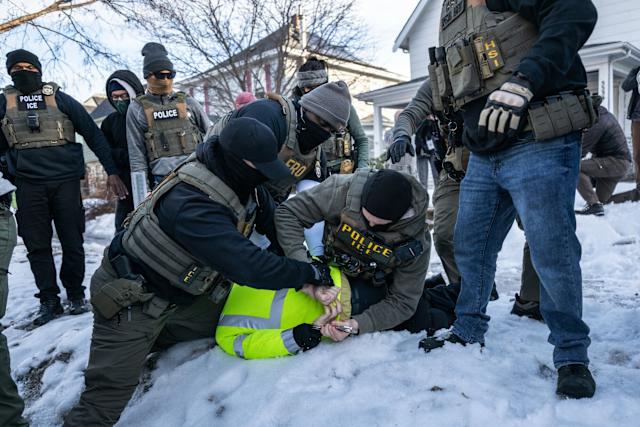
Earlier this month, the state of Minnesota made national and international headlines when Minneapolis resident and U.S. citizen, Renee Nicole Good, was fatally shot by an ICE officer while attempting to leave an area she was overseeing as a legal observer. Officer Jonathan Ross, who has an extensive background in ICE, the armed forces, border patrol, and law enforcement, was identified as the shooter, who shot Good three times through her open car window at point blank range. Although we are still waiting for more details and a potential trial, as well as input from the FBI, Vice President JD Vance has suggested that Ross is “protected by absolute immunity,” and that “he was doing his job” when shooting Good at point blank range while she attempted to drive away from the officers.
The day after the shooting, federal authorities declared the state of Minnesota had no jurisdiction to investigate the shooting, a move that has sparked legal controversy. The jurisdiction of the case has invited controversy elsewhere, as at least six top members of a Justice Department unit that investigates police killings resigned in protest after the Assistant Attorney General for Civil Rights, Harmeet Dhillon, declined to investigate the shooting. In the aftermath of the shooting, the Justice Department said there is “currently no basis” to start a criminal investigation, prompting local prosecutors to challenge the Trump administration directly.
Policy analysis: DHS Use of Force policies
Excessive use of force has been brought up as the story continues to unfold and more details come to light. The Department of Homeland Security’s Use of Force policies were last updated in 2022, and state that DHS LEOs (law enforcement officers) are allowed to use deadly force “only when necessary, that is, when the LEO has reasonable belief that that the subject of such force poses an imminent threat of death or serious bodily injury to the LEO or others.”
On the topic of “reasonableness,” the DHS derives the threshold for use of force from the Fourth Amendment, which protects privacy and limits overreaches of government power. The DHS’s use of force policy references the 1989 Graham v. Connor case which first tested this application, when discussing reasonableness.
Graham v. Connor
In 1989, a diabetic man had a friend drive him to a convenience store to purchase orange juice. The man was spotted by a police officer, who initiated an investigative stop, resulting in Graham being handcuffed and sustaining injuries while trying to explain his condition. The Supreme Court ruled that use of force in such encounters must be held up to the reasonableness standard to which LEOs are held to today, due to the Fourth Amendment’s protection against illegal search and seizure.
Today’s “reasonableness”
It is worth noting that the reasonableness standard established by Graham v. Connor is subjective and, especially in high-profile cases like Good’s death, is applied on a case-by-case basis. The concept of what is reasonable under the current administration is also likely much less reasonable than in the past. Following Good’s death, Secretary of Homeland Security Kristi Noem stated that Good “proceeded to weaponize her vehicle… The ICE officer, fearing for his life, and the other officers around him… fired defensive shots. He used his training to save his own life and that of his colleagues.” Additionally, the DHS has labeled Good’s actions as an “act of domestic terrorism,” and Good an “Anti-ICE rioter,” while Noem and other high-profile politicians have called Good a “domestic terrorist.” This commentary, in addition to the White House’s recent reframing of the January 6th Capitol riots, indicates attempts from the White House to influence public perception and memory on such matters.
Perception, of course, does not impact what really happened. Videos of the incidents have been circulated, and there was a crowd of witnesses present when Good was shot, and she appeared to be driving away from Jonathan Ross rather than weaponizing her vehicle. Vehicles, of course, can be used as weapons in confrontations with law enforcement, and it’s important that LEOs protect themselves against such threats. But video evidence shows that Ross stepped in front of Good’s car as she was trying to flee another ICE officer (likely illegally) trying to force entry into her car. Despite Ross’s dangerous positioning, he nonetheless had time to jump away from Good’s slowly moving car, leaving several feet of room between himself and Good’s car, as she was steering away from him.
Furthermore, in situations where a driver is weaponizing their vehicle, killing the driver willlikely not make that situation any safer, as the vehicle then becomes rogue, as was evidenced by Good’s car slamming into other parked cars in the neighborhood after she was shot. Had other cars not been in her car’s path, the car could have very easily struck an officer or civilian.That’s why in these situations, shooting the tires and disabling the vehicle is a much safer means of stopping an individual in a vehicle, whether they are weaponizing it or not. And regardless of whether or not the vehicle in question was being weaponized, it’s hard to fathom a situation in which a LEO would be justified using deadly force in what would, in any other situation, be viewed as a routine traffic stop. It’s also perfectly reasonable for a woman to quickly drive away from masked men approaching her car.
However, the White House’s attempt to reinterpret the case is concerning, especially given the subjectiveness of the reasonableness standard when it comes to justifying use of force. The FBI is currently investigating the case, and it is unclear what will happen next. But the agency’s input, along with any ensuing legal rulings, will likely shape interpretations of reasonableness in the future, and certainly during a Trump presidency.