
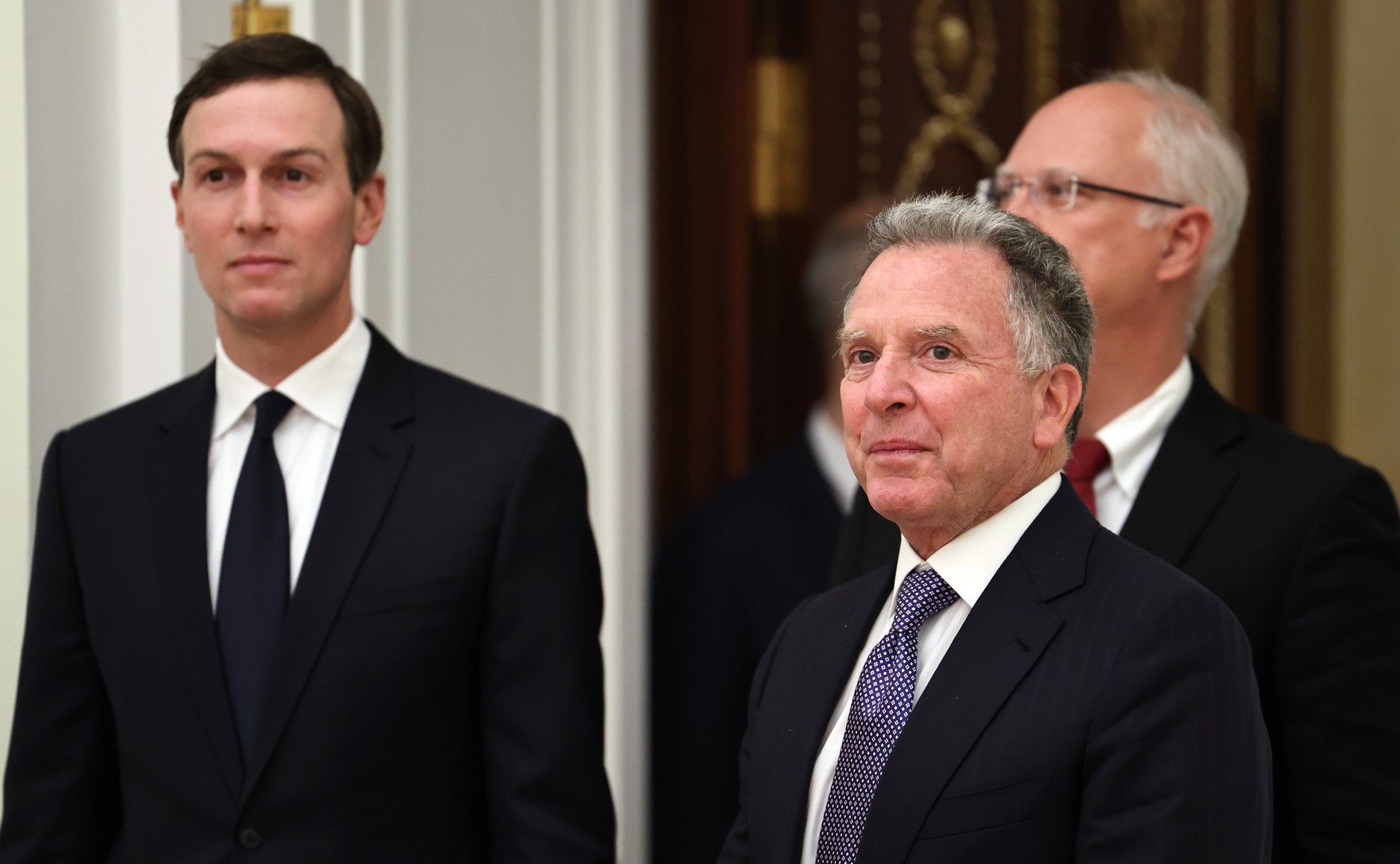
At a recent press conference, U.S. Defense Secretary and Christian nationalist Pete Hegseth justified the Trump administration’s unconstitutional act of starting the war with Iran by saying that before launching missiles, “We sent our best people to negotiate — Steve and Jared.” But that duo, Trump’s billionaire real estate buddy Steve Witkoff and son-in-law Jared Kushner, were unsuccessful in negotiating with Iran. Trump then started the war that has so far killed thirteen U.S. service members and wounded more than 300.
As the war drags on into its third month with no deal in sight and another round of botched negotiations in the rearview, many analysts and foreign policy experts have identified Witkoff and Kushner not as “the best people” serving U.S. diplomacy, but rather as dangerously inept and inexperienced envoys with serious conflicts of interest who risk prolonging the war.
Analysis
Witkoff and Kushner are symbolic of Trump’s cronyism, that is, his favoring of personal allies and business associates over qualified professionals for government roles. Whereas for decades professional diplomats from the State Department and the National Security Council have handled negotiations in global crises, Kushner and Witkoff come to the negotiating table with zero diplomatic expertise. Moreover, because they’re not formal U.S. government employees, they’re not subject to the guardrails of public financial disclosure laws or ethics laws, not to mention Senate confirmation.
The pair’s lack of accountability is reflected in their loosely defined titles. While engaging in crucial negotiations in the last year with heads of state from Russia, Ukraine, Iran, and Israel, Witkoff was called a special envoy, and Kushner deemed a volunteer. More recently, each of them has been designated by Trump as a Special Envoy of Peace Missions, set to continue high-level negotiations on behalf of the U.S. government. Further plaguing their lack of foreign policy experience, both Witkoff and Kushner bring serious conflicts of interest to their government work, in keeping with their boss’s well-documented self-dealing.
Witkoff’s Conflicts of Interest
In a public letter to the White House and the U.S. Office of Government Ethics, Sens. Elizabeth Warren and Christopher Murphy document Witkoff’s numerous conflicts of interest and the inaccuracies of his financial disclosure form. For example, the senators cite how in 2024 Witkoff partnered with the Trump family to launch the cryptocurrency company, World Liberty Financial. Later that year, after Witkoff was appointed U.S. Special Envoy to the Middle East, a UAE government-backed firm invested $2 billion in World Liberty Financial.
The senators point out that no agency ethics officials have signed Witkoff’s financial disclosure forms or stated that he is in compliance with ethics laws and regulations. They also show that the form lists June 30, 2025 as the appointment date of Witkoff’s government role, stating that he held no prior federal positions. However, records show that by January 2025 he was working in an official capacity, representing the Trump administration in high-level meetings in Saudi Arabia and Gaza, and participating in diplomatic negotiations concerning Israel and Gaza.
Kushner’s Conflicts of Interest
During his tenure as special advisor in Trump’s first term, Kushner exploited his government role to reap hundreds of millions of dollars in personal profit. When the role ended, he continued to capitalize on his government job by securing billions of dollars for his investment firm, Affinity Partners, from the very governments he had worked with in his official capacity.
This month, House Judiciary Committee ranking member Rep. Jamie Raskin opened a sweeping investigation of Kushner’s “staggering conflicts of interest,” warning that Kushner’s “dual role as Middle East negotiator and financier funded by Middle Eastern governments poses grave national security risks and likely violates federal law.” Raskin notes that Kushner’s firm has received more than $6 billion in assets and investments from foreign states, including Saudi Arabia, the United Arab Emirates, and Qatar, during Kushner’s time as a government operative. With such flagrant opportunism on display, it’s not shocking that Kushner misled the public about his intention of staying out of government service ahead of Trump’s return to office.
Their Diplomatic Efforts
While the pair did help broker a ceasefire in Gaza and secure the release of Israeli hostages held by Hamas, critics argue that isolated successes do not offset a broader pattern of inconsistency and inexperience in foreign policy, such as Witkoff’s and Kushner’s failed negotiations between Russia and Ukraine. Regarding their mishandling of the Iran negotiations, Aaron David Miller, who served in the State Department as an advisor for Middle East negotiations from 1978 to 2003, recently gave Kushner and Wikoff “an F in diplomacy.”
Conclusion
Iranian political analyst Ahmad Zeidabadi asserted that as a negotiator Kushner “represents the pragmatic and softer side of Trump.” But what Kushner—and Witkoff—mostly represent is Trump’s right-wing populist disdain for subject matter expertise and professional ethics in favor of, well, favoritism, and opportunities for personal financial gain.
American citizens—who continue to suffer the exorbitant costs of rising fuel prices spurred by the war and a wartime president who alienates foreign allies, threatens armageddon on Iran’s civilization, and sows confusion and doubt over the status of and goals for the war—deserve competent, uncompromised diplomats leading negotiations in an effort to end the Iran conflict.
Take Action
- Citizens for Responsibility and Ethics in Washington (CREW)
- “Fights for the democracy Americans deserve and aims to build a government that is accountable, transparent and ethical”
- Brennan Center for Justice
- A nonpartisan law and policy organization working to reform, revitalize, and defend the U.S. systems of democracy and justice
- House Judiciary Committee
- Established in 1813, the Committee strives “to protect U.S. Constitutional freedoms and civil liberties, oversight of the U.S. Departments of Justice and Homeland Security, legal and regulatory reform, innovation, competition and anti-trust laws, terrorism and crime, and immigration reform. The House Judiciary Committee has jurisdiction over all proposed amendments to the Constitution, and usually sends the greatest number of substantive bills to the House floor each year.”