
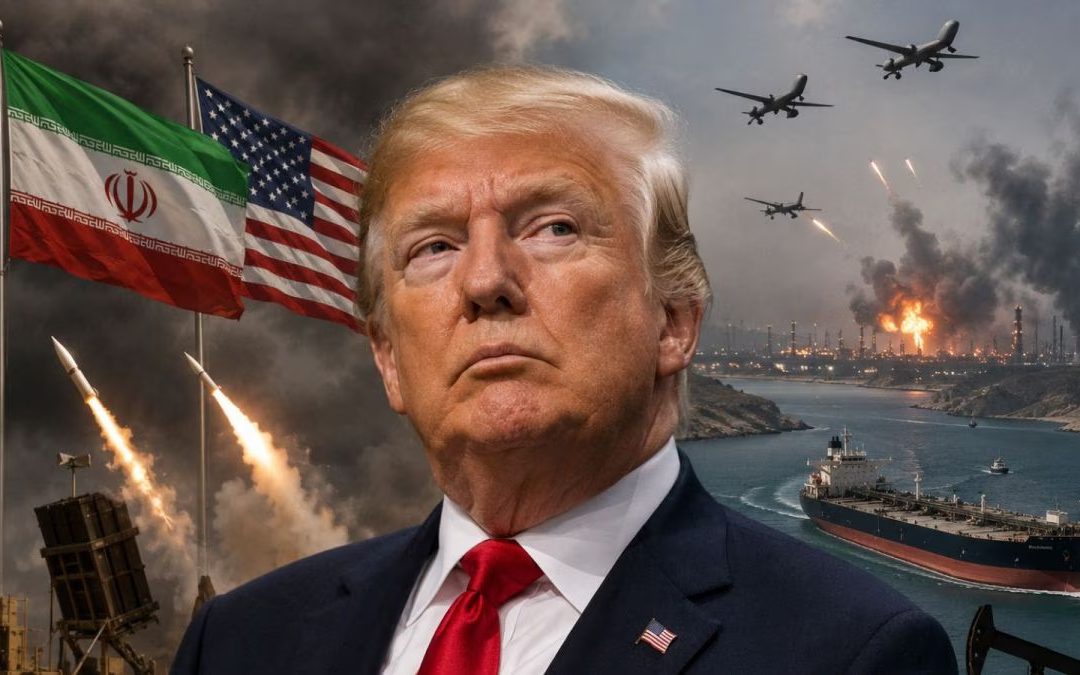
Now three months into his Iran war, President Trump continues to spew so much contradictory nonsense on the conflict that anyone attempting to take the president at his word would be lost in the morass. One moment Trump is threatening to annihilate Iran’s civilization, hurling churlish curses at the country’s leadership for not doing what he wants, the next he’s saying a deal is nearly complete. One minute he’s claiming the goal of regime change, the next he’s abandoning it in favor or “winding down” the war. One hour he’s saying “you don’t do a ceasefire when you’re literally obliterating the other side,” the next he’s gladly accepting a ceasefire.
The president’s utterly incoherent approach to the war evinces disrespect for American citizens looking for honest answers and assessments, which is exactly why we need to hold him accountable for his words. While we can’t get the truth from Trump or his administration, and while his sycophantic Republican colleagues refuse to hold him accountable, the record shows a president oozing confusion and desperate for an off-ramp to the war he started.
It’s either gaslighting or he’s ‘disconnected from reality’ himself
In late February, Trump tried to justify starting the war by claiming that Iran was mere weeks away from obtaining a nuclear weapon, an assessment disputed by nuclear experts and intelligence reports. The statement also made a mockery of Trump’s earlier claim that Operation Midnight Hammer conducted in June had “completely and totally obliterated” Iran’s nuclear program.
As the U.S. and Israel began bombing the Iranian regime, Trump casually told the people of Iran to “take back your country.” Given the regime’s well-documented brutality against its own citizens and the lack of a strong, organized opposition force, Trump’s advice was both deadly and outlandish. As noted, Trump would later claim regime change, but U.S. intelligence shows the regime is still intact.
Soon after starting the war, Trump declared, “there will be no deal with Iran except UNCONDITIONAL SURRENDER,” employing his trademark juvenile-bully caps. If we take Trump at his word here, then there will be no deal, because Iran has not only made it clear that they will not surrender, but also that they have the capacity to outmaneuver Trump, mainly by leveraging control of and thereby weaponizing the Strait of Hormuz to disrupt global energy markets.
When this Iranian strategic advantage emerged, Trump went further off the rails, most notoriously with his deranged Easter Weekend Truth Social post in which he pathetically cried, “Tuesday will be Power Plant Day, and Bridge Day, all wrapped up in one, in Iran. There will be nothing like it!!! Open the Fuckin’ Strait, you crazy bastards, or you’ll be living in Hell – JUST WATCH! Praise be to Allah. President DONALD J. TRUMP.” The post, widely condemned by sounder political operatives, was vintage bluster and bombast from Trump. Most embarrassingly for the president, the post effectively conveyed Trump’s failure to foresee Iran’s strategic advantage and his frustrated inability to solve it.
While Trump continued to issue countless falsehoods about the war—saying that the U.S. had “already met and exceeded all military objectives,” and achieved “Total and complete victory.100%. No question about it.”—the reality of Iran controlling the Strait of Hormuz posed a grave, geopolitical challenge that prompted Trump to impose a U.S. naval blockade on Iranian ports and shipping in the strait. The blockade, which sought to force Iran to free up passage of all global marine traffic, required 10,000 U.S. military personnel, more than a dozen warships, and over 100 fighter and surveillance aircraft.
By April, regarding Trump’s mishandling of the war, German Chancellor Friedrich Merz stated plainly that the U.S. is being “humiliated” by Iran. Rather than address the criticism, Trump responded with his typically petty social media posts attacking Merz and making false claims about him wanting Iran to have a nuclear weapon—the same baseless and preposterous accusation Trump made about Pope Leo. Merz’s comments, however, echoed the assessments of diplomats and global political analysts who lament how Trump got Iran wrong.Moreover, by failing to build a coalition of support before heading into the war, Trump has resorted to attacking European allies for not joining in his war of choice after the fact.
Conclusion
In their attempt to justify Trump’s starting of the war and evade holding him accountable for his words or actions, Republicans have collectively decided to hide behind a truism which no one anywhere has ever argued against, that Iran cannot have a nuclear weapon. Ironic, their claim, given that in 2018 Trump backed out of the Joint Comprehensive Plan of Action (JCPOA), the Obama-negotiated deal co-signed by China, France, Russia, the United Kingdom that had significantly curtailed Iran’s nuclear program.
Today, however, Trump has had to relent on his de-nuking demands, seeking instead a deal wherein Iran will simply reopen the Strait of Hormuz—that is, return the strait to the state it was in before Trump started his war and empowered Iran with control of the strait.
While the U.S. and Iran continue to trade strikes, Trump continues to give conflicting comments on the state of the ongoing negotiations, debasing himself, depriving American citizens of honest assessments, and lending credibility to the enemy’s assertion that the American president is “disconnected from reality.”
But Trump’s confused stew of words on the war do make it painfully clear that his lack of strategy, leadership, and coherent messaging have emboldened the Iranians and revealed how hard it will be to end his festering conflict.
Take Action
- Institute for the Study of War
- aims to provide ‘real-time intelligence to help leaders make informed decisions in conflict zones around the world and educate the next generation of national security leaders’
- The Center for Strategic and International Studies (CSIS)
- a bipartisan, nonprofit research organization ‘dedicated to advancing practical ideas to address the world’s greatest challenges’
- The Council on Foreign Relations (CFR)
- an independent, nonpartisan U.S. think tank ‘dedicated to helping policymakers, business leaders, and the general public better understand international affairs and U.S. foreign policy’