
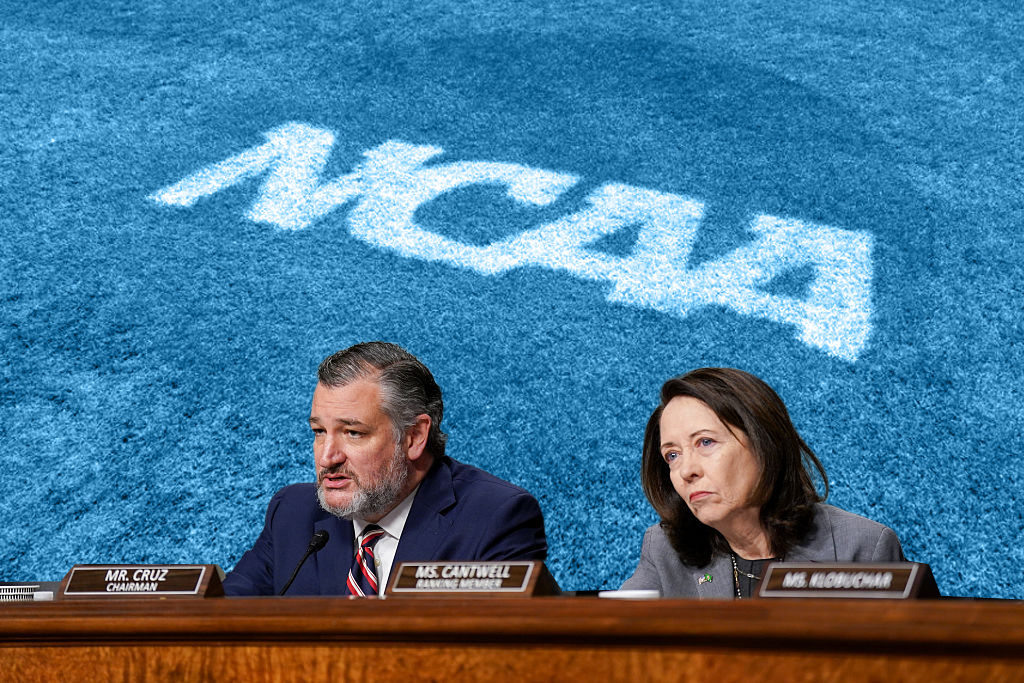
Last month, senators Maria Cantwell and Ted Cruz drafted the Protect College Sports Act in an attempt to regulate college sports at the federal level. The bipartisan bill is the latest of many such attempts to standardize the constantly fluctuating college sports industry—none of which have yet been signed into law. The Protect College Sports Act aims to regulate the NIL (name, image, and likeness) market, and it does so by drafting requirements for college athletes to report earnings of over $600 per year to athletic departments, which no other college students earning income are required to do.
In college sports, NIL refers to the rights of college athletes to earn money from business ventures like endorsements using their name, image, and likeness. Prior to 2021, the NCAA explicitly banned college athletes from earning money outside of financial aid and limited educationally-related expenses on the basis of its amateurism policies. College sports policy is nothing new both at the state and federal level. In 2019, the state of California introduced the Fair Pay to Play Act, which established NIL rights to college athletes for California college athletes, initially set to take effect in 2025. Today, NIL rights apply to college athletes in all 50 states.
However, when NIL-centric policy was first introduced, it was assumed that universities in NIL-friendly states would have a recruiting advantage, since NIL was not initially accessible to all college athletes, so after the initial California bill was introduced, a cascade of similar state-level NIL-focused policies followed. Months later, Florida introduced a similar bill with an expedited deadline of 2021 for NIL rights to take effect for athletes attending universities in Florida. The Florida bill forced the NCAA to get involved more quickly than the California bill, and the NCAA eventually handed over the responsibility of drafting NIL policies to 1.) states with NIL laws, and 2.) individual universities that were located outside of the handful of states that drafted their own legislation.
Fast forward to 2026, and the college sports industry is still grappling with the monumental changes that NIL brought to college athletic departments.
Because of the spotlight NIL brought to other restrictions on athlete rights, college sports policy has now expanded to account for other issues within the industry, like employee rights for college athletes. This happened over a decade ago when the Northwestern University football team attempted to unionize, but the 2020s have been the first consistent period of state and federal legislative focus on college sports policy. The Cantwell/Cruz bill is the latest iteration of such policy.
The bill also codifies updates to the Sports Agent Responsibility and Trust Act, a federal law enacted in 2004 that regulates the activity of sports agents, to include federal regulations to apply to agents representing college athletes. The bill would require agent registration, limit agent fees to five percent, and provide college athletes with a private right of action against agents who are deceptive, fraudulent, and abusive. Notably, the bill also continues the revenue sharing cap established by the House v. NCAA settlement past its expiration date of 2035, or the termination of the settlement.
The House settlement is an important piece of the Protect College Sports Act’s framework, as it ended the NCAA’s longstanding prohibition on athlete compensation and established a revenue sharing cap. The settlement, which was approved in July 2025 by Judge Claudia Wilkin of the U.S. District Court for the Northern District of California, differs from the Protect College Sports Act, but still impacts it. Specifically, the House settlement stipulated that universities could share up to $20.5 million of revenue with their athletes during the 2025-26 season, a figure that is expected to rise by 4% per year to keep up with inflation. This differs from NIL because NIL is payment from third parties, whereas revenue sharing is payment that comes directly from the universities themselves.
The Protect College Sports Act has several features that set it aside from previously drafted policies. First, it would establish a limited antitrust exemption in regards to athlete transfers and eligibility limits. Antitrust laws are designed to preserve competition in the free market, by prohibiting monopolies and other practices that limit fair trade. The NCAA has long been under scrutiny of antitrust violations due to the extensive levels of control it exercises over schools, conferences, and athletes. Thus, it has been seeking exemptions for some time now.
Antitrust exemptions are not new in the realm of sports law. Major League Baseball, for instance, operates under a full antitrust exemption regarding interstate commerce and player trades, and the National Football League has limited exemptions stemming from the Sports Broadcasting Act of 1961, which allows it to negotiate broadcast contracts collectively, and another that allows freer negotiation between the NFLPA and the league. Generally speaking, antitrust exemptions on behalf of sports leagues benefit the leagues themselves, not the athletes, and, thus, are periodically challenged in court, often by players. The exemption proposed in the Protect College Sports Act would likely follow a similar path if signed into law. This was not an issue in bills that only addressed NIL, but has come to light in federal-level bills.
The bill also touches on another controversial area in collegiate sports: athlete employee status. The debate over whether or not college athletes count as employees dates back to the 1950s when the NCAA first coined the term “student-athlete” to argue that college athletes were students rather than employees to deny them workplace rights like workplace compensation, disability coverage, and death gratuity. The latter benefit came to a head when Billie Dennison, widow of Fort Lewis A&M football player Ray Dennison, applied for death gratuity after her late husband died of a football-related injury. She was denied because Ray Dennison was not an employee by legal standards.
Although many link employee status to salaries for college athletes, there are many employee benefits that would be helpful to college athletes, like overtime pay and maternity rights. The Protect College Sports Act likely opts for neutrality on the topic because it would almost certainly face legal challenges if it included prohibitory verbiage. Even so, like its predecessors, it faces a steep uphill battle to make it through a divided Congress, though its provisions of scholarship guarantees and improved healthcare for college athletes helps its chances. In spite of its perks, however, the bill looks a lot like former college sports policy that failed to pass the House, let alone be signed into law, and offers limited protections and benefits to college athletes.