
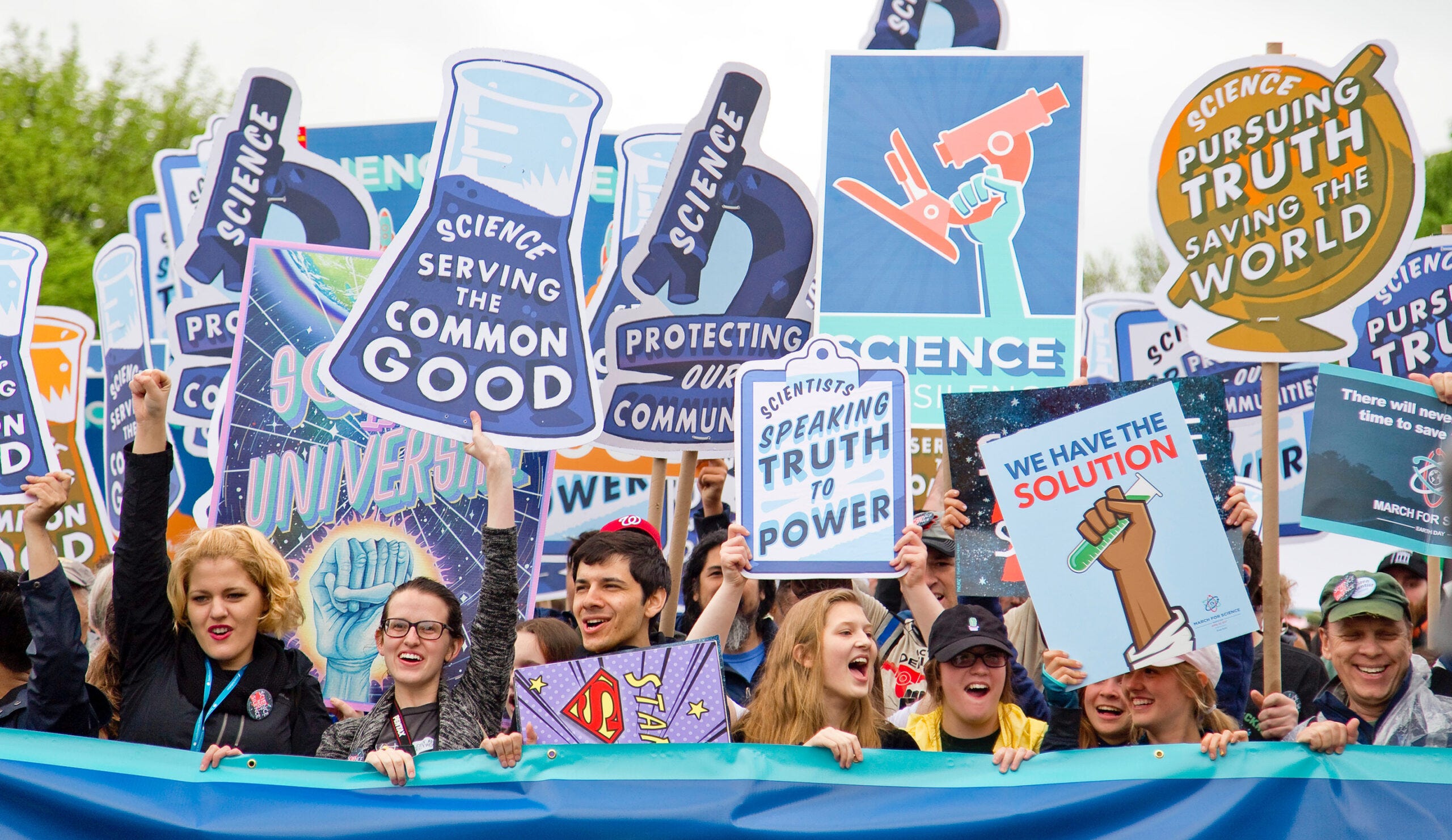
Photo Credit: rawpixel.com
Policy Summary:
Three months after the second inauguration of President Donald Trump, the new administration dismissed hundreds of scientists and authors who were at work on the National Climate Assessment.
But in a development that some may find inspirational, the scientists involved continue their work, under the auspices now of the American Geophysical Union and the American Meteorological Society. The result is the first paper in what will hereafter be known as the US Climate Collection.
The full report may be found under the title “Research priorities for robust climate assessments in the United States,” here. The lead authors (among 175 contributors) were Melissa Kenney, Robert Kopp and Costa Samaras. Kenney is a research professor at the University of Minnesota’s Institute on the Environment, Kopp directs the Earth System Science & Policy Lab at Rutgers, Samaras directs the Wilton E. Scott Institute for Energy Innovation at Carnegie Mellon.
Policy Analysis:
The new (Kenney-Kopp) report builds on an earlier one known as the Sixth Assessment Report (AR6) that said that the evidence that climate is changing and that the change is driven by emissions of greenhouse gases from human activities, is “unequivocal.” The changes include an increase in the likelihood, frequency and/or intensity of several types of extreme weather events, such as agricultural and ecological droughts, tropical cyclones, heat waves and extreme precipitation.
The scientists add, though, that many areas of physical science have advanced since AR6 (2023), and that continued research is necessary to “better characterize the climate future of the United States and Earth to provide insights to policy-makers, communities and other stakeholders and rights-holders on using climate science to support decision making.”
Much of the Kenney-Kopp work on research priorities concerns extreme event attribution, and the authors find that “confidence has grown in attributing climate change contributions to many types of extremes, including extreme fire weather, hurricane rainfall, marine heat waves and certain types of drought to the emissions of greenhouse gases.”
Some of the new work, too, concerns the non-obvious or indirect impacts of carbon emissions, often neglected in legacy estimates of the dangers ahead. In this context Kenney-Kopp cites for example the study published just this summer by Solomon Hsiang, in The Annual Review of Economics, a peer-reviewed journal published by an independent non-profit firm in California.
Hsiang’s survey of recent empirical work on the global economic impact of climate change finds that the delayed and indirect impacts of extreme weather events, such as the income that can not longer be earned or spent because a factory has been put out of commission by a flood, are greater and longer-lasting than the direct impacts (i.e. the capital costs of the same flood).
“The public and policymakers focus on immediate direct damages because they are salient, but delayed damages tend to be at least an order of magnitude larger,” said Hsiang.
The Kenny-Kopp survey of research trends also gives a brief look into climate risks to housing, insurance markets, public budgets and municipal credit, noting for example that “despite an increasing need for wider risk sharing, insurance premiums are rising, and availability is declining in high-risk areas, posing risks to regional governments as public pressure increases for them to fill the service gap.”
Finally (for this quick precis) the Kenny-Kopp report looks to issues of adaptation. Acknowledging that climate change is not a future risk but a fact underway, the issues to be faced are not those of heading it off by lowering carbon exhausts, but issues of how to adapt our lives and economy to the changes we know to be underway. Adaptation in this sense “reduces climate risk by decreasing exposure and vulnerability and increasing resilience.”
This is why it is intriguing that Costa Samaras is one of the leading figures in this group of fired-yet-working-still climate scientists. He has written about how energy and infrastructure systems can be made resilient to future climate risks. Continued papers from the US Climate Collection will surely address that point in greater detail.
Take Action:
- Research Priorities for Robust Climate Assessment, The Kenney-Kopp report discussed in the analysis above, available at the AMS’s Bulletin of the American Meteorological Society
- Hsiang, S. The global economic impact of climate change: an empirical perspective, Rev. Econ. 18, 225 (2026).
- University of Minnesota, Institute on the Environment. An interdisciplinary hub dedicated to building a sustainable future. About Institute of the Environment
- Earth System Science & Policy Lab (Rutgers), academic research group focused on sea-level change, climate risks, and policy integration. Rutgers Earth System Science & Policy Lab
- Wilton E. Scott Institute for Energy Innovation (Carnegie Mellon), developing and demonstrating the technologies that may allow a transition to a net-zero-carbon emissions future. cmu.edu