
Summary
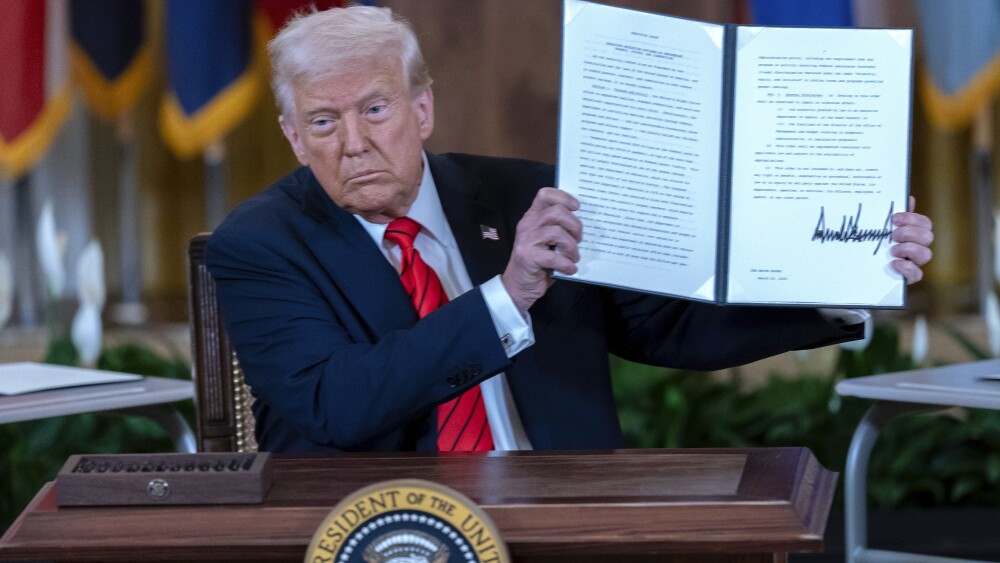
The Federal-State battle over AI regulation has heated up after President Trump signed an executive order on Dec. 11 that blocks states from enforcing their own regulations on artificial intelligence. The order seeks to create a “single national framework” for AI. However state lawmakers, tech experts, and civil rights organizations are worried about what this means for the country. Many believe that federal regulations could slow down America’s competitiveness in the global AI race and will have serious implications for national security.
ANALYSIS
Trump cites the use of 50 different regulatory regimes adopted by different states as a reason for the new regulations. To change this, his order directs Attorney General Pam Bondi to establish an AI Litigation Task Force (Task Force) within 30 days. The task force’s responsibility is to challenge state AI laws. Within 90 days of the order, Trump has ordered the Secretary of Commerce, in consultation with other advisors, to evaluate and publish an evaluation report on state AI laws. Focus will be on laws deemed to conflict with federal priorities like minimizing regulatory burden on AI developers, protecting national security and preventing what Trump called “ideological bias” in AI models.
The rationale behind the order was to update what Trump called a “patchwork” of regulations, which he felt hampered the progress and made compliance more challenging. In the order, Trump had written, “My Administration must act with the Congress to ensure that there is a minimally burdensome national standard — not 50 discordant State ones.” He added, “A carefully crafted national framework can ensure that the United States wins the AI race, as we must.”
In addition to addressing compliance challenges, the order seeks to correct state AI laws that Trump believes embed ideological bias in models and will impact 159 AI laws. This year has seen a large increase in new AI laws adopted by multiple states. According to a NYU State Technology Policy report, 46 states have enacted their own AI regulatory laws, which are now in the crosshairs. States like California and Colorado have some of the most comprehensive AI laws, which are now under threat. For example, the Colorado AI Act aims to protect people from algorithmic discrimination. State lawmakers have slammed the order, saying it weakens protections against algorithmic bias, reduces oversight of surveillance technologies, and undermines state authority. Some critics worry that the order could allow big tech companies to evade accountability.
Julie Scelfo, from the advocacy group Mothers Against Media Addiction, said in a statement that “Stripping states from enacting their own AI safeguards undermines states’ basic rights to establish sufficient guardrails to protect their residents.”
Colorado state Rep. Brianna Titone, whose recent AI law was referenced in the order, has no plans of stopping state AI regulation. Titone said, “States have rights to put policies in place that we feel are in the best interest of our constituents. The Constitution allows that … no executive order can legally stop us from doing that, and it will be challenged in court.”
The National Conference of State Legislatures took a stance against the order, and 280 state lawmakers sent a letter to Congress protesting it. The order has also sparked debate within the Republican Party, as members are divided over the path forward. Figures like Vice President JD Vance push for a lighter touch framework, while Florida Gov. Ron DeSantis has been vocal in his support for state-level regulation.
As state-level resistance grows, legal experts predict that the battle for AI-governance will be pushed into the courts for the Supreme Court to decide.
This isn’t the first attempt to prevent states from regulating AI. In July, Congress had blocked Republicans’ attempt to do the same thing, and some lawmakers believe the same could happen again. But for now, state governments, technology companies, and advocacy groups will have to face prolonged uncertainty as the scope of federal authority is tested.
Engagement Resources
- The White House Executive Order on Artificial Intelligence
- National Conference of State Legislatures AI Legislation Tracker
- NYU State Technology Policy Project
- US State AI Governance Legislation Tracker
- Federal Register AI Rulemaking Notices