
POLICY
The Amazon rainforest is rapidly degrading. The ecological functions of the rainforest such as absorbing greenhouse gases and releasing oxygen into the atmosphere are diminishing as the size of the rainforest shrinks. Global precipitation patterns depend upon the Amazon’s unique location on the planet. The diversity of plant life in the Amazon constitutes about a quarter of the globe’s stock of carbon biomass. There are 80,000 species of plants.
The degradation of this vital system is primarily due to deforestation, and behind the deforestation is agribusiness and organized crime. Climate scientists and biologists characterize the condition of the forest today as “very, very serious.” If deforestation reaches 20 – 25% there is likely to be a tipping point. At present, deforestation is at 18%. Once the tipping point is reached, a rapid acceleration of deforestation is forecasted with some scientists estimating up to a 70% habitat loss. Global carbon will then rise dramatically as will global temperatures.
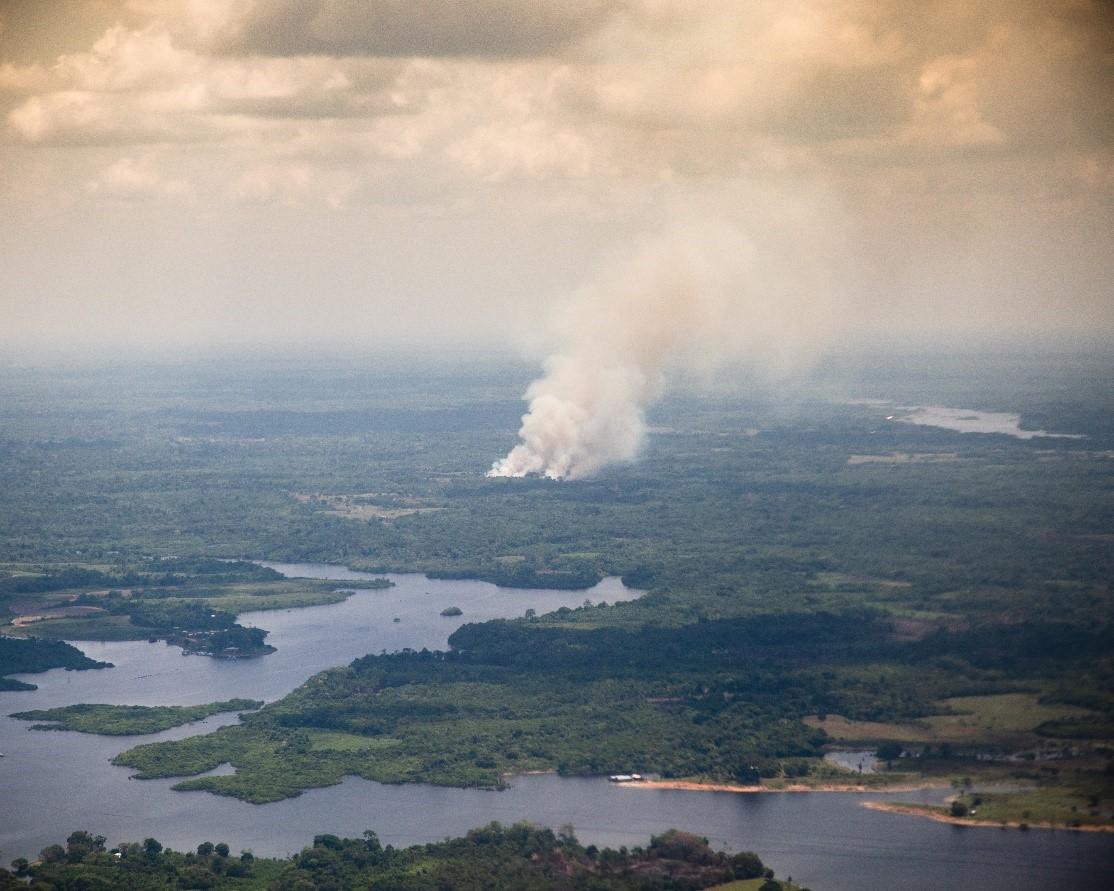
As witnessed and recorded by MapBiomas Fire Monitor, the burning of the Amazon was accelerated between January and October 2025. 7.5 million acres (3 million hectares) went up in carbon smoke, an area 39 times the land area of New York City. This was actually a year-over-year decrease due to local and regional firefighting efforts, yet even this progress is fragile. In 2024, an area the size of California was transformed to cinder and ash. These fires destroyed biomass, species habitat, and tribal territory not only in Brazil, but also in Peru, Colombia, and Ecuador.
The government of Brazil is the primary player in the effort to protect the Amazon. Brazil’s President Luiz Inácio Lula da Silva spoke in November of this year about their intentions at COP30 in Belem, Brazil. He said, “We have recorded the lowest deforestation rate in the Amazon in 11 years. Our commitment is to restore 40 million hectares of degraded pastureland over the next decade. But the forest is not made up solely of fauna and flora — around 50 million people live in the Amazon region of South America.” The actions he touched on were financing and the community-led securing of land rights for Indigenous Peoples. In terms of financing, he lent his support for the $125 billion-dollar Tropical Forests Forever Fund (TFFF).
On top of the continuing threats posed by man-made fires, large portions of the Amazon are experiencing drought – four severe droughts over the last two decades. Lakes are drying up and waters that remain are turning into “steaming cauldrons,” according to hydrologist Ayan Fleischmann. He and his team have investigated the many dolphins that are now dead and dying on Lake Tefe. The water temperature there was recorded at 106 degrees Fahrenheit (41 degrees Celsius).
Man-made fire is tied to industrial agriculture, cattle ranching and farming in particular. Land is burned as a method of clearing vast stretches to accommodate cattle. Beef production along with the sales and profits that result are the primary drivers. There is a single company, JBS, based in Brazil, that dominates the meat supply chain. They purchase cattle raised by over 40,000 independent ranchers and have a stated policy that all cattle are to be bought from “deforestation-free” ranches. “They say this is going to be implemented,” one rancher observed, “and I’d say straight away: that’s impossible.” JBS does have a network of “green offices” which advise ranchers on how to comply with their rules which includes the planting of trees on previously deforested land. The Bezos Earth Fund has contributed to this process of mobilizing livestock farmers to commit to not lighting existing rainforest land on fire. One of the many hurdles with compliance is that a significant portion of Amazon land used for ranching has been taken by force. These independent ranchers must also utilize ear trackers on cattle and satellite internet connectivity to verify compliance. A practice of “cattle laundering” is commonly used to make it appear that environmental regulations are followed.
ANALYSIS
In addition to industry, drug cartels and organized crime have a significant and growing presence in the Amazon, and is worth an estimated $280 billion dollars. Criminals in the jungle live by their own laws in their pursuit of wealth. They have established 31 airstrips, 13 of which are within indigenous lands. There are hit men that routinely kill those who oppose their efforts, including tribal members. In addition to being responsible for deforestation, the criminal gangs use mercury in their illegal mining operations. They perpetrate sexual violence and drug trafficking among the Amazon’s remaining native tribes including the Yanomami.
For the U.S.’s part in trying to contain Amazon deforestation, there continue to be minor contributions made to the Amazon Fund, created in 2008 by Brazil’s National Bank for Economic and Social Development (BNDES). The Amazon Fund’s mission is to promote sustainable use of the rainforest. That contribution from the U.S. is expected to end soon in line with President Trump’s elimination of USAID, a key partner for this program. We can expect no further participation from the Trump administration in any global climate-related conventions; there was no U.S. delegation at COP30. U.S. based NGOs such as Amazon Watch and the Rainforest Foundation will continue to campaign for Amazon’s protection.
One hopeful financing mechanism introduced at COP30 is The Tropical Forests Forever Facility (TFFF). The initiative aims to raise $125 billion to be paid as a kind of carrot to those countries (Brazil in particular) who keep their tropical forests intact. Payments are made based upon the number of hectares of preserved forest cover. Tropical forests areas will be monitored and verified through satellite technology. 20% of TFFF funding is to be allocated to indigenous tribes.
While governments and industries of the developed world go to battle over the bounty of the Amazon, the land has been home to millions of native peoples for millennia. Perhaps this is the strongest argument for its preservation: the relationship between indigenous tribes and the forest biome they call home. There are about 350 ethnic groups with an aggregate of around 2.7 million people who call the Amazon home. 60 of those ethnic groups have little or no contact with outsiders. For them, deforestation is the painful process of removing their identities. Likewise, native communities are and will continue to be the most faithful stewards of their ancestral lands.
Engagement Resources:
- https://amazonaid.org/ envisions an Amazon free of destructive mining practices where people have access to safe, dignified livelihoods and ecosystems thrive.
- https://mongabay.org/ is an independent, nonprofit media organization reporting on nature and planetary challenges with a global network of local journalists.
- https://amazonwatch.org/ protects the rainforest and advance the rights of Indigenous peoples in the Amazon Basin.