
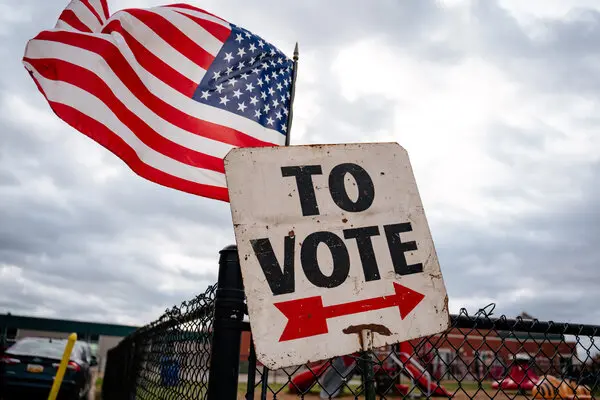
Policy Summary: On February 2, 2026 President Donald Trump stated in a podcast interview that Republicans in a number of states should take over elections in their states in order to protect the political party. He then added that elections in the United States should be “nationalized” and run by the Federal Government rather than the current setup where elections are run by individual states.
The United States Constitution provides in Article 1, Section 4, Clause 1 that “The Times, Places and Manner of holding Elections for Senators and Representatives, shall be prescribed in each State by the Legislature thereof; but the Congress may at any time by Law make or alter such Regulations[.]
After President Trump’s proposal to “nationalize” elections, a number of officials from both sides of the aisle came forward to disagree with the President’s proposal. Ohio State House Speaker Matt Huffman, a Republican, was clear in that he disagreed with the President and said that Ohio has done well in running elections in their state. Another Republican, U.S. Senate Majority Leader John Thune from South Dakota did not approve of the proposal, calling it a “constitutional issue.” Democrats were nearly united in their opposition. All twenty – four (24) Democratic governors released a joint statement where they condemned the President’s call to “nationalize” elections and characterized the President’s comments as an open call to rig future elections. Michigan Governor Gretchen Whitmer released a statement on social media stating that the U.S. has a “long, proud history” of decentralized federal elections and that because of this “America remains the longest running representative democracy in the world.” LEARN MORE, LEARN MORE, LEARN MORE
Policy Analysis: Donald Trump’s suggestion to nationalize elections in the United States goes against what the U.S. Constitution provides. Based on the text of Article 1, Section 4, Clause 1 the Constitution places the power to conduct elections – the times, places and manner of holding elections – clearly with each individual states. The clause even points out that this power applies to the elections of each state’s Senators and Representatives. The times, places and manner clause is directed to the details of running an election that a state legislature must decide – the hours a poll will be open for on election day and the places where polls will be set up in for the day such as local schools, local homes and apartment complexes and fire stations.
States also are entrusted with other details such as the number of poll workers at each poll location, how received ballots will be transported and how ballots will be tallied once received. Because there are so many small details in having an election, it does not seem practical to have the Federal Government be the one to issue regulations that would apply to every state and the thousands of counties that comprise the country. Situations in Hawaii could differ from Nebraska and from Florida. It would seem more prudent to follow the command of the Constitution where each state is in charge of the “times, places and manner” of having elections so as to have people who are more familiar with the county decide what is best since they are the ones who live and work in the county.
Senate Majority Leader John Thune was correct when he framed his disagreement with the President over this issue as a “constitutional issue.” Control over how elections are conducted are set out in the Constitution explicitly, and have worked remarkably well for almost two hundred fifty (250) years and so for the President to try to change it is a proposal that is not needed at this time.
That begs the question as to why the President is offering this proposal. His comments on the podcast show clearly that the President wants to make these changes because of his desire to protect the Republican Party. If the President’s motivation to try and contradict the Constitution is for partisan reasons than his proposal should be rejected outright. The Constitution is a document that serves all Americans regardless of their political beliefs audit should not be changed to give one political party an advantage over another but this is what President Trump wants. It was refreshing to see Republicans finally stand up to Trump on this issue as state Republican leaders and national Republican leaders pushed back on what they clearly saw as a foolish attempt by this President to meddle with how elections are run. Especially when it is well known that the President still holds a grudge on not winning the popular vote in 2016 and losing the election in 2020.
At its worst, his proposal does seem to be an attempt to set up a situation where elections could be more easily rigged if elections are no longer de – centralized to each state as is the current situation. Some reports have suggested that having all fifty (50) states in control of elections makes it harder to hack into fifty different election systems which is why Mr. Trump would prefer elections fully controlled by the Federal Government. But with bipartisan opposition to Mr. Trump’s nationalized elections proposal, there is at least some pushback to Mr. Trump making his proposal seem like a long shot for the moment. LEARN MORE
Engagement Resources
Common Cause – non – profit group’s review of Republicans who have made statements opposing President Trump’s plan to nationalize elections.
NPR – National Public Radio’s interview with David Becker of Center for Election Innovation and Research (CEIR) on Trump’s statement to nationalize elections.