
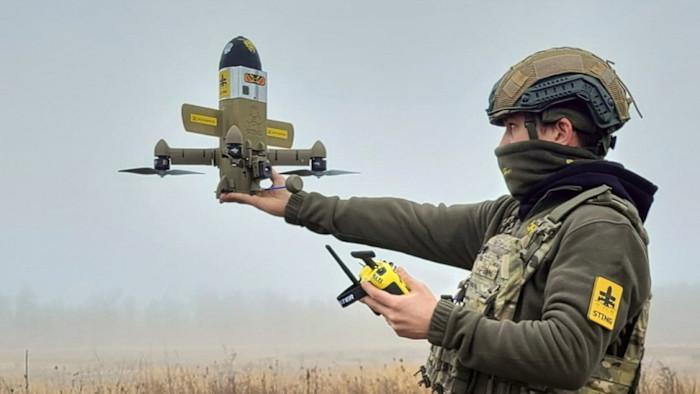
The geography of the war has changed. Once, the war in Ukraine was measured in miles of trenches, destroyed towns, and incremental advances across the Donbas steppe. Over the past two years, however, the conflict has expanded both vertically and territorially, carried not only by missiles and aircraft but also by relatively inexpensive drones assembled in workshops across Ukraine. The battlefield no longer ends at the front line. It now stretches hundreds—and sometimes thousands—of kilometers into Russian territory, reaching oil depots, military plants, logistics hubs, and even Moscow itself.
What Ukraine has built is more than a drone industry. It is what Reuters has described as an adaptive wartime ecosystem. Despite constant bombardment, power shortages, and labor disruptions, the country has developed one of the most rapidly evolving unmanned warfare programs in modern military history. Reuters describes Ukraine’s strategy as a campaign of mid-range and long-range strikes aimed at degrading Russia’s military logistics and energy infrastructure while compensating for Kyiv’s shortage of conventional firepower.
The scale of this transformation is difficult to overstate. Before Russia’s full-scale invasion in 2022, Ukraine’s domestic drone sector was modest and heavily dependent on imported components and volunteer initiatives. Today, Ukrainian officials openly discuss mass production. Drone units operate with a software-startup mentality: rapid iteration, constant redesign, and immediate battlefield feedback. A vulnerability discovered at the front—such as signal jamming—can lead to modifications within days rather than procurement cycles lasting years.
This acceleration has altered the strategic depth of the war. Ukrainian drones now routinely strike targets deep inside Russia, including areas once considered beyond Kyiv’s reach. Reuters reported in April that Ukraine struck an oil pumping station near the Ural Mountains, approximately 1,500 kilometers (932 miles) from the Ukrainian border. The symbolic significance was as important as the physical damage. For decades, the Urals were viewed as distant, industrial, and largely insulated from war. Ukrainian drones challenged that assumption.
Other strikes have reinforced the message. Ukrainian forces have targeted facilities in Cheboksary, also roughly 1,500 kilometers (932 miles) from Ukraine, including defense infrastructure linked to Russian military production. Oil refineries in Samara, Ryazan, Perm, Tuapse, and Krasnodar regions have repeatedly been hit in campaigns designed not only to damage infrastructure but also to reduce Russia’s wartime energy revenues. Reuters estimates that Ukrainian strikes disrupted approximately 700,000 barrels per day of Russian refining capacity between January and May 2026 alone.
Moscow, long considered politically untouchable territory, has also become a regular target. Russian authorities have reported frequent drone attacks on the capital, including a large-scale assault in March involving hundreds of drones. The military impact of these attacks varies, but their psychological effect is undeniable. Airports suspend flights. Air defenses fire over residential neighborhoods. Moscow residents, long removed from the daily realities of war, increasingly experience moments of uncertainty familiar to Ukrainians since February 2022.
Ukraine’s drone campaign reflects a broader shift in military power away from expensive centralized systems toward locally developed, low-cost technologies. A long-range drone may cost only a small part of a cruise missile while forcing a defender to deploy far more expensive air-defense assets. Russia can manufacture missiles at scale, but defending thousands of miles of infrastructure against persistent drone attacks presents a different challenge.
Experience has become Ukraine’s greatest strategic asset. No NATO military has accumulated comparable real-time knowledge of large-scale drone warfare under continuous combat conditions. Ukrainian operators combine reconnaissance drones, FPV systems (the First-Person View system that transmits a live video feed from a drone’s camera), maritime drones, electronic warfare tools, and long-range strike platforms into integrated operational networks. The result is not merely tactical innovation but the development of a new model of warfare.
Western defense analysts increasingly study Ukraine not only as a recipient of military aid but also as a laboratory of future conflict. The war has demonstrated how technological adaptation can partially offset disparities in population, industrial capacity, and ammunition reserves. It has also shown how quickly civilian expertise can be transformed into military capability. Many Ukrainian drone engineers once designed consumer electronics, software systems, or racing drones. Wartime necessity redirected their skills.
The deeper significance, however, lies elsewhere. The drone war has blurred the distinction between rear and front. A refinery in the Urals, a command facility hundreds of miles from Ukraine’s border, or a district of Moscow can no longer be considered entirely beyond reach. Distance, once central to strategic security, has become increasingly conditional.
The war is no longer confined to where soldiers meet. It now unfolds across networks, infrastructure, algorithms, and industrial geography. Ukraine’s drones have not defeated Russia. But they have changed the shape of the conflict and Russia’s military expectations, extending Ukraine’s reach far beyond what conventional military balances once suggested possible.
Take Action
- US Global Leadership Coalition. The Importance of U.S. Assistance to Ukraine, https://www.usglc.org/the-importance-of-u-s-assistance-to-ukraine/
- Syracuse University. Ukraine Crisis: Resources and Support, https://ivmf.syracuse.edu/ukraine-crisis-resources-and-support/#1-ways-to-give
- The Ukraine Oversite. The United States and its international partners provide a variety of training to the Ukrainian Armed Forces (UAF), including basic, collective, leadership, and platform-specific training, https://www.ukraineoversight.gov/Funding/Training-Advising/
- GMF (German Marshall Fund). In response to Russia’s brutal war against Ukraine, the German Marshall Fund of the United States (GMF) established a comprehensive emergency program to support Ukrainian citizens, civic activists and civil society organizations (CSOs), and journalists and independent media, https://www.gmfus.org/democracy/ukraine-relief-resilience-recovery