
Summary:
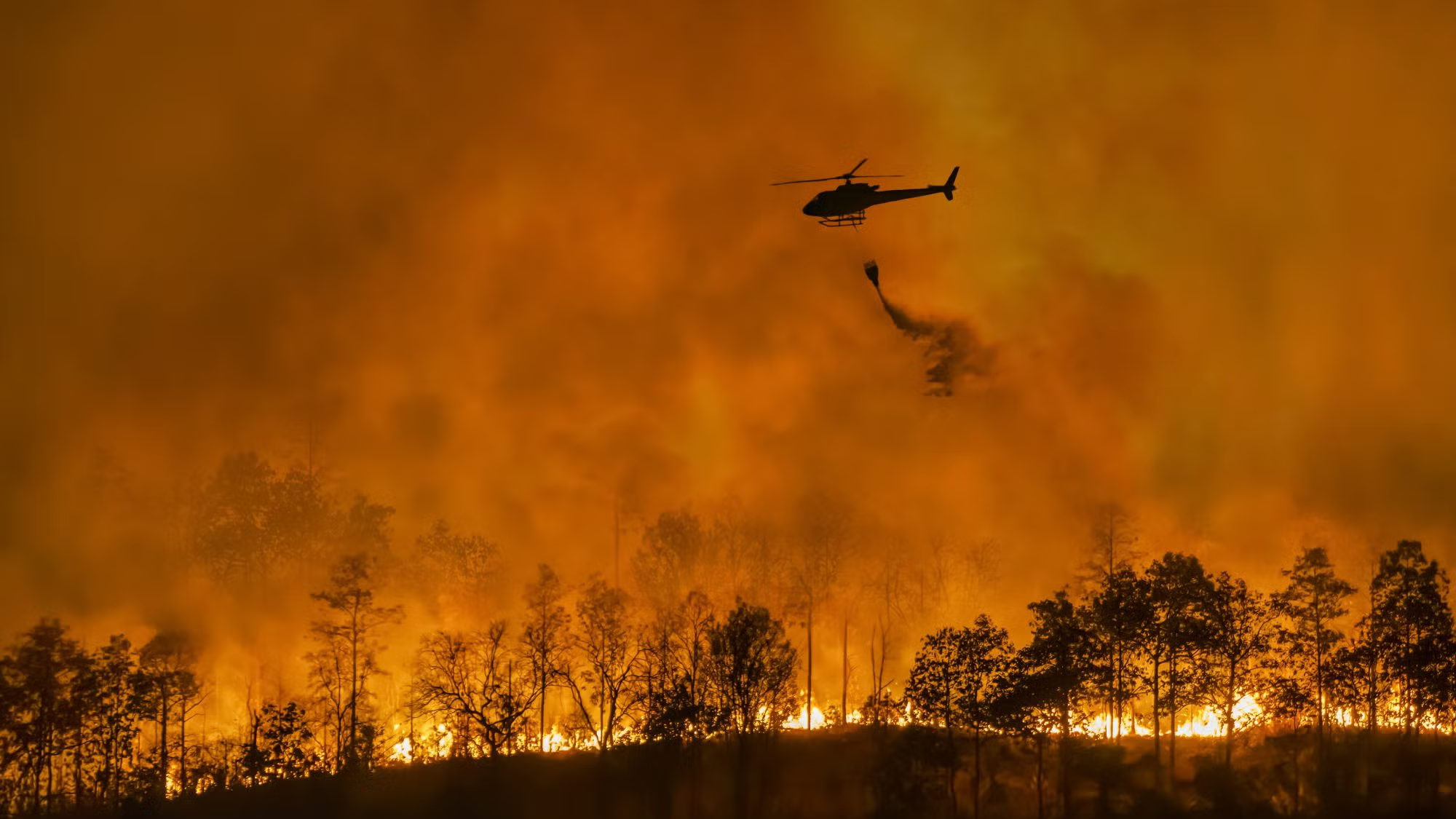
So far this year, over 45,000 wildfires have burned more than 12 million acres across the U.S. and Canada, and it’s only July. The U.S. has seen more wildfires so far this year than any January to July in the past decade. The ever-worsening climate crisis increases the risk of wildfires, the length of wildfire season, and limits responders’ ability to contain the fires.
Analysis:
The increase in extreme wildfires in the past 20 years is largely due to human-caused climate change. Above-average temperatures, shorter snow seasons, and less year-round precipitation all contribute to a hot, dry environment prime for wildfires.
According to the National Interagency Fire Center, most of North America received below-average snowfall this winter, and by the beginning of April more than 60% of the U.S. was in a drought. A drier winter and spring contribute to the start and rapid spread of many wildfires, and a lack of heavy summer rainfall makes wildfires harder to extinguish, increasing the demand for human intervention.
In June, Canada recorded “extremely low precipitation” in parts of British Columbia, Saskatchewan, Quebec, Labrador, and the Northwest Territories. “Extreme Drought” was also declared for British Columbia, northern Quebec, and Labrador.
While there have always been wildfires, some of which are actually beneficial to the environment, the continued development of cities and towns near wilderness areas brings humans closer to the dangers of wildfires and can also increase the amount of man-made materials in the fires. The EPA describes the wildland-urban interface (WUI) as “the line or area where the wilderness meets human development. A WUI fire results in the burning of both natural materials (e.g., trees, shrubs, etc.) and human-made structures and materials.” The expansion of the WUI brings more harmful materials into wildfire areas and increases the damage from fires, particularly adding to the harmful smoke content.
While the ecological damage at the sites of wildfires is tremendous, areas without any fires are often still affected by them. Wind can blow hazardous smoke large distances and create dangerous conditions to breathe in, making no one safe from the effects of wildfires. In mid-July, the Midwest and East Coast of the U.S. experienced air quality ranging up to 624 and 934 PM2.5, sometimes with the closest fire hundreds of miles away. Anything above 301 PM2.5 is considered hazardous.
According to the EPA, fine particle matter (PM2.5) is the biggest threat in wildfire smoke. Not only can this particle matter cause difficulty breathing, but even short-term exposure can lead to a heart attack or stroke. Additionally, most studies of the health effects of wildfire smoke are only on short-term exposure. The risks of long-term exposure are largely unknown.
Until human-driven climate change is addressed, wildfires will continue to be an increasing threat. According to the National Oceanic and Atmospheric Administration, “an average annual 1 degree C temperature increase would increase the median burned area per year by as much as 600% in some types of forests.” With current carbon-emitting human activity, the atmosphere will only continue to become hotter and drier, leading to more wildfires.
Take Action:
Preparing for and responding to wildfires
Resilience Strategies for Wildfire
Climate Mapping for Resilience and Adaptation