
Policy Summary:
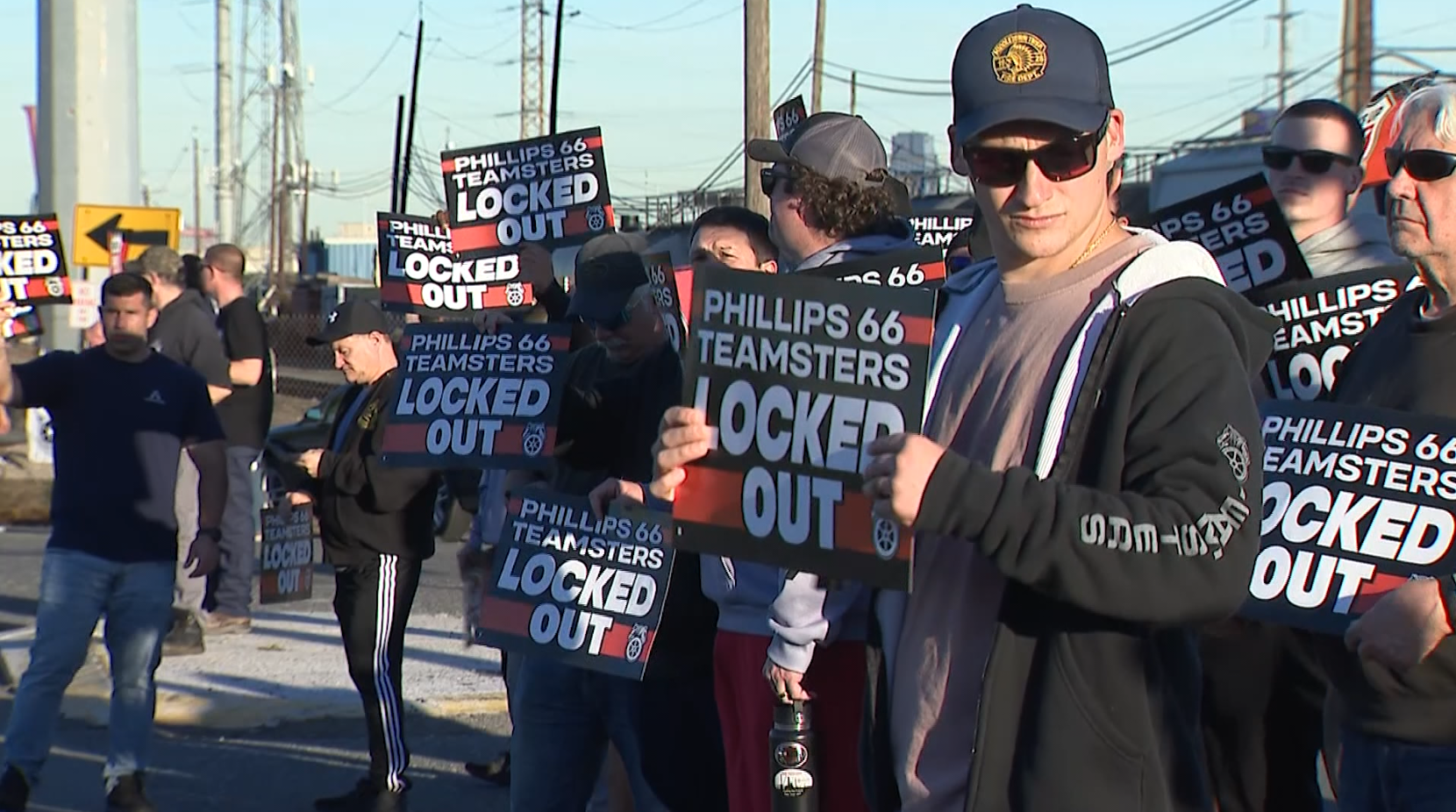
The very word “lockout” sends the mind back to an earlier era in industrial relations, the late 19th and early 20th centuries when labor-management relations in the United States, especially in manufacturing, railroads, and mining, were openly adversarial. But Phillips 66, a multinational corporation headquartered in Houston, Texas, induced a forward-to-the-past sense on October 19, when its contract extension with a teamsters local expired. Phillips locked out between 385 and 400 union members (local 477) from its Bayway refinery in Linden, New Jersey.
The lockout came as a preemptive measure soon after the Teamsters had authorized a strike amid floundering contract negotiations. The central issue of those negotiations seems to have been not compensation, but health and safety.
Policy Analysis:
Before the lockout, the Teamsters had complained about a Phillips 66 “Absence Control Policy” that allows discipline, inclusive of termination, for absences due to illness. Phillips only allows the number of sick days that New Jersey law requires it to allow. Beyond that, workers who fall ill must cut into their vacation time.
The Teamsters want more sick leave, better health benefits and protections related to fatigue. Relatedly, they complain of extended work schedules.
Phillips 66 has not gone in search of replacement employees from outside the bargaining unit. It is relying instead on what Jack Sanford, president of 877, has called a “skeleton crew,” conjured up largely through the re-assignment of supervisors and engineers. Negotiations with the Teamsters have continued since the lock-out.
Sanford has said that negotiations for a new arrangement have not proven successful because the company is refusing to offer a “fair and safe contract.” That is revealing language, putting forward as a co-equal with fairness the matter of safety, that of workers and perhaps the public as well. Fatigued or ill workers, working to avoid discipline, may open or close the wrong valve, fail to notice worrisome instrument readings, make mistakes in startup or shutdown procedures, and so forth.
There is, after all, the spectre of the BP refinery explosions in Texas City, Texas (2005) to consider. A series of explosions on March 23 of that year killed 15 workers, and injured 180 others, many in and around the work trailers that were near an atmosphere vent stack.
The official government report on the matter found that worker fatigue was a contributing factor. The report focused attention on the day board operator, the person whose job it is to monitor the refinery process from a central control room. The day board operator at Texas City had been working 12 hour shifts seven days a week for four weeks at the time of the accident. In careful bureaucratic language the report said that this overworked person “had a primary role on the day of the incident.”
Refinery workers (in this epoch of automation and artificial intelligence) have skilled tasks and as they become experienced their skill becomes especially suited to their particular workplace. They can be tricky to replace. This ‘should’ give the locked out workers and those negotiating on their behalf more leverage than their colleagues in other industries might have.
Another point that may give them leverage: The Bayway refinery processes roughly 275,000 barrels of oil each day, supplying gasoline and diesel throughout the northeastern United States, especially in Connecticut and Massachusetts.
At the moment, a fall-off in Bayway output does not seem to be a significant pressure point for higher prices. Indeed, it is impossible to confirm as yet that there has been a falloff in production, much less to give a quantitative account.
We should return once more, though, to the throwback nature of this news story. A lockout about a safety demand? It brings to mind why the National Labor Relations Act of 1935 was a progressive and necessary step toward civil and, yes, profit-maximizing labor-management regulations. A return to the ‘bad old days’ in such relations is very ominous for all parties.
Take Action:
- International Brotherhood of Teamsters
- (https://teamster.org/2026/09/phillips-66-teamsters-overwhelmingly-authorize-strike/) — a trade union founded 125 years ago, with more than one million members active throughout the United States and Canada
- National Council for Occupational Safety and Health (https://nationalcosh.org/press-room) — a non-profit founded in 2004 that serves as a national clearinghouse for issues of occupational safety and health.
- US Chemical Safety and Hazard Investigation Board (https://www.csb.gov/bp-america-texas-city-refinery-explosion) — a non-regulatory federal agency charged with investigating chemical incidents to determine actual or probable cause and contributing factors.
- Institute for Energy Economics and Financial Analysis (https://ieefa.org/resources/more-oil-fewer-jobs-employment-declines-us-oil-and-gas-sector) a think tank that seeks to “accelerate the transition to a diverse, sustainable and profitable energy economy”).