

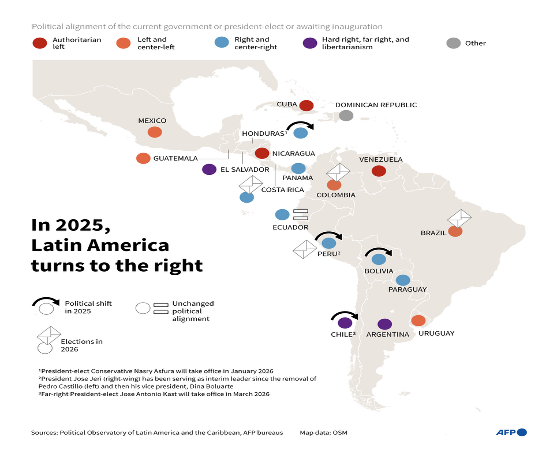
Latin America’s shift to the right
Latin America’s shift towards the political right has continued following the recent elections in both Chile and Honduras. In Chile the election of the far-right Jose Antonio Kast marked the country’s most significant shift rightward since the former Chilean dictator, Agusto Pinochet. The election of Kast now makes three neighboring South American states formerly at odds, Argentina, Bolivia and Chile, firmly in control by the rightwing and all seeking closer relations with the United States. In Honduras the Trump backed candidate, Nasry Asfura has been declared the winner after a more than two week long vote count left those in the small Central American country in suspense. Following the election results, the opposing Liberal Party candidate, Salvador Nasralla refused to concede and alleged interference in the election process by the United States after President Trump conditioned continued aid to the country on whether the right-wing candidate won. Trump also pardoned the former Honduran President found guilty of trafficking drugs to the United States.
The region has firmly moved away from its left-leaning majority after the second “pink tide” (term used to refer to the leftward shift of countries in Latin America) that swept the region in the late 2010s and early 2020s. Economic crisis, migration and violence that has continued to plague the region and anti-status quo sentiment has led to the political reversal. In 2026 the region has elections in Costa Rice, Brazil, Peru, Colombia and Haiti to look forward to.
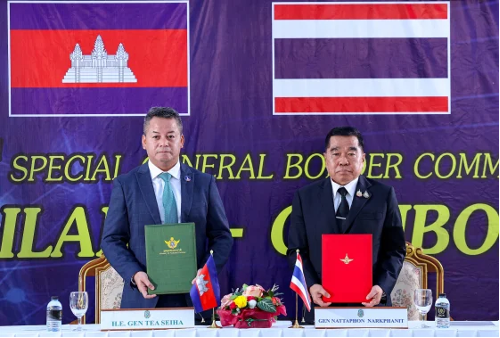
Cambodia’s Defense Minister Tea Seiha, left, and Thailand’s Defense Minister Nattaphon Narkphanit hold documents during the special General Border Committee meeting at a border checkpoint in Thailand’s Chanthaburi province.Agence Kampuchea Press / AFP Photo
Thailand and Cambodia sign ceasefire deal (Again)
Last week Thailand and Cambodia signed another ceasefire agreement that seeks to end weeks of fighting that began after the former July 2025 ceasefire deal was broken. The two countries blame each other for instigating the fresh round of fighting, which has spread to nearly every province along their border. Cambodia’s Defence Ministry said Thailand’s military struck first, carrying out a heavy bombardment of disputed border areas. Meanwhile Thai media claimed that Cambodian forces had launched heavy attacks overnight along the disputed border, where many homes were damaged by shelling.
Both countries claim to have acted in self-defence and accuse the other of attacking civilians. Yet since breaking the ceasefire deal, the two neighbours’ combined killed more than 40 people, according to official counts. About a million people have also been displaced. The conflict stems from a territorial dispute over the colonial-era demarcation of their 500 mile long frontier and a collection of temple ruins situated there.
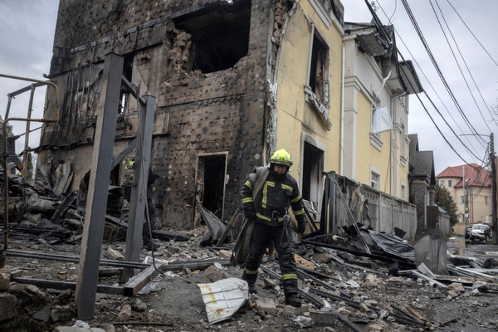
A firefighter walks at the site where a Russian drone struck a residential building during a night of Russian drone and missile attacks, amid Russia’s attack on Ukraine, in Kyiv, Ukraine, Dec. 27, 2025. Photo by Thomas Peter/Reuters
New round of attacks on Ukraine’s capital Kyiv
Russia launched a new wave of strikes on Ukraine’s capital Kyiv in the final days of the year. The strikes killed one person and wounded 27 just one day before a meeting between Ukrainian president Volodymyr Zelenskyy and Donald Trump. The two leaders met in Florida last week for further talks on ending the near four year long war. Zelenskyy described the attacks as evidence of Russian President Vladimir Putin’s false narrative on seeking peace. Zelenskyy stated “This attack is Russia’s answer to our peace efforts. It really shows that Putin doesn’t want peace,”.
The Russian ministry in turn said the strike was in response to Ukraine’s attacks on “civilian objects” in Russia. The past few weeks saw targeted bomb attacks in Moscow that killed Lt. General Fanil Sarvarov. General Sarvarov was the head of the Operational Training Directorate of the Russian Armed Forces’ General Staff. Since the beginning of its invasion of Ukraine, Russian authorities have blamed Kyiv for several high-profile assassinations of military officers and public figures in Russia. Ukraine has claimed responsibility for some of them, but has not yet commented on either of the recent attacks.
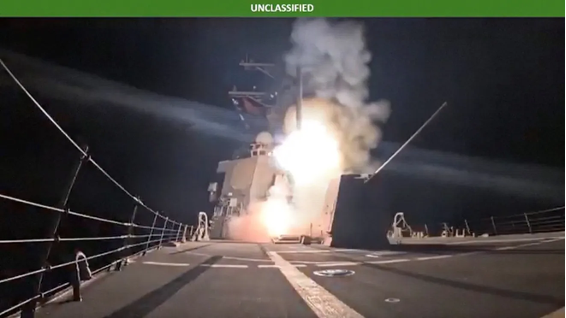
A missile is launched from a military vessel at an unidentified location, in this screen grab obtained from a handout video released by the Department of War on December 25, 2025. U.S. Department Of War Via X, Via REUTERS
US airstrikes inside of Nigeria
The US has carried out air strikes in Nigeria targeting two Islamic State-linked camps in the Bauni forest of the country’ s Sokoto State. The strikes are the outcome of a months-long tense diplomatic clash between the West African nation and the US that has morphed now into a new form of cooperation. The strikes were approved by Nigerian President Bola Tinubu and launched from maritime platforms domiciled in the Gulf of Guinea. Following the attacks, US President Donald Trump announced the strikes on Truth Social, saying that U.S. forces had launched strikes against Islamic State militants at the request of Nigeria’s government and laid out the reason for the attacks. Trump said it was based on claims of the group targeting Christians in the region and said there would be more military action to come. Nigeria’s foreign minister called the airstrikes a “new phase of an old conflict” and also said he expected more strikes to follow, stating “For us, it is something that has been ongoing,” referring to attacks that have targeted both Christians and Muslims in Nigeria for years.