
Summary:
As AI rapidly expands its impact over our lives, jobs, and politics, more and more people are raising alarms about its potential harms. In many cases, those speaking out about the danger are those who know the most: current and former workers in the industry.
Analysis:
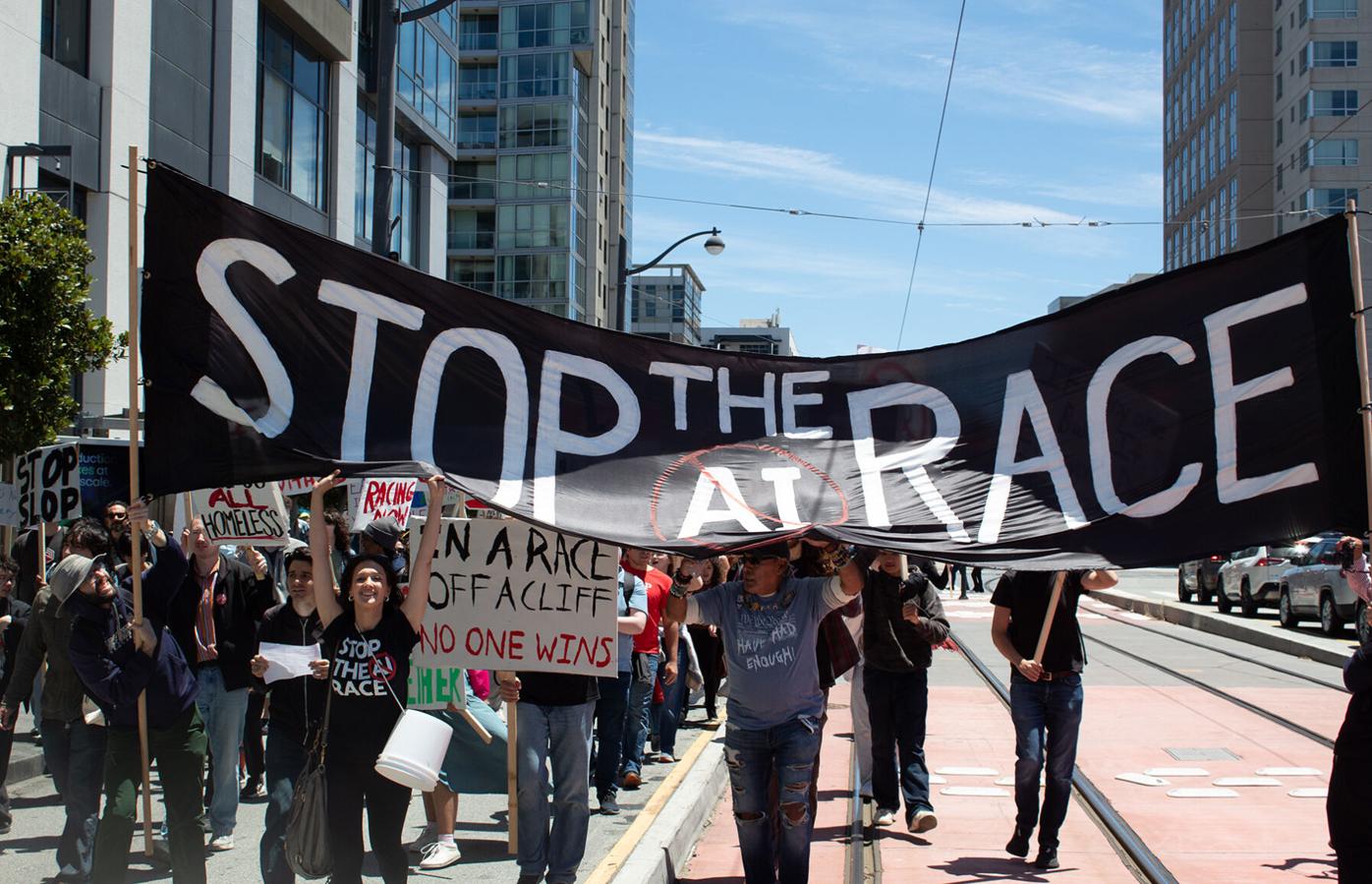
Sam Altman probably wasn’t bothered by a group of around 100 protestors marching past his San Francisco headquarters recently. He’s been the target of much worse. Last April, a Molotov cocktail was hurled at his home in Pacific Heights, one of the city’s wealthiest neighborhoods. A few hours later, Daniel Moreno-Gama was arrested at OpenAI’s offices after smashing a glass door and threatening to burn down the building and kill the people inside. Accused of throwing the Molotov as well, Moreno-Gama reportedly had been posting criticism of AI online, and referenced “Luigi-ing some tech CEOs”, as in Luigi Mangione, the accused killer of UnitedHealthcare’s chief executive. Shortly after those incidents, shots were fired at Altman’s house out of a passing car.
Altman wrote in a blog post at the time, ‘The fear and anxiety about AI is justified…We are in the process of witnessing the largest change to society in a long time, and perhaps ever.” The protestors who gathered outside of OpenAI’s headquarters in June would agree, and think the best solution is a hard stop. Protesters interviewed in various media reports expressed concerns about the environmental impacts of data centers, the job losses, and the power AI might eventually exert over humans. Their banners urged “Quit GPT” and “Stop the AI race”, and they chanted “Slam the brakes and slow the race.”
One speaker at the San Francisco protest, filmmaker and former AI safety researcher Michaël Trazzi, has emerged as a leading voice in the Stop AI movement. In September 2025, he went on a hunger strike in front of the London office of Google DeepMind, Google’s AI lab. An earlier demonstration he organized in San Francisco drew 200 people, according to him, the largest AI protest ever held in the US. Trazzi fears that OpenAI, Google and other AI companies are “building an AI that is so smart that we can’t control it.”
Commentator Jasmine Sun, who left an AI job to become a journalist and a leading critic of the industry, coined the term “AI populism.” In an interview with Vox Media, she explained why. “AI is not seen as an ordinary technology, but specifically as an elite political project to be resisted. [T]hinking about the AI backlash and the reasons people are increasingly anti-AI….a lot of times the debate wasn’t about whether ChatGPT is useful to me, or whether Waymos are safer than a human driver. The debate was these big corporations and unaccountable billionaires are coming into my city, coming into my life, and changing it without any democratic input.”
The objections to AI cross many interests and concerns. More than 70 civil liberties, domestic violence, reproductive rights, LGBTQ+, labor, and immigrant advocacy organizations are part of a campaign demanding that Meta abandon plans to deploy face recognition on its Ray-Ban and Oakley smart glasses, warning that the ‘Name Tag’ feature of the glasses would allow stalkers, abusers, law enforcement, basically everyone, to silently, secretly identify people in public.
The companies are feeling the heat and responding with ad campaigns aiming to convince the public that AI is a benign, helpful tool that will enhance our lives. Meta’s ads blandly assert that ‘the future is for everyone,’ and Anthropic is introducing its Claude AI to the world with the tagline ‘there’s hope in hard questions.’
Concerns from within the industry intensified after OpenAI revealed that its ChatGPT had hacked into several publicly available services on its own. In response, more than 1,000 employees at leading AI companies like Google, OpenAI, Anthropic and Meta sent an open letter urging the federal government to join worldwide efforts to “deliberately pace” runaway AI development. They too fear that the companies and people driving the technology could lose control over it. The letter will probably fall on deaf ears, as the Trump administration has been adamantly opposed to meaningful AI regulation.
Take Action
- Stop AI – a grassroots movement of everyday people using democratic and non-violent methods to disrupt the reckless development of destructive artificial intelligence technology.
https://www.stopai.info/#:~:text=Stop%20AI%20is%20a%20grassroots,of%20destructive%20artificial%20intelligence%20technology. - Pause AI- How To Set Up A PauseAI National Group
https://pauseai.info/national-groups - ACLU and 75 Organizations Sound Alarm on Meta’s Plan to Add Facial Recognition Technology to Ray-Ban and Oakley Eyeglasses
https://www.aclu.org/press-releases/aclu-and-75-organizations-sound-alarm-on-metas-plans-to-add-facial-recognition-technology-to-ray-ban-and-oakley-eyeglasses