
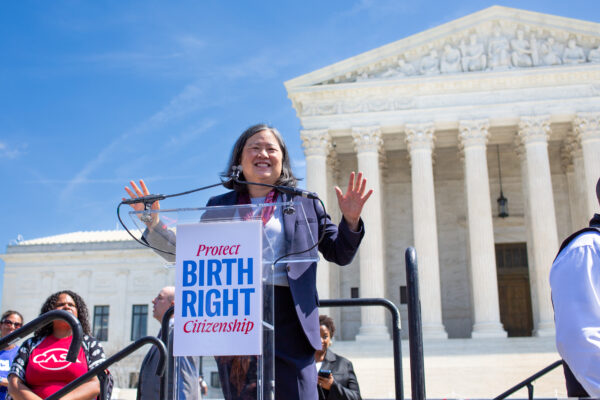
Policy Summary: On President Donald Trump’s first day in office of his second term, he signed Executive Order (EO) 14160. The EO is called Protecting the Meaning and Value of American Citizenship. The Order was intended to overturn the constitutional rule that recognizes birthright citizenship.
The rule of birthright citizenship provides that everyone born on United States soil is automatically an American citizen from the moment they are born regardless of the baby’s parents immigration status. This rule stems from the Fourteenth Amendment to the United States Constitution which was adopted in 1868. The first line of the Amendment provides “All persons born…in the United States…are citizens of the United States…” Furthermore, the Supreme Court upheld this principle in the 1898 decision United States v. Wong Kim Ark by holding that children born in the United States of alien parents are citizens of the United States. Birthright citizenship has been the legal rule in the United States for more than one hundred and twenty – five (125) years.
After President Trump issued his executive order, numerous lawsuits were filed challenging the order. A group of three families then directly challenged the order. Barbara is a Honduran woman and asylum applicant who was expecting to give birth in October 2025. Susan is a Taiwanese national in the United States on a student visa whose child’s U.S. passport application was pending. And Mark was a Brazilian national applying for permanent residence whose U.S. born son had already been issued a U.S. passport. Together these families filed suit due to concerns that the President’s order unlawfully stripped their children of United States citizenship. The case was brought in the Federal District Court for the District of New Hampshire which issued a preliminary injunction blocking Trump’s EO. The case was then appealed to the United States Court of Appeals for the First Circuit. But before the appeals court could issue a ruling, the case was appealed to the United States Supreme Court which granted certiorari to hear the case.
The Supreme Court ruled 6 – 3 in the Trump v. Barbara case to uphold the more than one hundred year old legal authorities and precedents that support the birthright citizenship rule. Chief Justice John Roberts wrote the majority opinion. LEARN MORE
Policy Analysis: The 6 – 3 decision in the case was not surprising even though the topic of immigration and the concept of birthright citizenship have been a hotly contested topic of public debate in recent years. President Trump had made immigration and overturning the legal rule of birthright citizenship a central point of his 2024 presidential campaign and he did sign Executive Order 14160 on his first day back in office. But the Supreme Court, even with a conservative majority, did not permit the president to change over one hundred years of constitutional and legal authority.
The Chief Justice’s majority opinion traces the rule of birthright citizenship to the common law of England which declared children born in England acquired British citizenship. When English settlers arrived in the U.S., he states, this rule was adopted by the new Nation. This rule was given additional support with the passage of the Fourteenth Amendment which meant to enshrine permanently the birthright citizenship concept into the U.S. Constitution. Later cases and congressional acts have always understood and accepted the birthright citizenship concept which is why it has remain undisturbed and unchallenged for more than one hundred and twenty eight years.
However, the dissenting opinion by Justice Samuel Alito tried to push back with a different interpretation of the development and adoption of the Fourteenth Amendment. He wrote that citizenship is conferred on children born in the U.S. “who owe allegiance solely to this country [United States].” That raises the question as to how a newborn baby’s allegiance was to be determined. Arguments made at the court also mention that a parent’s domicile should be considered. That interpretation is flawed because it contradicts the text of the Fourteenth Amendment and adds an unnecessary factor to consider. The text of the Fourteenth Amendment is simple – “All persons born…in the United States…are citizens of the United States…”
While most of us assume that a decision handed down by the Supreme Court is the final word on an issue, the Trump Administration apparently does not see it that way. On July 9, 2026 President Trump announced that he would be filing documents with the Supreme Court asking for a rehearing on the Barbara v. Trump case. While permitted by the procedural rules, this is a longshot as the Supreme Court has not granted a rehearing on a case they just decided since the 1960’s. But in Congress, some members have taken action to try and continue the fight to overturn the birthright citizenship rule. On July 13, 2026 Senator Jim Banks of Indiana introduced the Citizenship Act of 2026 which would codify into law President Trump’s Executive Order from January 2025. However, the bill was simply introduced and faces an uphill battle since both Houses of Congress would need to approve the bill.
As of 2026 the birthright citizenship rule granting children born on the soil of the United States automatic American citizenship is still the law of the land. LEARN MORE, LEARN MORE
Take Action
- SCOTUSblog – analysis of the Trump v. Barbara decision from Supreme Court blog.
- News Report – introduction of bill by Senator Jim Banks to codify President Trump’s Executive Order 14160 into law.